Patent Enforcement Index (1998-2025)
The Patent Enforcement Index (PEI) is a global comparative measure of how effectively patent rights are enforced across countries. Higher scores indicate stronger patent enforcement systems in which patent owners anticipate lower transaction costs. Developed by Professor Nikolaos Papageorgiadis (University of Liverpool) and Professor Wolfgang Sofka (Copenhagen Business School), the PEI now covers 66 countries over the period 1998-2025.
The 2025 update introduces expanded year coverage (2018-2025), broader country coverage (from 51 to 66), and new data for emerging economies. It also develops the new research insight of Patent Enforcement Velocity, which captures the rate and volatility of institutional change in patent enforcement systems.
The PEI is widely used by researchers, policymakers, and patent practitioners to benchmark national enforcement environments, assess innovation-related risk, monitor the effects of institutional reforms, and inform international patent filing and portfolio management strategies.
Visitors can explore global trends, view country profiles, download infographics, and access the full dataset, which is released under the Creative Commons Attribution–ShareAlike 4.0 International licence allowing reuse, adaptation, and redistribution, including for commercial purposes.
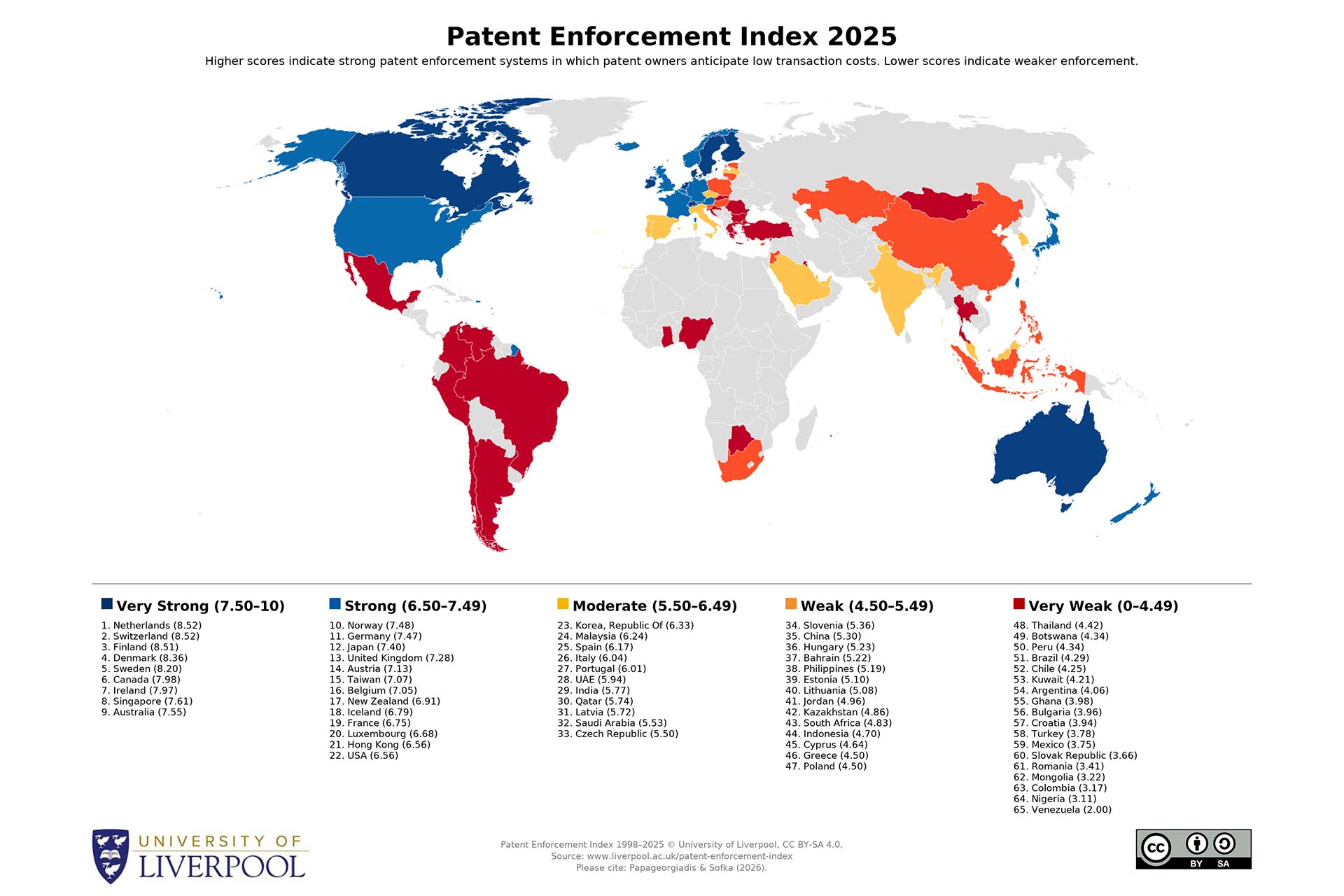
Patent Enforcement Index (PEI) 1998-2025
The PEI is a global comparative measure of how effectively patent rights are enforced across countries. Higher scores indicate stronger enforcement systems in which patent owners anticipate lower transaction costs and greater confidence when defending their rights.
Developed by Professor Nikolaos Papageorgiadis (University of Liverpool) and Professor Wolfgang Sofka (Copenhagen Business School), the PEI now covers 66 countries over the period 1998–2025.
It is used by researchers, policymakers, in-house patent teams, external counsel, consultants, and innovation specialists to:
- benchmark national enforcement environments,
- assess cross-country intellectual property risk,
- identify long-term patent enforcement level trends,
- understand patent enforcement velocity (the rate and volatility of institutional change),
- monitor the effects of institutional reforms, and
- inform international patent filing and portfolio management strategies.
The 2025 release provides expanded country coverage, updated year coverage, and new analytical insights on global patent enforcement patterns.
2026 Update: What’s New
The 2026 update introduces several important developments that expand the scope and depth of the Patent Enforcement Index. These include:
- Expanded country coverage from 51 to 66 countries, with new representation from emerging and middle-income economies.
- Updated time series covering 1998-2025, allowing visitors to trace almost three decades of changes in national patent enforcement conditions.
- Refined measurement of enforcement-related transaction costs, ensuring that the Index reflects the most up-to-date information available across monitoring, servicing, and property-rights protection dimensions.
- Introduction of Patent Enforcement Velocity, a new analytical insight capturing the rate, direction, and volatility of institutional change in patent enforcement systems.
- New global and regional trend patterns, highlighting which countries are strengthening, weakening, or remaining stable, and identifying emerging enforcement hubs.
Together, these developments make the 2025 PEI the most comprehensive and dynamic source of comparative information on patent enforcement systems worldwide.
Global Results (2025)
The 2025 Patent Enforcement Index reveals a diverse global landscape, with clear differences in the strength, stability, and direction of enforcement conditions across countries.
Key patterns include:
- Top performers:
The Netherlands, Switzerland, Finland, Denmark, and Sweden continue to lead, characterised by predictable legal processes, transparent decision-making, and strong institutional capacity. - Sustained improvers:
India, Indonesia, and Latvia show marked upward trajectories, reflecting ongoing reforms, institutional strengthening, and increased visibility of enforcement outcomes. - Moderate decliners:
The United States, Singapore, and the United Kingdom exhibit declining scores compared with previous highs, suggesting evolving litigation dynamics, administrative pressures, or shifts in procedural effectiveness. - Persistently weak systems:
A number of Latin American and African countries remain at the lower end of the Index due to structural challenges such as limited institutional capacity, high monitoring costs, and inconsistent judicial outcomes.
Overall, the 2025 results illustrate how differing levels of institutional development, litigation practice, judicial efficiency, and procedural predictability shape the global patent enforcement environment.
Why the PEI Matters
Patent enforcement conditions shape how and where firms innovate, protect their technologies, and make strategic decisions about international markets. Differences in enforcement strength influence the behaviour of multinational enterprises, SMEs, and investors, as well as the effectiveness of national innovation policies.
The PEI provides a consistent and evidence-based way to:
- Benchmark patent enforcement environments when assessing new markets or investment destinations, and help policymakers identify areas for institutional improvement.
- Support international patent filing and portfolio management strategies, particularly for firms operating across diverse institutional contexts or seeking to enforce their patents globally.
- Identify long-term enforcement level trends, including strengthening, stagnation, and decline.
- Understand patent enforcement velocity, which captures the pace and volatility of institutional change.
- Evaluate cross-country IP risk, including the likelihood of effective remedies and the predictability of judicial outcomes.
- Monitor the impact of legal and institutional reforms, including changes to courts, administrative procedures, and enforcement practices.
For practitioners and policymakers, the PEI offers a practical tool for anticipating risks, identifying emerging enforcement hubs, and gaining a clearer understanding of how global patent systems evolve over time.
Explore and Use the Index
The PEI serves patent practitioners, policymakers, academics, researchers, law firms, SMEs, and students. It provides evidence and resources to explore enforcement patterns, compare countries, and support analysis, strategic decision-making, and practical application. All PEI resources are freely available under the Creative Commons Attribution–ShareAlike 4.0 International licence (CC BY-SA 4.0), allowing reuse, adaptation, and redistribution in any medium or format, including for commercial purposes.
Available resources include:
- Full Dataset
Download the complete PEI dataset and use it to generate your own insights, integrate enforcement conditions into your analysis, or incorporate the data into econometric and comparative research. - Global Infographics and Visualisations
Download and use maps, charts, and summary figures illustrating global, regional, and country-level enforcement patterns. All files may be reused freely in reports, presentations, policy documents, and internal analysis. - Country Profiles
Compact summaries showing national PEI trends from 1998 to 2025, sub-index scores, and key enforcement characteristics. Additional countries will be added over time. - Training and Knowledge Exchange.
Information about upcoming workshops, practitioner briefings, and academic presentations related to patent enforcement systems, global IP strategy, and innovation management.
Methodological Foundations
The Patent Enforcement Index builds on more than a decade of peer-reviewed research on the measurement of patent enforcement strength and its effects on innovation and international business strategy. Earlier versions of the Index established a robust foundation for assessing cross-country enforcement conditions, using transaction cost economics to capture how administrative, judicial, and informational frictions shape the effective strength of patent rights.
Foundational publication
The first version of the Index was introduced in:
Papageorgiadis, N., Cross, A., & Alexiou, C. (2014). International patent systems strength 1998–2011. Journal of World Business, 49(4), 586-597. Read the article (free / open access). This paper provided the first comprehensive framework for quantifying enforcement-related transaction costs using secondary data.
Subsequent refinement
The second major contribution appeared in:
Papageorgiadis, N., & Sofka, W. (2020). Patent enforcement across 51 countries – Patent enforcement index 1998–2017. Journal of World Business, 55(4), 101092. Read the article (free / open access). This study refined the earlier formulation of the Index and improved its empirical validity, establishing the PEI as a widely used measure of cross-country enforcement strength.
The 2025 Update
The latest update (1998–2025) substantially extends and modernises the Index by:
- Expanding coverage from 51 to 66 countries,
- Updating the time series to 2025,
- Introducing revised and strengthened measurement of monitoring, servicing, and property-rights protection costs, and
- Developing a new research insight: Patent Enforcement Velocity, a dynamic measure capturing the rate and volatility of institutional change in patent enforcement systems.
The 2025 PEI is the most comprehensive and detailed dataset to date for analysing long-term trends and cross-country variation in the enforcement of patent rights. A pre-publication version of the accompanying research paper is available from the authors upon request during the peer-review process.
About the Researchers
The PEI is co-authored by:
Professor Nikolaos Papageorgiadis
Chair in International Business
University of Liverpool Management School
and
Professor Wolfgang Sofka
Professor for Strategic and International Management
Copenhagen Business School
Contact
For further information or collaboration enquiries, please contact:
nickp@liverpool.ac.uk