Liam Armstrong
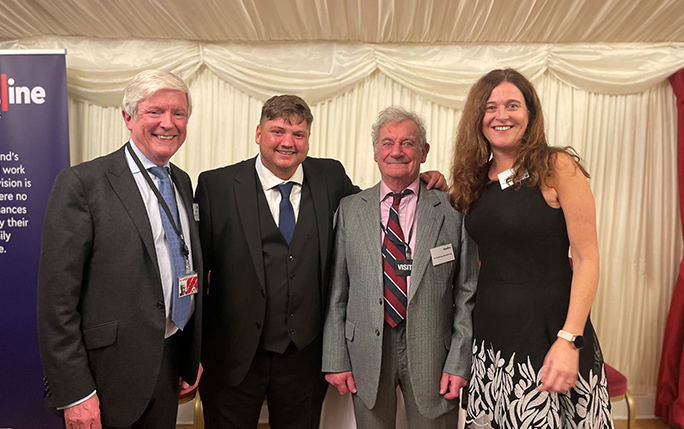
University of Liverpool Management School graduate Liam Armstrong (Business Management, 2022) recently gave a speech in the House of Lords as a Public Speaker and Ambassador for Frontline.
Who are Frontline?
Frontline is England's largest social work charity, working to create social change for children who do not have a safe or stable home. Helping to keep children free from harm and supporting them to achieve their full potential is at the heart of everything the charity does.
First of all, congratulations on this incredible achievement, Liam! How did your trip to Parliament come about?
Thank you. I’ve worked for Frontline since the beginning of my second year at university. Chris Barlow from the Management School forwarded a general link to the cohort, regarding a brand ambassador post, and his description of the charity and its values just resonated with my story, and my aspiring line of work, so I applied.
I wasn’t successful in attaining that post with Frontline, but they directed me to a more suitable position as a care-experienced assessor, and that’s where I started to really understand the value of giving back.
In September, my manager, Madeleine, thought I would be perfect for a role in writing and presenting a speech at the House of Lords.
The speech explained Frontline, the innovative work that we do and why it is so important to share the experience of somebody who has been through the care system, dealt with social services throughout their life, and explain what is unique about Frontline.
I was surprised at how well it went; it felt natural to me, and I’m so grateful to my director, Jackie, for having so much faith in me for such an important event.
What were the key points that you shared as part of your speech?
My speech was based on a care experienced/leaver narrative with a message of continuing to pay it forward. My story evidences my struggles with social services, the perception and narratives of a person who thought the barriers faced by society would block them from achieving, academically and in life.
The fact that I was where I was standing (giving a speech in Parliament), representing a cause so close to my heart, that I had always dreamed of being an exponent of, also felt like a success story.
My speech illuminated how I wish I had social workers in my life who were recruited, educated, and shaped by Frontline. Because Frontline, as England’s largest social work charity, is striving to make sustainable system-level change in social work and to enhance the quality of social workers who are currently working on bettering the support for the 700,000 children who need the support of social workers each year.
How did you feel on the day?
I felt confident, and I was excited to support the cause. My dream since I was 7 was to speak in Parliament, and Frontline made this possible. That’s what Frontline is evolving into, in my opinion.
They want to level up the opportunities that life did not provide to those who find themselves needing the support of social workers, or even in care and without a family. I can see them being a world-changing organisation in the years to come.
The night went great, it was amazing to speak to so many prominent peers and professionals who wanted to learn about social work and how they can give back to an important cause.
What have you taken away from the experience?
It was amazingly surreal to be around such prestigious people, such as Sir Peter Bottomley and Lord Tony Hall. Many people asked me, "What were they like?’’ and "Did they act privileged or special?’’ and those assumptions could not be further from the truth.
Sir Peter spent most of the night getting to know my family, and he offered to be my reference for an MPHIL at Cambridge, which was crazy. And Lord Hall, Frontline’s Chair, was so charismatic and humble when I asked whether to address him as Lord or Baron Hall, he said ‘’What? Don’t get caught up with that, I’m Tony’’.
Lord Tony has since provided me with mentorship and the opportunity to shadow him at future events. These people didn’t have to support the cause; they were there for the same reasons as all our social workers and me, because they wanted to contribute to enhancing the lives of those who needed it most.
Where do you think your ambition comes from?
I’ve always known I wanted to create change and never wanted to be part of a system, and I know this mindset stems from being overly analytical about the world.
Coming from a care-experienced/estranged background made me realise from a young age that I must work hard to acquire stepping stones that others may be lucky to have through heritage.
This has always been my driver. That, and always believing I had a point to prove to everyone, not in a way to seem better than others, but to prove that you can achieve anything, despite your context.
My ethos has always seen me excel most where the challenges are greater.
And I’ll always dedicate my success to those teachers who put me through hell in school, too. And to my Grandparents, for teaching me when no one else would.
What are your aspirations for the future?
I’ve never been a person who’s set on a specific career. I’d love to become involved in the political sphere as a change-maker influencing the system, as opposed to working for a system, if that makes sense.
The end goal is philanthropy, designing and implementing education systems with unique policies and an innovative logistical structure that promotes equality on a global scale.
I’m also really into technological advancements and will invest in AI, mechanics and robotic projects once I have the capital to back me.
What advice would you give to current students?
The best way to take advantage of the university is to make yourself more employable while being part of an academic institution.
Being a course representative, a student advocate or working on a society committee allows students to amass skills that employers highlight in their own concomitant competency criteria.
You’ll be a leader who knows how to run a team, as a team player, and understand how to make viable moves to escalate resolution and solutions, avoiding barriers, which you can’t learn from a textbook.
There are always loads of opportunities being offered to you as a student; it’s always worth skimming through emails from your faculty.