Current PhD students
Discover some of the current research being undertaken by the PhD candidates in the Landscape || Gender || Environment research cluster.
 |
Helen AngellPhD title: Poetry in the work of Brenda Colvin and the memorialisation of her post-industrial landscapes Overview: Landscape architect, Brenda Colvin (1897-1981), was at the forefront of ecological thinking and social planning in post-war Britain. Her designs for industrial landscapes, such as those around powerstations, reservoirs and quarries, sought harmony between technological progress and the natural world while also providing leisure facilities and countryside for workers and local inhabitants. Towards the end of her life, Colvin self-published Wonder in A World, an esoteric mixture of poetry, philosophy and ecology. This project explores the symbiosis between landscape architecture and poetry and how the latter is threaded through Colvin’s published work. It will position her in relation to other early women ecological writers such as Rachel Carson and Nan Fairbrother. Through creative practice, the project will investigate how poetry can memorialise Colvin’s post-industrial landscapes at Gale Common, Eggborough and Drakelow powerstations, Trimpley Reservoir and Warton Crag. It will respond to and make work at these endangered sites using fieldwork and oral histories to capture diverse perspectives and explore the role of memory. It will also experiment with poetic form as a linguistic architecture, not only representing the past but articulating future visions for living. Helen Angell is a first-year PhD student in Creative Writing and Architecture at the University of Liverpool. Her interests include twentieth-century architecture and landscape, and how poetry can be used to capture these. Helen’s focus on the poetry and philosophy of landscape architect Brenda Colvin (1897-1981) explores how Colvin’s writing underpinned her architectural practice and communicated her early ecological concerns. Helen has worked creatively with a number of organisations including The Hepworth, Millennium Gallery, The Whitaker and Manchester School of Architecture, often in collaboration with visual artists and musicians. Her poetry has appeared in a range of publications such as The North, Strix and The Modernist. She co-runs the Sheffield Modernist Society. |
|
Image: Photograph of Trimpley Reservoir from the Brenda Colvin Collection at the Museum of English Rural Life, University of Reading |
Josephine SweeneyPhD title: Landscape of Post-War Reservoirs: Environment, Conservation and PerceptionSupervisors: Professor Luca Csepely-Knorr, Guy Baxter (Museum of English Rural Life), Professor Richard Brook (University of Lancaster) Overview: Reservoir landscapes embody complex negotiations between political, social and ecological conditions, engineering economies and architectural approaches. My research explores these negotiations and their temporal qualities, including for example memories of drowned land and prospections of water scarce futures. I will interrogate how notions of ‘rural’ landscape manifested in the landscape architectural designs of post-war reservoirs, and situate their construction within the changing socio-political context of the British Welfare State. This is a Collaborative Doctoral Award in partnership with the Special Collections and Archives at the Museum of English Rural Life (MERL). Using visual and participatory research methods I will bring archival materials held at the MERL (including the drawings, photographs and letters of landscape architects, alongside the collections of organisations such as the Council for the Protection of Rural England and the Campaign for National Parks) into dialogue with communities that inhabit and/or rely upon reservoir landscapes. By drawing together archival representations, community memory and everyday experience my research will consider the ongoing impact of reservoir landscape architectural design on contemporary understandings of landscape, heritage policy and community use today. |
|
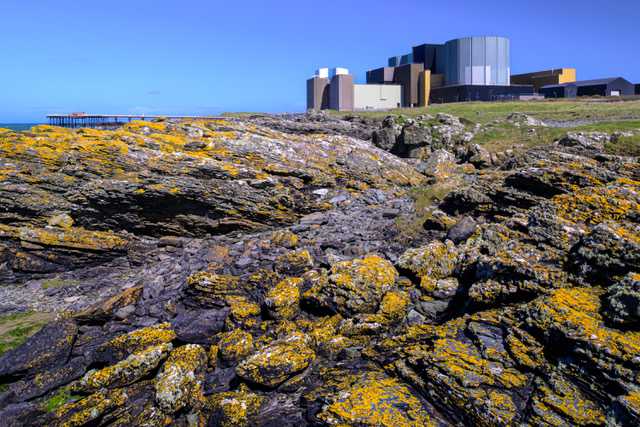
Image: Wylfa Magnox Station, as seen from Porth-y-pistyll Bay, demonstrates Dame Sylvia Crowe’s meticulous boundary treatments. The stone walls and layered landscape draw the surrounding terrain seamlessly to the edge of the reactor buildings. The building’s colour palette, devised by Crowe, was carefully chosen to harmonise with the wider landscape. |
Peter WilliamsPhD Title: Landscapes of Atomic Optimism: Exploring the Past, Present, and Future of Energy Infrastructure through Visual Inquiry Supervisors: Professor Luca Csepely-Knorr, Dr. Yat Shun Kei, Professor Richard Brook (Lancaster University) My research investigates Dame Sylvia Crowe’s groundbreaking landscape designs for the Central Electricity Generating Board (CEGB) during the development of Britain’s first-generation civilian nuclear power stations. Focusing on the sites of Bradwell, Trawsfynydd, and Wylfa, this study traces the evolution of these landscapes over six decades, contextualising their historical significance and contemporary relevance in the push for a zero-carbon future. Using photography as a method of visual inquiry, I aim to uncover how Crowe’s designs responded to the monumental challenges of integrating large-scale infrastructure within the British landscape. This research examines the influence of these landscapes on government policy, the profession of landscape architecture, and their enduring cultural and environmental legacy. By incorporating international comparisons with similar programmes in France and Germany, I highlight the role of landscape architecture in shaping the narrative of energy infrastructure. This study seeks to deepen understanding of Crowe’s enduring influence and the evolving relationship between energy, landscape, and societal values. |