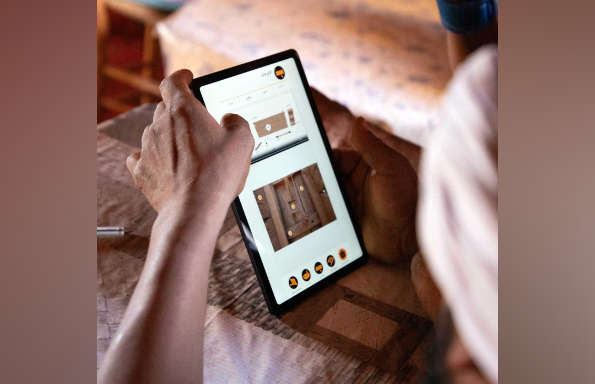
The ArCHIAM Centre has recently received an AHRC Impact Acceleration Account grant to undertake the project M’Hamid, Morocco: Safeguarding Traditional Earth Building Knowledge through Digitally Aided Field Transmission, Documenting Traditional Oasis Life at Risk. The project proposes to safeguard local traditional earth building knowledge and support its transmission by combining hands-on training with technology-enhanced learning, and to shed light on the impact of socio-economic, cultural, tectonic and climate change on traditional oasis life.
Dr Giamila Quattrone, Principal Investigator, will roll out Heres, the flipbook-type multimedia construction manual developed at ArCHIAM, as part of Terrachidia-led XXXI Oasis Campus in Ksar Ouled Youssef, and will train workshop participants in drawn and photographic documentation of spaces associated with oasis life. Implementing the use of Heres in the context of conservation training and real-world conservation works, will accelerate the impact of ArCHIAM’s research, which responds to UNESCO’s call for moving beyond the sole preservation of earth-built fabrics towards safeguarding the knowledge, competencies and skills behind those, reviving interest, particularly amongst the youth, revitalising crafts and building capacity. Monika Koeck of CineTecture, creator of the award-winning documentary M'Hamid Oasis Morocco, will join Dr Quattrone on site to film the daily routines of women and men, including domestic activities, farming and animal husbandry, trade and crafts, and social interaction, with the aim to understand how locals have adapted and built resilience to change.
On 25th September 2025, Dr Rim Yassine Kassab, a Liverpool School of Architecture PhD alumna and member of the research team that developed Heres, presented it at Kerpic’25, the 13th International Kerpic Conference on “Earthen Architectural Heritage”, held at the National School of Architecture (ENA) in Rabat. The flipbook was recognized by the audience for its innovative approach to safeguarding material cultural knowledge, particularly in regions where traditional practices are increasingly threatened by change and the decline of intergenerational transmission. During her talk, Dr Yassine Kassab demonstrated how digital technology-enhanced methods can support the documentation and transfer of the traditional earth building knowledge of an underrepresented region such as the South of Morocco.