In Post 1, I introduced PAS Cymru and reflected on my first two days of the placement, focusing on learning the fundamentals of finds recording, photography, and museum systems. In this second and final post, I discuss my experiences during days 3 and 4, from photographing artefacts and observing the reporting of a Roman coin hoard, to learning about archaeological illustration and conservation, before reflecting on the wider value of placements like this for archaeology students and early-career professionals!
Day 3: Recording, photography & the Roman Hoard
After a short break of a couple of weeks, I returned to Wrexham to complete my final two days of the placement. On day 3, I got the chance to practice my photography skills, looking at different objects and photographing them carefully, from all sides. After photographing them, I uploaded the photos to my laptop and started editing them on Affinity Photo 2 to get them ready for the database.
The highlight of day 3 was undoubtedly getting to witness a finder bringing in a Roman coin hoard in a pot - it was absolutely stunning, and I could barely believe my eyes! I could never imagine finding that in a field, metal detecting, or whilst digging my garden. The finder who brought it in was a regular finder, which was a common occurrence, where loads of people bringing finds in were already on the database and had brought different things in the past. It was a truly stunning sight, which I will never forget. For the finder, it seemed like it felt regular, but for me, it was the opposite of that! Finds like this tell us so much about certain areas and time periods, so it’s really nice to see people bringing them in out of the goodness of their hearts!
Thanks to this beautiful coin hoard coming in, I got to oversee the treasure paperwork process and how an F.L.O. (Finds Liaison Officer) would go about recording a treasure item. It involved obtaining the basic details of the finder, as well as those of the landowner, since in most cases, the finder and landowner were different individuals who had some sort of agreement between themselves. It’s important for all the paperwork to be filled in properly, as it becomes a legal matter and has to be fully reported on so the coroner can make the decision as to whether it qualifies as treasure. Treasure items undergo a long process after being recorded by F.L.O.s (Finds Liaison Officers), which can take 2 or 3 years, as they must be scientifically examined to confirm them as treasure finds, possibly also some conservation too. The local museum then gets the opportunity to acquire it for its collection, but raising the funds to do that can also take some time. It was incredibly enlightening to learn about the entire process, and to hear about Susie’s personal stories and experiences in the industry - it genuinely provided me with so much clarity and knowledge, and some stories were not only shocking but humorous too. It really showed me the “big picture” of heritage work, from finder to F.L.O., to record, to legal processes.
Day 4: Artefact illustration & final reflections
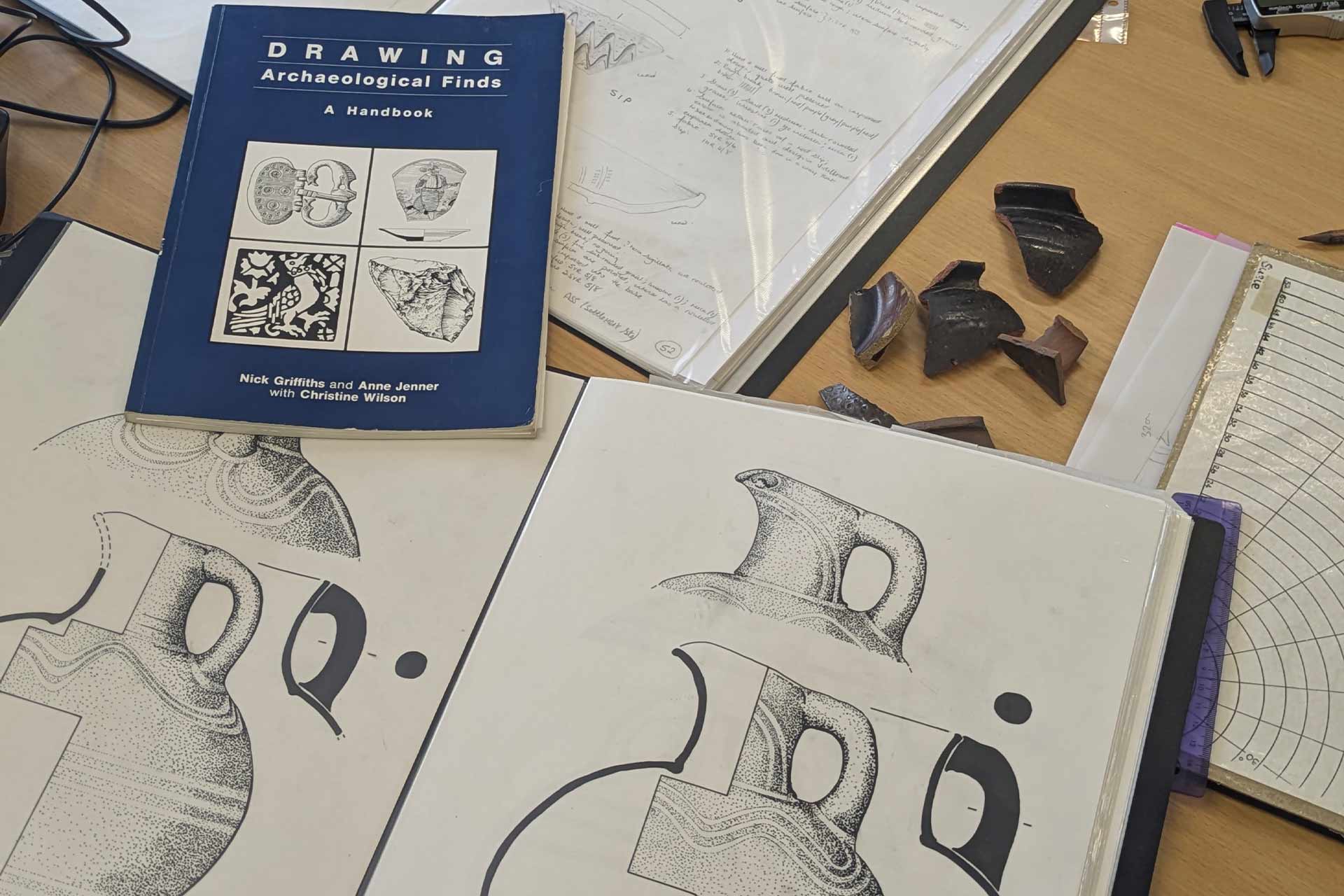
On day 4, the plan of action for the day was a little different from the previous days. During my rides with Susie to and from the train station, we often spoke about things like my personal interests and what I wanted to do in my near future academic and professional life. One of the topics that came up was my keen interest in professional artefact illustration, which, to my surprise and pleasure, Susie is a specialist in. Thus, she was incredibly kind to bring in her own portfolios of drawings, books, sherds, and materials to give me a crash course in archaeological illustration. This was a very impulsive but incredibly well-timed decision and activity, and I cannot be more thankful for Susie’s flexibility and willingness to satisfy my desire and interest! We both shared how passionate we feel about illustration in archaeology, and how its importance is diminished by some, although you can get the best details of an artefact by looking at it and drawing it, rather than from a photograph, as cameras don’t always show all details of an object. After the crash course and me spending about an hour flipping through Susie’s stunning portfolio and absorbing every detail, I was left to do some practice with the sherds she brought in for me. It was relaxing to practice with a point for reference from Susie’s portfolio and the book she brought in for me, and I definitely felt more confident in my skills with her support on this matter.
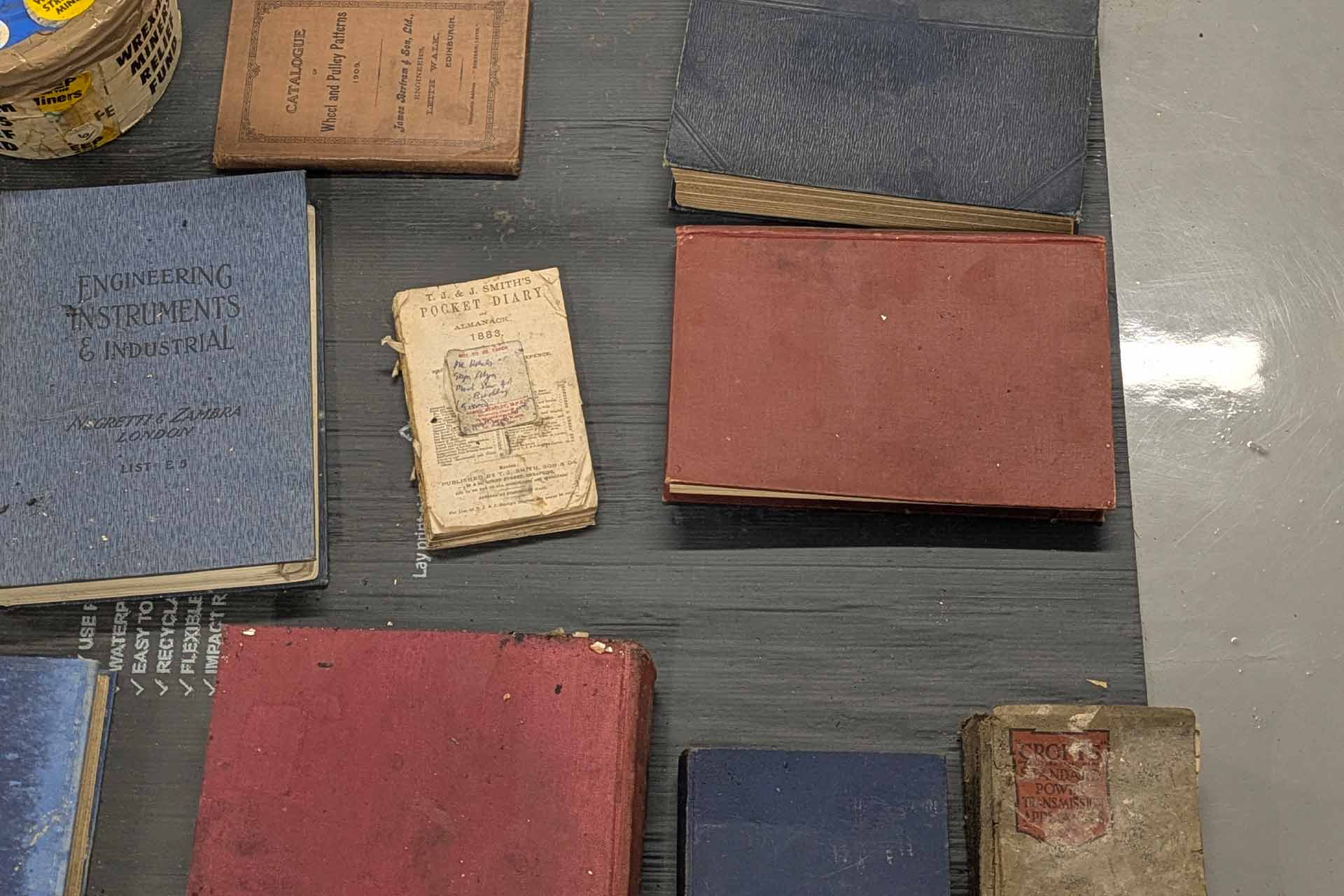
After I spent some time practising, Jane showed me around the collection of objects in the back, which was incredibly varied, and I helped her with some paper conservation of books that had experienced water damage. It was an enlightening experience, especially because I want to specialise in conservation, which Jane specifically remembered. (See figure 12)
Figure 13 - Some of the books which had water damage, which I helped Jane put anti-acid paper in between the pages of and popped in the freezer!:
Benefits for Archaeology students
This placement is the most educational and practical experience I have had the pleasure of undertaking in my academic life so far, due to the amount and variety of skills I gained, such as:
- Finds handling, recording, and detailed object description, combined with thorough research.
- Photography and image editing on Affinity Photo 2 to produce PAS-quality images.
- Using database systems like Axiell to accession objects in the museum collection
- Paperwork organisation and overseeing the treasure process
- Touching on conservation and museology with Jane, as a side activity
- Illustration as an additional transferable skill
Lastly, I have the chance to not only express my gratitude and feedback by writing this blog for Susie and PAS Cymru, but I will also be producing a short study paper on Roman fibulae, which became one of my new passions during this placement - and I’m really looking forward to both researching and writing about them in more detail!
Placements like this are invaluable to students like me, as they help us link classroom learning with real-world practice, whilst making connections in the industry. Working alongside professionals and understanding the career pathways in museums and the heritage sector is the most important thing for young professionals to get acquainted with, as it all gives us a better grasp of the industry we’re entering. Further, it improves awareness of different organisations (like the PAS) and the importance of material culture, as well as boosting our interpretation skills, contributing to not only our professional development but also our academic life. Personally, this placement was a massive confidence boost. It was definitely a motivation for my future career plans, and made me feel less hesitant and doubtful about the industry, which is what every young professional should feel - no one deserves to feel doubt about their desired career in a certain industry. Professionals like Susie and Jane are here to remind us that we can achieve professional success by putting ourselves out there and taking any opportunities that arise, with passion, enthusiasm, and a keen interest to constantly improve our knowledge and skills!
Conclusion
To conclude, this placement was one of the best things to come out of my academic life so far, and I am so delighted to have had the pleasure of meeting such wonderful professionals as Susie and Jane. I cannot thank both Susie and Jane enough, not only for their warm welcome and friendly demeanour, treating me like a colleague, but also for their continued support, willingness to answer all my questions, and sharing their personal experiences in the heritage industry. This has been an experience that I will treasure (pun intended) forever, and I am coming out of it with much more awareness, knowledge, and skills than I came to it with, which will undoubtedly help me in the next steps of my career! Thank you so much again, PAS Cymru - I hope to work with Susie and Jane again and get involved more in the future!