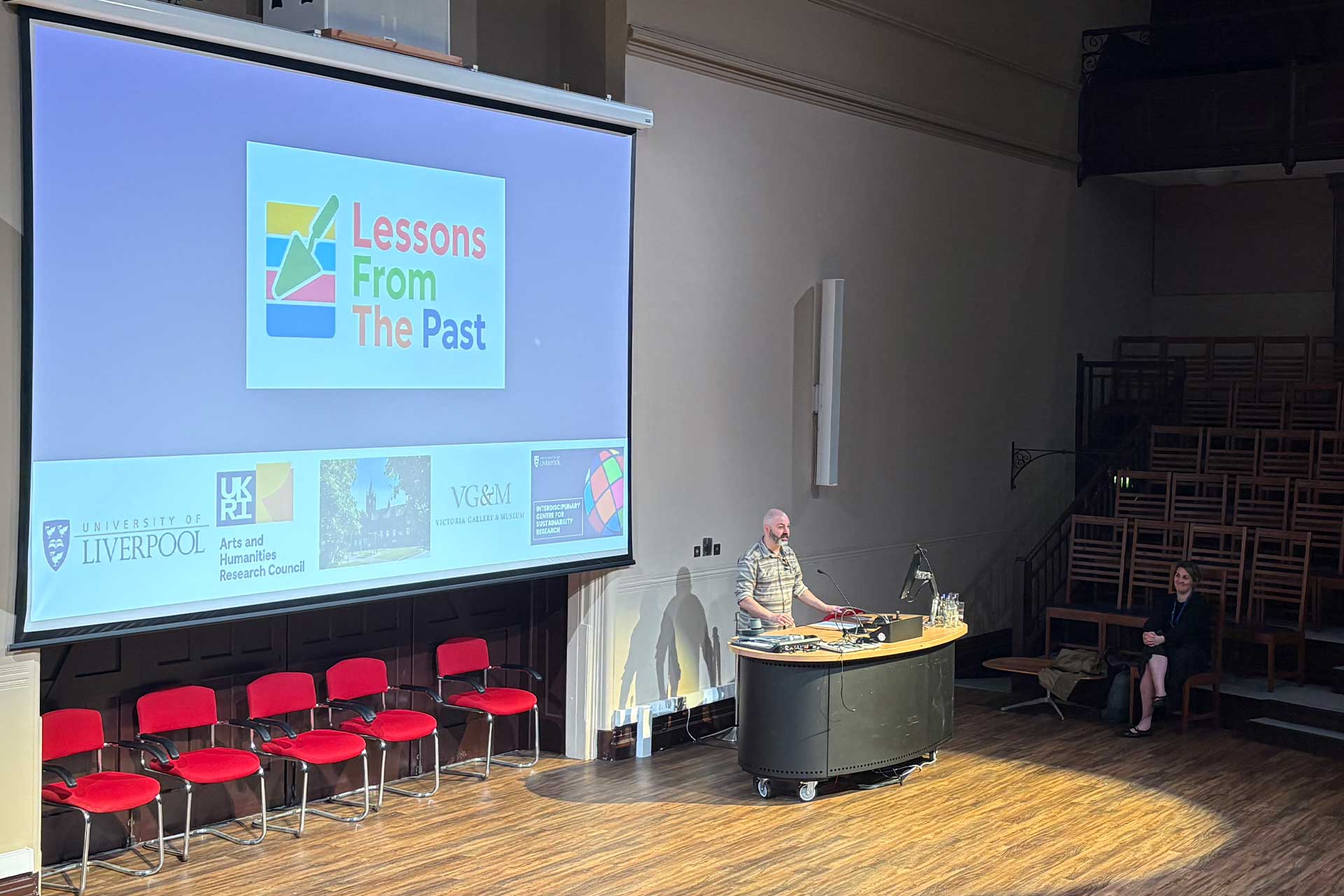
On 23 and 24 of March, academics and aspiring scholars such as myself from around the world congregated in the Victoria Museum & Gallery for the first Lessons from the Past conference. This conference tests the usual question of “what can you do with history?” and pushes it to the limit, demonstrating how the knowledge of the past can and must be taken into consideration to solve the issues in today's world.
The aim of the conference was for participants to use their respective fields of study to develop a solution to one of the UN’s 17 sustainability problems and to address how this could be implemented with funding and assistance from governments or companies to make the world a more prosperous place.
The first day
With this task in mind, a plethora of academics, including many of our own lecturers, researchers and PhD students, took on this challenge by providing their own talks for the first day of the conference. These talks were divided into categories by their area of focus; these were, to name a few, inequality, agriculture, corruption and tourism. Each talk discussed their issue with background context of a location and using knowledge of history and archaeology from prehistory to the medieval period and beyond, posed how the issue may be tackled. It was amazing to see how many different areas of history from all time periods could contribute and have an impact on creating a better future. It was even more incredible to see that some of these ideas have already begun to take shape; Dr Bruce Routledge’s ideas of reducing overconcentration of tourism in Jordan’s main archaeological hotspots have led to the development of an app for self-guided tours, incorporating other nearby archaeological sites to boost their exposure to tourism and boost the local economy.
The day came to an end with a keynote lecture given by Dr Robert. L. Kelly, one of the world's leading experts in Anthropology, focuses on the hunter-gatherer groups. Dr Kelly’s fascinating lecture took aspects from his book The Fifth Beginning: What Six Million Years of Human History can tell us about the Future (2016) to propose that the development of mankind can be perceived with an archaeological perspective as approaching a ‘fifth phase’ of development. With this rapid development of technology as well as changes in climate, economy and population at the forefront of global changes, Kelly reminds us that it is important to look at what our ancestors did to overcome these similar challenges and keep in mind the goal of a sustainable and prosperous world of peace.
The second day
The second day began with the poster session. These were submissions sent in by students and other academics around the country, addressing similar issues and solutions to the talks. These posters highlighted the importance of representation of the disabled, conquering misogyny and proposed recycling and ecological practises used by the Romans. A favourite of mine focused on languages, highlighting that around 45% of written and oral languages are endangered and becoming extinct; the most recent was lost just last year. This staggering statistic emphasises the need to support minority language communities with education in order to preserve their extensive culture and identity.
An optional tour of the Garstang Museum was given during this time, which, as a frequent museum attender, I had to join. Our own PhD student Lynsey Shale gave a tour of the museum, focusing on one of the key themes of the conference, inequality. The museum contains a collection from a tomb containing one of the earliest female names in history. From the predynastic period in Egypt, Neithhotep appears to have been an elite member of a royal family or potentially a sole ruler, portraying a positive image of women in commanding roles from nearly 5000 years ago. The tour also focused on a famous literary text from Egypt known as the ‘Satire of the Trades’, which talks about why the scribe is the best occupation, highlighting its power in Egypt and the inequalities surrounding class and education in society.
The main task for the day was to take part in the breakout discussion sessions for the talks with the most votes from the day before. I attended Lynsey Shale’s discussion on the gender pain gap, using Ancient Egyptian texts to propose greater support for women suffering from reproductive issues, and Breatriz Marin-Aguilera's discussion on the decolonisation of the Kalinago community, who have faced discrimination since the arrival of Christopher Columbus in the Caribbean. In these discussions, we aimed to outline the current support and opportunities for the solutions, the main barriers stopping current progression to solving these issues, and potential next steps to put these ideas in place to start making an impact. Although these issues were daunting, it was inspiring to contribute towards the solutions and to hear the collective thoughts of others on how to achieve these goals in the long term.
Closing of the conference and looking to the future
The conference came to a close with prizes given out for the best posters picked by the keynote speaker, Dr Keller. The conference caught the attention of West Derby MP Ian Byrne, who expressed his interest and support by sending a recorded message praising the idea. It was announced by conference organiser Chris Scott that the Lessons from the Past conference is to continue in the future on an annual basis, the next taking place in York. As the conference carries such an important message, it is great to see that it will be spread to more academics who can enact change. Overall, this was an unforgettable first conference for me, and it felt amazing to be a part of something that can make a difference to our future.