.jpg)
The Professor Elizabeth Slater Archaeological Research Laboratories at the University of Liverpool are transforming how we understand the past through scientific analysis. Recent collaborations with the Regional Archaeology Team at National Museums Liverpool for the exhibition Treasure: History Unearthed have demonstrated the important role the archaeological research laboratories play in combining advanced scientific techniques with museum interpretation.
Our researchers made important contributions to the exhibition through several targeted analytical investigations that deepened understanding of some of the objects on display. This work was led by Dr Matthew Ponting, a world-leading specialist in the scientific analysis of archaeological metalwork and archaeomaterials, Dr Nicola George a Research Technical Professional for the Archaeological Laboratories, specialising in archaeometallurgy and Ruth Watkins a postgraduate researcher in archaeological science, working in the laboratories as a technical assistant. Their combined efforts strengthened several parts of the exhibition narrative.
Viking Age Silver Hoards
Dr. Matthew Ponting has an established collaborative relationship with National Museums Liverpool and has contributed to several notable projects, including the study of the Cuerdale, Huxley, Silverdale and Malpas hoard
Dr. Ponting used microwave plasma atomic emission spectroscopy (MP AES) to analyse silver ingots from the Cuerdale, Huxley, and Silverdale Viking hoards. His findings indicate strong chemical links to Islamic dirhams from Central Asia and the Middle East, as well as mixed European sources. This supports the idea of long-distance trade and silver recycling in Viking Age networks.
The Malpas Hoard
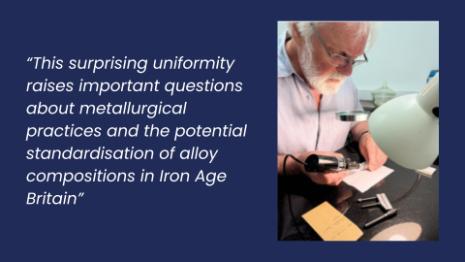
In 2016, Dr Ponting, Dr George and master's student Morgan Murphy investigated the Malpas Hoard, with a particular focus on its gold staters. Using scanning electron microscopy with energy-dispersive X-ray spectroscopy (SEM-EDS), they found a consistent alloy composition of approximately 20% gold, 10% silver, and 70% copper, despite the coins originating from different regions. This surprising uniformity raises important questions about metallurgical practices and the potential standardisation of alloy compositions in Iron Age Britain. The details of this study can be found in Proceedings of the 2016 Insights into Roman Hoards of North West England Conference at the Musuem of Liverpool.
The Ysceifiog Gold Torc
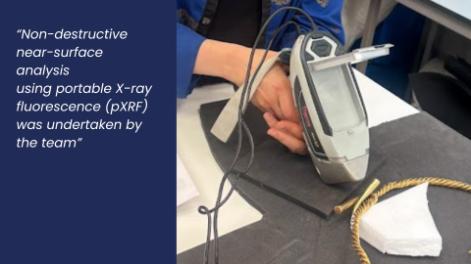
The impressive Ysceifiog gold torc, a large Bronze Age twisted wire style torc, discovered in North Wales in 1816, was also investigated. Non-destructive near-surface analysis using portable X-ray fluorescence (pXRF) was undertaken by the team from the Professor Elizabeth Slater Archaeological Research Laboratories with assistance from Steve Newman, Senior Metals Conservator at National Museums Liverpool. The results revealed that the torc was fashioned from a naturally occurring gold–silver alloy known as electrum. The surface composition indicates a high-purity natural gold alloy, containing approximately 86% gold and 13% silver, consistent with electrum. Trace amounts of copper and tin were also detected, supporting the classification of the material as native gold rather than the product of deliberate alloying.
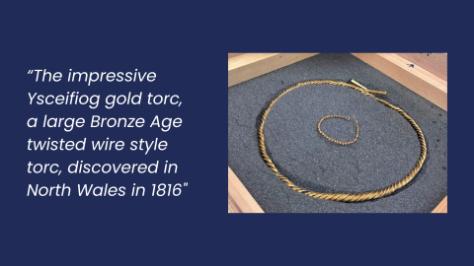
The analysis also identified a relatively modern repair: the torc had been damaged and subsequently mended with a zinc solder typical of the nineteenth century. Since zinc was unknown in the Bronze Age, this repair is clearly a later addition.
Wider Impact
These investigations and the broader collaboration with National Museums Liverpool’s Regional Archaeology Team are featured in the September/October 2025 issue of British Archaeology. The article brings the Professor Elizabeth Slater Archaeological Research Laboratories work to a national audience of archaeologists and heritage professionals and highlights Liverpool’s growing contribution to archaeological science and public heritage.
NML have also received the SMA awards for excellence for the exhibition project category for Treasure: History Unearthed! One of the things they commented on that they were very impressed with was the use of science within the exhibition.
Team and Training
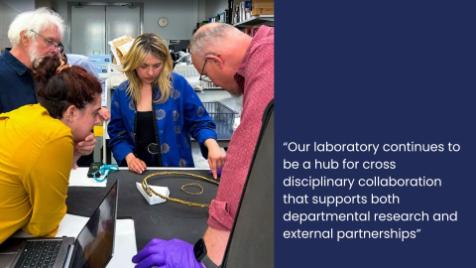
Our laboratory continues to be a hub for cross disciplinary collaboration that supports both departmental research and external partnerships. For colleagues and students in ACE the laboratories provide an open invitation to engage with scientific approaches to archaeological material, develop new projects in the labs and explore how analytical methods can enrich their research questions.
If you want to hear more about the exciting research taking place in the laboratories, follow @ livuni.archaeological.research on Instagram or email ACELaboratories@liverpool.ac.uk to work with us.
The Treasure: History Unearthed Exhibition ends on the 29th of March.