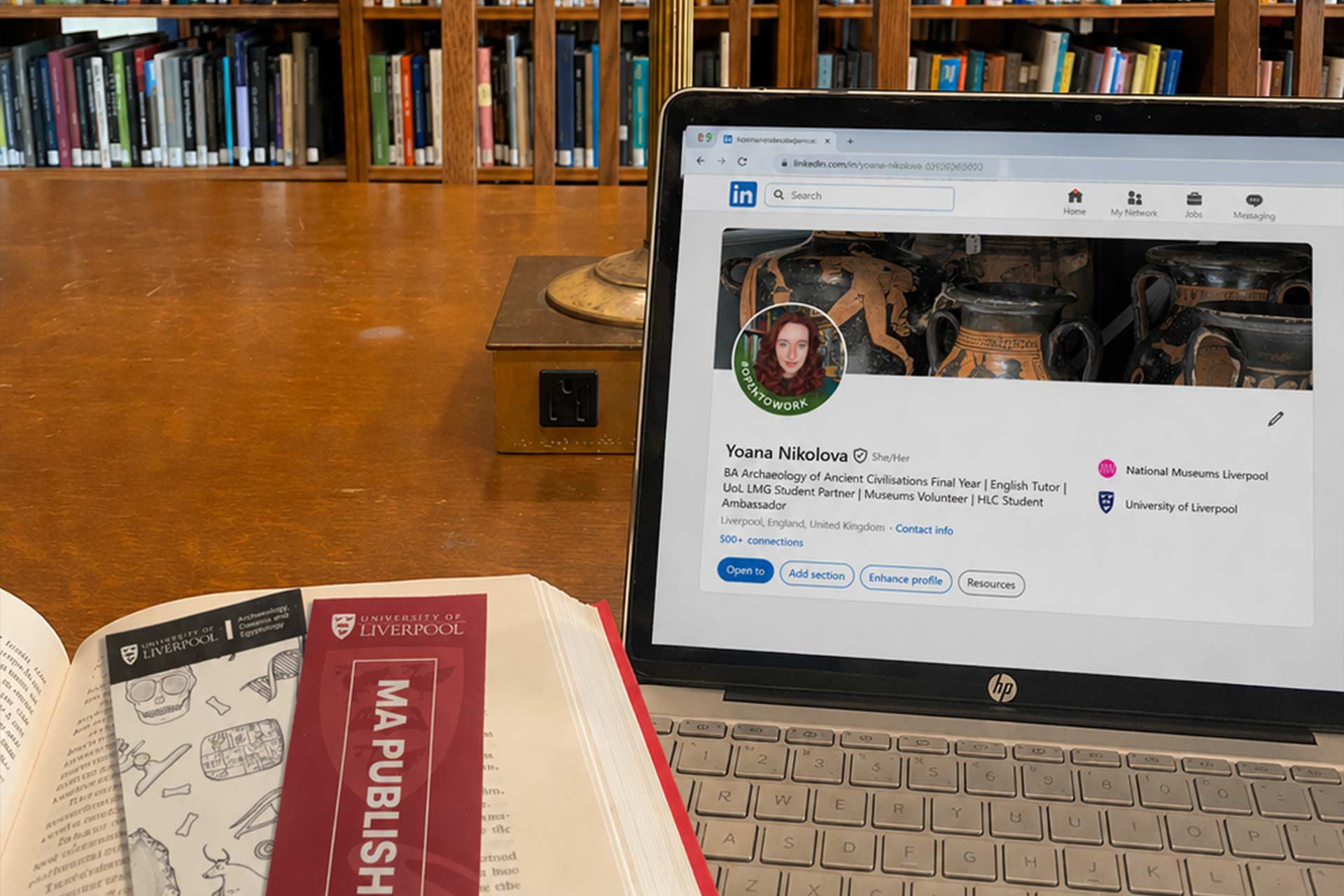
I am a final-year Archaeology and Classics student with a growing interest in museums, heritage, and creative industries, currently exploring how early-career opportunities shape pathways into the humanities. In this blog, I’ll share some of the practical things that have helped me start building experience in the humanities - from using LinkedIn and staying organised with applications, to navigating opportunities, networking, and looking after your wellbeing along the way.
Part 1: Getting started - building experience and visibility
There’s a very specific kind of panic that seems to hit at some point during a humanities degree.
It usually arrives mid-assignment, or right after submitting something you’ve spent weeks on. You close your laptop, take a deep breath, and then - completely uninvited - the thought appears: what am I actually doing after this?
Not in a vague, abstract way, but in a very real, slightly unsettling and really nerve-wracking way.
Because if you’re studying Archaeology, Classics, History, or anything humanities-related, the path ahead doesn’t feel linear. There’s no single obvious job title waiting at the end. Instead, there’s this wide, slightly overwhelming landscape of museums, heritage, publishing, academia, and creative industries - with very little clarity on how people actually move through it.
Over the past year, I’ve found myself navigating this uncertainty while trying to build experience alongside the final year of my degree, with the big question looming over me. I’ve had moments where everything felt aligned and exciting, and others where I questioned whether I was doing any of it “right” and if I was trying hard enough. What follows isn’t a perfect guide, but a reflection on what has genuinely helped me - and what I wish I had understood earlier.
LinkedIn is your new Instagram (and I’m not joking)
I know, I know...People see LinkedIn and their hearts skip a beat, as doubts about their own experience and academic integrity enter their minds. I did feel exactly like this about LinkedIn at some point, but that gradually changed. I didn’t expect LinkedIn to become such a central part of my routine - but now I spend hours on it per day, literally just scrolling and liking posts, aka my new Instagram.
LinkedIn has a reputation - it feels formal, slightly intimidating, and full of people announcing things in a tone that feels just a bit too polished. But if you shift how you think about it, it becomes something completely different.
What changed things for me was shifting how I viewed it. Instead of treating it as a formal, slightly intimidating platform, I started using it as a digital diary of everything I was doing academically and professionally. That shift alone made it feel less like self-promotion and more like documentation - almost like keeping a record of my intellectual and professional growth in real time! It was hard to get out of the “what will people think when they see this” mindset and post for myself, rather than for others, but that’s the most important step.
Not everything you post has to be groundbreaking. In fact, most of it won’t be - and that’s the point! I hear people saying, “I don’t have anything to post” all the time, but more often than not, that’s just not true. You’re already doing plenty of things - you’re just not recognising them as worth sharing yet!
You can post about absolutely anything you do.
Attended a talk with professionals? Post about it – and tag the people you met too!
Visited an exhibition or a new museum? Post about it – include photos and just say what you enjoyed!
Wrote an essay you genuinely enjoyed and are proud of (rare, I know)? Post about it – it shows growth and enthusiasm!
Wrote a blog in your spare time? Post about it – yes, it does count!
Researching a topic or planning a project? Post about it – people love hearing about other people’s ideas.
These aren’t “insignificant” moments, even if they seem like it. They’re evidence of engagement, curiosity, and growth!
For example, I’ve posted about:
• Writing projects and blog-style pieces I’ve worked on – personal blogs, reworked academic essays, and passion projects
• Museum visits and exhibitions that genuinely interested me – I went on a museum date on Valentine’s day to see the Museum of Liverpool History: Treasure Unearthed exhibition and posted about it – it did feel silly, and I did think “why would anyone care what I did on Valentine’s day – that's way too personal,” but there were a lot of positive reactions
• Ideas I was discussing in my dissertation – very much just talking about different ideas I was reading about, patterns that were popping up and satisfying outcomes
• Any sort of experience I got that was even remotely connected to my area of study and interest – sometimes you have to look for a connection, but there’s always something to take away from every experience!
At the beginning, it felt quite uncomfortable, and I kept thinking, “Oh, I could’ve written this better.” There’s a vulnerability in putting your thoughts and work into a public space, especially when you’re still figuring things out and don’t feel like an “expert” in your field. I remember overthinking wording, tone, and whether what I was sharing was even worth reading.
But over time, I started to notice something important - people engage with authenticity far more than perfection. People liked natural posts which weren’t too academic but showed that you are just a young person navigating your field and doing your best. And the positive reactions literally conditioned my brain to WANT to post on LinkedIn – sounds insane, I know, but it feels so reassuring posting about something and people showing genuine interest and support for you.
Gradually, I stopped seeing LinkedIn as something performative and more as a space where I could document my growth and interests without needing everything to be polished.
It has also led to conversations, connections, and opportunities I wouldn’t have encountered otherwise. That visibility, even in small and consistent ways, builds over time into something much more significant than it first appears!
The spreadsheet that genuinely kept me grounded
This is another thing I know people wouldn’t touch with a ten-foot pole, but once you get over the complicated functions and numbers, it is one of the most practical things I’ve implemented. If there is one thing, and one thing only, I would recommend to other young adults in university, it’s this: make a job application spreadsheet.
The spreadsheet I use to track job applications, deadlines, and everything in-between (colour-coded, of course!), alongside a really useful book I’ve been using in my cross-industry job search:
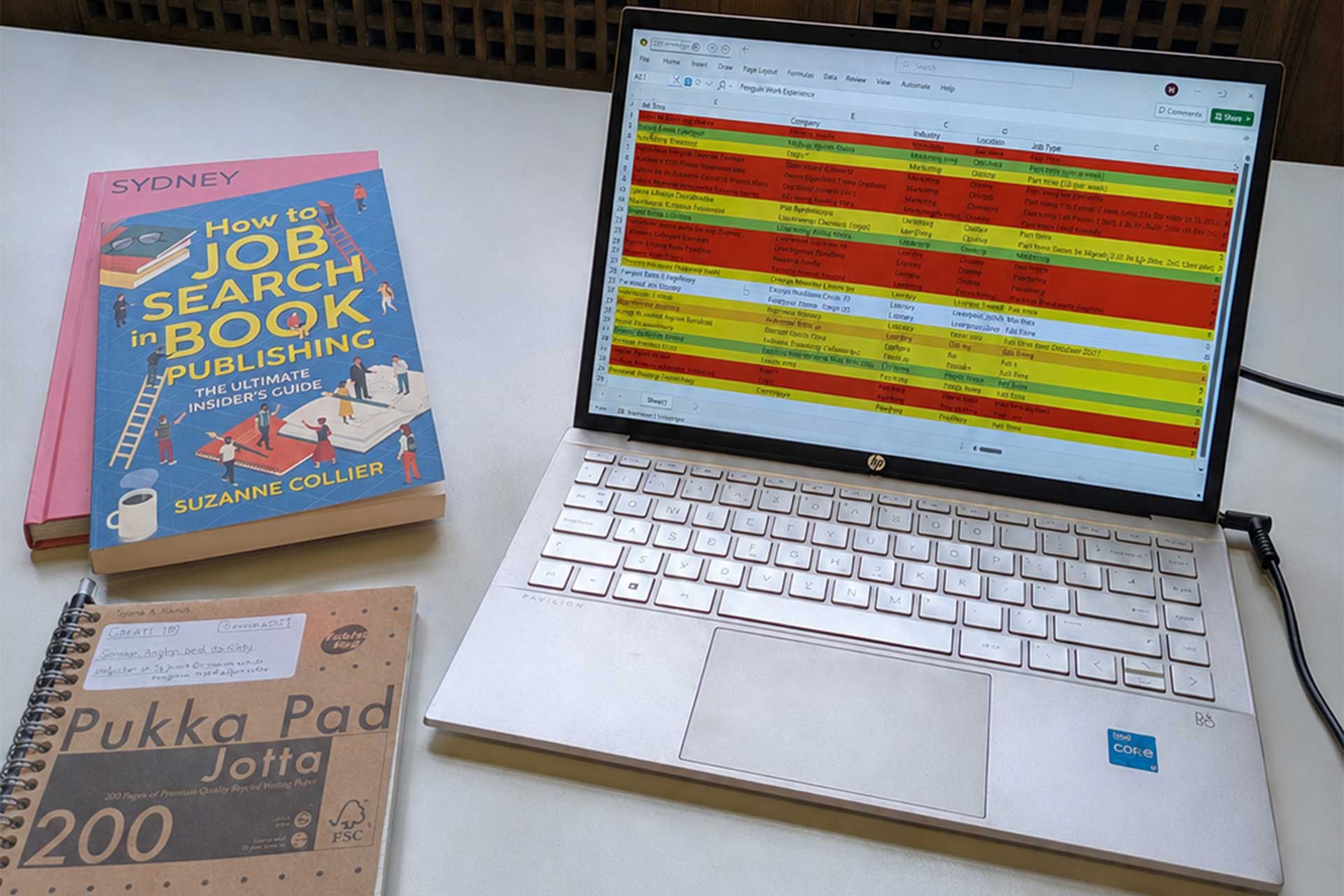
Yes, it will feel very empty at first, and you will feel very overwhelmed to fill it in as soon as possible, but slow down – the most important thing to have before jumping into a long and exhausting process like applying to jobs is a system. It doesn’t need to be complicated at all (mine isn’t, and I am still scared of Excel functions and formulas), but having a simple system makes everything so much easier to handle and cope with.
Every week (for me, it’s Mondays, so I start the week with something that makes me feel very productive), I sit down and update mine. I browse job boards like the Museums Association, add new opportunities and roles, check deadlines, and plan what I’m applying for over the next few days (always based on the deadline, so I don’t miss out on anything). It turns something overwhelming into something structured.
My spreadsheet includes:
• Job title and organisation
• Whether the role is part-time, full-time, or contract
• Pay – hourly or yearly
• Application deadline (the most important bit of information!)
• Date applied – easy to go back and check on an application if you’re still waiting to hear back, and realise that you only applied 2 days ago...
• Notes – how you feel about the job at first look
• Follow-up dates
And then, arguably, the most satisfying and fun part - colour-coding! I assign a colour for every outcome and stage of an application:
• Applied – yellow
• Chased up - orange
• Rejection – red
• Interview stage – purple
• Job offers – green
Most importantly, I don’t delete anything – not even rejections.
Looking back at the spreadsheet now makes me feel better about the stage in my life I am at, and the way I am handling the ‘real world.’ There have been weeks when I felt like I wasn’t making progress or doing enough, but the spreadsheet tells a different story. It shows consistency, effort, and a pattern of engagement that isn’t always visible day-to-day, unless you see it laid out in front of you – with lots of colours too!
It has also helped me reflect more critically on my applications. I’ve started noticing patterns in what gets responses, how I tailor applications, and how I present my experience. Over time, that reflection has made each application feel more intentional.
More than anything, it has shifted the process from something reactive to something structured—something I actively manage rather than something that happens to me. It just makes the whole process feel a little less overwhelming and a lot more manageable.
Persistence is not optional (even if it feels exhausting)
This has probably been the most challenging part to come to terms with, and the least enjoyable one.
You will apply for things and not hear back (annoyingly).
You will get rejections that don’t make sense (frustratingly).
You will question whether you’re doing something wrong (a lot).
That’s (unfortunately) part of the process.
In fields like museums and heritage, opportunities are often incredibly competitive and sometimes unpredictable. Getting a role isn’t just about being qualified - it’s about timing, visibility, and often just continuing to show up and apply over and over again. There have been roles I was genuinely excited about that I didn’t hear back from at all. Others resulted in rejections that were difficult to understand, especially when I felt I met the criteria or had put significant effort into the application, performed well in an interview, and followed up after the interview to make a positive and lasting impression.
Over time, I realised that this isn’t unusual – but I would never regret a failed application or an interview. Not only do you learn something, whether it be about yourself or the company, from every application and interview, your efforts also do not go unnoticed – trust me. The amount of work you put into your applications, interviews, and connecting with the employers and company will often get you in their system, even when you get rejected, because they will remember you and know they might need you and want you in the future. And that is sometimes more valuable than getting the job itself.
Persistence doesn’t mean applying to everything without thinking. It means staying consistent, learning from each application, and not letting setbacks completely derail your confidence – which is the hardest part. But once you get over that, you will literally be unstoppable. What has helped me is developing a routine and a mindset that separates effort from outcome. By consistently searching, applying, and following up (using my spreadsheet to keep track), the process becomes less emotionally driven and more structured – although you will get attached to certain jobs and you will put all your eggs in one basket.
I’ve also started sending polite follow-up emails after both applications and interviews. It felt uncomfortable at first - there’s always a hesitation about whether you’re being too forward or annoying - but it has helped me feel more proactive. In some cases, it has even led to responses or feedback that I wouldn’t have received otherwise, as well as the company asking me if they can keep my name in their system in case future opportunities become available.
In this way, persistence isn’t just about endlessly applying and growing more and more exhausted. It’s about continuing with intention, refining your approach, and recognising that progress often happens gradually rather than all at once! No matter what, you just have to remind yourself that you are doing everything you can.
In the next blog post, I will cover how to approach opportunities, networking, and navigating pressure. Watch this space!