When you think of Roman Britain, you probably think of the luxurious Roman baths or the monumental Hadrian's Wall spanning the width of the country, right? But did you know there's a whole city full of Roman history just a 40-minute Merseyrail ride away? That's right, I'm talking about Chester. After hearing about this in an Ancient Warfare lecture, I charged down to Liverpool Central and hopped on a train into the ancient world to explore the remnants of Roman Chester.
Upon my arrival, the first thing I noticed was that the weather was exactly how Tacitus described it nearly 2000 years ago. Some things really do not change.
Their sky is obscured by continual rain and cloud. Severity of cold is unknown.
– Tacitus, Agricola 12
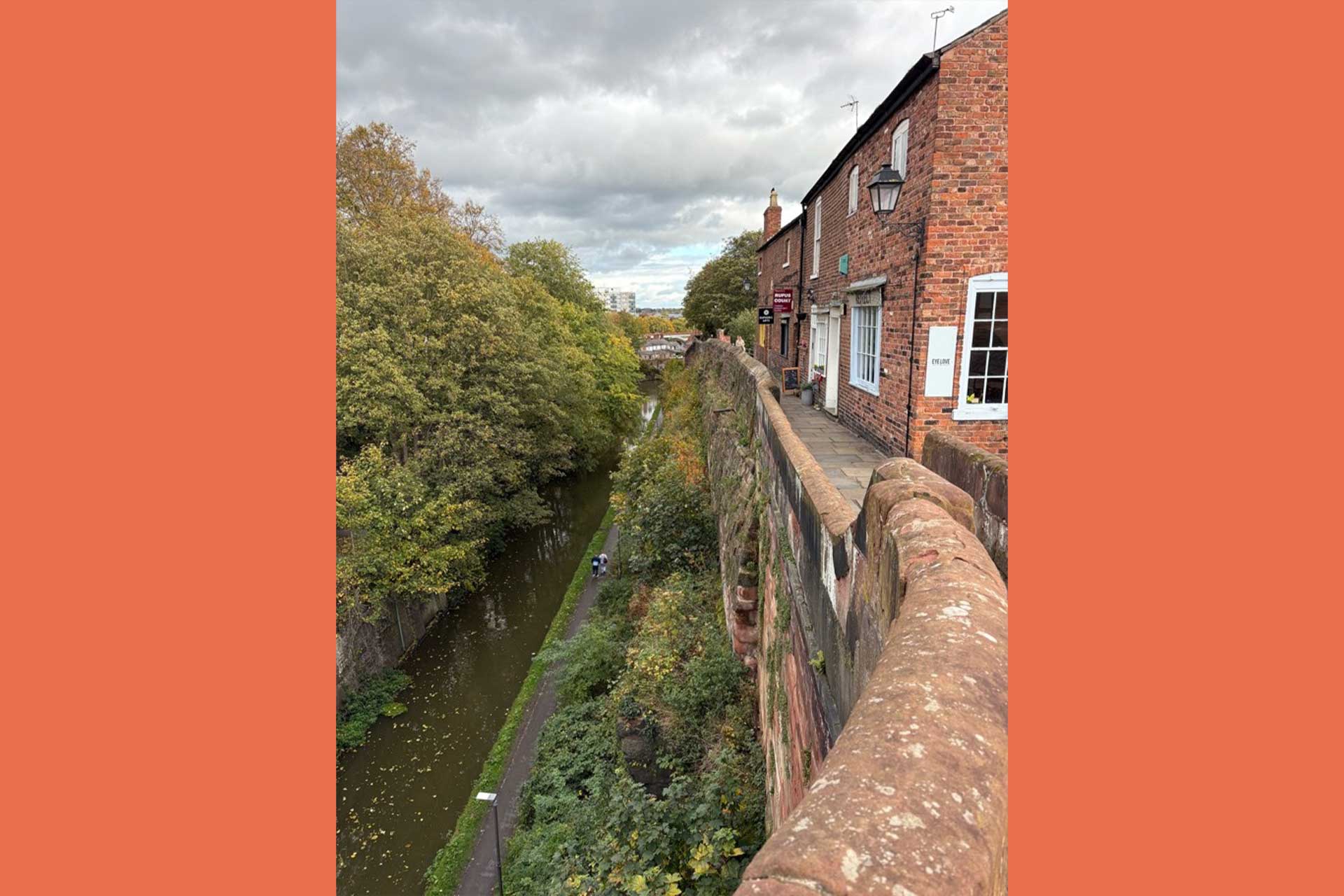
After a short walk from the station, I reached the first piece of Roman history at the heart of the city, the city walls. These immense walls are the only connected Roman walls in Britain, spanning 3km in a loop around the inner city. During the Roman period, these walls were crucial to protecting the port city of Deva. Although the walls you see today are medieval reconstructions, these walls still follow the original path set out by the Roman walls from the time of Agricola onwards. Standing atop this impressive structure, you can practically feel the Roman authority looking out over the wall towards the outer city and beyond (see first picture). However, Roman Britain is just the beginning of the story for the city walls of Chester. During the English Civil War, Chester was a Royalist city fighting against the Parliamentarians, and in the decisive battle of Rowton Moor, King Charles watched his army suffer defeat. It is on these battlements that I marched, a pencil as my sword, notebook as my shield, onto the next piece of Roman history.
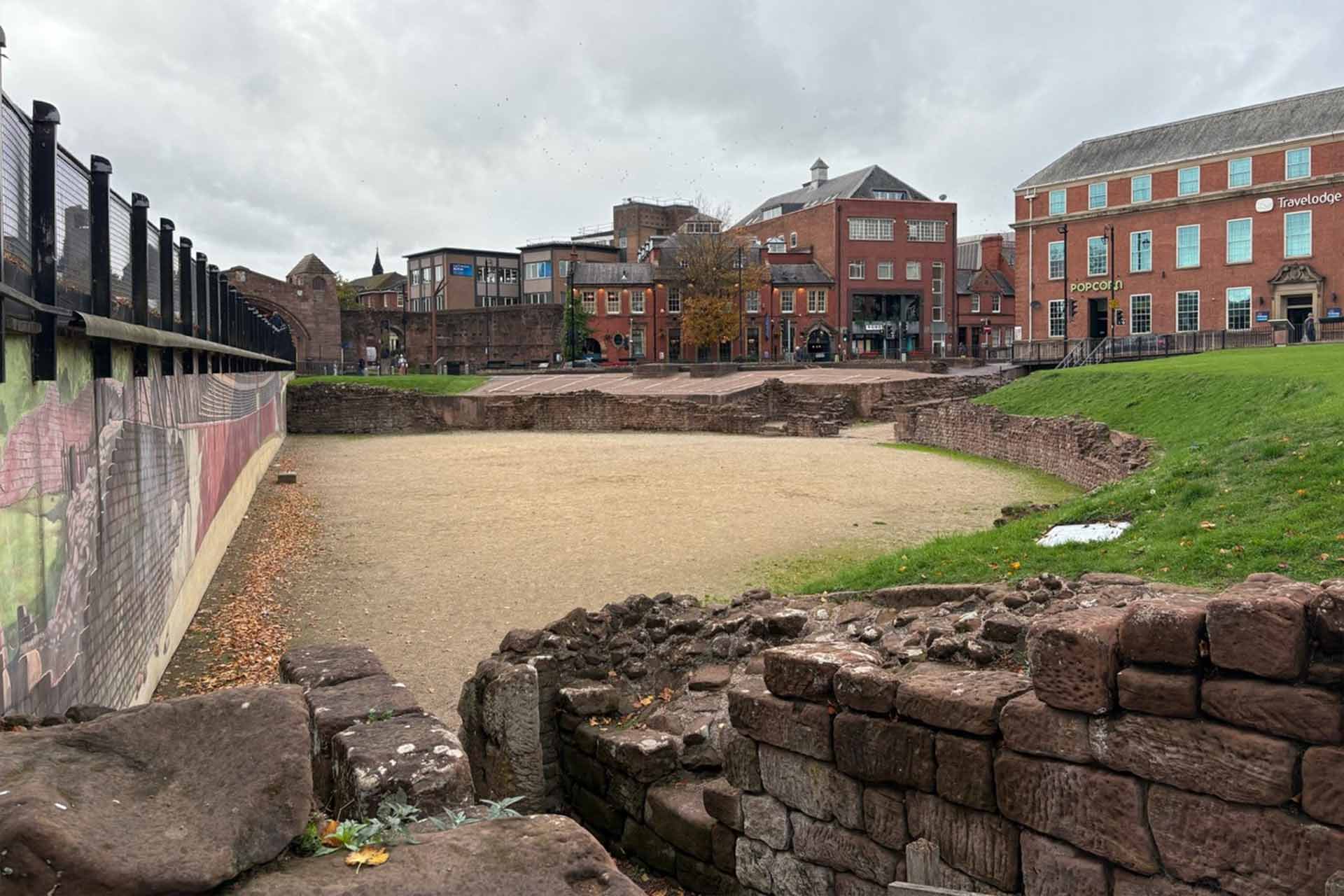
A short trek further along the wall and a bewildering view came into sight. Adjacent to a main road lies the remains of a Roman amphitheatre, but not just any amphitheatre (2). This is the largest Roman amphitheatre in all of Britain, holding around 7000 spectators at the time of its expansion in the 3rd century AD. In the 1930s, when the site was first discovered, plans were drawn up to build a road through the monument, leading to a nationwide campaign to prevent this precious piece of history. Thanks to this campaign, which took place nearly 100 years ago, we now have access to an incredible site you can experience for yourself. Through excavation, we learn that this amphitheatre was home to the brutal gladiatorial fights, the height of entertainment in the Roman world. By the north entrance of the arena, a small shrine was excavated, which was dedicated to Nemesis, a goddess worshipped by gladiators. This would've been a handy last-minute chance to save your skin before putting your life on the line for the Roman elite. Standing in the middle of the arena and imagining 7000 people looming over you is enough to make your stomach turn, and that’s before you have to fight a wild boar or other dangerous beasts. I can certainly say I was entertained by this site (I wish I could say the same about Gladiator II).
2. A view of the Roman amphitheatre from the proposed box office:
Many gladiatorial artefacts are currently in the Grosvenor museum (until 25th January) in an exclusive exhibition ‘Gladiators of Britain’ in collaboration with the British Museum and the Museums of Colchester and Ipswich. This exhibition displayed a fantastic selection of artefacts, highlighting the Roman image of the gladiators on anything from pottery lamps to marble reliefs. The gladiators were the celebrities of the Roman world, and the exhibition certainly highlighted the highs and lows of the Roman entertainment industry.
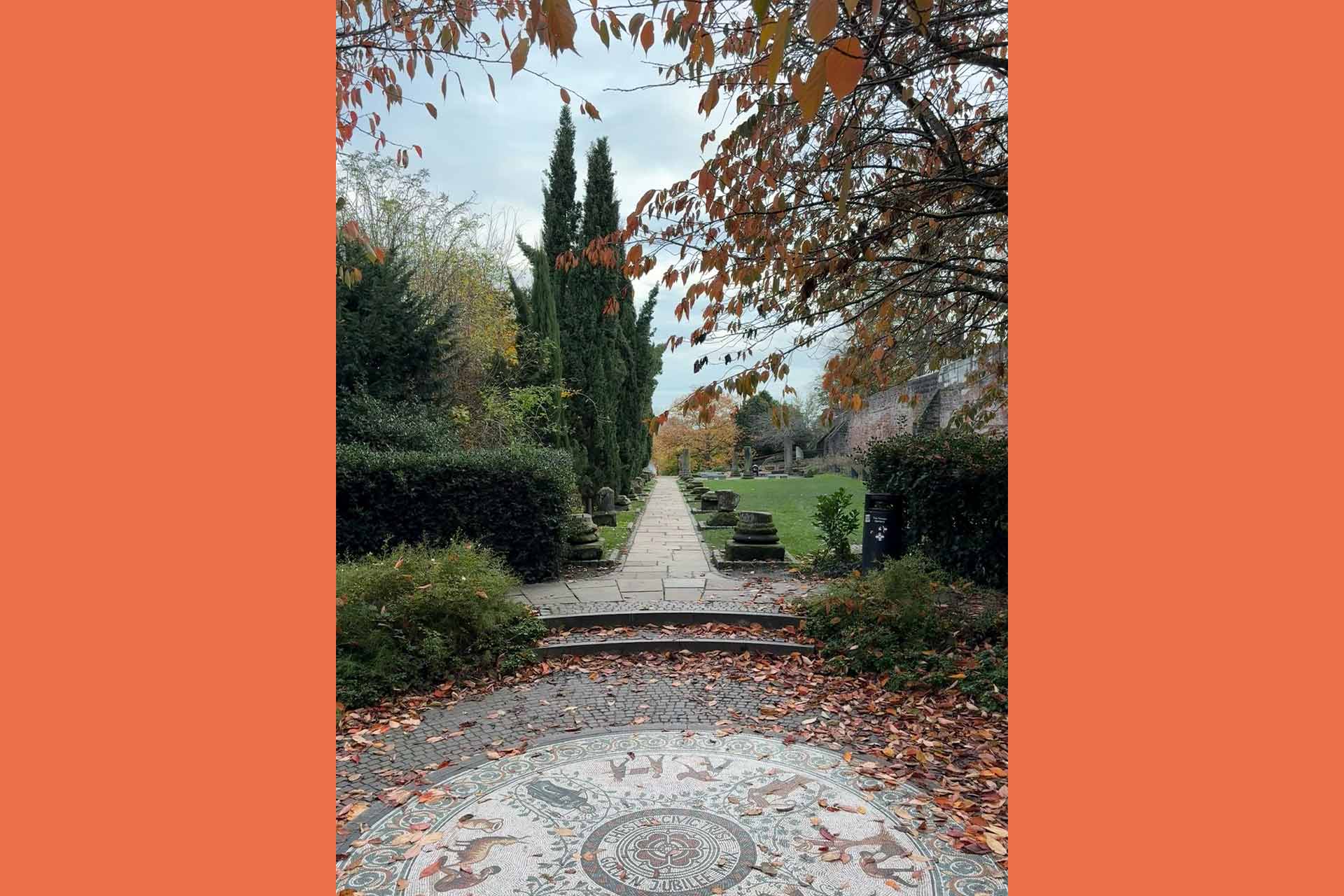
Beside the amphitheatre were the illustrious Roman gardens (3). With a path straight out of a rich Roman villa, this scenic area was constructed in 1949 as a way to display the artefacts found nearby. Excavations found sections of Roman military buildings and the Roman bath complex consisting of an exercise hall, bath houses and saunas. The most amazing find by far was the remains of a hypocaust system. This remarkable invention consisted of a fire beneath a raised floor, which allowed the hot air to spread beneath the floor and up the walls through small channels, which heated the entire room. I know where I’d be going on a wet and windy day in Roman Britain. This section of the Roman wall complex also contains more history from the English Civil War period. It was in this south-eastern section of the wall where the Parliamentarians breached the city walls in the siege of Chester in 1644, resulting in a devastating loss for the royalists.
3. A view of the Roman gardens from the entrance:
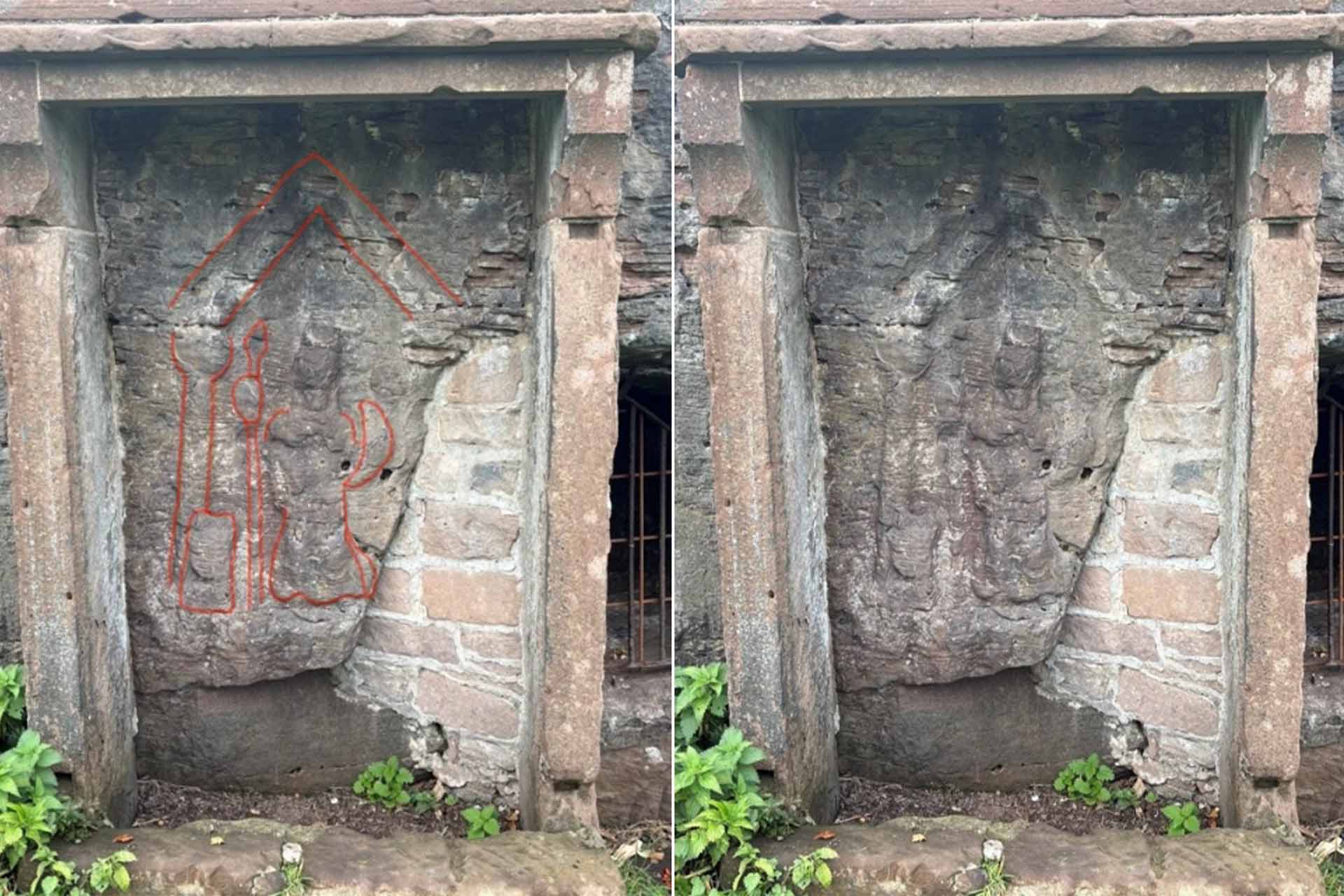
My favourite discovery on my day trip to the past is the shrine of Minerva (5). Located in a park near the medieval Dee Bridge is an immense rock of red sandstone. On the face of the front side of the rock is a small shrine dedicated to the Roman goddess Minerva (the Roman version of the Greek goddess Athena). Although it is now extremely weathered, you can still just about make out the main features of Minerva: a spear, shield and helmet, and an owl. This depiction also shows an altar in the bottom left corner. Minerva was the goddess of warfare, arms, medicine and a part of the Capitoline trio (Jupiter, Minerva and Juno), which were heavily associated with the Roman army. This fantastic piece of Roman history shows the versatility of the Roman army as craftsmen as well as soldiers. This shrine is one of the only depictions of a goddess discovered in situ, an incredibly rare and unique artefact.
4. The Shrine of Minerva. I have been able to highlight some of the key features in red on the left:
Overall, Chester is the perfect local location to fully experience the Romano-British period with astonishing sites that allow you to walk a mile in the sandals of the Roman soldiers and settlers from nearly 2000 years ago.