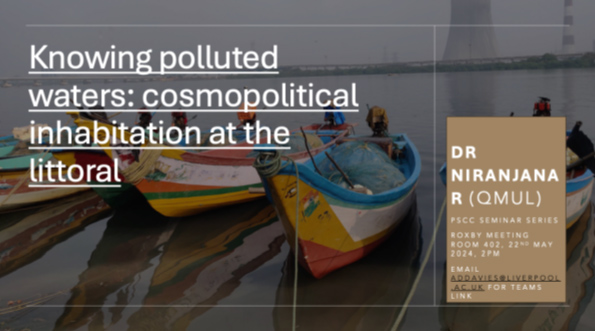
Knowing polluted waters: cosmopolitical inhabitation at the littoral
Dr Niranjana R (QMUL)
22nd May 2024, 2pm
Roxby Building, 4th Floor Meeting Room
In the Ennore-Pazhaverkadu wetlands north of Chennai, it is not unusual for a heavily polluted river estuary to disappear from official maps; for pipelines carrying oil or ammonia gas to leak spontaneously into coastal waters; and for fishers who rely on these waters to be told that it is not known how or why these things happen. The innocence from knowledge, however, only extends as far as the next plan for a coastal infrastructure project, which mobilises ‘expertise’ towards determining norms of habitation alongside the sea, the rivers and their estuaries. For fishers, whose embodied knowledge is much romanticised, this poses a challenge - what does it mean to know these continually polluted waters? How to even get to know water that behaves in such un-natural ways? How would that knowledge ultimately help in making a living? This paper explores the conundrum, attending to the socio-natural and multi-natural practices employed by fishers in navigating this fragmenting geography. It suggests that they offer cosmopolitical (Stengers, 2002) ways of reimagining inhabitation at the littoral.
Part of the Seminar Series “Transformations in Land, Labour, and Meaning in South Asia” organised by the Power, Space, and Cultural Change Cluster, Department of Geography and Planning.