Sharon Cooksey
I’m Sharon Cooksey, a final-year PhD student in the Work, Organisation and Management department of the University of Liverpool Management School. I also work part-time at the University of Strathclyde as a Global Practitioner, helping MBA and MSc students to successfully navigate their leadership, change and HRM learning journeys.
I am a veterinary surgeon and in 2020 gained an MBA, studying for both degrees at the University of Liverpool. I spent many years working in equine and large animal practice, followed by a decade working in the animal health (pharmaceutical) industry.
Despite being a vet, I have always been interested in helping people and giving them the greatest chance to be the best they can, whatever the circumstance.
Research
In my profession and in similar professions across the world the levels of poor mental health and proportional mortality rates for death by suicide far exceed those of the general population. I wanted to understand why this situation exists and why, despite decades of recognising these problems and multiple widescale interventions, it is not improving.
What many of these professions, e.g., vets and medics, have in common is the selective recruitment of high achievers. Because there is high competition for limited slots, obtaining a place on the respective degree courses demands that candidates demonstrate not only superlative academic performance, but also extra-curricular excellence as requirements for admission. Consequently, mental ill health and suicide in these professions is frequently associated with perfectionism (defined as characteristically striving for extremely high standards).
Sounds reasonable, right? What if I tell you that despite decades of research, perfectionism remains theoretically unresolved, it engulfs other constructs which describe striving for high standards, and it is still not possible to distinguish the helpful from harmful aspects of this trait?
So, I set out to understand what really drives these working individuals to achieve. Recruiting over 1200 qualified vets to be involved in the research, I investigated both conscious (including perfectionism) and subconscious drivers involved in the pursuit of achievement. I identified six distinct ‘latent’ (hidden) profiles which describe why and how these working individuals pursue achievement, as well as the overarching goal. I then analysed how these profiles were associated with mental ill-health (and turnover intention) over time.
The results indicate that individuals who exhibit profiles which are described by a strong subconscious need to achieve, driven by a fear of failure, show high levels of mental ill-health compared to individuals with other profiles. Interestingly individuals displaying a profile described by high perfectionism, not accompanied by this strong need, suffered significantly less mental ill-health.
Next steps
I am currently analysing the results of two studies. Almost complete is a longitudinal analysis of the effect of the pursuit of achievement on mental health (and turnover intention). The second study is a random, active controlled intervention study, with a treatment intervention which I designed and delivered based on the preliminary results from the first study.
Iam due to finish writing the PhD thesis at the end of 2025. I hope to be able to disseminate this research where it can have effect and to continue to research how we can further improve mental health in working people.
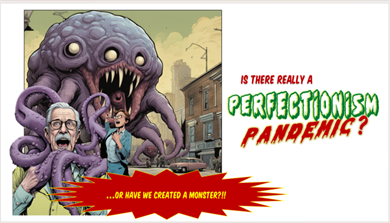
My Three Minute Thesis
Condensing three years’ work into three minutes seemed impossible at the start, but as I have always struggled with answering the question ‘so what is your research about?’ I knew it would be beneficial.
However, besides now having a (slightly long!) elevator pitch, while I was developing my 3MT I realised that this work has far broader scope than the medical professions. People who are driven by a high need for achievement are everywhere, actors, lawyers, students, academics … the list goes on! This work then becomes applicable across a vast spectrum of individuals and can hopefully help many more people than I ever imagined.