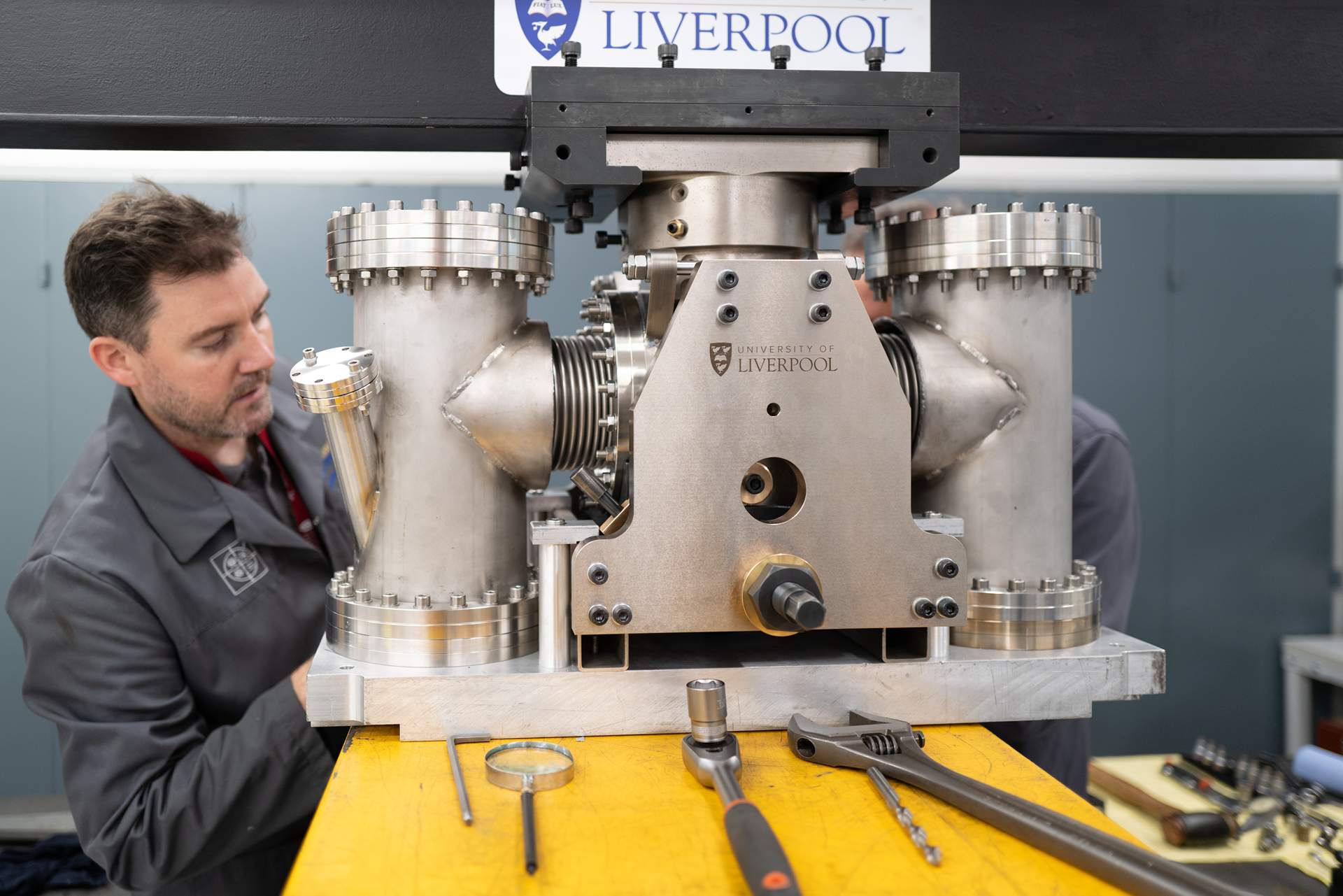
A team from the University of Liverpool’s Department of Physics have constructed a critical component for a proposed Proton Electric Dipole Moment (pEDM) experiment. This is an ambitious new experiment to answer one of the greatest mysteries about the big bang and the dawn of the universe.
According to our current understanding of physics, the Big Bang should have produced equal amounts of matter and antimatter. These are building blocks which are almost perfect mirror images that destroy each other when they meet. However, if matter and antimatter behaved entirely the some, the universe, as we know it, could not have evolved. Somehow matter won out over antimatter and survived, leaving us with one of the most profound mysteries in science.
Scientists think one clue might be hidden inside the proton, a tiny particle found in every atom. They are looking to the measure the slight electrical “lopsidedness,” called an electric dipole moment (EDM). This is predicted to exist at an almost unimaginably microscopic level in the standard model of physics – equivalent to measuring the diameter of our universe to the size of an atom.
Measuring the value of the proton EDM will shed light on the fundamental difference between matter and antimatter and might explain why matter prevailed after the Big Bang. It also opens a window to new physics beyond the reach of our highest energy accelerators at CERN.
Liverpool’s excellence in detector technology
Finding such a minute effect demands extreme precision. The instrument must be sensitive enough to tiny spin effects in protons. Spin is a fundamental quantum property of all matter behaving in a manner analogous to the way the axis of a gyroscope rotates. The polarisation of protons, the direction in which their spin axis points, is sensitive to the EDM.
A key component of a detector capable of detecting such a tiny imbalance has been assembled at the University of Liverpool by colleagues from the Department of Physics. The experiment requires studying a polarised proton beam in a storage ring similar to those to found at Fermilab, CERN or Brookhaven National Labs.
The Department first used this technique at Fermilab, on the Muon g-2 experiment to make the worlds best measurements of the muon spin including its EDM. But the proton EDM technology opens the door to an experiment millions of millions times more sensitive.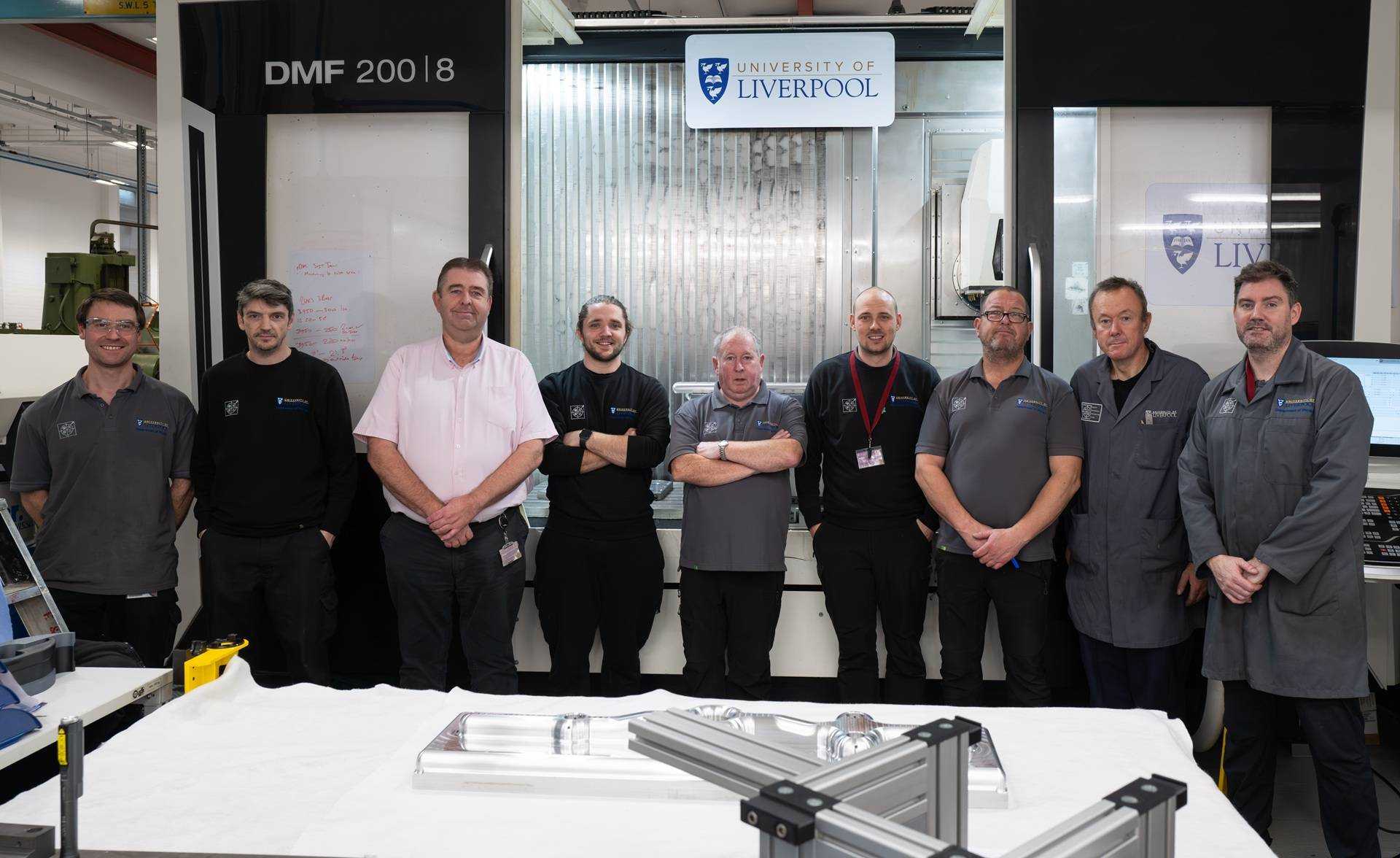
Image: The workshop team responsible for constructing the pEDM detector.
Lead investigator for this project Professor Themis Bowcock said “The original idea was proposed by scientists Bill Morse and Yannis Semertzidis at Brookhaven. It is a natural evolution of the g-2 experiment we have just completed at Fermilab which was led by Graziano Venanzoni. The highly skilled engineers in our workshop have produced what I believe is the critical component of the EDM experiment. Tests at Brookhaven will now take place that will allow us to demonstrate the feasibility of this measurement. This is a classic example of how UK research and industry are working together at the forefront of international research.”
The head of the Liverpool Particle Physic Research Cluster, Professor Joost Vossebeld said “A major challenge to the proposed proton EDM project was to demonstrate that the most critical components of the storage-ring could designed and manufactured to the exceptionally tight tolerances required for the measurement. In this joint project with Brookhaven, Themis, our engineering team and specialist workshop team have designed and built the first 1-meter-long demonstrator section, of what will ultimately be an 800m storage ring, clearing a major hurdle for this proposed project.”
Particle Physics Frontier
The University of Liverpool’s Particle Physics frontier drives innovation in instrumentation and analysis. We develop cutting-edge detector technology for major experiments at facilities like CERN and Fermilab as well as provide expert analysis to uncover new physics and deepen our understanding of the universe’s smallest elements. Watch this video to find out more.