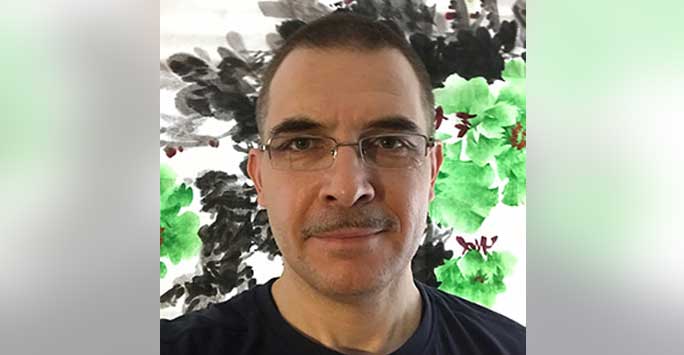
Sorin Baiasu (Department of Philosophy, School of the Arts) is Professor of Philosophy, Director of the Liverpool-Oxford-St Andrews Kantian (LOSAK) Research Centre, Distinguished Research Fellow at the Uehiro Institute, Oxford University, and Chair of the Steering Committee of the European Consortium for Political Research’s Kantian Standing Group.
Learn more about Sorin and his work in the Researcher in Focus podcast below.
I have a broad range of research interests, from the history of philosophy, metaphysics, epistemology, philosophy of religion and aesthetics, to political philosophy, philosophy of law, ethics and philosophical counselling.
Nevertheless, there has always been a particular emphasis in my work on topics in moral and political philosophy, particularly on questions of justice. In part, this is a result of my experience in Romania, where I was born and lived at a time when Ceaușescu’s dictatorial communist regime was in full swing. As with any dictatorial regime, the scope for doing politics was extremely narrow, but the motivation to think about it was always there. Yet, to a significant extent, credit for my focus on themes in political theory should also go to my PhD supervisor at Manchester University, Dr Ursula Vogel, who always motivated me to work out the political implications of my arguments.
What particularly preoccupies me in politics is the question of fairness, especially in the political organisation of institutions, states and international order. The idea of justice as fairness was introduced by John Rawls in the second half of the twentieth century, and I remain indebted to him for an exemplary articulation of this idea, which has been so influential during the last fifty years.
Part of Rawls’s legacy includes also an increased interest in the philosophical and cultural centrality of one of his most important predecessors, the 18th century German thinker, Immanuel Kant. Kant’s works have exerted a particular fascination on me, not only because they represent some of the most difficult writings in the history of philosophy, but also because they seem to me to be philosophically among the strongest, perhaps only matched by the works of the radically ancient sceptics.
Justice and accountability
What I have always found problematic, in the contemporary account of justice as fairness (in particular the justice of distributing goods in society), has been the lack of a proper place for how justice should depend on what individuals and groups can take credit for. This idea of accountability is fundamental in the work of Kant and, by drawing on Kant’s work, in some of my research, I have examined ways in which it is possible to retrieve a theory of justice that gives an appropriate place to accountability by taking into account what individuals and groups deserve and by emphasising the significance of responsibility.
As a result, in May this year, I started a 5-year €2 mil. Advanced Research Project selected by the European Research Council and funded by the UK Research and Innovation with the topic ‘Kantian Justice: A Desert-sensitive Responsibility-enhancing Theory’ [KantianDESERT]. At this point, members of the project’s team include Tom Bunyard, Tom Whyman and Roberto Mozzachiodi, who are philosophers with significant research interests in the area of the project.
KantianDESERT is designed to formulate a new model of distributive justice, in response to growing global economic disparities by offering an innovative case for a theory sensitive to just deserts. The project puts emphasis primarily on a notion of desert, which is critical-contestatory, rather than legitimising – in other words, a notion that can help identify unjust situations, rather than maintain and justify the status quo. Work as part of the project is designed to answer important metaphysical objections from moral responsibility scepticism by drawing on Kant’s work on freedom and moral agency; it will also integrate a critical account of desert as part of a theory of justice, which includes also other criteria, such as equality, efficiency or need. The new model will be applied to three case studies, in healthcare, education and business.
Philosophy-informed local policy
In addition to KantianDESERT, I am also principal investigator on an award offered by the Arts and Humanities Research Council for collaborative work between the university and a non-higher education institution, in this case, the Stoke-on-Trent City Council. The project offers funding for a PhD student to research a topic relevant for the Council with a view to contributing to the production of knowledge in the relevant scholarly area, but also contributing to the improvement of practices at local level.
The Stoke-on-Trent City Council is in the process of implementing restorative practices as part of its services. The restorative approach has been hailed for its outstanding capacity to promote progress and reconciliation. It has acquired global prominence as an alternative account in the criminal justice system to the traditional desert-based practices.
Yet, the approach has also been used in the domain of distributive justice. In the context of a local council, the approach is viewed as encouraging the co-creation by citizens, Council staff and partners of the services provided by the Council, leading to more effective engagement with service users, improved outcome for citizens, support for organisational change and a more positive and inclusive culture.
The focus of the project, however, is on those cases where citizens do not have the opportunity to participate properly in this process of co-creation and are placed under pressure to agree on particular outcomes, although they may not find them to be fair. In the context of criminal justice, this has been regarded as a process of second victimisation, and the solution is to employ a dual restorative-desert-sensitive approach. The project takes this to be a potential solution also in the domain of distributive justice, and in particular in the context of the services offered by the Council.
Currently, members of this project’s team include Chris Mountford - PhD student, James Doble – Director: Legal, Governance and Customer Services at the Stoke-on-Trent City Council and second supervisor, Thomas Schramme – Professor of Philosophy at the University of Liverpool and member of the supervisory board, and Phil Catney – Senior Lecturer in Politics at Keele University and member of the supervisory board.
The KantianDESERT project was officially launched with an international conference, which took place at the University of Liverpool at the beginning of November (https://philevents.org/event/show/141378). The LOSAK Research Centre will be officially launched as part of a Kantian Festival, which will take place at the University of Liverpool between 15 and 19 December, and will include a Winter School, a Workshop and the LOSAK Annual Lecture and Conference (for more information, see here).