Popular Music
UCAS code W340
- Study mode
- Full-time
- Duration
- 3 years
- Start date and application deadlines
-
- Start date
UCAS code W340
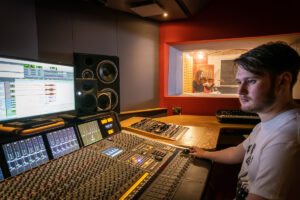
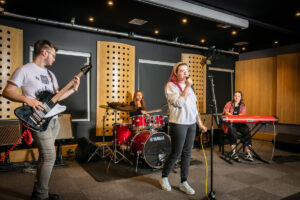
The University of Liverpool has a particular specialism in popular music, having established the world’s first specialist centre for its study - the Institute of Popular Music - in 1988. Recent investment in our teaching facilities has provided state-of-the-art studios, practice rooms, a games research lab and a large rehearsal space.
In addition to practical areas, this programme focuses on developing an in-depth and critical historical understanding of popular music repertoires, cultures, and practices. Practical modules are concerned with musical performance, song-writing, or creative music technology, although none of these are compulsory; while other modules focus on popular music history topics or the music industry. There are also options in areas such as music psychology and audio-visual media (films and videogames). Throughout, you will learn to write about popular music from a historical, critical, sociological, or philosophical viewpoint.
In your first year, core modules will take a detailed look at the nature of the popular music industries, and a critical exploration of 20th century popular music history – not only going through key musical milestones, but also exploring their social contexts and the long-term cultural implications.
In your second and final years you will focus in more depth on fewer selected topics, either concentrating solely on Popular Music modules, or retaining the option to pursue one or two modules in other areas. Specialist topics are studied alongside advanced level performance and music technology modules. In the final year, there is a particular emphasis on specialism and an extended or independent project (such as a research project, a music technology project, or an extended performance recital).
Year in Industry
Undergraduate students in the Department of Music have the opportunity to spend a year in industry, either in their third year, or by adding a ‘follow-on year’ at the end of their academic studies. These are paid placements within an organisation in industry, broadly defined, and you will receive support from the Department and the School of the Arts to source and apply for opportunities. Find out more about the difference between these options, including how to apply.

We want you to feel welcome from the moment you apply to study at Liverpool. We offer lots of support for our students who are moving from abroad. We can welcome you at Manchester Airport with our meet and greet service (for September starts) and we have a friendly International Advice and Guidance team who run events to welcome you on to campus and provide in person support and events all year round.
Discover what you'll learn, what you'll study, and how you'll be taught and assessed.
You will take three compulsory modules: MUSI140, MUSI121 and MUSI150; and five optional modules (the majority from popular music modules).
In year one, you:
| Compulsory modules | Credits |
|---|---|
| INTRODUCTION TO POPULAR MUSIC HISTORY (MUSI140) | 15 |
| MUSIC AS AN INDUSTRY (MUSI150) | 15 |
| MAKING MUSIC IN CULTURE (MUSI121) | 15 |
Programme details and modules listed are illustrative only and subject to change.
Your second year is made up entirely of optional modules. There may be some restrictions on which modules can be taken in conjunction with others, which will be explained during module registration.
Programme details and modules listed are illustrative only and subject to change.
You will undertake a major independent project in research, performance, composition or technology. The rest of your modules will be chosen from a range of options.
Programme details and modules listed are illustrative only and subject to change.
Options include performance, technology, audio-visual music, world music, and music industry. In years two and three you focus in more detail on the areas that interest you most (such as history, psychology, audio-visual, performance, or popular composition/song-writing).
We employ a range of teaching methods, including lectures, seminars, tutorials, workshops, master classes, 1-2-1 instrumental lessons, ensemble coaching, and online tasks and projects. The emphasis is on student participation and interaction. We fit the most appropriate mode of teaching to the particular subject, conscious that the learning process needs to be enjoyable, enabling you to acquire useful and marketable skills and knowledge.
Each module has an individually determined system of assessment (by coursework, written paper, test, recital, composition or technology portfolio, presentation or podcast, examination, and combinations of these), and we select the method that best suits the nature of the module.
We have a distinctive approach to education, the Liverpool Curriculum Framework, which focuses on research-connected teaching, active learning, and authentic assessment to ensure our students graduate as digitally fluent and confident global citizens.
The Liverpool Curriculum framework sets out our distinctive approach to education. Our teaching staff support our students to develop academic knowledge, skills, and understanding alongside our graduate attributes:
Our curriculum is characterised by the three Liverpool Hallmarks:
All this is underpinned by our core value of inclusivity and commitment to providing a curriculum that is accessible to all students.
Studying with us means you can tailor your degree to suit you. Here's what is available on this course.
University of Liverpool students can choose from an exciting range of study placements at partner universities worldwide. Choose to spend a year at XJTLU in China or a year or semester at an institution of your choice.
Immerse yourself in Chinese culture on an optional additional year at Xi'an Jiaotong Liverpool University in stunning Suzhou.
Broaden your world by spending an additional year of study at a partner university abroad following your second year of study.
Take a semester of your second year of study at one of our worldwide partner institutions.
Spend a summer abroad on a study placement or research project at one of our worldwide partner institutions.
Year in industry placements give you an in-depth workplace experience where you can develop your skills and apply your learning.
You don't need to decide now - you can choose to add a year in industry after you've begun your degree.
Learn more about year in industry
To spend a year in industry, you'll need to secure a placement with an organisation. If you're unable to find a placement, you'll continue with the standard version of the course without a year in industry.
Every student at The University of Liverpool can study a language as part of, or alongside their degree. You can choose:
With a combined degree, you can study two subjects as part of the same degree programme.
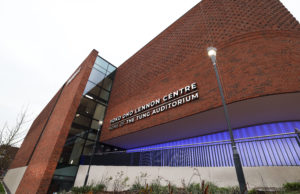
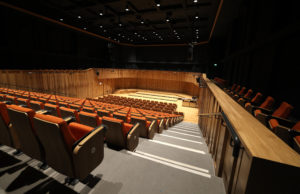
Much of your teaching will take place in the Department of Music. Our recently renovated facilities include studios, teaching spaces and industry standard equipment, and we recently opened the Tung Auditorium: a 400-seat state of the art performance venue, which has been developed to support our requirements and to function as a public-facing space for concerts outside of teaching time.


From arrival to alumni, we’re with you all the way:
My aim is to work in the music industry and this course offered a wide range of modules across the whole industry, allowing me to learn about how different areas operate. It’s also incredibly flexible as it has allowed me to combine performance, marketing, film composition, music history and workplace experience into my degree.

Want to find out more about student life?
Chat with our student ambassadors and ask any questions you have.
Studying Music opens up many career opportunities, including composing, performing, music therapy, community arts, and teaching.
As well as jobs in music employers in many sectors are increasingly seeking arts and humanities graduates for their transferable skills.
As a student in the School of the Arts, you will be supported to maximise your employability from day one.
The School has its own placements and employability officer, and you will have the opportunity to undertake the following work experience opportunities: