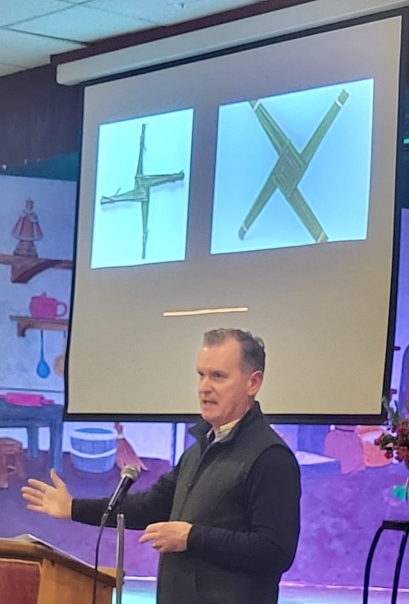
I was invited to speak at the Liverpool Irish Centre’s annual celebration of St Brigid’s Day or Lá Fhéile Bríde (1 February), which happened to fall on a Sunday this year. There was a terrific crowd there of all ages with colouring activities for younger audience members and a workshop after my talk on the making of the traditional St Brigid’s crosses with rushes imported from County Antrim!
The making of St Brigid’s crosses from rushes (the greener and thicker, the better) was very much part of my childhood and people waited keenly for the coming of 1 February as a marker of the approaching Spring and the slow lengthening of the days. By placing a cross above your main door, it was said that St Brigid would not allow any harm or evil spirit to pass the protective charm of her cross. The cross also provided protection to the household from fire and other dangers as well as blessing the thrashing and the cattle. It is said that the rushes you gather for your cross must be pulled on St Brigid's Eve and that’s certainly a tradition that we followed strictly as children.
The story of St Brigid is a mix of folklore and fact. She is one of three patron saints of Ireland, along with St Patrick and St Columcille. Her feast day marks the beginning of the pastoral year, or the coming of spring. In recent years this day is marked in the Republic of Ireland with a bank holiday. Brigid is remembered all across Ireland and further afield in the names of Churches, Streets, Schools and GAA clubs.
 St Brigid was born in the fifth century in Faughart, County Louth, near Dundalk and hence the St Brigid’s Cross appears on the Louth county GAA jerseys. By tradition she was both born and died on the first of February. Different versions of her life exist, but the consistent stories tell us that one of her parents was baptised a Christian by St Patrick himself. Known for her charitable and kind nature, she became a nun and aspired to build a church in what is now Kildare. She was initially denied land for her church, but was later granted 'only the amount of land that her cloak covered'. A miracle is said to have occurred when her cloak grew and grew until it reached a sufficient size for a church to be built. She is frequently depicted in icons and stained glass windows holding this church.
St Brigid's Day also coincides with the pre-Christian season of Imbolc, the festival of spring. Marking saints’ days in line with pagan festivals was common practice and seen as a way of easing the transition from folk religions to Christianity.
We finished the talk with a recitation of Antaine Ó Raifteirí’s poem ‘Anois Teacht an Earraigh’:
| Anois Teacht an Earraigh | Now Comes the Springtime |
|---|---|
| Anois teacht an earraigh, beidh an lá dul chun síneadh, is tar éis na Féile Bríde ardóidh me mo sheol |
Now comes the Springtime, the days will be getting longer, and after St Brigid’s Day I will raise my sail. |
For more information about the Liverpool Irish Centre and to see it's programme of events, please go to https://www.liverpoolirishcentre.org/.