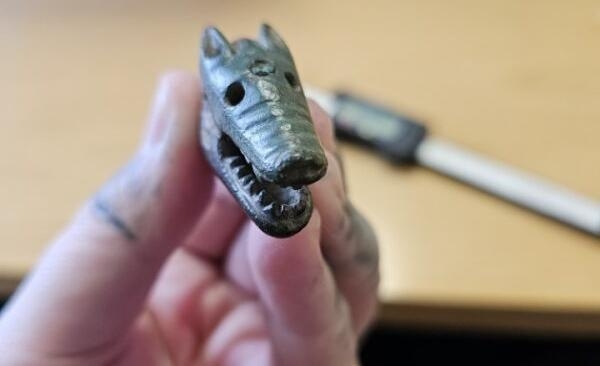
Although I only had the opportunity to work with Paul Sherman for one day, it was an incredibly exciting and rewarding experience. The day was packed with engaging challenges, hands-on learning, and invaluable insights that left a lasting impression.
I had the tremendous opportunity to meet with Paul Sherman, the director of NW Heritage CIC, at their office at Martland Mill, Burscough. I was thrilled to spend the day with Paul, as he’s an exceptionally insightful and knowledgeable individual. It was an inspiring experience, learning directly from someone with so much expertise in the field.
Paul was working on a display project for the “Viking North” Exhibition at the Museum of York; there were numerous items from the Aldwark Viking Camp assemblage to organise and process ready for display at the exhibition.
Paul assigned me, Mike and Jim a role to help with the sorting, processing and identification of the assemblage as we sat around the conference table.
- Step 1 – First, Paul would select an artifact, give it a number to coincide with the datasheet on the laptop, he would then state what the item was labelled as on the bag and tell us whether it had been identified correctly or misidentified.
- Step 2 -Then Jim, whose role was to weigh the item for the data sheet, would call out the weight to Paul for him enter it into the datasheet.
- Step 3 - Next, I would measure the length, width and depth of the item and call out the data to Paul.
- Step 4 – Finally, Mike would then take images with a scalebar in the frame to give an idea of size and to be connected to the data sheet. Paul would then re- bag the item and place it in the processed box.
As we worked through each item in the assemblage, we took the time to share our thoughts and interpretations. This is where Paul really brought his expertise to life— guiding us through the details of each piece while encouraging us to share our perspectives. Often, he’d ask for our input first, prompting us to think critically about what we were seeing. It made the whole process feel collaborative and added an element of excitement to the learning experience.
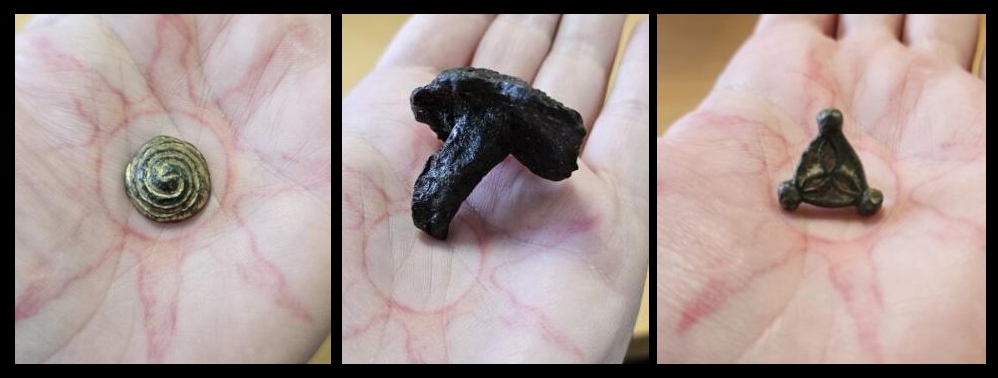
Though I handled numerous objects throughout the day (i.e. spindle whorls, gaming pieces, coins, buttons and brooches), there were four that truly grabbed my attention. But without a doubt, the standout was the wolf’s head—by far the highlight of my year. It was one of those moments where everything else just faded into the background.
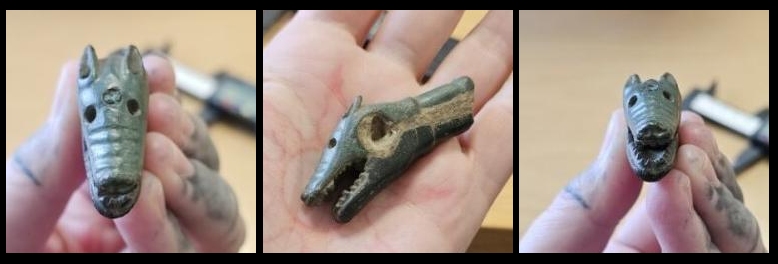
My favourite piece to behold was the dagger hilt, designed in the shape of a wolf’s head. For me, it perfectly encapsulated the Viking era. Having grown up on the stories of the Prose Edda, I’ve always been fascinated by the wolves that feature prominently in Viking mythology—from the fearsome Garm, the hound who guards the gates of Hel, to Hati and Skoll, the wolves eternally chasing the sun and moon, and of course, Fenrir, the colossal wolf born of Loki, whose battle with Odin during Ragnarök is one of the most iconic tales. Wolves were not just symbols of power and destruction but also played a huge role in Viking art and culture. So, to hold this beautifully preserved piece, so intricate and instantly recognizable as a wolf, was a joyous occasion for me. The detail in the craftsmanship captured the essence of these legendary creatures, bringing Viking mythology to life in a way that felt tangible. It was an experience I won’t forget, holding this small but powerful reminder of the Viking age in my hands.
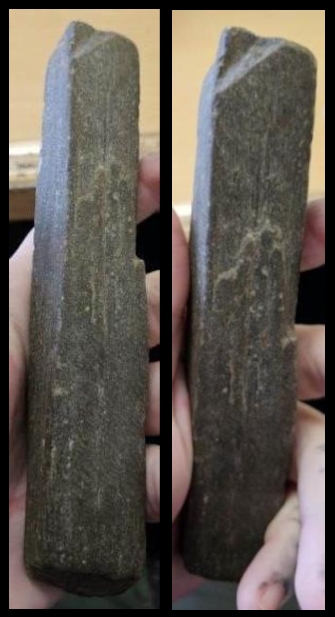 At first, I didn’t expect much from the whetstone when it was placed in my hand. I’d seen plenty of them before, so my initial thought was, 'It’s just a whetstone.' But the moment Paul began sharing the history and significance behind it, this seemingly simple stone came to life. This schist whetstone, was a premium material coveted by the Norsemen for its exceptional sharpening properties. What fascinated me even more was learning that, while some schist whetstones were sourced locally, others—like those found in Slavic regions—were imported from Scandinavia, reflecting the vast trade networks and cultural exchange of the Viking Age. I’d never encountered schist before, so I learned a lot from Paul about its unique properties and how it, with its mix of mica and quartz, provided the perfect abrasive quality for sharpening.
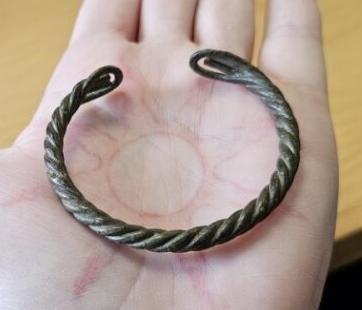 The twisted arm ring, crafted from copper alloy wire, instantly caught my attention for its sheer elegance. The level of craftsmanship that went into creating something so lightweight and delicate, yet striking in its design, was extraordinary. This piece was a perfect representation of the everyday jewellery worn by Scandinavians during the Viking Age—simple, functional, and beautiful. But what really piqued my curiosity was the size of the arm ring. I could barely get it near my wrist, which led me to wonder—who was it made for? Paul explained the making process behind these rings and suggested that it was likely crafted for a young adult, offering a fascinating glimpse into the personal and cultural significance of such pieces in Viking society.
I really enjoyed processing artefacts with Paul—it’s an experience I’d love to have more of in the future. During my work experience, I learned so much from Paul, and his knowledge and passion for history were truly inspiring. One of my dreams is to work at a Viking centre on the Wirral, curating displays that highlight the Battle of Brunanburh and the everyday life of those who settled and traded in the region. The idea of bringing these fascinating pieces of history to life for others, and showcasing the rich Viking heritage of the area, is something I’m truly passionate about.