Physics
UCAS code F303
- Study mode
- Full-time
- Duration
- 4 years
- Start date and application deadlines
-
- Start date
- September 2026 September 2027
- Apply by:
- Starts on:
UCAS code F303
We've set the country or region your qualifications are from as United Kingdom.
This programme is for those considering a career as a professional physicist in fundamental research or industrial research and development. It covers a wider range of topics than Physics BSc (Hons) and provides more research experience.
This programme is intended for those considering a career as a professional physicist in fundamental research or industrial research and development. It covers a wider range of topics than the Physics BSc and provides more research experience.
The Department has an excellent track record of securing PhD studentships and, as a consequence, our graduates have a good opportunity to study higher degrees spanning the whole of physics. The research-led teaching will provide a core of experience that will make you an excellent researcher and also prepare you to excel in many other professions.
Anyone who is curious about the fundamental laws of nature will enjoy Physics. It is one of the few disciplines that really challenge our view of the world. For example, in relativity we find that space and time are entangled and that clocks run slowly under the influence of a gravitational field. When we examine the world on a microscopic scale, we are in the realm of quantum mechanics, where the predictions, such as wave-particle duality, even seem strange to the physicists who study its foundations.
In addition to core physics modules, you will also take mathematics, computing and experimental physics modules. There is an advanced computer modelling project in the third year. There may be opportunities to carry out a major project at an international laboratory such as TRIUMF in Vancouver, CERN in Geneva or the Diamond Light Source in Oxfordshire during the summer vacation between the third and fourth years for three months. These projects are fully paid and can form the basis of a more substantial final-year project at the cutting-edge of research.
There are opportunities to work alongside our internationally renowned academics at projects at the LHC at CERN and in many international and national research centres in the USA, Canada, Japan, Korea and many European countries.
Our flexible programmes allow students to transfer up to the end of year two between any of the physics programmes.
This programme also has a year abroad option, an incredible opportunity to spend an academic year at one of our partner universities. On the 4-year integrated masters programme, you can go abroad either between Year 2 and 3 (apply in Year 2) OR Year 3 and 4 (apply in Year 3).
Our programmes are accredited by the Institute of Physics, which means they satisfy the academic requirements for Chartered Physicist status.
This programme is accredited by the Institute of Physics, which means it satisfies the academic requirements for Chartered Physicist status. The Institute of Physics is the professional body for physics in the UK and Ireland.

We’ve been awarded a Gold rating for educational excellence.
Discover what you'll learn, what you'll study, and how you'll be taught and assessed.
Your first year starts with a one-week project, designed to familiarise you with the staff and other students. There will be three mathematics modules in the first two years, which will provide the mathematical skills required by physics students.
| Optional modules | Credits |
|---|---|
| INTRODUCTION TO MEDICAL PHYSICS (PHYS115) | 7.5 |
| INTRODUCTION TO NUCLEAR SCIENCE (PHYS135) | 7.5 |
| INTRODUCTION TO ASTROPHYSICS (PHYS155) | 7.5 |
| INTRODUCTION TO GEOPHYSICS (PHYS175) | 7.5 |
Programme details and modules listed are illustrative only and subject to change. The course content currently shown on this page reflects the programme as it is running in September 2026. The University is currently reviewing all of its programmes for 2027 entry. View the 2027 version of this course for more information.
In year two you will broaden your understanding of physics, with modules designed to ensure you have mastered the full range of physics concepts.
| Optional modules | Credits |
|---|---|
| MATHEMATICS FOR PHYSICISTS IV (PHYS208) | 15 |
| ACCELERATORS AND RADIOISOTOPES (PHYS246) | 15 |
| STELLAR PHYSICS (PHYS251) | 15 |
Programme details and modules listed are illustrative only and subject to change. The course content currently shown on this page reflects the programme as it is running in September 2026. The University is currently reviewing all of its programmes for 2027 entry. View the 2027 version of this course for more information.
With the core physics modules completed in the first two years there is now considerable scope to choose amongst the optional modules available, mostly based around the research interests of the departmental staff.
| Compulsory modules | Credits |
|---|---|
| COMPUTATIONAL MODELLING (PHYS305) | 15 |
| QUANTUM AND ATOMIC PHYSICS II (PHYS361) | 15 |
| ELECTROMAGNETISM II (PHYS370) | 15 |
| STATISTICAL THERMODYNAMICS (PHYS393) | 7.5 |
| PRACTICAL PHYSICS III (PHYS306) | 15 |
Programme details and modules listed are illustrative only and subject to change. The course content currently shown on this page reflects the programme as it is running in September 2026. The University is currently reviewing all of its programmes for 2027 entry. View the 2027 version of this course for more information.
In the final year of the course you will have considerable flexibility to choose between the many optional modules based around various physics research areas. You will also undertake an extended project with a member of staff, normally in their research area.
| Compulsory modules | Credits |
|---|---|
| PROJECT (MPHYS) (PHYS498) | 45 |
Programme details and modules listed are illustrative only and subject to change. The course content currently shown on this page reflects the programme as it is running in September 2026. The University is currently reviewing all of its programmes for 2027 entry. View the 2027 version of this course for more information.
Our research-led teaching ensures you are taught the latest advances in cutting-edge physics research. Lectures introduce and provide the details of the various areas of physics and related subjects. You will be working in tutorials and problem-solving workshops, which are another crucial element in the learning process, where you put your knowledge into practice. They help you to develop a working knowledge and understanding of physics. All of the lecturers also perform world class research and use this to enhance their teaching.
Most work takes place in small groups with a tutor or in a larger class where staff provide help as needed. Practical work is an integral part of the programmes, and ranges from training in basic laboratory skills in the first two years to a research project in the third or fourth year. You will undertake an extended project on a research topic with a member of staff who will mentor you. By the end of the degree you will be well prepared to tackle problems in any area and present yourself and your work both in writing and in person. In the first two years students take maths modules which provide the support all students need to understand the physics topics.
The main modes of assessment are coursework and examination. Depending on the modules taken you may encounter project work, presentations (individual or group), and specific tests or tasks focused on solidifying learning outcomes.
At Liverpool, we take a distinctive approach to education through the Liverpool Learning Framework. This means teaching that is engaging, inclusive and designed to help you succeed during your studies and beyond.
You’ll develop specialist subject knowledge alongside the skills employers value most, including:
Our curriculum is characterised by the three Liverpool Hallmarks:
We also embed key priorities across our curriculum, including AI literacy, employability, and sustainability, helping you prepare for the future and make a positive impact in the world.
We’re committed to creating a supportive and inclusive learning environment where every student can thrive.
Studying with us means you can tailor your degree to suit you. Here's what is available on this course.
University of Liverpool students can choose from an exciting range of study placements at partner universities worldwide. Choose to spend a year at XJTLU in China or a year or semester at an institution of your choice.
Immerse yourself in Chinese culture on an optional additional year at Xi'an Jiaotong Liverpool University in stunning Suzhou.
Broaden your world by spending an additional year of study at a partner university abroad following your second year of study.
Take a semester of your second year of study at one of our worldwide partner institutions.
Spend a summer abroad on a study placement or research project at one of our worldwide partner institutions.
Every student at The University of Liverpool can study a language as part of, or alongside their degree. You can choose:
This course is also available as a three year BSc (Hons) programme.
This course is delivered by the School of Physical Sciences, one of the UK’s leading physics departments, with a history of discovery that goes back over 130 years. Day-to-day teaching takes place in our £23 million award-winning, state-of-the-art Central Teaching Laboratories, which have transformed the way in which physical sciences are taught at the University.
Find out a little bit more about Physics at Liverpool.
From arrival to alumni, we’re with you all the way:
Physics gives you a chance to explain how the world works, from the tiny, atomic scale to the large. I've enjoyed the practicals, getting to grips with handling the equipment and the scientific methods. I’ve developed a lot of skills that I will apply throughout my life.
Want to find out more about student life?
Chat with our student ambassadors and ask any questions you have.
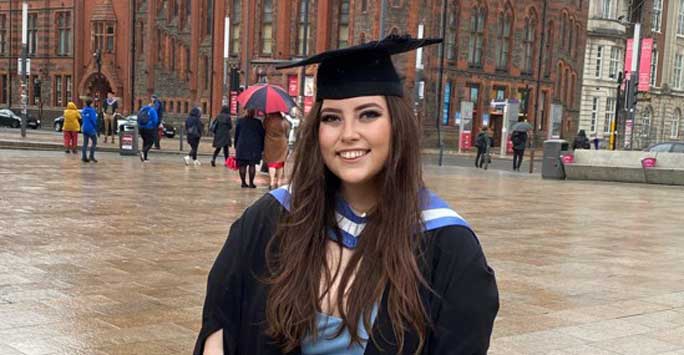
Third year student, Cara, gives her views on what its like studying Physics at Liverpool.
A physics degree is a great starting point for a physics-related career, engineering and computing careers.
Graduates of this course develop advanced analytical, quantitative and research skills that are highly valued across a wide range of professional sectors.
Throughout the programme, students gain experience in experimental investigation, computational modelling, advanced data analysis and scientific communication. They also develop the ability to address open-ended problems systematically and to evaluate complex evidence critically.
Engagement with research literature and investigative projects gives students insight into how new scientific knowledge is generated and how physicists contribute to addressing fundamental scientific questions and technological challenges.
The extended research project undertaken in the final year provides experience of independent scientific research and prepares graduates for doctoral study and careers requiring advanced scientific expertise.
Graduates pursue careers in areas including:
Many graduates progress directly to PhD programmes in physics or related disciplines.
88% of physics students find their main activity after graduation meaningful.
(Graduate Outcomes, 2018-19.)
Hear what graduates say about their career progression and life after university.
Abbie graduated from our Physics MPhys course and is now undertaking a Physics PhD at the University of Liverpool.
Rosetta Mission Project Scientist and University of Liverpool alumnus, Dr Matt Taylor, talks cosmos, computers and The Cambridge.
My qualifications are from United Kingdom.
Your tuition fees, funding your studies, and other costs to consider.
Full-time place, per year - £9,790
Year in industry fee - £1,955
Year abroad fee - £1,465 (applies to year in China)
Full-time place, per year - £32,000
Year in industry fee - £1,955
Year abroad fee - £16,000 (applies to year in China)
The fees shown are for the academic year 2026/27. Please be advised that tuition fees may increase each year for both UK and international students. For UK students, this will be subject to the government’s regulated fee limits.
Tuition fees cover the cost of your teaching and assessment, operating facilities such as libraries, IT equipment, and access to academic and personal support. Learn more about paying for your studies.
We understand that budgeting for your time at university is important, and we want to make sure you understand any course-related costs that are not covered by your tuition fee. You can find information on the general and subject-specific costs you could expect to incur on our study costs webpage.
We’re showing the scholarships available to students from United Kingdom.
We offer a range of scholarships and bursaries that could help pay your tuition and living expenses.
4 scholarships are available each year to support undergraduate applicants from socio-economically under-represented backgrounds who permanently reside in the Liverpool City Region. Successful applicants will receive a stipend of £5,000 per year for 3 years. Applications open in August 2026.
This scholarship will support undergraduate students from widening participation backgrounds in the Department of Languages, Cultures and Film with their year abroad.
This award offers £3,000 per year for a UK undergraduate student from an under-represented background who has successfully completed the Liverpool Scholars or Pathways to Medicine programme.
If you’re a UK student joining an undergraduate degree and have a household income below £35,000, you could be eligible for a Liverpool Bursary worth up to £2,000 for each year of undergraduate study.
Apply for an Asylum Seekers Scholarship and you could have your tuition fees paid in full and receive help with study costs. You’ll need to have applied for asylum in the UK, or be the dependant of an asylum seeker, and be joining an eligible undergraduate degree.
If you’ve spent 13 or more weeks in Local Authority care since age 14, you could be eligible for a bursary of £3,000 per year of study. You’ll need to be a UK student joining an eligible undergraduate degree and be aged 28 or above on 1 September in the year you start.
Are you a UK student with a Black African or Caribbean heritage and a household income of £25,000 or less? You could be eligible to apply for a Cowrie Foundation Scholarship worth up to £8,000 for each year of undergraduate study.
If you’re a UK student identified as estranged by Student Finance England (or the equivalent UK funding body), you could be eligible for a bursary of £1,000 for each year of undergraduate study.
Joining a School of Biosciences degree and have a household income of less than £25,000? If you’re a UK student, you could apply to receive £4,500 per year for three years of your undergraduate course.
Do you live in the Liverpool City Region with a household income of £25,000 or less? Did neither of your parents attend University? You could be eligible to apply for a Nolan Scholarship worth £5,000 per year for three years of undergraduate study.
Are you a UK student with a household income of £25,000 or less? If you’ve participated in an eligible outreach programme, you could be eligible to apply for a Rigby Enterprise Award worth £5,000 per year for three years of your undergraduate degree.
Are you a UK student with a household income of £26,500 or less? Did neither of your parents attend University? You could be eligible to apply for a ROLABOTIC Scholarship worth £4,500 for each year of your undergraduate degree.
Apply to receive tailored training support to enhance your sporting performance. Our athlete support package includes a range of benefits, from bespoke strength and conditioning training to physiotherapy sessions and one-to-one nutritional advice.
Joining a degree in the School of Electrical Engineering, Electronics and Computer Science? If you’re a UK student with household income below £25,000, you could be eligible to apply for £5,000 a year for three years of study. Two awards will be available per academic year.
If you’re a young adult and a registered carer in the UK, you might be eligible for a £1,000 bursary for each year of study. You’ll need to be aged 18-25 on 1 September in the year you start your undergraduate degree.
Have a question about this course or studying with us? Our dedicated enquiries team can help.
Last updated 9 September 2026 / / Programme terms and conditions