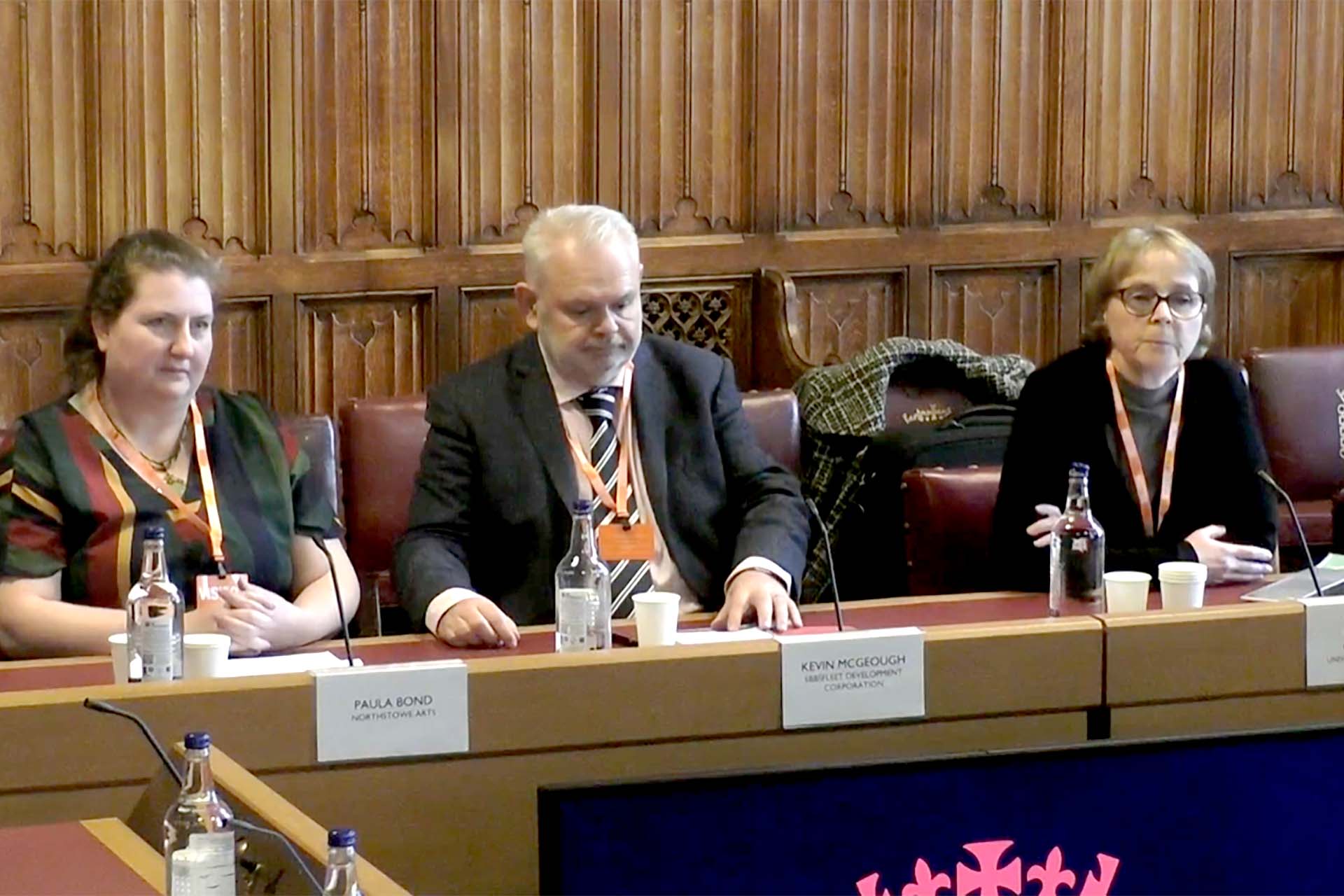
Professor Rhiannon Corcoran, Professor of Psychology and Public Mental Health in the Department of Primary Care & Mental Health, gave evidence to the House of Lords Select Committee on the Built Environment on 18 November, contributing her extensive expertise on how social and cultural infrastructure can support thriving communities. The session took place in Parliament and formed part of the Committee’s ongoing inquiry into the development and sustainability of new towns across the UK.
Appearing alongside Kevin McGeough of the Ebbsfleet Development Corporation and Paula Bond from Northstowe Arts—both involved in the evolution of modern UK new towns—Professor Corcoran helped the Committee understand how new communities emerge, the viability of social infrastructure, and what physical spaces residents need to sustain wellbeing and civic life. Her contributions focused on how stakeholders can help communities emerge organically, how social infrastructure can be prioritised in major developments, and who should be responsible for the long-term stewardship of social and cultural spaces.
Central to her evidence was her research and practice through Prosocial Place, a project co-founded in 2013 to integrate academic research with real-world urban design, regeneration, and community-led planning.
Reflecting on her appearance at the Committee, Professor Corcoran said, 'I felt honoured to be invited to give evidence to the House of Lords Select Committee on the Built Environment and considered it a statement of recognition that the research and practice work I’ve been doing over the last 12 years has had impact.
The issue of new towns is not uncontroversial, especially considering the scale of ambition set out by this Government. The sheer cost of the planned new towns alone makes it imperative that we do all we can to make these settlements a success. This means taking the opportunity to create environments where people can thrive, be involved and sustain a good quality of individual and community life.
This objective is in marked contrast to the enforced hollowing out of social infrastructure that we have witnessed happening in existing places over recent years (e.g. loss of libraries, closing of community hubs and reduced maintenance of parks and open spaces). It is critical that new towns do not inadvertently widen the health and wellbeing inequality gap by benefitting those who can move while leaving residents of disadvantaged existing places languishing, continuing to be deprived of the place-based assets that help us to feel good and function well together.
While it was challenging to get that point over in full within the session given the nature of the questions we were asked to address. However, I did take the opportunity to squeeze the issue of built-in inequity and I can only hope this is properly considered in any new town policies that arise.'