Wirral Child Health and Development Study
The Wirral Child Health and Development Study started in 2006. The study aims to identify social, emotional and biological risks and processes involved in the development of child and adolescent emotional and behavioural problems.
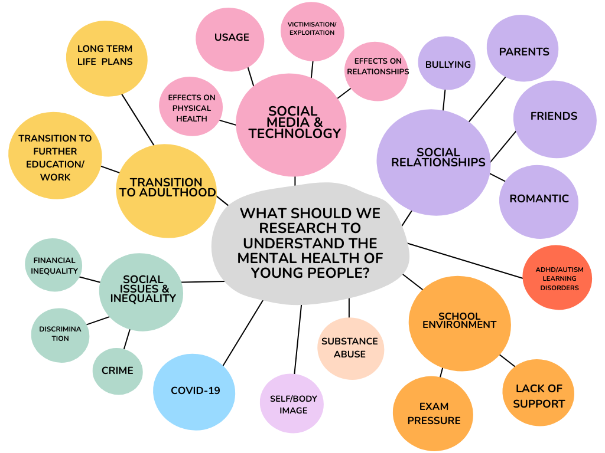
We recruited first-time pregnant women aged 18 years and above at their 20-week scan appointment, in the antenatal clinic at Arrowe Park Hospital, Wirral, Merseyside, between March 2007 and December 2008. Just under 70% of eligible families agreed to participate in the study at that time, and we have continued to follow their progress. We are currently completing the age 15-16 year questionnaire wave on the study and are applying for funding to continue following families as the young people transition towards adult life. Below are the factors our participants told us are most important for mental health during this time, which have informed our future plans:
The study is run jointly by Professor Jonathan Hill from Manchester Metropolitan University (ManMet) and Professor Helen Sharp from the University of Liverpool. The study was set up with the support of Wirral University Teaching Hospital NHS Foundation Trust and continues now to be supported by Wirral Community NHS Foundation Trust and Cheshire and Wirral Partnership NHS Foundation Trust. We have a team of research staff who work closely together to complete assessments with family members at different points during development, most recently support families completing questionnaires remotely from home.
The study was funded by the Medical Research Council for fourteen waves of data collection up to 2018. The age 12 data collection was funded by the CWP NHS Foundation Trust and the NIHR HPRU in Emerging and Zoonotic Infections, the Centre of Excellence in Infectious Diseases Research (CEIDR) and Alder Hey Charity, with support from Liverpool Health Partners and the Liverpool-Malawi-COVID-19 Consortium. The age 13 data collection is funded by the University of Reading and a British Academy Small Research Grant awarded to Dr Nicky Wright, a Senior Lecturer at MMU. The age 15-16 year data collection is funded by MMU internal funding awarded to Dr Nicky Wright.
Aims
This study aims to find out why some young people develop emotional and behavioural problems, and what factors lead to them persisting. We know that these difficulties often emerge in childhood and for some young people develop into more serious problems later in childhood, adolescence and adulthood. We want to understand what factors contribute to problems both persisting and desisting.
Previous research suggests many risk and protective factors may play a role. These include:
- Stress during pregnancy or in early life
- Aspects of the parent-child relationship, genetic make-up
- Family relationships
- Peer relationships
- Support from the wider community
- Cognitive (mental) and language development
- Physiological development
- Children’s emotional reactions to situations or events
- Poverty and social circumstances
- Life stressors.
As young people go through adolescence and towards early adulthood, other factors become salient, including:
- Physical, hormonal and psychological changes associated with puberty.
- Physical activity levels and physical development
- Experiences with social media
- Friendships, bullying and isolation
- School and academic pressures
- Engaging in risky behaviours.
We also know that there is likely to be a complex interplay between these factors and we hope to discover which are the most important and at which points in development. It is important to identify sources of resilience that might make it less likely that behavioural and emotional difficulties will develop. Such factors include individual characteristics of young people that make them resilient when faced with difficult events or stressors, and parenting qualities that might reduce the risk that such difficulties will develop in children who are vulnerable in other ways. We are also interested in whether some behaviours develop which are beneficial in the short term but prove to be far less beneficial if they persist longer than the situation warrants.
We are particularly interested to investigate whether the risks and protective factors are the same for boys and girls, because our findings to date have suggested that child mental health problems may arise in different ways in boys and girls. This may contribute to stark sex differences in emotional symptoms which arise in adolescence, the start of the elevated rates of depression in females observed throughout the lifespan. Identifying these differences may well have important implications for the targeting and nature of interventions that might best be used to help young people and families in the future.
We all experienced a major disruption to our lives from the COVID-19 pandemic. We have also collected information from families on the impact that the pandemic had on their lives, and have been collecting repeated questionnaires to allow us to understand the long term mental and social health effects.
As the young people in the study transition towards young adulthood, they increasingly enter into environments that they choose themselves, including further study and the workplace. The influence of peers relative to family becomes greater, and decisions about friendships and romantic relationships can have lasting impacts. We want to follow the young people over this important developmental period and examine the interplay between these decisions and actions made, the social risks and resources available to young people and mental health outcomes.
Cross-cultural replication in India
Some processes in child and adolescent mental health will be universal whereas others will be specific to certain cultures. The First Steps study has a sister cohort in Bangalore, India, designed to assess these similarities and differences Bangalore Child Health and Development Study | Institute of Population Health | University of Liverpool
How is the study progressing?
We successfully recruited 1286 first-time mothers, partners and babies during pregnancy and are now following the families until the young people reach 16 years of age. It is important to say that many young people in the study will develop without mental health difficulties, some will have transient difficulties, and some will have problematic behaviours or emotional difficulties that persist over time. It is important to study all of these young people.
We have followed all of the families and have asked for information from each family on ten occasions from pregnancy (20 weeks of pregnancy, birth records, 9-12 weeks old, 14 months old, 3½ years, 4½-5 years, 7 years, 9 years, 12 years and 13 years) and are currently collecting information at age 15-16 years. The whole sample is known as the “extensive sample”. We have asked for information from fathers or partners on five occasions.
In addition, during late pregnancy, a subgroup of just over 300 mothers reporting differing levels of stress during pregnancy agreed to tell us about their lives in even more detail. This subgroup is called the “intensive sample”. So far, these mothers have completed detailed interviews about their lives and have let us observe their children at additional time points to assess their emotional, physiological, behavioural, and cognitive (mental) development in our child development lab at the study base in the Lauries Centre, Birkenhead. These times were at 4 weeks, 7 months, 14 months, 2½ years, 4½ - 5 years, 7 years and 9 years of age. Most families in this intensive part of the study will have now completed fourteen sets of assessments in total since pregnancy.
Gathering information from multiple people is important for scientific research, as findings are always much stronger when based on reports from several different people. At three time points in childhood we collected information from teachers as well as parents.
We have published various findings in scientific journals and they are all available on our publications page.
Our latest study newsletters for young people and primary caregivers are available to download below:
- First Steps Study Newsletter - September 2025 (PDF, 0.7MB)
- Wirral Child Health and Development Study Young People Newsletter - January 2025 (PDF, 2.6MB)
- Wirral Child Health and Development Study Primary Caregiver Newsletter - January 2025 (PDF, 1.1MB)
Thank you!
We are incredibly grateful to all the families taking part in the study who have given their time and energy. The First Steps Study has done incredibly well, compared to other similar studies in the UK, at continuing to collect data from nearly all the families involved since the start. Every one of you makes a big difference. We hope that the study design, quality and frequency of assessments will enormously improve our understanding of the developmental pathways to mental health problems and will improve the chances of developing effective therapies or treatments to help families in future.

Teencam Pilot Study
The aim of the Teencam study is to test out a new method of recording parent and teenager interaction at home.


