This blog draws on findings from two case study sites in Belfast to highlight the obstacles to providing social housing in Northern Ireland and the implications for community planning and engagement in housing policy in the UK.
Northern Ireland, like places across the UK, is in the midst of a housing crisis. Right-to-buy (Rtb) schemes have decimated social housing stock, and the rate of new building has not kept pace with demand. With fewer social homes available, 14% of households in Northern Ireland and 19% of households in England are in a private rental property. Rising market rents have led to increased eviction rates in Northern Ireland. Moreover, the power-sharing government in Northern Ireland (hampered by repeated collapses, most recently in 2017 and 2022) has failed to prioritise communities in social housing need or to take obvious steps like building housing on vacant publicly owned land.
The housing crisis in Northern Ireland
Several trends have exacerbated the social housing crisis in Northern Ireland. Some of these are specific to Northern Ireland, while others are relevant across the UK.
Right to Buy. The RtB scheme introduced across the UK during the 1980s allowed tenants to buy social homes at a significant discount. Replacement social homes have not been built at an adequate rate and over 40% of former council houses in the UK later became private rental properties.
Lack of public funding. Spending on social housing in Northern Ireland fell by 38% in 2024 compared to 2023 levels, resulting in the lowest level of expected new builds in NI since 2009. In addition, up to 19,000 development applications are also stalled due to underinvestment in the sewage system.
Failure to engage communities. Regeneration efforts in Northern Ireland have too often prioritised the most profitable types of development, such as student apartments, offices and hotels, rather than addressing housing need. In Belfast, for example, there were protests against the proposed ‘TriBeCa’ development in the Cathedral Quarter for its lack of sensitivity to community need.
Territorial tensions. Nationalist-Catholic-identifying communities have long experienced systemic housing discrimination, and homelessness and housing need in Belfast remain highly concentrated in predominantly Nationalist areas. Refugees are blamed by some for the housing shortage, despite bearing no responsibility for it.
Case study sites
The two case study sites detailed here illustrate the need to engage with local communities during planning processes for major regeneration sites – and the benefits of genuine community participation in planning.
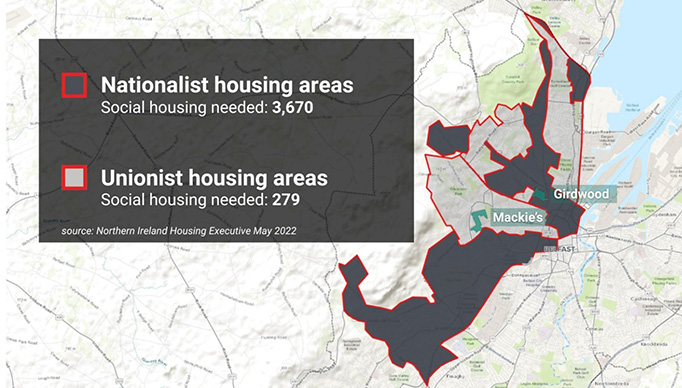
Figure 1: Map showing the two case study sites in the context of housing need in Belfast
Site 1: Girdwood Barracks
Girdwood Barracks is a 27 acre site in North Belfast which was demilitarised in 2005. Initially identified as an internationally significant opportunity to contribute to the peace process and a chance to provide much-needed social homes, subsequent developments have disappointed many local residents. In response to concerns that communities were not sufficiently involved in decision-making about the site, a ‘Residents Jury’ was established in 2008 by human rights NGO Participation and the Practice of Rights (PPR). However, a proposed masterplan for the site was rejected by Unionist leaders due to the inclusion of social housing and fears they would be electorally disadvantaged by the introduction of new residents to the area.
Following years of delay, Belfast City Council applied in 2012 for EU funding to restart the project. The eventual development included only a small number of homes – including just 60 social homes – with much of the site taken up by a community hub and playing fields. The project was widely criticised for its failure to account for community needs.
Site 2: Mackie’s
Mackie’s is a 25 acre former factory site in West Belfast which has been identified as an opportunity to learn from the failures of the Girdwood site and engage in genuine community planning. The site is located in an area of high housing need, deprivation and historic tensions between Unionists and Nationalists.
PPR used lessons learned from their Girdwood campaign to support local community engagement. In response to initial disappointing proposals from Belfast City Council, the Take Back The City (TBTC) coalition (including homeless families, housing professionals and academics) launched an international design competition for an inclusive and environmentally sustainable vision for the Mackie’s site in 2022. The winning bid includes an ecovillage with up to 725 new homes, a city farm, arts centre and 18,000 sqm of employment space.
Community engagement has been central to TBTC’s work on the site, with particular focus on moving beyond entrenched social and political divisions to address housing need. A community mapping process resulted in production of an online tool (The State of Belfast) visualising spatial and social inequality. However, whether the campaign to redevelop the site is successful will depend on large part on the willingness of planners and politicians to embrace new approaches.
Lessons for housing policy
- Coalition-building. The TBTC coalition has brought together those in housing need with housing professionals and others with the power to bring change. Participatory and ethnographic methods have been used to inform plans. In an era of political disengagement and low levels of participation, residents and other stakeholders must feel genuinely empowered if community engagement is to help genuinely shape future development.
- Sensitivity to community needs. In England, the Labour Government has introduced a range of changes through the Renters’ Rights Act 2025 including enhanced protections against evictions and new building safety rules for social housing. However, in Northern Ireland decisions about housing are stalled. Developing genuine understanding about the needs of different communities can help unlock development sites and build support for new housing.
- Working across political boundaries. Northern Ireland’s politics are defined by sectarian divides. However, the two sites discussed here sit across and between different communities, meaning cross-party collaboration is essential to bring forward development. In the UK more broadly, politics appears unstable, with traditional two-party politics seemingly a thing of the past. Politicians will increasingly need to work across party and ideological boundaries if social housing is to be delivered at the scale required.
About the authors
Dr. Elizabeth DeYoung is a Research Scientist at University of Pennsylvania’s Centre for Guaranteed Income Research. She is the author of Power, Politics and Territory in the ’New’ Northern Ireland (Liverpool University Press, 2023).
Paige Jennings is a policy officer for PPR. She worked in human rights and development roles in Africa and Latin America before becoming an Amnesty International researcher and writer for Minority Rights Group, Child Soldiers International, UNDP and UNHCR.
Marissa McMahon is the Assistant Director of Programmes for the Participation and Practice of Rights. She is currently completing a PhD through the European Wasatia Graduate School for Peace and Conflict Resolution.
A detailed history of the Girdwood Barracks site can be found in Power, Politics and Territory in the ‘New Northern Ireland’: Girdwood Barracks and the Story of the Peace Process by Elizabeth DeYoung, published by Liverpool University Press. The paperback version of the book was published on 3 February 2026.