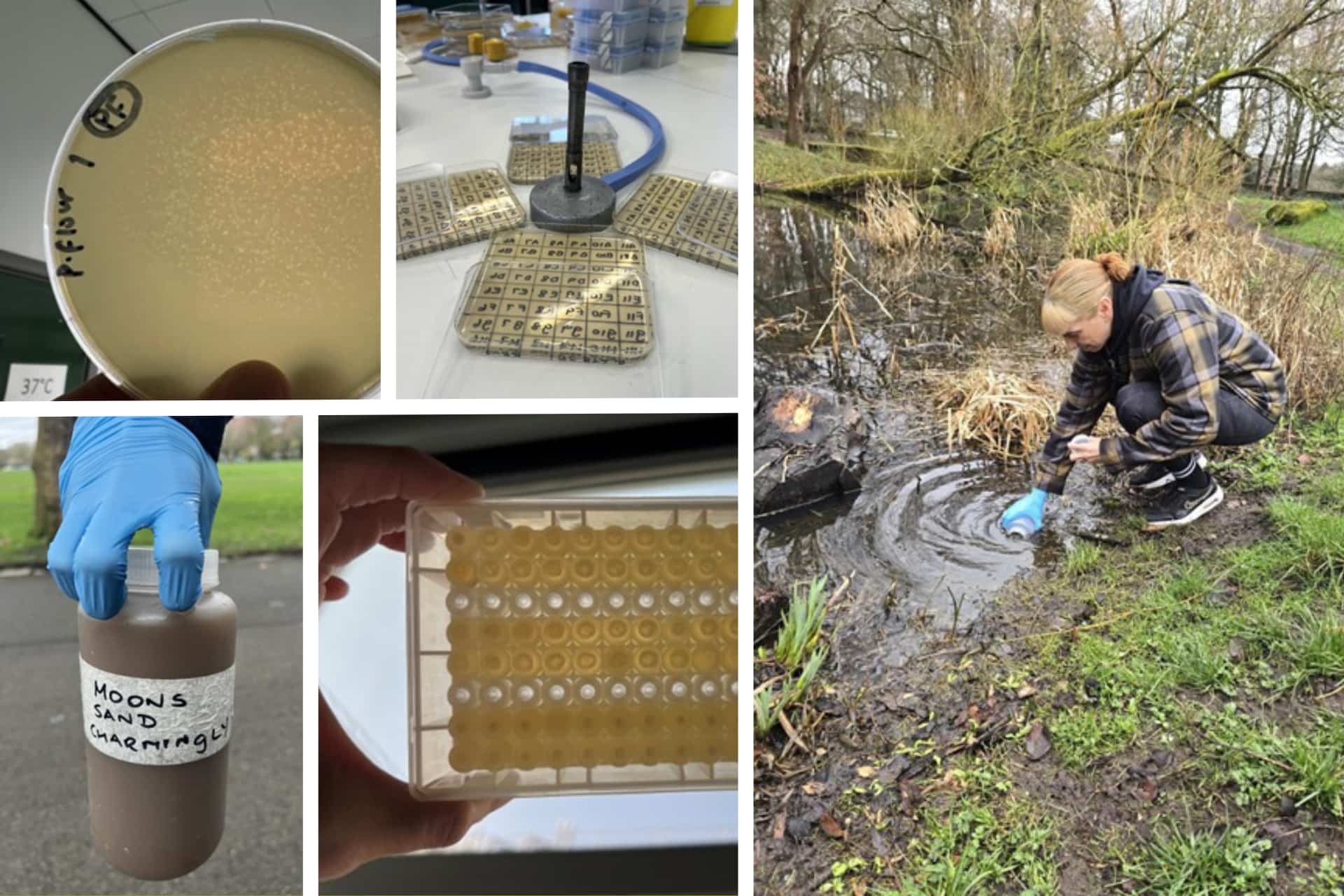
Bioscience education is changing, and at the University of Liverpool that transformation begins with something as ordinary as a handful of soil. Dr Rachel Floyd and Dr Amy Wedley discuss how BIOS206, a research connected module co created with students and industry partners, takes learners from field sampling to real microbiology research, building the skills, confidence and scientific curiosity the next generation of bioscientists need.
It usually starts with a handful of soil. Or a scoop of water. Or something far less glamorous, like a sample collected from a farm.
At first glance, it doesn’t look like much. But for students taking the BIOS206 module at the University of Liverpool, that sample is the beginning of a story. Because hidden inside it is an entire microbial world. One that might just hold answers to some of our biggest global health challenges.
Designing a practical like this doesn’t happen overnight. BIOS206 didn’t appear fully formed. It grew, slowly and iteratively, over several years.
There were early ideas, pilot studies, false starts, and moments where things simply didn’t work the way we expected. There were MSc projects that turned into protocols, student feedback that reshaped entire sessions, and countless conversations about what a modern bioscience module should look like.
At the same time, a major curriculum transformation was underway. BIOS206 became part of that change - an opportunity to rethink what practical bioscience teaching could be.
The importance of co-creation
One of the biggest turning points was deciding not to design this module alone. Instead, we opened the door. To students. To industry. To colleagues. Students wanted more ownership, more relevance, and a clearer sense of why they were doing what they were doing. Industry wanted stronger practical skills, but also confidence. Around 45% of life science employers in the North of England report struggling to find appropriately skilled applicants. We worked with partners including the NHS, UKHSA, AstraZeneca, Unilever, Illumina and the Environment Agency to understand what skills really matter.
BIOS206 was co-created - shaped by students, informed by industry, and grounded in real research.
From the field to the lab
Students don’t start in a lab, they start outside. Collecting environmental samples from soil, water, and farms. It’s messy, unpredictable and real. Then comes the lab… and the unknown.
In the lab, students isolate bacteria and bacteriophages. They identify microorganisms, test antimicrobial susceptibility, perform plaque assays, and analyse their own data. Some experiments work. Some don’t. That’s when students begin to think like scientists.
Why phages matter
Central to the module are phages, viruses that infect bacteria. They’re the most abundant biological entities on Earth and are found wherever bacteria exist. Their specificity means they can target harmful bacteria without affecting beneficial microbes. As antimicrobial resistance rises, phages are being explored as an alternative or complementary therapy to antibiotics.
A key part of the module has been interacting and integrating with ongoing research, such as Trailfinder-CF and the Citizen Phage Library. Through these student work contributes to real research, providing a powerful shift from learning to contributing.
A real clinical connection has been made through student samples also supporting phage libraries for therapy through Trailfinder-CF. Phages isolated from these samples could be used to treat people with no other treatment options left. Suddenly, the work matters in a very real way.
As part of this, the students learn that science doesn’t sit in a vacuum. Students explore how science connects to policy, regulation, and global health priorities.
The microbiome: a hidden world
Students begin to see the microbiome as a powerful, untapped resource and they learn this by doing. The module evolved through pilots, feedback, and iteration and students helped build it.
As part of our research and development, we attended a Phage Bootcamp, run by the Citizen Phage Library. Our attendance was supported by the University’s Microbiome Innovation Centre. This helped shape the module and connect it to a wider scientific community.
What sets us apart
Students aren’t just learning science, they’re doing it. Looking ahead, we see BIOS206 as part of a wider shift towards more meaningful, research-connected education.
We believe the best way to prepare students for science is to let them be part of it.
Dr Rachel Floyd is a Senior Lecturer and Programme Director for the BSc Biological Sciences in the School of Biosciences at the University of Liverpool. She is interested in understanding antimicrobial resistance in urinary tract infections (UTI) in humans and the possible therapeutic potential of bacteriopage as an alternative or complementary therapy to antibiotics for the treatment of UTI.
Dr Amy Wedley is a Lecturer in Microbiology in the Department of Clinical Infection, Microbiology and Immunology, part of the Institute of Infection, Veterinary and Ecological Sciences at the University of Liverpool. She is interested in understanding antimicrobial resistance in poultry, cattle and other food producing animals, and food borne pathogens such as Salmonella and Campylobacter in dairy cattle and poultry.