Key highlights
A summary of our key achievements since launching the Sustainability Strategy.
Interdisciplinary Centre for Sustainability Research
The launch of the Interdisciplinary Centre for Sustainability Research (ICSR) during Sustainability Week in February 2025 has strengthened capacity for interdisciplinary collaboration, bringing together expertise from across faculties to shape major funding bids aligned with the United Nations Sustainable Development Goals. In its first year, the Centre focused on climate-related SDGs resulting in 4 projects receiving pump priming:
- Microplastics in Construction: Understanding environmental and health risks to guide policy and public awareness.
- Co-Creating Geothermal Sustainable Heating.
- Feasibility study for renewable energy solutions in coastal ecosystems and fisheries.
- Green Adaptation Strategies for Flood Resilience in Infrastructure, ecosystems, health and wellbeing.
- Two IBM studentships also commenced in December 2025 and will undertake research into AI and air quality monitoring.
UKRI Concordat for the Environmental Sustainability of Research and Innovation Practice
Since becoming signatories to the Concordat for the Environmental Sustainability of Research and Innovation Practice in April 2024, work has taken place to address the six priorities areas through alignment with the new Sustainability Strategy delivery plan. This includes actions to address our business travel emissions, with the launch of new Sustainable Travel Guidance and the introduction of an offsetting scheme to support compliance with Wellcome Trust funding. Alongside this, we have published resources to support the research community in addressing the environmental impacts of their work, including Sustainability Laboratory Guidance.
LEAF
Plans to achieve Laboratory Efficiency Assessment Framework (LEAF) ‘gold’ ratings across all eligible labs by 2031 are progressing well, with 100% of labs (151) now registered for the framework and over 99% with an award. Driven by a dedicated Laboratory Sustainability Officer working across the three faculties, LEAF supports improvements in energy and water efficiency, waste reduction and sustainable procurement. As of January 2026, 20 labs had achieved a gold award, 60 had achieved a silver award, and 70 had a bronze award. Demonstrating our strong leadership in this area, the University is represented on the Institute for Technical Skills and Strategy (ITSS) Environmental Sustainability Network and the Northwest Lab Sustainability Network.
Liverpool Learning Framework
We have embedded sustainability more consistently across the student learning journey over the past 12 months, through the launch of the new Liverpool Learning Framework which was created as part of the Curriculum 2027 project and approved at the highest level by University Senate in the summer of 2025. The framework includes sustainability and global citizenship as core learning outcomes, ensuring that all students develop the knowledge, skills, and values needed to contribute to sustainable development. Beyond the formal curriculum, students have engaged with sustainability through co-curricular activity and volunteering opportunities offered by the Student Guild, while new sustainability and climate change training has supported staff to embed sustainability within their teaching and professional practice.
Living Labs
Our Living Labs programme was launched as a pilot in May 2025, providing opportunities for students and staff to collaborate on real-world sustainability challenges, supporting objectives set out in the Liverpool Learning Framework and reaffirming our commitment to the Joint Declaration on Embracing a Living Lab Approach to Promote Carbon Neutrality. Four project briefs have been adopted to date, including to explore domestic waste on campus, and fast fashion in halls. Outputs from these projects will be shared with the Sustainability Team to inform delivery of actions in the Sustainability Strategy. As part of the longer term roll out of the programme, sponsors will be sought from across the city region, strengthening ties with local partners as part of our wider civic mission.
Sustainability Week
Each year we host Sustainability Week as part of Feel Good February. Taking place between 24th-28th February 2025, last year’s event was our most successful with over 500 staff and students participating in 25 activities covering a broad range of sustainability topics. With over 20 stalls and nearly 250 attendees, the Sustainability Fair showcased sustainable research centres and projects, as well as sustainable initiatives taking place across the University in areas such as our libraries, IT Services, procurement and PCS. Several guided tours took place throughout the week including the Materials Innovation Factory, The Spine and the University’s onsite Energy Centre. The Liverpool Guild of Students played a key role in the success of Sustainability Week 2025 hosting a variety of workshops and events such as a Swap Shop which has since become a permanent fixture in the Guild running every Tuesday-Thursday 10-3pm.
Biodiversity Plan
A major milestone achieved during 2025 was the publication of our first Biodiversity Plan, supported by completion of estate-wide habitat surveys using the UK Habitat Classification. This work established a robust baseline aligned with Biodiversity Net Gain requirements and will inform future capital projects, grounds management and public realm improvements. Alongside these, initiatives such as the Hedgehog Friendly Campus, coordinated by staff and student volunteers and ongoing work at Ness Gardens, and planting at the Leahurst Site have supported our strategy commitments to protect and enhance nature across all our sites.
Waste and recycling
Significant progress has been made in reducing waste over the past 12 months. The Waste Management Plan 2021–2025 concluded, resulting in a 48% reduction in general waste sent to incineration with energy recovery compared with the pre-COVID baseline. This was achieved through the introduction of new recycling streams (including green waste, glass, mattresses, metals and wood), alongside expanded food-waste recycling, green waste composting and the launch of the Warp It reuse platform, delivering significant financial savings (£248k), avoiding 52 tCO2e carbon emissions and diverting 14 tonnes of waste. Our new Waste and Resources Management Plan will be published in 2026.
Energy
Our focus during 2025 was on developing a new Energy Strategy which serves as a framework to guide future decisions on the development and management of the University of Liverpool’s energy operations. It includes activity to prioritise clean energy and aligns with our broader Net Zero reduction targets. Through its implementation we will focus on energy conservation and efficiency across our large estate, as well as decarbonising our district heat network assets. Whilst still accounting for <1% of our total energy consumption, significant progress has been made towards increasing on-site solar generation, with an eightfold increase compared to our baseline. Alongside this, a geothermal feasibility study has been undertaken in collaboration with Royal Liverpool University Hospitals and supported by academic expertise from within the University, targeting upgrades to improve the efficiency and resilience of campus heat networks. Additionally, two projects are underway – funded by the previous Public Sector Decarbonisation Scheme to install air source heat pumps at Vine Court and the Small Animal Teaching Hospital at Leahurst.
Carbon reduction
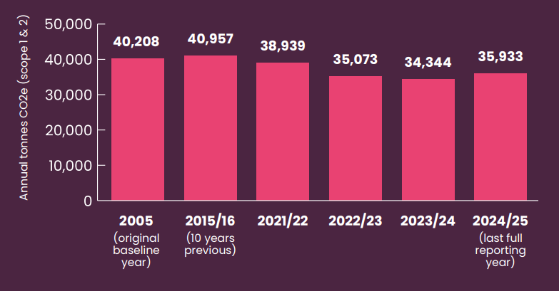
In 2024/25, total Scope 1 and 2 emissions from energy consumption and the vehicle fleet increased slightly, by 4.6%. This reflects seasonal operational fluctuations including increased usage across halls of residence. Despite the increase, overall Scope 1 and 2 emissions remain below both the original 2005 baseline and pre-pandemic levels.
It is important to note that 100% of the University’s grid-imported electricity is procured through certified renewable electricity tariffs. However, in line with reporting to EMR, HESA, the Financial Statements and this report, location based carbon factors have been applied, meaning imported electricity is calculated using the grid-average carbon intensity rather than being treated as zero carbon.
Absolute emissions are presented here to show long-term trajectory, while intensity-based metrics (per m² and per FTE) are reported through the Estates Strategy.
Statutory compliance
2025 was a strong year for statutory compliance at the University of Liverpool. We successfully maintained our ISO 14001 certification following a surveillance audit in November 2025 and achieved full compliance with our Greenhouse Gas (GHG) permit and UK Emissions Trading Scheme (ETS) responsibilities, while retaining Combined Heat and Power Quality Assurance (CHPQA) certification. We also completed the Energy Savings Opportunity Scheme (ESOS) Phase 3 and published our action plan, obtained a new environmental permit under the Industrial Emissions Directive and Specified Generators Regulations, and advanced heat network assurance by submitting a Heat Network Efficiency Scheme (HNES) grant application for a network optimisation study.
Residential services
Phase 1 of the halls lighting upgrade programme at Vine Court replaced 1,800 fittings with LED lighting, reducing energy demand and delivering annual savings of £22,325. Recycling performance in our student accommodation also improved year-on-year, with the recycling rate increasing to 22.75% (excluding food and glass), alongside a 21% increase in food waste diverted to anaerobic digestion through separate collections across all halls. And for the second consecutive year no skips were used during student move-out, resulting in zero landfill waste from this activity. These outcomes were complemented by the launch of the Sustainable Halls campaign, embedding sustainable behaviours into student induction and day-to-day living.