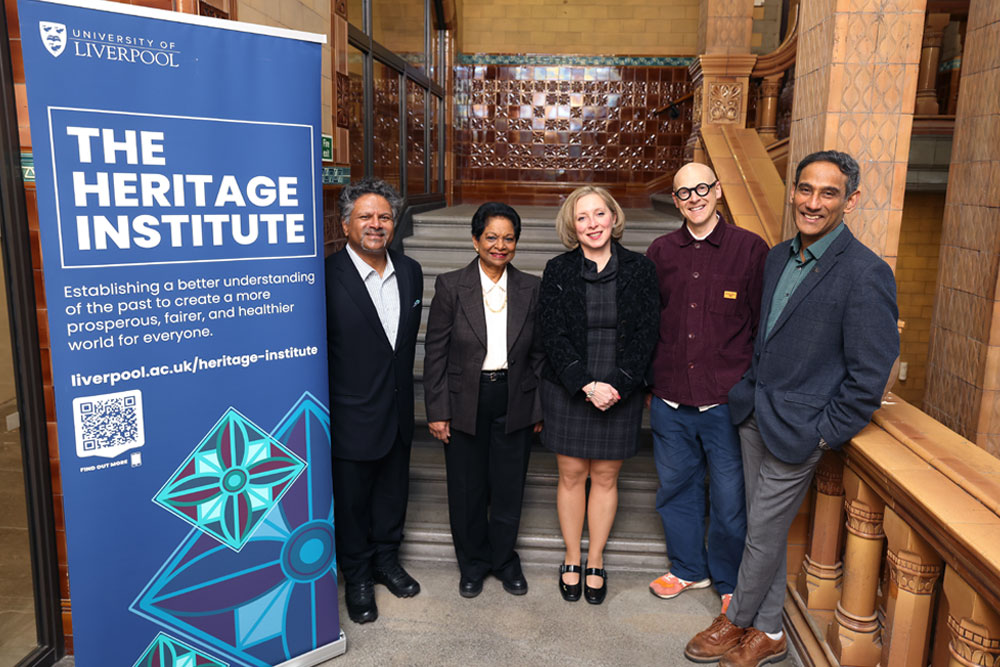
On Monday 1st December the Heritage Institute held a special triple book launch at the Victoria Gallery & Museum’s Leggate Theatre, where attendees gathered to celebrate the release of three new publications with their editors and authors.
Hosted by Professor Soumyen Bandyopadhyay as Director of the Heritage Institute the event offered a memorable afternoon focused on themes of urban and migrant heritage, featuring contributions the authors: Professor Iain Jackson, Dr Ataa Alsalloum and Dr Ian Magedera.
Reflecting on the occasion, Dr Ian Magedera highlighted the wider significance of the celebration, noting that attendees “got a sense of one core purpose of the University, to create internationally outstanding research and then bring it back to Liverpool in a form that both the local and University people can understand.”
Three unique perspectives
The first book introduced, Envisioning the Indian City, edited by Supriya Chaudhuri, Nandini Das, Iain Jackson and Ian Magedera, presents a series of ground-breaking studies examining Indian cities as places of physical, cultural and historical encounter, comparing three colonial cities—Goa, Calcutta/Kolkata and Pondicherry/Puducherry—with the postcolonial city of Chandigarh. The programme included recorded insights from co-editors Professor Chaudhuri and Professor Das, adding further depth to the discussion of colonial and postcolonial urban histories.
Also launched was Architecture, Empire, and Trade – The United Africa Company by Iain Jackson, Ewan Harrison, Michele Tenzon, Rixt Woudstra and Claire Tunstall. This open-access book reveals a previously untold history of West African architecture during the colonial era, drawing extensively on newly explored archives of the United Africa Company (UAC).
For the third publication, Tracing Intangible Cultural Migrant Heritage in the UK, Clara Arokiasamy OBE, President of ICOMOS-UK and author of the book’s foreword, addressed the audience. Then attendees heard from editor Dr Ataa Alsalloum and chapter contributors Teodora Manea, Alexandru Modoi and Nour Al Tarsha. Each spoke about their research and experiences. The volume explores how diverse migrant cultural practices, from life celebrations to death commemorations, have travelled with communities, evolved in new settings and taken root across the UK. While these practices and rituals are each distinct, authors noted how many elements of our traditions are shared and rooted in the same impulses to commemorate, to celebrate and to connect. Dr Alsalloum movingly dedicated the book to her parents, a moment that added warmth and poignancy to this celebratory afternoon. She commented:
“The launch of my book, Tracing Intangible Cultural Migrant Heritage in the UK, is a celebration of the knowledge, creativity, and resilience embedded in migrant experience. This book honours the everyday practices that sustain identity and belonging, and I am humbled by the generosity of those who contributed their stories. Sharing this moment with colleagues and communities has been truly inspiring.”

Peter Morgan provided traditional Irish music.
Guests were treated to traditional Irish music performed by accomplished violinist Peter Morgan, as well as a taste of Syria in the form of sweet pastries to take away. As the audience departed, many remarked on how the event had woven together music, memory and scholarship — a fitting tribute to three books that each, in different ways, illuminate the heritage that shapes our shared urban and cultural worlds.