Thomas Wonderley, a fourth-year LIV.INNO Centre for Doctoral Training (CDT) student, is conducting advanced research in collaboration with Mirion Technologies, a global leader in radiation measurement and monitoring solutions.
The project brings together academic research and industrial expertise to advance the field of gamma ray spectroscopy and detector diagnostics, with a particular focus on high-purity germanium (HPGe) detectors.
Through this collaboration, Thomas has contributed to several key areas of development within Mirion’s detector systems and analytical processes. His early work focused on improving the ISOCS characterisation process, using data-mining techniques to identify trends and extract insights from large detector characterisation datasets. This analysis has provided valuable guidance for refining calibration methodologies and improving the overall efficiency of the characterisation workflow.
Building on this, Thomas explored the use of machine learning for spectral analysis, applying advanced algorithms to automatically detect and classify detector issues visible in gamma-ray spectra. This work demonstrated how computational models can support diagnostic processes, allowing for faster and more consistent identification of detector performance issues across a range of operating conditions.
Over the past two years, Thomas’ main research focus has been the development of machine learning models for pulse shape analysis in HPGe detector signals. These models are designed for state-of-health monitoring, detecting subtle variations in signal characteristics that may indicate degradation, noise, or evolving detector faults. This approach contributes to the broader goal of predictive maintenance and long-term reliability monitoring within Mirion’s range of radiation detection systems.
Thomas has also worked as a remote member of Mirion’s Research and Development team in Meriden, Connecticut, engaging closely with engineers and scientists on ongoing projects. This involvement has included participation in project meetings and technical discussions, as well as the delivery of periodic research readouts to senior management and R&D leadership teams. The collaboration has provided valuable insight into how academic research integrates with industrial innovation pipelines and commercial product development.
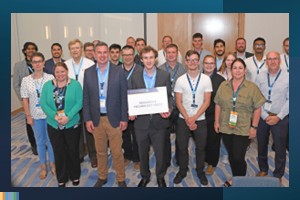
In 2025, Thomas attended the Mirion Connect conference as part of the Research and Technology track, where he had the opportunity to network with R&D teams from multiple Mirion locations around the world. This experience facilitated closer collaboration with experts across diverse areas of detector design, signal processing, and system development, further broadening the technical perspective of his research.
Access to Mirion’s advanced hardware platforms and professional expertise has allowed Thomas to conduct high-quality experimental and computational studies, bridging the gap between theoretical research and practical application. Working alongside Mirion’s technical teams has provided an appreciation of product development lifecycles, system testing methodologies, and the challenges involved in maintaining performance consistency across global product lines.
Through the LIV.INNO CDT, Thomas has also benefited from an interdisciplinary training environment that encourages collaboration between academia and industry. This structure has supported the development of a versatile skill set encompassing experimental physics, data science, and software engineering — all critical to advancing next-generation detector technologies.
Collectively, this partnership between the LIV.INNO CDT, Mirion Technologies, and the University of Liverpool highlights the value of collaborative doctoral training in driving innovation. By combining advanced data analysis with detector physics, Thomas' work contributes to the evolution of radiation detection systems and the continued enhancement of precision measurement capabilities for scientific and industrial applications.