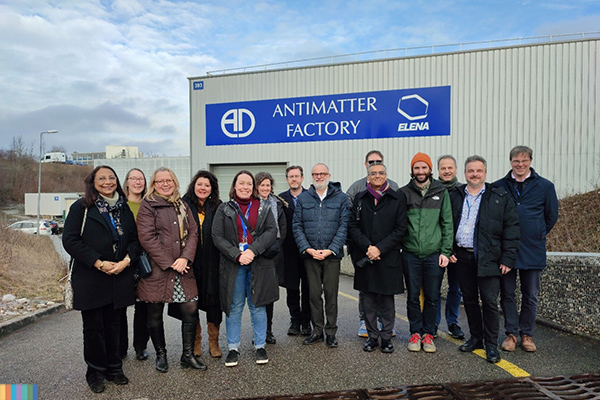
Liverpool’s department of physics welcomed senior University representatives Professor Anthony Hollander, Pro-Vice-Chancellor for Research and Impact, and Professor Tariq Ali, Pro-Vice-Chancellor for Global Engagement and Partnerships, to CERN last month, where a number of LIV.INNO students are playing important roles in major international experiments.
The visit provided an opportunity to showcase the breadth, scale and impact of the University of Liverpool’s research across particle physics, nuclear physics and accelerator science. All these research areas have several LIV.INNO students working within them. The visit highlighted the contributions of staff, postdoctoral researchers and students working at CERN.
A series of site visits and meetings took place which included a visit of the ALICE detector on the LHC. LIV.INNO student Matthew Ockleton was present at this visit to speak to the visiting delegation about his work on ‘Developing Machine Learning methods to constrain the properties of the Quark-Gluon Plasma’ which uses the ALICE detector as well as talking about the work of the wider collaboration.
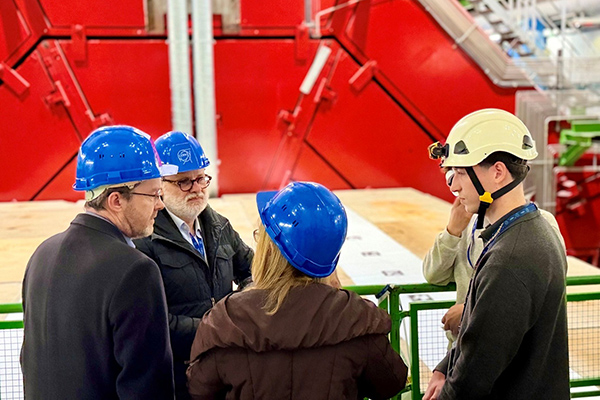
LIV.INNO student Matthew Ockleton (right) talking to the University of Liverpool delegation at the ALICE detector on the LHC.
Later during the visit LIV.INNO student Qiyuan Xu talked about how machine learning is now used as a tool for reconstructing the profile of some of the world's most demanding particle beams – an area that combines traditional accelerator science expertise in the QUASAR Group with a data-driven approach to analysis specific to our centre.
The programme also included discussions on emerging strategic areas, including quantum technologies and artificial intelligence – an area that LIV.INNO is already strategically developing into, and where a planned future CDT shall focus on. Conversations with CERN colleagues explored potential synergies in quantum computing, sensing and AI-enabled data analysis, building on Liverpool’s growing activity at the interface of fundamental physics and advanced technologies. It also allowed a discussion of the very successful partnership between CERN and Liverpool’s CDTs LIV.DAT and LIV.INNO. For years, Liverpool PhD students have had the exciting opportunity to spend part of their PhD at CERN, and this has boosted their research and allowed them to work in a truly international setting.
A reception was held at the end of the first day for Liverpool postgraduate researchers, postdoctoral researchers and students currently based at CERN. The event was attended by CERN’s Director-General Professor Mark Thomson and provided an opportunity to recognise the important achievements of early-career researchers and the central role they play in delivering world-leading science within large international collaborations.
Reflecting on the visit, Anthony Hollander said: “It was a real pleasure to spend time with colleagues at CERN and to see first-hand the extraordinary science being delivered by Liverpool researchers. My enthusiasm for particle physics, which was already very high, has gone through the rafters. The University is committed to supporting this work, and visits like this really bring home both its scientific importance and its international profile.”
Tariq Ali added: “I very much enjoyed our discussions on science – it was much-needed food for the soul. It was no surprise, but still wonderful, to see how highly Liverpool and its researchers are regarded within the global particle physics community. We are already investing strongly in this area, and it is important that we continue to communicate the scale and excellence of these achievements more widely.”
The visit reaffirmed the close connection between LIV.INNO and CERN and underlined the shared commitment to world-class research in data intensive science and to training the next generation of scientists and engineers.