Over the past few decades, the field of plasma-based accelerators - such as laser wakefield acceleration (LWFA) and beam-driven plasma wakefield acceleration (PWFA) has made remarkable advances.
The long-predicted GeV/m accelerating gradients are now routinely achieved at multiple experimental facilities around the globe, paving the way for the design of future compact accelerators with applications that range from medical and industrial uses to high-energy physics research.
Current research suggests that laser wakefield acceleration may achieve TeV/m gradients using high-density solid-state plasmas as accelerating media. Attaining such high gradients would be a significant leap forward in accelerator technology.
However, achieving plasma-based acceleration at these high densities presents significant challenges. Studies indicate that driving wakefields in such dense materials requires attosecond laser pulses, such as X-ray lasers. Drivers with these characteristics are either not yet available or remain extremely limited in availability. In addition, the short wavelengths of solid-state plasmas constrain how far particles can be accelerated.
An alternative approach to overcome these challenges involves the use of nanostructured targets. By arranging bundles of nanomaterials - such as carbon nanotubes (CNTs) or graphene layers - in an alternating pattern with empty or low-density regions, the overall plasma density can be reduced effectively. This reduction enables the use of longer-wavelength lasers and extends the plasma wavelength and the acceleration length.
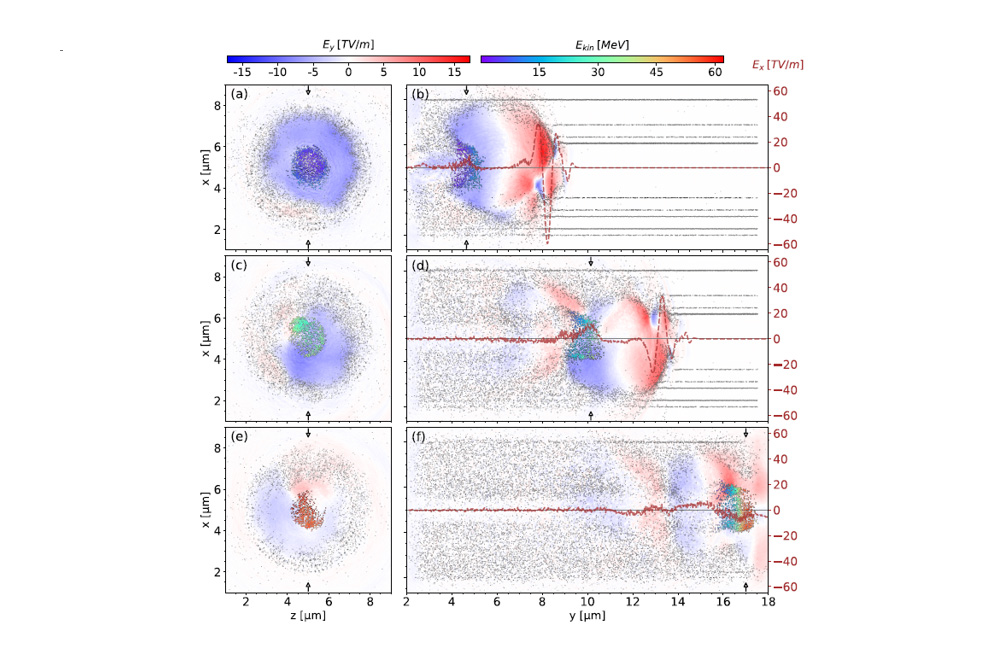
A paper recently published in Nature Scientific Reports led by Cristian Bonţoiu, during his time as a member of the LIV.DAT CDT, presents, for the first time, particle-in-cell (PIC) numerical results which demonstrate that it is theoretically possible to achieve laser wakefield acceleration in structured CNT targets with an 800 nm (infrared) laser pulse. Upon a suitable match of the laser pulse length and wavelength to the effective plasma density at complete ionization, electrons are self-injected and accelerated at TeV/m gradients with a total charge as high as 1 nC, contained within a bunch length as short as 5 fs.
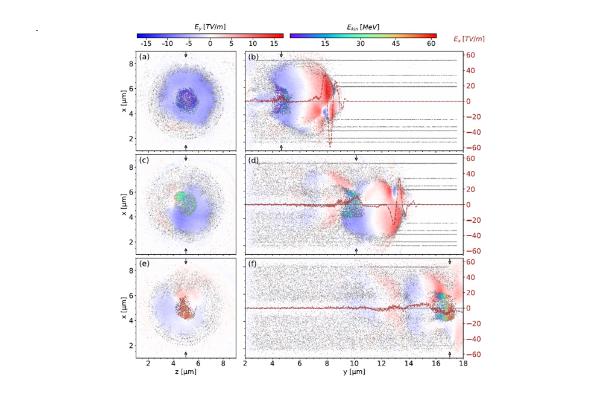
Electron macroparticles shown as grey dots and the longitudinal electric field shown as a colour density plot with the full pulse length 8 fs (3 cycles), peak intensity 1021 W/cm2: (a-b) at t/T = 11; (c-d) at t/T = 18; (e-f) at t/T = 25, where t is the simulation time and T is the laser period. The dashed-brown line shows the on-axis vertical electric field, which is due mostly to the laser pulse.
It was found that due to the collective behaviour of the laser-target interaction, self-injection and acceleration does not depend on the exact arrangement of the CNT bundles and thus multiple choices can be made as long as the overall effective plasma density remains constant (~1020 cm-3). Moreover, a certain degree of misalignment and variation of the bundle diameter can be accepted while manufacturing the target.
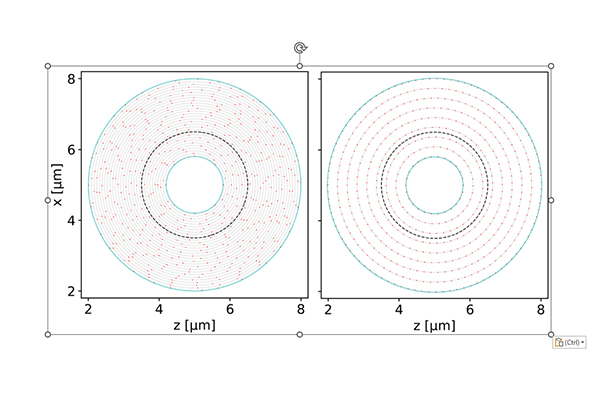
Transverse view of two targets built with 25 nm-thick CNT bundles: (Left) 535 CNT bundles are distributed more uniformly in 30 shells; (Right) 546 CNT bundles distributed less uniformly in 9 shells. The black dashed line indicates the laser spot size.
If confirmed experimentally, the concept may have an impact on fundamental femtosecond research by delivering the shortest electron bunches ever produced in the laboratory with excellent potential to advance ultra-fast electron diffraction techniques beyond current limits. With further development, required to reduce the energy spread and divergence of the extracted electron bunches, it may also become a medium for compact light sources such as FELs or Compton γ-ray sources with promising implications across fields such as cell biology, surface chemistry, and condensed matter.
More information: