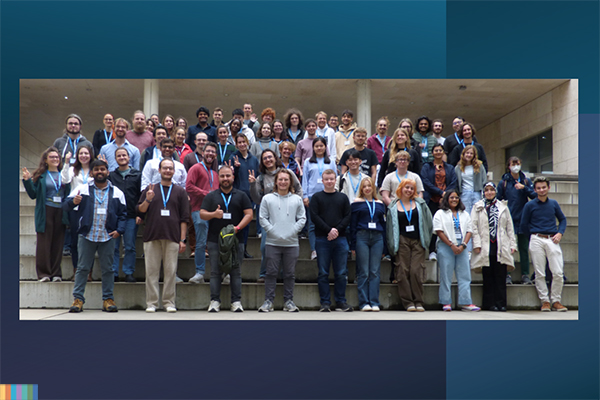
The 2025 IMPRS-HD Summer School, held in Heidelberg from 8-12 September, brought together students and researchers to explore the growing role of artificial intelligence in astronomy. Hosted by the International Max Planck Research School for Astronomy and Cosmic Physics (IMPRS-HD), the event aimed to equip students with the skills to integrate cutting-edge AI methods into their research. Teaching was delivered through a blend of lectures and hands-on sessions, provided by leading researchers working in the fields of AI and astronomy.
With the rapid growth of both deep observational surveys and large-scale cosmological simulations, astronomy has entered an era of big data. Developing and understanding tools capable of analysing these vast datasets has become essential. The summer school provided not only an introduction to a range of AI methods for interpreting such data today, but also a glimpse into ongoing efforts to prepare for the next generation of deep-sky surveys and simulations.
The lecture series covered a broad spectrum of AI topics, including simulation-based inference (Matthew Ho, Columbia University), differentiable programming (François Lanusse, CNRS), large-scale generative modelling (Carolina Cuesta-Lazaro, Harvard University), transformer models (Ioana Ciuca, KIPAC), and domain adaptation (Aleksandra Ciprijanovic, Fermilab). The applications of such methods to ongoing astrophysical problems were described in great depth over the course of the week.
Hands-on sessions complemented the lectures, giving students the chance to experiment directly with the techniques discussed. Delivered through interactive Google Colab notebooks, these sessions provided a practical setting to code and test AI models, reinforcing the theoretical material presented during the lectures. Some examples of hands-on programming include building and applying deep-learning models such as Convolutional Neural Networks, writing a transformer model from scratch, and utilising coding packages such as JAX for solving inverse problems.
Local researchers from Heidelberg also contributed, with postgraduate and postdoctoral speakers presenting their work on applying AI methods to a variety of astronomical challenges.
The school fostered a welcoming and collaborative atmosphere, encouraging discussion and networking among participants and invited speakers. A number of social events offered opportunities for informal conversations about science and research, including a visit to the Max Planck Institute for Astronomy and its research facilities and observatories.
LIV.INNO student Ryan Roberts, who attended the summer school, had this to say about the experience: “It was a fantastic opportunity to meet and learn from top experts in the field, as well as like-minded students. The fast pace of AI research can make it hard to keep up with new developments and applications, but this school provided the perfect environment to understand the state-of-the-art from both a big-picture and detailed perspective. I’m excited to apply the knowledge and experience I gained here to my own research.”