A single-injection cure for hepatitis C virus in low- and middle-income countries
While hepatitis C virus (HCV) infection occurs in all global regions, many people living with hepatitis C reside in low- and middle-income countries. The highest burden of disease is in the Eastern Mediterranean Region, but numbers are high in the South-East Asia region, European region and the African region, with Western Pacific and South American Regions not far behind. The majority of these communities having limited access to life-saving medication due to various complexities in healthcare programmes.
Hepatitis C infection is an inflammation of a person's liver caused by the hepatitis C virus which can cause both acute and chronic hepatitis. The severity of infection can range from a mild illness to a serious, lifelong illness including liver cirrhosis and cancer both of which can lead to death.
The hepatitis C virus is a bloodborne virus most commonly transmitted through the reuse or inadequate sterilization of medical equipment such as syringes and needles in healthcare settings, the transfusion of unscreened blood and blood products, and sharing of injection equipment during drug use.
The World Health Organization stipulate the importance of understanding that hepatitis C is not spread through breast milk, food, water or casual contact such as hugging, kissing and sharing food or drinks with an infected person.
Symptoms of hepatitis C virus infection
Most people do not exhibit symptoms in the first few weeks after they are infected. It can take between two weeks to six months to have symptoms, which can include:
- Fever
- Feeling very tired
- Loss of appetite
- Nausea and vomiting
- Dark urine
- Pale faeces
- Joint pain
- Jaundice (yellowing of the skin or eyes).
The hepatitis C virus burden
- Globally, an estimated 50 million people have chronic hepatitis C virus infection, with about 1 million new infections occurring per year. 75% of these cases occur within low- and middle-income countries (LMICs)
- Approximately 242,000 people died from hepatitis C caused liver diseases in 2022; mainly cirrhosis and hepatocellular carcinoma (primary liver cancer)
- Antiviral medicines can cure more than 95% of people with hepatitis C infection, but access to diagnosis and treatment is low in LMICs.
Source: World Health Organization: Hepatitis C
LONGEVITY and hepatitis C
Oral drugs for hepatitis C require an extensive regimen that can be difficult to maintain. Replacing these with a single long-acting injection would cure patients of the hepatitis C virus at the point of diagnosis.
Hepatitis C virus can be cured by taking three daily tablets for eight weeks, amounting to 168 tablets for a full course. A long-acting injectable treatment lasting for 8 weeks or more could equate to a single-injection cure for many patients, providing rapid therapy and eliminating issues around pill burden, complex delivery modes and stigma.
Our highly accessible and simple to administer curative treatment could contribute massively to the target set by The World Health Organisation for global elimination of this virus by 2030.
LONGEVITY's hepatitis C virus journey
The below information shows the foundations of the journey that LONGEVITY takes from concept to project completion for our hepatitis C virus work.
The map below is to show the pathway of our milestones using the green line, but the black lines show the work that also goes on simultaneously to other parts of the project. There have been and may be tweaks and changes to how this process works at different times, but the essence is there. The arrow on the map shows where we’re currently up to.
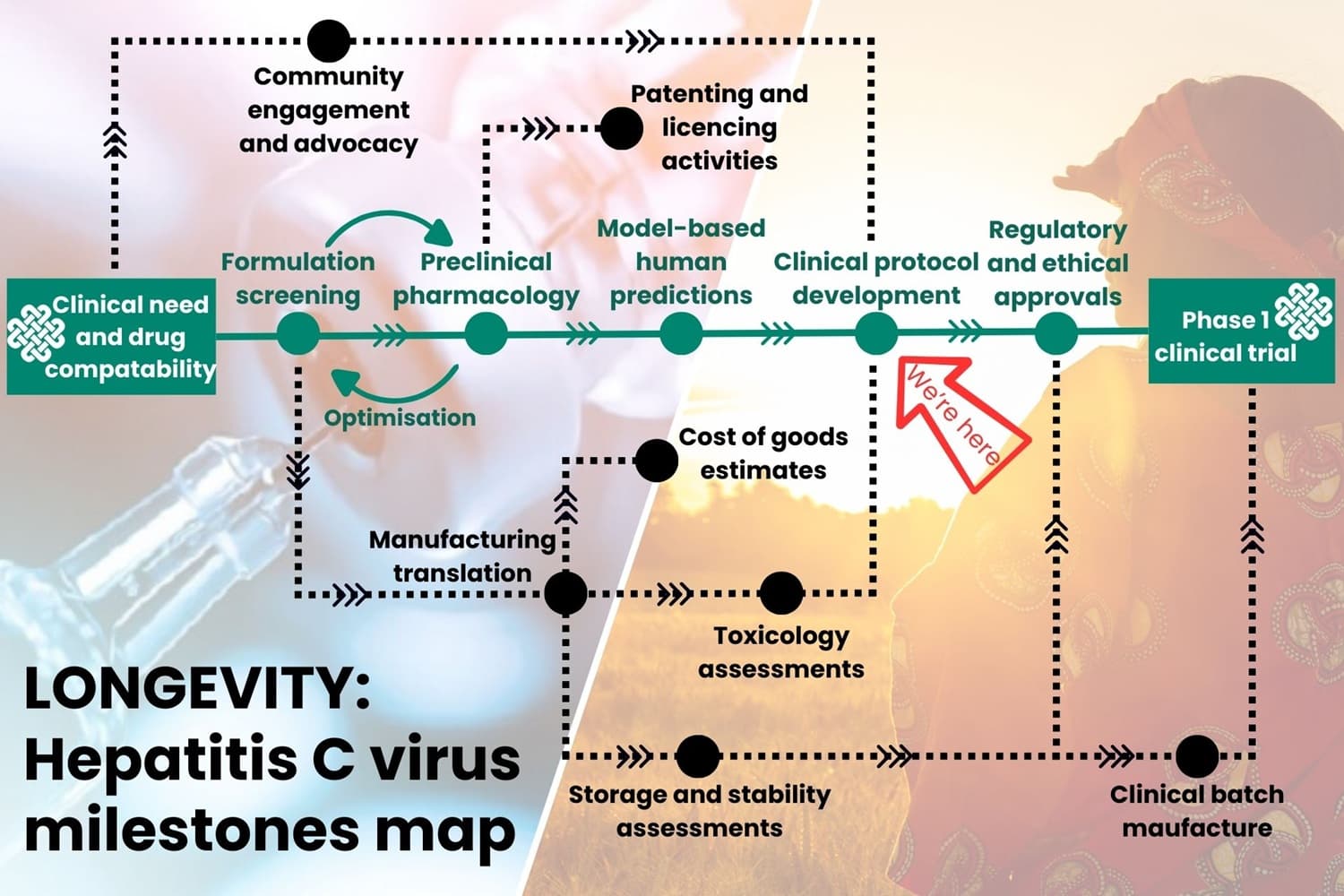
LONGEVITY hepatitis C virus milestones
Click below for an explanation of what each stage can entail.
Clinical need and drug compatibility
- Identify an existing, safe drug regimen that isn’t working well or could be improved through long-acting formulation to positively impact patients’ lives
- Two drugs are being taken forward - glecaprevir and pibrentasvir.
Formulation screening
- Screen hundreds of potential formulations, following the leads that come from them
- Use currently available drugs to create formulations that are potentially long-acting
- Perform in-house stability studies on leads to make sure the formulation is stable at different temperatures over days and weeks.
Preclinical pharmacology
- Receive leads from CELT Global Health’s chemistry team
- In vitro testing and drug release testing
- identify which leads release fastest and slowest so we know the range for an in vivo study and can identify the best leads to take into animals
- In vivo study
- find the highest safest dose for a rodent, to evaluate the pharmacokinetics of the drugs
- Complete non-good laboratory practice toxicology studies to analyse PK and injection site toxicity.
- This stage is cyclical with formulation screening as the findings from one are used to optimise the other.
Model based human predictions
- Modellers use all the data alongside clinically available human oral and intravenous data, to predict a dose range that gives the best pharmacokinetics for first in human phase one trial
- Modellers work with the good laboratory practice toxicology data and compare them to the preclinical data from CELT Global Health
- They will simulate doses that would achieve the therapeutic exposure in humans
- The results from the simulation go into clinical protocol development as a recommended dose range for humans.
Clinical protocol development
- Once we know it’s stable and safe, manufacture the good manufacturing practice material for the clinical trial. This must be within the timeline for stability of the formulation as the stability clock starts ticking as soon as the first manufacture starts
- Engage with regulatory authorities prior to carrying out some aspects of the programme, such as good laboratory practice toxicology, to ensure the plan covers what is needed for progression to first-in-human trials
- Write a clinical protocol to engage with regulatory authorities to initiate first in human clinical trials (CELT Global Health and Johns Hopkins University)
- For our hepatitis C virus work, these will be in the United States under Food and Drug Administration (FDA) regulations.
Regulatory and ethical approvals
- Clinton Health Access Initiative (CHAI)
- Work with the FDA on regulatory paperwork required throughout clinical protocol development and manufacturing stages
- Assign a regulatory contract research organisation to submit the investigational new drug to the FDA and manage the clinical trial.
Phase 1 clinical trial
- First doses in human volunteers.
Manufacturing translation
- Scale drug manufacture up to a kilogram format to be able to make the good manufacturing practice representative batch for good laboratory practice toxicology study
- Manufacture is completed at a contract development and manufacturing organisation.
Toxicology assessment
- The optimal formulation is administered to animals at a contract research organisation in a good laboratory practice toxicology study. This shows the safety of the long-acting injectable route and the pharmacokinetics of the drug in animals
- The information is used in clinical protocol development and informs the investigational new drug submission for the FDA, alongside all chemistry information on the formulation.
Storage and stability assessments
- Stability trials are completed at both ambient and high temperatures, and humidity, to show how long a formulation is stable in both conditions
- This tells us how long a drug will work for before degradation starts and informs us for hot countries
- This also tells us if the drug needs to be refrigerated at the clinic, which could impact if a drug will be utilised.
Clinical batch manufacture
- A batch of formulation is manufactured within a good manufacturing practice facility at the contract development and manufacturing organisation
- The batch generated is released by a qualified person, who certifies it has been manufactured under good manufacturing practice and is safe for clinical trial.
Patenting and licencing activities
- Extentus Pharma Ltd and Medicines Patent Pool run this work from when the long-acting formulation is ready to the end of the project
- Extentus Pharma Ltd hold patents and work with Medicines Patent Pool to ensure equitable access by including prioritisation of LMICs to access licences of drug
- Extentus Pharma Ltd perform Freedom to Operate searches throughout the programme to ensure intellectual property does not infringe on others.
Cost of goods estimates
- The direct costs associated with producing a drug, including the raw materials, manufacturing, labour and packaging are estimated
- It’s a crucial metric for drug companies to assess pricing.
Community engagement and advocacy
- University of Nebraska Medical Center (UNMC) and Treatment Action Group (TAG) run this research throughout the whole project
- UNMC
- carry out surveys within communities in LMICs to see what the patients and providers think about long-acting injectables
- As the project moves along, they use more specific questions;
- preference of injecting area
- if patients would prefer to inject themselves
- TAG
- Long-acting Community Advisory Board (LAT CAB)
- TAG and members of the community such as a practitioner, a health care assistant, patients, non-infected from the community, government officials, and more, create a real representation of the community
- Discuss product, target formulation profiles
- All the findings are used to inform the application of drug development decisions.
- Long-acting Community Advisory Board (LAT CAB)
What’s Next?
LONGEVITY’s Unitaid funding ends once we reach clinical trial, however there will still be work to be done to make sure these medications reach LMIC patients in need. CELT Global Health will remain a proactive part of the work that needs to be done.
- Clinton Health Access Initiative (CHAI)
- Find a development partner (generics drug company) who will:
- Take the drug through clinical trial phase 2, which is administering doses to patient volunteers with the disease
- Take the drug through clinical trial phase 3, which is comparing the new drug to the existing drug to show that it works as well or better prioritise LMICs in need. This stage is in collaboration with LONGEVITY partner Medicines Patent Pool
- Lead commercialisation of the final product in LMICs
- File investigational new drug to FDA and wait for approval of formulation as licensed drug.
Read our latest hepatitis C virus blogs and news
- Let's break it down: Exciting hepatitis C virus update for World Hepatitis Day 2025
- Hepatitis Testing Day 2025: Not just a US issue
- Patients in low- and middle- income countries are enthusiastic about long-acting injections to treat hepatitis C virus
- For World Hepatitis Day 2024 we highlight the exciting findings we presented at CROI
- Doctors in low- and middle-income countries say ‘yes’ to long-acting treatments for Hepatitis C
- Developing a single-injection cure for hepatitis C virus for low- and middle-income countries
- Community engagement – shaping the long-acting technologies pipeline.
Subscribe to the LONGEVITY newsletter
Any personal information you provide will be held in accordance with The EU General Data Protection Regulation (GDPR). For more information please see our Privacy notice.
Our funding
The LONGEVITY Project is funded by Unitaid

The project also involves critical partners and collaborators in the Clinton Health Access Initiative, Extentus Pharma Ltd, Johns Hopkins University, Medicines Patent Pool, Treatment Action Group and the University of Nebraska Medical Center.

- Find a development partner (generics drug company) who will: