This year is the fifth observance of Maternal Health Awareness Day, and we’re reflecting on a year of our Community of Practice for long-acting therapeutics for maternal and paediatric health.
The 23 January is Maternal Health Awareness Day, as created by the American College of Gynecologists (ACOG). The theme for 2026 is ‘Holding Ground on Maternal Health’. They’re using this year to ask stakeholders
to join the ACOG community and our partners in reaffirming our staunch commitment to preventing maternal deaths and advancing respectful, evidence-based care.
On this day last year, the Centre of Excellence for Long-acting Therapeutics – Global Health (CELT Global Health), directed by Professor Andrew Owen and Professor Steve Rannard, launched our Community of Practice for long-acting therapeutics for maternal and paediatric health. Funded by global health agency Unitaid, and overseen by Dr Adeniyi Olagunju’s Perinatal Pharmacology group, one of the main aims for this Community of Practice is to create stronger pathways for including maternal patients (pre-pregnancy, the three stages of pregnancy, post-pregnancy and during lactation) in clinical trials.
We know that there is often not enough information about these stages of physiological change in clinical results. Our aim is to make clinical work and medications as safe for all populations as possible. We specialise in making long-acting versions of on-the-market medications, and as long-acting technologies are at an early point in their journey, it feels important to build these principles into that work now.
A year of the Community of Practice
We’ve asked our Community of Practice’s Stakeholder Engagement Coordinator, Rachel Daley, to guest write a piece for us this year as a contemplation of the first full year of this project. Quite coincidentally, Rachel’s words really resonate with the theme in hand. We are holding ground.
On Maternal Health Awareness Day, we pause to reflect. Our Community of Practice for long-acting therapeutics in maternal and paediatric health has highlighted that when wom*n, families, communities, researchers, and policymakers work hand in hand, the maternal health agenda evolves from a pressing issue into a global commitment to change.
This year, our we became more than a project, it became a real movement for change. A growing global space where lived experience matters, science is shared openly, and innovation is shaped with, not just for, the people it is meant to serve.
Over the past year, we brought together over 200 participants from across the world through webinars and in-person workshops, exploring regulatory science, safety, innovation, and the future of long-acting therapeutics in maternal health. What made this work special was not just the data we shared, but the people behind it — clinicians, regulators, researchers, patients, advocates, industry partners, and community voices, many with deep ties to low- and middle-income countries (LMICs).
Our network grew into a truly diverse and inclusive community, representing 14 different stakeholder groups, with a strong and growing presence from those working and living in LMICs. Together, we created a space where questions could be asked safely, challenges could be debated honestly, and solutions could be co-designed.
Through focus groups and collaborative discussions, members co-created knowledge that is now shaping a forthcoming peer-reviewed white paper and maternal health review, ensuring that maternal health innovation is grounded in real-world needs, ethics, and equity, rather than theory alone.
But the most powerful outcomes were human, not technical:
- People feeling heard
- Communities feeling represented
- Researchers becoming more accountable
- Partnerships forming across continents
Participants told us that what they value most is the openness, diversity of voices, and the sense that they are part of something meaningful - not just attending meetings and workshops, but contributing to real and meaningful outcomes.
Today, as we mark Maternal Health Awareness Day, we celebrate this progress. But we also recognise that the work is far from finished.
Far too many women still face preventable complications, unsafe births, and unequal access to care. Innovation still reaches some communities faster than others. Too often, those most affected are the last to be consulted.
So today is not only about celebration — it is a recommitment:
To equity.
To inclusion.
To listening deeply.
To designing solutions with wom*n, not for them.
Because when we invest in maternal health, we invest in families, futures, and generations to come.
To every mother, every midwife, every advocate, every researcher, every clinician and every community leader and member involved with the Community of Practice - thank you for moving this work forward.
#MaternalHealthAwarenessDay #MaternalHealth #GlobalHealth #EquityInCare #CommunityOfPractice #HealthInnovation #WomenAndGirls
To learn more about some of the the project's maternal health work so far, recordings of the maternal health related sessions and talks are available via CELT Global Health’s You Tube channel:
- The Maternal Health session from our first in-person meeting in July 2025
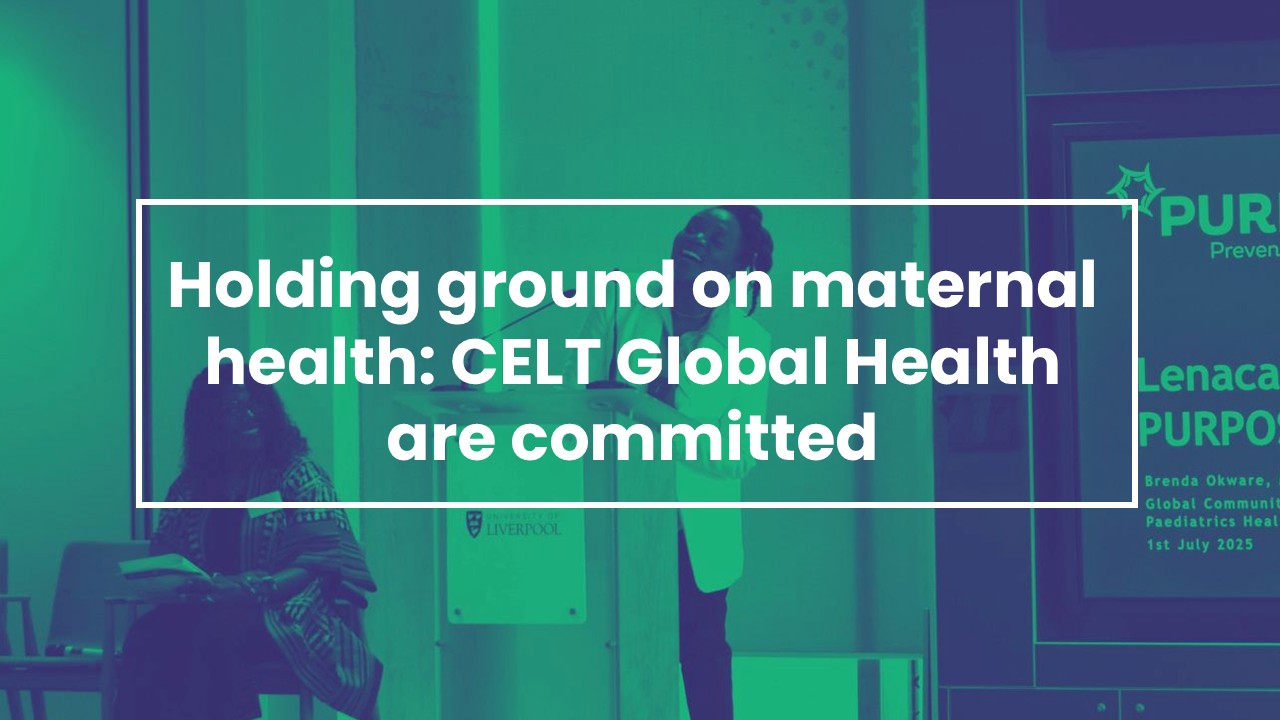
- The Global Health session from the in-person meeting included regulatory considerations, but Dr Brenda Okware from Gilead’s talk was about maternal health considerations within the clinical trials for lenacapavir
- In our ‘Dynamic paediatric and maternal physiology in long-acting therapeutics development’ webinar, Dr Robert Bies presented a talk titled ‘Dynamics of physiological changes in pregnancy impact on PK modelling’.
The Community of Practice for long-acting therapeutics for maternal and paediatric health is funded by global health agency Unitaid.