Re-imagining doctoral supervision: empowerment practices through power negotiation
Posted on: 22 January 2026 by Eli Saetnan in 2026
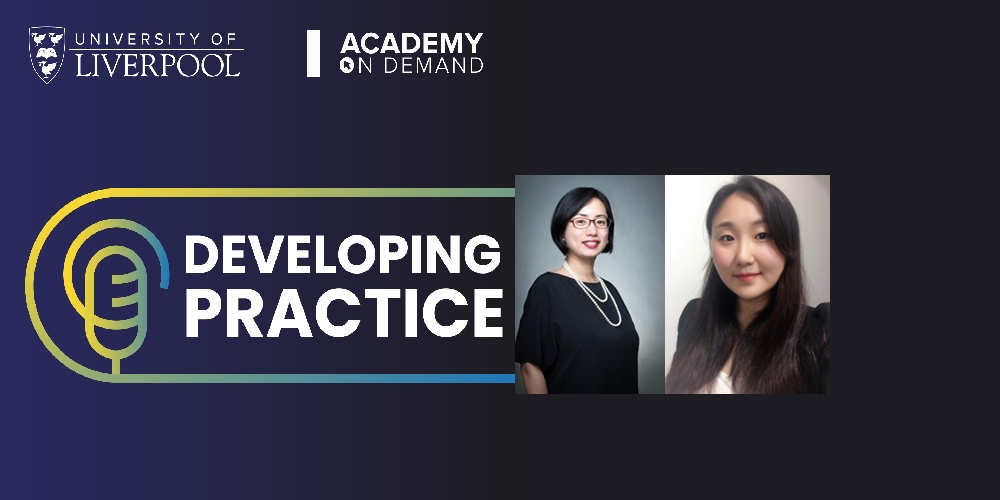
At the recent Pedagogic Research Conference, we had the pleasure of welcoming Dr. Sarah Wang and her PGR student Cheng Cui as our invited keynote speakers from XJTLU. Their research focuses on the PGR-Supervisor relationship within a trans-national context at XJTLU.
Ahead of the conference, I had the opportunity to sit down with them both for a conversation about their research for our Developing Practice Podcast. This episode is now available:
Supervision can be challenging and rewarding in equal measure, fraught with uncertainty at times even for very experienced supervisors. So what does it take to be good at supervision? As a developer, I have spent the past 10 years thinking and reading about what makes good supervision and I still discover new insights all the time. Learning about the work of Sarah Wang and Cheng Cui gave me more food for thought and new insights from a very different context to my own. Their work is situated within a trans-national university, working with Chinese students and international supervisors at an institution which bridges the two cultures of Western and Chinese higher education.
At the core of effective supervision is relationship building, developing trust between supervisor and supervisee. What I took away from my conversation with Sarah and CC was how relationship building involves negotiation of power and the implications of different supervisory strategies on the student. Their work highlighted the emotional aspect of such work, both positive and negative emotions. As supervisors, we need to not only recognise the emotional response of our students but also reflect on our own emotional response to that supervisory relationship.
I would like to follow up on this conversation for my own development and reflection and have identified some further reading that plan to delve into. You might find this useful too.
- Yanan Xu, Haibo Gu, Qian Wang, Jeong Jin Yu, Michelle Tornquist, Juming Shen (2025) A case study of a teacher's extrinsic emotion regulation on students' positive emotions and learning experience. International Journal of Educational Research, 134, 102811, https://doi.org/10.1016/j.ijer.2025.102811
- Han Y and Xu Y (2021) Unpacking the Emotional Dimension of Doctoral Supervision: Supervisors' Emotions and Emotion Regulation Strategies. Frontiers in Psychology 12, 651859, https://doi.org/10.3389/fpsyg.2021.651859