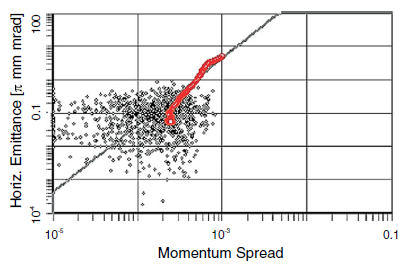
The Group have been investigating the performance of rings, such as ELENA and the USR, by means of beam dynamic simulations for different operation modes. This includes modelling all relevant physics phenomena for this kind of machine, e.g. Intra-Beam-Scattering (IBS), scattering on the residual gas and interaction with the electron cooler. This allows us to study lifetime and stability of the beam, as well as calculate the dynamic aperture of the machine under realistic assumptions.

Selected publications
C. P.Welsch, A. I. Papash, J. Harasimowicz, O. Karamyshev, G. A. Karamysheva, D. Newton, M. Panniello, M. Putignano, M. R. F. Siggel-King, A. Smirnov, 'Beam life time studies and design optimization of the Ultra-low energy Storage Ring', Hyperfine Interactions, DOI 10.1007/s10751-014-1063-2 (2014)
A. Papash, A. Smirnov and C.P. Welsch, 'Nonlinear and long-term beam dynamics in low energy storage rings', Phys. Rev. ST Accel. Beams 16, 060101 (2013)
Back to: QUASAR Group