Detection Limits of Blood Metabolites at Physiological Concentrations Using Benchtop NMR
LIV.INNO data science fellow Dr Alexander Hill, along with collaborators from ViBo Health, and the Universities of Liverpool and Leicester have recently published a paper sharing their work towards real-time, accessible metabolic tracking.
The paper, “Detection Limits of Blood Metabolites at Physiological Concentrations Using Benchtop ¹H NMR,” is now out in NMR in Biomedicine. The study forms part of a long-term collaboration between the QUASAR Group and ViBo Health, focusing on translating low-field magnetic resonance into practical healthcare tools.
Monitoring the metabolism of a person rapidly and non-invasively would enable the tracking of individual trends, opening up major opportunities for screening, disease monitoring, treatment evaluation, and understanding responses to lifestyle change.
ViBo Health is developing DigiScan™, a benchtop finger-scanning device based on low-field magnetic resonance spectroscopy. The key questions in the design process are: which blood metabolites are realistically observable at physiological concentrations, by which methods is signal maximised, and how differentiable are variations in concentration?
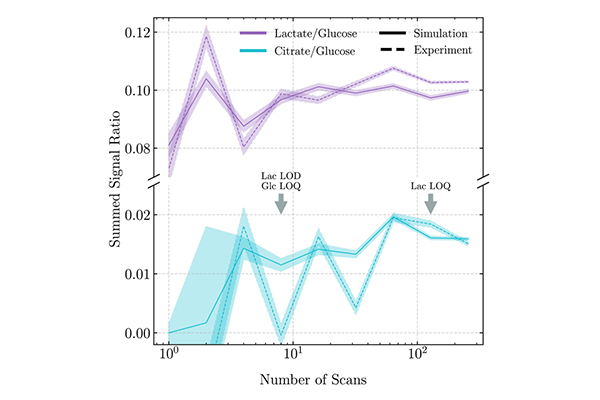
Simulation-based fitting enhances the accuracy and stability of metabolite quantification at low signal-to-noise ratio (Image credit: A.D. Hill, et al., NMR in Biomedicine 39(2), (2026), CC by 4.0)
The team have systematically evaluated a commercial benchtop spectrometer, operating at a field strength comparable to DigiScan, across key blood metabolites (glucose, lactate, and citrate) at concentrations from 0.05 to 10.0 mmol/L. By characterising the relationship between concentration, acquisition time, and signal-to-noise ratio across multiple pulse sequences, they established quantitative benchmarks for what is practically achievable.
In order to improve quantification reliability under the low signal to noise conditions inherent to rapid, low-field measurements, they worked with a collaborative computational project for NMR (nuclear magnetic resonance) to develop a simulation-based template-fitting approach, eliminating reliance on large experimental libraries.
Millimolar metabolites such as glucose and lactate are detectable within around 20 seconds, with concentration differences readily distinguishable. The simulations stabilised quantification even under challenging signal to noise ratio conditions. In contrast, sub-millimolar metabolites like citrate required much longer acquisition times, helping define realistic boundaries for practical applications.
In an important next step, early results from biofluids are also presented, where glucose and lactate are again readily detectable at low field.
More information:
'Detection Limits of Blood Metabolites at Physiological Concentrations Using Benchtop ¹H NMR', A.D. Hill, et al., NMR in Biomedicine 39(2), (2026) https://doi.org/10.1002/nbm.70215