QUASAR Group participates in cERL operations at KEK

Researchers from the QUASAR Group at the University of Liverpool and IJCLab (Orsay, France) have recently returned from an extended research stay at the High Energy Accelerator Research Organization (KEK) in Tsukuba, Japan. The visit formed part of the Horizon Europe EAJADE Staff Exchange Programme, which fosters international collaboration between European and Japanese accelerator research teams.
During the four-week stay, QUASAR PhD student Connor Monaghan and Dr Alex Fomin joined the cERL team at KEK for the latest operational run of the compact Energy Recovery Linac (cERL). The visit provided a unique opportunity to observe the operation of one of the world’s leading ERL test facilities and to carry out dedicated machine studies directly relevant to the design and optimisation of PERLE, an ERL currently under development at IJCLab.
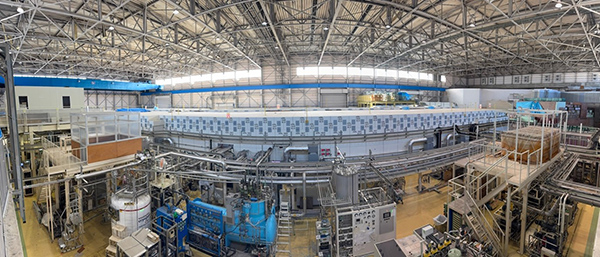
A view of the ERL test facility with compact ERL.
Connor led an experimental study on beam halo formation in the injector at high bunch charge. Together with the cERL team, they successfully pushed the injector up to 100 pC per bunch, gathering valuable measurements to benchmark simulated effects of cERL and scale them to the 500 pC design charge of PERLE. These results will inform ongoing efforts to understanding the onset and control of halo formation; a key challenge for maintaining beam quality in high-current ERLs.
Meanwhile, Alex carried out a beam-based study of quadrupoles with integrated corrector coils, steering the cERL beam across the magnet to map the resulting kicks. The measurement provides essential input for the design and placement of these types of magnets in PERLE’s design.
Beyond the technical achievements, the visit offered a valuable opportunity for hands- on experience in beam tuning, commissioning procedures, and control room operations. Working closely with KEK’s accelerator physicists, Connor and Alex gained insight into day-to-day ERL operations, from injector setup and optics tuning, to diagnostic techniques essential to understanding the beam.
Connor commented: “Being part of the cERL run was a truly unique and enriching experience. Seeing how an operational ERL is tuned and maintained gave me a practical understanding that will complement the simulation work I have conducted throughout my PhD. It also underscored the value of working closely with international teams, whose experience and perspectives are essential as we develop the next generation of ERLs.”
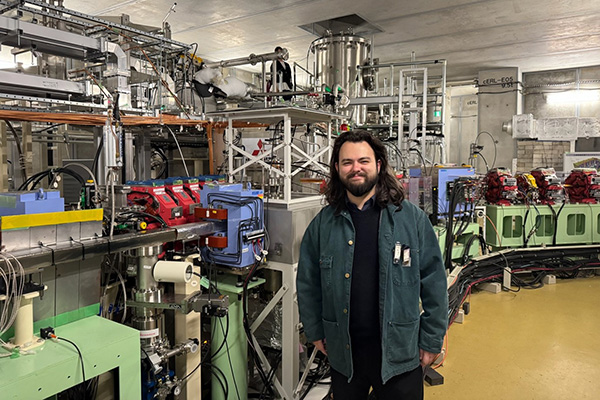
Connor during his visit to KEK.
The collaboration between KEK, IJCLab, and the University of Liverpool represents an important bridge between European and Japanese research efforts. By combining experimental data with modelling expertise, these exchanges accelerate the development of next-generation energy-efficient accelerators and strengthen the global ERL community.
The lessons learned during this visit will directly support upcoming beam dynamics studies within the PERLE project. The knowledge gained at cERL will also feed back into the QUASAR Group’s ongoing research in beam dynamics and non-invasive diagnostics.