From Liverpool to CERN: New Beam Gas Curtain (BGC) monitor successfully delivered
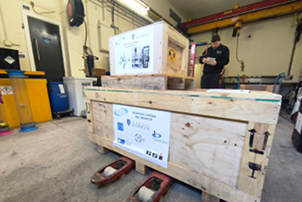
On 19th February 2026, a new version of the Beam Gas Curtain (BGC) monitor was successfully delivered to CERN by the department’s QUASAR Group. This monitor was developed under the STFC phase II project of the UK's contribution to the High-Luminosity upgrade of the Large Hadron Collider (HL-LHC).
The multi-year installation phase of the HL-LHC will start later this year and finish in 2029. This crucial accelerator upgrade is expected to increase the number of particle collisions by a factor of 10. This will enable measurements of the Higgs boson with much higher precision, and open pathways for entirely new discoveries.
Previously, the QUASAR Group and their international partners managed to successfully install a similar monitor in the LHC in 2023. This innovative device quickly became an operational instrument for routine use by the LHC control group.
By generating a supersonic gas curtain and maintaining the ultra-high vacuum environment, the monitor detects the fluorescence generated in the interaction between the gas curtain and the primary charged particle beam, i.e. protons or lead ions in the LHC. This signal can then be used to obtain the beam size and emittance over the entire acceleration cycle of the LHC, including beam injection, energy ramp-up, and stable beam physics exploitation. This capability allows for better beam control and makes an important contribution to LHC machine operation.
The BGC monitor that was now delivered to CERN will initially be installed at CERN’s electron beam test stand (EBTS). This dedicated test stand aims at providing a beam halo removal solution, a so-called hollow electron lens (HEL) for the LHC. The machine protection device works by moving unwanted beam halo particles into a larger radial position where they can be removed safely by the machine collimators. The removal efficiency of the HEL device strongly relies on being able to control a hollow electron beam. Specifically, the electron beam needs to be extremely stable in a concentric position within the LHC beam pipe.
The purpose of the BGC monitor is to help ensure this concentricity by measuring the profile of both, the electron and proton/ion beams simultaneously. The particular challenge is to generate a 60 mm uniform curtain without perturbing the background vacuum too much, where the previous version of the monitor was designed for a maximum beam size of around 25 mm. The QUASAR Group’s BGC team optimized the design with its international partners at CERN and GSI to ensure that the very stringent requirements are satisfied. The system was thoroughly tested at the Cockcroft Institute’s DITALab.
 The QUASAR BGC team is preparing the BGC shipment to CERN. From left to right: Ravi Gupta, Hao Zhang and Milaan Patel.
The monitor was successfully received at CERN’s Prevessins site in France on Monday, 23rd February 2026, underlining the QUASAR Group’s ability to deliver world-class scientific instruments to major accelerator facilities and a strong commitment to international collaborations.
As one of the final deliveries of the HL-LHC UK phase II project, the monitor will be installed in the existing EBTS setup over the next few months. Measurements will then be conducted at full electron beam intensity in continuous operation mode – a measurement that was impossible without the BGC monitor. This will enable the measurement of the hollow electron beam under different operation modes and help optimize the hollow electron lens for potential future use in the HLLHC.