Northern Powerhouse Rail is back – but this is no way to plan transport infrastructure
Posted on: 16 January 2026 by Dr Tom Arnold in Blog
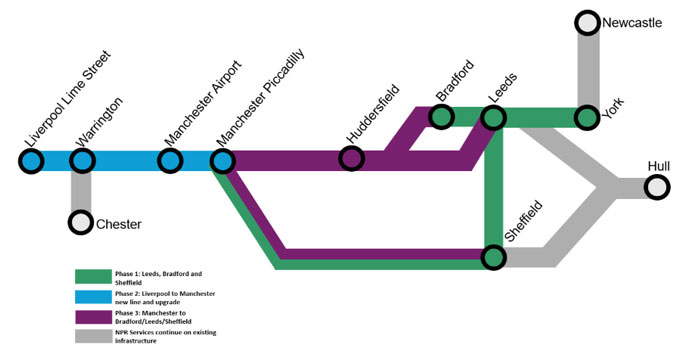
Heseltine Institute Research Associate, Dr Tom Arnold explores the latest announcement from central government regarding rail transport links in the region.
The last month brought two major announcements on transport infrastructure in Northern England. Just before Christmas, the government paused plans to develop a tram network in Leeds, meaning the city will remain the largest in Western Europe without a mass transit system for at least another decade. Now, plans for Northern Powerhouse Rail (NPR) have been revived after several years of uncertainty about the future of the project. An initial £1.1bn has been provided for design and planning, with construction proposed to start in the early 2030s. The delay to West Yorkshire Mass Transit, and the revival of NPR, illustrate the ongoing tension in the political economy of Northern transport infrastructure.
NPR was first announced by then-Chancellor George Osborne in 2014 and has since been through several iterations. Early plans were designed to align with new stations and associated infrastructure developed for HS2, the new high speed rail line originally designed to shorten journeys between London, the Midlands and Northern England. The cancellation of HS2’s eastern leg from Birmingham to the East Midlands and onto Yorkshire in 2021 threw these NPR proposals into doubt. The scrapping of HS2 Phase 2 in its entirety in 2023, meaning it would stop at Birmingham and not continue onwards to Manchester, appeared to be the final nail in the coffin for the project. Following its election in 2024, the Labour government made positive noises about NPR without committing new money. Now, under pressure from the party’s mayors in Greater Manchester, West Yorkshire, Liverpool City Region and South Yorkshire, the project is back on. While the government’s renewed commitment to NPR has been widely welcomed, the project’s recent history shows why scepticism about the future of the project remains.
A decade of transport policy churn for Northern England
Over the last ten years, Northern England has been the subject of several plans for improvements to transport infrastructure. In few places is this almost constant policy churn more evident than Bradford. The city and its population of 500,000 is poorly connected to its Northern neighbours. The 10-mile journey to Leeds takes between 20 and 25 minutes by rail, while roads between the two cities are routinely congested. The 30-mile rail journey to Manchester takes almost an hour. Since the mid-2000s, Bradford’s leaders have lobbied for improvements to infrastructure, arguing that the city’s potential is being stifled by weak transport connectivity. These efforts have increased since the establishment of West Yorkshire Combined Authority in 2014, and appeared to have paid off in 2018 when proposals for a new line between Manchester and Leeds, via a new station in Bradford, were included in the first concrete plans for NPR developed by Transport for the North, the sub-national strategic rail transport body established in 2015.
Following the cancellation of the HS2 eastern leg and amidst uncertainty about the future of NPR during the last Conservative government, leaders in West Yorkshire sought to revive plans for a West Yorkshire mass transit network that were previously cancelled in the 2000s. The 2021 Integrated Rail Plan for the North and Midlands provided £100m to develop plans for the project, with West Yorkshire Mayor Tracy Brabin identifying it as a priority for her first term in office, and during her successful re-election in 2024. Local leaders responded to the government’s shift in support from a pan-Northern rail project to a more localised mass transit network by moving resources and focus from the former to the latter.
Now, with West Yorkshire Mass Transit on the backburner and NPR apparently revived, regional leaders and officials must once again pivot their attention. While NPR 2.0 has been broadly welcomed, they may wonder how long it will be before their focus must shift again.
Northern England: one region or several?
The frequent changes in strategy on NPR and associated transport projects reflects the failure of successive governments to settle on a coherent spatial vision for the Northern economy. Can the North West and much of Yorkshire be regarded as a polycentric region containing several interlinked urban areas, akin to Germany’s Rhine-Ruhr, where improvements to mainline rail could effectively make the Liverpool-Manchester-Leeds-Sheffield diamond a single functioning economic area? Or is the North a patchwork of city-regions where improvements to urban transport connectivity would have a greater impact on local economies?
Since the emergence of the Northern Powerhouse concept in 2014, strategy has swung between these two visions of Northern England’s economic geography, shaped by factors such as the politics of the post-EU referendum era, the focus in the 2019 election on the so-called ‘Red Wall’, and, latterly, the influence of an increasingly powerful coterie of Northern Labour mayors. The publication of a Northern Growth Strategy alongside plans for NPR marks a positive step for policymakers thinking clearly about the economic objectives of transport infrastructure.
Devolution and its limits
The lack of consistency in transport policy is one reason why new infrastructure in the UK takes so long, and is so expensive. So too is the churn in institutions responsible for infrastructure delivery. Transport for the North, an organisation set up primarily to deliver NPR, was stripped of its guiding role on the project in 2021 and is notable by its absence from government announcements this week – despite the revived plans being broadly similar to those showcased in its Strategic Transport Plan. In 2020, the Northern Transport Acceleration Council was established by the Department for Transport, but appeared to be quietly abolished even before 2024’s change of government. High-profile mayors across Northern England have a direct line to the current Labour government and , but this dynamic appears fragile and dependent on the results of mayoral and national elections over the coming years.
The return of NPR illustrates both the progress made by regional devolution in England over the last decade, and its limitations. The growing profile of elected mayors is evident in the collective efforts of those representing Northern England in pushing government to commit real resources to develop the project. Yet their aspirations for improved rail infrastructure – or in the case of Bradford, anything that would improve the dire state of connectivity with its close neighbour Leeds – remain reliant on the whims of national government. A change of Prime Minister, a reallocation of resources, a shift in priorities – all appear plausible in the medium-term, and all could result in yet another pause or cancellation for a major infrastructure project.
Header image: The proposed route map for Northern Powerhouse Rail (Source: https://www.gov.uk/government/news/northern-powerhouse-rail-to-drive-biggest-travel-upgrade-in-the-north-in-a-generation)
Keywords: Transport.