Medicine and Surgery
UCAS code A100
- Study mode
- Full-time
- Duration
- 5 years
- Start date and application deadlines
-
- Start date
- September 2026 September 2027
- Apply by:
- Starts on:
UCAS code A100
Study medicine at the University of Liverpool and prepare to deliver outstanding, compassionate and evidence based patient care in today’s healthcare system, and the one of the future. Liverpool’s MBChB programme is designed to support your development as a confident, ethical and adaptable doctor. You will learn through a distinctive spiral curriculum, combining strong scientific foundations with authentic clinical learning, research connected teaching and supportive learning communities. Our main undergraduate medicine programme is the A100 (5 year) MBChB. Graduates with home status may also be eligible to apply to the A101 (4 year) programme.
At Liverpool, you will develop the knowledge, skills and professional behaviours required to practise medicine safely and ethically, in line with the General Medical Council’s Outcomes for Graduates. Your training is underpinned by a commitment to excellence in teaching, research and patient‑centred care. Learning is supported by GP‑led small‑group teaching, access to some of the UK’s leading specialist clinical units, and state‑of‑the‑art learning facilities, including simulation and technology‑enhanced environments. We place strong emphasis on professional identity formation, leadership development, research and scholarship, and digital fluency. Throughout the programme, you will be supported to become a lifelong learner, capable of responding confidently to the evolving demands of modern healthcare.
Programme in detail
The MBChB curriculum is structured around a spiral design, which acts as a core signature pedagogy of the programme. Key concepts are introduced early, revisited regularly, and developed in increasing depth and complexity as your clinical experience grows. Learning is organised around integrated themes and systems, bringing together basic sciences, clinical knowledge and professional practice. This approach supports the progressive development of clinical reasoning, judgement and decision‑making, while encouraging tolerance of uncertainty and reflective practice.
From Year 2 onwards, students undertake extensive clinical placements across hospital and community settings, including NHS Trusts, GP practices, hospices, community services and specialist providers across the North West. Clinical placements follow a block rotational model, designed to help students build confidence when transitioning between healthcare settings and working within different multidisciplinary teams and with different patient demographics – an essential preparation for postgraduate medical training.

Discover what you'll learn, what you'll study, and how you'll be taught and assessed.
The first two years focus on building a robust scientific and professional foundation for clinical learning, with a strong emphasis on basic and clinical sciences. These are taught using an integrated ‘Systems’ approach. Each System Block includes physiology, biochemistry, pathology, microbiology, immunology, pharmacology and anatomy, genetics and cell and molecular biology. The focus of year one teaching is on the structure and function of the human body under ‘normal’ conditions. Learning takes place through lectures, practical classes, small‑group teaching, anatomy sessions, clinical skills training and simulation. Communication for Clinical Practice sessions with simulated patients supports the development of consultation and interpersonal skills. Please note that the programme details listed are illustrative only and subject to change. The MBChB programme is a non-modular programme, and all components of the MBChB are mandatory.
Programme details and modules listed are illustrative only and subject to change. As part of our commitment to continuous improvement, we are currently reviewing all of our programmes. This may include refining study pathways, strengthening links with employers, integrating generative AI, developing students’ research skills, and enhancing alignment with our research strengths. The course content currently shown on this page reflects the programme as it is running in September 2026. This page will be updated for students beginning in September 2027 by 1 September 2026 at the latest.
In year two, the integrated systems‑based teaching is extended to explore abnormality, disease processes and the interaction between health, illness and the environment. Secondary care placements begin as an experiential programme, enabling students to apply knowledge safely in clinical settings. Learning activities and workplace‑based tasks are recorded in a personalised e‑portfolio.
Both years one and two introduce the foundations of research and scholarship, including literature searching, critical appraisal and evidence‑based practice.
Programme details and modules listed are illustrative only and subject to change. As part of our commitment to continuous improvement, we are currently reviewing all of our programmes. This may include refining study pathways, strengthening links with employers, integrating generative AI, developing students’ research skills, and enhancing alignment with our research strengths. The course content currently shown on this page reflects the programme as it is running in September 2026. This page will be updated for students beginning in September 2027 by 1 September 2026 at the latest.
Years three and four increasingly focus on the application of prior learning in clinical practice, across a range of core and increasingly complex clinical presentations and encounters.
In year three, students gain exposure to the core principles of medicine and surgery through a series of four‑week clinical placement blocks. Each block is preceded by an Academic Week, providing ‘just‑in‑time’ teaching through lectures, case‑based learning, community clinical teaching, clinical skills preparation, simulation and time for student‑led research and scholarship activities.
This approach supports the timely integration of theory and practice, enabling students to develop diagnostic skills, clinical reasoning and patient management capabilities.
Students rotate through a range of hospital and community‑based settings. You’re expected to engage fully in clinical care as part of multidisciplinary teams, gaining experience through both timetabled teaching and supervised opportunistic learning.
Programme details and modules listed are illustrative only and subject to change. As part of our commitment to continuous improvement, we are currently reviewing all of our programmes. This may include refining study pathways, strengthening links with employers, integrating generative AI, developing students’ research skills, and enhancing alignment with our research strengths. The course content currently shown on this page reflects the programme as it is running in September 2026. This page will be updated for students beginning in September 2027 by 1 September 2026 at the latest.
In year four, the combination of academic weeks and placement blocks supports more specialist and challenging clinical experiences. These include mental health, neurology, paediatrics, obstetrics and gynaecology, and a nationally recognised placement of excellence in palliative care.
At the end of the year, students undertake a four‑week elective, with many choosing to study abroad. This elective allows students to explore personal interests, global health, research, or specialist clinical areas.
Programme details and modules listed are illustrative only and subject to change. As part of our commitment to continuous improvement, we are currently reviewing all of our programmes. This may include refining study pathways, strengthening links with employers, integrating generative AI, developing students’ research skills, and enhancing alignment with our research strengths. The course content currently shown on this page reflects the programme as it is running in September 2026. This page will be updated for students beginning in September 2027 by 1 September 2026 at the latest.
The final year focuses on intensive clinical experience to support a successful transition into postgraduate medical training.
Students complete placements in Emergency and Acute Medicine, Surgery and General Practice, and have supportive on-campus Academic ‘Preparation for Practice’ weeks, interprofessional simulation and support for national licensing assessments, ensuring that graduates are well prepared for foundation year training. Students also complete a five‑week research, audit or quality improvement project, a community‑based initiative or a specialist placement tailored to their interests.
Towards the end of the final year, students gain vital experience in a ward‑based shadowing block that consolidates complex clinical skills and professional behaviours in preparation for medical practice.
Programme details and modules listed are illustrative only and subject to change. As part of our commitment to continuous improvement, we are currently reviewing all of our programmes. This may include refining study pathways, strengthening links with employers, integrating generative AI, developing students’ research skills, and enhancing alignment with our research strengths. The course content currently shown on this page reflects the programme as it is running in September 2026. This page will be updated for students beginning in September 2027 by 1 September 2026 at the latest.
At Liverpool, you will learn through a dynamic and integrated approach designed to prepare you for the realities of modern medical practice.
The MBChB programme is built on a spiral, systems‑based curriculum, where medical sciences are taught in a clinical context and revisited throughout the programme with increasing depth and complexity. This supports the progressive development of clinical reasoning, professional judgement and confidence.
Your learning is shaped by a combination of case‑based learning, clinical experience and ‘just‑in‑time’ teaching. Academic weeks are carefully aligned with each clinical placement, ensuring you revisit and apply knowledge at the point it is most relevant. During placements, you will learn directly from patients and multidisciplinary teams in a wide range of settings across the region, supported by structured learning activities and rich opportunities for near‑patient learning.
You will be part of supportive learning communities, working closely with peers, academic staff and clinicians in small‑group settings. These collaborative environments encourage discussion, reflection and shared problem‑solving, helping you develop confidence while building a strong sense of belonging.
Teaching methods are varied and interactive, including case‑based learning in small and large groups, interactive lectures and seminars, clinical skills and simulation workshops, Human Anatomy Resource Centre (HARC) practicals, communication skills training with simulated patients, community‑based teaching in primary care settings, and a staged programme of research and scholarship
Technology‑enhanced learning is embedded throughout the programme. You will use mobile learning, simulation, virtual reality and a personalised e‑portfolio to support your development. You will also develop strong digital and AI literacy, learning to use digital health records, simulation tools and emerging AI technologies critically, ethically and safely. Teaching emphasises professional judgement, patient safety and understanding the limits of technology, preparing you for a rapidly evolving healthcare environment.
We also place strong emphasis on leadership, teamwork and professional development. Through experiential learning opportunities, you will develop the leadership and followership skills needed to work effectively in complex clinical environments. Across all aspects of the programme, you will be encouraged to become an active, reflective and self‑directed learner, supported by regular feedback and guided independent study.
This breadth of learning experiences ensures that you graduate with the knowledge, skills and professional behaviours required to become a safe, compassionate and adaptable doctor.
Assessment at Liverpool is designed to support your learning and professional growth through assessment for learning (AFL) and assessment for progression (AFP). There is an emphasis on assessment for learning through subject-specific tests, such as quizzes, and AFL Clinical and Professional Skills Assessment (CPSA) using an OSCE format.
Assessment for Progression takes place at the end of each year and includes written papers and practical exams (CPSA) in the later years.
We use technology to facilitate online marking and annotate feedback of written assignments, deliver AFL online tests for students at the end of each teaching block and collate and deliver CPSA data, providing students with more useful feedback as a result.
A bespoke electronic portfolio, integrated throughout the curriculum, provides students with a personalised learning space where they can collect evidence and develop their skills through reflective activities. The e-portfolio charts the student learning journey over the course of the programme.
At Liverpool, we take a distinctive approach to education through the Liverpool Learning Framework. This means teaching that is engaging, inclusive and designed to help you succeed during your studies and beyond.
You’ll develop specialist subject knowledge alongside the skills employers value most, including:
Our curriculum is characterised by the three Liverpool Hallmarks:
We also embed key priorities across our curriculum, including AI literacy, employability, and sustainability, helping you prepare for the future and make a positive impact in the world.
We’re committed to creating a supportive and inclusive learning environment where every student can thrive.
Studying with us means you can tailor your degree to suit you. Here's what is available on this course.
University of Liverpool students can choose from an exciting range of study placements at partner universities worldwide.
Immerse yourself in Chinese culture on an optional additional year at Xi'an Jiaotong Liverpool University in stunning Suzhou.
Spend a summer abroad on a study placement or research project at one of our worldwide partner institutions.
Every student at The University of Liverpool can study a language as part of, or alongside their degree. You can choose:
Earn an additional undergraduate or master's degree by adding a year of intercalated study. Once you've completed your intercalation year - usually following your third year - you'll finish the rest of your programme.
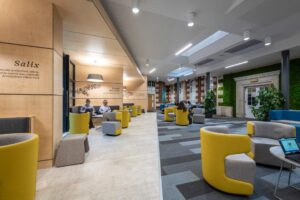
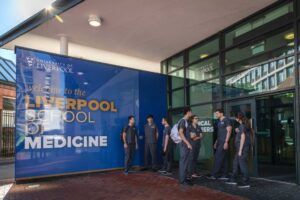
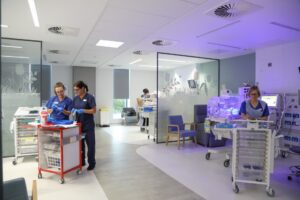
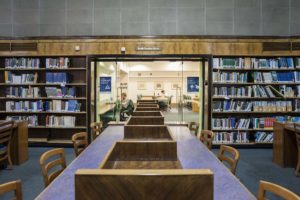
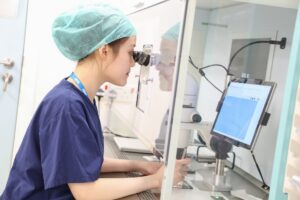
The School of Medicine is one of the largest providers of medical education in the country. Students have access to facilities such as the unrivalled Human Anatomy Resource Centre and Clinical Skills Resource Centre, as well as our Virtual Learning Environment. We also offer access to a comprehensive placement network with nationally recognised centres of excellence.

From arrival to alumni, we’re with you all the way:
It really is great to be on the ward - and that’s how you learn. The Medical School is very good and very supportive. It’s definitely set me up well for my future career, and I’m looking forward to getting into the job.

Want to find out more about student life?
Chat with our student ambassadors and ask any questions you have.
Our programmes are for individuals who wish to become qualified medical practitioners. A diverse range of careers are open to you as a medical graduate, varying from medical science, perhaps laboratory-based research, through public health and the development of health care strategies to clinical practice in the hospital and community.