An award-winning collaboration for student learning
Posted on: 5 March 2026 by Olga Chatzidaki in News, Awards & Insights
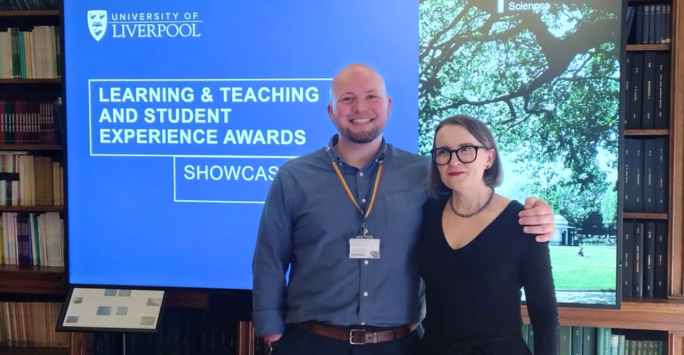
How collaboration helped transform a final-year module and create a more authentic student experience
A conversation over coffee led to an award-winning collaboration between Careers & Employability and the Department of Languages, Cultures and Film at the University of Liverpool.
What began as a discussion about refreshing a final-year French module became a wider rethinking of assessment, student engagement and employability. The result was an innovative redesign of French Dressing: 600 Years of Clothing and Cultural History in France, which went on to win the Sir Alastair Pilkington Award for Teaching Excellence.
In this interview, Matt Jones, Career Consultant in Careers & Employability, and Dr Rebecca Dixon, academic in Languages, Cultures and Film, reflect on how the collaboration began, what changed, and why it has had such a powerful impact on students.
How did this collaboration begin?
Matt:
As part of my role in Careers & Employability, I’m aligned to the School of Histories, Languages and Cultures, so I work with academic colleagues across the school to explore how employability can be embedded into modules in a way that feels meaningful and appropriate.
Rebecca and I had been aware of each other’s work for some time, but the real starting point came when we sat down together to talk about one of her modules. I’ve always said the module had really good bones. It was already strong, but through our conversations we identified some exciting opportunities to build on that foundation and make employability more explicit within the student experience.
Rebecca:
It really did start very simply — with a coffee. I got in touch with Matt because I knew I wanted to make some changes, especially around assessment. At first, I think I was hoping he might point me towards a few useful resources or strategies. But what actually happened was much more valuable than that.
We talked the whole thing through properly, and from that conversation the project emerged. The beauty of the collaboration is that I couldn’t have done this by myself. The ideas we developed together were much more ambitious and much more exciting than anything I had imagined at the start.
What was the module like before the redesign?
Rebecca:
The module is a final-year undergraduate French module called French Dressing: 600 Years of Clothing and Cultural History in France. I’ve taught it for a long time, and it comes out of my own research interests in fashion history and art history.
There was already a lot in it that worked well. But over time I began to feel that some parts of the student experience had become a little tired. The seminars were useful, but they had become quite repetitive. The assessments also needed refreshing.
Students completed a smaller museum exhibition catalogue entry and then a more traditional essay. They did well, but I was finding that essays often became quite similar because students naturally clustered around certain themes, centuries or artists. That wasn’t the students’ fault — it was really about the structure of the assignment. I started to feel there must be more we could do with it.
What changed?
Matt:
The major change was to transform the traditional 3,000-word essay into an exhibition proposal. That gave students much more autonomy in how they engaged with the material.
Students now choose a venue, select a century, develop a cross-cutting theme, identify the audience for their exhibition and justify their decisions. They’re still drawing on all the academic content and analytical rigour of the module, but they’re doing it in a format that feels much more authentic and connected to the wider world.
We also brought in enterprise education. That means helping students think not only creatively, but strategically. Why this venue? Why this audience? What value does the exhibition create? How would you communicate it? How would you justify it to funders or stakeholders?
Rebecca:
That was what made the project so exciting. Students weren’t simply interpreting artefacts anymore — they were building a whole concept. They had to think about ideas, audiences, decisions and impact.
Some of them had encountered exhibitions before in other contexts, but nothing like this. This assignment asked them to bring together academic understanding, creativity and strategic thinking all at once.
How did students respond?
Matt:
At first, they were understandably nervous. This is not the kind of assessment most students will have done before. But once they started to engage with it, their confidence really grew.
One of the most exciting things for me was seeing the language they used begin to change. They started thinking much more strategically. They were talking about audience, value, funding, communication and decision-making in ways that felt much closer to professional practice.
This is why I see the assignment as an important bridge between study and work. It helps students recognise that they already have many of the skills they need, and then supports them in applying those skills in a more formalised and professional context.
Rebecca:
The response has been fantastic. Students have really run with it.
They choose themes that matter to them personally, and that gives the work a real depth. Some focus on accessibility, some on queer theory, some on women’s history, and others on audiences who may not traditionally see themselves reflected in exhibition spaces. The projects become very individual, very thoughtful and very rich.
And the quality has been extraordinary. Students were always doing well on the module, but attainment has gone up. I’ve awarded some of the highest marks of my career on this module, and they were fully deserved. The work has been astonishing in its depth, passion and rigour.
Just as importantly, it’s been a joy to teach. I redesigned the seminars so they became more scenario-based and much more connected to the new assessment. Seeing students genuinely excited by what they are doing has been incredibly rewarding.
Why do you think this approach worked so well?
Matt:
Because it brought different kinds of expertise together. Rebecca brought deep subject knowledge, creativity and a strong understanding of the module. I brought experience in employability and enterprise education. When those things came together, we were able to create something that felt genuinely impactful.
The assessment is still academically rigorous, but it also gives students the chance to apply what they’ve learned in ways that feel more real, more purposeful and more energising.
Rebecca:
That balance is exactly what matters. Students still have to demonstrate a strong understanding of the academic content. They still have to show rigour. But now they are also doing much more than that.
If you only had the creative or professional side, it wouldn’t be enough. If you only had the academic side, it wouldn’t be as exciting. The strength of the redesign is in the combination of both.
How did this lead to award recognition?
Matt:
Once we had run the module in this way and seen the impact, we wanted to share the practice more widely. So we submitted it for a Learning, Teaching and Student Experience Award in the Faculty of Humanities and Social Sciences.
It’s a rigorous process and you have to evidence a lot, including impact and scholarship. We were thrilled to be recognised as one of eight award-winning projects in the faculty.
All eight teams were then invited to give an eight-minute pitch for the Sir Alastair Pilkington Award for Teaching Excellence, which is the University’s most prestigious award for teaching quality.
We genuinely did not expect to win. The standard of work across the institution was phenomenal. We were proud of the project and believed in it, but it still came as a huge surprise.
Rebecca:
It really was a surprise. We went into it thinking it would be a great opportunity to share the work, and that in itself felt worthwhile. So when we heard our names announced, it was quite surreal.
We’re still on cloud nine.
What happens next?
Matt:
Winning the award has given us not only recognition, but also the chance to think about what comes next. The funding attached to the awards gives us an opportunity to develop the module even further.
It also gives us a really strong case study. This work is highly transferable. The format may be specific here to an exhibition proposal, but the wider principles — authentic assessment, enterprise education, strategic thinking, employability — can be adapted far beyond this one module.
That feels especially timely in the context of Curriculum 2027, when colleagues across the University are reviewing programmes and assessments and thinking about how to make them more authentic, engaging and future-focused.
What would you say to colleagues thinking about changing their own modules?
Rebecca:
Do it.
If you can see that something needs to change, trust that instinct and act on it. Don’t assume that innovative work is for someone else, or that it wouldn’t apply to your discipline or your module.
Yes, it takes work. But that work pays you back many times over. It transforms the student experience, and it can transform your experience as an educator too.
I would also say: trust your students. If you build something meaningful and support them properly, they will rise to it. You do need to scaffold it carefully, but when you do, the results can be extraordinary.
Keywords: Education and Student Experience.