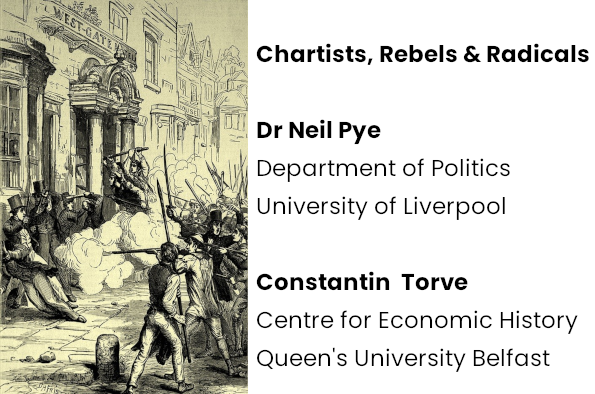
Chartists, Rebels & Radicals - Dr Neil Pye and Constantin Torve
- Viola Segeroth
- Admission: FREE but registration requested at www.eventbrite.co.uk/e/1985517033897
- Event website
- Book now
Add this event to my calendar
Click on "Create a calendar file" and your browser will download a .ics file for this event.
Microsoft Outlook: Download the file, double-click it to open it in Outlook, then click on "Save & Close" to save it to your calendar. If that doesn't work go into Outlook, click on the File tab, then on Open & Export, then Open Calendar. Select your .ics file then click on "Save & Close".
Google Calendar: download the file, then go into your calendar. On the left where it says "Other calendars" click on the arrow icon and then click on Import calendar. Click on Browse and select the .ics file, then click on Import.
Apple Calendar: The file may open automatically with an option to save it to your calendar. If not, download the file, then you can either drag it to Calendar or import the file by going to File >Import > Import and choosing the .ics file.
The 19th century was a period of profound social and political transformation across the British Isles and the wider empire. Rapid population growth, economic change, and industrialisation unsettled established social relations and brought new groups into the sphere of politics.
Agricultural labourers, small tenants, artisans, and industrial workers increasingly challenged the political monopoly of a wealthy and educated elite, demanding the abolition of unjust laws, a fairer distribution of resources, and a more representative political system.
Two of the most important popular movements to emerge from these conditions were Irish agrarian agitation and British Chartism. Although they developed in different social and economic contexts, both reflected the growing politicisation of the lower orders and the emergence of mass politics in the nineteenth century. In Ireland, rural protest movements mobilised against rack-rents, tithes, and evictions, often drawing on older traditions of collective resistance and moral economy. In Britain, Chartism organised working people around a national programme of political reform, centred on the People’s Charter and its demand for expanded political rights. The legacies of these movements continue to shape British, Irish, and even Australian politics to this day.