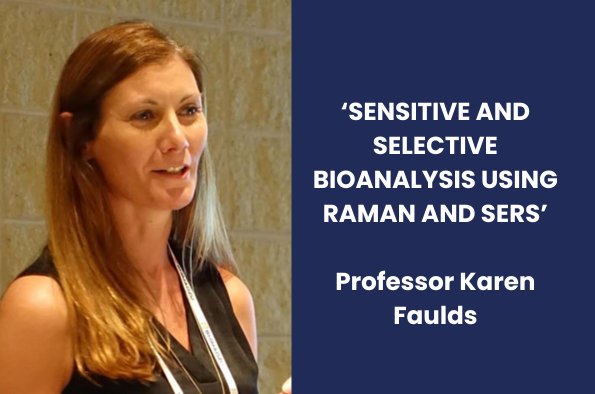
Professor Karen Faulds - 'Sensitive and selective bioanalysis using Raman and SERS'
1:00pm - 2:00pm /
Thursday 7th May 2026
/ Venue: Physiology Seminar Room Nuffield Wing
Type: Seminar /
Category: Department
/ Series: Institute of Systems, Molecular and Integrative Biology
- ISMIB Seminar Team
- Admission: Free, no registration required.
Add this event to my calendar
Click on "Create a calendar file" and your browser will download a .ics file for this event.
Microsoft Outlook: Download the file, double-click it to open it in Outlook, then click on "Save & Close" to save it to your calendar. If that doesn't work go into Outlook, click on the File tab, then on Open & Export, then Open Calendar. Select your .ics file then click on "Save & Close".
Google Calendar: download the file, then go into your calendar. On the left where it says "Other calendars" click on the arrow icon and then click on Import calendar. Click on Browse and select the .ics file, then click on Import.
Apple Calendar: The file may open automatically with an option to save it to your calendar. If not, download the file, then you can either drag it to Calendar or import the file by going to File >Import > Import and choosing the .ics file.
Professor Karen Faulds, Head of Bionanotechnology and Analytical Research Section, Department of Pure and Applied Chemistry, Technology Innovation Centre, University of Strathclyde
Abstract:
Raman is a molecularly specific technique which can be used for label free imaging of biological samples giving high resolution biochemical information. However, it is fundamentally a weak effect therefore lacking sensitivity as well as being a relatively slow imaging modality. The sensitivity and imaging speeds can be improved by using advanced Raman techniques such as stimulated Raman scattering (SRS) and surface enhanced Raman scattering (SERS).
SRS is a multiphoton coherent Raman spectroscopy technique which improves the sensitivity of Raman and allows near video-rate imaging. We have applied this approach for the imaging of drug-cell interactions, lipid metabolism as well as developing organelle targeting vibrationally responsive probes. We have also made great progress in the development of SERS as a sensitive, quantitative method for bioanalytical applications with the ultimate goal of creating platforms for medical diagnostics. The development of new bioanalytical assays based upon SERS which have been used successfully for the detection of bacterial pathogens using modified SERS active probes and development of SERS active functionalised nanoparticles for the detection of biomarkers using SERS based lateral flow immunoassays (SERS-LFIA) direct from patient blood will be presented.
All welcome
Abstract:
Raman is a molecularly specific technique which can be used for label free imaging of biological samples giving high resolution biochemical information. However, it is fundamentally a weak effect therefore lacking sensitivity as well as being a relatively slow imaging modality. The sensitivity and imaging speeds can be improved by using advanced Raman techniques such as stimulated Raman scattering (SRS) and surface enhanced Raman scattering (SERS).
SRS is a multiphoton coherent Raman spectroscopy technique which improves the sensitivity of Raman and allows near video-rate imaging. We have applied this approach for the imaging of drug-cell interactions, lipid metabolism as well as developing organelle targeting vibrationally responsive probes. We have also made great progress in the development of SERS as a sensitive, quantitative method for bioanalytical applications with the ultimate goal of creating platforms for medical diagnostics. The development of new bioanalytical assays based upon SERS which have been used successfully for the detection of bacterial pathogens using modified SERS active probes and development of SERS active functionalised nanoparticles for the detection of biomarkers using SERS based lateral flow immunoassays (SERS-LFIA) direct from patient blood will be presented.
All welcome