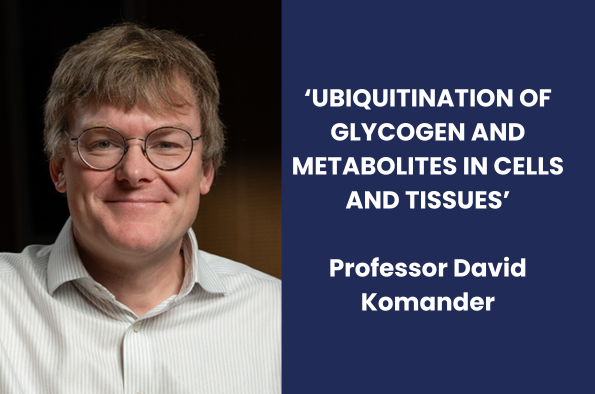
Prof David Komander - 'Ubiquitination of glycogen and metabolites in cells and tissues'
1:00pm - 2:00pm /
Monday 23rd March 2026
/ Venue: Physiology seminar room Nuffield Wing
Type: Seminar /
Category: Research
/ Series: Institute of Systems, Molecular and Integrative Biology
- Professor Sylvie Urbé
- Admission: Free, no registration required.
Add this event to my calendar
Click on "Create a calendar file" and your browser will download a .ics file for this event.
Microsoft Outlook: Download the file, double-click it to open it in Outlook, then click on "Save & Close" to save it to your calendar. If that doesn't work go into Outlook, click on the File tab, then on Open & Export, then Open Calendar. Select your .ics file then click on "Save & Close".
Google Calendar: download the file, then go into your calendar. On the left where it says "Other calendars" click on the arrow icon and then click on Import calendar. Click on Browse and select the .ics file, then click on Import.
Apple Calendar: The file may open automatically with an option to save it to your calendar. If not, download the file, then you can either drag it to Calendar or import the file by going to File >Import > Import and choosing the .ics file.
Title: 'Ubiquitination of glycogen and metabolites in cells and tissues'
Professor David Komander, The Walter and Eliza Hall Institute of Medical Research, WEHI, Melbourne University, AustraliaProfessor David Komander studies the ubiquitin system and has considerably expanded our understanding of the 'Ubiquitin Code.’ He showed that many proteins in the ubiquitin system assemble, recognise and cleave ubiquitin chains with high specificity, developed methods to study ubiquitination and deubiquitinases (DUBs), and explained linkage-specificity using structural biology methods. He discovered OTULIN as a new human DUB and showed its role in inflammation and autoinflammatory disorders. David's recent work explained how PINK1, Parkin and USP30 regulate mitochondrial turnover / mitophagy via phosphorylated ubiquitin, with relevance in early-onset Parkinson’s Disease.
David received his PhD from the University of Dundee, Scotland, worked as a postdoctoral fellow at ICR London, and led a group at the MRC Laboratory of Molecular Biology, Cambridge, from 2008-18. Since 2018, he has been Head of the Ubiquitin Signalling Division at WEHI, Melbourne, Australia.
Professor Komander is a member of EMBO, the Lister Institute, a Fellow of the Australian Academy of Sciences (2023) and the Royal Society, London (2024). In 2024, he received the GSK Award for Research Excellence.
Please contact Sylvie Urbé and Michael Clague if you would like to meet with David during his visit.
--
Abstract:
Ubiquitination regulates protein function and stability, but its modification of non-protein biomolecules remains poorly understood. We developed NoPro-Clipping, an unbiased mass-spectrometry workflow combining Ub-clippases [1] and sortagging [2] to detect and quantify non-protein ubiquitination in cells and tissues. Using this approach, we discovered widespread ubiquitination of small metabolites and abundant ubiquitinated glycogen in mouse tissues, particularly liver and skeletal muscle. Glycogen ubiquitination directs glycogen to lysosomes through a ubiquitin-dependent glycophagy pathway and increases during fasting, when liver glycogen is depleted. Up to ~1% of total ubiquitin in liver is attached to glycogen. These findings reveal ubiquitin as a regulator of glycogen metabolism and demonstrate physiological roles for non-protein ubiquitination.
[1] Swatek et al, Nature 2019
[2] Antos et al, Curr Opin Struct Biol 2016
Professor David Komander, The Walter and Eliza Hall Institute of Medical Research, WEHI, Melbourne University, AustraliaProfessor David Komander studies the ubiquitin system and has considerably expanded our understanding of the 'Ubiquitin Code.’ He showed that many proteins in the ubiquitin system assemble, recognise and cleave ubiquitin chains with high specificity, developed methods to study ubiquitination and deubiquitinases (DUBs), and explained linkage-specificity using structural biology methods. He discovered OTULIN as a new human DUB and showed its role in inflammation and autoinflammatory disorders. David's recent work explained how PINK1, Parkin and USP30 regulate mitochondrial turnover / mitophagy via phosphorylated ubiquitin, with relevance in early-onset Parkinson’s Disease.
David received his PhD from the University of Dundee, Scotland, worked as a postdoctoral fellow at ICR London, and led a group at the MRC Laboratory of Molecular Biology, Cambridge, from 2008-18. Since 2018, he has been Head of the Ubiquitin Signalling Division at WEHI, Melbourne, Australia.
Professor Komander is a member of EMBO, the Lister Institute, a Fellow of the Australian Academy of Sciences (2023) and the Royal Society, London (2024). In 2024, he received the GSK Award for Research Excellence.
Please contact Sylvie Urbé and Michael Clague if you would like to meet with David during his visit.
--
Abstract:
Ubiquitination regulates protein function and stability, but its modification of non-protein biomolecules remains poorly understood. We developed NoPro-Clipping, an unbiased mass-spectrometry workflow combining Ub-clippases [1] and sortagging [2] to detect and quantify non-protein ubiquitination in cells and tissues. Using this approach, we discovered widespread ubiquitination of small metabolites and abundant ubiquitinated glycogen in mouse tissues, particularly liver and skeletal muscle. Glycogen ubiquitination directs glycogen to lysosomes through a ubiquitin-dependent glycophagy pathway and increases during fasting, when liver glycogen is depleted. Up to ~1% of total ubiquitin in liver is attached to glycogen. These findings reveal ubiquitin as a regulator of glycogen metabolism and demonstrate physiological roles for non-protein ubiquitination.
[1] Swatek et al, Nature 2019
[2] Antos et al, Curr Opin Struct Biol 2016