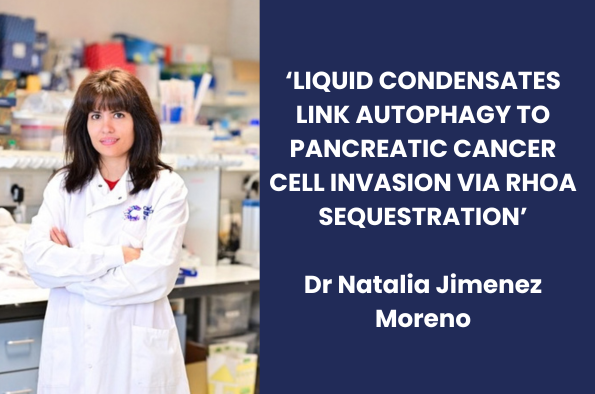
Dr Natalia Jimenez Moreno - 'Liquid condensates link autophagy to pancreatic cancer cell invasion via RhoA sequestration'
1:00pm - 2:00pm /
Thursday 23rd April 2026
/ Venue: Physiology Seminar Room Nuffield Wing
Type: Seminar /
Category: Research
/ Series: Institute of Systems, Molecular and Integrative Biology
- ISMIB Seminar Team
- Suitable for: All are welcome
- Admission: Free
Add this event to my calendar
Click on "Create a calendar file" and your browser will download a .ics file for this event.
Microsoft Outlook: Download the file, double-click it to open it in Outlook, then click on "Save & Close" to save it to your calendar. If that doesn't work go into Outlook, click on the File tab, then on Open & Export, then Open Calendar. Select your .ics file then click on "Save & Close".
Google Calendar: download the file, then go into your calendar. On the left where it says "Other calendars" click on the arrow icon and then click on Import calendar. Click on Browse and select the .ics file, then click on Import.
Apple Calendar: The file may open automatically with an option to save it to your calendar. If not, download the file, then you can either drag it to Calendar or import the file by going to File >Import > Import and choosing the .ics file.
The endoplasmic reticulum (ER) is a ubiquitous and dynamic organelle that makes regulatory contacts with other cytoplasmic structures. It is remodelled by a selective form of autophagy known as ER-phagy driven by facilitator proteins known as ER-phagy receptors. However, knowledge of the regulation and physiological roles of ER-phagy remain undefined. Indeed, in pancreatic cancer, one of the most aggressive human malignancies, there is a significant correlation between high expression of ER-phagy receptors and increased patient survival.
This suggests the potential of ER-phagy in controlling cancer hallmarks. In this study, using a pancreatic cancer cell model, proximity biotinylation coupled with CRISPR/Cas9 screening identified the cytoplasmic interactomes of ER-phagy receptors, which included PRKAR1A, canonically known as a subunit of PKA. PRKAR1A directly binds an amphipathic helix in the otherwise disordered cytoplasmic domain of the ER-phagy receptor FAM134B, independently of its role in the PKA complex. Indeed, PRKAR1A -but not PKA kinase activity- is required for FAM134B/C ER-phagy in response to cAMP signalling.
Using a suite of imaging techniques including super-resolution, FRAP and CLEM imaging revealed novel interorganellar contacts between liquid-like condensates of cAMP-bound PRKAR1A and the ER. PRKAR1A condensates act as a “molecular glue”, facilitating the clustering of ER-embedded FAM134B with LC3B. Proteomic analysis further reveals that cytoplasmic RhoA interacts with these clusters, leading to the sequestration of both molecules within lysosomes embedded within the proximal condensates. This results in reduced actomyosin contractility and thereby dictating cell morphology and the modality of cancer cell invasion from collective to single cell invasion mode.
In summary, ER-condensate contacts mediated by FAM134B are novel cellular degradation hubs that coordinate ER and cellular remodelling, broadening the cellular roles of FAM134B ER-phagy receptors beyond ER remodelling and proteostasis. While this study highlights a pivotal mechanism in cancer, future research across diverse cellular models and disease states will be essential to define the uncharted ER remodelling networks that influence cancer progression, opening new therapeutic targets.
This suggests the potential of ER-phagy in controlling cancer hallmarks. In this study, using a pancreatic cancer cell model, proximity biotinylation coupled with CRISPR/Cas9 screening identified the cytoplasmic interactomes of ER-phagy receptors, which included PRKAR1A, canonically known as a subunit of PKA. PRKAR1A directly binds an amphipathic helix in the otherwise disordered cytoplasmic domain of the ER-phagy receptor FAM134B, independently of its role in the PKA complex. Indeed, PRKAR1A -but not PKA kinase activity- is required for FAM134B/C ER-phagy in response to cAMP signalling.
Using a suite of imaging techniques including super-resolution, FRAP and CLEM imaging revealed novel interorganellar contacts between liquid-like condensates of cAMP-bound PRKAR1A and the ER. PRKAR1A condensates act as a “molecular glue”, facilitating the clustering of ER-embedded FAM134B with LC3B. Proteomic analysis further reveals that cytoplasmic RhoA interacts with these clusters, leading to the sequestration of both molecules within lysosomes embedded within the proximal condensates. This results in reduced actomyosin contractility and thereby dictating cell morphology and the modality of cancer cell invasion from collective to single cell invasion mode.
In summary, ER-condensate contacts mediated by FAM134B are novel cellular degradation hubs that coordinate ER and cellular remodelling, broadening the cellular roles of FAM134B ER-phagy receptors beyond ER remodelling and proteostasis. While this study highlights a pivotal mechanism in cancer, future research across diverse cellular models and disease states will be essential to define the uncharted ER remodelling networks that influence cancer progression, opening new therapeutic targets.