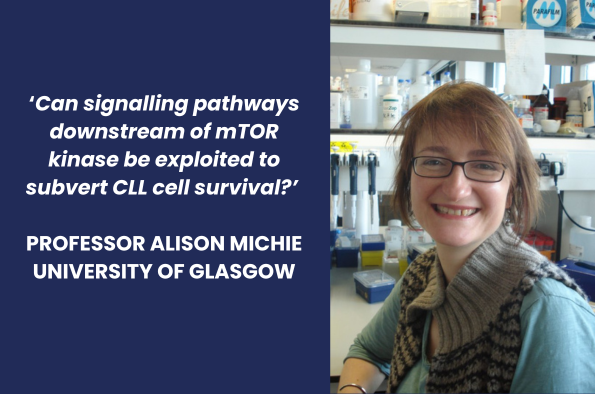
Professor Alison Michie - 'Can signalling pathways downstream of mTOR kinase be exploited to subvert CLL cell survival?'
1:00pm - 2:00pm /
Tuesday 10th February 2026
/ Venue: Physiology seminar room Nuffield Wing
Type: Seminar /
Category: Research
/ Series: Institute of Systems, Molecular and Integrative Biology
- ISMIB Seminar Team
- Admission: Free. Registration not required.
Add this event to my calendar
Click on "Create a calendar file" and your browser will download a .ics file for this event.
Microsoft Outlook: Download the file, double-click it to open it in Outlook, then click on "Save & Close" to save it to your calendar. If that doesn't work go into Outlook, click on the File tab, then on Open & Export, then Open Calendar. Select your .ics file then click on "Save & Close".
Google Calendar: download the file, then go into your calendar. On the left where it says "Other calendars" click on the arrow icon and then click on Import calendar. Click on Browse and select the .ics file, then click on Import.
Apple Calendar: The file may open automatically with an option to save it to your calendar. If not, download the file, then you can either drag it to Calendar or import the file by going to File >Import > Import and choosing the .ics file.
SPONSORED BY NORTH WEST CANCER RESEARCH
Professor Alison Michie, University of GlasgowProfessor Michie graduated with a PhD in Biochemistry from the University of Glasgow, before being awarded a post-doctoral fellowship from Cancer Research Institute to study T cell development with Juan Carlos Zúñiga-Pflücker at the University of Toronto, Canada. An MRC Career Development Award enabled Alison to return to the University of Glasgow to start her independent research group investigating the molecular events that regulate B-lymphocyte lineage commitment and development. During the course of her studies Alison established that subversion of PKCa signalling acts as an oncogenic trigger in B-lymphocytes, resulting in the development of chronic lymphocytic leukaemia (CLL). This finding resulted in a change in focus for her research group from lymphocyte development towards translational CLL research and in 2005, Alison established the Molecular Lymphopoiesis group within Experimental Haematology with Professor Tessa Holyoake. In 2008, the department moved to Paul O’Gorman Leukaemia Research Centre, a purpose built research, state-of-the-art lab based in the west end of Glasgow within Gartnavel General Hospital site.
The main focus of Alison’s research is to determine the cellular and molecular mechanisms that underlie the initiation and progression of CLL, with a view to identifying novel targets for therapeutic intervention: the CLL model she developed offers great potential for translational research, resembling a model of progressive CLL which, combined with studies involving CLL patient samples, provides a cohesive translational platform to enable characterisation of novel drug targets/therapies.
All welcome.
Professor Alison Michie, University of GlasgowProfessor Michie graduated with a PhD in Biochemistry from the University of Glasgow, before being awarded a post-doctoral fellowship from Cancer Research Institute to study T cell development with Juan Carlos Zúñiga-Pflücker at the University of Toronto, Canada. An MRC Career Development Award enabled Alison to return to the University of Glasgow to start her independent research group investigating the molecular events that regulate B-lymphocyte lineage commitment and development. During the course of her studies Alison established that subversion of PKCa signalling acts as an oncogenic trigger in B-lymphocytes, resulting in the development of chronic lymphocytic leukaemia (CLL). This finding resulted in a change in focus for her research group from lymphocyte development towards translational CLL research and in 2005, Alison established the Molecular Lymphopoiesis group within Experimental Haematology with Professor Tessa Holyoake. In 2008, the department moved to Paul O’Gorman Leukaemia Research Centre, a purpose built research, state-of-the-art lab based in the west end of Glasgow within Gartnavel General Hospital site.
The main focus of Alison’s research is to determine the cellular and molecular mechanisms that underlie the initiation and progression of CLL, with a view to identifying novel targets for therapeutic intervention: the CLL model she developed offers great potential for translational research, resembling a model of progressive CLL which, combined with studies involving CLL patient samples, provides a cohesive translational platform to enable characterisation of novel drug targets/therapies.
All welcome.