Clearing 2026

We have places available on some courses for 2026 entry.

If you’re a UK student you can browse Clearing courses now, start your application from 3pm on Tuesday 11 August and submit it on Thursday 13 August. International students who have their results can apply now.

Qualification type
BSc (Hons)

Diagnostic Radiography

UCAS code B821

Study mode
Full-time
Duration
3 years
Start date and application deadlines
Apply by:
Starts on:

We've set the country or region your qualifications are from as United Kingdom.

How to apply

Although the UCAS equal consideration date has now passed, many of our courses are still accepting applications from UK students for 2026 entry through UCAS.

The deadline for international students was 30 June 2026.

Please note, courses may close earlier than the advertised application deadline due to demand.

Combine this subject

With a combined degree, you can study two subjects as part of the same degree programme.

  • Choose from 30 subjects and over 300 combinations
  • Choose joint or major minor subjects
  • Same number of credits as single honours students
  • Same classes as single honours students
  • Appeal to a wide range of employers

Explore combined degrees for Health Sciences and Nursing courses

Get a prospectus

Complete form

Download a course leaflet

Your course leaflet download should begin automatically but if not, click to download. If you would like to keep up to date with the latest events from the University of Liverpool, complete the form below.

Complete form

Change country or region

We’re currently showing entry requirements and other information for applicants with qualifications from United Kingdom.

Please select from our list of commonly chosen countries below or choose your own.

If your country or region isn’t listed here, please contact us with any questions about studying with us.

Book your Open Day place

Be the first to hear when bookings open for our 2026 open events. Don’t miss this opportunity to experience our courses, campus and city for yourself.

About this course

Study Diagnostic Radiography and we will prepare you personally and professionally, for the role of a competent caring radiographer, within the diagnostic imaging department.


Introduction

You will gain the knowledge and skills to undertake a comprehensive range of radiographic techniques needed for first post competencies working in the modern healthcare sector.

Students will develop an awareness of anatomy, physiology and pathology, using radiographic and cross-sectional images, along with an understanding of radiological science, associated with medical imaging and radiation protection. You will also acquire an appreciation of research methods with respect to diagnostic radiography and the importance of evidence-based practice in relation to the profession.

This is a vocational programme with approximately a 50:50 ratio of theory to practice and is delivered in both the university academic setting and at clinical placement sites throughout the region. The modules, which are delivered at the University, follow four strategic themes. These include: patient-centred radiographic practice, anatomy, physiology and pathology, radiation science and research methods. There is an on-site static digital imaging suite, a CT scanner, and mobile x-ray equipment to support delivery

As a student, you will be allocated a hospital placement to attend in several clinical blocks throughout each of the three years. The focus of each of these placements is closely linked to the academic modules, which are taught using a variety of student-centred teaching styles, including traditional lectures and small group tutorials. You will also have the opportunity to engage in the award-winning team-based learning (TBL) approach, an internationally recognised effective teaching method, well evaluated by our current students. You will participate in problem-based learning, where discussions around ‘patient-specific’ scenarios help to enhance your understanding of related issues. You will also be involved in interprofessional learning, which features in all three years of the programme and assists you in understanding the multidisciplinary team (MDT) approach to healthcare.

A continuous clinical assessment scheme (Practice Assessment Record & Evaluation Portfolio – PARE), linked to the radiographic practice modules, is used in the clinical sites to record your clinical performance and give you regular feedback, which will enhance your clinical learning. This information is stored online and is accessible to you, clinical placement staff, and academic staff to monitor your progress throughout the programme. During the programme, you will also have the opportunity to enrich your clinical experience by undertaking an elective placement in an imaging department of your choice, which can be locally, nationally or internationally.


What you'll learn

  • Research gathering techniques
  • Critical thinking skills
  • Communication skills
  • Self-directed learning techniques
  • Patient care
  • Physics, radiobiology and technology skills relating to Radiography
Back to top

We’ve been awarded a Gold rating for educational excellence.


Course content

Discover what you'll learn, what you'll study, and how you'll be taught and assessed.

Year one

Year one will equip you with foundational knowledge and skills, which will be developed in the subsequent years of the programme. The modules in this year follow the previously mentioned themes: patient centred radiographic practice, anatomy, physiology and pathology, radiation science and research methods.

All modules are compulsory and must be successfully completed before progression to the next year of study.

Modules

Programme details and modules listed are illustrative only and subject to change. The course content currently shown on this page reflects the programme as it is running in September 2026. The University is currently reviewing all of its programmes for 2027 entry. View the 2027 version of this course for more information.

Year two

The aim of year two is to consolidate the learning experiences from year one and extend them further to provide a foundation for more complex examinations involving specialist equipment. Professional practice will inspire students to become increasingly autonomous, encouraging an appreciation of the challenging issues relating to healthcare.

All modules are compulsory and must be successfully completed before progression to the next year of study.

Modules

Programme details and modules listed are illustrative only and subject to change. The course content currently shown on this page reflects the programme as it is running in September 2026. The University is currently reviewing all of its programmes for 2027 entry. View the 2027 version of this course for more information.

Year three

The aim of year three is to expand your knowledge of the specialist clinical areas and to promote a level of independence and professional responsibility in preparation for graduation and registration with the Health and Care Profession Council (HCPC). As a qualified diagnostic radiographer you can become a member of the Society of Radiographers.

All modules are compulsory and must be successfully completed before progression to the next year of study.

Modules

Programme details and modules listed are illustrative only and subject to change. The course content currently shown on this page reflects the programme as it is running in September 2026. The University is currently reviewing all of its programmes for 2027 entry. View the 2027 version of this course for more information.

Teaching and assessment

How you'll learn

Learning is promoted through a wide variety of activities which that enables students to become autonomous and independent continuous learners. An award winning team based learning approach features in many of the modules, along with interactive lectures and student led seminars. Problem-based learning is used to cover patient centred scenarios and collaborative projects are often used to teach research and evidence based practice. The programme has the benefit of an onsite digital imaging suite and CT scanner to enhance clinical skills teaching and there is access to the Human Anatomy Resource Centre, which complements students’ learning.

Throughout the programme there are shared lectures, and tutorials with students from other directorates within the School of Allied Health Professions and Nursing. This is to promote inter-professional education and learning opportunities across all healthcare professions.

How you're assessed

Using a mixture of coursework and examination, a range of assessment methods can be seen across the programmes. These include seen and unseen written examinations, essay assignments with specific word lengths, multiple choice questions, case study presentations, video analysis and interactive practical examinations. Assessment of the work-based learning element of all programmes is an important aspect. You will be required to communicate your views orally and in written form; analyse, implement and evaluate your practice; and to extend the research and evidence base of your chosen profession.

The various methods of assessments have been chosen to provide a balance that will permit the undergraduates to demonstrate their intellectual abilities in all areas to the full.

Liverpool Learning Framework

At Liverpool, we take a distinctive approach to education through the Liverpool Learning Framework. This means teaching that is engaging, inclusive and designed to help you succeed during your studies and beyond.

You’ll develop specialist subject knowledge alongside the skills employers value most, including:

  • Digital fluency
  • Confidence
  • Global citizenship

Our curriculum is characterised by the three Liverpool Hallmarks:

  • Research-connected teaching - learning informed by the latest ideas and discoveries
  • Active learning - taking part, applying knowledge and learning by doing
  • Authentic assessment - assessments designed around real-world tasks and challenges

We also embed key priorities across our curriculum, including AI literacy, employability, and sustainability, helping you prepare for the future and make a positive impact in the world.

We’re committed to creating a supportive and inclusive learning environment where every student can thrive.

Back to top

Course options

Studying with us means you can tailor your degree to suit you. Here's what is available on this course.

Global opportunities

University of Liverpool students can choose from an exciting range of study placements at partner universities worldwide.

Summer abroad

Spend a summer abroad on a study placement or research project at one of our worldwide partner institutions.

  • Spend a summer abroad in addition to your degree programme
  • Study abroad without adding an extra year
  • Choose any summer between your first and final year of study
  • Get the chance to study subjects outside your discipline

Where can I spend a summer abroad on this course?

  • Hong Kong
  • Japan
  • South Korea

More about taking a summer abroad

Language study

Every student at The University of Liverpool can study a language as part of, or alongside their degree. You can choose:

  • A dedicated languages degree
  • A language as a joint or major/minor degree
  • Language modules (selected degrees)
  • Language classes alongside your studies

Read more about studying a language

Back to top

Your experience

Diagnostic Radiography students at the University of Liverpool benefit from our experience in delivering more than 100 years of teaching across practical and professionally focused programmes.

Our curriculum is developed and assessed by leading healthcare providers throughout the North West. Many such partners across the North West provide exciting placement opportunities which allows you to bring your studies to life by gaining a breadth of patient-focused practical experience in a region with a particularly diverse population, providing an invaluable insight to future roles.

We place an emphasis on interprofessional learning modules in order to reflect the multi-professional environments you will encounter in today’s healthcare settings.

Explore where you'll study

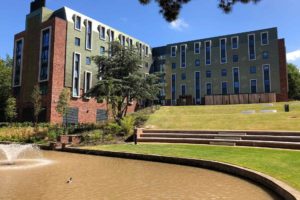
The courtyard of the Greenbank Halls of residence.
Accommodation
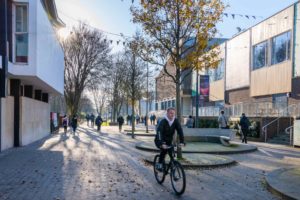
Cyclist passing the Liverpool Guild of Students
Liverpool Guild of Students
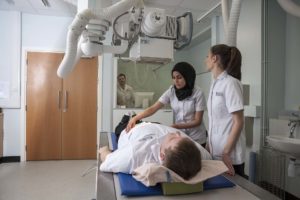
Students undertaking practical work
Health Sciences students undertaking practical work
Practical learning
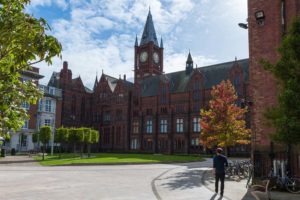
North Campus view of the Victoria Gallery and Museum
The Quadrangle behind the VGM

Virtual tour

Supporting your learning

From arrival to alumni, we’re with you all the way:

An exciting place to study

  • Major centre for education and research in health sciences
  • State-of-the-art facilities
  • Opportunities for in-depth study and development of advanced clinical skills
  • Flexible programmes for postgraduate study
  • Active research environment
  • Provides specialist training with taught and clinical placement components.

One of the things I find most interesting about the course is the placement, which offers new experiences every day. When you go into the hospital, you never quite know what you are going to come across. You meet new people and new challenges, developing your technique and communication skills.

Leonardos Papadopoullos, BSc (Hons) Diagnostic Radiography
Two students chatting while walking through campus.

Chat with our students

Want to find out more about student life?
Chat with our student ambassadors and ask any questions you have.

Watch on Panopto: A day in the life of Allied Health Professions and Nursing student Charmain Yip

A day in the life of Allied Health Professions and Nursing student Charmain Yip

Back to top

Careers and employability

As a graduate of the School of Allied Health Professions and Nursing, you’ll be eligible to apply for registration with the Health and Care Professions Council (HCPC). You will have gained a qualification that meets the Government’s criteria for ‘fitness for purpose’ and ‘fitness for practice’ as well as developing transferable skills such as communication, information technology, problem solving and teamwork.

You can look to explore careers in:

  • National Health Service
  • Social Services
  • Private sector

99% of the School of Allied Health Professions and Nursing students find their main activity after graduation meaningful.

(Graduate Outcomes, 2018-19.)

Back to top

My qualifications are from United Kingdom.

Fees and funding

Your tuition fees, funding your studies, and other costs to consider.

Tuition fees

UK fees (applies to Channel Islands, Isle of Man and Republic of Ireland)

Full-time place, per year - £9,790
Year in industry fee - £1,955
Year abroad fee - £1,465 (applies to year in China)

International fees

Full-time place, per year - £32,000
Year in industry fee - £1,955
Year abroad fee - £16,000 (applies to year in China)

The fees shown are for the academic year 2026/27. Please be advised that tuition fees may increase each year for both UK and international students. For UK students, this will be subject to the government’s regulated fee limits.

Tuition fees cover the cost of your teaching and assessment, operating facilities such as libraries, IT equipment, and access to academic and personal support. Learn more about paying for your studies.


Additional costs

We understand that budgeting for your time at university is important, and we want to make sure you understand any course-related costs that are not covered by your tuition fee. You can find information on the general and subject-specific costs you could expect to incur on our study costs webpage.


We’re showing the scholarships available to students from United Kingdom.

Scholarships and bursaries

We offer a range of scholarships and bursaries that could help pay your tuition and living expenses.

The Bloomberg Scholarship

4 scholarships are available each year to support undergraduate applicants from socio-economically under-represented backgrounds who permanently reside in the Liverpool City Region. Successful applicants will receive a stipend of £5,000 per year for 3 years. Applications open in August 2026.

Ruth Cannell Scholarship Fund

This scholarship will support undergraduate students from widening participation backgrounds in the Department of Languages, Cultures and Film with their year abroad.

Whiteley Award

This award offers £3,000 per year for a UK undergraduate student from an under-represented background who has successfully completed the Liverpool Scholars or Pathways to Medicine programme.

The Liverpool Bursary

If you’re a UK student joining an undergraduate degree and have a household income below £35,000, you could be eligible for a Liverpool Bursary worth up to £2,000 for each year of undergraduate study.

Care Leavers’ Opportunity Bursary

If you’ve spent 13 or more weeks in Local Authority care since age 14, you could be eligible for a bursary of £3,000 per year of study. You’ll need to be a UK student joining an eligible undergraduate degree and be aged 28 or above on 1 September in the year you start.

Cowrie Foundation Scholarship

Are you a UK student with a Black African or Caribbean heritage and a household income of £25,000 or less? You could be eligible to apply for a Cowrie Foundation Scholarship worth up to £8,000 for each year of undergraduate study.

Estranged Students Bursary

If you’re a UK student identified as estranged by Student Finance England (or the equivalent UK funding body), you could be eligible for a bursary of £1,000 for each year of undergraduate study.

Genesys Life Sciences Scholarship

Joining a School of Biosciences degree and have a household income of less than £25,000? If you’re a UK student, you could apply to receive £4,500 per year for three years of your undergraduate course.

Nolan Scholarships

Do you live in the Liverpool City Region with a household income of £25,000 or less? Did neither of your parents attend University? You could be eligible to apply for a Nolan Scholarship worth £5,000 per year for three years of undergraduate study.

Rigby Enterprise Award

Are you a UK student with a household income of £25,000 or less? If you’ve participated in an eligible outreach programme, you could be eligible to apply for a Rigby Enterprise Award worth £5,000 per year for three years of your undergraduate degree.

ROLABOTIC Scholarship

Are you a UK student with a household income of £26,500 or less? Did neither of your parents attend University? You could be eligible to apply for a ROLABOTIC Scholarship worth £4,500 for each year of your undergraduate degree.

Sport Liverpool Performance Programme

Apply to receive tailored training support to enhance your sporting performance. Our athlete support package includes a range of benefits, from bespoke strength and conditioning training to physiotherapy sessions and one-to-one nutritional advice.

Technetix Broadhurst Engineering Scholarship

Joining a degree in the School of Electrical Engineering, Electronics and Computer Science? If you’re a UK student with household income below £25,000, you could be eligible to apply for £5,000 a year for three years of study. Two awards will be available per academic year.

Young Adult Carer’s (YAC) Bursary

If you’re a young adult and a registered carer in the UK, you might be eligible for a £1,000 bursary for each year of study. You’ll need to be aged 18-25 on 1 September in the year you start your undergraduate degree.

Back to top

Entry requirements

We have places available on some courses for 2026 entry. Find out more about our vacancies at the links below:

Alternatively, go straight to our quick and easy application form. When Clearing is open you can use this to check detailed entry requirements and submit an application.

Back to top

English language requirements

You'll need to demonstrate competence in the use of English language, unless you’re from a majority English speaking country.

We accept a variety of international language tests and country-specific qualifications.

Qualification Details
IELTS IELTS 7.0 overall, with no component below 6.5
International Baccalaureate English A: Literature or Language & Literature Grade 6 at Standard Level or grade 6 at Higher Level
International Baccalaureate English B Grade 7 at Higher Level
Back to top

Contact us

Have a question about this course or studying with us? Our dedicated enquiries team can help.

Back to top

Last updated 16 July 2026 / / Programme terms and conditions

Changes to Diagnostic Radiography BSc (Hons)

See what updates we've made to this course since it was published. We document changes to information such as course content, entry requirements and how you'll be taught.

16 July 2026: Updates to module and course information for 2027 entry – Undergraduate AHP and Nursing

This course has been updated for 2027 entry as part of a review of all our programmes. This review has considered refining study pathways, strengthening links with employers, integrating generative AI, developing students’ research skills, and enhancing alignment with our research strengths. Please note, as at all times, the University reserves the right to make reasonable changes, including to content, entry requirements, or fees, or to discontinue programmes. Applicants will be informed of any significant change.

14 October 2025: 2026/27 UK and international fee increase – undergraduate HLS courses

2026/27 international fee updates for HLS undergraduate courses.

2 September 2025: Diagnostic Radiography BSc (Hons) – Entry requirements

Welsh Bacc updated from Grade A to Grade B

14 January 2025: Duolingo English Test requirements updated

Duolingo English Test requirements updated. See English language requirements for details of the revised requirements.

16 December 2024: Change to Year in Industry information

This course was updated to reflect the fact that an official “Year in Industry” option is not currently available.

11 December 2024: Diagnostic Radiography BSc (Hons) – entry requirements

‘5 GCSE subjects graded 5-9 (or A*-C) and must include: English Language, Mathematics and Science’ updated to: ‘3 GCSEs in English, Maths and a science at grades 5/C’.

18 April 2023: International qualifications update

English language requirements have been updated – IELTS.

7 June 2022: New course pages

New course pages launched.