FLUORINE SUBSTITUTION AND MOLECULAR MODELLING
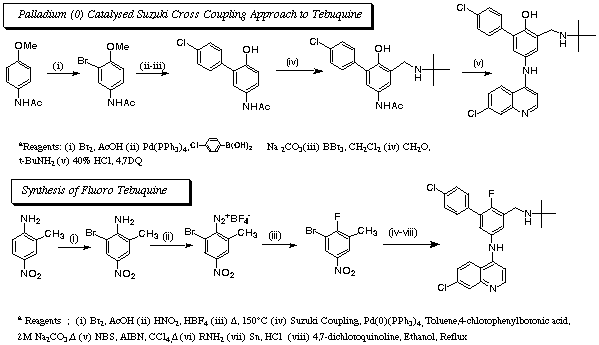
We are currently engaged in a programme of synthesis of novel 4-aminoquinoline antimalarial drugs. This programme is based on an interplay of chemistry, biology and modern molecular modelling techniques. Recent studies have focused on the antimalarial agent tebuquine (1). Tebuquine is a 4-aminoquinoline that is significantly more active than amodiaquine (2) and chloroquine (3) both in vitro and in vivo. We have developed a novel more efficient synthetic route to tebuquine analogues which involves the use of a palladium catalysed Suzuki Reaction. This chemistry can also be applied to the synthesis of a range of fluorinated derivatives of tebuquine (Scheme 1).
The novel analogues were subjected to testing against the chloroquine sensitive HB3 strain and the chloroquine resistant K1 strain of Plasmodium falciparum. Tebuquine was the most active compound tested against both strains of Plasmodia. Replacement of the 4-hydroxy function with either fluorine or hydrogen led to a decrease in antimalarial activity.
Figure 1 (a) Structures of 4-Aminoquinoline Antimalarials and (b) the Solvated Heme / Tebuquine Complex
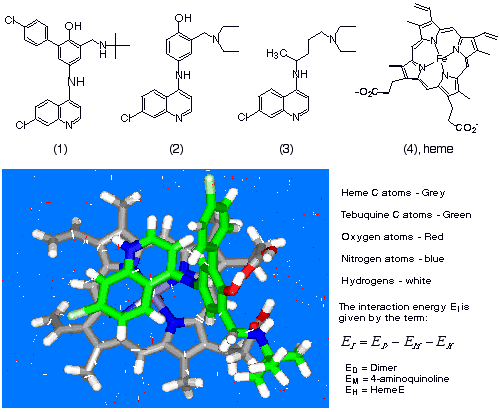
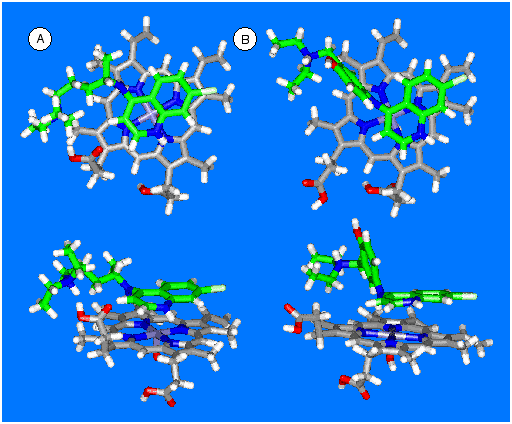
The mechanism of action of 4-aminoquinolines such as tebuquine is believed to involve complexation with heme (4) in the food vacuole of the parasite. We have carried out molecular modelling studies on heme-drug (Figure 1) complexes using MOPAC and have compared the antimalarial activity of a number of 4-aminoquinolines with their heme-drug interaction energies (see figure 2 for chloroquine and amodiaquine). Further studies are underway to investigate the activity of non-quinoline Mannich-base antimalarials.
Figure 2 Complexes of Heme with A) chloroquine and B) amodiaquine
Fluorine Substitution
The biotransformation of drugs and chemicals may lead to two major consequences, namely, (i) the detoxification of the chemical and its enhanced clearance from the body, or (ii) the activation of the chemical to reactive intermediates, forming electrophiles which may covalently bind to essential macromolecules. The bioactivation process frequently involves oxidation to a toxic intermediate. We have explored the effect of fluorine substitution as a means of blocking toxicity in drugs that are toxic through oxidative metabolism. Examples include the analgesic paracetamol and the antimalarial drugs primaquine, amodiaquine and tebuquine.
Selected References
1. Raynes, K.J.; Stocks, P.A.; O’ Neill, P.M.; Park, B.K.; Ward, S.A. "New 4-Aminoquinoline Mannich Base Antimalarials. 1. Effect of an Alkyl Substituent in the 5'-Position of the 4'-Hydroxyanilino Side Chain", Journal of Medicinal Chemistry,1999, 42, 2747-2751
2. O' Neill, P.M.; Hawley, S.R.; Bray, P.G.; Ward, S.A.; Park, B.K., "The 4-Aminoquinolines-Past, Present and Future-A Chemical Perspective", Pharmacology and Therapeautics , 1998, 77, 29-58
3. Hawley, S.R.; Bray, P.G.; Mungthin, M.; Atkinson, J.D.; O’ Neill, P.M.; Ward, S.A., "The Relationship Between Antimalarial Activity, Accumulation and Inhibition of Haem Polymerisation in Plasmodium falciparum In Vitro", Antimicrob. Agents Chemother, 1998, 42, 682-686
4. O’ Neill, P.M., Storr, R.C.; Park, B.K., " Synthesis of the 8-Aminoquinoline Antimalarial 5-Fluoroprimaquine", Tetrahedron, 1998, 4615-4622
5. Ruscoe, J.E.; Tingle, M.D.; O’Neill, P.M.; Ward, S.A.; Park, B.K., " Effect of disposition of Mannich Antimalarial Agents on Their Pharmacology and Toxicology", Antimicrob. Agents Chemother, 1998, 42, 2410-2416
6. O' Neill, P.M.; Willock, D.J.; Hawley, S.R.; Bray, P.G.; Storr, R.C.; Park, B.K., "Synthesis, Antimalarial Activity and Molecular Modelling of Tebuquine Analogues", Journal of Medicinal Chemistry , 1997, 4, 437-448
7. Hawley, S.R.; Bray, P.G.; O’Neill, P.M.; Park, B.K.; Ward, S.A., "The Role of Drug Accumulation in 4-Aminoquinoline Antimalarial Potency -the Influence of Structural Substitution and Physicochemical Properties, Biochemical Pharmacology, 1996, 52, 723-733
8. O’Neill, P.M.; Tingle, M.D.; Mahmud, R.; Storr, R.C; Ward, S.A; Park, B.K "The Effect of Fluorine Substitution on the Haemotoxicity of Primaquine" Bioorganic & Medicinal Chemistry letters , 1995, 5, 2309-2314
9. Jewell, H.; Maggs, J.L.; Harrison, A.C., O’Neill, P.M.; Ruscoe, J.E. ; Park, B.K., Role of Hepatic-Metabolism in the Bioactivation and Detoxication of Amodiaquine,., Xenobiotica, 1995, 25 , 199-217
10. O’Neill, P.M.; Harrison, A.C.; Storr, R.C. ; Hawley, S.R.; Ward, S.A., Park, B.K., "The Effect of Fluorine Substitution on the Metabolism and Antimalarial Activity of Amodiaquine" Journal of Medicinal Chemistry , 1994, 37, 1362-1370
11. Barnard, S; Storr, R.C.; O'Neill, P.M; Park, B.K., " The Effect of Fluorine Substitution on the Physicochemical Properties and the Analgesic Activity of Paracetamol", Journal of Pharmacy and Pharmacology, 1993, 45, 736-744