DRUG DESIGN AND MEDICINAL CHEMISTRY
Semi-synthetic Analogues of Artemisinin
(a) C-10-Carba Analogues of Dihydroartemisinin
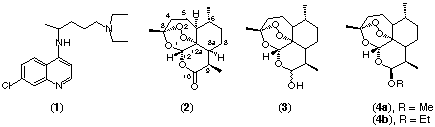
Despite efforts to eradicate malaria, the disease still affects approximately two billion people per year. The development of drug resistance by many strains of Plasmodium falciparum to the traditional alkaloid drugs chloroquine (1) and quinine has enhanced the prevalence of the disease throughout the world. The frightening spread of parasite resistance has led the WHO to predict that without new antimalarial drug intervention, the number of cases of malaria will have doubled by the year 2010. Artemisinin (2) (qinghaosu) is an unusual 1,2,4-trioxane, which has been used clinically in China for the treatment of multidrug resistant Plasmodium falciparum malaria. Reduction of artemisinin to the lactone-reduced dihydroartemisinin (3) (DHA) has led to the preparation of a series of semisynthetic first generation analogues which include artemether (4a, R=-Me) and arteether (4b, R= -Et).
However poor bioavailability and rapid clearance are observed with these analogues, principally as a result of the chemical and metabolic instability of the acetal function present in these derivatives. One of the principle routes of metabolism of artemether, for example, involves oxidative dealkylkation to DHA, a compound associated with toxicity and short half-life. Replacement of the oxygen at the C-10 position with carbon would be expected to produce compounds not only with greater hydrolytic stability, but also with a longer half-life and potentially lower toxicity. Consequently, a number of groups have developed synthetic and semi-synthetic approaches to C-10 carba analogues.
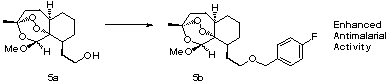
Since several researchers had previously observed that the presence of a liphophilic fluorine containing aromatic group promotes high antimalarial activity in the peroxide class of drugs, we decided to incorporate a fluorinated aromatic ring into our novel C-10-carba derivatives. A similar strategy for producing potent derivatives was reported earlier by Posner, who demonstrated that the antimalarial potency of the simplified trioxane alcohol 5a could be significantly improved by conversion to the benzyl fluoro ether derivative 5b. This compound was several times more potent than artemisinin .
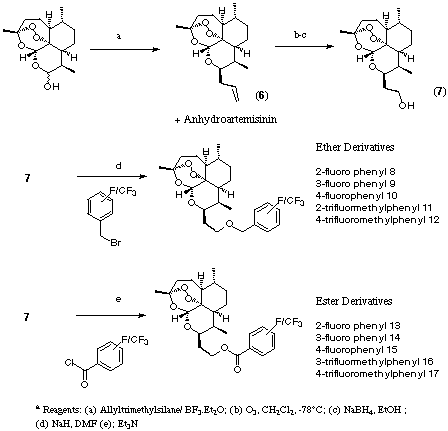
The fluorinated aromatic ring systems selected were linked to C-10 carba alcohol (7) by either an ester linkage 8-12 or an ether linkage 13-17 as shown in Scheme 1.
The key intermediate required for the synthesis of targets was the allyl deoxo derivative 6 (Scheme 1). Coupling of dihydroartemisinin with allyltrimethylsilane in the presence of BF3 etherate gave the required derivative 5 as a white crystalline product. The observed stereochemistry at the C-10 position was
b in line with the previous observation of Ziffer et al. The modest yield of allyldeoxoartemisinin 6 was attributed to the competing dehydration reaction and subsequent formation of anhydroartemisinin. The resultant alkene was subjected to a stream of ozone at —78°C for 30 minutes in CH2Cl2 and the subsequent ozonide was then treated with NaBH4 for 2h at 0°C in THF/methanol (9:1) (Scheme 1). The alcohol 7 was then deprotonated and reacted with a range of benzyl bromides to give the targets 8-12 (Scheme 1). Synthesis of the ester derivatives was achieved by standard esterification with the appropriate fluorinated acid chlorides to give the crystalline ester derivatives 13-17.Scheme 1
(b) C-10-Phenoxy Analogues
A possible alternative approach to increasing the metabolic stability of artemisinin derivatives involves incorporation of a phenyl group in place of the alkyl group (in the ether linkage) of first-generation analogues, e.g. (4a) and (4b). This chemical modification would be expected to prevent the in vivo oxidative dealkylation of artemether (Scheme 2).
Scheme 2

Recently, Suzuki and co-workers, investigated the O to C glycoside rearrangement of phenoxy glycosides. Different Lewis acid promoters have been used, including BF3 etherate, SnCl4 and Cp2HfCl2-AgClO4 with varying success. In 1992, Toshima discovered the efficient
b-stereoselective C-aryl glycosidation of 1-O-methylsugars by the use of a TMSOTf-AgClO4 catalyst system. This procedure gives excellent yields, and diastereoselectivity in favour of the b —isomer by rearrangement of the pre-formed phenoxy glycoside as shown (Scheme 3).Scheme 3

Such intriguing results led us to explore the use of TMSOTf-AgClO4 catalysis in our DHA-phenol coupling reactions. This approach involves dissolving 1 equivalent of DHA, approximately 2 equivalents of the desired phenol and one-fifth of an equivalent of AgClO4 in anhydrous dichloromethane, under nitrogen at —78 °C. TMSOTf (1 equivalent) is then added to the reaction mixture. In every case, the reaction provided excellent yields with good diastereoselectivity in favour of the beta isomers (Scheme 4). Notably, only minor quantities of AHA were observed (Scheme 3) and no O - to C —aryl glycoside rearrangement was noted for any of the phenoxy derivatives obtained (in contrast to the situation depicted in Scheme 3). The reaction was repeated for a range of phenols and yields are recorded in Scheme 4. The diastereoselectivity ratios were calculated from NMR data and the stereochemistry of the phenoxy derivatives was confirmed by X-ray crystallography .
Scheme 4
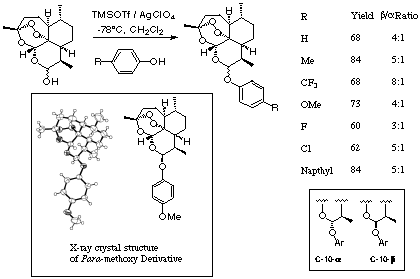
Several of these new phenoxy derivatives had potent antimalarial activity in vitro. Indeed, the p-trifluoromethyl-phenoxy derivative also had superior activity to artemether in vivo versus Plasmodium berghei. From metabolism studies, this derivative is not converted to DHA in vivo in rodents and therefore represents a novel lead for the development of a second generation peroxide antimalarial drug.
(c) Parasite-Targeted Artemisinin Derivatives
One of the principle aims of our SAR work is to investigate novel strategies to improve the antimalarial activity of peroxide containing drugs.
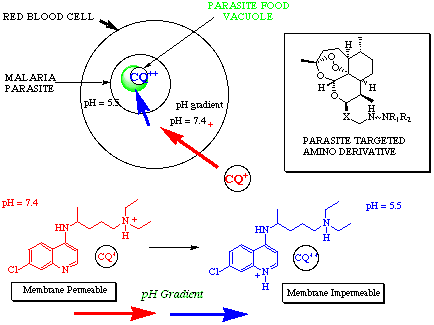
The mechanism of action of artemisinin is believed to involve an interaction with ferriprotoporphyrin IX ("heme") in the acidic parasite food vacuole which results in the generation of cytotoxic radical species. Based on this knowledge, several "mechanism-based approaches" have been investigated for improving the antimalarial activity of artemisinin derivatives. These include the incorporation of groups to enhance the stability of proposed "parasiticidal intermediates" and the covalent attachment of ‘iron chelator functionality" to enhance the interaction of the peroxide bridge with available "free iron" in the food vacuole of the parasite.The high intraparasitic accumulation, in the acidic parasite food vacuole, of the 4-aminoquinoline chloroquine is crucial for high antimalarial potency. The observed accumulation is achieved on account of the fact that the diprotonated form of this drug is impermeable to biological membranes. Based on this concept we have linked artemisinin to a range of different amine groups with the hope that this chemical modification will "drive"more of the peroxide drug into the "ferrous rich" food vacuole of the parasite. Once inside the vacuole, this increased concentration of drug should in theory be turned over to greater quantities of cytotoxic free radicals (Figure). In collaboration with the WHO, we are preparing a whole range of new amino containing peroxide drugs.
Figure 1 The Mechanism of Accumulation of Chloroquine in the Parasite Food Vacuole. Chloroquine travels down a pH gradient and inside the parasite becomes diprotonated. This form of the drug (shown in blue) is impermeable to biological membranes. On the right of the figure is a generic structure of a parasite targeted artemisinin derivative
References on Peroxide Antimalarials
1. O’Neill, P.M.; Bishop, L.P.; Searle, N.L.; Maggs, J.L.; Storr, R.C.; Ward, S.A.; Park, B.K.; Mabbs, F. The Biomimetic Fe(II)-Mediated Degradation of Arteflene (Ro-42-1611). The First EPR Spin-Trapping Evidence for the Previously Postulated Secondary Carbon Centred Cyclohexyl Radical., Journal of Organic Chemistry, 2000, 65,
2. Maggs, J.L.; Bishop, L.P.D.; Edwards, G.; O’Neill, P.M.; Ward, S.A.; Winstanley, P.A.; Park, B.K. Biliary Metabolites of
b-Artemether in Rats: Biotransformations of An Antimalarial Endoperoxide. Drug Met. Disp., 2000, 28, 209-2173. O’Neill, P.M.; Searle, N.L.; Wan, K.-W.; Storr, R.C.; Maggs, J.L.; Ward, S.A.; Raynes, K.; Park, B.K. Novel, Potent, Semi-synthetic Antimalarial Carba Analogues of the First Generation 1,2,4-Trioxane Artemether, J. Med. Chem., 1999, 42, 5487-5493
4. O’Neill, P.M.; Miller, A.; Ward, S.A.; Park, B.K.; Scheinmann, F.; Stachulski, A.V. Application of the TMSOTf-AgClO4 Activator System to the Synthesis of Novel, Potent, C-10 Phenoxy Derivatives of Dihydroartemisinin, Tetrahedron Lett., 1999, 40, 9129-9132
5. O’Neill, P.M.; Miller, A.; Bickley, J.F.; Scheinmann, F.; Oh, C.H.; Posner, G.H. Asymmetric Syntheses of Enantiomeric 3-p-Fluorophenyl 1,2,4-Trioxane Analogues of the Antimalarial Artemisinin. Tetrahedron Lett., 1999, 40, 9133-9136
6. Raynes, K.J.; Stocks, P.A.; O’ Neill, P.M.; Park, B.K.; Ward, S.A. New 4-Aminoquinoline Mannich Base Antimalarials. 1. Effect of an Alkyl Substituent in the 5'-Position of the 4'-Hydroxyanilino Side Chain, Journal of Medicinal Chemistry, 1999, 42, 2747-2751
7. Bishop, L.P.D.,; Maggs, J.L.; O’ Neill, P.M.; Park, B.K. Metabolism of the Antimalarial Endoperoxide Ro 42-1611 (arteflene) in the rat: Evidence for Endoperoxide Bioactivation. Journal of Pharmacology and Experimental Therapeutics, 1999, 289, 511-520
8. O’ Neill, P.M.; Searle, N.L.; Maggs, J.L.; Raynes, K.J.; Ward, S.A.; Maggs, J.L.; Park, B.K; Posner, G.H., A Carbonyl Oxide Route to Antimalarial Yingzhaosu A Analogues; Synthesis and Antimalarial Activity, Tetrahedron Letters, 1998, 39, 6065-6068
9. Park, B.K.; O’Neill, P.M.; Maggs, J.L.; Pirmohamed, M., Safety Assessment of Peroxide Antimalarials:Clinical and Chemical Perspectives, Brit. J. Clin. Pharmacol, 1998, 46, 521-529
10. O’ Neill, P.M.; Bishop, L.P.; Searle, N.L.; Maggs, J.L.; Bray, P.G.; Ward, S.A.; Park, B.K., The Biomimetic Iron-Mediated Degradation of Arteflene (Ro-42-1611), an Endoperoxide Antimalarial: Implications for the Mechanism of Antimalarial Activity, Tetrahedron Letters , 1997, 38, 4263-4266
11. O’Neill, P.M.; Bishop, L.; Hawley, S.R.; Storr, R.C.; Ward, S.A.; Park, B.K., Mechanism-Based Design of Parasite Targeted Artemisinin Derivatives; Synthesis and Antimalarial Activity of Benzyl and Alkylaminoether Analogues of Artemisinin , Journal of Medicinal Chemistry , 1996,39, 4511-4514