This covers sailing vessels built in the Solway: at Ravenglass,
Whitehaven, Harrington, Workington, Maryport, Allonby, Bowness, Port
Carlisle, Carlisle, Annan, the river Nith [Carsethorn, New Abbey,
Glencaple, Kelton, Kingholm], the Water of Urr [Kippford, Palnackie,
Dalbeattie], Kirkcudbright, Wigtown Bay[Bladnoch, Garlieston, Isle of
Whithorn], Luce Bay[Port William]. Dates 1810 to 1870 with detail;
list 1800 to 1900.
Steam vessels built Solway.
[*** under construction -- so far vessels
fully listed and wrecks mainly covered: some details still in progress
*** Please contact me if you can add/correct/...]
See also:
Early steam vessels in NW England;
Sailing vessels built Morecambe Bay;
Steam vessels built at Preston;
Sailing vessels built in the Ribble;
Steam Vessels built Liverpool and the Mersey;
Sailing Vessels built Liverpool and the Mersey;
Steam Vessels built in the Dee Estuary;
Sailing Vessels built in the Dee Estuary and N Wales.
Vessels built Isle of Man
MDHB wreck listings
Main index
Scope of vessels built in NW: 1800-60, number of vessels listed in
LR archives:
Liverpool 541; Whitehaven 223; Maryport 181;
Workington 169; Chester 123; Harrington 57; IOM 57; Runcorn 43;
Ulverston 36; Annan 31; Lancaster 25; Birkenhead 25; Preston 24;
Dumfries (Nith) 21 [Kelton 7; Glencaple 6]; Flint 18; Kirkcudbright
16; Bangor 12; Warrington 11; Conway 10; Frodsham 10; Northwich 10;
Beaumaris 9; Lytham 7; Barrow 7; Glasson 7; Mostyn 6; ...
List of number of vessels built in Solway and
nearby, 1857-1870, showing decline in wooden ship-building.
Port: Ravenglass; Whitehaven; Harrington; Workington; Maryport;
Bowness;
Carlisle; Annan;
River Nith; Water of Urr;
Kirkcudbright;
Wigtown Bay;
Luce Bay;
Ravenglass built vessels:
Cumberland of Whitehaven 140t 1735 armed 10 guns 18 men
Mary snow 137t 1742 reg Wh 163/1786, BU 1807
Speedwell, circa 1767
Hazard Sl 1829
Wooden sloop Hazard, built Pickthall & Falcon, Eskmeals, Ravenglasss, 1829, 38 tons. Sawyers' list of Maryport registered vessels in 1840, names builder as William White - probably the managing shipwright. Registered Maryport 2/1839, Newry 3/1854, ON12169. For sale at Newry, 1864. In MNL to 1867, owned Russell, Cardiff, registered Newry, 31 tons.
[from Cumberland Pacquet and Ware's Whitehaven Advertiser - Tuesday 05 May 1829]:
On Saturday last a very handsome sloop, built by and for Messrs
Pickthall and Falcon, was launched from a yard on Esk Meals on the
east side of the main road to Crosswater, at ten o'clock in the
forenoon, in the presence of at least 300 spectators,... She was
named the HAZARD, and is of nearly 50 tons burthen. It is upwards of
sixty years since a vessel was built in that neighbourhood. The last
was called the Speedwell, but the stocks on which she was constructed
were on the west side of the road, at a distance of a few hundred
yards from the place where the Hazard was built. ... history of
Ravenglass shipbuilding.
Whitehaven: Shipbuilders index;
Ship index by date.
Whitehaven (steam vessels here)
sailing vessel builders:
1814 summary; 1824 summary;
1828 summary;
1840 summary.
Unfortunately the Cumbrian newspapers for 1809 are not on BNA - so that year is less easy to research. An index to ship launches and sales in the newspaper Cumberland Pacquet to 1860 is available. A spreadsheet of some information from shipping registers is also available. Cumbrian registered 1811 and 1840.
Image
of a rescue to a shipwreck in Whitehaven harbour (circa 1826).
History,
with maps and 1828 list.
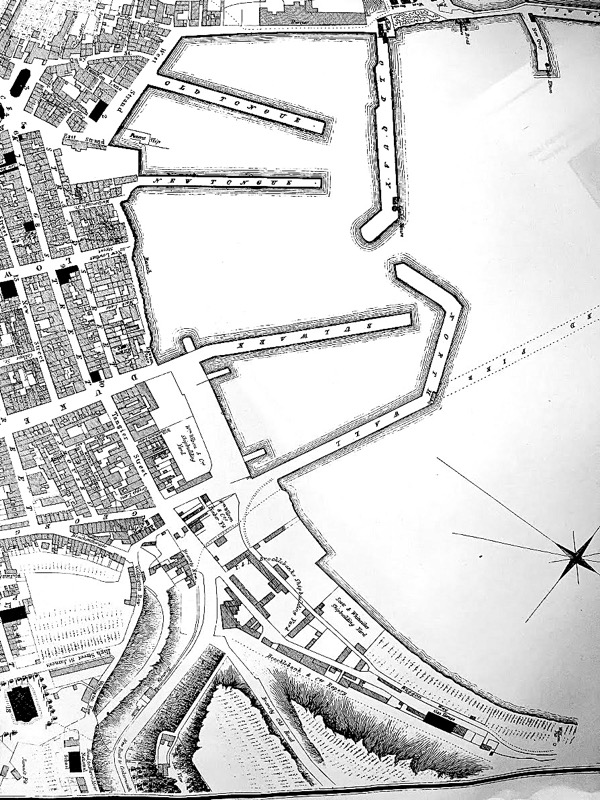
Whitehaven port 1832, showing Bowes, Wilson,
Brocklebanks, and Scott & Whiteside shipyards, not north-up.
Whitehaven Ship-builders:
Brocklebank, Daniel; then Thomas and John.
William Bowes
William Wilson, also Wilson & Walker.
Robert Hardy.
Whiteside & Scott.
Lumley Kennedy
Hugh Williamson
Whitehaven Ship Building Company
Other Whitehaven builders.
Unknown builder at Whitehaven
Wooden sailing vessels 1800-70, date index, built Whitehaven:
1800: Ariel; Active;
Cumberland; Mercury;
Thomas; Orion;
Albion; West Indian;
Diana; James;
Favourite; Whitehaven;
1801: General Hunter; Dryad;
Neptune; Eliza;
Alliance; Friendship;
Ann; Lightfoot;
Thetis; Dispatch;
Matty;
1802: Experiment;
Isabella; Britannia;
Augusta; Eleanor;
Successful Nancy; Martha;
Sarah;
1803: Volunteer; King George;
Commerce; Elizabeth;
Friends; Byam;
Industry; Liberty;
Minerva; Fortitude;
1804: Beaver; Queen Charlotte;
Sally; Clementson:
Mariner; Ant;
Dwina; Dale;
Resolution; Mercury;
Clyde; John;
1805: Hercules;
Fame; Louisa;
Mary & Isabella;
Susan; David Shaw;
Asgardstrand; Violet;
1806: Swallow; Chilham Castle;
1807: Ariel; Brown;
Clarendon; Lady Elizabeth;
Margaret; Brilliant;
1808: Dryad; Trelawney;
Jamaica; Westmorland;
Hope; Lady Caroline;
1809: Maranham; Balfour;
Whitehaven Lass; Mary Ann;
Europa;
1810: Caroline;
Earl of Lonsdale; Cumberland;
Martha;
1811: Nimble; Bransty;
Prince Regent; Antigua;
Friends; Comet;
Radcliff; Greenhow;
Julius Caesar; Wellington;
Nicholson; Hartley;
Watson;
1812: London; Mary;
William; Harmony; Scipio;
Ceres; Ocean;
Volunteer; Acasta;
Alert;
James; Minerva;
Abbey; Milham;
General Goldie; Mary;
1813: Cossack; Westmoreland;
Margaret & Frances; Aimwell;
Tobago; Aurora;
Vittoria; True Briton; Ann;
Bridget; Industry;
Caesar; Fame;
Peteral; Bridget;
Henry Hastings; Martha Brae;
Lady Arabella;
1814: Westmoreland; New Triton;
Foyle; Wilkinson;
Rambler; Two Sisters;
Ann; Duke of Wellington;
Emperor Alexander; Neptune;
1815: Antigua Packet; Princess Charlotte;
Jamaica; Alliance;
Brown; Ann;
Tolson; Waller;
Eleanor;
1816: Prince Leopold; Shammon;
Dryad; Supply;
Jane; Cumbrian; Betty;
Laurel;
1817: Constellation; Thetis;
Transit; Lady Gordon;
Barclay; Swallow;
1818: Doris; Zephyr;
Matilda; Atlantic;
Rosehill; Jason;
Lavinia;
1819: Perseverance; West Indian;
Nimble; Diana;
Despatch; Union;
Mary; William M'Gillivray;
Santon;
1820: Ariel; Candidate;
Cumberland; Hero;
Neptune; Triton;
Smyrna; Isabella;
1821: Crown; Rosina;
1822: Swallow; Globe;
Atalanta; Fortescue;
1823: Telegraph; Andes;
Cherub; Emerald;
Defiance;
1824: Whitehaven; Bolivar;
Manchester; Bransty;
Pacific;
1825: Affleck; Grecian;
Superior; Morton;
Margaret; Providence;
George Bentinck; Whitehaven;
1826: Gazelle; Courier;
Helvellyn; Enterprize;
Irton; Alert;
1827: Oberon; Express;
Lady Shaw Stewart;
1828: Gleaner; Dash;
Herculean; Irt;
Buoyant; Esk;
Magnet; Diamond;
Floraville;
1829: Maypo; Camilla;
Elizabeth;
Portenia; Margaret;
1830: Mite; Tampico;
Avoca; Bonanza;
Amethyst; Mail;
1831: Mackerel; Hindoo;
Mazeppa; Intrepid;
Ruby;
1832: Bransty; Patriot King;
Lord Althorp; Eclipse;
Perseverance; Unknown;
Pearl; Elizabeth;
1833: Mary Gordon; Jumna;
Vanguard; Lowther Castle;
Ino; Evergreen;
1834: Rimac; Earl Grey;
Ituna;
Watkins; Gunga;
Mercury; Mary;
Malcolm; John Dugdale;
1835: Cumberland; Alciope;
John Scott;
1836: Globe; Tigris;
Volunteer; Seymour;
Anne & Jane; Bleng;
Lady Bentinck; Penelope;
1837: Fairie; Dryad;
Mite; Elizabeth Buckham;
Siam; Frances;
Calder; Reaper;
Watson; Wasdale;
1838: Patriot Queen; Horsburgh;
Druid: Santon;
Nile; British Queen;
Capella; Earl of Lonsdale;
Sarah; Sarah Rawes;
1839: Aden; Swallow;
Harbinger; Ringdove;
Jane & Jessie; Elizabeth;
Diadem; Star;
Sirius; Woodville;
Water Witch;
1840: Kestrel;
Warlock; Champion;
Wilson; Syren;
Midge; Kyanite;
Elizabeth; Albion;
Industry;
1841: Princess Royal; Valparaiso;
Enchantress; Arequipa;
Bleng; Vicar of Bray;
1842: Callao; Camana;
Lanercost; Patna;
Ennerdale;
1843: Swallow;
1844: Unknown; Hyperion;
Inca; Emblem;
Robert Pulsford;
New Margaret; Thomas & John;
1845: Courier; Sir Henry Pottinger;
Menzies;
1846: Lord Hardinge;
1847: Crisis; Thomas Brocklebank;
Mary Spencer; Magician;
1848: Unity;
1849: Harold;
John Spencer; Sorata;
1850: Petchelee;
Walton Muncaster; Eagle;
1851: Arachne; Braganza;
1852: Martaban; Affghan;
John Peile; Pudsey Dawson;
Remark;
1853: Pizarro;
1854: Aracan; Miranda;
1855: Comorin;
John o'Gaunt; Valdivia;
1856: Herculean; Orontes;
1857: Eskett;
Mallard; Bolivia;
1858: Rajmahal; Sumatra;
Hannah Nicholson; Hematite;
1859: Juanpore;
Star; Excel;
Phaeton; James Bruce;
1860: Veronica;
Magellan; Belem;
Excelsior;
Ebenezer; Whitehaven Lass;
1861: Cambay; Tenasserim;
Banda;
1862: Burdwan; Ariel;
Anne Lowther; Tanaro;
Mary Nicholson;
Lady Lilford; Adamatine;
1863: Everest;
Tarragona; Bertie;
Ehen; Eugenie;
1864: Bowfell; Erato;
Christiana Davis;
1865: Mahanada; Island Maid;
James Davidson; Ann Humphreys;
1866: Ellen Ashcroft; Elizabeth Kelly;
1867: John Ewing; Trial;
Ann Middleton; Pearl;
1868: Viola; Miriam;
1869: Florist; Chrysolite;
1870: Jane Williamson; Maria;
Sea Mew;
1871: Beckermet;
Built D, then T & J Brocklebank, Whitehaven. [steamers here ]. Vessels built for Blocklebank's themelves, unless marked otherwise.
Information from Ship-builder's site: D Brocklebank; T & J Brocklebank; Brocklebank Fleet List; MNL; LR; Cumbria shipping registers; Newspapers;
Daniel Brocklebank moved from America to Whitehaven in 1775, as
master of his own boat, Castor. This was fitted out as a privateer.
He expanded in the following years into operating a fleet of ships,
and then into building them from around 1785, building about 26
vessels. Following Brocklebank's death in 1801, his sons Thomas and
John took over the business, which was incorporated as Thomas and John
Brocklebank.
The line's operations were based out of Liverpool and run by Thomas
Brocklebank, while John ran the Whitehaven shipyard until his death in
1831. The next generation of Brocklebanks, Thomas Jr. and Ralph,
became partners in the business in 1843, and the following year the
line reached its peak with a fleet of fifty ships.
In 1865 the shipyard at Whitehaven closed.
[from Cumberland Pacquet and Ware's Whitehaven Advertiser - Tuesday 06 July 1847]:
... The paper I hold in my hand contains a list of 51 vessels built at
our yard [Brocklebank] between February, 1827 and March, 1847, according
to which the average tonnage per year turned out by them is 614 tons;
that estimate includes the large vessels at present on the stocks.
Should the vessels be launched this year, they would amount to one
thousand tons. The tonnage of another vessel on the stocks is about
600 tons; it will be the largest vessel ever built by the firm. The
vessels are built for Messrs. Brocklebank's own use. Not more than
three out of the number of 51 were built for other parties.
Note that by the 1850s, their fleet contained some vessels built elsewhere than Whitehaven: Mindanao 1854 at Harrington and Florence Nightingale 1855 at New Brunswick.
Some of their vessels lasted very well: Patriot
Queen was in service over 50 years; Rimac rounded Cape
Horn 56 times without incident.
Alfred S 1796
Ariel S 1800
Active Bg 1800
Cumberland S 1800
Matty Sn 1801
General Hunter S 1801
Dryad S 1801
Experiment Sr 1802
Volunteer S 1803
King George S 1803
Beaver Bg 1804
Unknown 1804
Queen Charlotte Sw 1804
Hercules S 1805
Swallow Bg 1806
Ariel Bg 1807
Brown Sw 1807
Dryad Bg 1808
Maranham Bg 1809
Balfour Bk 1809
Caroline S 1810
Nimble Bg 1811
Bransty Bg 1811
London Bg 1812
Mary Bg 1812
William Bg 1812
Cossack Bg 1813
Westmoreland ? S 1813
Margaret & Frances Bg 1813
Aimwell Bg 1813
Tobago Bg 1813
Westmoreland Bg 1814
Duke of Wellington Bg 1814
New Triton Sl 1814
Antigua Packet S 1815
Princess Charlotte S 1815
Jamaica Bg 1815
Prince Leopold Bg 1816
Shammon Bg 1816
Dryad Bg 1816
Constellation Bg 1817
Doris Bg 1818
Santon Bg 1819
Perseverance S 1819
West Indian Sl 1819
Ariel Bg 1820
Candidate Bg 1820
Crown Bk 1821
Swallow Bg 1822
Globe Bg 1822
Telegraph Sr 1823
Andes Bg 1823
Whitehaven Bg 1824
Bolivar Bg 1824
Manchester Bg 1824
Bransty Sr 1824
Affleck Bg 1825
Grecian Bg 1825
Superior Bg 1825
Gazelle Bg 1826
Courier Sr 1826
Helvellyn Bk 1826
Lady Shaw Stewart Bg 1827
[Countess of Lonsdale PS 1827]
Oberon Bg 1827
Gleaner Sl 1828
Dash Sr 1828
Herculean Bk 1828
Irt Bk 1828
Buoyant Sr 1828
Esk Bk 1828
Maypo Bk 1829
Mite Sl 1830
Tampico Bg 1830
Avoca Bk 1830
Bonanza Sr 1830
Mackerel Cu 1831
Hindoo Bk 1831
Mazeppa Br 1831
Bransty Bg 1832
Patriot King Bq 1832
Lord Althorp Bg 1832
Mary Gordon Sl 1833
Jumna S 1833
Rimac Bg 1834
[Earl of Lonsdale PS 1834]
Earl Grey Bg 1834
Ituna Bg 1834
Globe Bg 1836
Tigris S 1836
Fairie Sl 1837
Dryad Bg 1837 (yd.112)
Mite Sl 1837
Patriot Queen S 1838 (yd.115)
Horsburgh S 1838
Druid Sr 1838
Santon Bk 1838
Aden Bk 1839
Swallow Bk 1839
Kestrel Bg 1840
Princess Royal S 1841
Valparaiso Bk 1841
Callao Bg 1842 (yd.125)
Camana Bg 1842
Lanercost Bk 1842
Patna Bk 1842
Robert Pulsford S 1842
Unknown Sr 1844
Courier Br 1845 (yd.131)
Sir Henry Pottinger Bk 1845
Crisis S 1847
Thomas Brocklebank S 1847
Harold S 1849
Petchelee Bk 1850
Arachne S 1851
Martaban S 1852
Aracan S 1854
Comorin S 1855
Herculean S 1856
Eskett Bn 1857
Rajmahal S 1858
Sumatra Bk 1858
Juanpore Bk 1859
Veronica Bk 1860 (yd.146)
Cambay S 1861 (yd.147)
Tenasserim S 1861
Burdwan S 1862
Ariel Sr 1862
Everest S 1863
Bowfell S 1864
Mahanada S 1865 (yd.153)
Wooden ship Alfred, built Daniel Brocklebank, Whitehaven, 1796, 314t. Owned Brocklebank, by 1836 whaling, crushed in ice, Davis straits, 3 July 1847, crew saved. More history
[from Hull Packet - Friday 17 September 1847]:
LOSS OF TWO WHALING SHIPS. THE BON ACCORD OF HULL, AND THE ALFRED OF
BONESS. SUBSEQUENT SUFFERINGS OF THE CREWS. We regret that we have
this week to record the total loss of two vessels, employed in the
Davis Strait Fishery - one the Bon Accord of Hull, commanded by
Captain Lee, and the other the Alfred of Boness. .... In addition to
the above, Mr. Robert Collinison, who arrived hero from Hamburgh, on
Wednesday, states that there were in that port fourteen of the crew of
the Alfred, who had arrived from Davis' Straits, via Copenhagen, and
reported that the whole of the crews of both the wrecked vessels were
saved, except one of the Bon Accord's, who died previous to her loss,
and another of the same crew by falling from an ice berg. Both were
Shetlandmen. [loss 3rd July, ships destroyed by ice]
Wooden ship Ariel, built D Brocklebank,
Whitehaven, 1800, 238 tons. Registered Whitehaven 5/1800. To Liverpool
October 1801. Owned Brocklebank, then Williams from 1803, Moss from
1804. Armed (14 then 18, then 12 guns).
LR (eg 1804-1810uw) has a
second ship Ariel, built Whitehaven in 1801, 256 tons, 20 6-pounders,
but this may be a typo; that vessel is listed as making a triangular
(slave) voyage 80362,
1804-5 owned Moss, master Payne, from Liverpool.
Newspaper
reports do not suggest that there were two different vessels named
Ariel. This vessel had a long life - being based at Liverpool,
Greenock, Ardrossan, then London. Voyage London to Madeira and
Demerara, disabled in a storm and abandoned, 19
January 1843, crew saved.
[from Cumberland Pacquet and Ware's Whitehaven Advertiser - Tuesday 14 January 1800]:
On Saturday last, a fine new vessel, called ARIEL, was launched by Mr. D.
Brocklebank, built for Capt. Fox.
[from
Morning Advertiser - Thursday 30 January 1840]:
TROON, Jan. 22. ... tremendous gale ... The Ariel, from Ardrossan to
Dublin, which sunk off the pier on the 19th instant, is breaking up.
[seems to have been repaired - reported in LR, with "Damage repaired
1841", 1840-2 with master Morris]
[from Lloyd's List - Thursday 04 August 1842]:
London: Cleared outwards, Aug 3. Madeira & Demerara, Ariel, Smith, 236.
[also reported as master Morris]
[from
Belfast News-Letter - Tuesday 31 January 1843]:
HAVRE JAN. 25 - The Ariel of Greenock, dismasted and a total wreck, was
fallen in with on the 19th inst. in lat. 49. 8. long. 11. 12. and
the crew taken off, and arrived here. [master Smith]
Wooden brig Active, built Thomas and John Brocklebank, Whitehaven, 1800, 131 tons. Registered Whitehaven 26/1800. Owned Brocklebank. Registered Whitehaven 40/1838, 134 tons. For sale at Whitehaven 1838, 134 tons, master Shilton. Listed as Whitehaven registered in 1840. In LR to 1840s Voyage Dublin to Whitehaven, ashore Ballyquintin Point, 30 September 1849, crew saved. More history (with a different conclusion).
[from Cumberland Pacquet and Ware's Whitehaven Advertiser - Tuesday 03 April 1804]:
FOR SALE by PRIVATE CONTRACT. ....
The Brigantine ACTIVE, 134 tons per Register not Four Years old.
Apply to THOMAS and JOHN BROCKLEBANK, Whitehaven.
[from
Cumberland Pacquet and Ware's Whitehaven Advertiser - Tuesday 09 October 1849]:
The Active, Murphy, from Dublin for this port, was driven on shore
on the 30th ult., on the rocks on Ballyquinton Point, east side of
Strangford Lough, and soon after became total wreck. Crew saved.
Wooden ship Cumberland, built Thomas and John Brocklebank, Whitehaven, 1800, 340 tons, armed (10 guns). Registered Whitehaven 43/1800. Owned Hartley. In 1810, a new Cumberland was built for Hartley, and this one was sold to Thompson, based Greenock. Voyage Jamaica to Greenock, struck rock off Rathlin and sank, 21 June 1815, crew saved.
[from Cumberland Pacquet and Ware's Whitehaven Advertiser - Tuesday 07 October 1800]:
Yesterday morning, a fine new vessel (for the West India trade) was
launched here by Mr. Thomas Brocklebank called the CUMBERLAND, the
property of John Hartley Esq & Sons.
[from
Bell's Weekly Messenger - Sunday 02 July 1815]:
Tuesday June 27.....
The Cumberland, Thompson, of and for Greenock, from Jamaica, was
becalmed the evening of the 21st instant, off Rathlin Island, drifted on a
sunken rock, and, on the following morning, broke up, previous to which,
Captain Fullerton, of the Wickham Revenue cruiser, had taken off the
crew and nine puncheons of rum, two bags pimento and three bags
coffee, which all that is expected be saved.
Wooden snow Matty, built Brocklebank, Whitehaven 1801, 163 tons. Registered Whitehaven 35/1801. Share for sale at Whitehaven 1803, as barque, master Michael Hutchinson. In storm, 4 January 1829, sought shelter at Piel island, but sank outside the bar.
[from Cumberland Pacquet and Ware's Whitehaven Advertiser - Tuesday 02 June 1801]:
On Tuesday last a fine new vessel was launched here by Messrs. Brocklebank,
called the Matty, built for Capt. Michael Hutchinson.
[from Cumberland Pacquet and Ware's Whitehaven Advertiser - Tuesday 13 January 1829]:
The following vessels put in to the Pile of Fouldry, the 4th inst.:
the Matty, Porteus, sunk outside the bar; Argo, inside bar with five
feet water in the hold; the Ocean, Burton, with damage and must
discharge; the Carrier, Cowman, and Industry, Atkinson, without much
damage; the Lark, Grayson, from hence for Whithorn.
[from
Gore's Liverpool General Advertiser - Thursday 22 January 1829]:
The Matty, Porteus, of Whitehaven, which grounded at Hilpsford, at the
entrance of the harbour of Pile of Foudry, on Sunday the 4th is likely
to become a total wreck. Her hull, as it lay, with lower masts
standing; and bowsprit, were to be sold on Friday the 16th. She had
imbedded herself on the shoal, and heeled over, and being heavily
laden with coals and flags, it was not probable that she could be got
off.
Wooden ship General Hunter, built Thomas and John Brocklebank, Whitehaven, 1801, 217 tons. Registered Whitehaven 26/1801. No report of launch found. Evidence of builder from Brocklebank fleet list. Owned Adamson 1803. For sale 1804, master described as late Adamson. Armed (2 4-pounders). Voyage Miramichi to Liverpool, with timber, captured and burnt by an American privateer, off Mizen Head, August 1814.
[from
Morning Post - Monday 22 August 1814]:
American Privateers. Crookhaven Aug. 18. ... York privateer of
Boston, of 14 guns and 140 men, commanded by Captain F Burch. .....
The ship General Hunter, W. Smith, with timber, from Miramichi, was
burnt last night, 20 miles South West from the mizen head by the above
privateer, and the master and crew also landed here; the privateer was
seen this morning.
Wooden ship Dryad, built Thomas and John Brocklebank, Whitehaven, 1801, 256 tons. Registered Whitehaven 73/1801. Owned Brocklebank, then sold 1805 to Taylor for London - Jamaica trade. Armed (3 3-pounders). Voyage London to Jamaica, missing from convoy 13 November 1806. Note: another Dryad was built 1808.
[from Carlisle Journal - Saturday 21 November 1801]:
On Thursday afternoon was launched from the building yard of Messrs.
Brocklebank, Whitehaven, a fine new vessel, called the Dryad, burden
256 tons.
[from Evening Mail - Friday 21 November 1806]:
..., the Dryad, Dawson, from London to Jamaica; sailed from Portsmouth,
11th inst. under convoy of the Blonde frigate; the former was missing the
12th, and the latter on the 13th.
Wooden schooner Experiment, built Thomas and John Brocklebank, Whitehaven, 1802, 108 tons. Registered Whitehaven 10/1802, 89 tons. Crew mutiny in 1806. In LR (so) to 1825. Voyage to Richibucto from Liverpool, abandoned at sea, 7 May 1824, crew saved.
[from Carlisle Journal - Saturday 27 March 1802]:
On Wednesday se'nnight, a fine new vessel, called the Experiment, was
launched at Whitehaven, from the building-yard of Messrs. T. and J.
Brocklebank. Voyage West Indies to Halifax, captain and mate killed by
mutinous crew, retaken by H M Flying Fish, 1805-6.
[from Cumberland Pacquet and Ware's Whitehaven Advertiser - Tuesday 25 February 1806]:
The brig Experiment (late Logan), one of the vessels that sailed with the
last howeward-bound fleet under convoy of the Diana frigate and Pelican brig, is
carried into Port Royal, Jamaica, by the Flying Fish schooner. The crew
having murdered the captain and mate, and taken possession of the vessel,
were making for Cuba, but were retaken by the Flying Fish.
[from
Star (London) - Tuesday 18 February 1806]:
The Flying Fish schooner, of 10 guns. Lieutenant Price, arrived on
Wednesday, with the American schooner Julian, from Dominica, for
Crooked Island, with rum, sugar, and coffee, detained by her; and the brig
Experiment, late Captain Logan, which sailed for Halifax, in company
with the last homeward bound fleet, under convoy of the Diana
frigate. The brig left this port with a crew chiefly composed of
foreigners. At night, when off Mole St. Nicholas, Capt. Logan, while
in the act of extending his arms to help his mate to some meat on the
supper table, had a knife plunged into his side by a Spaniard
attending. and instantly fell. The mate was dispatched by a handspike,
and the mutineers possessed themselves of the vessel, with an intention
of beating off. Something in the management exciting suspicion, the
Flying Fish ran down, boarded, and recaptured her, and the mutineers
were immediately taken out.
When the Experiment was boarded by the
boats of the Flying Fish, it was found that the Captain had been dead
about two hours, his skull was fractured, and there were five or six
knife wounds near his breast. The mate, who had upwards of fifteen in
the upper part of his body, expired about two o'clock the next
morning, and with his last breath declared, that a foreigner, French
or Italian. who has been brought in, was the murderer of the master,
and, he believed, the ringleader of the plot. On the approach of the
Flying Fish three of the a crew took to the jolly boat, but were run
down in it and perished; the second mate and three seamen are now on
board La Pique frigate.
[from
Bell's Weekly Messenger - Sunday 04 July 1824]:
New York, May 31. The Montano, Smith, arrived from Havre, boarded on the
7th inst. in lat. 46. lon. 30. the brig Experiment of Liverpool, masts
gone, half full of water, and no person on board.
[bound to Richibucto from Liverpool, crew saved]
Wooden ship Volunteer, built Thomas and John Brocklebank, Whitehaven, 1803, 354 tons, for Hartley of Whitehaven. Armed (12 guns). Master Barwise. For sale 1812. Owned Wallace & Co, Liverpool, master Ashley, for trade to Brazil. Captured by US frigate Chesapeake and sent into Portsmouth, N.H. where sold, before 9 April 1813. A new vessel of the same name was built in 1812.
[from Cumberland Pacquet and Ware's Whitehaven Advertiser - Tuesday 04 October 1803]:
On Friday morning, a new ship (one of the largest ever built in these
ports) was launched here, by Messrs. J. and T. Brocklebank. ... This
noble vessel, the property of Messrs. T. and M. Hartley, is called The
VOLUNTEER.
[from Cumberland Pacquet and Ware's Whitehaven Advertiser - Tuesday 11 August 1812]:
TO BE SOLD, by Private Contract, The ship VOLUNTEER; With all her Stores and
Materials, as she arrived from JAMAICA. She was built nine Years ago, by
Messrs. Brocklebank, for her present Owners; has been always
commanded, and kept in the highest Order, by Captain John Barwise, measures 354 Tons
per Register, ... Hartley ...
[from Star (London) - Tuesday 08 June 1813]:
The Chesapeake frigate, which arrived at Boston, on the 9th April,
made the following captures during her cruize, viz, brig Julia, from
Lisbon for Boston, with a British licence, arrived at Boston, and
condemned; ship Volunteer, from Liverpool to the Brazils, arrived at
Portsmouth, N. H.; brig Liverpool Hero, from Liverpool to the Brazils,
cargo taken out and vessel burnt ; brig Earl Percy, from Cape de Verds
to the Brazils, on shore at Long Island.
[from Maidstone Journal and Kentish Advertiser - Tuesday 08 June 1813]:
The cargo of the British ship Volunteer, prize to the Chesapeake frigate,
sold in the United States for 182,000 dollars, and the ship, which was
bought by the Government, for 10,000 dollars.
Wooden ship King George, built Thomas and John Brocklebank, Whitehaven, 1803, 264 tons. In LR1805uw, owned Brocklebank. Registered Whitehaven 47/1803. Report of launch 7 June. Evidence of builder from Brocklebank fleet list. Later sold to Rodie. Voyages reported to August 1833, as a barque, arriving Benin from Liverpool, master Cox, who is reported as dying there in July 1833. LR1835 has vessel marked "LOST". Return voyage Africa to Liverpool, master Tatham, put into Fayal, leaky, and wrecked at anchor there in a storm, 12 March 1834.
[from
Gore's Liverpool General Advertiser - Thursday 08 May 1834]:
Fayal, 7th April. The King George, Tatham, from Africa, arrived here
24th Feb. and having been surveyed, discharged part of her cargo. On
the 12th of March, during a heavy gale from N.E. she was driven with
three anchors ahead upon the rocks to the S.W. of the bay, & went to
pieces; the crew and part of the cargo remaining on board, about 143
casks of all sizes saved. The cargo of the King George is shipping on
board the schooners Vulcan, Sylph, and George IV, for Liverpool.
Wooden brig Beaver, built Thomas and John
Brocklebank, Whitehaven, 1804, 80 tons. [LR 1806uw has built
Workington, owned Brocklebank, but newspapers report Whitehaven].
By 1810 owned by master Forrest, last voyage found leaving Whitehaven for
Newry 22 February 1819.
Report of collier Beaver missing Workington to
Ireland, sailing 17 October 1819 - master Gilead, so probably
another vessel- built Chester 1761. A sloop called Beaver was
also
built at Ulverston in 1818.
[from Cumberland Pacquet and Ware's Whitehaven Advertiser - Tuesday 25 December 1804]:
Friday last, a fine new vessel was launched here by Messrs T and J
Blocklebank called the BEAVER.
[from
Morning Advertiser - Friday 19 November 1819]:
WHITEHAVEN, Nov. 15. The Apollo, Collis, sailed from hence the 22nd ult. for
Dublin, and the Lark and Beaver, coal laden, sailed from Workington
for Ireland the 17th ult. and have not since been heard of.
Wooden Unknown, built Thomas and John Brocklebank, Whitehaven, 1804, 225 tons, [possibly later named Queen Charlotte].
[from Cumberland Pacquet and Ware's Whitehaven Advertiser - Tuesday 03 April 1804]:
FOR SALE by PRIVATE CONTRACT. A New VESSEL, on the Stocks 225 Tons, Register
Measure, Copper-Bolted - May be launched in Two Months.
The Brigantine ACTIVE, 114 tons per
Register not Four Years old.
The brigantine EXPERIMENT, 89 tons per register, two years old .
Apply to THOMAS and JOHN BROCKLEBANK, Whitehaven
Wooden snow Queen Charlotte, built Thomas and John Brocklebank, Whitehaven, 1804, 211 tons. In LR1818uw, still owned Brocklebank, but trading Greenock to Antigua. Voyage Greenock to Jamaica, ashore on Scilly Rock (east of Bryher), 27 January 1815. 3 passengers and 1 crew lost, 13 crew saved.
[from Carlisle Journal - Saturday 16 June 1804]:
On Monday last, was launched from the building yard of Messrs T and J Brocklebank,
a fine new vessel, called the Queen Charlotte.
[from
Lloyd's List - Tuesday 07 February 1815]:
The Queen Charlotte, Rayside, from Greenock to Jamaica, was totally
wrecked on the night of the 27th ult. near Scilly. Three Passengers and
one Seaman drowned. Part of the Cargo saved, with damage. The remainder of
the Crew were taken off the Rocks by some Pilots from Sciliy, in which
service two them were drowned. [lost on rock called Scilly, 13 crew saved]
Wooden ship Hercules, built Thomas and John Brocklebank, Whitehaven, 1805, 301 tons, armed (6 6-pounders). Used for troop transport 1808-17. Sunk by collision off the Smalls, 12 November 1825. Crew saved.
[from Cumberland Pacquet and Ware's Whitehaven Advertiser Tuesday 19 November 1805];
Tuesday last, a fine, new, copper-bottomed ship was launched here, from the building
yard of Messrs. Thomas and John Brocklebank, called the HERCULES ;
pierced for 20 guns; and 360 register tonnage,
[from
Liverpool Mercury - Friday 25 November 1825]:
Ship Hercules, Kerr, from London for this port, was, on the
12th instant, off the Smalls, run on board of by the
sloop Ardent, Boyd, from London for Belfast. The Hercules was struck
in some weak part of her hull, and went down soon aftetwards. The
captain and the crew escaped in the boats, and landed in safety
at Swansea. The Ardent put into Falmouth on Tuesday week. She
carried away her bowsprit and injured her stern.
Wooden brig Swallow, built Thomas and John Brocklebank, Whitehaven, 1806. 114 tons. Owned Brocklebank. Sold 1809, owned Fisher. In LR, master Bell, until 1818, but voyages, Whitehaven - Jamaica, only found to 1816. Swallow is a common ship name.
[from Cumberland Pacquet and Ware's Whitehaven Advertiser - Tuesday 06 May 1806]:
Yesterday morning, a fine new vessel, called the SWALLOW, was launched
from the building yard of Messrs. T. and J. Brocklebank.
[Royal Gazette of Jamaica - Saturday 27 July 1816]:
The French Officers who, with the crew of the Dingwall, of Glasgow
(in all 24 persons), were taken out of that vessel on the 22d of November
last, a short time before she sunk, have presented Captain Bell, of
the brig Swallow, of Whitehaven, a trader to this island, with a
silver goblet, handsomely ornamented, and inscribed "Reconoissance au
Capt. John Bell," as a tribute of gratitude to their deliverer.
Whitehaven. Sailed 20 Jan 1816, Swallow, Bell, for Jamaica.
Arr Montego Bay, March 1816
[from Lloyd's List - Friday 14 February 1817]:
The Swallow, Mossop, from Savannah to Jamaica, was wrecked 10th
December last [1816], on the Reefs on the North Side of Eleuthera, Bahama
Islands. Capt. and Crew saved. [seems to have traded Jamaica to
Savanna - so a different vessel]
Wooden snow Brown, built Thomas and John Brocklebank, Whitehaven, 1807, 200 tons. Owned by her master, Fisher. Last voyage found with master Fisher: arriving Whitehaven from Jamaica 1810. In LR (uw) to 1811.
[from Cumberland Pacquet and Ware's Whitehaven Advertiser - Tuesday 24 February 1807]:
Yesterday afternoon, a fine new vessel, called The BROWN, was launched from the
building-yard of Messrs. T. and J. Bocklebank, intended for the West India Trade.
[from
Lloyd's List - Friday 13 July 1810]:
Whitehaven. July 8. arrived from Jamaica: Brown, Fisher
[15 Sept, 1810, Brown, Fell, arrived Jamaica from Whitehaven.]
Wooden brig Ariel, built Thomas and John Brocklebank, Whitehaven, 1807, 204 tons. Owned Brocklebank. Captured off Portland by French privateer March 1809.
[from
Cumberland Pacquet and Ware's Whitehaven Advertiser - Tuesday 08 December 1807]:
Tuesday last, was launched from the building yard of Messrs T and J Brocklebank,
a beautiful vessel (with her masts in) called the Ariel, register tonnage 204;
and will carry 350 tons.
[from
Bell's Weekly Messenger - Sunday 05 March 1809]:
The brig Ariel, of 200 tons and 12 guns, from Curacoa to London, was
taken off Portland by the Adventurer privateer, of Calais, after an
action, and carried into Cherbourg.
Wooden brig Dryad, built Thomas and John Brocklebank, Whitehaven, 1808, 215 tons. Lost August 1810 in St Mary's Bay, Newfoundland, 2 crew lost.
[from Cumberland Pacquet and Ware's Whitehaven Advertiser - Tuesday 11 October 1808]:
Yesterday sennight, a fine new ship, called the DRYAD, was
launched here, from the building yard of Messrs. T. and J.
Brocklebank.
[from Carlisle Journal - Saturday 20 October 1810]:
We are sorry to announce the loss of the Dryad, Gunson, of Whitehaven,
which happened about the middle of August last, in St. Mary's Bay,
Newfoundland, two of the crew (boys) lost.
Wooden brig Maranham, built Thomas and John Brocklebank, Whitehaven, 1809, 150 tons, owned Brocklebank. Voyage Whitehaven to Jamaica, wrecked Langness, Isle of Man, 16 December 1814. crew saved.
[from Lancaster Gazette - Saturday 11 March 1809]:
Monday night, A fine new vessel was launched from the building yard of
Messrs. T. and J. Brocklebank, of Whitehaven. She is called the
Marinham[sic], and sailed on Sunday, (six days after her leaving the
stocks) for the Brazils.
[from London Moderator and National Adviser - Wednesday 28 December 1814]:
The Maranham, Wise, from Whitehaven to Jamaica, was wrecked 16th inst.
near the Isle of Man. Crew and part of the cargo saved.
[from Carlisle Journal - Saturday 24 December 1814]:
The Maranham, of Whitehaven, Wm. Osborne. which sailed on the 10th
ult. for Cork (to join convoy for Jamaica), with a valuable cargo, is
on shore on the east side of Longhands Point [sic Langness], Isle of Man, and is
likely to go to pieces, crew and part of the cargo saved.
Wooden barque Balfour, built Thomas and John Brocklebank, Whitehaven, 1809, 310 tons, ON2275. Armed, traded to East and West Indies. registered Liverpool. 20/03/1865: Abandoned in a sinking condition in the Bay of Biscay, on a voyage from the Tyne to Cadiz with a cargo of coal & coke, crew saved. More history
[from Shields Daily Gazette - Saturday 01 April 1865]:
LOSS OF THE BARQUE BALFOUR OF NORTH SHIELDS. The barque Balfour,
Benham, of and from Shields for Cadiz (coal and coke), having
experienced heavy ales from SSE in the Bay of Biscay, and the vessel
having been struck with heavy seas, unshipping the wheel, filling the
cabin with water, and sweeping away the galley, was abandoned on the
20th ult. After the crew had been at the pumps for 50 hours, hoisted
the ensign, when the French schooner Jeanne, of Dunkirk bore down and
took them off and landed them at Dunkirk, the 29th inst. When abandoned
the Balfour had five feet water in her hold. The Balfour was 310 tons
register, built at Whitehaven in 1809, and was the property of William
Johnson, North Shields.
Wooden ship Caroline, built [probably] Thomas and John Brocklebank, Whitehaven, 1810, 237 tons. First appears in LR 1814, owned J Mitchell, armed (8 9-pounders) as built Whitehaven. In LR1818 owned Hancock. However, fleet list suggests it was a French prize. Voyage to Brazil, wrecked near Maranham, 29 October 1826.
[from Lloyd's List - Tuesday 19 December 1826]:
Maranham, 3d Nov. The Caroline, Cowman, from Liverpool, was wrecked
29th ulto. on the Atin Shoals, about three hours sail from hence. Crew and letter
bag saved.
Wooden brig Nimble, built Thomas and John Brocklebank, Whitehaven, 1811, 139 tons. Owned Brocklebank. Armed (6 guns). For London - Dublin trade. By 1820, owned Thompson for Hull - Wyborg trade. By 1830s registered Dundee. Stranded Loch Eriboll, with herrings in barrels, 5 March 1834, no further voyages found.
[from Cumberland Pacquet and Ware's Whitehaven Advertiser - Tuesday 26 March 1811]:
Saturday morning, a fine new vessel, called the NIMBLE, was launched
here, from the building yard of Messrs. T. and J. Brocklebank. She was
launched with her lower masts in; and is expected to sail for Jamaica, on
Sunday next.
[from
Inverness Courier - Wednesday 02 April 1834]:
PUBLIC SALE OF DAMAGED HERRINGS. There will be Sold by Public Roup,
at Cammisindown Bay, Loch Eribol, on Friday the eleventh day of April,
(if not previously disposed of) Five Hundred and Twenty-five Barrels
of White Herrings saved in a damaged state, from the Brig Nimble of
Dundee, stranded at this place on the 5th instant [March].
Wooden brig Bransty, built Thomas and John Brocklebank, Whitehaven, 1811, 104 tons. In LR1813uw as Branstey, owned Brocklebank. Voyage Whitehaven to Newport, ashore at Rush, Ireland, 9 January 1819, crew saved.
[from Cumberland Pacquet and Ware's Whitehaven Advertiser - Tuesday 24 September 1811]:
Thursday last, at noon, (and about the time of high-water) a fine new
vessel, rigged as a brigantine, (with her masts standing, &c ) was
launched from the building yard of Messrs. T and J. Brocklebank. She is
called The BRANSTY; is of the burthen of 104 tons, and calculated to
draw the smallest possible depth of water for that burthen.
[from
Carlisle Patriot - Saturday 16 January 1819]:
The Bransty, Edmondson, of Whitehaven for Newport, is on shore at Rush, in Ireland, and gone to pieces,
crew saved. [between Rush and Skerries]
Wooden brig London, built Thomas and John Brocklebank, Whitehaven, 1812, 351 tons, owned Brocklebank, then sold 1849. Registered Liverpool 56/1834, 351 tons, and 113/1847, then 194/1850, 511 tons (after a rebuild presumably). Listed in Liverpool register 237/1851, 511 tons, as condemned. In Marwoods 1854 registered Liverpool, owned Millers & Thompson, 442 tons. Last voyage found, Liverpool to Valparaiso, arrival reported August 1852.
[from Lancaster Gazette - Saturday 25 January 1812]:
Tuesday sennight, a fine new vessel was launched at Whitehaven, by
Messrs. Thomas and John Brocklebank, called the London; burthen about six
hundred tons, the largest brig ever built in a British port.
Wooden brig Mary, built Thomas and John Brocklebank, Whitehaven, 1812, 208 tons. By 1813 owned Penn; by 1814 owned Wilson, trading to Jamaica, etc. A very common ship name - so hard to track. In LR1833uw, owned Brocklebank, master Mann. At Cape Breton August 1833.
[from Cumberland Pacquet and Ware's Whitehaven Advertiser - Tuesday 29 September 1812]:
And in the evening [of Tuesday], another
fine ship was launched from the building-yard of Messrs T. and J
Brocklebank, called the MARY. And on Tuesday morning, another was
launched from the same building yard, called the WILLIAM.
Wooden brig William, built Thomas and John Brocklebank, Whitehaven, 1812, 237 tons. Launched September 1812. By 1816, owned by her master, Richardson, trading Liverpool to Berbice. By 1824 owned by her master, W Frazer, trading Liverpool to Newfoundland. Captured by a pirate, January 1825, but later recovered. For sale, repaired, Whitehaven 1825. By 1827 master Potts. Voyage Newry to New York, with passengers, condemned for having too many passengers aboard, sold, renamed Diamond of Perth Amboy (NJ).
[ffrom Public Ledger and Daily Advertiser - Tuesday 22 March 1825]:
The William, Frazer, from Porto Rico to Gibraltar, was taken by a pirate
on the 1st of January. [The master arrived at Gibraltar in the Danish brig Sun;
William, late Frazer, was at Gravesend 5 August 1825]
[from Cumberland Pacquet and Ware's Whitehaven Advertiser - Tuesday 25 September 1827]:
William, Potts, of this port, condemned at New York, for having
landed in the United States a greater number of passengers than the laws of
that country allow, was sold on the 17th July, stated in our paper of
the 11th inst. for 3,900 dollars - £855 sterling. She is now called the
Diamond, and belongs to Perth Amboy.
Wooden brig Cossack, built Thomas and John Brocklebank, Whitehaven, 1813, 172 tons (from local newspaper). However, LR1814so has Cossack, 172 ton brig, built Workington 1812, owned Brocklebank. Armed (8 guns). Newspapers report a larger (292 ton) Cossack built Workington 1814. LR1824uw has master Kerr, brig, 172 tons, built Whitehaven 1813, owned Brocklebank. Lost in River Plate Estuary, on English bank, prior to 28 April 1824.
[from
Cumberland Pacquet and Ware's Whitehaven Advertiser - Tuesday 09 February 1813]:
Thursday last, a fine new vessel called the Cossack, was launched from the
builkding yard of Messrs T and J Brocklebank.
[from New Times (London) - Tuesday 06 July 1824]:
FALMOUTH. JULY 3. - Arrived the Countess of Chichester
packet from Buenos Ayres; sailed 28th April, and from Monte Video
3d May; during the time she lay at Buenos Ayres, accounts reached of
the loss of the following vessels, viz.: The American ship Importer,
English brig Cossack, Kerr, from Liverpool, with dry goods, and a
brig, name unknown, on the English bank; a long boat has been picked
up with sailors' clothes in it.
Wooden brig Westmoreland (also Westmorland), built [probably] by Thomas and John Brocklebank, Whitehaven, 1813, 168 tons. Brocklebank fleet list has built 1813, 168 tons. Not found in LR. Launch not found in newspapers. [note Westmorland of 310 tons was built by Stitt at Whitehaven in 1808, and a later Westmorland was built by Brocklebank in 1814, probably to replace this one]. Sailed Newcastle to Archangel, arriving 26 July. On return, captured by a Danish privateer, 13 September 1813.
[from
London Moderator and National Adviser - Wednesday 15 December 1813]:
The Westmoreland, Morrison, from Archangel to Liverpool, was taken
13th September, by a Danish privateer, and carried into Bergen.
Wooden brig Margaret & Frances [also Margaret & Francis], built Thomas and John Brocklebank, Whitehaven, 1813, 90 tons, for Captain Welsh, later owned Captain Phillips. In LR to 1823.
[from
Cumberland Pacquet and Ware's Whitehaven Advertiser - Tuesday 04 May 1813]:
Saturday morning, a new vessel was launched here, by Messrs T and J
Brocklebank, called the MARGARET AND FRANCES built for Capt Hugh
Welsh.
Wooden brig Aimwell, built Brocklebank, Whitehaven, 1813, 257 tons. Owned Captain Bouch. Shares for sale 1839, master Wilson. Not in LR1839. Lost on Crooked Island, Bahamas, 6 December 1838.
[from Cumberland Pacquet and Ware's Whitehaven Advertiser - Tuesday 31 August 1813]:
Thursday last, two fine new vessels were launched here; one ....; the
other, by Messrs. T. and J. Brocklebank, called the AIMWELL, built
for Captain Bouch.
[from Carlisle Journal - Saturday 02 February 1839]:
The Aimwell, Wilson, of Whitehaven, from St. Jago de Cuba for Swansea,
was totally lost on Crooked Island, on the 6th December, crew saved.
Wooden brig Tobago, built Thomas and John Brocklebank, Whitehaven, 1813, 268 tons. Owned Brocklebank, then by 1816 owned Hartley. Sold to London 1818. For sale 1824 at London. Owned Hopper. Voyage Pugwash to London, traped in ice and driven ashore on Amity Island [Anticosti?], 24 May 1939, condemned.
[from Cumberland Pacquet and Ware's Whitehaven Advertiser - Tuesday 26 October 1813]:
Thursday last, a fine new vessel, called the Tobago, was launched here by Messrs
T and J Brocklebank.
[from The News (London) - Monday 04 January 1830]:
Whitstable, Dec.24. The ship which was on shore on the Spaniard Sand
yesterday, proves to be the Tobago, Reed, from Gaspee. She was
assisted off with the loss of an anchor and cable, and proceeds
to-morrow for London.
[from Bell's Weekly Messenger - Saturday 15 June 1839]:
Pugwash. May 3. The Tobago. Porrett, sailed hence 12th ult., for
London, became entangled in ice, in the Gulf, 24th was driven on shore
on Amity Island, and has been condemned and sold. Cargo saved.
Wooden brig Westmoreland (also Westmorland), built Thomas and John Brocklebank, Whitehaven, 1814, 195 tons. Owned Brocklebank. Then owned Owen, Porthmadoc by 1857. ON25791. In MNL to 1870, 189 tons. For sale March 1869 at Borth.
[from Carlisle Journal - Saturday 19 March 1814]:
A fine new vessel, called the Westmorland, was lately launched from
the building-yard of Messrs. T. and J. Brocklebank, of Whitehaven.
[from Liverpool Mercury - Tuesday 02 March 1869]:
Sale ... at Borth, Portmadoc. The Copper-fastened, Brig WESTMORELAND, of
Portmadoc, now lying at Borth for Inspection, register tonnage 188, and
carrying 300 tons dead weight. All her materials are in good condition,
and the vessel can be made ready for sea at a trifling expense. ...
[probably broken up]
Wooden brig Duke of Wellington, built Thomas and John Brocklebank, Whitehaven, 1814, 140 tons. Owned by her master, A Kerr. Voyage Liverpool to Bahia, ashore Rio Real, 6 September 1821.
[from Cumberland Pacquet and Ware's Whitehaven Advertiser - Tuesday 24 May 1814]:
Thursday last, a fine new vessel, called the Duke of Wellington,
was launched here, built by Messrs T and J Brocklebank.
[from
Cumberland Pacquet and Ware's Whitehaven Advertiser - Monday 03 December 1821]:
About 200 packages of goods, well as a number of articles loose, but
all more or less damaged, have been saved from the Duke of Wellington,
Kerr from Liverpool to Bahia, on shore at Rio Real.
[Liverpool Oct 31. lost main mast before going on shore - 30
leagues N of Bahia]
Wooden sloop New Triton (launched as Triton), built Thomas and John Brocklebank, Whitehaven, 1814. Not in Brocklebank fleet list. Not found LR. Probably name changed on sale, since there was an earlier brig Triton of Whitehaven, master Fox, built Maryport 1809, which returned from Antigua 1818, with master Henry Fox, dead. [Then probably that vessel went missing late 1818]. A vessel named New Triton starts trading from Whitehaven from 1815, master Beedon (various spellings), described as a sloop. Voyage Whitehaven to Ballyshannon, aground and lost 24 December 1823.
[from Cumberland Pacquet and Ware's Whitehaven Advertiser - Tuesday 18 October 1814]:
Friday last, a fine new vessel was launched here by Messrs T and J Brocklebank,
called the Triton.
[from Carlisle Patriot - Saturday 17 January 1824]:
The sloop New Triton, Smith, from Whitehaven was grounded at
Ballyshannon on the 24th ult. and has since gone to pieces.
Wooden ship Antigua Packet, built Thomas and John Brocklebank, Whitehaven, 1815, 272 tons. Owned Dawson. Registered Whitehaven 34/1838, 272 tons. ON9364. Later registered Liverpool, from 1860, barque, in MNL to 1864. Voyage Demerara to Workington, with timber, aground on Dumroof Bank, 18 October 1863, crew saved, Captainn Coleman presumed lost.
[from Carlisle Journal - Saturday 04 November 1815]:
Launched from the building-yard of Thomas and John Brocklebank, of
Whitehaven, a fine ship called the ANTIGUA PACKET, Captain Dawson, for
Antigua.
[from
Whitehaven Herald and Cumberland Advertiser - Saturday 24 October 1863]:
Dumries, Oct, 19. The Antigua Packet, Coleman, of Liverpool, from
Demerara for Workington, (greenheart), struck on Drumroof Bank,
yesterday morning at half past eight o'clock. The captain mistook
Maryport for Workington, and standing his ship across for the purpose
of getting back to what he considered Workington, and not being being
aware of his position, being early on the tide and blowing a gale, she
struck. The crew landed at Southerness on the Scotch side, about
ten o'clock, all being saved except the captain who refused to leave
the vessel until he got all his things with him, and as the vessel was
beginning to break up, crew would not wait. They took to the long
boat, and endeavoured to induce the captain to accompany them, but he
refused, saying he wished to save all his things. While the crew were
waiting in the boat under the lee of the vessel, the rudder and
sternpost of the latter were knocked to pieces, and her back stays
began to give way; the masts threatened to come down, and, in fact,
the vessel appeared as if about to part. The crew again sung out to
the master to come along, but he would not comply, and at length they
were obliged for their own salety to leave. There was a small boat
left with the ship, but whether the captain took to her after the crew
left has not been ascertained. The vessel could not be seen from
Southerness this morning, so it is feared she has become wrack. The
Antigua Packet belonged to Messrs Gatcliff and Co. of Liverpool, and
it is stated that she was not insured. The value of the cargo would be
something like £6000, and from the great weight of the timber
there is no chance of its recovery; it would sink with rapidity in the
sands of the Solway.
Wooden ship Princess Charlotte, built T & J Brocklebank, Whitehaven, 1815, or their own use, for trade to India. 515 tons, one of the largest vessels built at Whitehaven. Registered Liverpool. In LR to 1841. For sale 1847. Registered Scarborough 15/1847, later as a barque. Voyage West Indies to Britain, with mahogany, abandoned on Newfoundland Banks, 20 January 1854. Crew of 19 saved.
[from Carlisle Journal - Saturday 09 September 1815]:
On Wednesday was launched from the building-yard of Messrs. Thomas and
John Brocklebank, of Whitehaven, amidst the greatest concourse of
people ever witnessed, the fine ship, PRINCESS CHARLOTTE, burden about
900 tons. Her upper and lower deck beams have iron knees; most of them
4 cwt. a piece, weighing between 5 and 6 tons. The day was fine, and
the launch beautiful. She received her name from J. Hodson, Esq.
Captain and Adjutant of the Whitehaven Local Artillery; late of
Carlisle.
1815: the maiden voyage of the new ship Princess Charlotte to Calcutta was a success following the end of the East India Company's monopoly.
[from Liverpool Albion - Monday 22 March 1847]:
The fine British-built and copper-fastened Ship PRINCESS CHARLOTTE,
of Liverpool, 514, OM.. per register; built at Whitehaven by
Messrs. Brocklebanks and Co., for their own especial trade. She has a
flush deck, and between decks laid, and is strongly fastened with iron
knees. The old register tonnage is small when compared with the
new, and she carries one of the largest cargoes, in proportion to her
tonnage, of any vessel out of this port. She is now in good condition,
being well found, and has an extra supply of sails, and could be sent
to sea at a small expense. She underwent a thorough repair, last
August, by Messrs. White and Son, of Waterford, at a cost of £1,500,
having been refastened and doubled with 2.5-inch elm, and sheathed with
patent galvanized iron over patent felt. This vessel will be found
very desirable for the Cotton or Timber Trade. She has just returned from
Mobile, is perfectly tight, and is now lying in the Albert Dock,
Liverpool.
[from
North British Daily Mail - Thursday 09 February 1854]:
Arrived at Troon, on Monday morning, the ship Helen Thomson, of Ayr,
Captain Brown, from St John's, N.B. Sailed on the 9th ult., had very
stormy weather during the passage. On the 20th ult., she fell in with
the barque Princess Charlotte, of Scarborough, on the banks of
Newfoundland, bound to London, with mahogany from the Mosquito shore,
making water, rudder gone and disabled. Took off the captain,
officers, and crew, nineteen in number, and landed them safely at
Troon. The Helen Thomson came by the North Channel.
Wooden brig Jamaica, built Thomas and John Brocklebank, Whitehaven, 1815, 215 tons. Launched February 1815 from Brocklebank's yard, for Wilson Fisher. Bought back by Brocklebank 1824. Voyage Gotherburg to Liverpool, ashore at Brouwershaven Gut, before 19 January 1854, crew of 13 saved.
[from Shipping and Mercantile Gazette - Tuesday 24 January 1854]:
Sirs. I, the undersigned, George Fletcher, Commander of tha brig
Jamaica, belonging to the port of Liverpool, being on my voyage from
Gottenburg to Liverpool, stranded with my vessel, on the Dutch coast,
or Oosterbank, near the entrance of Brouwershaven Gut, would most
probably, with the entire crew, consisting of thirteen, have perished,
if we had not been courageously rescued in a most noble and
praiseworthv manner by the Schokker, belonging to the South Holland
Institution for the Preservation of Life from Shipwreck, established
in Rotterdam. We were most kindly treated, and rendered every
assistance our perilous situation demanded after being brought safe on
shore at Brouwershaven, for which, to God and man, I feel myself so
uncommonly obliged and thankful that I consider it my duty to
acknowledge this openly and beg you'll have the goodness to assist me
through the medium of the Shipping and Mercantile Gazette. ... GEORGE
FLETCHER, Captain of the brig Jamaica, Brouwershaven, Jan. 19. 1854
Wooden brig Prince Leopold, built Thomas and John Brocklebank, Whitehaven, 1816, 111 tons. Launched April 1816. Owned Brocklebank for trade to Brazil. Sold 1839. Registered Waterford 3/1839, 101 tons. ON14206. In MNL to 1868, owned Power, Waterford, 100 tons. Voyage Cardiff to Waterford, with coal, ashore St Patrick's Bay, 21 December 1867, crew saved.
[from
Waterford Chronicle - Friday 27 December 1867]:
Wreck of a Waterford Vessel. Saturday night, during fog, the brig
Prince Leopold, for Waterford, from Cardiff, coal laden, went ashore
in St. Patrick's Bay, on the sea coast of the county Wexford; crew
saved.
Wooden brig Shammon (also Shannon), built Thomas and John Brocklebank, Whitehaven, 1816, 161 tons, owned Hale & Co, master Hale for Liverpool - Ireland service. By 1844, owned Fletcher, Whitehaven. Voyage Dunlaoghaire to Whitehaven, driven ashore near Balbriggan, 2 November 1844, 3 crew drowned, 5 saved.
[from Ware's Whitehaven Advertiser - Tuesday 12 November 1844]:
The total loss of the brig Shammon, Collins, this port, during a severe storm
which visited the Irish coast on the 2d and 3d instant, the particulars
of which are as follows:
The Shammon sailed from Kingstown on Wednesday evening
the 30th ult., and had nearly reached this port when she was driven back by
the storm, and eventually went on shore about a mile north of
Balbriggan harbour, at twelve o'clock on Saturday the 2d instant, during s
vere gale with the wind at East. On the vessel striking, four of the crew
immediately landed in her own boat, leaving the captain, mate, and two of
the crew on board of the ill-fated vessel. At three o'clock she lay
over on her beam ends, and the four persons on board were seen
clinging to the main shrouds, the sea was so rough that no boat could venture
to their assistance. Soon after this the decks gave way, and along with
them the masts, when she turned nearly keel uppermost, and three of the number
board were precipitated into the water, one, a boy, came ashore on a
plank; the other two (the captain and a man) attempted to swim on
shore, but, melancholy to relate, were drowned. The mate was now the only
person remaining the wreck, and meeting with a hole in the bottom the
vessel, clung to it until assistance went from the shore, but not before
life had become nearly extinct. The utmost exertions were made by the
coast guard and the inhabitants to save the unfortunate mariners during
the raging of the storm, but their efforts proved of no avail. The Shammon
was 161 tons register, in first-rate repair, and launched at this port in
1816, by Messrs. Brocklebank.
Wooden brig Dryad, built Thomas and John Brocklebank, Whitehaven, 1816, 231 tons. Owned Brocklebank. Voyage Quebec to Whitehaven, foundered in Atlantic, 25 September 1830, crew saved.
[from
Cumberland Pacquet and Ware's Whitehaven Advertiser - Tuesday 05 November 1816]:
Yesterday was launched from the building yard of T. and J. Brocklebank, a fine new
copper bottomed vessel, called the DRYAD.
[from Gore's Liverpool General Advertiser - Thursday 05 November 1829]:
For PERNAMBUCCO, The very fine Brig DRYAD, David Power, Master; Burthen per
register 231 tons, sails fast, and is in all respects a desirable conveyance. For
freight or passage, apply to T. and J. BROCKLEBANK
[from Cumberland Pacquet and Ware's Whitehaven Advertiser - Tuesday 19 October 1830]:
Kilrush 1 Oct. The Dryad, Power, from Quebec to Whitehaven, upset during a gale on the 25th
ultimo, and the crew were picked up on the 28th, by the Edward, Atcheson,
arrived here from St. John's, N.B.
Wooden brig Constellation, built Thomas and John Brocklebank, Whitehaven, 1817, 187 tons. Launched 27 June 1817. In LR1819uw. Owned Brocklebank. Voyage Whitehaven to St John's, lost Nova Scotia, with 140 passengers - all saved.
[from Cumberland Pacquet and Ware's Whitehaven Advertiser - Tuesday 06 April 1819]:
PASSAGE to AMERICA. for St. John's, New Brunswick, The
remarkably-fast-sailing Coppered Brig CONSTELLATION. [Thomas Fell.
Master] A Commodious and Roomy Vessel, not Two Years and as she will
fitted up with convenient Births, PASSENGERS will find the Conveyance
most desirable. She will sail from Hence the latter End of APRIL.
Apply in the mean Time, on Board the Vessel, or T. and J. BROCKLEBANK,
Bransty. Whitehaven, 15 March, 1819.
[from Carlisle Journal - Saturday 24 July 1819]:
The Constellation, Fell, of Whitehaven, with 140 passengers, is lost
off the coast of Nova Scotia; passengers saved.
Wooden brig Doris, built Thomas and John Brocklebank, Whitehaven, 1818, 133 tons. Owned Jefferson. Voyage St Domingo to Falmouth, lost in Gulf of Florida, before 24 May 1825, crew saved.
[from Carlisle Journal - Saturday 27 June 1818]:
Yesterday week, a fine new vessel, called the Doris, burden 134 tons per
register, was launched from the building-yard of Messrs. T and J.
Brocklebank of Whitehaven
[from Cumberland Pacquet and Ware's Whitehaven Advertiser - Tuesday 24 May 1825]:
The Doris, White, from Aux Cays (St Domingo) for Falmouth and Antwerp, is
lost in the Gulf of Florida, Crew saved.
Wooden brig Santon, built Thomas and John Brocklebank, Whitehaven, 1819, 170 tons. In LR to 1822, owned Gaitskill. Voyage Whitehaven to Ireland, 11 December 1821, in gale, struck Bank off IOM and foundered. Only 1 survivor, 9 lost.
[from
Carlisle Journal - Saturday 24 July 1819]:
Last week a remarkably fine brig, called the Santon, 170
tons burthen, built for Captain gaiskell, and intended for the
foreign trade, was launched from the yard of Messrs T and J Brocklebank, Whitehaven.
[from
London Courier and Evening Gazette - Friday 14 December 1821]:
Whitehaven, Dec. 11. The Santon, Banks, sailed hence on the 6th instant
for Ireland, and experienced the same night a heavy gale at S.S.E.;
six hours after sailing she struck on King William's or the Bahama
Bank; the Captain and Mate were washed overboard; five of the crew
took to the boat, and left two on board, who went down with the vessel;
four out of five perished through cold and fatigue, and the fifth
had been picked up by some vessel and landed at Wigton, in
Scotland.
[survivor named Henry Banks; IoM Heritage
names those lost: Master, Banks; mate, Wm Turmer,; crew, B McBride; W Barrow;
William Hadden; Thomas McMeeking; Thomas Furnass; John Richardson;
and Archibald Allen; the wreck of the Santon drifted into Glen Luce Bay]
Wooden ship Perseverance, built Thomas and John Brocklebank, Whitehaven, 1819, owned Brocklebank. In LR to 1828, 512 tons, master Brown, trading Liverpool to Calcutta. Ashore near Narsapur Point, Bay of Bengal, 28 February, 1829, crew saved.
[from
Carlisle Patriot - Saturday 25 September 1819]:
Yesterday morning was launched from the building-yard of Messrs. Thomas
and John Brocklebank, a fine new vessel, called the Perseverance,
copper bottomed, with two decks, admeasuring per register 512 tons,
built for East India trade, and is supposed will carry one thousand tons.
She is the longest keel of any ship ever built in Cumberland ...
[from
Liverpool Mercury - Friday 16 October 1829]:
The ship Perseverance, of this port, was on shore on the 28th of
February, at Bandarmalankar, lat. 16 30 N. Bay of Bengal. On the 23d
of March she had 11 feet water in her hold, and was thumping heavily
on the sand. Captain and crew safe, but little hopes of saving the
cargo. [master Brown, Liverpool to Calcutta, lost Narsapoor Point]
Wooden sloop West Indian, built Thomas and John Brocklebank, Whitehaven, 1819,
for inter-island trade. 44 tons, wrecked 1839 in West Indies.
Wooden brig Ariel, built Thomas and John Brocklebank, Whitehaven, 1820, 154 tons, sold 1845, owned Liverpool. Probably vessel registered Liverpool 44/1844 142 tons. Voyage Rio de Janeiro to Bremen, stranded Langeoog 13 February 1849, crew saved.
[from Liverpool Shipping Telegraph and Daily Commercial Advertiser - Thursday 22 February 1849]:
NORDEN Feb. 14. The brig Ariel, Griffiths, from Rio de Janeiro for Bremen,
was stranded on the outer grounds off the island of Langeroog, 13th
inst.; crew saved.
Wooden brig Candidate, built Thomas and John Brocklebank, Whitehaven, 1820, 225 tons. Voyage Cape Verde to Buenos Ayres, with salt, aground near Punta Indio and Banco Ortiz, and abandoned, 12 June 1823.
[from Bell's Weekly Messenger - Monday 15 September 1823]:
Buenos Ayres, June 18. On the
12th inst. the brig Candidate, Bacon, from
the Cape Verdes, with a cargo of salt, took the ground in the mid channel,
between Pont del Indio, and the Ortes Bank, bilged, and was abandoned
by the master and crew, who arrived here yesterday.
Wooden barque Crown, built Thomas and John Brocklebank, Whitehaven, 1821, 297 tons, owned Brocklebank, for sale 1848. Registered Liverpool 149/1826, 293 tons, Lengthened and nearly rebuilt 1848-9. In MNL ON1964, 430 tons, registered Liverpool 11/1849. Voyage to Cameroon River, aground, got off, leaky, condemned, 11 June 1859.
[from Liverpool Standard and General Commercial Advertiser - Tuesday 04 July 1848]:
The Barque CROWN, she now lies in the Canning Graving Dock, No. 1 ;
292 83-94 tons per register, and following length, 97 feet, breadth 26
feet 9 inches, height between decks 6 feet. Built at Whitehaven, by
Messrs Brocklebank, of the best materials. The frame of the vessel is now
exposed to view, the ceiling under the holds having been entirely removed. For
further particulars, apply to Messrs. T. and J. BROCKLEBANK,
[from
Glasgow Saturday Post - Saturday 16 July 1859]:
Cape Coast, June 11. The barque Crown, in approaching the river
Cameroons, struck on the Dog Heads; got off the next day, after throwing all
her salt overboard, but making so much water that she could scarcely
be kept afloat, and was put on shore on the banks ot the river. The
principal portion of the dry goods were saved. The ship will be hove
down. [condemned]
Wooden brig Swallow, built Thomas and John Brocklebank, Whitehaven, 1822, 141 tons, owned Brocklebank. Voyage to St. Johns (Newfoundland) from Liverpool, departed 16 March, 1837, missing, bodies and long boat ashore, April 1837, at Fresh Water, south of Renews, Newfoundland. All 9 crew lost.
[from Carlisle Patriot - Saturday 04 January 1823]:
A fine new brig, called the Swallow, was launched from the building
yard of Messrs. Brocklebank, Whitehaven, yesterday week.
[from Carlisle Journal - Saturday 27 May 1837]:
The following heart-rending particulars are contained in a letter
dated on the 8th of April last, addressed by Mr. Goodridge, of Renews,
Newfoundland, to Messrs. M'Bride and Kerr, of St. John's. The
ill-fated vessel alluded to belonged to Whitehaven, and two of her
unfortunate crew, John Clucas and a man named Thompson, are natives of
the county. The former, a very promising young man, was carpenter on
board, and son of Mr. Clucas, ship carpenter, of Whitehaven. Thompson,
we understand, belongs to Workington. As the whole of the Swallow's
crew are supposed to have perished, the way in which the disaster
occurred, or the nature and extent of the sufferings on board previous
to the final unhappy event, will in all probability, never be
ascertained. Mr. Goodridge, who saw the dead bodies of the sufferers,
thus writes to his friends: "I lament to communicate the melancholy
fate of nine unfortunate men, supposed to be lost on Tuesday night, at
a place called Fresh Water, about six miles south of this. Nine dead
bodies discovered on Wednesday last, as also the wreck of a large
clinker-built long-boat. It appears they must have abandoned their
vessel for some time, as they were prepared for a long voyage in their
boat. They must have fallen in with the land in their boat during the
fog on Tuesday night, and run on shore in hopes to escape with their
lives. The cove being full of ice, with a tremendous sea running on
the shore, it would be impossible for any of them to land. The news
only reached this a few hours before. Some of their clothes were
marked 'A. M. Kean.' There seems no reason to doubt that the above
ill-fated vessel was the brig Swallow, Captain Alexander M'Kean, which
sailed from Liverpool on the 16th of March last, for St. John's,
Newfoundland. She was the property of Messrs. T. and J. Brocklebank,
and had a very valuable cargo on board.
Wooden brig Globe, built Thomas and John Brocklebank, Whitehaven, 1822, 212 tons. Armed. Voyage Liverpool to Bahia, wrecked near Bahia, 8 February 1835, crew saved.
[from
Manchester Mercury - Tuesday 01 October 1822]:
Intended to sail the 1st November, for Valparaiso and Lima. The fine
new and armed Brig, GLOBE. Joseph Pinder, Master. Burthen per register 212 tons,
built of the best materials, and particularly constructed for fast
sailing, has excellent accommodations for passengers, and is in all
respects most desirable conveyance. For freight or passage apply to T. and J.
BROCKLEBANK.
[from
Bell's Weekly Messenger - Monday 20 April 1835]:
Liverpool, April 10. The Globe, Mann, hence to Bahia, was wrecked near
the latter port 8th Feb. 80 packages dry goods, a few boxes of soap and
firkins of butter, saved; the vessel is reported to have gone to pieces
previous to 14th Feb., and it is feared nothing more will be saved from
her.
Wooden schooner Telegraph, built Thomas and John Brocklebank, Whitehaven, 1823, 111 tons. Owned Brocklebank. Voyage from Alvarado, lost off Havana, reported 21 April 1825.
[from Cumberland Pacquet and Ware's Whitehaven Advertiser - Monday 15 September 1823]:
The new schooner Telegraph, Dixon, sailed hence for Liverpool on Wednesday.
[from
Lloyd's List - Tuesday 26 April 1825]:
Liverpool. 21 April. The Telegraph, Dixon, from Alvarado, lost near the Havana.
Wooden brig Andes, built Thomas and John Brocklebank, Whitehaven, 1823, Registered Liverpool 8/1824, 217 tons. Owned Brocklebank. Voyage Bahia to Hamburg, wrecked Terschelling, 21 October 1852, crew saved.
[from Carlisle Patriot - Saturday 01 November 1823]:
A beautiful vessel was launched on the morning of the 21st ult. from
the building yard of Messrs. Brocklebank, Whitehaven, called the
Andes, burthen per register 215 tons; she sailed on the 25th for
Liverpool.
[from
Shipping and Mercantile Gazette - Saturday 30 October 1852]:
TEXEL Oct. 27 The brig Andes, Barnes, from Bahia
for Hamburg, was on shore on the outer grounds near Terschelling, 21th
Oct.; crew saved, vessel expected to be a wreck.
Wooden brig Whitehaven, built Thomas and John Brocklebank, Whitehaven, 1824, 203 tons. In LR to 1828, owned Brocklebank, master J Walker. Arrived Whitehaven 16 October 1826, from Cork and Quebec, master Walker. Note another vessel of this name, re-built 1825.
[from Carlisle Patriot - Saturday 08 May 1824]:
Monday morning, a very handsome vessel, burthen 203 tons, per
register, was launched from the building yard of Messrs. T. and J.
Brocklebank, called the Whitehaven, intended for the South American
trade.
Wooden brig Bolivar, built Thomas and John Brocklebank, Whitehaven, 1824, 204 tons, for sale 1826. Registered London 564/1836, 405/1847, 266/1851, all 212 tons. For sale September 1848. Remains in LR to 1853, registered London. In August 1850, there was a court case over payments between master (King) and owner (Greathead), concerning a voyage to St Vincent. Voyage Demerara to London, with rum and sugar, foundered, 28 November 1853, near Barbados.
[from Public Ledger and Daily Advertiser - Wednesday 09 August 1826]:
THE very superior brig BOLIVAR, A 1, 204 22-94 tons per register,
copper-fastened and coppered, built for private use, under particular
inspection, and of the best materials, by Messrs. Brocklebank,
Whitehaven, in 1824, sails remarkably fast, carries a large cargo, and
may be sent to sea with little expence beyond provisions. Her
dimensions are, length 90 feet 2; breadth 22 feet 9; depth in hold 15 feet
1. ...
[from Lloyd's List - Wednesday 05 May 1852]:
Entered outwards, May 4. St Vincent, Bolivar, Berryman, B 212 WID Scrutton.
[from Barbadian - Saturday 03 December 1853]:
The Brig "Bolivar," of and for London, from Demerara, laden with Rum
and Sugar, foundered on the night of the 28th November. Captain
Berryman, wife, and crew of eight men, were taken off by the Lady of the
Lake, after using every exertion to get her to Barbados.
Wooden brig Manchester, built Thomas and John Brocklebank, Whitehaven, 1824. Sold to Armstrong, Workington: by 1852, registered Workington, 7/1852, then 9/1854, 150 tons. ON1535. In MNL to 1874, brigantine. Voyage Liverpool to Dublin, 25 June 1873, ashore then beached at Egremont (Mersey).
[from Carlisle Patriot - Saturday 27 November 1824]:
On Saturday last was launched from the building-yard of Messrs. T. and
J. Brocklebank, Whitehaven, a handsome new copper-bottomed brig, of
about 160 tons register, called the Manchester, and intended for the
South American trade.
[from
Shipping and Mercantile Gazette - Friday 27 June 1873]:
Liverpool. June 26. The Manchester, Armstrong, hence for Dublin,
reported yesterday as beached at Egremont after being ashore, has
since filled.
Wooden schooner Bransty, built Thomas and John Brocklebank, Whitehaven, 1824. 130 tons. Launch reported 30 November 1824, for S America trade. Voyage Tampico to Liverpool, wrecked on Alacranes reef, 2 April 1830, crew saved. Another vessel named Bransty was built 1832.
[from Gore's Liverpool General Advertiser - Thursday 17 June 1830]:
Tampico, April 25. The Bransty, Dixon, from Liverpool for Tampico, was
cast away on the Alacranes (the coast of Yucatan), on the 2d inst. at
about two o'clock in the morning. The crew left the vessel without saving any
thing, and, fortunately, met with a Mexican schooner, which tooh them to
Campeache, where the captain made an engagement with the owner of the
island, that the half of the saved goods should be delivered to him
free of all expences at Campeache, and then returned with some of his
men to the Alacranes.
Wooden brig Affleck, built Thomas and John Brocklebank, Whitehaven, 1825, 237 tons, owned J Fell. Traded to Tobago. Registered Whitehaven. Launched 22 February 1825. In LR1841 marked "lost". Voyage Savanilla to Liverpool, wrecked on Tortugas, 30 April 1841, crew saved.
[from
Sun (London) - Monday 01 October 1838]:
Falmouth Sept. 28. The brig Affleck, of Whitehaven, Charter, Master,
from London, for Demerara, went on shore in a fog this morning, at
five o'clock, between the Blackhead and Coverack Pier, but was hove
off with the assistance of a pilot and others, and proceeded, supposed
without damage. [master Chester in another report]
November 1840, Loading Liverpool for Santa Martha, master Chester [sic, Banks]
[from Whitehaven Herald and Cumberland Advertiser - Saturday 19 June 1841]:
The Affleck, Banks, from Savanilla for Liverpool was wrecked on the
Tortugas on the 30th April, crew and part of the materials saved.
Wooden brig Grecian, built Thomas and John Brocklebank, Whitehaven, 1825. Launched 22 February 1825, for Capt L Bouch, for foreign trade, 235 tons. In LR to 1833, master Bouch; then master Joseph Bacon; then Whitley. For sale at Liverpool October 1833, owned Bouch. Voyage Liverpool to Cape of Good Hope, driven ashore off Liverpool, 31 DEcember 1833, master Salisbury, all hands lost.
[from
Gore's Liverpool General Advertiser - Thursday 17 January 1828]:
For MONTE VIDEO & BUENOS AYRES (Should the latter Port be open).
The remarkably fine Brig, GRECIAN, Lancelot Bouch, Master; 235 tons
per register, A 1 at Lloyd's, being nearly a new vessel, sails
fast, and in every respect a superior conveyance. ...
[from
Carlisle Journal - Saturday 11 January 1834]:
Storm... Liverpool, it has been most extensive. Innumerable
casualties have occurred; one steamer (the Vale of Clwyd) after
landing her passengers, was sunk the river, but raised without much
loss, and several vessels driven ashore and damaged. The tide rose
nine feet above its proper height. The most terrible loss was that of
the Grecian, a Whitehaven built vessel, recently sold out of this
port, which was wrecked on the banks, with a valuable cargo, and every
soul on board perished.
[from Lloyd's List - Friday 03 January 1834]:
Liverpool Jan 1. The gale continued throughout last night and the
greater part of today.
The Grecian. Salisbury, from hence to the
Cape of Good Hope, is totally lost and all on board drowned. Part of
the cargo washing on shore at the mouth of the River. [Grecian sailed
on Thursday 26 December, put back, wrecked Tuesday 31 December, ]
[from Westmorland Gazette - Saturday 25 January 1834]:
Court sessions.. on Friday week, five men were charged with stealing
a number of guns and spades from the wreck of the Grecian, ...
Wooden brig Superior, built Thomas and John Brocklebank, Whitehaven, 1825, 250 tons, ON23228, More history. Wrecked in storm at Vassilikos, Black Sea, 13 November 1859,
[from Lloyd's List - Friday 25 November 1859]:
VARNA, 24th Nov. ... Vassilikos,
Brigs, English SUPERIOR, Robertson; .... totally lost
[from Liverpool Shipping Telegraph and Daily Commercial Advertiser - Tuesday 20 December 1859]:
CONSTANTINOPLE Dec. 6. Captain John Robertson, of the brig Superior,
wrecked at Vassiliko (as previously reported), and the following,
being part of the crew, viz. Samuel Allen, chief mate; Peter Kuper,
John Carty, and Edward Quinn, have been forwarded to-day for England,
from the Constantinople Sailors' Home.
Wooden brig Dawson, Lloyds Register has only
one brig Dawson, built 1826 - and they report it as built Whitehaven.
However newspaper evidence states clearly that a brig Dawson was built 1826, by
Worthington at Skerton, Lancaster, and sailed from Whitehaven, owned Dawson, October
1826.
Wooden brig Gazelle, built Thomas and John Brocklebank, Whitehaven, 1826, 241 tons. Owned Captain Benn, for S American trade. Registered Liverpool 91/1826, 242 tons. Later traded to Australia. Voyage Sydney to London, wreckage picked up off Kent, 26 November 1850.
[from Westmorland Gazette - Saturday 18 March 1826]:
A handsome vessel of 242 tons register, called the Gazelle, was
launched on Saturday morning from the building yard of T. and J.
Brocklebank, Whitehaven; she was built for Capt. T. Benn, and
intended for the South American trade.
[from Shipping and Mercantile Gazette - Wednesday 27 November 1850]:
Ramsgate Nov 26. About nine or 10 tons of tallow were this morning landed here from the
smack Prosperity, of this port, which were picked yesterday between
the Kentish Knock and Long Sand. The casks are iron-hooped, and the
marks as follows: "Tattalia. Beef Tallow. Ravensworth. An anchor, S. R. & C. B. & C.
B. (underneath)" Also, the Sydney Morning Herald, July 6, 1850, addressed, Mr.
J. Thomson, Faylow, Bungendore and, very indistinctly, "John Brown,
Bowness, Cumberland, A man figure-bead was also seen, but not picked
up.
This Day, 2 45 p.m. Some papers relating to the Gazelle have been
picked up among tallow landing here, also her boat, bottom upwards [The
Gazelle, Ramsey, sailed from Sydney in the month of July for
London - Ed.]
Wooden schooner Courier, built Thomas and John
Brocklebank, Whitehaven, 1826, 142 tons, Launched 24 July 1826, schooner, for S
American trade. Sold 1845 to London. Not then in LR. A new vessel named Courier was launched in 1845.
Wooden barque Helvellyn, (launched as Meteor), built Thomas and John Brocklebank, Whitehaven, 1826, 240 tons. Owned William Boadle. Registered Whitehaven 162/1826, 241 tons, sold 1853, owned Harker, registered London 38/1855. ON26926. In MNL to 1864. Voyage Cardiff to London, struck bank off Dover, 9 January 1857, 1 man lost, 9 saved.
[from
Cumberland Pacquet and Ware's Whitehaven Advertiser - Tuesday 19 September 1826]:
A beautiful vessel was launched
on Friday afternoon last from the building yard of Messrs. T. and J.
Brocklebank, of 210 tons register, called the METEOR, built for Capt.
William Boadle, and intended for the foreign trade.
[from Cumberland Pacquet and Ware's Whitehaven Advertiser - Tuesday 07 November 1826]:
The name of the new vessel built at this port, and launched the 15th
Sept. last, for Capt. W. Boadle, is changed from METEOR to the HELVELLYN.
[from
Morning Herald (London) - Monday 12 January 1857]:
DOVER, Jan. 10. The Empress (mail steamer), from Calais to this port,
which arrived here this morning at 10.20, picked up in a boat, the
master, and eight men of the barque Helvellyn, of London, from
Cardiff, which had struck on the Ridge, but afterwards drew into deep
water, and sank: one man drowned. [cargo coal, lost previous night]
Wooden brig Lady Shaw Stewart, built Thomas and John Brocklebank, Whitehaven, 1827, registered Whitehaven 10/1827, 182 tons, then 2/1845. Not owned by the Brocklebanks. Was at San Francisco, master Roper, on 14 August 1850; in Liverpool graving dock to 20 February 1851. In LR1850, not LR1851.
[from Carlisle Patriot - Saturday 24 February 1827]:
On Friday last, a handsome new brig of 181 tons register, was launched
from the building yard of Messrs. T. and J. Brocklebank, Whitehaven, called the
Lady Shaw Stewart, built for Messrs. Henry Jefferson and Sons, and
intended for the Antigua trade.
[from Liverpool Shipping Telegraph and Daily Commercial Advertiser - Thursday 20 February 1851]:
Graving Dock. Brunswick. No. 1. Lady Shaw Stewart 90 Storm.
Wooden brig Oberon, built Thomas and John Brocklebank, Whitehaven, 1827. Launched Friday 23 November 1827. Registered Liverpool 29/1828, 150 tons, 34/1845. Sold 1845. Voyage Sierra Leone to Liverpool, departing 20 November 1846, missing.
[from Liverpool Mail - Saturday 20 March 1847]:
The Oberon, Tasker, sailed from Sierra Leone for Liverpool, November
20, and has not since been heard of.
Wooden sloop Gleaner , built Thomas and John Brocklebank, Whitehaven, 1828. Launched 31 March 1828. Wrecked near Ardwell Bay, south of Portpatrick, 23 February 1835, crew presumed lost.
[from
Whitehaven Herald and Cumberland Advertiser - Tuesday 10 March 1835]:
.. night of 22nd ...
On the following day, the sloop Gleaner of Whitehaven, was driven upon
the rocks near to Ardwell Bay, about ten miles to the south of Port
Patrick, with the loss of her spars, rigging, and sails. It is just
possible that the crew may have escaped in the small boat; but as
the vessel was on her beam ends when discovered, the worst fears
are entertained for their fate,
Wooden schooner Dash, built Thomas and John Brocklebank, Whitehaven, 1828. Launched 13 June 1828, 77 tons. Sold 1845. Registered Liverpool 1847, 77 tons, ON1403. Voyage Liverpool to Cork, ashore West Hoyle, 18 October 1855, crew saved.
[from Liverpool Albion - Monday 22 October 1855]:
The schooner Dash, hence for Cork, laden with Indian corn, is aground
on West Hoyle: crew saved by the lifeboat. [30 October, reported as went to pieces]
Wooden barque Herculean, built Thomas and John Brocklebank, Whitehaven, 128, registered Liverpool 2/1844, 317 tons, 329/1853. Launched 29 April 1828, for Calcutta trade. Returning from Akyab, put in to Mauritius leaky, 22 May 1855, and remained there. New vessel named Herculean built by Brocklebanks in 1856.
[from Lloyd's List - Tuesday 17 July 1855]:
Mauritius. Arrived. Herculean, from Akyab, for Liverpool, had heavy gales
27th April in 5 S, 87 E and sprung a leak. [master Penny]
[from
Shipping and Mercantile Gazette - Friday 26 October 1855]:
Akyab, Herculean, Penny, (March 24) Queenstown, at Mauritius May 22. Leaky.
[also reported to February 1856 - so presumably being repaired, or condemned]
Wooden barque Irt, built Thomas and John Brocklebank, Whitehaven, 1828. Launched 27 May 1828. Registered Liverpool 45/1844, Whitehaven 16/1849, 215 tons. ON25036, registered Sunderland by 1870. In MNL to 1884, brig 221 tons [listed as built Sunderland!].
[from Shields Daily Gazette - Wednesday 22 October 1884]:
Sunderland. The brig Irt, of Sunderland, passed Southend on Monday.
Wooden Schooner Buoyant, built Thomas and John Brocklebank, Whitehaven, 1828. Launched 20 September 1828, as a ketch, for the South American trade. 130 tons. Sold 1838. Voyage Kirkcaldy to Londonderry, with coal, strunk a rock (named as Skeirgeritich, near Glash Light, Lewis), 28 October 1843, crew and 2 passengers saved. [possibly Sgeir Griadach, near Eilean Glas LH]
[from
Northern Whig - Tuesday 31 October 1843]:
Arrived in our Lough [Belfast], yesterday afternoon, the brig Hammond, of
Belfast, Rainey, from St Petersburg to Liverpool. On Saturday,
Captain Rainey picked up the crew of the schooner Buoyant, of
Whitehaven, the schooner struck on a rock, near the Isle of Skye, and
was abandoned by the crew, who, with the Captain's wife and child, had
taken to the long-boat, and must inevitably have all perished, had not
the Hammond fallen in with them, as, very shortly after, the severe
gale of Saturday came on, which threw the Hammond on her beam-ends,
and obliged both her topsails to be cut sway, before she righted, and
will cause her to remain here, till she gets new sails.
Wooden barque Esk, built Thomas and John Brocklebank, Whitehaven, 1828.
Launched 27 October 1828, for South American trade.
Registered Liverpool 168/1828, 217 tons, ON25790. For sale 1855. Sold foreign 1855.
29 December 1855 Esk left Liverpool for Para, master Logenes. Last voyage found, at Riga
2 September 1857.
Wooden barque Maypo, built Thomas and John Brocklebank, Whitehaven, 1829. Registered Liverpool 83/1835, 174 tons, 224/1846, 51/1849, later London 77/1853, then Melbourne 157/1854. Launched 17 June 1829. First voyage August 1829 to Valapraiso, etc. Voyage Melbourne to Calcutta, wrecked King's Island, 28 May 1855, 4 crew lost.
[from
Glasgow Courier - Tuesday 04 September 1855]:
Melbourne, June 15. The Maypo, from Melbourne for Calcutta, was
wrecked on King's Island, 28th May. The master and three men were
drowned.
Wooden sloop Mite, built Thomas and John Brocklebank, Whitehaven, 1830, 54 tons, missing 1833. A new Mite was built 1837. Traded Whitehaven to Liverpool. Missing voyage from Whitehaven during gale of 19-20 February, 1843.
[from Bell's New Weekly Messenger - Sunday 10 March 1833]:
Whitehaven, 5th March. Among the vessels which sailed from this port
preceding the Gale of the 19th and 20th ult. the following are yet
unaccounted for: Aurora, Cannon; Union, Bibby; Despatch, Clark;
and Mite, M'Mullen. [Mite reported taking iron ore to Cardiff;
other three taking coal to Dublin]
[from here]:
William Sharp, whose father was a sailor in
Messrs Brocklebank's employ, and lost his life in one of Messrs
Brocklebank's vessels (the Mite) some years ago.
Wooden brig Tampico, built Thomas and John Brocklebank, Whitehaven, 1830, 129 tons, owned Brocklebank. Sold (as brigantine) 1839 and owned Harrington, registered Workington 3/1839. In August 1842, master changed from Winder to Greggs. Voyage Limerick to Glasson, with wheat, oats, etc, struck rock entering Sligo, 5 January 1843, only 3 of crew of 7 saved.
[from Cumberland Pacquet and Ware's Whitehaven Advertiser - Tuesday 14 September 1830]:
The Tampico, Sproule, sailed hence for Liverpool the 12th inst. This
vessel was launched on the 7th inst. from the building-yard of Messrs. Thos, and John
Brocklebank, and registers 129 50-94 tons.
[from Gore's Liverpool General Advertiser - Thursday 25 November
1830]:
For VERA CRUZ, Loading in Prince's Dock, The superior new Brigantine
TAMPICO, Benj. Sproule, Master; Burthen per register 130 tons; sails
remarkably fast, and is in every respect an excellent conveyance; her
accommodations for passengers are spacious, and fitted up with every
requisite for comfort and convenience. THOS. and JNO. BROCKLEBANK
[from Lloyd's List - Thursday 12 January 1843]:
Sligo, 9th Jan. The Tampico, Greggs, from Limerick to Glasson Dock,
struck on a rock in this Bay during the night of the 5th inst., and
became a total wreck; four of the Crew drowned; the Master and two men
saved. [master Greggs]
[from
Limerick Chronicle - Wednesday 18 January 1843]:
MELANCHOLY SHIPWRECK. The schooner Tampico, Gregg, of Workington,
laden with wheat, oats, and beans, from Limerick, and bound for
Glassondock, after having been on her beam ends, and lost binnacle,
with compasses, &c. was running for Sligo harbour on the night of the
5th inst. in a thick shower, struck on Harbowling [sic, Ardboline],
near Roughley Point, and became a total wreck. The master and two of
the crew were saved by a boat which put off from the Roughley [sic
Raghly] pilot station. Four of the sailors were drowned. Two of the
bodies were washed ashore, and an inquest held by Alexander Burrows,
Esq. on them. The following evidence was given: Thomas Curry, sailor,
who being sworn, saith that he was foremast man on board the schooner
Tampico, bound from Limerick to Glassondock, for which from (Tarbert
Roads,) he sailed in said vessel on the 2d of January, with a cargo of
wheat, oats, and beans, and that on the second day after leaving
Tarbert, the vessel sustained some damage in a gale, which obliged the
Captain to bear up for the harbour of Sligo, near which, off Roughley,
the vessel struck, at about 10 p.m. on the 5th in a fog, upon
Harbowling rock, upon which she remained for some hours, and went to
pieces; three of the crew. consisting of seven persons, namely, the
Captain. Wm. Gregg, the above named Thomas Curry, and Charles Jay,
having been saved; the remaining four, namely, William Cohen. the
mate, Simon Flanagan, James Curry, and James Walker were washed off
the wreck, and drowned; the deceased, Simon Flanagan, was washed
overboard about 5 o'clock, a.m. on the 6th ; the remaining three,
namely, William Gregg, Thomas Curry, and Charles Jay, having been
rescued by Thomas Carway and his crew in a boat. He states further
that they were so exhausted by fatigue and exposure to cold and wet,
that they could not possibly have survived much longer. Charles Jay.
one of the survivors who was on board of the Tampico, corroborated the
above statement.
Wooden barque Avoca, built Thomas and John Brocklebank, Whitehaven, 1830, 256 tons, owned Brocklebank. Registered Whitehaven 11/1830. Shares for sale at Whitehaven 1847. Reg closed 1858. [another vessel of the same name was launched at Waterford 1855]
[from
Cumberland Pacquet and Ware's Whitehaven Advertiser - Tuesday 02 February 1830]:
A new barque of 256 tons register, called the Evoke[sic, Avoca], was launched from
the building-yard of Messrs. Brocklebank at this port, on Thursday
last.
[from Lancaster Gazette - Saturday 08 May 1847]:
New Zealand. Auckland Nov 30 1846. The barque Avoca leaves here tomorrow with 350 tons
of copper ore, from the Kauau-mine, for Sydney, and sarsaparilla has
been found lately in great abundance.
[from Daily News (London) - Tuesday 13 September 1853]:
Barque Avoca, Crowner, master, 138 days from Cardiff, having been
wind-bound 28 days in the Straits of Conception; drove in with
westerly gales; foresail, topsail, and main spencer split and mizen
boom carried away. June 1. [Later arrived Valparaiso]
Wooden schooner Bonanza, built Thomas and John Brocklebank, Whitehaven, 1830, Described as a topsail schooner or brigantine. Registered Liverpool 127/1835, ON10510, 176 tons, later 47/1856. In MNL to 1857. Sailed 4 October 1856 from Porto Cabello for Rio Hacha, no reports found after that - so possibly went missing.
[from Gore's Liverpool General Advertiser - Thursday 08 April 1830]:
On Saturday last, a very handsome three-masted schooner called
the Bozanza [sic, Bonanza] of 176 tons register, was launched from the yard of Messrs.
Brocklebank, at this place, and intended for the foreign
trade.
Wooden barque Hindoo, built Thomas and John Brocklebank, Whitehaven, 1831, ON5609. Registered Liverpool to 1879, 266 tons Voyage Montreal to Liverpool, with petroleum oil, driven ashore near Crosby LH, 23 October 1862, 5 crew lost. Salvaged - since advertised for sale September 1863. In MNL to 1879.
[from
Gore's Liverpool General Advertiser - Thursday 20 January 1831]:
A fine new barque called the Hindoo, burthen 268 tons register
measurement, was launched from the building-yard of Messrs. T. and J.
Brocklebank, of Whitehaven, on Thursday last; she is intended for the
South American trade, and to be commanded by Capt. Joseph Pindar.
[from
Liverpool Mercury - Tuesday 28 October 1862]:
THE LOSS OF THE BARQUE HINDOO, INQUEST ON THE SUFFERERS. Yesterday
... coroner for this district of the
county or Lancaster, held an Inquiry at tke Blundeli Arms Inn,
Little Crosby, before a highly-respectable jury, touching the death of
John Andrew Johnston, aged 21 years, second mate of the barque Hindoo;
John Dawson, 28, carpenter; Thomas Neville, 48, and Patrick Carty,
28, able seamen; and William Ward, 14, all of whom were drowned early
on Wednesday morning, when the unfortunate vessel went ashore off
Crosby in the terrific gale which was then blowing. ...
Michael Murphy of Liverpool, Captain, said: ... At nine o'clock on
Wednesday evening I took a pilot at Point Lynas. His name was Shaw,
and he came from the pilot boat No. 3. We hove-to for the night, and next
morning, as soon as it had cleared a little, we ran, wearing
occasionally, but keeping a fair way. We made the north-west
lighthouse, and afterwards the bell buoy, as well as one or two of the
leading buoys. Feeling all confidence, I left the ship to the pilot,
retiring to change my clothes. We were then close upon thu bar, off
Formby. In a few minutes I found the ship being braced-up to the wind,
and I left the cabin, which was upon the deck, end remonstrated with the
pilot. He replied that the sea was too heavy on the bar for her to
cross with safety, and he added that he had not seen so heavy a sea
there.
I repeatedly told him that our only chance was to take the bar, and
that it would be our destruction to do otherwise. There was a heavy
gale of wind blowing at the time. In a few minutes I was in the fore
part of the round house, and the pilot was upon the top, when he sent
word that he wanted me. I went to him, and he then said - "We are
close on the bank now, and can't keep off much longer. What shall we
do?" I said it was what I had told him, and there was nothing for it
but to clew up the sails and let go the anchors; he concurred, and
that was done. Immediately, both anchors being run out. Whilst
furling, the ship struck heavily aft, and the starboard cable parted.
I called out to bear a hand down from aloft, and then ordered the
masts to be cut away. This was done promptly, the pilot and myself
both assisting. The ship proved to be filling fast, and was striking
heavily on the fall of each sea, the anchor at times coming away and
at other times holding. I thought it was about four o'clock when we
first let go anchor. We so waited on the chance of the tide relieving
us until about nine o'clock, when I concluded the only chance left was
to slip the remaining anchor and allow us to float ashore upon the
rising tide. After cutting away the masts, the pilot took no principal
part, but consulted with me, and appeared to concur in all that I did.
The anchor was slipped and we drifted shoreward bumping heavily with
every sea. The rudder had gone over on our originally striking, and
the ship went broadside to the sea, which washed directly over the
deck. We had commenced to unshackle about nine o'clock, and from about
ten o'clock were fairly adrift; we had no light on board. About 11 30,
as I thought, on the ship grounding all fast, the starboard side flew
out with a portion of the cargo, followed by the other on the next
sea, and I saw a dozen of the crew rush away from me, the mate at the
same time calling to me to save myself. I and two of the crew remained
on the deck, which was separated from the sides of the ship, and
continued to drift further to shore. The cargo was afloat about us.
The lifeboat then showed a light and hailed us; I returned their hail
and bade them come to leeward and we could come on board, I heard no
reply and I saw nothing of the boat. It is my belief she might have
saved all hands had she only boarded us. The deck gave way under me,
and my hands being covered with oil I had to be hauled up by the two
men on the deck. We proceeded to the round house, and then the sea
fell considerably and very suddenly. We next found we were on the bank
in only a foot or two of water. One of the men striking a match caused
the oil within and around the round house to ignite, and we found
ourselves unable to extinguish this. The clothes of the crew were
chiefly within this. Going towards this part of the deck, three of the
crew hailed us from the other portion of the wreck. and we assisted
them to join us. We could get no further answers to our hailing, This
was about one o'clock. We left the wreck and waded ashore, and went to
the Crosby Lighthouse, where we were received and well treated. In a
while we returned to the wreck from which it was said there was a cry,
and two officers, the light keeper, and three of ourselves went and
found the steward lashed to the wreck, and in a state of
insensibility. He was taken to the lighthouse and brought round; we
had previously found that five of the crew were missing, and these
must have been found after my leaving for Liverpool the same morning.
[from
Liverpool Journal of Commerce - Thursday 23 January 1879]:
Kinsale. Jan 21. The barque Hindoo, Irvine, with petroleum, for
Bristol, four days from Queenstown. has put in with loss of sails;
vessel making water; men exhausted. [later reported off Bristol 29 January]
Wooden cutter Mackerel, built Whitehaven 1831, ON17221. 23 tons.
Listed in Brocklebank fleet so presumed built by them. Registered Whitehaven 6/1850.
In MNL to 1899, smack registered Whitehaven, 17 tons, owned McLeod, Kyleakin.
Name suggests used for fishing.
More history.
Wooden brigantine Mazeppa, built Thomas and John Brocklebank, Whitehaven, 1831, ON2891, 134 tons. By 1862 reg West Hartlepool. In MNL to 1864. More history.
[from
Gore's Liverpool General Advertiser - Thursday 20 October 1831]:
For VERA CRUZ, The very fine new brigantine, MAZEPPA, 134 tons per
register, Joseph Witson, Master (Who is well acquainted with the the
Gulph of Mexico;) has excellent accommodations for passengers, and is
in every respect a first-rate conveyance. Apply to THOS. & JOHN BROCKLEBANK.
Wooden brig Bransty , built Thomas and John Brocklebank, Whitehaven, 1831, 99 tons, ON13121. Registered Whitehaven, in MNL to 1881. Voyage Whitehaven to Newport with oats, wrecked on Long Rocks, Dundrum Bay, County Down, 8th February 1881; all 4 crew saved.
[from
Gore's Liverpool General Advertiser - Thursday 23 February 1832]:
On Friday last, a handsome new brig called the Bransty, about 126 tons
was launched from the building yard of Messrs, Brocklebank, at
Whitehaven.
[from
Shields Daily Gazette - Wednesday 09 February 1881:
The: brigantine Bransty, of Whitehaven, bound to Penarth, laden with
oats, has been wrecked at Tyrella, County Down; crew saved by
lifeboat. The master broke his leg; the vessel will probably break up.
Wooden barque Patriot King, built Thomas and John Brocklebank, Whitehaven, 1832, 338 tons, ON1696, reg Liverpool, for sale May to July 1868. Reported broken up 1868.
[from Whitehaven Herald and Cumberland Advertiser - Tuesday 03 April 1832]:
A handsome barque was launched from the building of Messrs. T. and J..
Brocklebank, on the morning of the 31st ult., she was named PATRIOT
KING, and registers 339 tons, to be commanded by Capt. Joseph Pinder,
in the East India Trade.
Wooden brig Lord Althorp. built Thomas and John Brocklebank, Whitehaven, 1832, 233 tons. Probably launched as Renovator. Registered Liverpool 20/1832, ON1020, In MNL to 1861. Voyage Liverpool to Pernambuco, arrival reported September 1858, sailed 15 January 1859 for Liverpool. Probably went missing.
[from Liverpool Albion - Monday 09 July 1832]:
On Saturday week, a fine copper-fastened brig, called the Renovator was
launched from the building yard of Messrs Brocklebank, at Whitehaven,
burthen per register 233 tons, and intended for the South American trade.
[from
Lancaster Herald and Town and County Advertiser - Saturday 21 July 1832]:
The quickest passage ever known, we believe, between this port and
Liverpool, was made on Saturday, by the Lord Althorp, a brig which was launched
a few days ago by Messrs. Brocklebank, from their ship yard in
Whitehaven. She sailed at one o'clock, was off the light at Liverpool
by eight the same evening, and in dock by half past nine.
[from Gore's Liverpool General Advertiser - Thursday 30 August 1832]:
For CALCUTTA. The fine new Brig LORD ALTHORP, Having a large proportion
of her cargo engaged, will be quickly despatched; expected to sail
remarkably fast, and has very excellent accommodations for passengers. Apply to
Messrs T. & J. Brocklebank. [234 tons in other adverts]
Wooden sloop Mary Gordon, built Whitehaven
1833, listed as in Brocklebank fleet, 55 tons, but sold 1833, so
probably built by them. In the list of Whitehaven registered vessels
of 1840. Not found MNL. Newspapers report a sloop Mary Gordon of
Whitehaven trading Strangford to Belfast 1836-8.
Wooden ship Jumna, built Thomas and John Brocklebank, Whitehaven, 1833, registered Liverpool, 99/1833, 365 tons, ON25674, 1858 registered Dundee for whaling. An auxiliary screw engine was fitted 1862, but she was lost while whaling in lat 70 N, on 6 July 1863. Crew saved.
[from
Gore's Liverpool General Advertiser - Thursday 25 April 1833]:
Launch. Yesterday morning was launched fram the building yard of Messrs T.
and J. Brocklebank, of this town, in the presence of a vast body of
spectators, a magnificent ship called the Jumna, burthen 364 tons, The
Jumna is a first class vessel, built for the East India trade, and
like most of the vessels of this extensive house, is built for their
own use. She is coppered and copper-fastened, and of a build
calculated for speed as well as burthen. She is built on the model of
the Patriot King, launched from the same yard last year, only having
twelve inches more in the beam.
[from
Dundee, Perth, and Cupar Advertiser - Friday 09 October 1863]:
LOSS OF THREE WHALERS. A telegram has been received from Captain
Patterson, of the Pacific, of Aberdeen, advising the loss of that vessel,
and of the Lady Sale, of Hull, and the Jumna, of Dundee - crews all saved. The
three ships were all lost on or about the 29th of June, at which time
they would probably be making the hazardous crossing for Melville Bay.
The Pacific was a sailing vessel; the Lady Sale was a small screw
steamer; the Jumna, formerly a sailing vessel, was fitted with a screw
by Messrs Gourlay, of Dundee, last winter, and this was consequently
her first venture under steam to the whale fishing. This news came by
way of Copenhagen, and is particularly unfortunate, as there is a
great demand for, and great scarcity of, fish oil in this town, where
it is extensively used in some of the manufacturing processes
connected with the staple trade of the port.
[later report: Captain Deuchars, no whales caught, lost 6 July, crushed by ice, lat 75 10N]
Wooden brig Rimac, built Thomas and John Brocklebank, Whitehaven, 1834, 214 tons, ON26058. Registered Liverpool. Image, remarkably she was credited wth rounding Cape Horn 56 times without incident. For sale 1870. Owned Blyth. In MNL to 1875. Voyage to Blyth, ashore at Saltfleet, south of the Humber, 11 December 1874, crew saved.
[from Whitehaven Herald and Cumberland Advertiser - Tuesday 01 April 1834]:
On Wednesday, a very elegant brig, called the Rimac, was launched
from the building-yurd of Messrs. T. & J. Brocklebank. The Rimac is
intended to trade to the western coast of South America, and as a
large portion of her return freights is expected to consist of specie,
is a very superior vessel. She is constructed of the best materials,
elaborately finished, and with a profusion of copper fastenings, her
planking being African oak, her timbers English oak of large
scantling, and great care taken to ensure thorough ventilation. She is
very clean both in the stem and entrance, so as to sail swift, and carries
her breadth on deck more aft than has hitherto been usual in vessels
built on this coast. She is to be commanded by Capt. Dixon, who has
had great experience and success in the navigation of that part or the
world. We believe she is generally considered the most beautiful
vessel of her class ever launched in this port. [burthen 220 tons]
[from
Sunderland Daily Echo and Shipping Gazette - Friday 15 January 1875]:
INQUIRY INTO THE LOSS OF THE RIMAC, OF BLYTH. Yesterday, the inquiry
instituted by the Board Trade, into the stranding the brig Rimac, Blyth,
the morning of the 11th December, Saltfleet, was resumed at the North
Shields Policecourt, before Ald. Green and Mr. Jos. Robinson, assisted by
Captain Hight and Captain Foster, nautical assessors. Mr. V. Hamel appeared
for the Board of Trade. John Farrow, able seaman, gave evidence, and stated
that the lead was used several times on the passage home. He did not see
it used a few hours before the ship struck, but he was told the lead
was thrown out when he was below. When the ship struck the weather was
hazy below and clear above. The crew walked ashore. .... [Master William Heron
judged in default and certificate suspended for two years]
Wooden brig Earl Grey, built Thomas and John Brocklebank, Whitehaven, 1834, ON1915, 242 tons, registered Liverpool 175/1832, sold 1860, owned Kirkcudbright; 1873 reg Glasgow, Voyage Glasgow to Lisbon, 2 March 1873, foundered off Ushant, one life lost.
[from
Whitehaven Herald and Cumberland Advertiser - Tuesday 29 July 1834]:
On Tuesday last, a very handsome brig, burthen 242 tons,
was launched from the building yard of Messrs. T. & J.
Brocklebank, of this town, and named the Earl Grey in honour
of our late distinguished premier. ... [for China trade]
[from
Liverpool Daily Post - Friday 12 January 1872]:
The Earl Grey, from Huelva for Lisbon and Glasgow, is at Cadiz, making 12 inches
of water per hour.
[from
Liverpool Journal of Commerce - Monday 10 March 1873]:
CASUALTIES, &c. The Earl Grey, for Lisbon, sunk 60 miles SW of Ushant.
Crew, except one, saved.
Wooden brig Ituna, built Thomas and John Brocklebank, Whitehaven, 1834, built for A Bell & Co. Registered Whitehaven 4/1834. 222 tons. ON24875. In MNL to 1874, owned Wm Kelly, Whitehaven. Voyage Doboy, GA, to Liverpool with timber, aground, leaky, abandoned 25 January 1874.
[from
Whitehaven Herald and Cumberland Advertiser - Tuesday 18 November 1834]:
On Wednesday last, was launched from the building yard of Messrs. J. &
T. Brocklebank, in this town, for Mr. A. Bell and owners, a handsome
new brig, named the Ituma, burden 221 tons. The Ituma [sic, Ituna] derives her name
from the appellation given by the ancient geographers to the estuary
of the Solway. Having named the builders, we need scarcely add that
she is in every respect an admirable vessel, fully equal to any ever
launched in this port, both in materials, workmanship, and draught.
Her first voyage, we believe, will be to Antigua.
[from
Manchester Evening News - Saturday 07 March 1874]:
INQUIRY INTO THE LOSS OF THE ITUNA OF WHITEHAVEN. A Board of Trade
inquiry into the loss of the brig Ituna, Whitehaven, which, having
been stranded, at Doboy and sprung a leak, was abandoned by the crew on a
voyage from Doboy to Whitehaven, with a cargo of pitch pine timber, was
opened the magistrates' courtroom, Whitehaven, on Tuesday, and
terminated on Thursday. The decision of the court was that the master,
James Smith, had committed a wrongful act in shipping the deckload
without having taken any proper steps to examine the ship after the
stranding; and, bearing in mind the nature of the voyage and the
season of the year, they thought this wrongful act rendered necessary
the abandonment of the ship, and they therefore suspended his
certificate for three calendar months.
Wooden brig Globe, built Thomas and John
Brocklebank, Whitehaven, 1836, 232 tons, ON1073. Registered Liverpool 292/1836.
To Whitehaven from 1863. In MNL to 1907, registered Whitehaven, owned Carlingford,
reg closed 1907.
Image[from Newry Reporter - Thursday 16 December 1937].
[from Cumberland Pacquet and Ware's Whitehaven Advertiser - Tuesday 27 September 1836]:
A very handsome new vessel of 253 tons register measurement, called
GLOBE, was yesterday launched from the building of Messrs T. and J
Brocklebank, this port, and intended for the foreign trade.
Wooden ship Tigris, built Thomas and John Brocklebank, Whitehaven, 1836, 424 tons, ON1079, registered Liverpool 224/1835. Wrecked by hurricane at Manila, 27 October 1865.
[from
Whitehaven Herald and Cumberland Advertiser - Tuesday 26 January 1836]:
On Tuesday last, was launched from the building yard of Messrs. T. & J.
Brocklebank, a splendid new ship, called the TIGRIS, registerirg
upwards of 432 tons. The Tigris is generally considered to be the finest vessel ever
launched in this port.
[from
Shields Daily News - Wednesday 29 November 1865]:
DREADFUL HURRICANE AT MANILA. On the 26th and 27 ult, a fearful
hurricane, passed over Manila, doing so much damage to the shipping,
and also to the buildings and vegetation. The barometer indicated a
falling of the mercury on the 25th, and the next day a more rapid
decline took place. At four o'clock on the morning of the 27th the
lowest point was attained, the mercury having fallen altogether
six-tenths. The gale commenced about midnight of the 26th and 27th, and
was at its greatest strength from 4 am. to 7 a.m. of the 27th and
gradually subsided during the day, The destruction of native houses
has been great, and many substantial buildings have sustained damage.
Trees of large size were torn from the ground, and it is feared that
much destruction has been caused to the crop of sugar cane, &c. The
casualties in the bay were numerous. The following vessels were driven
on shore: The British ship Tigris, British barque Sabrina, Dutch
barque Commissaris des Koning van der Heim. Will probably not get off.
The British barque Margaret Wilkie was obliged to cut away her masts.
Almost all the vessels in harbour damaged.
Wooden brig Dryad, built Thomas and John Brocklebank, Whitehaven, 1837, ON7070 yd.112. Registered Liverpool 81/1837, 252 tons. More history, stranded Manacles 1894.
[from
Carlisle Journal - Saturday 21 January 1837]:
On Thursday last, a splendid new vessel of 202 tons register
measurement, called the DRYAD, was launched from the building yard of
Messrs. Brocklebank, at Whitehaven. She is intended for the South
American trade, and will be commanded by Capt. Askew, late of the
Hindoo.
[from
Exeter and Plymouth Gazette - Monday 03 December 1894]:
RESCUE BY A CORNISH LIFEBOAT The brig Dryad, of Whitehaven, bound from
Teignmouth for Glasgow with a cargo of china clay, was wrecked on the
Manacles Bocks, off the coast of Cornwall, on Friday morning. On
intelligence of the casualty reaching Porthoustock, the lifeboat
Charlotte, belonging to the Royal National Lifeboat Institution, was
launched within ten minutes of the information being received, and
saved the vessel's crew of seven men.
Wooden schooner Fairie, built Thomas and John Brocklebank, Whitehaven, 1837, 80 tons, registered Whitehaven 14/1837, then 20/1848. ON8874. In MNL to 1885, owned James Pluck, Bray, Wicklow. Voyage Wexford to Glasgow, foundered on Arklow Bank, 11 December 1883, all crew lost.
[from Dublin Daily Express - Saturday 05 January 1884]:
SHIPWRECK. APPEAL OF ANNE PLUCK and her SIX CHILDREN, widow and orphans the
late Captain James Pluck, the schooner Fairie, residing at 43 York
road, Kingstown, respectfully showeth - That during the disastrous gale of
Tuesday night, 11th December last, when the vessel was on her passage
from Wexford to Glasgow and off the Wicklow Head, at 8.30 p.m, the
gale struck the Fairie, carrying away spars and sails, rendering the
vessel unmanageable. When last seen she was driving before the gale to
the sand banks to leeward, on which the ill-fated crew met a watery
grave, by which the father, eldest son, and all the means of the family
are lost. Anne Pluck and her orphans now appeal to the charitable to
assist her with some little means to rear the children.
Wooden sloop Mite, built Thomas and John Brocklebank, Whitehaven, 1837, 55 tons, ON6377, registered Wexford 13/1847, in MNL to 1890, as schooner, owned Allen, Wexford. Voyage Gloucester to Wexford with salt, sunk by collision in Kingroad, off Bristol, 11 November 1890, crew saved.
[from
Cumberland Pacquet and Ware's Whitehaven Advertiser - Tuesday 04 July 1837]:
A very handsome new Sloop of 81 tons, new measurement, was launched
from the building yard of Messrs T. and J Brocklebank, at this port,
on Saturday last, called the MITE, intended to ply between this
place and Ravenglass.
[from
Gloucester Journal - Saturday 15 November 1890]:
Port of Gloucester. Exports: to Wexford, Mite, Murphy, 90 tons salt.
[from
Western Daily Press - Wednesday 12 November 1890]:
COLLISION OFF PORTISHEAD, A SCHOONER SUNK. Early yesterday morning a
collision took place in Kingroad, between the schooner Mite and the
tug-boat Oberon, resulting in the sinking of the first-named craft. It
seems that the Mite left Sharpness for Wexford at 6.30 on Monday
morning, laden with salt and having a pilot on board, She arrived at
Kingroad at 12.30 and anchored there, hoisting a masthead light at sunset.
The collision occurred at half-past five yesterday morning, and the
Mite sank 20 minutes afterwards, the crew being taken off by the
Oberon and landed at Portishead. The names of the crew were Michael
Murphy, master; Stephen Connoly, mate; Thomas Carr, ordinary seaman;
and Michael Byrne, boy. They were sent on to Bristol by the
Shipwrecked Mariners' Society and taken care of at the Sailors' Home
by Mr Bryan, the superintendent. They will remain at the home till
to-morrow, when they will be sent on to Wexford through the agency of
the above-named society.
Wooden ship Patriot Queen, built Thomas and John Brocklebank, Whitehaven, 1838, 547 tons, ON1694, yd.115. In MNL to 1889, when owned Liverpool. Voyage Darien to Clyde with timber, became leaky and abandoned on 6 June 1889. Crew set hulk alight to avoid collisions.
[from Gore's Liverpool General Advertiser - Thursday 01 February 1838]: A splendid new ship, of 547 tons, new register measurement, was on Friday launched from the yard of Messrs. Brocklebank, at Whitehaven, called the Patriot Queen, and intended for the East India trade. This magnificent vessel made a beautiful launch; she is copper-fastened, and is the largest, with the exception of the Princess Charlotte and the Perseverance, ever built at that port - The Patriot Queen will be commanded by Captain Hoodless.
[from Liverpool Echo - Friday 05 July 1889]:
BRITISH SHIP ABANDONED. [BY TELEGRAPH.] The crew, numbering thirteen,
of the British ship Patriot Queen, have been brought to Philadelphia.
They had to abandon the vessel in the Atlantic, and, to prevent the
hulk from endangering other vessels, set her on fire.
[from
Paisley & Renfrewshire Gazette - Saturday 20 July 1889]:
SHIP BURNED AT SEA. The American liner Ohio, from Philadelphia, which
arrived at Queenstown on Monday, brings intelligence of the
destruction by fire of the Liverpool ship Patriot Queen, laden with
330,000 feet of yellow pine, and the rescue of the crew. The vessel
was bound from Darien for Scotland, and was the oldest merchant vessel
in service, having completed her fifty second year. The Patriot Queen
sailed from her port of loading in charge of Captain Heybarn, of
Belfast, on the 3rd May, and, a month afterwards, a violent gale broke
out, which continued for four days, and caused the vessel to leak so
badly that the crew, when sounding, found twelve feet of water in
the hold, notwithstanding that they were night and day at the pumps.
They then hoisted signals of distress and on the 6th ult., in latitude
49 20. long. 25, the American clipper ship William G. Davis, bound
from Liverpool to Philadelphia, bore down upon the distressed vessel
and rescued her entire crew. Soon afterwards fire was discovered on
board the abandoned ship, and subsequently she was enveloped in
flames. The shipwrecked crew were landed safely at Philadelphia.
Wooden ship Horsburgh, built Thomas and John Brocklebank, Whitehaven, 1838, 320 tons, registered Liverpool 154/1838. Voyage Huasco to Valparaiso, with copper ore, driven on rocks 29 July 1855, crew saved.
[from Whitehaven Herald and Cumberland Advertiser - Saturday 08 September 1838]:
A splendid vessel of 320 tons (new measurement) was launched from the
building-yard of Messrs. T. and J. Brocklebank, at this port,
yesterday afternoon, named the HORSBURGH, (in complement to Mr. Horsburgh,
the author of the East India Directory, an invaluable work to persons visiting
our Eastern dominions) built for Capt. Askew, of Harrington, and intended
for the India trade. The Horsburgh was full rigged when launched, is
coppered to the bends, and is a better finished vessel was perhaps never
launched by the same eminent builders.
[from Hull Packet - Friday 21 September 1855]:
VALPARAISO, July 30 - On the morning of the 29th instant, ran on the
rocks at the point of the Playa Ancha, near the lighthouse, the
British barque Horsburgh. She was coming from Huasco with a cargo of
copper ores, and whilst entering the harbour, wind from the north
drove her against the coast; the crew saved.
Wooden schooner Druid, built Thomas and John Brocklebank, Whitehaven, 1838. 65 tons. Not found MNL or 1840 list of Whitehaven registered vessels, or Brocklebank fleet list.
[from
Cumberland Pacquet and Ware's Whitehaven Advertiser - Tuesday 09 October 1838]:
On Tuesday last, a new schooner, of 65 tons register measurement, was launched
from the building-yard of Messrs. T. and J. Brocklebank, at this port,
named the DRUID, and intended for the coasting trade.
Wooden barque Santon, built Thomas and John Brocklebank, Whitehaven, 1839, 343 tons. Voyage Calcutta to Liverpool, with sugar, rice, saltpetre, driven ashore at Ballyteigue, Wexford, 12 January 1843, 4 crew lost.
[from
Carlisle Journal - Saturday 09 March 1839]:
The new barque, Santon, Captain William Hextable, sailed from
Whitehaven for Liverpool, on the 2nd instant, to load for Calcutta.
[from
Waterford Chronicle - Saturday 21 January 1843]:
Shipwreck and Loss of Life. We regret state that the barque Santon, of
Liverpool, Capt. Huxtell, master, from Calcutta to Liverpool, with
sugar. rice, and saltpetre, was driven ashore at Ballyteigue, in the
gale of wind yesterday (Friday) morning, where she became a complete
wreck. It is our painful duty to add, that after she struck, the captain
and three of the crew went into the cabin for the purpose, it is supposed,
of bringing some of their effects, but whilst below she lurched, and
the four perished. The other hands got safely on shore, after much
difficulty. Up to our hour of going to press, it blew a whole gale of
wind from the N W, and we are in great apprehensions for the result
along the coast
[from Wexford Conservative - Saturday 11 February 1843]:
TO BE SOLD BY AUCTION, THURSDAY, the 16th INSTANT, on the BURROW OF
BALLYTEIGUE, near the Bar of Lough, the entire valuable Wreck of
the new barque Santon, burthen 500 Tons,
consisting of African Oak Beams, Knees, Keel, and Keelson, Top Timbers,
Bilge, Ceiling and Deck Planks, &c. &c. ,,,
Wooden barque Aden, built Thomas and John Brocklebank, Whitehaven, 1839, ON10587, 339 tons, ON10587, registered Liverpool 146/1839, 389/1854. By 1887 listed as a 3-masted schooner, abandoned 1877 near Grand Banks.
[from Gore's Liverpool General Advertiser - Thursday 20 October 1831]:
[from Cumberland Pacquet and Ware's Whitehaven Advertiser - Tuesday 02 July 1839]:
Saturday morning last, a splendid new barque, coppered and
copper-fastened, called the ADEN, burthen per register 313 tons, old
measurement, and 339 tons, new measurement, was launched from the
building-yard of Messrs. T. and J. Brocklebank, of this port, and
intended for the East India trade. The Aden will be commanded by Captain Henry
Ponsonby, late of the Princess Charlotte.
[from Shipping and Mercantile Gazette - Saturday 03 November 1877]:
SHOREHAM. Nov. 2: Captain M'Moran and crew of the barque
Aden, of Liverpool, from Miramichi for Belfast were landed here this
evening per Deal lugger Lord Paget. The captain reports that the
vessel was totally dismasted in a hurricane on the banks Oct. 17, and
was abandoned Oct. 20, they going on board an American schooner bound
for Nieuwe Diep, the captain of which transferred them to the Deal
lugger off here this day.
Wooden barque Swallow, built Thomas and John Brocklebank, Whitehaven, 1839, 236 tons. Voyage to Guayaquil, on return departed 15 July 1840, missing with all hands.
[from Cumberland Pacquet and Ware's Whitehaven Advertiser - Tuesday 26 November 1839]:
On the afternoon of the above day, a splendid new
barque was launched from the celebrated ship-building yard of Messrs.
T. and J. Brocklebank, called the SWALLOW, burthen per register 237
tons new, and 226 tons old measurement. She is intended for the East
India trade, and will he commanded by Capt. John Nelson, late of the
Courier, of this port. The Swallow will proceed to Liverpool as soon her
masts and rigging are completed, where she will take in a cargo prior
to proceeding for the East. As to model and finish we may safely say she
ranks with any of the numerous first-class ships ever built the same
firm,
[from Cumberland Pacquet and Ware's Whitehaven Advertiser - Tuesday 04 February 1840]:
The new barque Swallow, Nelson, sailed from Liverpool for Valparaiso on the 31st ult.
[reported at Lima previous to 23rd March 1940]
[from
Bell's Weekly Messenger - Saturday 31 July 1841]:
Whitehaven, July 20. The Swallow. Nelson, sailed from Guayaquil, 15th
July, 1840, for Cadiz, and has not since been heard of.
[from Carlisle Journal - Saturday 24 July 1841]:
Loss of the Swallow of Whitehaven.
It is now more than two years since this vessel was launched from the
yard of Messrs. Brocklebank at that port, who were both the builders and owners
of the Swallow, which on being launched proceeded to Liverpool, from
whence she took a cargo and left for South America, where she arrived
in safely. On the 15th of July, 1840, the Swallow sailed from
Guayaquil, with a cargo of cocoa for Cadiz, with two gentlemen on
board as passengers, who were owners, we believe, of the cargo. After
leaving Guayaquil, the Swallow was never more either seen or heard of,
and as upwards of a year has now elapsed without any tidings of the
unfortunate vessel, the conclusion naturally is, that she must have
foundered and all hands perished. This unfortunate vessel had on
board four fine promising young men belonging to Whitehaven, whose
untimely deaths are deeply lamented, namely, John Nelson, master, a
clever seaman, who had been some time in Messrs Brocklebank's
employment; Thomas Maxwell, first mate, eldest son of Captain Maxwell,
of the Claremont, of London, and late of Whitehaven; Alexander Hatton,
second mate, son of Mr. Hatton of New Lowther-street, in the 20th
year of his age; and William Sharp, whose father was a sailor in
Messrs Brocklebank's employ, and lost his life in one of Messrs
Brocklebank's vessels (the Mite) some years ago. leaving a widow and
family, whom the above-named son contributed mainly to support.
Wooden brig Kestrel, built Thomas and John Brocklebank, Whitehaven, 1840, 231 tons, ON1575, registered Liverpool, In 1863 sold to Whitehaven, then Maryport, registered Whitehaven. Voyage Maryport to Londonderry, with coal, ashore near Lamlash, 4 January 1886. More history.
[from Greenock Telegraph and Clyde Shipping Gazette - Tuesday 05 January 1886]:
BRIG STRANDED. The brig Kestrel has gone ashore at King's Cross,
Arran, and is likely to become total wreck.
[from
Barrow Herald and Furness Advertiser - Saturday 09 January 1886]:
WRECK OF A MARYPORT BRIG. A telegram was received at Maryport on Monday, stating
that the brig Kestrel, owned by Mr Joseph Abbot, of Maryport, had gone
ashore in Whiten Bay, near Lamlash, and is likely to become a total
wreck. The Kestrel left Maryport about a week ago with a cargo of
coals for Ireland. The cargo is not insured.
Wooden ship Princess Royal, built Thomas and John Brocklebank, Whitehaven, 1841, 579 tons, ON1069, in MNL to 1877. Launched 8 March 1841, for the East India trade, under Capt Daniel Robinson, late of the Tigris. A very common ship name. More history
Wooden barque Valparaiso, built Thomas and John Brocklebank, Whitehaven, 1841, registered Liverpool 242/1842, 317 tons, ON14157, in MNL to 1869. For sale February 1869, described as built at Whitehaven by her owners in 1841. In LR1870-3 with no owner. Reported sold to Valparaiso 1869.
Wooden brig Callao, built Thomas and John Brocklebank, Whitehaven, 1842, 170 tons, yd.125, registered Liverpool 43/1842, ON13585. Launch reported 18 January 1842. Sold to Whitehaven 1860. For sale 1889 at Cork. In MNL to 1890. Probably broken up. More history
Wooden brig Camana, built Thomas and John Brocklebank, Whitehaven, 1842, 185 tons, ON24301, registered Liverpool 1842. Launched Nov 1842. Sold to Whitehaven 1860, in MNL to 1864. Voyage Antigua to Liverpool, with rum, molasses, suga, hit whale and became leaky, 25 May 1863, abandoned ship, crew saved.
[from Liverpool Shipping Telegraph and Daily Commercial Advertiser - Friday 24 July 1863]:
LOSS OF THE CAMANA, BOUND FOR LIVERPOOL The steamship North America,
arrived in the Mersey yesterday, reports the wreck of the brig Camana
while on her voyage from Antigua to his port. The following is the
statement of her commander, David Conethand - "Left Antigna, loaded
with sugar, rum, and molasses, on the 27th April, at 4 p.m., with a
light E.S.E. wind, which continued for about nineteen days; from that
time till the 25th May, about 5 35, the ship going 8 knots, carrying
starboard topmast studding-sail, wind W.S.W., was struck by a whale,
knocking the false stem over to starboard, and starting the main stem
from the heading. Ship began to make a great quantity of water, both
pumps going for three hours - water had gained six feet on the pumps,
and ground tier being gone, ship began to be very uneasy. The long
boat being stove, had nothing but the small boat to save our lives in.
At 9 40 all hopes being gone of saving the ship, and every sign of a
heavy gale, we left the vessel in our frail boat, no ship in sight but
trusting in the hands of God. At 2 p.m.. the barque Commerce hove in
sight, bearing down upon the abandoned ship. We were embarked safe on
board the Commerce at 5 p.m., having lost all but what we had on our
backs. Every praise is due to Capt. Robinson of the barque Commerce,
of Middlesboro', for his humanity, both to myself and crew, in
supplying us with dry clothes and everything necessary, during the
time we were on hoard (43 days)."
Wooden barque Lanercost, built Thomas and John Brocklebank, Whitehaven, 1842, 318 tons, ON7079. Sold to Workington 1869. Voyage Baltimore to Belfast with indian corn, departing 9 February 1872, missing, all 13 crew lost.
[from
Belfast Weekly News - Saturday 30 November 1872]:
FOUNDERING OF TWO LIVERPOOL SHIPS WITH ALL ON BOARD. There is now
every reason to believe that the barque Lanercost, which sailed from
Baltimore for Belfast the 9th of February last, with full cargo of
provisions, has foundered at sea, and that every person on board has
perished. The Lanercoast passed Fortress Monroe all well on the 19th of the same
month, since which time nothing has been seen or beard of her. The
Lanercost was fine barque, of about 300 tons register, and waa, we
understand, owned in Liverpool.
Wooden barque Patna, built Thomas and John Brocklebank, Whitehaven, 1842, 362 tons, registered Liverpool 1842, ON6979. Launched Oct 1842. Sold 1868, owned Whitehaven, in MNL to 1886. For sale March 1886, described as built Brocklebank. Probably broken up. More history
Wooden ship Robert Pulsford, built Thomas and John Brocklebank, Whitehaven, 1844, 593 tons, ON6022, registered Liverpool 103/1844. Launched April 1844. For sale 1872, built by Brocklebank. Sold to Valparaiso, named Reina del Pacifico, then Roberte Pulsford. Abandoned 1900.
Wooden schooner Unknown, built Thomas and John Brocklebank, Whitehaven, 1844, 64 tons.
[from Cumberland Pacquet and Ware's Whitehaven Advertiser - Tuesday 10 December 1844]:
ON SALE. NEW SCHOONER. Measuring Sixty Four Tons, N.M. and Eighty-
Seven Tons, O.M. The Frame of this Vessel is of well seasoned English
Oak throughout, and the Binding Strakes and Gunwales are of African
Oak. She is bound with Stringers and Knees in the upper Deck, and has
in addition Four hanging Iron Knees on each side. Besides being well
finished in all respects, she is well calculated for despatch, and
will carry large Cargo at an easy Draught of Water. For further
Particulars enquire of Messrs THOS. and JOHN BROCKLEBANK (by whom the
Vessel was built), at Bransty Yard,
Wooden brig Courier, built Thomas and John Brocklebank, Whitehaven, 1845, 135 tons, registered Liverpool 1845, yd.131 ON27592. Launched March 1845. By 1857, registered Maryport; by 1864 reg Whitehaven; by 1882 reg Drogheda. Last reported voyage 1893, master Whitehead. In 1894 reported lying at Drogheda for 3 months. More history, reg closed 1895.
Wooden barque Sir Henry Pottinger, built Thomas and John Brocklebank, Whitehaven, 1845, 334 tons, ON7948, registered Liverpool 213/1845. Launched August 1845. Voyage Callao to Swansea, silver ore, copper regulus, etc, struck Cefn Sidan Sands and abandoned, 29 December 1859. Crew of 16, and 3 passengers (Captain Barnes' wife and 2 children) saved, second mate lost. Wreck for sale, as it lies, October 1860.
[from Manchester Times - Saturday 07 January 1860]:
Another tempestuous south-westerly gale has swept the coast, it
has been accompanied by heavy falls of rain, and in the more
western parts by thunder and lightning of a most severe character.
Several serious losses have resulted from its violence. The homeward bound
barque Sir Henry Pottinger, 318 tons, belonging to Liverpool , was
totally wrecked on Friday morning on Cefyn Sands in Carmarthen Bay. Captain
Burns succeeded in lowering his boat, into which he got his wife and
children, and, with the crew (with the exception of one man), they
were saved.
[from
Liverpool Daily Post - Tuesday 02 October 1860]:
Tuesday next, the 9th instant, at Twelve o'clock, at Llanelly, South Wales.
The WRECK of the Barque SIR HENRY POTTINGER; as she may then lie; stranded on Keven
Lidan Sand [sic], Carmarthen Bar, in Dec, 1859, together with any
portion of the Cargo of Copper Ore that may then be on board; 313 tons per
register; built at Whitehaven, 1845, by Messrs. T. and J.
Brocklebank, and classcd A 1 twelve years; she is thoroughly copper
fastened, and was sheathed with yellow metal in January. 1859; weight
of metal 28, 30, and 32 oz. Is a very strongly built vessel, and
it is thought may be raised from her present position, as the hull does
not appear to have sustained very material injury. For further
particulars apply to Messrs. T. and J. Brocklebank....
Wooden ship Crisis, built Thomas and John Brocklebank, Whitehaven, 1847, 426 tons, ON1203, registered Liverpool 1848, Voyage Liverpool to Singapore, with a valuable cargo, struck on Arklow Bank, 15 January 1862, crew of 21 saved.
[from
Cumberland Pacquet and Ware's Whitehaven Advertiser - Tuesday 21 January 1862]:
Loss of the Ship Crisis. Some particulars of the loss of the ship
Crisis, built at this port by Messrs. Brocklebank, in 1847, are
recorded in our shipping news in the eighth page. We may remark here
that this was the first voyage of the captain (Thompson), who belongs
to this port, in the capacity of master, and we find that amongst the
crew, who, though supposed in the first instance to have been lost,
happily turn out saved, there is a son of Mr. White, of this place,
custom house broker. Upwards of £50,000 appears have been done on
the cargo of the Crisis at Lloyds, and £80,000 is reported to be
the actual loss.
CASUALTIES. DROGHEDA, Jan. 17. The Crisis, barque, Thompson, of and
from Livepool for Singapore, struck on Arklow Bank yesterday and
foundered, eight men came on shore at Clogher Head in the pinnace. the
master and remainder of the crew left the ship in the other boat, but have
not yet been heard of.
By telegraph, yesterday: Capt. Thompson and
crew got in safety to the Kish Light ship. The Dundalk steamer brought
news to Liverpool this morning at 4.0 a.m. All well. The crisis was
built at this port by the Messrs. Brocklebank.
Wooden ship Thomas Brocklebank, built Thomas and John Brocklebank, Whitehaven, 1847, 629 tons, ON6993, registered Liverool 1847. Launche April 1874. Sold 1869 to Simpson, Glasson Dock, later Cliff, Liverpool. In MNL to 1878. Voyage Montego Bay to Liverpool, with sugar, wrecked on reef near Pine Island [now Cayo del Rosario, Isla del Juventad], circa June 1878, crew saved. More history
[from
Liverpool Albion - Saturday 22 June 1878]:
SHIPPING DISASTERS. THE WRECK OF A LIVERPOOL SHIP. On Thursday we
briefly mentioned that information had reached Liverpool by cable,
from Havana of the total wreck of the ship Thomas Brocklebank, whilst
on a voyage from Montego Bay to Liverpool. The vessel at the time was
sugar laden, and went ashore at Pine Isle, on the coast of Cuba. No
mention was made as to the fate of the crew, and it is therefore
concluded that they are saved. She originally sailed from Liverpool,
which port she left on the 18th December last for Kingston, Jamaica,
under the command of Captain Brown and having on board a crew of about
fifteen hands. She had only left Montego Bay a few days before she
stranded. The ship and cargo were valued at £18,000, and the
vessel was solely insured in Liverpool.
On the last voyage the
Thomas Brocklebank fell in with the American schooner Louisa Swett, in
a disabled condition, and rescued the crew, under circumstances of
great peril, an act which was promptly recognised by the United States
Government.
[from
Liverpool Journal of Commerce - Wednesday 17 July 1878]:
SAFETY OF A SHIPWRECKED CREW. Information has just been received at Liverpool
which sets at rest the anxiety manifested for the safety of the crew
of the Liverpool ship Thomas Brocklebank, which was lost while on a
voyage from Montego Bay, Jamaica, to the Mersey. The news was received
by the owners, Messrs. Cliff and Son, from Captain Brown. who states
that the vessel struck on a reef of Pine Island, about 71 miles from
land, the crew saving themselves in their own boat. The vessel at the
time had a valuable cargo of sugar on board. Captain Brown wrote from
Havannah, where he was staying, awaiting a naval court of inquiry into
the disaster.
[Court of inquiry - lost on Rosario Reef, Jamaica, master held not to blame]
[from Cumberland Pacquet and Ware's Whitehaven Advertiser - Tuesday 06 July 1847]:
... 51 vessels built at our yard since February 1827 to March 1847, only 3 not
for Messrs Brocklebanks own use.
Wooden ship Harold, built Thomas and John Brocklebank, Whitehaven, 1849, 666 tons, ON10533. Registered Liverpool 191/1849. In MNL to 1876. In LR1876 owned Leroux, Havre. Damaged by explosion while loading coal at Newport 2 December 1883. In LR to 1890, marked "Broken up" owned Corblet, Havre. More history
[from
Cumberland Pacquet and Ware's Whitehaven Advertiser - Tuesday 26 June 1849]:
On Saturday evening last, the largest vessel which has ever been
constructed at Whitehaven was launched from the building yard Messrs.
Brocklebank, of this town and of Liverpool. This ship, which received
on quitting the stocks, the name of the HAROLD, built of the best
materials, is handsomely, as well as substantially, fitted up for the Hast
India and China trade, and is of 666 tons register, new measurement. She
is registered A. 1. Lloyds; is coppered to the bends, and the whole of
the bolts used are of copper, even those which are usually formed, in
other vessels of the same class and magnitude, of iron. She is to be
commanded Captain Mann, of the Patna. of this port. ....
[from Western Times - Tuesday 04 December 1883]:
A serious explosion occurred on Sunday on board the barque Harold, of Havre,
lying in Alexandra Docks Newport (Mon.) The vessel was laden with
Risca steam coal, and was ready to sail for Guadaloupe. Her decks were
ripped up and much damage done. Five of the crew were seriously
injured, one being badly burnt, and were removed to the Infirmary. One
sailor was blown through the deckhouse into the water, but saved
himself by swimming.
Wooden barque Petchelee, built Thomas and John Brocklebank, Whitehaven, 1850, 393 tons, ON13560. Registered Liverpool, in MNL to 1882. Probably sold to Norway. Voyage Troon to Christiana, with coal, strandedMore history.
[from Whitehaven Herald and Cumberland Advertiser - Saturday 03 August 1850]:
The new barque Petchelee, Carr, hence at Liverpool on the 27th
ultimo, and entered loading for Calcutta on the 29th.
[from Greenock Telegraph and Clyde Shipping Gazette - Friday 21 March 1884]:
About seven o'clock yesterday morning, the barque Petchelee, bound from
Troon to Christiana with coal, drifted on to the rocks in Ardneil Bay,
and the tide being very high the time, there will be great difficulty in
getting her off by the Ardrossan rocket apparatus. [crew saved]
Wooden ship Arachne, built Thomas and John Brocklebank, Whitehaven, 1851, 654 tons, ON26039. Voyage Calcutta to Liverpool, with a valuable cargo, leaky and put in to St Helena, continued on 26 October, but abandoned 12 November 1866, near Cape Verde. Crew saved.
[from
Whitehaven Herald and Cumberland Advertiser - Saturday 06 September 1851]:
Launch of an East Indiaman. On Saturday last being remarkably fine and mild,
with a smooth transparent sea, and the tide on that day being the
highest, except one, for the month of August, viz., 20 feet 4
inches, it was determined by the managers of the building yard of
Messrs. T. and J. Brocklebank, of this port, to launch one of
the largest vessels yet built by that firm, on the occasion .....
She was moulded and constructed by Mr. William Huddart, foreman of the
yard, .... She is 654 tons new and 600 tons old measurement; is
copper-fastened throughout; and will be commanded by Capt. Alexander
Adamson, late of the Princess Royal.
[from Whitehaven Herald and Cumberland Advertiser - Thursday 29 November 1866]:
St. Helena, Oct. 27th. The Arachne (ship), Kenworthy, from Calcutta for
Liverpool, arrived here on the 16th making, it is said, nine inches of
water per hour. She obtained a pair of pumps here, and proceeded on the
26th ultimo.
[from
Weekly Dispatch (London) - Sunday 16 December 1866]:
HEAVY LOSS AT SEA. Telegrams from Falmouth report the arrival there, on
Friday, of the Keldhead, having on board the officers and crew of the
ship Arachne, which foundered on the 12th of last month. She was homeward
bound from Calcutta with the following cargo: One hundred tons of saltpetre,
335 cwt, of silk, 570 bales of jute, 161 cwt. of shellac, 9,735 hides,
etc., 200 tons of linseed, 170 tons of rapeseed and other articles.
Insurances to the extent of £125,000 were effected upon the ship and cargo in
the City.
Wooden ship Martaban, built Thomas and John Brocklebank, Whitehaven, 1852, 852 tons, ON25946. Registered Liverpool. In MNL to 1873. On sale September 1873. Future voyages not found.
[from
Cumberland Pacquet and Ware's Whitehaven Advertiser - Tuesday 19 October 1852]:
SHIP LAUNCH AT WHITEHAVEN, Friday last the noblest vessel ever built
at this port was launched from the yard of Messrs. Brocklebank. ...
the name she now bears, Martaban, was gone through, and the mighty
mass glided gracefully into the element in which, we trust, she is destined
to achieve signal success, amid the heart-stirring cheers of the
assembled multitude. The dimensions of the Martaban are 827 tons,
O.M., and 852 tons, N.M. She is not only the largest ship ever built in
Whitehaven, but the longest in proportion of length to beam; her
length for measurement being 171 feet 2 inches, and her extreme
breadth 32 feet.
[from
Cork Examiner - Friday 09 September 1853]:
An Emigrant Ship Ashore. Intelligence has reached Liverpool of the
emigrant ship Martaban, Captain M'Kerbie, having gone ashore on Arklow
Bank, coast of Ireland. The Martaban sailed {rom Liverpool on Tuesday
morning last for Melbourne, with 105 passengers and a full cargo. She
proceeded on her voyage, although encountering rough weather, until
Thursday morning, about eleven o'clock, shen she went ashore as above
stated. After beating about until nine p.m. she got off. Some of the
passengers got on shore and proceeded by the Crescent brig to
Waterford, where several came to Liverpool by the steamer Mars, and
the remainder went to Dublin. ,,,
Wooden ship Aracan, built Thomas and John Brocklebank, Whitehaven, 1854, 788 tons, ON1080. Voyage London to Hong Kong, collision off Portland, 8 March 1874, sank, crew saved. More history
[from
Liverpool Shipping Telegraph and Daily Commercial Advertiser - Monday 24 April 1854]:
On the 4th inst., a new ship was launched from the building-yard of
Messrs. Brocklebank at Whitehaven. All the preparations were
completed at the moment the tide was at its height, and precisely at
half-past 11 o'clock the noble mass glided into the watery element,
amidst the plaudits of the assembled multitude. The ship was named the
Aracan, with the usual ceremonials. The Aracan is a flush ship, and has
a full length female figure-head. in Asiatic costume. Her dimensions
are, 864 tons O.M., and 911 tons N. M.; her length for measurement is
186 feet 7 inches. and her breadth 32 feet. The Aracan is intended to
class A 1 at Lloyd's for fourteen years. She is designed for the east
India trade.
[from
Lloyd's List - Tuesday 10 March 1874]:
Southampton, 9th Mar., 2.17 p.m. The American (s), towing the Syria
(s), arrived from the Cape of Good Hope, was in collision at 10 20
p.m., yesterday, off Portland, with the Aracan, bound down Channel;
the latter vessel sunk in an hour; crew all saved by the Syria, except
one man crushed; the American received considerable damage port side
amidships.
[Another telegram] 9th Mar., 2.50 p.m. The AMERICAN (s), Baynton,
with the Syria (s), Diver, in tow, has arrived here, and reports that
between 10 and 11 last night, 16 miles off Portland, she was fouled on
the port side by the Aracan (ship), of Liverpool, carrying away all
her boats, bulwarks, and running gear on that side, and staving some
of her iron plates; the Aracan sunk shortly afterwards; crew on board
the Syria (s). [The Aracan, of Liverpool, from London to Hong Kong,
was off Shanklin, I.W., 7 th Mar.]
Wooden ship Comorin, built Thomas and John Brocklebank, Whitehaven, 1855, 803 tons, ON2347. Registered Liverpool. In MNL to 1883. More history
[from
Carlisle Patriot - Saturday 04 August 1855]:
Ship Launch at Whitehaven. There was launched from the building yard of Messrs.
T. and J. Brocklebank, at Whitehaven, on Tuesday last, a splendid new
clipper ship called the Comorin, after Cape Comorin, in Asia. She is
911 tons old measurement, and registers 802 tons new; is sheathed with
yellow metal up to the bends. She is the sharpest vessel yet built by
the same firm; but though so sharp, she combines both sailing and
carrying qualities, and is expected fully to maintain the high
reputation of her builders. She is plainly but substantially built,
and no unnecessary ornamental carving, as she is only adorned at the
bow with a plain billet head. She is be rigged with all despatch, and
is intended for the East India trade.
Wooden ship Herculean, built Thomas and John Brocklebank, Whitehaven, 1856, 530 tons, ON16183. Voyage Whampoa to London, wrecked 12 January 1861, Gaspar Straits, [Selat Gaspar] all 27 crew saved.
[from
Carlisle Journal - Friday 06 June 1856]:
Ship Launch. On Tuesday morning a fine new ship of 530 tons register
was launched from the building yard of Messrs. T. and J. Brocklebank,
of Whitehaven. The vessel is clipper built, and is pronounced by
competent judges in marine matters to be a beautiful specimen of naval
architecture. ... The vessel is named the Herculean, and is intended
for the East India or China trade. The Herculean will class A 1 at
Lloyds' for as many years as any vessel ever constructed, with the
exception of vessels built under cover, which are allowed a year more
than those constructed in the open air, and will be commanded by
Captain Joseph Bell, late of the Crisis.
[from
Western Daily Press - Tuesday 29 January 1861]:
Intelligence has also reached the Underwriters' Association of the
loss the Liverpool ship Herculean, Captain Bell, belonging to the
well-known firm of Brocklebank. The Herculean sailed with valuable
cargo on the 16th November, and on the 30th took the ground in Gaspar
Straits, and became a total wreck. The crew were taken off by a Dutch
ship, and landed safely at Batavia. [also described as at St Paul's Head]
Wooden brigantine Eskett, built Brocklebank, Whitehaven 1857, 115 tons, ON18083. In LR1877, built Whitehaven 1857, no builder specified. Registered Whitehaven 1857, 123 tons. Shares for sale 1871. In MNL to 1878, owned Lowden Liverpool, brig, 115 tons. Voyage Whitehaven to Newport, with iron ore, departing 26 October 1877, missing, all 6 crew lost. More history.
[from
Cumberland Pacquet and Ware's Whitehaven Advertiser - Tuesday 26 May 1857]:
On Saturday last was launched from the building yard of Messrs. T. and
J. Brocklebank, at this port, a beautiful brig called the ESKATT
[sic, Eskett]. She will be commanded by Captain Lowden, and is
intended for the iron ore trade.
[from Carlisle Journal - Tuesday 20 November 1877]:
SUPPOSED LOSS OF A WHITEHAVEN SHIP AND ALL HANDS. The brigantine Eskett, of
Whitehaven, Captain Enwright, is supposed to be lost. The Eskett left
Whitehaven with a cargo of iron ore for Newport, on the 26th of October, with a
crew of six hands, and no tidings whatever bave been received of her. The
Eskett was a fine brigantine, and thoroughly equipped, and in good sea-going
condition. The following are the names of the crew: Daniel Enwright, master,
leaves a wife and one child; James Callan[?], mate, leaves a wife and two children;
Patrick King, able seaman, leaves a wife and two children; Roger Barker, able
seaman, married, leaves a wife; the other two were ordinary seamen,
and were, we believe, unmarried. The Eskett was owned by
Captain Lowden of Whitehaven.
Wooden ship Rajmahal, built Thomas and John Brocklebank, Whitehaven, 1858, 1301 tons, ON21495. Registered Liverpool. Damaged and towed to Liverpool 1883. For sale, as she lies, at Liverpool, February 1883. Later with captain Roberts to Bombay, reported left Holyhead 19 August and spoken off Cape Verde 13 Sept 1883, then further south. Posted missing. In MNL to 1884.
[from Carlisle Patriot - Saturday 24 April 1858]:
Whitehaven. There was launched on Friday from the shipbuilding yard of Messrs.
Brocklebank, Whitehaven, the largest, and in point of material, model
and finish, certainly one of the finest and most valuable vessels ever
built in Cumberland. In dimensions she is 1301 tons register, 1466 tons builders
measurement, and 2,000 tons burthen; length on deck, 228 feet, breadth
of beam, 37 feet, depth of hold 23 feet 9 inches. She comprises the latest
improvements, and no skill or expense has been spared in her construction. The
launch was a beautiful one, and as the ship left the ways she was
christened the Rajmahal, .... for Calcutta trade ...
[from
Liverpool Daily Post - Thursday 01 February 1883]:
A DISABLED LIVERPOOL SHIP. The Liverpool ship Rajmahal, from Calcutta for
Liverpool, passed the Lizard yesterday disabled. She was in tow of a steamer,
and had lost her main and mizzen masts.
A telegram
received yesterday afternoon reports that the steamer's tow rope broke and had
not then been replaced. The steamer was still in attendance, and the disabled
vessel is about ten miles west of the Lizard signal station, with
head seawards. The last signal made was "N F" - Do not abandon me.
[for sale, partially dismasted, at Liverpool February 1883]
[from
Lloyd's List - Thursday 27 March 1884]:
The Committee will be glad of any information regarding the following vessel:
RAJMAHAL, Roberts, which sailed from Liverpool, for Bombay, on
Aug. 11 last, and was spoken on Oct 28, in lat. 39 S, long 10 W.
Wooden barque Sumatra, built Thomas and John Brocklebank, Whitehaven, 1858, 774 tons, ON26181. Registered Liverpool. 1876 sold to IoM, 1885 named Clara B of Montevideo; Norwegian Clara from 1887. Stranded and wrecked 22/01/1901 at Horns Reef, Denmark whilst on a voyage from London to Moss in ballast. More history.
[from Whitehaven News - Thursday 28 October 1858]:
Ship Launch. On Friday morning there was launched from the Messrs. Brocklebank's yard at
this port, a splendid new ship called the Sumatra. She left the ways
amid the hurrahs of large concourse of people, and was taken in tow by
the new steam-tug. The tug brought her beautifully round, and
deposited her safely outside the Sugar-tongue. The vessel was piloted
by Capt. Roper, of the Cumbrian. The tonnage of the Sumatra is, per
register, 773 tons; measurement, 827 tons; length over all, 172 ft.
in.; breadth of beam, 32 ft 1 in. She has a billet head, is to be ship
rigged, and to go upon the East India station. She is built in the
substantial manner that has distinguished the work of her builders
from the origin of their firm, is well copper fastened, and classed A
1 at Lloyd's for 14 years.
Wooden barque Juanpore, built Thomas and John Brocklebank, Whitehaven, 1859, 460 tons, ON27652. Voyage Orkney to Santos, with coal, departed 24 October 1891, missing, all 12 hands lost. More history
[from Carlisle Journal - Tuesday 10 May 1859]:
There was launched from the building yard of Messrs. T. and J.
Brocklebank, at Tuesday last, a splendid new ship called the Juanpore.
She is clipper built, beautifully modelled and designed, is as
strongly and substantially built as any of her predecessors launched
by the same firm, and classed at Lloyd's A 1 fourteen years, though in this
instance the Messrs. Brocklebank have not thought proper to classify at all. She
registers 460 tons, and is 480 tons measurement. She
is intended for the China trade, and is in every respect calculated
to sustain the reputation of the firm by whom she is built, and who
are to have her management.
[from
Dundee Advertiser - Thursday 31 March 1892]:
DUNDEE BARQUE MISSING. Yesterday the Dundee barque Juanpore was posted
at Lloyds as missing. The Juanpore, under the command of Captain
Macgregor, left Sunderland on 23d September last bound for Santos with
a cargo of coals. Stress of weather caused the vessel to put into
Longhope, where she lay at anchor until 24th October. A few days after
she had left Orkney a series of gales were experienced in the vicinity
of the British Isles, and it is feared that in one of these the
Juanpore had gone down with all hands. The passage to Santos is
usually made in about 60 days but as 158 days have elapsed since
Juanpore was last heard of, no hope of her safety is now entertained,
She had twelve seamen on board:
Peter M'Gregor, 13 Park Avenue, Dundee, master;
Alexander Scott, 19 St Matthew Street, Dundee, first mate;
Robert R. Gibson, 56 Lilybank Road, Dundee, second mate;
Charles Croll, 45 High Street, Laurencekirk, cook and steward;
Anel Norbeck, c/o Petersen, West Holborn, South Shields, A.B.;
Albert Masterton, c/o Petersen, West Holborn, South Shields, A.B.;
Anton B Freiberg, c/o Petersen, West Holborn, South Shields, A.B.;
Ole Lauritz Anton Olsen, c/o Sutherland, West Holborn, South Shields, A.B.;
Muts Frederick Hansen, c/o Sutherland, West Holborn, South Shields, O.S.;
George Lindsay, 138 Murraygate, Dundee, O.S.;
William Grant, 1 Northumberland Street, Sunderland, O.S.;
John Foster, 16 Malrigs Rqy, Sunderland, boy.
The Juanpore was built of wood at Whitehaven in 1859, and was
purchased by Mr Robert Ferguson about two years ago, before which she
was owned in London.
Wooden barque Veronica , built Thomas and John Brocklebank, Whitehaven, 1860, 333 tons, ON28192, yd.146, registered Liverpool, then 1874 London, then 1879 Aberdeen. LR1886 gives owned Robertson, London. In MNL to 1886, 344 tons. Voyage Cape Town to Swansea, loading copper ore at Port Nolloth, in collision, 8 February 1886, and foundered. More history.
[from Liverpool Shipping Telegraph and Daily Commercial Advertiser - Monday 23 January 1860]:
LAUNCHES. Whitehaven. Jan. 13. A new vessel was launched from the building
yard of Messrs. T. and J. Brocklebank to-day, to register 332 tons
n.m., and classed A 1 for 14 years.
[from
Manchester Courier - Tuesday 16 February 1886]:
A BARQUE SUNK BY COLLISION. A special cable message received from
Lloyd's yesterday states that the barque Veronica, of Swansea, 355
tons register, whilst loading a cargo of ore at Port Nolloth, South
Africa, dragged her anchors and came into collision with the barque
Marquis of Worcester, also loading her outward cargo. The Veronica
sank a few minutes after the collision with 521 tons of cargo on
board, the crew being rescued by the boats of the other ship.
[from South Wales Echo - Thursday 18 March 1886]:
THE LOSS OF A SWANSEA BARQUE. The Cape Times, which is just to hand,
contains a report of the Board of Trade inquiry into the loss of the
Veronica, a barque which has been trading with Swansea for many years
past, and which was manned principally by Swansea men. The inquiry was
held at Port Nolloth, on Wednesday, February 17tb, before Mr J. M.
Crossby, with Captain Penfold, of the firm of Donald Currio and Co.,
as nautical assessor. The Veronica, as we reported on Wednesday, came
into collision with the Marquis of Worcester, another Swansea vessel,
and foundered almost immediately. No lives were lost. The court came
to the conclusion that the foundering of the vessel was due to the
accident, in colliding with the Marquis of Worcester, and not to any
fault of the master or mate.
Wooden ship Cambay, built Thomas and John Brocklebank, Whitehaven, 1861, yd.147, ON29628, 1000 tons. Registered Liverpool, in MNL to 1884. In LR 1885 owned Sorensen, Kragero, Norway, renamed Arvilla, as a barque. Broken up 1909. More history.
[from Whitehaven News - Thursday 28 February 1861[:
Ship Launch at Whitehaven. A very fine modelled ship was launched from the building
yard of Messrs. Brocklebank, Whitehaven, on Monday, which will class A
1 at Lloyd's for 14 years. By builder's measurement 1,114 tons, will register 1,000
33-100 tons. The vessel was christened (after a province in Hindostan) Cambay
by Capt. M. Walker, of Whitehaven.
[from
Lloyd's List - Wednesday 17 February 1909}:
Christiania Feb. 12. The barque Arvilla of Kragero has been sold to be broken up.
Wooden ship Tenasserim, built Thomas and John Brocklebank, Whitehaven, 1861, 1000 tons. Registered Liverpool, 263/1861, ON44139. In MNL to 1865. Voyage Liverpool to Calcutta, driven on Arklow Bank, 25 December 1865, crew saved.
[from Whitehaven News - Thursday 15 August 1861]: Launch of the Tenasserim at Whitehaven. Another fine vessel was launched from the building yard of Messrs. Thomas and John Brocklebank, Whitehaven, Saturday last, a large number persons having assembled to witness the interesting proceeding. She was christened the Tenasserim by Miss Brocklebank, daughter of one of the firm; her name being derived from a province in the East Indies, she being destined for the East India trade. The Tenasserim is the twin sister the Cambay, whose admirable proportions were so much admired on her launching on the 25th of February last.
[from
Shipping and Mercantile Gazette - Thursday 04 January 1866]:
Report of Captain John Howson, late Master of the Ship Tenasserim, of
and from Liverpool, 1,002 tons, for Calcutta (general), wrecked on the
Arklow Bank (as announced in the Shipping and Mercantile Gazette of
the 27th).
Left Liverpool Dec. 23, weather cloudy, wind moderate
from S.S.W., in tow the tug Cruiser. At 4 30 p.m. discharged the
Pilot. At 4 20 a.m. of the 24th, wind S.S.W., 6 A.M., weather overcast,
South Stack Light bore about N.E. by compaas, eight miles, the tow
rope broke. Wore ship to westward. Set fore and aft canvas. Signalled
the tug to come and take us in tow, which he declined do. Made sail to
second reefs. At 7 30 a.m. South Stack Light about N.E. by E. 0.5 E.
by compass, and distant about miles. Worked down Channel about 20
miles, weather squally and unsettled, wind from S. to S.W. 6 to 8 p.m.
sail carried required, log kept going, lead hove at four and two hours
intervals, soundings satisfactory, but not remembered, log and charts
being all lost. At Noon of 25th wind about S., blowing hard, weather
thick and unsettled, position by d.r. about 52 45 N., and near 5
meridian W., soundings still satisfactory. At 0 30 p.m. wore ship,
wind increasing to hard gale, weather very thick at times, sea rising,
reduced and reefed sails, vessel's head reaching 1.5 knots, wind S. to
S.W. by S. At 8 p.m. a heavy gale, weather thick and rainy, sounded
42.5 fathoms. At 9 P.M., thick and squally, wind S.S.W., a violent
gale, heading about W. by N., light was reported on port bow, and was
taken as ship's light. At 10 p.m., ship's head, still W. by N.,
breakers reported to leeward, and almost instantly struck. The helm
was put hard up, mizen taken in, and every endeavour made to wear her
round, but she fixed almost immediately, with her stem to wind and
sea; boats cleared, and distress signals shown; the sea breaking
fearfully over the ship, sweeping the decks. About 11 P.M. ordered all
hands to take to the foremast, the last resource to save life. Soon
after taking to the rigging, the Arklow and Wicklow lights were seen
and recognised. By midnight the decks were broken up, and cargo
washing out, and vessel settling down. We remained in the rigging
until about 3 p.m. of 26th. when the Arklow lifeboat took us off.
Logs, charts, every thing belonging to the Crew were lost. We were
also assisted in landing bv the ship's lifeboat. The ship was totally
immersed, and the main and maintopmasts gone. The casualty was caused
by stress of weather, and the cast of the lead at 8 P.M. leading us to
believe vessel was in a safe position, and also of the insufficiency
of the lighting of that part of the channel.
Wooden ship Burdwan, built Thomas and John Brocklebank, Whitehaven, 1862, 803 tons, registered Liverpool 313/1862, ON45394. In MNL to 1885. Voyage Anyer to Manilla, lost, crew saved, 1885. More history.
[from Whitehaven Herald and Cumberland Advertiser - Saturday 30 August 1862]:
On Wednesday last a new ship, 803 tons new and 900 tons old
measurement, was launched from the building yard of Messrs Brocklebankat this port.
Her length between perpendiculars is 192 feet, breadth of beam 32 feet, and depth of hold 21,
and will have two of Cunningham's patent topsails, main and fore. She
is sister ship to the Comorin and Arracan, the latter of which made
the passage to Calcutta in 84 days. ... named Burdwan ....
[from Liverpool Evening Express - Saturday 29 August 1885]:
Messrs T and R Brocklebank of Liverpool, the owners of the ship
Burdwan, received information of the total loss of that vessel. The
captain and crew had safely arrived at Singapore. The vessel left the
Mersey on the 23d April under the command of Capt Woodward for Angera
for orders, and was going from Anger [sic Anjer, now Anyer] to Manilla
when she was lost. [lost Gaspar or Macclesfield Straits, - reported by French SS Suez]
Wooden schooner Ariel, built Thomas and John Brocklebank, Whitehaven, 1862, 124 tons, ON44227. Registered Whitehaven 2/1863. Owned Thomas Kelly, Whitehaven. Latterly described as a brigantine, owned Tyrrell, Arklow, 97 tons. In MNL to 1900. Coasting voyages, master Tyrrell, found to November 1899. More history,
[from Carlisle Journal - Tuesday 25 November 1862]:
Friday there was launched from Messrs. Brocklebank's shipbuilding yard a new
clipper schooner, which was named Ariel, to class A 1, 12 years, 130 tons
register;
Wooden ship Everest, built Thomas and John Brocklebank, Whitehaven, 1863, 571 tons, registered Liverpool 1854, ON48768. In MNL to 1875 Voyage Hong Kong to Cork, with hemp and sugar, wrecked on North Danger Shoal, 5 September 1873, crew saved.
[from Whitehaven News - Thursday 15 October 1863]L
Ship-launch at Whitehaven. Yesterday there launched from the
ship-building yard of Messrs. Brocklebank and Co., a fine Vessel
intended for the China trade. The following are the dimensions of the
vessel; Length of keel for tonnage, 171 feet; length of deck, 175
feet; length over all, 188 feet; register new tonnage, 571 tons;
builder's tonnage, 724 tons per register. The vessel is named the
Everest, and the Messrs. Brocklebank and Co. have had the vessel built
for their own use.
[from
London and China Telegraph - Monday 27 October 1873]:
By the s.s. Colombo, which arrived on Sept. 18th from Hong Kong, we
learn of the loss of the British ship Everest, Captain Jones, from
Manila for Cork, with a cargo of hemp and sugar, on the evening of
Sept. 5th, on the North Danger Shoal in the China Sea. The crew had
been six days in the boats, endeavouring to make their way to Hong
Kong, when they were picked up by the Colombo.
Wooden ship Bowfell, built Thomas and John Brocklebank, Whitehaven, 1864, 1002 tons, registered Liverpool 423/1864, ON50496. In MNL to 1886. Voyage Manilla to Liverpool, lost on Discovery Shoals, after 3 April 1886, crew (21) saved. More history.
[from Whitehaven News - Thursday 21 July 1864]:
Ship Launch at Whitehaven, Yesterday. A splendid new clipper ship, intended for the
East India trade, was launched yesterday from the shipbuilding yard of
Messrs. T. and J. Brocklebank at Whitehaven. She was christened the Bowfell by
Captain Bennett. Her dimensions: length, 196.2 feet; breadth, 35.2
feet; depth, 22.9 feet; and she admeasures 1,002 tons register, and
1,126 tons builder's measurement. The vessel has been built in Messrs.
Brocklebank's usual manner, coppered and copper-fastened, and is
intended to class A 1 at Lloyd's for 14 years.
[from
Shields Daily News - Friday 21 May 1886]:
WRECK OF A BRITISH SHIP. THE CAPTAIN AND FIVE MEN RESCUED. A Lloyd's
telegram dated Batavia, Friday, 11 15 am announces that the steamer
Tambora, belonging to the Netherland India Steam Navigation Co., has
picked up a boat containing captain and five hands from the wreck of the
British ship Boyfell (? Bowfell), which struck on Discovery Shoals,
E.N.E. of Billiton [sic Belitung]. It was reported that two boats containing 16 hands
were missing. The British ship Bowfell left Manilla on April 3rd last
for Liverpool.
A Lloyd's telegram from Batavia says the missing boats of the
Bowfel have arrived here. The ship is totally lost.
Wooden ship Mahanada, built Thomas and John Brocklebank, Whitehaven, 1865, 1003 tons, registered Liverpool 201/1865, ON29901. In MNL to 1883. Sold to Norway, as Sigrid, barque. in LR1890. Voyage Trondheim to Mobile, foundered 10 April 1904, north of Westray, crew saved
[from
Whitehaven Herald and Cumberland Advertiser - Saturday 29 April 1865]:
LAUNCH OF THE LAST OF MESSRS T AND J. BROCKLEBANK'S WHITEHAVEN BUILT
SHIPS. On Wednesday last, shortly after 11 o'clock am, the clipper ship
Mahanada was launched from the building yard, on the North Sands at
this port; occupied by princely Liverpool house of Messrs T and J Brocklebank,
The Mahanada is the fourth vessel the Messrs Brocklcbank have
built on the same model, a remarkably fine one, combining great
carrying capacity with strength, durability, and rapid sailing qualities. Her
register tonnage is 1003 tons, and her class A 1 at Lloyds' for 14 years. Her
length is 195.2 feet; breadth, 35.3 feet; and depth, 22.9 feet. She
is intended for the East India trade, and will be commanded by Captain
Clement Mossop, late of the Rajmahal. Her name was given her, as she
moved easily and steadily from the ways, by Miss Robinson, daughter
of Ms Jos. H Robinson. The sunny beauty and genial temperature of the
morning, and the interest occasioned by the idea which prevails that
the Mahanada is, in all probability, the last of the noble fleet of
merchantmen built here, and owned, by the Messrs Brocklebank, ... 153 ships
built at yard ...
[from
Greenock Telegraph and Clyde Shipping Gazette - Tuesday 12 April 1904]:
FOUNDERING OF NORWEGIAN BARQUE. A Kirkwall correspondent,
telegraphing yesterday, states that the Norwegian barque Sigrid, from
Drontheim for Mobile, in ballast, foundered six miles north of
Nouphead, Westray, Orkney, yesterday morning. The crew were rescued by
the trawler St Clair, of Hull, and landed at Longbope last
night.
To top of pages
Jump to: Ravenglass; Whitehaven; Harrington; Workington; Maryport;
Bowness;
Carlisle; Annan;
River Nith; Water of Urr;
Kirkcudbright;
Wigtown Bay;
Luce Bay;
Back to main index
William Bowes, Whitehaven. William Bowes, Snr, died 1817.
His shipyard was for sale, after the death of William Bowes, Jr, in December 1831.
Mary Isabella S 1789
Friendship Bg 1797
Atlas Bn 1799
Diana S 1800
Favourite S 1800
Neptune S 1801
Isabella Bg 1802
Britannia Sw 1802
Commerce 1803
Elizabeth S 1803
Clyde Sl 1804
Fame Bg 1805
Louisa S 1805
Brilliant S 1807
Trelawney S 1808
Hope Bg 1808
Prince Regent S 1811
Unknown Bg 1811-2
Harmony Bg 1812
Scipio Sr 1812
Ceres Bg 1812
Vittoria Bg 1813
True Briton 1813
Ann Bg 1813
Foyle S 1814
Wilkinson Bg 1814
Ann Bg 1815
Jane Sr 1816
Cumbrian Bg 1816
Betty 1816
Barclay S 1817
Matilda Bg 1818
Zephyr Bg 170t 1818
Nimble Sr 98t 1819
Diana Bg 1819
Cherub Br 1823.
Express 1827.
Amethyst Br 1830.
Eclipse Sr 1832
Wooden ship Mary Isabella, built Whitehaven, 1789, 237 tons, armed (6 4 pounders). Reported lost in convoy, Portugal, 2 April 1804, more detail.
[from
Cumberland Pacquet and Ware's Whitehaven Advertiser - Wednesday 11 November 1789]:
Tuesday afternnon, a fine new vessel was launched here, called the MARY ISABELLA, buiit by
Messrs. Bowes & Son, for Capt James Grayson.
Wooden brig Friendship, built Bowes, Whitehaven 1797, 191 tons, owned Brown, master Griffin. Registered Whitehaven 45/1797, to Liverpool 1798. Friendship, Griffin, of Liverpool, reported lost in convoy, Portugal, 2 April 1804, more detail.
[from
Cumberland Pacquet and Ware's Whitehaven Advertiser - Tuesday 29 August 1797]:
On Wednesday last, a fine new vessel, called FRIENDSHIP, was launched from the
building yard of Messrs, Bowes & Co.
Wooden brigantine Atlas, built Bowes, Whitehaven, 1799, 244 tons. owned Whiteside. Voyage from West Indies to Whitehaven, wrecked while waiting to enter Whitehaven, 25 October, 1806, 12 crew and 6 dockers, only 1 saved.
[from Cumberland Pacquet and Ware's Whitehaven Advertiser - Tuesday 22 October 1799]:
A fine new vessel called the ATLAS was launched here on Tuesday by Messrs William
Bowes & Co, built for Captain Whiteside.
[from Lancaster Gazette - Saturday 08 November 1806]:
Some time in the night of Saturday the 25th ult. the ship Atlas,
Capt. Joseph Stockdale, was totally wrecked in the Solway Frith,
(supposed to have struck upon Dumrief Sands) and all on board
perished, except one man, who was picked up by a boat the next
morning, (near Blackshaw, in the neighbourhood of Annan) sitting upon
a piece of wreck, in a state of insensibility, from which he has
since been recovered. The number of persons, on board this ill-faved
ship, was eighteen; six of whom had gone on board (to assist the
crew) on the Saturday morning, whilst she was off Whitehaven harbour. Her cargo
consisted of rum, sugar, pepper, logwood, fustic, &c, Several rum
puncheons have been thrown upon the Blackshaw Sands, and at other
places; and also a box, containing the ship's papers,
Wooden ship Diana, built Willaim Bowes, Whitehaven 1800, registered Whitehaven 7/1800, 320 tons, armed (18 guns). Owned Campbell. One of the fleet, with master Brown, under convoy to West Indies, driven ashore 2 April 1804, but seems to have been put back in service. By 1820 owned Kennan. Voyage Honduras to London, lost, near Honduras, prior to 21 October 1819, crew saved.
[from
Cumberland Pacquet and Ware's Whitehaven Advertiser - Tuesday 18 February 1800]:
Yesterday sennight was launched here a fine new vessel, called the Diana, built
by Mr Bowes; to be commanded by Captain Watson.
[from Public Ledger and Daily Advertiser - Saturday 22 January 1820]:
The Herald, Hadaway; and Diana, M'Culloch, from Honduras to London, were
totally wrecked, near Honduras, previous to the 4th of November. Crew saved,
cargoes expected to be saved. [previous to 21st October, in heavy gale]
Wooden ship Favourite, built Bowes, Whitehaven, 1800, 224 tons. For trade to Lisbon. Voyage Jamaica to whitehaven, caught in a storm off Whitehaven, 26 October 1806, and beached at Barlucco Bay. All crew saved.
[from
Cumberland Pacquet and Ware's Whitehaven Advertiser - Tuesday 23 September 1800]:
Thursday last, a fine new ship was launched here, called the FAVOURITE
built for Capt. Fisher, by Mr. Bowes.
[from
Limerick Gazette - Friday 07 November 1806]:
Extract of a letter from Whitehaven, dated October 25. We had a dreadful
tempest on Saturday morning, the effects of which are truly deplorable.
It had blown very hard all the preceding night; and the gale, from the S.
S. W. increased in an alarming manner, with the flow of the morning's
tide. The sea ran very high, and a great deal of rain fell. About nine
o'clock several vessels appeared off the harbour - among which were the
Neptune, Bouch; Atlas, Stockdale; and Favourite, Richardson; all
from Jamaica. Notwithstanding every assistance that could be given to
them, only the first named of these vessels could be got into port.
The two latter, after several ineffectual attempts to get within the
piers, stood off to the westward. The Vigilance, Fisher, from
Waterford, being also unable to get in, after some time, stood to the
Northward.
Respecting the three ships which stood out to sea on Sunday
evening, a distressing account was received from Bo'ness, of a ship's
ensign staff, some spars, and other articles, marked "Atlas of
Whitehaven," having drifted on shore near that place on Saturday night,
or early on Sunday morning. This is all that is known with any
degree of certainty.
[from
Lancaster Gazette - Saturday 08 November 1806]:
The ship Favourite, Capt. Henry Richardson, (one of the vessels
mentioned in our last) was, on Sunday morning, (the 26th) put on shore
at Barlocco Bay, about ten miles to the eastward of Kirkcudbright. The people
are all saved, and hopes were entertained that the ship
(notwithstanding she had suffered considerably) might have been got
off, but the latest accounts say, that from the tempestuous weather
of Sunday and Monday last, that cannot be effected.
Wooden ship Neptune, built Bowes, Whitehaven, 1801, 300 tons. Pierced for 20 guns. Registered Whitehaven 67/1801. LR quotes 6 guns. Voyage from St Domingo to Liverpool, wrecked at Holyhead, 6 September 1807.
[from Carlisle Journal - Saturday 26 September 1801]:
On Tuesday morning was launched from the building yard of Messrs.
Fisher and Bowes a fine new vessel, called the Neptune, built for
Messrs. Hartley and Co., admeasures 363 tons;
[pierced for 20 guns]
[from
Cumberland Pacquet and Ware's Whitehaven Advertiser - Tuesday 28 July 1807]:
The Neptune, Bouche, of this port, is at St. Domingo, after being chased by privateers.
[from
Morning Herald (London) - Saturday 12 September 1807]:
A letter from Holyhead, of the 7th instant, after describing the
tremendous gale which blew on the preceding day, mentions the following ships as
among the wrecks on that coast, and in the mouth of Holyhead harbour.
The ship Neptune, from St. Domingo to Liverpool, with coffee,
indigo, and cotton, Patterson, Master, completely wrecked.
The brig Mary Ann, of Whitehaven, Thompson, Master.
The ship Flexon, of Shields, bound to Quebec (in ballast), George Spuns, master,
towed in dismasted.[sic, Flaxton],
A Galliot, name unknown, with cattle and soldiers, are drowned.
A Collier, at the back of Holyhead; name unknown.
A Ship dismasted at anchor at the back of Curling's Head; name unknown.
Two small Craft; names unknown.
The brig Scout, of Dumbarton, from Glasgow (wrecked), Robert
Blair, master.
Wooden brig Isabella, built Bowes, Whitehaven 1802, 169 tons. Advert gives built 1802, but LR has built 1800. Owned by her master, J Collins. Registered Whitehaven 12/1801, 169 tons. For sale 1808. Traded Carlisle to Canada, voyages found to December 1822, master Hind (various spellings). Then Maryport to Miramichi to Carmarthen with master Matches, ariving August 1823. Voyage Richibucto to Carmarthen, leaky, abandoned, 14 November 1823, 4 saved, 5 lost.
[from Cumberland Pacquet and Ware's Whitehaven Advertiser - Tuesday 27 September 1808]:
Sale... The good Brigantine, or vessel ISABELLA, (John Collins, Master)
Burthen 169 Tons per. Register; built in Whitehaven by Messrs. William Bowes and Co,
in the Year 1802,...
[from
Carlisle Patriot - Saturday 20 December 1823]:
A letter has been received from Captain Matches of the Isabella, of
Maryport, which foundered at sea, on the 14th ult., that two of the
crew were drowned, and three were starved to death. The master and
three of the crew were five days on the wreck, and had nothing to
subsist upon, but the body of one of their deceased companions: they
were picked up by a schooner, and carried to St. Peter's,
Newfoundland. The Isabella was bound from Richibucto to Carmarthen.
Wooden snow Britannia, built Bowes, Whitehaven 1802, 200 tons, owned by her master, Nixon. Registered Carlisle 1813, Dumfries 1826, Carlisle 1833. By 1830s, trading to Miramichi. Voyage Miramichi to Carlisle, abandoned, 28 November 1840. Crew saved.
[from Carlisle Journal Saturday 22 May 1802]:
On Monday, a fine new vessel, called the Britannia (built for Capt.
Wilson Nixon), was launched from the yard of Mr. Bowes, at Whitehaven.
[
Cork Constitution - Saturday 05 December 1835]:
Maryport Dec 23. The Britannia, Halliday, which arrived at Bowness
20th inst., broke from her moorings at the Jetty 21st, took the
ground, upset nearly keel up ; totally dismasted, and bowsprit nearly
carried away, Crew saved. [arrived from Bathurst, N,B.; Was repaired]
[from
Lloyd's List - Friday 11 December 1840]:
Havre 8 Dec. The Britannia, Halliday, from Miramichi to Carlisle, was
abandoned in a sinking state, 28th ult. in lat. 47. lon. 32.; Crew
saved by the Ville de Lyon, Stoddard, arrived here.
Wooden SV Commerce, built Bowes, Whitehaven, 1803. Not found in LR, although a brig of this name of 194 tons was built Harrington, 1805, not Whitehaven. That vessel is listed in LR until at least 1828.
[from Carlisle Journal Saturday 12 February 1803]:
On Monday morning, was launched from the building yard of Messrs.
Fisher and Bowes, at Whitehaven, a fine new vessel, called the
Commerce.
Wooden ship Elizabeth, built Bowes, Whitehaven, 1803, 261 tons, armed (24 guns). By 1815, less guns. Owned Kidstone for trade to Halifax, wrecked on Little Hope island, near Port Mouton (NS) late March 1815.
[from Cumberland Pacquet and Ware's Whitehaven Advertiser - Tuesday 15 February 1803]:
On Monday the 7th indst. a fine new ship was launched here, upwards of
three hundred tons burthen; built by Mr. Bowes, for Messrs. William
Bowes & Co; She is called the ELIZABETH, the name of the Hon Miss
Lowther, eldest daughter of Lord and Lady Lowther.
[from Caledonian Mercury - Saturday 06 May 1815]: Wooden sloop Clyde, built Bowes, Whitehaven, 1804, 60 tons.
For sale 1814 and again in 1817. Registered Wigtown 1819, also 1836.
Launched 24 January 1804.
Master in 1833 was William Kevan. Voyages found to August 1837. Not found in LR.
[from Cumberland Pacquet and Ware's Whitehaven Advertiser - Tuesday 09 October 1804]: [from
Cumberland Pacquet and Ware's Whitehaven Advertiser - Tuesday 06 September 1814]: Wooden brig Fame, built Bowes, Whitehaven,
1805, 108 tons, owned Bowes. Voyage to Spain, probably Santander, to
support Wellington's army, captured by French privateer, 27 November
1813, and scuttled, crew
saved.
[from Cumberland Pacquet and Ware's Whitehaven Advertiser Tuesday 05 February 1805]: [from
Star (London) - Saturday 25 December 1813]: Wooden ship Louisa, built Bowes, Whitehaven, 1805, 324 tons,
armed (14 guns), owned Eccles. Registered Greenock 14/1845, 320 tons. For sale 1849
at Greenock, as a barque. Not tracked thereafter.
[from Cumberland Pacquet and Ware's Whitehaven Advertiser, Tuesday 10 December 1805]: [from Cumberland Pacquet and Ware's Whitehaven Advertiser - Tuesday 17 December 1805]: Wooden ship Brilliant, built Bowes, Whitehaven, 1807, 367 tons,
armed (16 guns), owned Hyde, Greenock. By 1821 owned Campbell, master Fenn.
Voyage Madras to Bengal, lost off Cornega, reported September 1821, crew saved.
More hostory.
[from Cumberland Pacquet and Ware's Whitehaven Advertiser - Tuesday 14 April 1807]: [from
Morning Advertiser - Wednesday 05 September 1821]: Wooden ship Trelawney (also Trelawny), built
Bowes, Whitehaven, 1808, 236 tons. Owned Whiteside, Whitehaven. This
276 ton ship-rigged vessel was launched by William Bowes, shipbuilder,
of Whitehaven on 26th February 1808. Armed (18 guns). She was lost in Montego
Bay, Jamaica, 11 April 1822, on a passge to London. Image.
[from
Commercial Chronicle (London) - Thursday 02 May 1822]: Wooden brig Hope, built Bowes, Whitehaven 1808,
registered 22/1840, 241 tons. Armed (8 9-pounders). Launch reported 29
November 1808. In 1840 Maryport list. Voyage Quebec to Whitehaven, driven ashore near
harbour at Whitehaven, 15 November 1847, crew and 1 passenger saved.
[from Dumfries and Galloway Standard - Wednesday 17 November 1847]: Wooden ship Prince Regent, built Bowes,
Whitehaven, 1811, 435 tons. Pierced for 22 guns. Last voyage found
with master Burt was arriving Liverpool, from Quebec, September 1837.
Then sailed to Demerara where captain Catley and many crew were killed
by disease. Then, with master Sterling, sailed for Honduras, where wrecked in Rio
Ulua, 12 February 1839. In LR to 1839. More
historylost 1839.
[from Public Ledger and Daily Advertiser - Saturday 14 September 1811]: [from
Cumberland Pacquet and Ware's Whitehaven Advertiser - Tuesday 16 June 1812]: [from
Caledonian Mercury - Saturday 08 December 1838]: [from
Lloyd's List - Thursday 18 April 1839]: Wooden SV Unknown, built Bowes, Whitehaven 1811-2, 165 tons.
[from Cumberland Pacquet and Ware's Whitehaven Advertiser - Tuesday 03 December 1811]: Wooden brig Harmony, built Bowes, Whitehaven
1812. 241 tons. ON3598. Launch reported 19 May 1812. By 1870, owned Sunderland. Voyage Sunderland
to Nieuwe Diep, with coal, lost 14
September 1870, under Egmond, crew of 9 lost. More
history.
[from
Shields Daily Gazette - Friday 16 September 1870]: Wooden brig Ceres, built Bowes, Whitehaven,
1812, ON8682. Registered Whitehaven 23/1839, 154 tons. Crew list to
1874. Voyage Dublin to Whitehaven, driven on shore in Luce
Bay, 22 September 1875, condemned, crew saved.
[from Carlisle Journal, 2 May 1812]: [from
Workington Free Press and Solway Pilot - Saturday 09 October 1875]: Wooden brig Scipio, built Bowes, Whitehaven
1812. 187 tb. For sale 1871 at Whitehaven. In MNL to 1872, owned
Burnyeat, Whitehaven, 179 tons, ON1396. Voyage Maryport to Dublin,
with coal, abandoned in
Ramsey Bay, 22 January 1872, crew of 7 saved.
[from Carlisle Journal 20 June 1812]: [from Cumberland Pacquet and Ware's Whitehaven Advertiser - Monday 12 November 1821]: [from
Isle of Man Times - Saturday 27 January 1872]: Wooden brig Vittoria, built W Bowes,
Whitehaven, 1813. 242 tons, also described as a snow. Armed (2
4-pounders), owned Bowes. For sale 1820, owned Cohen & Co. Voyage
Lisbon to Liverpool, with lead ore, leaky and abandoned,
November 1825, crew of 6 saved.
[from Cumberland Pacquet and Ware's Whitehaven Advertiser - Tuesday 31 August 1813]: [from Dublin Morning Register - Wednesday 23 November 1825]: Wooden SV True Briton, built W Bowes,
Whitehaven, 1813. Not found in LR. Possibly renamed when sold.
Note: a new Canadian-built vessel called True Briton was for
sale at Liverpool, October 1813.
[from Cumberland Pacquet and Ware's Whitehaven Advertiser - Tuesday 28 September 1813]: Wooden brig Ann, built W Bowes, Whitehaven,
1813. 72 tons, owned master, Grayham. Trade Liverpool to
Mediterranean. In LR1821 with master and owner Huxtable. Voyage
Waterford to Glasgow, with wheat, missing,
presumed lost Isle of Man, December 1821.
[from
Cumberland Pacquet and Ware's Whitehaven Advertiser - Monday 17 December 1821]: [from
Bell's Weekly Messenger - Sunday 23 December 1821]: Wooden ship Foyle, built Bowes, Whitehaven,
1814, 257 tons. Voyage from New York, driven ashore at
Jamaica, around 17th October 1815, 13 lost, 3 saved.
[from Cumberland Pacquet and Ware's Whitehaven Advertiser - Tuesday 07 June 1814]: [from
Public Ledger and Daily Advertiser - Monday 18 December 1815]: [from
Royal Gazette of Jamaica - Saturday 04 November 1815]: Wooden brig Wilkinson, built Bowes,
Whitehaven, 1814, 217 tons. Registered Whitehaven 15/1842, 216 tons,
then 4/1849. ON9245. For sale 1855 at Whitehaven. Voyage Quebec to
Holyhead, damaged by storm in Atlantic and abandoned 29th
October 1858, crew saved.
[from Cumberland Pacquet and Ware's Whitehaven Advertiser - Tuesday 29 November 1814]: [from
York Herald - Saturday 04 December 1858]: [from
Whitehaven Herald and Cumberland Advertiser - Saturday 04 December 1858]: Wooden brig Ann, built Bowes, Whitehaven,
1815, 149 tons, owned Barker. Voyage Hull to Vyborg, wrecked on
Bornholm, 15 July 1832, crew saved.
[from
Cumberland Pacquet and Ware's Whitehaven Advertiser - Tuesday 23 May 1815]: [from
Public Ledger and Daily Advertiser - Tuesday 07 August 1832]: Wooden brig Jane, built Bowes, Whitehaven
1816. 175 tons. Shares for sale 1847, master Barwise. ON9324. Voyage
Liverpool to St. John's, Newfoundland, with salt, damaged by ice and
abandoned, 6
May 1861, crew of 9 rescued.
[from Cumberland Pacquet and Ware's Whitehaven Advertiser - Tuesday 21 March 1826]: [from
Roscommon Herald - Saturday 18 May 1861]: Wooden brig Cumbrian, built William Bowes, Whitehaven, 1816,
172 tons. ON8698. In 1874 owned Burnyeat, Whitehaven, 148 tons.
Voyage Solway to Dublin, with coal, took shelter in Strangford Lough,
and lost near
Portaferry, 3 July 1874, crew saved.
[from Cumberland Pacquet and Ware's Whitehaven Advertiser - Tuesday 20 November 1832]:
Sale.... All that good Brig, or Vessel, called the CUMBRIAN, of Harrington,
Ed. Grayson, Master, Burthen per Register 172 Tons. The Cumbrian
carries a large Cargo at an easy Draught of Water, having discharged 257
Loads of Timber this Season, from Quebec; takes 120 Waggons of Coals; is in
every respect well found, and may be sent Sea at a trifling expense. The
Vessel was built the late Mr. Bowes, Whitehaven, and is daily expected
arrive at this Port, ...
[from
Liverpool Mercury - Monday 06 July 1874]: Wooden SV Betty, built Bowes, Whitehaven, 1816.
Not found in LR.
[from Cumberland Pacquet and Ware's Whitehaven Advertiser - Tuesday 09 January 1816]: Wooden brig Matilda, built Bowes, Whitehaven,
1818. 148 tons. Mainly traded Liverpool to West Indies. In LR to 1835.
Voyage to St Domingo City, lost off the
port, 5 August 1835, 3 crew lost.
[from Cumberland Pacquet and Ware's Whitehaven Advertiser - Tuesday 10 February 1818]: [from
Chester Chronicle - Friday 19 March 1824]: [from
Gore's Liverpool General Advertiser - Thursday 12 February 1835]: [from Cork Constitution - Saturday 26 September 1835]: Wooden ship Barclay, built Bowes, Whitehaven 1817,
277 tons. Registered London 308/1828, 276
tons. Last voyage found, arriving Gambia, 27 January 1929, master
Bailey, then to Rio Grande (near Sierra Leone) 25 April 1829, master
Holmes.
[from
Cumberland Pacquet and Ware's Whitehaven Advertiser - Tuesday 02 September 1817]: [from
Public Ledger and Daily Advertiser - Friday 28 September 1821]: Wooden brig Zephyr, built Bowes, Whitehaven,
1818, 170 tons. Listed as registered Whitehaven in 1840. Share for
sale 1842 at Whitehaven. In LR to 1843, with change of ownership from
Bell to Carruthers. Not found in MNL. Voyage Troon to Malaga, aground near
Peniche, Portugal, 24 March 1844, crew saved.
[from Cumberland Pacquet and Ware's Whitehaven Advertiser - Tuesday 13 October 1818]: [from
London Evening Standard - Monday 15 April 1844]: [from
Scottish Guardian (Glasgow) - Friday 19 April 1844]: Wooden schooner Nimble, built Bowes,
Whitehaven, 1819, 98 tons, ON13161. Registered Whitehaven. Latterly 67
tons. Voyage Newport to Dublin, with coal, departing 10 October 1870,
missing,
wreckage at Hell's Mouth, all 4 crew lost.
[from Carlisle Patriot - Saturday 03 April 1819]: [from
Whitehaven News - Thursday 20 October 1870]: Wooden brig Diana, built Bowes, Whitehaven,
1819, 172 tons, ON9276 Registered Whitehaven 1849, 180 tons, crew list
to 1867, when owned Burnyeat 168 tons. In LR 1868 marked missing.
Voyage Liverpool to Harbor Grace (Newfoundland), departing 15 April
1868, missing.
[from Cumberland Pacquet and Ware's Whitehaven Advertiser - Tuesday 26 October 1819]: [from Shipping and Mercantile Gazette - Monday 11 September 1848]: [from
Whitehaven Herald and Cumberland Advertiser - Saturday 15 February 1868]: [from
Shields Daily Gazette - Friday 09 October 1868]: Wooden brig Cherub, built William Bowes,
Whitehaven 1823, 161 tons, by 1832 owned by her master, Hodson. For
sale 1831 at Whitehaven. In LR 1833, with master Gelling. Voyage
Whitehaven to Dublin with coal, departing 28 October 1834, missing, long
boat came ashore in Luce Bay, all 8 crew lost.
[from Ware's Whitehaven Advertiser - Monday 14 April 1823]: [from Bell's Weekly Messenger - Monday 01 December 1834]: Wooden schooner Express, built Bowes,
Whitehaven 1827. 127 tons, owned Hammond. Registered Whitehaven
49/1836, 103 tons, then Maryport 5/1847. For sale February 1858 at
Liverpool, of Maryport, apply Capt Robert Welsh, sold to Dumfries.
ON21304. Voyage Redbay to Workington, with iron ore, ashore near Red
Bay, Co. Antrim, 16 January 1880. crew of 4 saved.
[from Cumberland Pacquet and Ware's Whitehaven Advertiser - Tuesday 23 January 1827]: [from Cumberland Pacquet and Ware's Whitehaven Advertiser - Tuesday 21 November 1826]: [from Belfast Morning News - Wednesday 21 January 1880]: [from Cumberland Pacquet and Ware's Whitehaven Advertiser - Tuesday 24 March 1829]: Wooden brig Amethyst, built William Bowes, Whitehaven 1830,
192 tons. In 1832, owned Bowes. Registered Liverpool, trading to Trinidad,
Then Swansea, trading to Cuba. By 1843 on East coast. Probably this vessel:
Voyage Memel to Boston, ashore at Brekkestø Harbour on rocks, October 1847, leaky
and sent to Kristiansand for repairs. No further voyages found.
[from Gore's Liverpool General Advertiser - Thursday 08 April 1830]: [from Gore's Liverpool General Advertiser - Thursday 14 June 1838]: [from Morning Advertiser - Wednesday 03 November 1847]: [from Gore's Liverpool General Advertiser - Thursday 22 September 1831]: Wooden schooner Eclipse, built in William
Bowes' shipyard, Whitehaven, 1832, 136 tons. ON18953. Repairs 1849 at
Whitehaven. Voyage Whitehaven to Dublin, came ashore at
Groudle, IoM, 29 January 1857, crew saved,
[from Cumberland Pacquet and Ware's Whitehaven Advertiser - Tuesday 31 January 1832]: [from Liverpool Shipping Telegraph and Daily Commercial Advertiser - Saturday 24 January 1857]: Built W Wilson, (also Wilson & Walker), Whitehaven.
Wooden ship Augusta, built Wilson,
Whitehaven, 1802, 266 tons. Registered Whitehaven 4/1803, 259 tons.
In LR1810(uw), with master Campbell and owner D Ferguson, trading
Greenock to Jamaica, marked "lost". Voyage Clyde to Jamaica, wrecked near
Figueira, 13 February 1809, 6 crew lost.
[from Carlisle Journal Friday 31 December 1802]: [from
Cumberland Pacquet and Ware's Whitehaven Advertiser - Tuesday 10 December 1805]: [from
Globe - Thursday 06 April 1809]: [from Caledonian Mercury - Monday 10 April 1809]: Wooden brig Friends, built Wilson,
Whitehaven, 1803, 181 tons. Owner, Captain Dawson, died 1818.
Descibed as of Workington. Voyage Quebec to Limerick, ashore in St.
Lawrence, around 15 November, 1824, condemned.
[from Carlisle Journal Saturday 29 October 1803]: [from
Morning Herald (London) - Friday 20 November 1818]: [from Lloyd's List - Tuesday 18 November 1823]: [from
British Press - Saturday 03 January 1824]: [from Carlisle Patriot - Saturday 17 January 1824]: Wooden schooner Mercury, built Wilson, Whitehaven,
1804, 93 tons. Master Hinde until 1821, when master Beck. Transported
troops to Ireland, then ashore at
Duddon, 1 December 1821, all 5 crew lost, no passengers.
[from
Cumberland Pacquet and Ware's Whitehaven Advertiser - Tuesday 10 July 1804]: [from
Cumberland Pacquet and Ware's Whitehaven Advertiser - Tuesday 25 January 1820]: [from
Morning Post - Wednesday 07 November 1821]: [from
Cumberland Pacquet and Ware's Whitehaven Advertiser - Monday 10 December 1821]: Wooden brig Sally, built Wilson, Whitehaven,
1804, 183 tons. Listed in 1811 directory as owned Whitehaven, master
Grayson. ON14612. In MNL to 1876, registered Whitehaven, 177 tons.
Converted to a hulk at Workington, reg closed 1876. More
history
[from Carlisle Journal Saturday 10 November 1804]: Wooden schooner Susan, built Wilson,
Whitehaven, 1805. 97 tons, owned Hayes. Made two triangular (slave)
voyages 83649,
83650 in 1805-7. Armed (8 6-pounders). In LR(uw) to 1811, owned
Hipper, master White. Last voyage found: schooner Susan, White,
arrived Barbados, October 1808, from Cork for Jamaica.
[from Carlisle Journal Saturday 28 September 1805]: Wooden ship David Shaw, built Wilson,
Whitehaven, 1805, 342 tons, owned Stitt & Co. Voyage Pictou to
Liverpool, struck iceberg, abandoned, 23
June 1826, 1 lost. Described as a barque.
[from Carlisle Journal Saturday 05 October 1805]: [from
Liverpool Mercantile Gazette and Myers's Weekly Advertiser - Monday 21 August 1826]: [from Cork Constitution - Thursday 14 September 1826]: Wooden ship Chilham Castle, built Wilson,
Whitehaven, 1806, 410 tons, armed (20 12 pound carronades), owned
Stitt. Voyage Surinam to London, ashore on Goodwin Sands and wrecked, 13
April 1811, crew saved.
[from Cumberland Pacquet and Ware's Whitehaven Advertiser - Tuesday 23 December 1806]: [from
Globe - Monday 15 April 1811]: Wooden ship Clarendon, built Wilson, Whitehaven, 1807, 507 tons,
armed (18 9-pounders, 2 24C, 2 9C). For sale or contract, master Scott, Oct. 1813 at London.
No voyages found with master Scott after arriving from Jamaica, September 1813.
Note a newer ship Clarendon was built 1813 at Chester for trade Liverpool to West Indies.
In 1814 sailed to Batavia, under EIC license, on return, captured off Cape
of Good Hope by American privateer Young Wasp, 6 January 1815, taken to Baltimore,
where she was condemned.
More history.
[from Cumberland Pacquet and Ware's Whitehaven Advertiser - Tuesday 01 December 1807]: [from
Public Ledger and Daily Advertiser - Monday 18 October 1813]: Wooden brig Aurora, built Wilson, Whitehaven,
1813, 166 tons. Owned Steward. Presumed all 4 crew lost in storm of
19 February 1833, during voyage Whitehaven to Dublin, with coal.
[from Carlisle Journal 9 October 1813]: [from
Whitehaven Herald and Cumberland Advertiser - Tuesday 05 March 1833]: [from Cumberland Pacquet and Ware's Whitehaven Advertiser - Tuesday 09 April 1833]: Wooden brig Rambler, built Wilson,
Whitehaven, 1814, 256 tons. Owned, master, Carruthers. In July 1825
left Liverpool for New Brunswick, master reported as Carruthers,
though he was owner. Voyage Richibucto to Liverpool, ashore at Cape
George, NS, 26 October, 1825, crew saved.
[from Cumberland Pacquet and Ware's Whitehaven Advertiser - Tuesday 15 November 1814]: [from
Public Ledger and Daily Advertiser - Friday 09 December 1825]: Wooden brig Alliance, built Wilson, Whitehaven, 1815, 225 tons.
LR1819so has typo "built Workington". Owned Bell.
Voyage Campeachy to London, ashore on Florida Reef, 17 November, 1828, condemned,
sold, voyaged to Marseilles 1829.
[from Carlisle Journal - Saturday 26 August 1815]: [from Morning Advertiser Friday 07 August 1829]: Wooden brig Tolson, built Wilson, Walker,
Whitehaven, 1815, 158 tons. Owned Tolson, later owned Scott.
Registered Workington, voyage Dublin to Solway, wrecked St Bees,
25th February 1830, crew saved.
[from Carlisle Journal - Saturday 01 July 1815]: [from
Westmorland Gazette - Saturday 06 March 1830]: Wooden schooner Supply, built Wilson, Walker,
Whitehaven, 1816, 98 tons, owned Barker. Voyage Whitehaven to
Liverpool, with 30 passengers, ashore south of
St Bees Head, 11 May 1823, crew and male passengers saved, 12 women
and children lost.
[from Cumberland Pacquet and Ware's Whitehaven Advertiser - Tuesday 09 January 1816]: [from
Belfast Commercial Chronicle - Wednesday 21 May 1823]: Wooden brig Thetis, built Wilson, Whitehaven,
1817, 161 tons, owned Wilson. Voyage to Sierra Leone, master Hewitt,
1837. Voyage London to Antigua, master Harper, foundered 16 May
1837, 2 passengers and 2 crew lost, 9 saved.
[from Carlisle Patriot - Saturday 29 March 1817]: [from Whitehaven Herald and Cumberland Advertiser - Saturday 24 June 1837]: excerpt [from
Brighton Patriot - Tuesday 25 July 1837]:
On the 16th, at 3 30 a.m., in lat. 39 52N, long. 14
36W, just as the moon had set, something struck a violent blow
forward. I was awakened in my bed by the force of the shock, which
was so great that I thought some ship had come in contact with
us. I jumped out and ran on deck, when, to my surprise, one of the
people was running aft, calling out "the ship is going down - the
bowsprit is stove in". I immediately got a light, when the second
mate and myself went down to ascertain the extent of the damage.
Having removed the scuttle, we discovered that it was too true that
the vessel was in a sinking state. We commenced immediately to
cut and clear away the long-boat, put the helm a starboard, and
brought the ship by the lee, letting all the haulyards run fore
and aft. We had some difficulty in getting the boat clear of the
stanchions. She felt so light, that the instant she cleared the
brig she fell on her starboard beam-ends, which was the melancholy
cause of Mrs. Dean and her child, and a man named John Black, not
getting into the boat, all of whom were unfortunately drowned. The
captain gained the boat bv swimming. The vessel went down so
suddenly, that we floated off the deck, and by the time we got the
boat clear of the rigging, her royal yards were in the water.
Unfortunately the boat got stove, and in less than five minutes the
brig entirely disappeared. This melancholy accident was not the work
of more than fifteen or twenty minutes. In the boat there were myself,
eight of the crew, and Mr. Lennard, a passenger. ... cook died 24th ...
reached brig Invincible of Barcelona on 24th. .. after 8 days in the boat.
Wooden snow Rosehill, built William Wilson,
Whitehaven, 1818, 254 tons. Registered London 325/1833, 253 tons. By
1837, owned Newcastle. Voyage Newcastle to London, lost off
Southwold, 24 February 1837, crew saved. More
history.
[from Cumberland Pacquet and Ware's Whitehaven Advertiser - Tuesday 24 February 1818]: [from Lloyd's List - Tuesday 28 February 1837]: Wooden brig Lavinia, built Wilson, Walker & Co, Whitehaven, 1818.
157 tons, owned Herring for trade to West Indies from Belfast. Leaky and condemned
at Bermuda 1828.
[from
Cumberland Pacquet and Ware's Whitehaven Advertiser - Tuesday 28 July 1818]: [from
Public Ledger and Daily Advertiser - Tuesday 05 August 1828]: Wooden schooner Dispatch (also Despatch),
built Wilson, Whitehaven, 1819, 99 tons, for Barker for Whitehaven to
Liverpool trade. Last voyage found with master Gill: leaving Belfast for Whitehaven,
20 November 1829. Probably, with master Irving, one of
the 4 vessels reported lost in the storm of February 1833.
[from Carlisle Journal - Saturday 28 August 1819]: Wooden ship Cumberland, built Wilson,
Watson, Whitehaven, 1820, 402 tons, owned Hartley.
In LR to 1843, master Power, but voyages continue with master
Power to late 1848, when put in to Cobh, leaky.
Several Whitehaven-built vessels had this name: built 1800, 1810, 1820, 1835
[from Cumberland Pacquet and Ware's Whitehaven Advertiser - Monday 28 August 1820]: [from Westmorland Gazette - Saturday 06 March 1830]: [from
Liverpool Shipping Telegraph and Daily Commercial Advertiser - Monday 01 January 1849]: Wooden brig Atalanta, built Wilson & Walker,
Whitehaven, 1822, 185 tons. Repaired 1847 and advertised for sale. ON
18081. Registered Liverpool 1853, Whitby by 1860, Sunderland by 1870.
In MNL to 1876, owned Dix, 184 tons. Voyage Sunderland to Karlskrona
departing about 21 August 1876, missing, all 6
crew lost.
More history
[from Cumberland Pacquet and Ware's Whitehaven Advertiser - Monday 01 April 1822]: [from
Sunderland Daily Echo and Shipping Gazette - Tuesday 26 September 1876]: Wooden brig Emerald, built Wilson, Whitehaven, 1823, 193 tons.
Owned Hamilton trading Dublin to Demerara. Registered Sunderland 45/1842, 189 tons.
In LR to 1850, owned Reynolds. In April 1850, in Yarmouth Roads, master Robinson.
Not later voyages found.
[from Gore's Liverpool General Advertiser - Thursday 09 October 1823]: [from Cumberland Pacquet and Ware's Whitehaven Advertiser - Monday 13 October 1823]: Wooden brig Pacific, built William Wilson,
Whitehaven, 1824, 180 tons, Owned Walker, Whitehaven. Voyage to
Montego Bay (where master Thomas Burnell died], then to St Andrews
(N.B.), wrecked near
Eastport, Maine, 29 November, 1829, crew saved.
[from Cumberland Pacquet and Ware's Whitehaven Advertiser - Monday 22 March 1824]: [from Liverpool Mercantile Gazette and Myers's Weekly Advertiser - Monday 25 January 1830]: Wooden schooner Enterprize (newspapers have Enterprise), built Wilson,
Watson, Whitehaven, 1826, 123 tons, for trade Whitehaven to London.
Owned Hammond 1831, master J Duck. In LR to 1859, master and owner Gibbsa. Last voyage found
Fflint to Holyhead arriving 10 December 1857.
[from Cumberland Pacquet and Ware's Whitehaven Advertiser - Tuesday 21 November 1826]: [from
Cumberland Pacquet and Ware's Whitehaven Advertiser - Tuesday 19 December 1826]: Wooden barque Magnet, built Wilson, Walker,
Whitehaven, 1828, 272 tons, in 1831 owned Affleck for trade to West
Indies, master M'Nairn. For sale 1849-50 at Liverpool. Registered
Glasgow 10/1850. LR1850 has Magnet, Bk, master Miller, owned
Stephens, Glasgow, marked "condemned". Sailed September 1850 for
Patagonia from Glasgow. Struck rocks in
Sea-Bear Bay, 23 December 1850, and damaged - condemned.
[from Carlisle Patriot - Saturday 26 January 1828]: [from
Glasgow Chronicle - Wednesday 02 April 1851]: Wooden brig Diamond, built Wilson, Walker,
Whitehaven, 1828, circa 210 tons. In 1831 brig, owned Wilson & Co.,
master T Connell, 211 tons. Registered Whitehaven 6/1846, 211 tons,
then Belfast 50/1850. ON 14061. In MNL to 1870, owned Simey,
Sunderland.
[from Gore's Liverpool General Advertiser - Thursday 12 June 1828]: [from Cumberland Pacquet and Ware's Whitehaven Advertiser - Tuesday 25 November 1828]: [from
Shields Daily News - Friday 07 January 1870]: Wooden brig Camilla, built Wilson & Co, Whitehaven, 1829.
165 tons. Registered Whitehaven 21/1841, 165 tons. For sale 1851. ON9268. In MNL to 1859.
12 April 1859 sailed from Liverpool for Newfoundland, arriving St
John's 16 May 1859, master Quirk. Shipping register reports: Lost near Cape
Ray, Newfoundland, 18 June 1859.
[from Cumberland Pacquet and Ware's Whitehaven Advertiser - Tuesday 14 July 1829]: Wooden brig Intrepid, built W Wilson,
Whitehaven, 1831, 124/117 tons, ON25383, registered Liverpool, then
Aberdeen from 1868. In MNL to 1879, when broken up, as brigantine,
117 tons.
[from Cumberland Pacquet and Ware's Whitehaven Advertiser - Tuesday 19 April 1831]: [from
Gore's Liverpool General Advertiser - Thursday 10 November 1831]: Wooden barque Perseverance, built W Wilson &
Co, Whitehaven, 1832, 237 tons. Registered Whitehaven 2/1832, 238
tons. Also 1840. Then registered London 11/1847 and 651/1854.
ON18413. In MNL to 1857. In LR1857, as a brig, owned by her master,
J. Skerry. Sailed Shields to Lisbon, arriving 25 October 1857, then wrecked near
Sines, 7 December 1857.
[from Cumberland Advertiser - Tuesday 10 January 1832]: [from
Gore's Liverpool General Advertiser - Thursday 25 August 1853]: [from Morning Post - Friday 18 December 1857]: Wooden barque Pearl, built by Wilson, Whitehaven 1832,
160 tons, snow, rebuilt 1837. For sale 1849. Registered London 233/1849, 212
ton. ON23261. Registered Whitby by 1860, then Hartlepool from 1864.
In 1867 owned Banks, Hartlepool, 192 tons, Voyage Sonderhamn to
Hartlepool, capsized off
Hantsholm, 3 December 1867, one crew member lost.
[from
Whitehaven Herald and Cumberland Advertiser - Tuesday 23 October 1832]: [from Shipping and Mercantile Gazette - Tuesday 26 June 1849]: [from
Liverpool Shipping Telegraph and Daily Commercial Advertiser - Thursday 19 October 1854]: [from Shipping and Mercantile Gazette - Wednesday 11 December 1867]: Wooden brig Vanguard, built Wilson, Walker,
Whitehaven, 1833. 238 tons. Owned by her master, Walker. Traded to S
America, then to China. 1845 returned to Whitehaven, last voyage with
master Walker, for sale at Whitehaven. Registered Maryport 1/1846, 237
tons, owned Ritson. In LR to 1850, as a barque. Vanguard, Robinson,
sailed from Jamaica, 22 January 1850, for Liverpool. On voyage, driven ashore at
Crooked Island, Bahamas, 4 February, 1850, crew saved.
[fom Carlisle Journal - Saturday 19 January 1833]: [from Lloyd's List - Friday 22 March 1850]: Wooden schooner Mercury, built Wilson, Walker,
Whitehaven, 1834.
Registered Whitehaven 8/1836, 84 tons, then 11/1850, ON 9353, in MNL to
1885, 75 tons, owned Thomas Wilson. Last voyage
found: 1878 bringing coal from Briton Ferry to Dublin.
[from Carlisle Journal - Saturday 18 January 1834]: Wooden brig Mary, built Wilson, Walker & Co. Whitehaven,
1834. 204 tons. Owned H Birkett.
In LR to 1839, master Birkett, but last voyage found is leaving Montreal for Liverpool
December 1834.
[from Carlisle Journal - Saturday 28 June 1834]: [from
Liverpool Albion - Tuesday 02 December 1834]: Wooden ship Cumberland, built Wilson, Walker & Co. Whitehaven,
1835. 298 tons. Voyage Alexandria to Cobh, abandoned off
Sardinia, 26 February 1853, crew saved.
[from Carlisle Journal - Saturday 28 November 1835]: [from
Glasgow Courier - Saturday 19 March 1853]: Wooden barque Volunteer, built W Wilson &
Co., Whitehaven, 1836, 242 tons. Registered Whitehaven in 1840. For
sale at Whitehaven 1841. Registered London 62/1846, 242 tons, and
232/1848. Built for Captain Barwise. For sale again 1847. Owned by
her master, Charles Humphrey, sailed London to Sydney. At Sydney 6 January
1849, loading for London, then no later voyages found. In LR to 1851.
[from
Whitehaven Herald and Cumberland Advertiser - Tuesday 08 March 1836]: [from Gore's Liverpool General Advertiser - Thursday 23 June 1836]: [from North British Daily Mail - Saturday 03 June 1848]: Built Robert Hardy, Whitehaven [he is decscribed as "late" in 1853]:
1825-42 18 built, here are those I have tracked down:
Wooden brig Floraville, built Robert Hardy,
Whitehaven, 1828. Owned Younghusband, Whitehaven. 200 tons. Voyage
Penang to Calcutta, in Hooghly, struck sandbank and capsized, 24
November 1843, one man lost.
[from Cumberland Pacquet and Ware's Whitehaven Advertiser - Tuesday 08 January 1828]: [from Cumberland Pacquet and Ware's Whitehaven Advertiser - Tuesday 13 February 1844]: Wooden sloop Unknown, built Robert Hardy, Whitehaven, 1832.
45 tons.
[from Northern Whig - Thursday 21 June 1832]: Wooden smack Elizabeth, built Hardy,
Whitehaven, 1832, registered Whitehaven 1832, then Wigtown 1833. 45
tons, smack. Master from 1832: M'Readie. Voyages found to 1838,
calling at Port William. ON21636. By 1870 registered Irvine. Wrecked 28
December 1879 [from MNL] at Millport.
[from Whitehaven Herald and Cumberland Advertiser - Tuesday 31 July 1832]: [from
Shipping and Mercantile Gazette - Friday 02 January 1880]: Wooden barque Malcolm, built Robert
Hardy, Whitehaven, 1834. Registered Whitehaven 10/1837, then 1/1846,
237 tons. ON24511. In 1840 owned Sim. LR1853, owner and master J Sim,
trading to West Indies latterly. Foundered near
Antigua 2 September 1855, crew saved.
[from Cumberland Pacquet and Ware's Whitehaven Advertiser - Tuesday 18 February 1834]: [from Lloyd's List - Wednesday 03 October 1855]: Wooden ship John Dugdale, built Robert Hardy,
Whitehaven, 1834. Traded to China. Owned John Dugdale. Registered
Liverpool 89/1842, 407 tons. Also 313 tons, ON16164. In MNL to 1858.
Last voyage found from Hong Kong to Shanghai leaving 25 August, 1857.
[from Cumberland Pacquet and Ware's Whitehaven Advertiser - Tuesday 26 August 1834]: Wooden brig Penelope, built Robert Hardy, Whitehaven 1836,
125/100 tons, ON9277. Registered Whitehaven 1844, 141 tons. In MNL b 1835,
in LR b 1836. 1840
owned John Thompson at Whitehaven. Registered Belfast from 1881, 100
tons, in MNL to 1892, owned Kingsberry, Belfast. Damaged by collision
at Belfast 2 September 1889. In LR to 1893.
More history
[from Whitehaven Herald and Cumberland Advertiser - Tuesday 22 March 1836]: [from Dublin Daily Express - Wednesday 04 September 1889]: Wooden brig Wasdale, built Robert Hardy, Whitehaven, 1837,
176 tons for Mr Joseph Tyson. Registered Whitehaven 68/1837, then
Workington 3/1846, 177 tons. ON 39298. In MNL to 1869, registered
Whitehaven, owned Isaac Hodgson, Whitehaven. Voyage Whitehaven to
Newport, with iron ore, missing,
supposed by collision, after 9 December 1868, all 7 crew lost.
[from Whitehaven Herald and Cumberland Advertiser - Saturday 11 November 1837]: [from Liverpool Mercury - Friday 08 January 1869]: Wooden schooner Diadem, built Robert
Hardy, Whitehaven, 1839. 87/77tons ON8686. Registered Whitehaven.
Crew lists to 1883, when owned County Down. More
history. Voyage Drogheda to Harrington, struck rock near Peel and
sank, 8
October 1883, crew saved.
[from Cumberland Pacquet and Ware's Whitehaven Advertiser - Tuesday 19 March 1839]: [from Shipping and Mercantile Gazette - Wednesday 17 October 1883]: Wooden brig Star, built Robert Hardy,
Whitehaven, 1839. Registered Whitehaven 1840, for sale 1844. Registered Liverpool,
182 tons, 233/1844, then 433/1854. In LR1857, 182/195t,
then later to 1863 with stale listing. Last voyage report found,
arriving Demerara, December 30 1856, with master Watson, owner
Longton. In MNL to 1864, ON23997.
[from
Cumberland Pacquet and Ware's Whitehaven Advertiser - Tuesday 02 July 1839]: [from
Cumberland Pacquet and Ware's Whitehaven Advertiser - Tuesday 03 September 1844]: Relevant? [from Liverpool Shipping Telegraph and Daily Commercial
Advertiser - Saturday 18 March 1854]: Wooden smack Water Witch, built Robert Hardy,
Whitehaven, 1839. 33 tons. Info from 1839 survey. Voyages found from Whitehaven to
Skerries to 1847, master Burns.
Wooden brig Elizabeth, built Robert Hardy,
Whitehaven, 1840. registered Whitehaven 1840, 115 tons. ON9317. In
MNL to 1881. Voyage Newport to Cork, with coal, ashore near
Youghal, 22 October 1881, one crew member drowned. More
history
[from Cumberland Pacquet and Ware's Whitehaven Advertiser - Tuesday 24 March 1840]: [from Whitehaven News - Thursday 27 October 1881]: [from Cork Constitution - Tuesday 25 October 1881]: Wooden schooner Albion, built Plymouth 1836,
79 tons, wrecked at Whitehaven 1838, rebuilt [LR has new wales and
large repair 1840] by Hardy at Whitehaven by 1840. Registered
Whitehaven 25/1840. Later registered Swansea 10/1854, 68 tons.
ON14047. By 1870 registered Cardigan, 59 tons. In MNL to 1885. In LR1877.
[from Carlisle Patriot - Saturday 08 December 1838]: [from
Cumberland Pacquet and Ware's Whitehaven Advertiser - Tuesday 17 March 1840]: [from West Briton and Cornwall Advertiser - Tuesday 16 October 1877]: Wooden barque Vicar of Bray, built Robert Hardy, Whitehaven, 1841.
ON25349.
[from
Cumberland Pacquet and Ware's Whitehaven Advertiser - Tuesday 27 April 1841]: The Vicar of Bray is historically significant as the sole surviving
example of vessels that supplied San Francisco during the Gold Rush. A
three-masted barque, she was the 15th of 18 vessels built by Robert
Hardy between 1825 and 1842. She was launched on April 22, 1841, and
was originally 97 ft long and 24.2 ft beam. She was given the official
number 25349 and registered at Liverpool. She was used as a hulk
at Goose Green, Falklands, from 23 October 1880. More details with images;
More history;
See also.
Wooden brig Hyperion (possibly launched as Emblem), built Robert
Hardy, Whitehaven, 1844. Registered Liverpool, 241 tons, ON25820.
Traded to West coast of S America. Voyage Vera Cruz to Laguna to
load. Damaged
in a storm, condemned at Laguna 1856. Image.
[from Carlisle Journal - Saturday 25 May 1844]: [from
Carlisle Journal - Saturday 22 June 1844]: [from Carlisle Patriot - Friday 04 October 1844]: Wooden brig Remark, built Robert Hardy,
Whitehaven, 1852. Registered Dundee 4/1853, 231 tons. ON7218, in MNL
to 1865. Voyage Vaparaiso to Dunedin, foundered 11
July 1865, off Tahiti, 10 crew saved.
[from Carlisle Patriot - Saturday 04 September 1852]: [from
Liverpool Albion - Monday 13 November 1865]: Sailing vessels built Whiteside & Scott, Whitehaven.
Wooden brig Mary & Isabella (Mary Isabella in
newspapers), built Whiteside and Scott, Whitehaven, 1806, 142 tons.
Owned Blacklock (Blaycock in some newspapers). Not traced after 1820.
[from Cumberland Pacquet and Ware's Whitehaven Advertiser - Tuesday 25 February 1806]: Wooden ship Jamaica, built Scott, Whitehaven 1808,
owned Whiteside, 250 tons, armed (10 9-pounders).
Voyages only found 1811 on. Later described as a brig. Voyage
Liverpool to Rio de Janeiro, leaky and abandoned, 5
November 1813.
[from
Cumberland Pacquet and Ware's Whitehaven Advertiser - Tuesday 27 September 1808]: [from Star (London) - Saturday 25 December 1813]: Wooden brig Greenhow, built John Scott,
Whitehaven, 1811. 230 tons. Owned Wilson. For sale 1819. Master
Hossack (Arrived St Andrews NB from Belfast, rep 27 Nov 1821).
Lengthened 1837. Registered London 182/1841, 291 tons. Owned R Bews.
Oct 7 1844 sailed for Sierra Leone, master Bews; returned to Cobh
April 1845, then to Pembroke. In LR to 1845. May 7 1845, master
Frasier, sailed Milford to Quebec. Shown wrecked on S side of Anticosti
Island in chart.
Wrecked June
1845 on Anticosti Island.
[from Cumberland Pacquet and Ware's Whitehaven Advertiser - Tuesday 30 April 1811]: Wooden Ocean, built Whiteside and Scott, Whitehaven, 1812.
In LR as 314 (or 325) tons, by 1827 with master Marshall, owned LeRoy, trading Liverpool
to America. Ocean, Marshall, reached New York in July 1825, after putting
in to Cork for repairs. In LR to 1834, with stale information.
[from Carlisle Journal 22 February 1812]: Wooden brig Minerva, built Whiteside and
Scott, Whitehaven, 1812, 154 tons. Voyage Liverpool to Wyborg, ashore near Fair
Head, 28 August 1829, 8 lost, 3 saved.
[from Cumberland Pacquet and Ware's Whitehaven Advertiser - Tuesday 22 September 1812]: [from Carlisle Journal 10 September 1812]: [from Carlisle Patriot - Saturday 12 September 1829]: Wooden sloop Peteral, built Scott, Whitehaven, 1813, 53 tons,
owned Stockdale, coasting.
[from
Cumberland Pacquet and Ware's Whitehaven Advertiser - Tuesday 11 May 1813]: Wooden brig Martha Brae, built Scott,
Whitehaven, 1813, 240 tons. Built for Captain Farish for trade to
West Indies. Voyage Jamaica to Whitehaven, ashore at Key
Biscayne, on coast of Florida, 6 June 1816, all except 2 saved.
[from Cumberland Pacquet and Ware's Whitehaven Advertiser - Tuesday 14 December 1813]: [from Carlisle Patriot - Saturday 17 August 1816]: Wooden brig Ann, built Whiteside and Scott, Whitehaven, 1814, 106 tons.
Owned master Shillan. In LR to 1822, reported damaged at Pwllheli 1821, no later voyages found.
[from Cumberland Pacquet and Ware's Whitehaven Advertiser - Tuesday 20 September 1814]: [from Bell's Weekly Messenger - Sunday 25 March 1821]: Wooden brig Brown, built Scott, 1815, 120
tons. Owned Scott. By 1829 owned by her master, Campbell. Voyage
Dublin to Liverpool, with cattle, ashore in Church
Bay, reported 22 August 1829, captain Campbell drowned.
[from Carlisle Journal - Saturday 13 May 1815]:
On Monday, a fine new vessel, with her masts and rigging up, was
launched from the building yard of Mr Scott, Whitehaven, called the BROWN,
built for Captain J Wood, and intended for the Jamaica trade.
[from
Lancaster Gazette - Saturday 22 August 1829]: Wooden smack Emperor Alexander, built Whiteside and Scott,
Whitehaven, 1814. 27 tons.
[from
Cumberland Pacquet and Ware's Whitehaven Advertiser - Tuesday 26 April 1814]: Wooden brig Waller, built Whiteside and Scott,
Whitehaven, 1815, 171 tons, built for Captain Hannay (Hannah). Ashore at
Arranmore, 22 November 1825. Wreckers of whiskey
punished.
[from Carlisle Journal - Saturday 04 November 1815]: [from Cumberland Pacquet and Ware's Whitehaven Advertiser - Tuesday 07 November 1815]: [from Dublin Evening Mail - Wednesday 11 January 1826]: [from Belfast News-Letter - Friday 14 April 1826]: [from
Star (London) - Monday 01 May 1826]: Wooden Eleanor, built Whiteside & Co.,
Whitehaven, 1815, 107 tons, for Captain Stowell. Traded Whitehaven - Strangford until 1827,
with master Stowell.
[from Cumberland Pacquet and Ware's Whitehaven Advertiser - Tuesday 07 November 1815]: Eleanor, Stowell: Sailed 21 April 1827 from Whitehaven for Strangford.
Arrived 24 August 1827 Whitehaven from Strangford.
?[from
Freeman's Journal - Wednesday 11 September 1833]: Wooden ship Lady Gordon, built Scott,
Whitehaven, 1817, 272 tons. For sale 1836 at Whitehaven. Registered
Maryport 6/1842, 283 tons, then 1/1853. In MNL to 1868, owned Scurr,
301 tons. ON9323.
Voyage from Brunswick, became leaky and abandoned, 26
December 1867. Crew saved.
[from Cumberland Pacquet and Ware's Whitehaven Advertiser - Tuesday 14 January 1817]: [from Maryport Advertiser - Friday 17 January 1868]: Wooden brig Atlantic, built Whiteside and
Scott, Whitehaven, 1818, 180 tons. By 1822 owned master, Brown.
Registered Whitehaven. Voyage Kingston to St Lucia, lost on N side
of Jamaica, reported January 1822.
[from Cumberland Pacquet and Ware's Whitehaven Advertiser - Tuesday 07 April 1818]: [from Lloyd's List - Friday 25 January 1822]: Wooden ship Mary, built Whiteside and Scott,
Whitehaven, 1819, 300 tons, owned Whiteside. Last voyage found:
arriving Liverpool from Paraiba, master Ware, 26 April 1830. Not in
LR1831so.
Also described as built Henry Fisher [from Carlisle Journal - Saturday 11 December 1819]: [from Carlisle Patriot - Saturday 11 December 1819]: [from Sun (London) - Wednesday 17 May 1826]: [from Public Ledger and Daily Advertiser - Wednesday 16 July 1828]: Wooden brig Smyrna, built Whiteside & Co.,
Whitehaven 1820, 89 tons. Registered Liverpool 1825, Kirkcudbright
1837, Workington 4/1850. On passsage, sought shelter at Dublin, but
ran aground,
28 September 1852, all 4 crew lost.
[from Carlisle Patriot - Saturday 10 June 1820]: [from Whitehaven Herald and Cumberland Advertiser - Saturday 09 October 1852]: Wooden ship Hero, built Whiteside and Scott,
Whitehaven, 1820, 388 tons. Registered Liverpool 61/1840, 388 tons.
Owned Brockbank in 1830. Not in LR every year from 1843-57, but in
1848, master Grant, owned Benn, Liverpool for trade to Africa. By
1854 [Marwood] owned Robert Benn, master Frances, Liverpool.
[from Carlisle Patriot - Saturday 23 December 1820]: [from Cumberland Pacquet and Ware's Whitehaven Advertiser - Monday 11 February 1822]: Wooden ship Fortescue, built Whiteside and
Scott, Whitehaven, 1822, Later barque rigged. Registered London
471/1840. For sale 1852. Registered Liverpool 8/1853, 305 tons,
barque. Voyage Bombay to Melbourne, with 25 passengers, leaky,
put in to Colombo, 11 February 1854, later condemned.
[from Carlisle Patriot - Saturday 26 October 1822]: [from Liverpool Shipping Telegraph and Daily Commercial Advertiser - Tuesday 21 March 1854]: [from
Bombay Gazette - Monday 05 June 1854]: Wooden brig Defiance, built Scott, Whitehaven,
1823, 166 tons. By 1827 owned Clowston[sic], by 1828 owned Whiteside,
trading Liverpool to Barcelona. Voyage St Domingo and Bermuda to
Liverpool, with mahogany, ashore near Piel Island, then drifted up to
near Bardsea, capsized, 1
February 1836, crew of 12 saved.
[from Carlisle Patriot - Saturday 27 December 1823]: [from
Westmorland Gazette - Saturday 06 February 1836]: Wooden brig George Bentinck, built Whiteside
and Scott, Whitehaven 1825, 166 tons. Registered Newcastle 44/1851,
166 tons, ON2639. In MNL to 1864. Voyages as an East coast collier
reported to May 1863, and a newspaper report says "four colliers
recently lost".
[from Cumberland Pacquet and Ware's Whitehaven Advertiser - Tuesday 26 April 1825]: [from
Gore's Liverpool General Advertiser - Thursday 13 February 1834]: Wooden brig Morton, re-built Whitehaven 1825,
152 tons (om). In Whitehaven 1840 list as built
John Scott. In LR, described as built Whitehaven 1825, "old timber".
Voyages found with master Bell from 1825, then master Creighton from
September 1834. By 1839, her master was Thomas Kelly. Shares for
sale 1841. Voyage Liverpool to St John's Newfoundland; then on to
Quebec, wrecked near
Cape North, Cape Breton Island, 15 May 1849, crew saved. Location
probably Neil's Harbour.
[from
Cumberland Pacquet and Ware's Whitehaven Advertiser - Tuesday 13 December 1825]: [from Lancaster Gazette - Saturday 27 December 1834]: [from
Shipping and Mercantile Gazette - Wednesday 13 June 1849]: [from
Shipping and Mercantile Gazette - Thursday 21 June 1849]: Wooden brig Irton, built Whiteside and Scott,
Whitehaven, 1826. 200 tons. Voyage Quebec to Liverpool, wrecked Straits
of Belle-isle, 28 September 1835, crew saved.
[from
Cumberland Pacquet and Ware's Whitehaven Advertiser - Tuesday 19 September 1826]: [from Liverpool Standard and General Commercial Advertiser - Tuesday 10 November 1835]: Wooden schooner Alert, built Whiteside and
Scott, Whitehaven, 1826, 123 tons, for trade Whitehaven to London.
Registered Whitehaven 87/1836, 124 tons, then 12/1841, 105 tons.
Owned Hammond 1831, master Williams. ON26237. Shares for sale, at
Whitehaven 1849, master Conning. Voyage Cardiff to Gibraltar, with
coal, abandoned off
Trevose Head, 26 November 1859, crew saved.
[from Cumberland Pacquet and Ware's Whitehaven Advertiser - Tuesday 21 November 1826]: [from Glasgow Herald - Wednesday 30 November 1859]: Wooden Unknown, built Whiteside and Scott, Whitehaven, 1828, 205 tons.
[from
Gore's Liverpool General Advertiser - Thursday 06 March 1828]: Wooden SV Unknown, built Whiteside and Scott, Whitehaven, 1829,
207 tons register, for Buenos Ayres trade.
[from Carlisle Patriot - Saturday 10 January 1829]: Wooden brig Portenia [Portentia in newspapers], built Whitehaven, 1829,
207 tons, [probably by Whiteside & Scott], owned Tayleur, Liverpool.
By 1839 owned by her master, Coming, but marked "timbers defective"
in LR 1839-44. Voyages found with Coming to 1839 only. But seems to have
been taken to Australia and New Zealand and based there. Sailed to Sandwich Islands,
San Francisco, and Realejo, 1851.
[from
Gore's Liverpool General Advertiser - Thursday 12 February 1829]: [from Lloyd's List - Wednesday 20 February 1839]: Wooden sloop Margaret, built Whiteside and Scott, Whitehaven, 1829.
Possibly vessel registered Whitehaven 46/1836, 88 tons.
[from Cumberland Pacquet and Ware's Whitehaven Advertiser - Tuesday 14 April 1829]: Wooden brig Mail, built Whiteside and Scott,
Whitehaven, 1830, 169 tons. Owned by her master Bennett, for trade to
Valparaiso. Voyage Buenos Ayres to Rio Grande, lost at latter
port, 20 May 1835, crew saved.
[from
Cumberland Pacquet and Ware's Whitehaven Advertiser - Tuesday 16 March 1830]: [from
Whitehaven Herald and Cumberland Advertiser - Tuesday 18 August 1835]: Wooden schooner Ruby, built Whiteside and
Scott, Whitehaven, 1831, 93 tons. Voyage Liverpool to Lisbon, abandoned 18
November 1841, 4 crew had been lost.
[from Cumberland Pacquet and Ware's Whitehaven Advertiser - Tuesday 09 August 1831]: [from Liverpool Albion - Monday 07 December 1840]: [from
Liverpool Standard and General Commercial Advertiser - Tuesday 16 February 1841]: Wooden ship Ino, built Whiteside and Scott, Whitehaven, 1833,
224 tons, ON24744, registered Whitehaven 29/1833, then 19/1854, later at other ports, as a brig.
In MNL to 1877, registered Newhaven, owned Sunderland.
More history
[from Cumberland Pacquet and Ware's Whitehaven Advertiser - Tuesday 23 July 1833]: [from
Sunderland Daily Echo and Shipping Gazette - Tuesday 10 October 1876]: Wooden ship Evergreen, built Whiteside and
Scott, Whitehaven, 1833, 159 tons. Voyage Whitehaven to Buenos Ayres,
wrecked near
Montevideo, 1834, condemned.
[from Carlisle Journal - Saturday 16 March 1833]: [from
Carlisle Journal - Saturday 07 June 1834]: Wooden brig Watkins, built Whiteside and
Scott, Whitehaven, 1834, 236 tons. Registered Liverpool 178/1845, 236
tons, then Glasgow 79/1849. First voyage to Batavia, master
Whitesides. For sale 1845. Voyage West Indies to Liverpool, with
sugar, struck by ship Agnes in fog, off Tuskar, 6 April 1848, sank, only 2 out
of 11 crew saved.
[from Carlisle Journal - Saturday 11 October 1834]: [from
Cork Examiner - Wednesday 12 April 1848]: Wooden barque Gunga, built Whiteside & Scott,
Whitehaven, 1834. She was built for ship-owner Younghusband,
Registered Whitehaven 38/1834, 277 tons, then Liverpool 184/1847.
Driven ashore and wrecked at
Madras, 22 May 1850. Crew saved.
[from
Gore's Liverpool General Advertiser - Thursday 16 October 1834]: [from Morning Post - Thursday 01 August 1850]: Wooden brigantine John Scott, built Whiteside
& Scott, Whitehaven, 1835. Registered Whitehaven 2/1845, 225 tons,
ON6484. Crew list to 1873, when owned Hodgson, Whitehaven, 186 tons.
Voyage Whitehaven to Newport, struck Codling Bank, leaky, beached at
Kilcoole, 2 February 1873, only one crew member saved.
[from
Carlisle Journal - Saturday 01 August 1835]: [from Shipping and Mercantile Gazette - Tuesday 04 February 1873]: [from
Shipping and Mercantile Gazette - Thursday 06 February 1873]: Wooden schooner Seymour, built Whiteside and
Scott, Whitehaven, 1836 registered Dublin 5/1836, 63 tons. Voyage from
Whitehaven, with coal, wrecked in storm
on Burford Bank, 16 March 1844, all aboard lost.
[rom Public Ledger and Daily Advertiser - Friday 25 March 1836]: [from Dublin Evening Mail - Monday 18 March 1844]: Wooden brig Lady Bentinck, built Whiteside and Scott, Whitehaven,
circa 1836, registered Whitehaven, master Joseph Hamilton. Local
history reports that Captain Joseph Hamilton's vessel was built by
John Scott. Coastal trader. Not found in LR. Earliest newspaper mention is September
1836. Shares for sale October 1837, vessel 185 tons.
Voyage Waterford to Liverpool, with grain etc, lost off Formby,
29 October 1843, all hands lost (4 or more).
[from
Cumberland Pacquet and Ware's Whitehaven Advertiser - Tuesday 30 August 1836]: [from
Cumberland Pacquet and Ware's Whitehaven Advertiser - Tuesday 13 September 1836]: [from
Carlisle Patriot - Saturday 04 November 1843]: [from Liverpool Albion - Monday 20 November 1843]: Wooden brig Elizabeth Buckham, built Whiteside and Scott, Whitehaven, 1837
ON26491, 269 tons.
Ashore Burbo Bank 1866 - wreckers overdosed on rum.
More wreck info.
[from Cumberland Pacquet and Ware's Whitehaven Advertiser - Tuesday 24 October 1837]: Wooden brig Sarah Rawes, built Whiteside and Scott, Whitehaven, 1838
Registered Whitehaven 3/1838, 158 tons,
Voyage Whitehaven to Cardiff, struck Breaksea Point, 16 January 1853,
wrecked.
[from Carlisle Journal - Saturday 31 March 1838]: [from
Silurian - Saturday 22 January 1853]: Wooden schooner Sirius, built Whiteside and Scott,
Whitehaven, 1839. Registered Whitehaven 21/1839, 52 tons, registered
Lancaster 1852, then Liverpool, ON6962. For sale 1856. Shares for sale
at Belfast 1889. In MNL to 1890, owned Portaferry, 46 tons.
[from Carlisle Journal - Saturday 31 August 1839]: [from
Galloway Gazette - Saturday 05 August 1876]: Wooden brig Woodville, built Whiteside and Scott, Whitehaven, 1839.
136 nrt, ON8683, from 1865 registered Dublin, reg closed 1895.
More history
Sailing vessels built Lumley Kennedy, Whitehaven. [steam here];
Lumley Kennedy was managing shipwright at Brocklebank to 1835 when he
set up his own business, closed 1865 then shipyard operated by Joseph
Shepherd 1865-79. His yard was prevously that of Whiteside & Scott.
See a listing
of vessels he built.
Wooden brig Alciope, built Lumley Kennedy,
Whitehaven, 1835. 194 tons, ON24350, reg Whitehaven 36/1835, then
Liverpool 422/1854. Later to Maldon 1866. Voyage Blyth to Chatham,
with coal, put in to Lowestoft after a collision, 15
November, with a barque, then towed out, leaky, beached, condemned, 21
November 1877.
More history.
[from Cumberland Pacquet and Ware's Whitehaven Advertiser - Tuesday 27 October 1835]: [from
Shipping and Mercantile Gazette - Friday 16 November 1877]: [from Lloyd's List - Thursday 22 November 1877]: Wooden barque Anne & Jane, built Lumley
Kennedy, Whitehaven, 1836, 275 tons, ON31777. Launched July 1836.
Registered Melbourne 1854, later to New Zealand, Dunedin, possibly as a coal hulk.
Destroyed by fire at Wellington 1898.
More history.
Wooden brig Bleng, built Lumley Kennedy,
Whitehaven, 1836, 250 tons, built for Younghusband for the Foreign
trade. Launched November 1836. Registered Whitehaven. Traded to East
Indies and to West Indies. Her first master, John M'Dowell, died of
illness in Mexico in December 1839. She was driven ashore at
San Blas by a hurricane 28 October 1840. A new vessel, named Bleng,
was launched in November 1841.
More history.
[from Whitehaven Herald and Cumberland Advertiser - Saturday 13 February 1841]: [from Cumberland Pacquet and Ware's Whitehaven Advertiser - Tuesday 13 July 1841]: Wooden ship Siam, built Lumley Kennedy,
Whitehaven, 1837, 422 tons. Registered Whitehaven. Launched April
1837. Voyage Liverpool to Singapore and Manilla, wrecked Java
Head [now Tanjung Layar], 7 June 1839, crew saved.
[from
Cumberland Pacquet and Ware's Whitehaven Advertiser - Tuesday 11 April 1837]: [from Whitehaven Herald and Cumberland Advertiser - Saturday 05 October 1839]: Wooden brig Frances, built Lumley Kennedy,
Whitehaven, 1837. Launched May 1837. Registered Whitehaven 4/1847, 180 tons, for
sale 1851, then Dublin 52/1854, 165 tons. ON8744. Later named
Francis. In MNL to 1872, owned Cushendall, 157 tons. Broken up 1871.
[from
Carlisle Journal - Saturday 06 May 1837]: [from
Cumberland Pacquet and Ware's Whitehaven Advertiser - Tuesday 25 March 1851]: Wooden brig Calder, built Lumley Kennedy,
Whitehaven, 1837, ON17780, registered Whitehaven 32/1837, 226 tons. By
1857, registered Liverpool. Launched June 1837. Voyage Huelva to
Newcastle, with copper ore, leaky and abandoned 15
July 1870, crew of 7 saved.
[from Carlisle Patriot - Saturday 08 July 1837]: [from
Dundee Courier - Tuesday 30 August 1870]: Wooden schooner Reaper, built Lumley Kennedy,
Whitehaven, 1837, registered Whitehaven 1837, 116 tons, ON12661. Then
registered Dublin 1863-1897, 78 tons, owned Wicklow. Voyage up the
river Usk, with sand, 13 August 1896, damaged by collision and
beached. Crew saved. Subsequently condemned.
[from Whitehaven Herald and Cumberland Advertiser - Saturday 05 August 1837]: [from
South Wales Echo - Saturday 15 August 1896]: [from
Lloyd's List - Wednesday 19 August 1896]: Wooden brig Watson, built Lumley Kennedy,
Whitehaven, 1837, 164 tons. Voyage Whitehaven to Cardiff, sank<.a> off Wicklow
[Arklow Bank], 24 December 1838, crew saved.
[from Carlisle Journal - Saturday 09 December 1837]: [from Carlisle Journal - Saturday 05 January 1839]: Wooden brig Nile, built Lumley Kennedy, Whitehaven, 1838,
237 tons, registered Whitehaven 21/1838, then Dumfries 1/1854, 3 masts. Launched May 1838,
for Capt Anderson, for foreign trade. ON26643. By 1870 to Whitby, as brig, 216 tons.
In MNL to 1880. For sale at Hartlepool 1874. November 1876 sailed
from Shields to Niewe Diep, no further voyages found.
For sale at Whitby 1880. In MNL to 1880, so probably broken up.
[from
Cumberland Pacquet and Ware's Whitehaven Advertiser - Tuesday 15 May 1838]: [from
Whitby Gazette - Saturday 31 January 1880]: Wooden brig British Queen, built Lumley,
Kennedy, Whitehaven, 1838. Launched late May 1838. Registered
Whitehaven 20/1838, 217 tons; 6/1847, 218 tons. ON9360, in RCUS.
Latterly owned T Cowmans. Voyage Liverpool to Greenspond,
Newfoundland, with salt, struck ice and foundered, 6 May
1861, crew of 11 saved.
[from Carlisle Patriot - Saturday 02 June 1838]: [from Morning Post - Monday 27 May 1861]: Wooden schooner Capella, built Lumley Kennedy,
Whitehaven, 1838, 121 tons, launched Nov 1838. Registered Whitehaven
38/1838, 118 tons, then 17/1850. ON9250. Voyage Whitehaven to
Newport, with iron ore, foundered off
Baily LH, 13 October 1870, 5 crew saved.
[from
Whitehaven News - Thursday 20 October 1870]: Wooden barque Earl of Lonsdale, built Lumley
Kennedy, Whitehaven, 1839, 350 tons, launched January 1839. Registered
Whitehaven 8/1839, then 21/1848, 351 tons. Registered Greenock 1854.
ON7840. Voyage Demerara to Clyde, with timber, leaky and
abandoned 24 November 1860, 12N, 58W, 14 crew saved.
[from Greenock Telegraph and Clyde Shipping Gazette - Saturday 05 January 1861]: Wooden barque Harbinger, built Lumley Kennedy,
Whitehaven, 1839. Launched March 1839. Registered London 1852, 297
tons, ON24643. Voyage Cardiff to Maranham, with coal, lost on Middle
bank, 14 September 1860, crew of 12 saved.
[from Cumberland Pacquet and Ware's Whitehaven Advertiser - Tuesday 19 March 1839]: [from Patriot - Monday 16 August 1841]: [from
Daily News (London) - Wednesday 31 October 1860]: Wooden brig Ringdove, built Lumley Kennedy,
Whitehaven, 1839. Launched May 1839. Registered Whitehaven 6/1839,
176 tons. Then Liverpool 338/1851, and 85/1853. Voyage 1855/6 to
Crimea, Malta, Catania, Wilmington, London. Reported ashore twice (at
Hellespont and near Wilmington). Voyage Sunderland to Carthagena, foundered near
Gibraltar 25 December 1856, 9 crew lost, 5 saved. Not in MNL.
[from Lloyd's List - Monday 19 May 1856]: [from Montrose Review - Friday 23 January 1857]: Wooden brigantine Jane & Jessie, built Lumley
Kennedy, Whitehaven, 1839, registered Whitehaven 18/1839, 123 tons,
ON9368, launched August 1839. In MNL to 1882, latterly brigantine, 99 tons, owned Bie,
Isle of Whithorn.
[from Shields Daily News - Saturday 02 September 1882]: Wooden barque Warlock, built Lumley Kennedy, Whitehaven 1840, 291 tons,
registered Whitehaven 8/1840, 331 tons. ON1949. In MNL to 1867, owned William Burnyeat,
Whitehaven. Voyage Cardiff to Port Mahon, then Villanueva, with coal,
driven ashore 2 December 1866, and wrecked, crew saved.
[from
Cumberland Pacquet and Ware's Whitehaven Advertiser - Tuesday 21 January 1840]: [from
Whitehaven News - Thursday 13 December 1866]: Wooden barque Champion, built Lumley Kennedy, Whitehaven, 1840.
Registered Whitehaven 10/1840, 241 tons; Dumfries 12/1850; Arbroath 1857; Dundee 1863. ON24371. By 1865
owned W Moore, Dundee, 222 tons.
Voyage St Marc to Falmouth, with lignum vitae and logwood, foundered off
Pointe Plateforme, Haiti, 14 January 1865, crew saved.
[from Cumberland Pacquet and Ware's Whitehaven Advertiser - Tuesday 11 February 1840]: [from Cumberland Pacquet and Ware's Whitehaven Advertiser - Tuesday 09 October 1849]: [from Liverpool Mail - Saturday 13 September 1856]: [from Dundee, Perth, and Cupar Advertiser - Friday 22 March 1861]: [from Arbroath Guide - Saturday 19 October 1861]: [from Dundee Courier - Tuesday 14 February 1865]: [from Morning Herald (London) - Tuesday 14 February 1865]: Wooden brig Wilson, built Lumley Kennedy,
Whitehaven, 1840. yd.19. Launched April 1840. Registered Whitehaven 30/1846,
176 tons, ON9314, in MNL to 1903, owned Arklow, 137 tons. Voyage from
Weymouth with Portland Stone, disabled in a
gale and towed into Weymouth, 7 March 1903.
More history.
[from Whitehaven Herald and Cumberland Advertiser - Saturday 04 April 1840]: [from Weymouth Telegram - Friday 03 April 1903]: Wooden barque Syren, built Lumley Kennedy,
Whitehaven, 1840. Launched September 1840. Registered Liverpool
202/1840, 314 tons. Sailed to S America, Calcutta, etc. Loading at La
Guaira (for Liverpool) driven ashore and wrecked, 21 May
1847.
[from Liverpool Mail - Saturday 03 October 1840]:
For MONTE VIDEO and BUENOS AYRES, The beautiful new barque SYREN,
Jos. Mondel, Jun., Commander; Built expressly for the trade,
and expected to be one the fastest vessels in the trade; now loading in
the Prince's Dock. For freight or passage, having superior accommodations, apply to
Captain Mondel, ...
[from
Cumberland Pacquet and Ware's Whitehaven Advertiser - Tuesday 29 June 1847]: Wooden sloop Midge, built Lumley Kennedy, Whitehaven, 1840.
Launched November 1840. Registered Whitehaven 31/1840, 28 tons. Voyage
in 1841 with master James, to Antigua, arriving 1 May. Then used in the
West Indies.
[from
Cumberland Pacquet and Ware's Whitehaven Advertiser - Tuesday 17 November 1840]: Wooden brig/barque Kyanite, built Lumley Kennedy, Whitehaven, 1840
Registered Whitehaven 30/1840, 124 tons; then Liverpool 54/1850, 124 tons. ON18702, registered
Bridport, 4/1854, 170 tons; then Plymouth, 4/1856, 152 tons; then Bridport again 1865; by
1872 rigged as a barque, then Guernsey
1878, as barquentine, 140 tons. In MNL to 1882, owned John Hamley, Guernsey.
Voyage Shields to Guernsey, with coal, departing 22 October 1882,
posted missing, all 7
crew lost.
[from
Gore's Liverpool General Advertiser - Thursday 24 December 1840]: [from Guernsey Star - Thursday 04 January 1883]: [from Jersey Express and Channel Islands Advertiser - Tuesday 28 November 1882]: [from Glasgow Weekly Herald - Saturday 03 March 1883]: Wooden barque Enchantress, built Lumley
Kennedy, Whitehaven, 1841. Registered Whitehaven 8/1841, 285 tons,
later 11/1849, ON24828. Launched February 1841. In MNL to 1864.
Voyage London to East Indies, driven ashore near Rye,
26 October 1855, only one survivor.
[from Whitehaven Herald and Cumberland Advertiser - Saturday 03 November 1855]: [from Carlisle Patriot - Saturday 03 November 1855]: Wooden barque Arequipa, built Lumley Kennedy,
Whitehaven, 1841. Launched June 1841. Registered Whitehaven 5/1841, 282 tons, later
Liverpool 285/1854. ON24228. Voyage New York to Yarmouth, with
petroleum, burnt, abandoned, 38N
46W, on 5 July 1872. Crew of 10 saved.
[from Lloyd's List - Tuesday 23 July 1872]: Wooden barque Bleng, built Lumley Kennedy,
Whitehaven, 1841. Launched November 1841. Owned Younghusband, to
replace vessel of the same name lost 1840.
Registered Whitehaven 25/1841, 232 tons. ON14768. By 1860 registered
Liverpool, by 1871 registered Madras. In MNL to 1909.
More history.
Wooden ship Ennerdale, built Lumley Kennedy,
Whitehaven, 1842. Registered Whitehaven 6/1842, 343 tons. ON10596.
In MNL to 1879. Voyage Oran to Cardiff, with iron ore and esparto
grass, caught fire, 13 September 1879, and abandoned, crew
of 10 saved. More
history.
[from Carlisle Express and Examiner - Saturday 20 September 1879]: Wooden schooner Swallow, built Lumley Kennedy,
Whitehaven, 1843. Registered Whitehaven 2/1843, 124 tons. Launched
February 1843. Advertised for sale, 1843, so possibly owned by Kennedy until
sold. Registered Bristol 32/1849 then Liverpool 388/1853. Not found in
MNL, in LR to 1857, with stale information: owned Avery, Bristol,
master Jellard. Last voyage found with master Jellard was
Newfoundland to Montreal, reported July 1853. However, Marwood's 1854 list of
Liverpool registered vessels has Swallow, brigantine, master Isaac Jarvis, 142 tons,
and Swallow, Jarvis, is listed as arriving Melbourne, 4 January 1854.
A Swallow of 124 tons is registered at Geelong in 1854, then later
at Penang. ON31518. In MNL to 1872 - but with no listing of place of build.
[from Gore's Liverpool General Advertiser - Thursday 05 January 1843]: Wooden barque Inca, (launched as Sancta
Bega), built Lumley Kennedy, Whitehaven, 1844, 265 tons.
Registered Liverpool 54/1844, 265 tons, later Liverpool 559/1854, then
51/1856. ON24761. Registered Beaumaris 1865-8. Crew
list with details of loss: Found derelict in mid Atlantic, 31
December 1868, all 10 crew, mostly from N Wales, missing. Vessel washed ashore at
Belmullet, Co Mayo, Ireland, 16 February 1869. No trace of crew.
[from Carlisle Journal - Saturday 20 January 1844]: [from
Cumberland Pacquet and Ware's Whitehaven Advertiser - Tuesday 09 April 1844]: [from
Morning Herald (London) - Saturday 20 February 1869]: Probably the New Margaret - see below:
[from
Shipping and Mercantile Gazette - Saturday 20 April 1844]: Wooden schooner Emblem, built Lumley Kennedy,
Whitehaven [from Mighty Seas], 1844. A vessel of this name
was registered Newport 9/1845, 92 tons. Also described
as a brig. Not found in LR.
Master Sydney Jenkins 1845 - Feb 1846, then Scantlebury.
Voyage Newport to Liverpool, with steam coal, swept onto South Bishop,
in a calm, and wrecked, 30
April 1846, all 6 crew saved.
[from Monmouthshire Merlin - Saturday 02 May 1846]: Wooden ship New Margaret, built Lumley
Kennedy, Whitehaven, 1844. Registered Liverpool 178/1844 412 tons,
registered Exeter 4/1852. ON 14359. By 1870 registered London. In MNL to 1872,
owned Londonderry, barque, 371 tons. Sold 1872 at Hong Kong.
[from Cumberland Pacquet and Ware's Whitehaven Advertiser - Tuesday 02 July 1844]: [from
Shipping and Mercantile Gazette - Monday 01 April 1872]: Wooden SV Thomas & John, built Lumley Kennedy, Whitehaven, 1844.
In one list of vessels built - but not found elsewhere.
Wooden ship Menzies, built Lumley Kennedy, Whitehaven, 1845.
Registered Liverpool 1/1846, 488 tons, then 146/1855. ON15025. From 1882 registered Penang.
In MNL to 1887, 419 tons.
[from Carlisle Journal - Saturday 06 December 1845]: Wooden ship Lord Hardinge, built Lumley
Kennedy, Whitehaven, 1846. Launched May 1846. Registered Whitehaven
22/1846, 424 tons, then London 434/1854. ON25907. Later registered
Glasgow, 390 tons. Glasgow to Mayaguez with machinery, stranded, 22
October 1871, Corona Reef, south of Mayaguez, all 15 crew saved.
[from
Carlisle Journal - Saturday 23 May 1846]: [from
Greenock Telegraph and Clyde Shipping Gazette - Tuesday 24 October 1871]: [from
Shipping and Mercantile Gazette - Saturday 28 October 1871]: Wooden ship Mary Spencer, built Lumley
Kennedy, Whitehaven, 1847. Registered Whitehaven 12/1847, 480 tons,
ON 15380. By 1868 owned Birkenhead, and by 1872 South Shields. Later
barque rigged, 436 tons.
Fire noticed in hold, 20 April 1886, abandoned ship a day later and
vessel was seen to burn & sink. She was on a voyage from Aquilas to
Dundee with a cargo of esparto grass.
More history
[from Cumberland Pacquet and Ware's Whitehaven Advertiser - Tuesday 17 August 1847]: [from
Carlisle Patriot - Friday 24 September 1847]: [from
Dundee Courier - Tuesday 04 May 1886]: Wooden brig Magician, built Lumley Kennedy,
Whitehaven, 1847. Registered Liverpool 249/1847, 216 tons, later
81/1854. ON25932. By 1870 registered London, In MNL to 1874, owned
Port William, 209 tons. Voyage Pomaron to Maryport, with ore, ashore Cabo
Raso, 31 October 1873, crew saved.
[from
Cumberland Pacquet and Ware's Whitehaven Advertiser - Tuesday 14 September 1847]: [from Liverpool Journal of Commerce - Monday 03 November 1873]: Wooden brig Unity (launched as
Rosabelle), built Lumley Kennedy, Whitehaven, 1848, 169 tons
(nm); for sale at Liverpool August 1848. Registered Liverpool
201/1848, 169 tons [as Unity]. ON24811. By 1860 registered Port
Elizabeth, in MNL to 1864. Voyage Table Bay to Port Elizabeth,
departing 28 August 1859, missing with
some wreckage ashore, all aboard lost.
[from
Carlisle Journal - Friday 04 August 1848]: [from
Gore's Liverpool General Advertiser - Thursday 10 August 1848]: [from Daily News (London) - Saturday 26 November 1859]: Wooden ship John Spencer, built Lumley Kennedy,
Whitehaven, 1849. Registered Whitehaven 7/1849, 520 tons. ON3048. In
MNL to 1859. Voyage Calcutta to Penang and Singapore, departing 30
March 1858, posted missing.
[from Carlisle Journal - Friday 16 March 1849]: [from
Whitehaven News - Thursday 30 September 1858]: Wooden barque Sorata, built Lumley Kennedy,
Whitehaven, 1849. Registered Liverpool 170/1849, 373 tons. ON 7133.
Registered Sydney 17/1863, by 1870 registered London, barque, 332
tons, in MNL to 1878. Voyage London to Jamaica, foundered off
Ramsgate, 11 November 1877, all 15 crew and 4 (or 8) passengers lost.
More history
[from
Whitehaven Herald and Cumberland Advertiser - Saturday 26 May 1849]: [from
Lloyd's List - Saturday 17 November 1877]: Wooden barque Walton Muncaster, built Lumley
Kennedy, Whitehaven, 1850. Registered Whitehaven 1850, 413 tons.
ON4910. Voyage to west coast of S America, driven onto a reef near
Caldera, late June 1857, and wrecked, 11 lost
when ship's boat capsized, 4 lost in a rescue attempt.
[from Carlisle Journal - Friday 28 June 1850]: [from
Carlisle Patriot - Saturday 05 September 1857]: Wooden brig Eagle, built Lumley Kennedy, Whitehaven, 1850.
ON1157, 147 tons, registered Whitehaven, then Liverpool, then Swansea.
In MNL to 1880, owned Evan David, Porthcawl, brigantine, 165 tons.
In LR1880 marked missing. Note an SS Eagle of Swansea was lost in July 1879.
Voyage Santander to Newport, depart 1 December 1879, missing, 6 lives lost. More
history.
[from Gore's Liverpool General Advertiser - Thursday 06 June 1850]: Wooden ship Braganza, built Lumley Kennedy,
Whitehaven, 1851. Registered Liverpool 1851, 398 tons. ON1439. For
sale 1865. In MNL to 1870, owned J Shilston of Plymouth, as a barque.
In LR to 1871. Voyages found to 1866. Loss reported 1870.
Note. Steamer Brazanza of Liverpool, ON13588, was sunk off Anglesey
in 1869.
[from Cumberland Pacquet and Ware's Whitehaven Advertiser - Tuesday 18 February 1851]: [from
Gore's Liverpool General Advertiser - Thursday 17 August 1865]: [from Lloyd's List - Thursday 09 August 1866]: Wooden barque Affghan, built Lumley Kennedy,
Whitehaven, 1852. 606 tons, ON26249. Registered Whitehaven. By 1873
registered Shields. Sailed from the Tyne, 19 November 1875 for
Garrucha, with coal and coke, , and subsequently reported missing, all 14
crew lost.
More history
[from Cumberland Pacquet and Ware's Whitehaven Advertiser - Tuesday 05 August 1851]: Wooden barque John Peile, built Lumley Kennedy, Whitehaven, 1852.
367 tons, ON1318. Registered Whitehaven.
Near Teneriffe, abandoned, 15
November 1878, crew saved.
More history.
[from Cumberland Pacquet and Ware's Whitehaven Advertiser - Tuesday 10 February 1852]: Wooden ship Pudsey Dawson, (launched as Coringa) built Lumley Kennedy,
Whitehaven, 1852. 761 tons, ON12938. yd.41. Registered Liverpool, then Plymouth
from 1876. In MNL to 1888, when owned Bristol. Reported as in use as a hulk
at Bristol 1888.
More history.
[from Cumberland Pacquet and Ware's Whitehaven Advertiser - Tuesday 16 November 1852]: [from
Lloyd's List - Saturday 11 February 1888]: Wooden ship Pizarro, built Lumley Kennedy, Whitehaven, 1853.
Registered Liverpool 1853, 463 tons. ON1569. By 1872, owned Blyth.
Voyage Boston to Liverpool, with grain, departing 6 December 1872,
missing, with
all 12 hands lost [RCUS].
[from Carlisle Journal - Friday 27 May 1853]: [from
Morning Advertiser - Monday 17 March 1873]: Wooden barque Miranda, built Lumley Kennedy, Whitehaven, 1854.
336 tons ON25632. In MNL to 1875, registered Liverpool, then Brisbane.
Voyage Brisbane to Brunswick River, to load cedar. driven ashore, 29
December 1874, crew saved.
[from Carlisle Journal - Friday 03 February 1854]: [from
Shipping and Mercantile Gazette - Friday 21 May 1875]: Wooden ship John o' Gaunt, built Lumley
Kennedy, Whitehaven, 1855. 860 tons, ON24201, registered Liverpool.
In MNL to 1877. Voyage Liverpool to Manilla, with coal, wrecked Island
of Batag, 8 January 1877, crew of 24 all saved.
More history
[from Cumberland Pacquet and Ware's Whitehaven Advertiser - Tuesday 08 May 1855]: [from
Liverpool Journal of Commerce - Thursday 10 May 1877]: Wooden barque Valdivia, built Lumley Kennedy,
Whitehaven, 1855. 356 tons, ON7042. Registered Liverpool 375/1855,
then Bristol by 1870. In MNL to 1884. Voyage Old Calabar to Falmouth,
with palm nut kernels, departing 26 November 1883, missing.
More history
[from Whitehaven Herald and Cumberland Advertiser - Saturday 03 November 1855]: [from Bristol Times and Mirror - Thursday 27 March 1884]: [from Lloyd's List - Wednesday 09 April 1884]: Wooden brig Orontes, built Lumley Kennedy,
Whitehaven, 1856. 126 tons, ON9380. Registered Whitehaven. Voyage
Villa Real to Liverpool, with sulphur ore, missing, after 22
February 1870, all 6 crew lost [from RCUS].
[from Whitehaven Herald and Cumberland Advertiser - Saturday 04 October 1856]: [from Lloyd's List - Thursday 09 June 1870]: Wooden barque Mallard, built Lumley Kennedy,
Whitehaven, 1857, 604 tons, ON12864. Registered Liverpool, then
Maryport, then Chatham, New Brunswick. Voyage Pensacola to Falmouth,
with timber, partly capsized, 5 crew lost, 6 saved, abandoned, 30
April 1882, 300 miles off Scillies. Later hull picked up, derelict, and
towed to Plymouth, where for sale. In MNL to 1888, with same owner.
More
history.
[from Cumberland Pacquet and Ware's Whitehaven Advertiser - Tuesday 20 January 1857]: [from Eastern Morning News - Saturday 20 May 1882]: Hull of barque Mallard, for sale, where she lies in the Cattewater,
Plymouth, August 1882.
[from
Express and Echo - Friday 05 May 1882]: Wooden barque Bolivia, built Lumley Kennedy, Whitehaven, 1857,
378 tons, yd.50. ON4458. Reg Liverpool, then Bristol from 1872. Reg closed 1898.
In LR1899, marked "Broken Up 7 98".
More history
[from Liverpool Mercury - Monday 02 March 1857]: A curiosity. [from Dundee Evening Telegraph - Monday 10 January 1898]: Wooden barque Hannah Nicholson, built Lumley
Kennedy, Whitehaven, 1858. 252 tons, ON41488, yd.55. Registered Melbourne
1858, then Adelaide, then Sydney, then Dunedin. Reg closed 1926 - used
as a hulk at Timaru. Image
of figurehead. More
history, even
more.
[from Cumberland Pacquet and Ware's Whitehaven Advertiser - Tuesday 02 March 1858]: Wooden smack Star, built Lumley Kennedy,
Whitehaven, 1859, Registered Whitehaven 1859, ON21091, 21 tons. Owned
Brockbank. Fishing vessel. Reg closed 1907. In MNL to 1906. Trawler
Star of Whitehaven, no 16, went aground in
Kirkcudbright Bay, 22 October 1906, crew saved.
[from
Cumberland Pacquet and Ware's Whitehaven Advertiser - Tuesday 08 March 1859]: [from Lloyd's List - Monday 22 October 1906]: Wooden brigantine Excel, built Lumley Kennedy,
Whitehaven, 1859. 100 tons, ON21092. Registered Whitehaven, latterly
owned Portaferry. In MNL to 1892. Voyage Teignmouth to Liverpool,
with clay, 15 February 1892, struck Harry
Furlong Rocks, crew of 5 saved.
More history
[from Carlisle Patriot - Saturday 07 May 1859]: [from
Manchester Evening News - Wednesday 17 February 1892]: Wooden barque Phaeton, built Lumley Kennedy,
Whitehaven, 1859. 416 tons, ON16265. To Dumfries 1860. Later, 1871,
sold foreign as Elena, later named Phaeton again, registered London.
In MNL to 1878. Driven ashore and wrecked, 21 June
1874, near Tellicherry [now Thalassery] and Mahe, India.
More history
[from Carlisle Journal - Friday 14 October 1859]: [excerpts from Shipping and Mercantile Gazette - Tuesday 04 September 1877]: [from
Greenock Telegraph and Clyde Shipping Gazette - Saturday 02 November 1889]: Wooden smack James Bruce , built Lumley
Kennedy, Whitehaven, 1859. 25 tons, ON21093, owned Brockbank,
registered Whitehaven, for fishing. Returned from trawling in a
storm, 22 December 1894, foundered Saltom
Bay, all 3 crew lost.
[from
Whitehaven News - Thursday 03 November 1859]: [from
Cumberland Pacquet and Ware's Whitehaven Advertiser - Thursday 27 December 1894]: Wooden ship Magellan, built Lumley Kennedy,
Whitehaven, 1860. Registered Liverpool 17/1860, 613 tons. ON26810. In
MNL to 1887, when owned Griffiths, Caernarfonshire, 614 tons, barque.
There was a court case about payment due from the owner (Griffiths) to
the Master (Ellis), 1886 - and the vessel was ordered to be sold.
Sold to Norway (from LR), in LR to 1890, registered Norway.
[from Cumberland Pacquet and Ware's Whitehaven Advertiser - Tuesday 28 February 1860]: [from
Liverpool Shipping Telegraph and Daily Commercial Advertiser - Thursday 04 March 1886]: Wooden barque Belem (launched as Rifleman),
built Lumley Kennedy, Whitehaven, 1860. Registered Liverpool
204/1860, 203 tons. ON29136. Registered Aberystwyth 1865-7. Crew
list. Vessel dismasted and abandoned, 19
March 1867, off Ballycotton, crew saved.
[from Cumberland Pacquet and Ware's Whitehaven Advertiser - Tuesday 10 July 1860]: [from Whitehaven News - Thursday 09 August 1860]: [from Liverpool Mercantile Gazette and Myers's Weekly Advertiser - Monday 03 September 1860]: [from
Liverpool Journal of Commerce - Friday 22 March 1867]: Wooden brigantine Excelsior, built Lumley
Kennedy, Whitehaven, 1860. LR quotes built August 1860. Registered
Whitehaven 9/1860, 126 tons, ON28402. In MNL to 1864. Voyage Villa
Real to Liverpool, departing 31 March 1862, missing, all
crew lost.
[from Liverpool Shipping Telegraph and Daily Commercial Advertiser - Monday 26 November 1860]: [from Carlisle Journal - Tuesday 17 June 1862]: Wooden barque Banda, built Lumley Kennedy,
Whitehaven, 1861. 482 tons, registered Liverpool 21/1862, ON44658.
Launched Nov 1861. By 1875 registered London. In MNL to 1878. Voyage
Newcastle to Shanghai, with coal, wrecked
Chesterfield Reef, 21 May 1877. More
history
[from
Aberdeen Press and Journal - Friday 08 June 1877]: Wooden brig Anne Lowther, built Lumley
Kennedy, Whitehaven, 1862. Launched March 1862. 136 tons, registered
Whitehaven, ON44224, Huelva to Liverpool, with ore, departing 8
January 1868, missing, all 8
crew lost. More
history
[from Liverpool Albion - Monday 22 April 1867]: [from
Carlisle Patriot - Tuesday 25 February 1868]: Wooden snow Tanaro, built Lumley Kennedy,
Whitehaven, 1862. 140 tons, ON44226, launched July 1862. Registered
Whitehaven 13/1862, crew list to 1876, when brig, owned Cowman.
Voyage Newport to Huelva, departing 16 November 1876, with coal and
iron, missing, some
wreckage came ashore near Huelva. More
history
[from
West Cumberland Times - Saturday 17 February 1]: Wooden barque Mary Nicholson (launched as
Princess Alexandra), built Lumley Kennedy, Whitehaven, 1862. 604 tons,
ON45429, registered Liverpool. In MNL to 1870. Voyage Yokohama to
Hong Kong, in ballast, abandoned 1
October 1869, one crew member lost.
More
history
[from Carlisle Journal - Friday 03 October 1862]: [from Liverpool Daily Post - Thursday 25 November 1869]: [from
London and China Express - Friday 14 January 1870]: Wooden brig Tarragona, built Lumley Kennedy,
Whitehaven, 1863. 45 tons, yd.60, ON44230. Launched August 1863.
Registered Whitehaven 8/1863. By 1927 MV, registered Dublin. In MNL
1940, owned Tyrrell, Arklow. More
history.
Wooden barque Bertie, built Lumley Kennedy,
Whitehaven, 1863, 470 tons, ON44229. Launched June 1863. Later reg Jersey, then
Aberystwyth in 1879. Reg closed 1894. Crew list
to 1891, master Daniel. More
history. Reported that captain Daniels and crew were stricken down with yellow
fever in Brazil in 1891, subsequently vessel sold for use as a hulk at
Santos.
Wooden barque Ehen, built Lumley Kennedy,
Whitehaven, 1863, 301 tons, ON47782. Launched November 1863.
Registered Whitehaven, in MNL to 1888, when sold to French owners at
le Havre. Voyage Bremen to Bordeaux, with rice, wrecked Mutton
Cove, Portland, 21 April 1890, crew saved.
More
history.
[from
Sheffield Evening Telegraph - Tuesday 22 April 1890]: [from Lloyd's List - Monday 19 May 1890]: Wooden brig Erato, built Lumley Kennedy,
Whitehaven, 1864. 153 tons, ON47784, registered Whitehaven.
Voyage Villa Real to Liverpool, departing 28 December 1865, missing, ship's
boat ashore at Lizard. More
history.
[from Whitehaven Herald and Cumberland Advertiser - Saturday 21 May 1864]: [from
Carlisle Journal - Friday 02 March 1866]: Built H Williamson, Whitehaven [previously of Douglas]:
Wooden brig Hematite, built H. Williamson,
Whitehaven, 1858, 112/104 tons, ON18086, registered Whitehaven 1858,
112 tons, register closed to 1902, owned Tyrrell, Arklow, 85 tons.
Variously described as a brigantine and a schooner. Voyage Arklow to
Llanelly, with macadam, driven ashore at
entrance to Arklow, 2 June 1902, 5 crew saved. More
history
[from
Carlisle Journal - Friday 15 January 1858]: [from Wicklow People - Saturday 07 June 1902]: Wooden schooner Ebenezer, built H.
Williamson, Whitehaven, 1860, 76 tons, ON28403. Registered Whitehaven
14/1860, 89 tons, then Runcorn 1863-90. Voyage Mersey to Londonderry,
with salt, driven ashore on
Salthouse Bank, off St. Annes, 8 November 1890, crew of 4 saved. More
history.
[from Cumberland Pacquet and Ware's Whitehaven Advertiser - Tuesday 18 September 1860]: [from
Blackpool Gazette & Herald - Friday 14 November 1890]: Wooden barque Whitehaven Lass, built H.
Williamson, Whitehaven, 1860, ON28405, 244 tons, registered
Whitehaven. Voyage Spain to Workington, towed into Whitehaven, but
tow broke, ashore at Parton and wrecked, 29
January 1883. Crew saved.
More history
[from Carlisle Journal - Friday 02 November 1860]: [from
Whitehaven News - Thursday 01 February 1883]: Wooden schooner Lady Lilford, built
H Williamson, Whitehaven 1862, 67 tons, ON45666. Registered Preston,
then Barrow, then Greenock. Voyage Glasgow to Port Talbot, departing
24 July, with bricks, sunk by
collision, off Copeland Islands, 26 July 1911, all 4 crew lost.
More history
[from Carlisle Journal - Tuesday 25 November 1862]: [from
County Down Spectator and Ulster Standard - Friday 11 August 1911]: [from
Newry Reporter - Saturday 30 December 1911]: Wooden barque Adamantine, built H
Williamson, Whitehaven 1862, 292 tons, ON45388. Voyage Liverpool to
Buenos Ayres, stranded on
English Bank, 3 February 1863, crew saved.
More history
[from
Lloyd's List - Friday 27 March 1863]: Wooden brigantine Eugenie, built H
Williamson, Whitehaven 1863, 127 tons, ON45684. Registered Lancaster,
then Barrow. By 1888 owned James Ashcroft, Barrow. Voyage Waterford
to Garston, with scrap iron, sunk by
collision, 30 August 1888, off Blackwater LV, 2 crew lost, 3 saved.
More history
[from Liverpool Shipping Telegraph and Daily Commercial Advertiser - Monday 03 September 1888]: Wooden schooner Christiana Davis, built H
Williamson, Whitehaven 1864, 72 tons, ON51075. Registered Lancaster, then Barrow.
29 April 1918 shelled and sunk
by U.105 when 8 miles SE by S from Tuskar
Rock, on passage Newport for Duncannon with coal.
More history
Wooden schooner Island Maid, built H Williamson, Whitehaven 1865, 110 tons,
ON47789. Reg closed 1911
Voyage Llanelly to Cherbourg, with coal, wrecked on Doom
Bar, Padstow, 12 November 1911.
More history
Wooden brig Ellen Ashcroft, built H
Williamson, Whitehaven 1866, 176 tons, ON53137. Registered Whitehaven,
then Belfast. In MNL to 1891. In collision off
Mew Island, Belfast Lough, 30 April 1891, crew saved.
More history
[from Liverpool Journal of Commerce - Wednesday 06 May 1891]: Wooden schooner John Ewing, built H
Williamson, Whitehaven 1867, 95 tons, ON56790. Registered London, then
Aberystwyth, then Caernarfon, then Cardigan, reg closed 1926.
Reported ashore at
Moelfre, 20 October 1925. More
history
[from
Liverpool Journal of Commerce - Wednesday 21 October 1925]: Wooden schooner Viola, built H Williamson,
Whitehaven 1868, 99 tons, ON58188. Registered Whitehaven, then
Chester. Reg closed 1919. Aground and abandoned, with
stone, on Kimmeridge Ledges, 4 May 1919.
More history
[from Daily Express - Monday 05 May 1919]: Wooden brig Jane Williamson, built H
Williamson, Whitehaven 1870, 163 tons, ON58191. Launched March 1870.
Registered Whitehaven, then Belfast.
10 September 1917, sunk
by gunfire from UC.51 when 20 miles NNE of St. Ives, Liverpool for
Cherbourg with coal. At 4pm the crew was shelled in their boats, 4 dead
including master.
More history
Whitehaven Ship Building Co. [steamers here]
(List 1871-1889, all iron, unless marked steel).
Other Whitehaven builders.
Spedding
James Shepherd [died 1803]
Wooden brig Orion, built Shepherd,
Whitehaven, 1800, 175 tons. Owned Captain Wilson. Registered
Whitehaven 10/1800. In LR(uw) to 1811, master Lewis, owned Wilson,
trading Belfast to Whitehaven. [from
Cumberland Pacquet and Ware's Whitehaven Advertiser - Tuesday 18 February 1800]: [from Lloyd's List - Tuesday 15 January 1811]: Wooden SV Whitehaven, built James Shepherd, Whitehaven, 1800.
Not found in LR - possibly renamed.
[from Cumberland Pacquet and Ware's Whitehaven Advertiser - Tuesday 25 November 1800]: Wooden brig Thetis, built Shepherd, Whitehaven 1801,
138 tons. Registered Whitehaven 30/1801. Owned Hornby trading
Liverpool to Russia. Voyage Petersburg to Liverpool, driven on shore
on Balta Island, Shetland, 25 December 1806. Crew saved. Cumbrian SR states
salvaged and put back in service, on Shetland.
[from
Cumberland Pacquet and Ware's Whitehaven Advertiser - Tuesday 02 June 1801]: [from Cumberland Pacquet and Ware's Whitehaven Advertiser - Tuesday 20 January 1807]: Wooden brig Eliza, built James Shepherd,
Whitehaven, 1801. 204 tons. Registered Whitehaven 64/1801. In LR1844
as a snow, master D Fleming and owner J Fleming, of North Shields.
Voyage Tyne to Rouen, wreckage came
ashore near Folkestone, 28 December 1845, crew presumed lost, 3 bodies
recovered. More
history.
[from Carlisle Journal - Saturday 26 September 1801]: [from Morning Post - Thursday 01 January 1846]: Wooden ship Minerva, built Shepherd, Whitehaven,
1803, 287 tons. Owned Key & Co, registered Whitehaven, 40/1803. In LR(so)
from 1804-10, with stale information, Master R Moore, owner Key; not in LR(uw).
Last voyage found with master Moore, is arriving Liverpool
from Petersburg November 1803. Minerva is a very common ship name.
[from Cumberland Pacquet and Ware's Whitehaven Advertiser - Tuesday 12 April 1803]: Thomas Kirk
Wooden snow Lady Cremone, built Kirk, Whitehaven 1797, 230 tons.
Registered Newcastle, voyage Gibraltar to Quebec, wrecked 1 Augst 1848, on south side of St
Lawrence.
More history.
[from
Cumberland Pacquet and Ware's Whitehaven Advertiser - Tuesday 29 August 1797]: [from Newcastle Journal - Saturday 09 September 1848]:
QUEBEC, Aug. 15 ... The Lady Cremorne, Evans, Newcastle from Gibraltar, was
stranded the south side of the St. Lawrence on the 1st ultimo; crew,
materials, and cargo saved. [between Shiphead and Cape Rosier]
Wooden ship Mercury, built T Kirk,
Whitehaven, 1800, 209 tons, owned Stitt, registered Whitehaven
16/1800. Arrived Liverpool, 21 August 1804, from Jamaica. Captured by
French privateer off Cuba, July 1805. Whitehaven shipping register
states: Sworn at Whitehaven 29 November 1816. Note vessels named
Mercury were also built at Whitehaven in 1804
and 1834, and at Wigtown in 1824.
[from Cumberland Pacquet and Ware's Whitehaven Advertiser - Tuesday 04 March 1800]: [from Lancaster Gazette - Saturday 14 December 1805]: Wooden ship West Indian, built Kirk Whitehaven 1800, 237 tons,
registered Whitehaven 19/1800. Transferred to Liverpool 1804. LR1804 owned
Richardson.
Voyage from Antigua, in convoy, captured by a French fleet, 8 June 1805.
more details
[from
Cumberland Pacquet and Ware's Whitehaven Advertiser - Tuesday 18 March 1800]: Wooden snow Alliance, built T Kirk,
Whitehaven, 1801, 221 tons. owned Bragg in LR1803. Registered
Whitehaven 44/1801. Wrecked near
Belfast January 1803.
[from Carlisle Journal Saturday 04 July 1801]: [from
Cumberland Pacquet and Ware's Whitehaven Advertiser - Tuesday 18 January 1803]: [from
Cumberland Pacquet and Ware's Whitehaven Advertiser - Tuesday 25 January 1803]: Wooden brig Dispatch, built Thomas Kirk, Whitehaven, 1800-1,
registered Whitehaven 13/1801. 178 tons. In 1828 list of Workington vessels.
Owned Still then Dixon, then Fell. For sale at Workington, after
repairs, March 1828. In LR to 1828.
Wooden snow Friendship, built T Kirk, Whitehaven, 1801, 175 tons.
Registered Whitehaven 66/1801. Found in LR1804-5(so), owned Cockhill [sic, Corkill], her master.
Voyages with master Corkhill found 1805 only. This is a very common ship name at that date.
Note that another Friendship of Whitehaven was active 1797-1804.
[from Carlisle Journal Saturday 17 October 1801]: Wooden sloop Liberty, built T Kirk,
Whitehaven, 1803, 46 tons, registered Whitehaven 24/1803. Registered
Kirkcudbright 1814, Wigtown 1836. Not Found in LR. ON21708. From
1836, master Stitt. Voyage from Larne, cargo lime, leaky and caught fire, 2
December 1867, at mouth of Loch Feochan.
[from Cumberland Pacquet and Ware's Whitehaven Advertiser - Tuesday 12 April 1803]: [from
Liverpool Journal of Commerce - Friday 06 December 1867]: Wooden snow Mariner, built T Kirk,
Whitehaven, 1804, 207 tons owned Askew. Traded to West Indies, with
several different owners. By 1823 master Brown. Voyage Ayr to
Richibucto, leaky, abandoned, 23
August 1823, crew saved.
[from Carlisle Journal Saturday 30 June 1804]: [from
Cumberland Pacquet and Ware's Whitehaven Advertiser - Monday 22 September 1823]: Wooden ship Resolution, built T Kirk,
Whitehaven, 1804, 204 tons, owned Fearon. Voyage Whitehaven to
Genada, on return to London, lost on Devon
coast, September 1809, with all crew.
[from Carlisle Journal Saturday 30 June 1804]: [from Star (London) - Thursday 07 September 1809]: Wooden fishing smack Industry, built Thomas Kirk, 1813. 30 tons.
Also another later in 1813.
[from Cumberland Pacquet and Ware's Whitehaven Advertiser - Tuesday 04 May 1813]: [from
Cumberland Pacquet and Ware's Whitehaven Advertiser - Tuesday 11 May 1813]: William Stitt:
Wooden ship Westmorland, built William Stitt,
Whitehaven 1808. 310 tons, owned Hartley, for trade to Jamaica. Armed
(10 6-pounders). By 1823, owned Ogilvie, trading London to West Indies.
Lost on West
Caicos, 5 December 1822, crew saved.
[from
Cumberland Pacquet and Ware's Whitehaven Advertiser - Tuesday 22 November 1808]:
Yesterday morning, a fine new ship was launched from the building yard of Messrs
William Stitt and Co. called the Westmorland, of burthen upwards of three hundred tons,
per register, built for Thos and Milman Hartley Esqs for the Jamaica trade.
[from
Public Ledger and Daily Advertiser - Wednesday 26 February 1823]: Wooden ship Whitehaven Lass, built Stitt,
Whitehaven, 1809, 184 tons. Armed (12 6 and 9 pounders). In LR1810so,
owned Stitt, so he was probably the builder. Advertsed as available
for charter at London in 1810. Voyage from Honduras, departing 9
November 1810, missing.
[from Public Ledger and Daily Advertiser - Wednesday 09 May 1810]: [from Carlisle Journal Saturday 11 May 1811]: Wooden ship Earl of Lonsdale, built Stitt,
Whitehaven, 1810, 503 tons. Traded to Jamaica. Owned Stitt & co, then
Faith. Armed (20, then 16, then 14 guns). Hurricane at Jamaica, 18-19
October 1815, driven ashore at
Annotto Bay.
[from Lancaster Gazette - Saturday 10 February 1810]: [from Commercial Chronicle (London) - Tuesday 19 December 1815]: Wooden ship Cumberland, built Stitt,
Whitehaven, 1810, 382 tons. Pierced for 22 guns. Registered
Whitehaven, owned Hartley. Maryport shipping list 1828 states built
William Wilson, Whitehaven; possibly the foreman shipwright. Sold to
Ashbridge when a new ship Cumberland was built
for Hartley in 1820. Note some later LR entries quote built 1817 - a
typo. By 1835 registered Maryport, wrecked St Lawrence, November
1835. Wreck sold and repaired at Quebec. Registered Shields 1848, 384
tons, ON2233, barque. In MNL to 1878. In LR1877 - broken up. More
history
[from Carlisle Journal - Saturday 10 November 1810]: [from
Carlisle Journal - Saturday 09 January 1836]: Wooden brig Friends, built William Stitt,
Whitehaven 1811. 169 tons, owned Captain Robinson. Sold to White.
Voyage Waterford to Liverpool, with grain, ashore off
Ribble, 4 December 1821, crew saved.
[from
Cumberland Pacquet and Ware's Whitehaven Advertiser - Tuesday 02 April 1811]: [from Cumberland Pacquet and Ware's Whitehaven Advertiser - Monday 10 December 1821]: Wooden barquentine Comet, built Stitt,
Whitehaven, 1811, 96 tons, ON9322. Described in 1840 Whitehaven list as
built William Wilson - probably the managing shipwright. Registered
Whitehaven 73/1836, 105 tons, then 3/1847. Reg Milford 1882 - 1900
when register closed. More
history
[from Carlisle Journal - Saturday 26 October 1811]: Wooden ship Antigua, built Stitt, Whitehaven,
1811, 233 tons. Registered Whitehaven, trading to Antigua. Armed (6
6-pounders). Captured by an American privateer late February 1815.
[from Carlisle Journal - Saturday 30 November 1811]: [from
Cumberland Pacquet and Ware's Whitehaven Advertiser - Tuesday 03 November 1812]: [from
Lancaster Gazette - Saturday 06 May 1815]: [from
Carlisle Journal - Saturday 20 May 1815]: Wooden ship Volunteer, built William Stitt,
Whitehaven 1812. 398 tons. Owned Hartley. by 1827 owned Davies,
sailing from Cork Voyage Cork to Quebec with many passengers, lost Cape Breton
Island, in fog, 30 May 1833, all aboard (approx 200) saved.
[from Carlisle Journal, 10 Sept 1812]:
Shipbuilding at Whitehaven: Yesterday week a vessel called the
Volunteer was launched from the yard of W Stitt & Co.
[from Dublin Morning Register - Thursday 18 July 1833]: Wooden brig Acasta, built William Stitt,
Whitehaven 1812. 225 tons. Registered Whitehaven. Voyage Port-Maria
to Liverpol, wrecked on Dry
Tortugas, before 23 November 1818. Crew saved.
[from Cumberland Pacquet and Ware's Whitehaven Advertiser - Tuesday 29 September 1812]: [from Royal Gazette of Jamaica - Saturday 16 January 1819]: Wooden brig Alert, built W Stitt, Whitehaven, 1812, 164 tons.
Not found in LR - perhaps renamed.
[from
Cumberland Pacquet and Ware's Whitehaven Advertiser - Tuesday 08 December 1812]: Built Samuel Nicholson.
Wooden ship James, built Nicholson, Whitehaven, 1800,
255 tons. Launched 4 February 1800. Registered Whitehaven 8/1800,
then Liverpool 1802. In convoy to West Indies, wrecked off
Portugal, 2 April 1804. Crew saved (1 lost in one report).
[from Cumberland Pacquet and Ware's Whitehaven Advertiser - Tuesday 04 February 1800]: [from
Lancaster Gazette - Saturday 05 May 1804]: A CORRECTED LIST. Of the fleet from Cork under convoy of his
Majesty's ships Apollo and Carysfort, 26 of March, 1804; All those
printed in Italic [only these are copied] were lost on the Coast of Portugal.
Another list [from Cumberland Pacquet and Ware's Whitehaven Advertiser - Tuesday 29 May 1804]: Wooden snow Thomas, built Samuel Nichloson, Whitehaven, 1800, 211 tons.
Registered Whitehaven 11/1857. ON1520. (lengthened 1851).
More history.
Leaky, abandoned,
off Cape Romain Point, 26 September 1878. Crew of 7 saved. Position
approx 32 58.23N, 79 20.0W..
[from Cumberland Pacquet and Ware's Whitehaven Advertiser - Tuesday 16 December 1800]: [from Workington Free Press and Solway Pilot - Saturday 09 November 1878]: Wooden snow Ann, built Samuel Nicholson,
Whitehaven, 1801, 200 tons. Owned Younghusband. Registered Whitehaven
43/1801. Voyage Liverpool to Limerick, with salt, wrecked
Ballyheige, near Tralee, 2 February 1833, 7 lost, one saved.
[from Carlisle Journal Saturday 27 June 1801]: [from
Cumberland Pacquet and Ware's Whitehaven Advertiser - Tuesday 12 February 1833]: Wooden ship Lightfoot, built Samuel
Nicholson, Whitehaven, 1801, 229 tons. Owned Watson. Registered
Whitehaven 74/1801. Voyage Pictou to Liverpool, with timber, ashore on
Caernarfon Bar, 12 December 1810, 12 crew saved, master lost.
[from Carlisle Journal - Saturday 21 November 1801]: [from
Lancaster Gazette - Saturday 22 December 1810]: Wooden brig Eleanor, built Samuel Nicholson,
Whitehaven, 1802, 184 tons. Registered Whitehaven 60/1802, 3/1843, 17
tons,lost. Share for sale at Whitehaven 1844, master R Thompson.
Voyage Dublin to Whitehaven, in ballast, aground on Salkield Rocks
[sic, Selker?], in ballast, refoated but sank nearby, 5
December 1850, crew saved.
[from Carlisle Journal Saturday 06 November 1802]: [from
Carlisle Patriot - Saturday 07 December 1850]: Wooden brig Industry, built Nicholson, Whitehaven, 1803, 205 tons,
registered Whitehaven, 30/1803.
Voyage Liverpool to Limerick, in ballast, wrecked Aughris
Head, near Sligo, 7 November 1821, 3 saved, 8 crew and 1 passenger
lost.
[from Cumberland Pacquet and Ware's Whitehaven Advertiser - Tuesday 12 April 1803]: [from Saunders's News-Letter - Saturday 17 November 1821]: Wooden snow Ant, built Samuel Nicholson,
Whitehaven, 1804, 156 tons. Shares for sale at Whitehaven 1828.
Voyage from St Thomas to St John (NB), disabled in storm and abandoned, 16
September 1844, crew saved.
[from Cumberland Pacquet and Ware's Whitehaven Advertiser - Tuesday 14 February 1804]: [from
Shipping and Mercantile Gazette - Thursday 14 November 1844]: Wooden barque Dwina, built Samuel Nicholson,
Whitehaven, 1804, 212 tons, owned Eyles [in LR]. Voyage in convoy from
St Thomas's to Liverpool, parted in hurricane, 27 August 1809, and
went missing.
[from Cumberland Pacquet and Ware's Whitehaven Advertiser - Tuesday 21 February 1804]: [from
Lloyd's List - Tuesday 17 October 1809]: Wooden hopper No 5, built Samuel Nicholson, Whitehaven, 1804.
[from Cumberland Pacquet and Ware's Whitehaven Advertiser - Tuesday 11 September 1804]: Wooden brig Dale, built Samuel Nicholson,
Whitehaven, 1804, 158 tons, for Captain Mitchell. Share for sale at
Whitehaven 1822, master Birkett. By 1835, registered Maryport. Voyage
from Maryport to Dublin, struck Water
Rock, off Killough, 3 November 1835, all 11 aboard (including 2
passengers) lost.
[from Cumberland Pacquet and Ware's Whitehaven Advertiser Tuesday 04 December 1804]: [from The Scotsman - Wednesday 18 November 1835]: Wooden brig John, built Nicholson,
Whitehaven, 1804, 156 tons. In LR as owned by master, J Rookin. Her
master, John Stagg, died 1831 and vessel for sale October 1831.
Reported in list of vessels registered Whitehaven 1840, master
Gaitskell. Shares for sale 1841, master Smith. Registered Whitehaven 23/1841, 160 tons.
Not traced thereafter.
[from Cumberland Pacquet and Ware's Whitehaven Advertiser - Tuesday 11 December 1804]: [from Cumberland Pacquet and Ware's Whitehaven Advertiser Tuesday 20 September 1831]: Wooden sloop Lady Elizabeth , built Samuel Nicholson, Whitehaven, 1807.
58 tons. Known as Isle of Man Packet - named Lady Elizabeth. For sale 1823 at Whitehaven.
Voyages found with master Quayle to 1827.
[from Cumberland Pacquet and Ware's Whitehaven Advertiser - Tuesday 22 September 1807]: [from
Cumberland Pacquet and Ware's Whitehaven Advertiser - Monday 03 February 1823]: Wooden brig Radcliff, built Nicholson,
Whitehaven, 1811, 167 tons. By 1816 advertised to voyage from Maryport
to Miramichi, Captain Smith. In LR to 1819. Voyage Pictou to
Liverpool, ashore Cape St
George [Newfoundland], 22 December 1818, crew saved.
[from Carlisle Journal - Saturday 21 December 1811]: [from
Carlisle Patriot - Saturday 02 March 1816]: [from New Times (London) - Wednesday 17 February 1819]: Wooden brig James, built Nicholson, Whitehaven, 1812, 208 tons.
Owned by her master, Crake, by 1815. Arrived at Whitehaven June 1824, from Jamaica, with
master described as "late Crake". In LR to 1826 with master still listed as Crake.
[from Cumberland Pacquet and Ware's Whitehaven Advertiser - Tuesday 10 March 1812]: Wooden smack Neptune, built Nicholson, Whitehaven, 1814, FV,
21 tons, owned Gibson. Listed as registered Maryport 1840.
[from Cumberland Pacquet and Ware's Whitehaven Advertiser - Tuesday 19 April 1814]: Built Thomas Cowan.
Wooden sloop Lady Caroline, built Thomas Cowan, Whitehaven, 1808,
38 tons.
[from Cumberland Pacquet and Ware's Whitehaven Advertiser - Tuesday 30 August 1808]: Wooden galliot Mary Ann, built Cowan, Whitehaven
1809, 43 tons. Possibly vessel registered Whitehaven 32/1809.
In list of 1828 Workington vessels.
Registered Maryport 18/1842, then 10/1845. Presumed sunk by
collision off Dublin, before 10 June 1850.
[from Sun (London) Thursday 13 June 1850]: Wooden ship Julius Caesar, built Thomas
Cowan, Whitehaven, 1811. 305 tons. Armed (10 9-pounder carronades).
Owned Piries for trade to Surinam. For sale 1821. 1825 advertised
sailing to Carthagena, master Stafford. 1828 to Honduras. By 1833
owned Pope, Plymouth, barque. Voyage Newport to New York, with iron,
ashore at Barnegat and wrecked, 4
December 1833.
[from
Cumberland Pacquet and Ware's Whitehaven Advertiser - Tuesday 29 January 1811]: [from
Lloyd's List - Friday 27 September 1833]: [from Caledonian Mercury - Monday 06 January 1834]: Wooden brig Wellington, built Thomas Cowan,
1811. 225 tons. Registered Bideford 1843, then London 1850. 225 tons.
In LR to 1851, owned Dixon, London, master Lawson. Voyage Seaham to
London, with coal, sank off Cromer,
3 October 1850, crew saved.
[from Carlisle Journal - Saturday 08 June 1811]: [from Arbroath Guide - Saturday 04 October 1851]: Wooden brig Nicholson, built Cowan, Whitehaven, 1811, 122 tons.
ON12005. For sale 1831 at Harrington. BU 1876 when owned Hodgson, registered Workington.
More history.
[from Carlisle Journal - Saturday 26 October 1811]: Wooden brig Hartley, built Thomas Cowan,
Whitehaven, 1811. 232 tons. Owned Sibson. Voyage Gibraltar to Bahia,
captured and burnt by an
American privateer, 8 May 1813. [A new vessel called Hartley was then
built in Harrington in 1814].
[from Carlisle Journal - Saturday 07 December 1811]: [from Lloyd's List - Friday 16 July 1813]: Wooden smack Mary , built T Cowan, Whitehaven, 1812.
[from
Cumberland Pacquet and Ware's Whitehaven Advertiser - Tuesday 19 May 1812]: Wooden brig Abbey (Abby in early LR), built T
Cowan, Whitehaven, 1812. 104 tons. Owned Field. By 1822 owned Skelly
for trade Liverpool to Drogheda. Capsized off
Liverpool, on voyage Drogheda to Liverpool, 11 November 1822, 2
persons drowned, 13 saved.
[from Carlisle Journal 29 August 1812]: [from Public Ledger and Daily Advertiser - Friday 15 November 1822]: Wooden brig Milham (Millom in newspaper),
built T Cowan, Whitehaven, 1812. 182 tons. By 1818 owned Whiteside.
Later owned Crosthwaite of Sligo. Voyage Quebec to Cardigan, departing
20 November 1831. Driven ashore 23
November, 2 lost, remainder saved.
[from Carlisle Journal 5 September 1812]: [from Whitehaven Herald and Cumberland Advertiser - Tuesday 10 January 1832]: [from
Cumberland Pacquet and Ware's Whitehaven Advertiser - Tuesday 11 March 1834]: Wooden brig Henry Hastings (Henry as
launched), built T Cowan, Whitehaven, 1813, 77 tons. Owned Hastings.
Registered Newry 21/1840, 60 tons, then Strangford 6/1850. ON8050.
Voyage Irvine to Strangford, with coal, ashore Cushendun
Bay. 22 March 1859.
[from Carlisle Journal 6 February 1813]: [from Lloyd's List - Monday 11 April 1859]: Wooden sloop Bridget, built Thomas Cowan, 1813.
For sale at Whitehaven 1824, William Moore, master, 38 tons. Seems to have been used between
Carlisle and Whitehaven, master Laird, in 1826. For sale again 1826-7, now described as a smack.
[from Cumberland Pacquet and Ware's Whitehaven Advertiser - Tuesday 30 March 1813]: Wooden fishing smack Caesar, built Thomas Cowan, 1813. 30 tons.
[from
Cumberland Pacquet and Ware's Whitehaven Advertiser - Tuesday 01 June 1813]: Wooden schooner Fame, built Thomas Cowan, 1813.
Not found in LR.
[from
Cumberland Pacquet and Ware's Whitehaven Advertiser - Tuesday 08 June 1813]: Wooden smack Two Sisters, built Thomas Cowan, 1814. FV 50 tons.
[from Cumberland Pacquet and Ware's Whitehaven Advertiser - Tuesday 19 July 1814]: Wooden schooner Laurel, built Thomas Cowan,
1816. 77 tons Owned Whiteside for trade to West Indies, In LR1821,
master Nicolson. Voyage Jacmel (Haiti) to London, wrecked on Isle
of Vache [Ile-a-Vache], 2 March 1822.
[from
Cumberland Pacquet and Ware's Whitehaven Advertiser - Tuesday 16 July 1816]: [from Saint James's Chronicle - Thursday 23 May 1822]: Sailing vessel built Middleton, Whitehaven,
This vessel was built on the beach north of the harbour, almost single-handed,
by William Middleton.
Wooden schooner Lowther Castle (launched as
Castle), built Wm Middleton, Whitehaven 1833. 45 tons. Owned
Middleton. LR 1835: Lowther Castle, Sr, master: Middleton, 43 tons,
built: Whtvn 1833, owned: Middleton, Liv.coast. Voyage Glasgow to
Runcorn, foundered 26
January, 1842, between IoM and Liverpool, all 4 crew lost.
[fom Carlisle Journal - Saturday 19 January 1833]: [from Carlisle Patriot - Saturday 30 October 1841]: [from
Carlisle Journal - Saturday 27 August 1842]: Sailing vessels built Eilbeck, Whitehaven. Possibly he arranged for a shipwright to
build some vessels for him.
Wooden schooner Sarah, built Eilbeck,
Whitehaven, 1838, 50 tons. Registered Whitehaven 32/1838, 52 tons,
then 2/1850. In 1840, described as owned Robert Eilbeck, master
Patterson. Probably the vessel Sarah, voyage Newcastle to Whitehaven,
struck on Scroby Sands 3 September 1851, and wrecked 4th
September 1851, crew saved.
[from Carlisle Journal - Saturday 28 July 1838]: Possibly relevant [from Preston Guardian - Saturday 12 October
1850]: [from
Cumberland Pacquet and Ware's Whitehaven Advertiser - Tuesday 09 September 1851]: Wooden schooner Elizabeth, built Eilbeck,
Whitehaven, 1839, 75 tons. Registered Whitehaven 30/1839, 70 tons,
also 23/1846 and 6/1854. In 1840, described as owned Robert Eilbeck,
master John Adamson. ON9328. Reported ashore at Bray and for sale - by
1873 owned Bray. In MNL to 1875. Voyage Howth to Whitehaven, aground at Bally
Macormick Point, near Groomsport, 26 September 1875, crew saved.
[from Cumberland Pacquet and Ware's Whitehaven Advertiser - Tuesday 26 November 1839]: [from
Carlisle Journal - Saturday 29 August 1840]: [from
Irish Times - Tuesday 15 March 1870]: [from
Workington Free Press and Solway Pilot - Saturday 09 October 1875]: Built John Harrison; also Younghusband and Harrison.
Wooden brig/snow Transit, built Harrison &
Younghusband, Whitehaven, 1817. 220 tons. Reported in 1828 Whitehaven
and 1840 list as built Younghusband.
Owned Harrison. Registered Whitehaven 49/1825, 219 tons. ON9207. In
MNL to 1864. In LR to 1863, marked LOST. Driven ashore near Parton,
January 1863 - but sold and repaired. Voyage Quebec to Liverpool, with
timber, ashore on N side
of Magdalen Islands, 18 November 1863, 7 crew lost, 3 saved.
[from Cumberland Pacquet and Ware's Whitehaven Advertiser - Tuesday 18 March 1817]: [from Cork Constitution - Tuesday 24 April 1832]: [from
Whitehaven News - Thursday 22 January 1863]: [from
Cumberland Pacquet and Ware's Whitehaven Advertiser - Tuesday 08 December 1863]: Wooden brig Jason, built Harrison, Whitehaven, 1818.
159 tons. Initially owned Harrison. For sale 1821, advertised as a collier.
In LR to 1827, owned Vance, master Boag/Poog, trading from Belfast.
[from
Cumberland Pacquet and Ware's Whitehaven Advertiser - Tuesday 12 May 1818]: [from Cumberland Pacquet and Ware's Whitehaven Advertiser - Tuesday 16 November 1819]: Wooden snow Union, built Younghusband, 1819,
168 tons. Owned by her master, Wallace, for Whitehaven - Dublin
trade. In LR1832uw, master Cowman for Liverpool - Newfoundland trade.
Lost 1832 Red
Island near Quebec.
[from
Carlisle Journal - Saturday 09 January 1819]: [from Whitehaven Herald and Cumberland Advertiser - Tuesday 04 September 1832]: Wooden snow Neptune, built Harrison & Co., Whitehaven, 1820. 174 tons.
LR1825 gives owner Younghusband of Whitehaven.
LR1830 Owned Gibson. Then master and owner John Saul, London, to 1837, when for sale.
Not in LR1838. Possibly sold foreign.
[from Carlisle Patriot - Saturday 01 April 1820]: [from
Public Ledger and Daily Advertiser - Thursday 02 March 1837]: Wooden schooner Triton, built Younghusband,
Whitehaven, 1820, 62 tons. In 1828 registered Whitehaven, and listed
as built Younghusband. Registered Maryport 14/1840. ON8736. In MNL
built Whitehaven 1820. Foundered east
of Great Orme, 4 July 1876, crew saved.
[from Cumberland Pacquet and Ware's Whitehaven Advertiser - Tuesday 02 May 1820]: [from Cumberland Pacquet and Ware's Whitehaven Advertiser - Monday 15 September 1823]: [from Liverpool Daily Post - Tuesday 11 July 1876]: [from Liverpool Journal of Commerce - Saturday 02 September 1876]: Built Andrew Green, Whitehaven.
Wooden schooner, Margaret, built Andrew
Green, Whitehaven, 1825. 50 tons. In LR, 54 tons, owned Killet & Co,
master Hastie, then Bragg, then Mondell. Latest definite voyage found
is arriving Whitehaven from Liverpool 14 January 1834, with master
Mondell.
[from Cumberland Pacquet and Ware's Whitehaven Advertiser
- Tuesday 11 January 1825]: Tulk & Ley, owners of Lowca Iron Foundry, built one
iron schooner nearby, in 1843, at Lowca, midway between Whitehaven and Harrington.
Iron schooner Lowca, built Tulk & Ley of
Lowca, near the Lowca iron foundry, 1843. 121 tons. Owned by master,
Dobson. The first iron vessel built in Cumbria. Shares for sale 1847.
Voyage Hull to Liverpool, ashore Pentland
Firth and sank, 3 October 1848, crew saved.
[from Whitehaven Herald and Cumberland Advertiser - Saturday 29 July 1843]: [from Caledonian Mercury - Monday 09 October 1848]: William Huddart, Whitehaven.
[from Whitehaven Herald and Cumberland Advertiser - Saturday 11 November 1865]: Wooden schooner Trial, built William Huddart, Whitehaven, 1867.
93 tons, ON58181. Later registered Ramsey, then Newry. By 1920 named Mollusc of Newry,
probably as a barge to be towed.
Register closed 1939.
More history
[from
Whitehaven Herald and Cumberland Advertiser - Saturday 23 February 1867]: Wooden brigantine Florist, built William
Huddart, Whitehaven, 1869. 126 tons, ON58189. Owned Kelly, Whitehaven.
Crew list to 1882. Voyage Swansea to Belfast, storm damaged, abandoned, 24
November 1882, in Cadigan Bay. 3 out of 6 crew lost [including Owen Michael].
More history.
[from
Whitehaven News - Thursday 23 November 1882] Wooden smack Maria, built William Huddart,
Whitehaven, 1870. 24 tons, ON67121. Registered Whitehaven. Wrecked 20
August 1926 at Harrington.
More history
[from
Liverpool Journal of Commerce - Monday 23 August 1926]: Shepherd & Leech.
Wooden barquentine James Davidson, built
Shepherd & Leech, Whitehaven, 1865, 198 tons, ON47790. Launched April
1865. Later barque rigged. For sale 1887, as a barquentine. In MNL to 1888, owned Brazilian Coal Co.,
Cardiff. Sailed Cardiff to Rio de Janeiro, arriving 25 December 1887. Possibly
then used as a hulk. More
history
Wooden barquentine Ann Humphreys, built
Shepherd & Leech, Whitehaven, 1865. 160 tons ON53132. Launch November
1865. Reg closed 1900. Voyage from Ipswich to Plymouth, sunk by
collision off South Coast, 2 August 1900.
More history
[from
Shields Daily News - Friday 03 August 1900]: Wooden brigantine Elizabeth Kelly, built
Shepherd & Leech, Whitehaven, 1866. 116 tons, ON53135. Registered
Whitehaven, then Dublin. Voyage Treport to Drogheda, with phosphate,
lost, 17
November 1893, off Cherbourg. More
history
[from
Dundalk Herald - Saturday 25 November 1893]: Wooden brig Ann Middleton, built Shepherd &
Leech, Whitehaven, 1867, 174 tons. ON53140. Registered Whitehaven. MNL
to 1868. Voyage Agrigento to Ipswich, with sulphur, departing 20
January 1869, missing, all 8
crew lost.
[from Whitehaven Herald and Cumberland Advertiser - Saturday 15 May 1869]: Wooden schooner Pearl, built Shepherd &
Leech, Whitehaven, 1867. 3-masted. 96 tons, ON58186. Registered Whiteaven, then
Waterford, then Gloucester, owned Carrickfergus, then Cardiff. Reg
closed 1927. Voyage, with coal, ashore near Old
Head of Kinsale, 19 December 1927, all 4 crew lost.
More history
[from
Liverpool Echo - Tuesday 20 December 1927]: [from
Gloucester Citizen - Wednesday 28 December 1927]: Wooden brigantine Miriam, built Shepherd &
Leech, Whitehaven, 1868, 126 tons, ON58187. Registered Whitehaven,
owned Joseph Shepherd. Voyage Newcastle to Oporto, with coal, stranded
entrance to Oporto, 11 November 1871, crew of 6 saved.
[from
Shipping and Mercantile Gazette - Thursday 07 December 1871]: Wooden schooner Chrysolite, built William
Huddard, Whitehaven, 1869. 128 tons, ON58190. Registered Whitehaven,
then Penzance, then Manchester. Reg closed 1918. Voyage Swansea to
Treguier, with coal, departing 3 August 1918, sank by
collision, in Bideford Bay, crew of 4 lost.
More history
[from
South Wales Daily News - Thursday 31 October 1918]: [from
Cornishman - Wednesday 30 July 1919]: Wooden smack Sea Mew, built Shepherd & Leech,
Whitehaven 1870, launched November 1870. Registered Whitehaven 1870,
31 tons, ON58193. Registered Whiteaven. In 1866, owned Portaferry, 32
tons. Voyage Portaferry to Solway, with wheat, driven ashore on
Galloway coast, 7 December 1886, all 3 crew lost.
[from
Galloway Gazette - Saturday 11 December 1886]: [from
Newtownards Chronicle & Co. Down Observer - Saturday 11 December 1886]: Wooden brigantine Beckermet, built Shepherd & Leech, Whitehaven 1871,
223 tons, ON58194. Registered Whitehaven, owned Thomas Middleton, in MNL to 1883.
Voyage Florida to Hartlepool, with timber, driven ashore at
Sheringham, 1 October 1883, crew saved.
More history.
[from
Whitehaven News - Thursday 08 June 1871]: [from Shipping and Mercantile Gazette - Wednesday 10 October 1883]: Builder unknown, Whitehaven:
Wooden ship Adelphi, built Whitehaven May
1796, 276 tons, for Captain Hutchinson. Launched May 1796. For sale 1802. Registered
Liverpool. Undertook triangular (slave) voyages: 80036,
80037 1802-4. Captured April 1805 after landing slaves.
[from Cumberland Pacquet and Ware's Whitehaven Advertiser - Tuesday 17 May 1796]: [from Lancaster Gazette - Saturday 24 April 1802]: [from
Lancaster Gazette - Saturday 27 April 1805]: Wooden ship Jamaica, built Whitehaven, 1793, 232 tons,
armed (6 4 pounders), owned Hartley. Registered Whitehaven 66/1793.
Reported lost in convoy, Portugal, 2 April
1804, more detail.
Wooden ship Albion, built Whitehaven, 1800,
220 tons. Owned Connor, master Key. Registered Whitehaven 56/1800.
First voyage found 1801 arriving Dublin from Jamaica. Later owned
Birkett. Voyage Dublin to Whitehaven, with whiskey, foundered, 27
December 1825, off Great Orme, crew escaped, but captain remained and
died.
[from Chester Courant Tuesday 20 November 1810]: [from Gore's Liverpool General Advertiser - Thursday 12 January 1826]: Wooden ship Successful Nancy, built
Whitehaven 1802, 205 tons. Registered Whitehaven 42/1802. Reg
Liverpool 1804. In LR1807 owned by her master, Griffin. Voyage
Antigua to Tortola, 14 August 1805, ashore on Sandy
Island, crew saved.
[from Lancaster Gazette - Saturday 04 June 1803]: [from
Lancaster Gazette - Saturday 16 November 1805]: Wooden snow Martha, built Whitehaven 1802, 185 tons.
Registered Whitehaven 33/1802. Driven ashore, near Harrington, 15 December 1818 and
wrecked.
[from Lancaster Gazette - Saturday 02 January 1819]: Wooden brig Sarah, built Whitehaven 1802, 159 tons,
registered Whitehaven 34/1802, and 22/1805. Owned Coulthart.
LR(so) has master Ditchburn: last voyage found is in Gulf of St Lawrence, making for Quebec,
30 August 1807.
Wooden ship Byam, built Whitehaven, 1803, 235 tons.
Registered Whitehaven 58/1803. Launch reported 9 August 1803. Master Dawson. In convoy from
Antigua to Britain, captured by a French fleet, 8 June 1805.
[from Cumberland Pacquet and Ware's Whitehaven Advertiser - Tuesday 13 August 1805]: Wooden barque Fortitude, built Whitehaven, 1803, 202 tons.
not found in LR.
March 1804, Fortitude, King, sailed from Whitehaven for the West Indies.
Part of convoy to West Indies that was
wrecked on the Portuguese coast, 2 April 1804.
[from
Cumberland Pacquet and Ware's Whitehaven Advertiser - Tuesday 27 December 1803]: Wooden brig Clementson, built Whitehaven,
1804 [from LR], 182 tons. Launched Feb/Mar 1804. Owned by master, Peele. Coasting. First
voyage found, June 1805. Voyage Pictou to Clyde, wrecked
Colonsay, 29 December 1812, crew saved.
[from Cumberland Pacquet and Ware's Whitehaven Advertiser - Tuesday 17 December 1811]: [from Carlisle Journal Saturday 21 December 1811]: [from
Caledonian Mercury - Monday 11 January 1813]: Wooden ship Asgardstrand (in LR as
Agardstrand), built Whitehaven, 1805, 250 tons [from LR], master
Nelson. The name is a Norwegian coastal town - now
Åsgårdstrand. No newspaper report found of vessel at
Whitehaven. Norwegian
Records state built 1805 at Asgardstrand, ship, 207.5 tons,
wrecked Faroes 1818, captain Nielsen,
Wooden schooner Violet, built 1805, in
Whitehaven (from Cumbrian shipping spread-sheet), or Maryport (from
LR1810uw), 44 tons, owned Middleton. Registered Whitehaven 22/1805.
LR has master Ismay. Voyage: arriving Maryport, from Ireland, with
master Ismay, May 1811. Nothing later found.
Wooden smack Margaret, built Whitehaven, 1807, 60 tons.
Registered Kirkcudbright 1810, master Mitchell, then McIntyre, Clark, Grier,
Riddick. Voyages to 1838, BU 1839.
Wooden ship Europa, built Whitehaven 1809,
345 tons, armed (6 guns), traded to West Indies. For sale 1821.
Registered Bristol. Voyage Chiozza to Plymouth, driven ashore on
Keith's Reef (Ecueil Keith, Banc Esquerquis) between Tunisia and
Sicily, 17 July 1826, only 3 saved, 12 lost.
[from Public Ledger and Daily Advertiser - Friday 23 February 1821]: [from
Lloyd's List - Friday 21 July 1826]: Wooden brig Martha, built Whitehaven, 1810,
143 tons. Owned by Captain Thomas Palmer until August 1816 when he
died at Dublin. Then captain and part-owner, I Rookin. Ran aground at
Langness 4 March 1818. All 8 crew lost.
[from IOM Heritage]: Wooden brig Watson, built Whitehaven 1811,
102 tons. Owned by her master, Roper. From 1826 master Stoup. In LR
to 1830. A new vessel called Watson was
launched for Captain Stoup in 1837, wrecked 1838. Voyage Whitehaven
to Dublin, with coal, sheltered in Douglas bay, but driven ashore 20
September 1830, crew saved, vessel abandoned and sank off Laxey.
[from Westmorland Gazette - Saturday 02 October 1830]: Wooden schooner General Goldie, built
Whitehaven 1812, 61 tons. For sale 1819 at London. Registered
Dumfries, voyage from Waterford, with wheat, departing 7 May 1821,
posted missing.
[from Public Ledger and Daily Advertiser - Thursday 04 March 1819]: [from
Cumberland Pacquet and Ware's Whitehaven Advertiser - Monday 28 May 1821]: Wooden schooner Lady Arabella, built
Whitehaven, 1813, 58 tons. In 1820, owned by her master, Gibson.
Registered Newry 16/1842, 59 tons, ON3286. For sale 1822 at
Whitehaven. In MNL to 1864. Voyage Runcorn to Newry, foundered off
Douglas Head, 19 Dec 1855, while making for Douglas harbour. Crew of 4
lost.
[from
Morning Herald (London) - Monday 31 December 1855]: [from Manx heritage]: Wooden FV Paragon, built Parton [just north of Whitehaven],
1814.
[from Carlisle Journal Saturday 17 September 1814]: Wooden sloop Swallow, built Whitehaven, 1817,
23 tons. Registered Whitehaven 26/1817; Dumfries 1819, 35 tons;
Kirkcudbright 1830, 33 tons; Dumfries 1855, 23 tons; Wigtown 1860.
ON21720. [MNL has built 1870]. Lost off
Carleton bay, near Ballantrae, 12 January 1888, crew saved.
[from Lloyd's List - Friday 13 January 1888]: Wooden brig William M'Gillivray (William
M'Gillivry also), built Whitehaven 1819, 157 tons. For sale 1824, 1827
and 1829. Voyage St Petersburg to Newry, wrecked near
Newry bar, 6 August 1829.
[from Public Ledger and Daily Advertiser - Friday 09 February 1827]: [from
New Times (London) - Tuesday 28 April 1829]: [from Bell's Weekly Messenger - Sunday 06 September 1829]: Wooden brig Isabella, 158 tons, LR(so) gives
built Whitehaven 1820, owned Harper; while LR(uw) gives built "Wghtn" 1820, owned M'Kettie.
First voyage found Liverpool to Montreal, master Agnew, leaving April 1821.
Newspapers give voyages Liverpool to St Domingo, master Agnew, to September 1825, then change
to master Athol. Last voyage found leaving Liverpool for Quebec 28 Aug 1826. A very
common ship-name, however.
Wooden sloop Rosina, built Whitehaven 1821,
49 tons, registered Carlisle 20/1836, then 2/1855, owned T Wilson,
ON16201. For sale 1854, at Carlisle, described as a schooner. BU 1870.
Wooden flat Providence, built Whitehaven, for carrying stone, 1825.
[from Cumberland Pacquet and Ware's Whitehaven Advertiser - Tuesday 05 April 1825]: Wooden brig Whitehaven (launched as Whitehaven
Lass), re-built Whitehaven 1825. 156 tons. Described in LR as built
Whitehaven 1825, with "old timbers". In 1827 attacked by Turkish
pirates. By 1830, owned Simm, master Fidler. Registered Whitehaven
13/1842 and 14/1848. ON9234. In MNL to 1869, owned Burnyeat,
Whitehaven, 142 tons.
Voyage Whitehaven to Dublin, with coal, storm damage, put back to
Whitehaven, wrecked near N
pier, 4 November, 1869, 6 crew saved.
[from
Cumberland Pacquet and Ware's Whitehaven Advertiser - Tuesday 13 December 1825]: [from
Cumberland Pacquet and Ware's Whitehaven Advertiser - Tuesday 03 July 1827]: [from
Liverpool Mercantile Gazette and Myers's Weekly Advertiser - Monday 19 August 1833]: [from
Liverpool Daily Post - Saturday 06 November 1869]: Wooden schooner Elizabeth, built Whitehaven
1829, 58 tons, Registered Whitehaven 16/1847, 65 tons. ON9344.
Registered Londonderry 1864 to 1884. Latterly owned Sheppard
Waterford, More
history.
[from
Ayr Advertiser - Thursday 23 November 1882]: Wooden schooner Industry, built Whitehaven
1840, 86 tons. In LR, owned Lyon, coasting from Whitehaven.
Registered Whitehaven 29/1840, 64 tons. ON9228. Voyages with master
Shimmons to November 1843. Voyage Whitehaven to Dublin, lost in severe
storm, Dun Loaghaire, 6 February 1861, 1 man lost, 3 saved [RCUS],
while newspaper quotes 1 saved.
[from Northern Whig - Monday 11 February 1861]: Built Harrington. Harrington ship-builders:
Askew, Elwood & Co.
Some vessels built at Harrington, pre 1800, presumably by Askew & Elwood: Wooden brig Atlantic, built Askew, Elwood, Harrington, 1801.
Not found in LR - so possibly renamed - Alexander maybe.
[from Carlisle Journal - Saturday 08 August 1801]: Wooden brig Lark, built Askew, Elwood,
Harrington, 1802, 71 tons. Owner intitially Askew. In list of Workington vessels 1828, built by
ship-wright "Daniel Brough". Voyages found to November 1831, master
Curry, then to 1832 with master Taggart. Voyage from Harrington, wrecked near
Southerness, with all aboard lost, sailed 20 December 1832.
[from
Cumberland Pacquet and Ware's Whitehaven Advertiser - Tuesday 01 January 1833]: Wooden brig Askew (in early LR as Astrea and as Eskew),
built Askew, Elwood, Harrington, 1804, 157 tons. Owned Heard.
In LR1815 noted as "captured".
Wooden galliot New Industry, built
Harrington, 1804, 64 tons, probably by Askew, Elwood. In 1811 list of Harrington
registered vessels, owned by her master, Smith. In LR to 1814.
Wooden brig Commerce, built Askew, Elwood,
Harrington, 1805, 195 tons. In 1828 list, 193
tons. In LRuw as built Workington; in LRso as built Harrington. Voyage
Liverpool to Quebec, lost Cape Breton
4 July 1830, one boy lost.
[from Cumberland Pacquet and Ware's Whitehaven Advertiser - Tuesday 19 March 1805]: [from Cumberland Pacquet and Ware's Whitehaven Advertiser - Tuesday 31 August 1830]: Wooden snow Mary & Betty, built Harrington,
1807, 156 tons, probably by Askew, Elwood. In 1811 list of Harrington
registered vessels, owned by her master, Taggart. Voyage Liverpool to
Copenhagen, loss reported 17 November 1818, on Lewis.
[from Caledonian Mercury - Saturday 21 November 1818]: Wooden brig Henry, built Askew, Elwood,
Harrington, 1809, 175 tons. Owned Harrington. In list of Workington vessels 1828, built "Tubman
Carter". Registered Whitehaven 70/1825, then 14/1847. For sale 1847 at
Workington. Share for sale Sept 1853, Simon, master. Struck Holyhead
breakwater 4 January 1854, leaky, beached Porth Namarch. LR1854 has
"stranded"
[from British Press - Friday 17 November 1809]: [from Liverpool Albion - Monday 09 January 1854]: Wooden brig Elizabeth, built Harrington,
1809. 172 tons. First owner and master: Winder. In list of Workington vessels 1828, built Tubman
Carter: who was foreman for Askew, Ellwood and then Peile, Wood. The
former is more likely at this date, although Lloyds survey gives
builder W Peile & Co. Registered Workington 19/1840.
Voyage Cardiff to New York, with coal, dismasted and disabled, abandoned 29
December 1851, crew of 9 saved.
[from Whitehaven Herald and Cumberland Advertiser - Saturday 31 January 1852]: William Peile, Wood, & Co; later William Peile & Co.
Wooden ship Victory, built Peile, Wood, & Co, Harrington, 1811, 290 tons.
Owned Collins, Liverpool. Reported June 1823, Victory, M'Kellop, at Halifax from Liverpool.
In LR(uw) to 1824.
[from
Cumberland Pacquet and Ware's Whitehaven Advertiser - Tuesday 05 November 1811]: Wooden snow Marquis Wellington, built
Peile, Wood, & Co, Harrington, 1812. 235 tons. She was wrecked when
driven from her mooring in Holyhead Bay, 24 November, 1826 with loss
of all on board (13).
More
history.
[from Cumberland Pacquet and Ware's Whitehaven Advertiser - Tuesday 01 September 1812]: [from Chester Chronicle - Friday 01 December 1826]: Wooden brig Harmony, built W. Peile, Wood,
& Co, Harrington, 1813, 152 tons. (in 1828
list as reg. Workington). Owned Ray. Voyage Tralee to Liverpool,
leaky, abandoned, 20
November 1830, wreck towed to Colonsay.
[from Carlisle Journal 17 April 1813]: [from
Cumberland Pacquet and Ware's Whitehaven Advertiser - Tuesday 07 December 1830]: Wooden galliot William Peile, built W.
Peile, Wood, & Co, Harrington, 1813, 107 tons. More
history. On 23 March 1831, aground on
Plymouth breakwater.
[from Gore's Liverpool General Advertiser - Thursday 31 March 1831]: Wooden brig Fancy (Fanny in some lists),
built Peile, Wood, & Co, Harrington, 1814, 118 tons. By 1828
registered Whitehaven. Registered Whitehaven 27/1836. In 1840 list.
For sale November 1849 at Whitehaven, sold to Davies of Cardigan,
registered 2/1850. ON353. In MNL to 1864, owned Thomas, trading from
Milford. Voyage Huelva to Liverpool, with ore, foundered 21
February 1864.
[from Cumberland Pacquet and Ware's Whitehaven Advertiser - Tuesday
15 March 1814]: [from Liverpool Albion Monday 07 March 1864]: Wooden brig St George, built Peile, Wood, & Co, Harrington, 1814
ON1134. Broken up 1884.
More history.
[from
Cumberland Pacquet and Ware's Whitehaven Advertiser - Tuesday 10 May 1814]: Wooden brig Cherub, built Peile, Wood, & Co,
Harrington, 1814, 275 tons. Traded to Canada from Greenock. Ashore on
Goose Island, 5 April 1834 - condemned - sold - probably repaired,
since sailed from Quebec by new owner, Harby. Trading from London to
West Indies. Voyage Charleston to Amsterdam, abandoned 20
June 1836, crew saved.
[from Cumberland Pacquet and Ware's Whitehaven Advertiser - Tuesday 20 September 1814]: [from Caledonian Mercury - Saturday 19 July 1834]: [from
Liverpool Albion - Monday 11 July 1836]: Wooden brig Traveller, built Peile, Wood, &
Co, Harrington, 1815, 229 tons, Registered Whitehaven, owned Carr.
Voyage Liverpool to Canada, sank by collison
20 June 1828, 11 saved, 1 lost.
[from Carlisle Journal Saturday 04 March 1815]: [from
Cumberland Pacquet and Ware's Whitehaven Advertiser - Tuesday 15 July 1828]: Wooden brig Hannah, built Peile, Wood, & Co, Harrington, 1815, 150 tons.
First owner Irwen/Irving. Later owned Crowther.
Last voyage found: Hannah, Crowther, with timber, arrived, November 1828, at Liverpool from Halifax.
[from Cumberland Pacquet and Ware's Whitehaven Advertiser - Tuesday 14 November 1815]: Wooden ship Britannia, built Peile, Wood, &
Co, Harrington, 1816, 342 tons. Registered Liverpool. Owned Manning.
Voyage London to St Kitts, wrecked Madeira,
1 April 1828, 1 crew member lost.
[from Cumberland Pacquet and Ware's Whitehaven Advertiser Tuesday 23 January 1816]: [from Atlas - Sunday 13 April 1828]: Wooden brig Mary, built Peile, Wood, & Co, Harrington, 1816, 237
tons. In LR1819-22. Owned Atkinson. Sailed London to Berbice, February 1821, master Petrie.
[from Cumberland Pacquet and Ware's Whitehaven Advertiser - Tuesday 04 June 1816]: Wooden snow Tiffin , built Peile, Wood, &
Co, Harrington, 1817, 164 tons, owned Dryden. Shares for sale 1826-8,
registered Workington. Voyage Whitehaven to Londonderry, with coal,
anchored off Walney, then driven ashore and capsized, 19
January 1839. Crew of 10 saved.
[from
Carlisle Patriot - Saturday 08 February 1817]: [from Cumberland Pacquet and Ware's Whitehaven Advertiser - Tuesday 11 February 1817]: [from
Carlisle Journal - Saturday 02 February 1839]: Wooden brig Martha, built Peile, Wood & Co., Harrington, 1817.
In LR as 200 tons. ON25690. Registered Whitehaven 1853, 200 tons.
Crew list to 1874. In MNL to 1876, owned William Burnyeat, Whitehaven, 174 tons.
Reported broken up 1876.
[from
Cumberland Pacquet and Ware's Whitehaven Advertiser - Tuesday 28 October 1817]: Wooden schooner Ann, built Peile, Wood, & Co,
Harrington, 1818, 130 tons. For sale 1848 at Whitehaven, William
White master, 117 tons n.m. ON9280. Registered Whitehaven. In MNL to
1864. Wrecked at
Bideford on voyage to Cardiff, with iron ore, 25 October 1859, only
master saved.
[from
Cumberland Pacquet and Ware's Whitehaven Advertiser - Tuesday 26 May 1818]: [from Whitehaven Herald and Cumberland Advertiser - Saturday 05 November 1859]: Wooden schooner Cherub, built Peile, Wood, &
Co, Harrington, 1818, 133 tons. Registered Whitehaven 32/1836, 127
tons. ON8619. Master and owner Ditchburn from 1831-1864. Aground near
Peel, all 5 crew lost, 12 October
1870. Note: RCUS has this vessel built Dartmouth 1851, erroneously.
[from Cumberland Pacquet and Ware's Whitehaven Advertiser - Tuesday 20 October 1818]: [from Whitehaven News - Thursday 27 October 1870]: Wooden brig Frances, built Peile, Wood, &
Co, Harrington, 1819, 191 tons. Owned master Pattinson. Last voyage
found, leaving Liverpool for Bahia December 1824, arrival reported 25
March 1825. Voyage Bahia to Macaio, lost, reported
May 1825.
[from
Cumberland Pacquet and Ware's Whitehaven Advertiser - Tuesday 23 March 1819]: [from Public Ledger and Daily Advertiser - Monday 02 May 1825]: Wooden schooner Robert Lovely, built Peile,
Wood, & Co, Harrington, 1819, Registered Workington 14/1846, 73 tons.
Voyage Tralee to Clyde, departing 16 January 1847, missing.
[from
Cumberland Pacquet and Ware's Whitehaven Advertiser - Tuesday 23 November 1819]: [from Glasgow Chronicle - Wednesday 09 June 1847]: Wooden brigantine Constitution, built Peile,
Wood, & Co, Harrington, 1820, registered Workington 6/1841, 242 tons.
Voyage Whitehaven to St Johns (NB), 29 January 1851, ashore in Bay of
Fundy, master and crew saved, except cook.
[from Cumberland Pacquet and Ware's Whitehaven Advertiser - Tuesday 04 April 1820]: [from Glasgow Saturday Post - Saturday 01 March 1851]: Wooden brig Hercules (launched as Dorothy -
in LR1822-5so as Dorothy, owned Peile), built Peile, Wood, & Co,
Harrington, 1820, 244 tons. Listed 1828 as
built by Peile. Sailed from Annan to Canada. For sale at Whitehaven
1837. In LR to 1839. Possibly sold foreign.
[from Cumberland Pacquet and Ware's Whitehaven Advertiser - Monday 13 November 1820]: Wooden brig Monarch, built Peile, Wood, &
Co, Harrington, 1822, 220 tons. Owned by her master, Mundell.
Registered Liverpool 83/1843, .. 378/1854. ON1462. Later registered
and owned Shields by 1857. Voyage Shields to London, with coal, ashore on Leman
Sands [from RCUS], 24 January 1860, 8 crew saved.
[from
Cumberland Pacquet and Ware's Whitehaven Advertiser - Monday 27 May 1822]: [from Liverpool Albion - Monday 30 January 1860]: [from
Newcastle Daily Chronicle - Tuesday 31 January 1860]: Wooden brig Nestor, built Peile & Co.,
Harrington, 1823, 207 tons. [builder from
here]. ON32899. Registered Whitehaven 43/1837, 207 ton; Carlisle
2/1855, 209 tons. Voyages with master Clarke, then Stewart, between
Canada and Port Carlisle. Voyage Port Carlisle to Miramichi, wrecked N point
of PEI, 28 October 1857, crew saved.
[from Cumberland Pacquet and Ware's Whitehaven Advertiser - Monday 27 October 1823]: [from
Whitehaven News - Thursday 03 December 1857]: Wooden brig Susannah, built Peile, Wood, &
Co, Harrington, 1824, 140 tons. Owned Birkett. For sale January 1838,
at London. Owned Martindale. Registered Whitehaven 12/1839. Voyage
Genoa to Cork, departing 27 October 1847, missing.
[from
Carlisle Patriot - Saturday 24 April 1824]: [from
Caledonian Mercury - Thursday 11 March 1847]: Wooden brig Christian, built Peile, Wood, &
Co. Harrington, 1825, 259 tons. Owned by her master, Christian. Later
master Steele. Missing Quebec
to Liverpool, departing 24 September 1831.
[from Cumberland Pacquet and Ware's Whitehaven Advertiser - Tuesday 08 March 1825]: [from
Morning Advertiser - Friday 11 November 1831]: Wooden brig Mary, built Peile, & Co, Harrington, 1825, 161 tons.
A very common name. Traced to LR1833 with master Porteus.
[from
Cumberland Pacquet and Ware's Whitehaven Advertiser - Tuesday 23 August 1825]: Wooden brig Martha, built Peile, Wood & Co., Harrington, 1826.
In LR as 208 tons, owned Ditchburn.
Struck ice and sank, 10 May
1833, 290 miles off Newfoundland, all crew saved after 15 days in
their boat.
[from Cumberland Pacquet and Ware's Whitehaven Advertiser - Tuesday 04 July 1826]: [from Preston Chronicle - Saturday 06 July 1833]: Wooden brig Alcides, built Peile, & Co,
Harrington, 1827, 253 tons. Owned by her master, Isaac Mounsey.
Traded to Brazil. Voyage to Falmouth, lost in
Pernambuco Bay, reported July 1832.
[from
Carlisle Patriot - Saturday 03 February 1827]: [from
Liverpool Albion - Monday 30 July 1832]: Wooden brig Carnation, built Peile, & Co,
Harrington, 1827, 136 tons, owned Peile. Traded to Haiti. Later owned Carr. Wrecked Inagua
10 September 1832.
[from
Cumberland Pacquet and Ware's Whitehaven Advertiser - Tuesday 18 September 1827]: [from
Gore's Liverpool General Advertiser - Thursday 01 November 1832]: Wooden brig Philomela, built Peile,
Harrington, 1828. Registered Workington 7/1843, 237 tons. Owned
Peile. Voyage Montevideo to Britain, caught fire, 27 December 1847,
and abandoned, crew
of 13 saved after 13 days in a small boat.
[from
Cumberland Pacquet and Ware's Whitehaven Advertiser - Tuesday 22 January 1828]: [from
Barbadian - Wednesday 01 March 1848]: Wooden brig Rose, built Peile, Wood, & Co,
Harrington, 1828, 138 tons. Owned and registered Tralee 1/1849, 130
tons. Voyage from Malta, in storm sank at
Essaouira, 20 December 1850.
[from Cumberland Pacquet and Ware's Whitehaven Advertiser - Tuesday 01 July 1828]: [from Shipping and Mercantile Gazette - Wednesday 22 January 1851]: Wooden Sv Unknown, built Peile, Wood, & Co, Harrington, 1828
[from Cumberland Pacquet and Ware's Whitehaven Advertiser - Tuesday 11 November 1828]: Wooden barque Chandos (launched as Standard),
built Peile, Wood, & Co, Harrington, 1829, 275 tons. Registered Liverpool 10/1837.
Shares for sale 1845. Last voyage found: arriving Rio de Janeiro, 27 September 1846,
from Patagonia, master Wighton. In LR to 1847.
[from Cumberland Pacquet and Ware's Whitehaven Advertiser - Tuesday 06 October 1829]: [from Cumberland Pacquet and Ware's Whitehaven Advertiser - Tuesday 06 December 1836]: Wooden barque Standard, built Peile, Wood, &
Co, Harrington, 1830. 244 tons. Lengthened 1840, 306 tons. Voyage Demerara to Liverpool, wrecked near
Martinique 1848, master and 8 crew lost. More
history (with typo on builder's name).
[from
Cumberland Pacquet and Ware's Whitehaven Advertiser - Tuesday 04 May 1830]: [from
Cumberland Pacquet and Ware's Whitehaven Advertiser - Tuesday 25 May 1830]: [from Halifax Guardian - Saturday 03 March 1849]: [from Liverpool Albion - Monday 19 March 1849]: Wooden brigantine Lily, built Harrington,
1831, most probably by Peile & Co. (see advert). 138 tons, registered
Workington 8/1839. Voyage Harrington to Liverpool, then to
Newfoundland, master Lawrence, departing April 1845, missing.
[from
Gore's Liverpool General Advertiser - Thursday 27 January 1831]: [from Cumberland Pacquet and Ware's Whitehaven Advertiser - Tuesday 15 March 1831]: Wooden barque Lawrence built Peile & Co,
Harrington, 1832, 277 tons. Owned Gill, traded to Calcutta. Sailed
to Manilla April 1844, master Foster. Lengthened 1853 - now 350 tons.
ON25864. Owned Robinson, trade to Far East. By 1865 registered
Sydney, 309 tons. in MNL to 1869. Wrecked 1865
Flinders island.
[from Liverpool Albion - Monday 09 July 1832]: Wooden brig Harmony, built Peile, Wood, & Co, Harrington, 1834, 134 tons.
Initially owned Pelie, voyage to West Indies. In LR1843 as based Cape of Good Hope. For
sale at London 1847, inbound from CGH. 132 tons n.m. Not in LR1847.
[from
Cumberland Pacquet and Ware's Whitehaven Advertiser - Tuesday 21 January 1834]: [from
Shipping and Mercantile Gazette - Thursday 24 June 1847]: Wooden barque Colonist, built Peile, Wood, &
Co, Harrington, 1835, 261 tons. Registered Whitehaven 7/1836, 261
tons. For sale March 1848 at Liverpool. Registered Belfast 29/1848.
Sailed to Australia. By 1853 owned Lagaard of Skien, Norway. In LR to
1855, voyages found to 1861, when lost 4 November
1861 at Brielle, near Rotterdam.
[from
Cumberland Pacquet and Ware's Whitehaven Advertiser - Tuesday 22 December 1835]: [from Lloyd's List - Tuesday 05 November 1861]:
Key, Carr and Co. Some reports quote builder as their foreman ship-wright: eg Henry Milward,
James Carr,..
Wooden brig Maria, built Key, Carr & Co, Harrington, 1811, 192 tons.
In 1828 list, registered Workington. Owned Ditchburn.
Sailed from Liverpool, 18th April 1843, for Newfoundland and Quebec, master Hargrove;
sailed from Halifax for St John's NB on 13 June.
[from Carlisle Journal - Saturday 06 April 1811]: Wooden brig Lightfoot, built Key, Carr & Co,
Harrington, 1811, 252 tons, owned Watson. In 1828
list. Registered Whitehaven 3/1839, 252 tons, then 6/1848. For
sale December 1847. Owned Edgar. Voyage Whitehaven to Quebec, in
ballast, ashore near
Griffin Cove, 3 August 1850, crew saved.
[from
Cumberland Pacquet and Ware's Whitehaven Advertiser - Tuesday 10 September 1811]: [from Whitehaven Herald and Cumberland Advertiser - Saturday 09 November 1850]: Wooden brig Ruth, built Key, Carr & Co,
Harrington, 1812, 188 tons. Registered Workington, owned Pattinson.
Voyage to Canada, lost
Gaspé Bay, September, 1819.
[from Cumberland Pacquet and Ware's Whitehaven Advertiser Tuesday 14 April 1812]: [from
Carlisle Patriot - Saturday 04 December 1819]: Wooden brig William, built Key, Carr & Co, Harrington, 1812, 160 tons.
In LR to 1825, owned Wylde, master Buster/Bustel. Not identified in newspapers.
[from Cumberland Pacquet and Ware's Whitehaven Advertiser Tuesday 14 July 1812]: Wooden brig Harrington, built Key, Carr & Co,
Harrington, 1813, 182 tons. In 1828 list of
vessels. By 1830 owned Atkinson. Voyage Limerick to Liverpool, ashore on West
Hoyle, 12 December 1830, crew lost.
[from Carlisle Journal 6 February 1813]: [from
Cumberland Pacquet and Ware's Whitehaven Advertiser - Tuesday 21 December 1830]: Wooden brig Mayflower, built Key, Carr, & Co., Harrington,
1813, 172 tons. For sale 1819.
Owned by her master, Alexander.
Registered Whitehaven 4/1839. ON9247. Voyage Cardiff to Liverpool, foundered off
Milford Haven, 24 January 1862, all 6 crew lost.
[from
Cumberland Pacquet and Ware's Whitehaven Advertiser - Tuesday 04 May 1813]: [from Carlisle Journal 8 May 1813]: [from
Carlisle Patriot - Saturday 20 January 1816]: [from
Cumberland Pacquet and Ware's Whitehaven Advertiser - Tuesday 16 March 1819]: [from Whitehaven Herald and Cumberland Advertiser - Saturday 01 February 1862]: Wooden brig Sibson, built Key, Carr & Co,
Harrington, 1813, 200 tons. Listed
as launched October 1813. Builder presumed to be Key, Carr, since
they built the replacement in 1815. Owned
Captain Clark, 9 men, 4 guns. Captured and sunk by American
Privateer, off Tuskar, 16 August 1814, in ballast.
[from Cumberland Pacquet and Ware's Whitehaven Advertiser - Tuesday 30 August 1814]: Wooden snow Blucher (launched as General
Blucher), built Key, Carr & Co, Harrington, 1814, 224 tons. In 1828
and 1840 registered Workington. Also registered Workington 6/1847.
Voyage Patagonia to New York, struck a reef near Dominica and foundered, 20
July 1850, off Guadeloupe, crew saved.
[from Carlisle Journal 13 April 1814]: [from
Whitehaven Herald and Cumberland Advertiser - Saturday 24 August 1850]: Wooden brig Eleanor, built Key, Carr & Co, Harrington, 1814, 235 tons.
Owned Wise. In LR(so) as built Whitehaven; LR(uw) has Harrington. Last voyage found with
master Wise: 29 April 1815, Eleanor, Wise, reported arrived at Barbados.
In LR to 1822(uw). There were several
vessels named Eleanor trading from the Solway ports.
[from Carlisle Journal - Saturday 24 September 1814]: Wooden brig Esther, built Key, Carr & Co,
Harrington, 1814, 97 tons. In list of
Workington vessels in 1828, built Henry Milward. Owned by her master, Gibson.
Voyage Harrington to Dublin, departing 20 December 1832, missing.
[from
Cumberland Pacquet and Ware's Whitehaven Advertiser - Tuesday 29 January 1833]: Wooden barque Scotia, built Key, Carr & Co, Harrington, 1815, 206 tons.
For sale 1826 at London. Registered London 9/1830, 208 tons. Master King - voyages found to
September 1834, arriving Gravesend from St. Petersburg.
[from Cumberland Pacquet and Ware's Whitehaven Advertiser Tuesday 21 March 1815]: Wooden brig Sibson, built Key, Carr & Co,
Harrington, 1815, 213 tons. Owned Captain Clark. For sale 1820, 213
tons, built Harrington 1815. Also for sale 1822 at London. LR has
built 1813 - confusing with the earlier vessel
of the same name, until the 1840s. Registered Newcastle 99/1838, 216
tons, then Shields 132/1850. LR has "of Blythe". Voyage Blythe to
London, leaky, abandoned, 3
February 1852, off Souter Point, crew saved.
[from
Cumberland Pacquet and Ware's Whitehaven Advertiser - Tuesday 02 May 1815]: [from
Fifeshire Advertiser - Saturday 14 February 1852]: Wooden brig Hyndman, built Key, Carr & Co,
Harrington, 1815, 214 tons. Owned Hyndman. Voyage Dublin to
Barbados, ashore near
Carlisle Bay, 14th April 1816, crew saved.
[from
Cumberland Pacquet and Ware's Whitehaven Advertiser - Tuesday 07 November 1815]: [from
Cumberland Pacquet and Ware's Whitehaven Advertiser - Tuesday 11 June 1816]: Wooden brig Thomas, built Key, Carr & Co,
Harrington, 1816, 207 tons. In list of
Maryport vessels 1828, as built Henry Milward, probably their foreman
shipwright. In LR1835 marked LOST, registered Workington, owned
Osborne. Voyage Laguna to London, wrecked on
Indian Key, September 1835, crew saved.
[from
Lloyd's List - Friday 04 December 1835]: [from Cumberland Pacquet and Ware's Whitehaven Advertiser - Tuesday 19 January 1836]: Wooden brig Mariner, built Key, Carr & Co,
Harrington, 1816, 170 tons. By 1818 owned by her master, Willis. Last
voyage found London to Madeira, &c., spoken Oct in lon 23W, bound for
Havana. Voyage London to Havana, lost before 16
December 1818, on Coronadas [possibly on Cayo Coco], crew saved.
[from Cumberland Pacquet and Ware's Whitehaven Advertiser Tuesday
16 July 1816]: [from Saint James's Chronicle - Tuesday 29 December 1818]: [from Caledonian Mercury - Saturday 02 January 1819]: Wooden brigantine Albion, built Key, Carr &
Co, Harrington, 1817, ON39299. 162 tons. Voyage Whitehaven to
Newport, iron ore, leaky and abandoned off
Bahama Bank, 27 April 1871, crew of 6 saved.
[from Cumberland Pacquet and Ware's Whitehaven Advertiser - Tuesday 25 February 1817]: [from
Shipping and Mercantile Gazette - Saturday 29 April 1871]: Wooden brig Manley (launched as Henry Manley,
also written Manly), built Key, Carr & Co, Harrington, 1818. 166 tons.
ON8633. Voyage Newport to Dubin, with coal, stranded, 27
September 1871, near Drogheda, 6 crew lost, 1 saved.
[from Cumberland Pacquet and Ware's Whitehaven Advertiser Tuesday 17 February 1818]: [from
Whitehaven Herald and Cumberland Advertiser - Saturday 07 October 1871]: Wooden snow Prince Leopold(launched as
Watson), built Key, Carr, Harrington, 1818, 247 tons. Owned Belfast.
Later based Tyne. Last voyage found: March 24 1828, passed Deal for
Paimboeuf [outport of Nantes, in Loire Estuary], master Richardson.
SBS reports lost at Nantes 1838.
More history
[from Cumberland Pacquet and Ware's Whitehaven Advertiser - Tuesday 06 October 1818]: Wooden brig Joseph, built Key, Carr & Co,
Harrington, 1819, 206 tons. Owned Captain Christopherson, registered
Whitehaven. With a new owner, voyage Liverpool to Quebec, lost on Bird
Rock, near Magdalen islands, 13 May 1829, crew saved.
[from Cumberland Pacquet and Ware's Whitehaven Advertiser Tuesday 10 August 1819]: [from
Carlisle Patriot - Saturday 27 June 1829]: [from Southern Reporter and Cork Commercial Courier - Tuesday 23 June 1829]: Wooden brigantine Quebec Packet, built Key,
Carr & Co, Harrington, 1820, 154 tons, registered Workington 10/1844,
ON 3387. In MNL to 1883, 124 tons, owned W Shilton, Maryport.
Damaged December 1882, entering harbour. Possibly then broken up.
More
history.
[from Carlisle Patriot - Saturday 08 January 1820]: [from Carlisle Journal - Friday 22 December 1882]: Wooden brig Innes (also Innis; launched as
James), built Key, Carr & Co, Harrington, 1820. 250 tons. Owned Kerr.
Later owned Smith. Voyage Leith to Odessa, struck near John
o Groats, 12 January 1837, sank, crew saved.
[from Carlisle Patriot - Saturday 16 September 1820]: [from Aberdeen Herald - Saturday 28 January 1837]: Wooden snow Planter, built Key, Carr & Co,
Harrington, 1821, 233 tons. Registered Whitehaven 19/1837, 233 tons,
.. 17/1854. ON13104. Voyage Cardiff to Dublin, with coal, ashore
Llansanffraid, 20 February 1860, all 10 crew saved.
[from Cumberland Pacquet and Ware's Whitehaven Advertiser - Monday 30 July 1821]: [from Whitehaven Herald and Cumberland Advertiser - Saturday 25 February 1860]: Wooden brig Jessey (also named Jessie), built
Key, Carr & Co, Harrington, 1822, 185 tons. In
1828 list, as Jessey of Harrington, master Wilson. Voyages to
West Indies, Ichaboe,.. Registered Whitehaven 17/1845. ON 9342. By
1864 registered Lowestoft, by 1867 registered Sunderland, 178 tons.
Voyage Seaham to Dordt, with coal, stranded Dutch
coast, 21 November 1871, all 6 crew saved.
[from
Newcastle Journal - Friday 24 November 1871]: R Williamson, from 1839, later mainly iron, moved to Workington 1880.
Fleet list.
Steamship built Harrington).
Wooden schooner Union built Williamson,
Harrington, 1839, registered Workington 1/1839. Whitehaven 22/1840, 64
tons. For sale 1840, lying Harrington. In LR to 1844. During severe
storm, 27 October 1846, driven ashore at
Pwllgwaelod. More
history.
[from Cumberland Pacquet and Ware's Whitehaven Advertiser - Tuesday 19 March 1839]: [from Preston Guardian - Saturday 31 October 1846]: Wooden ship Mindanao, built R Williamson, Harrington, 1854, yd.16,
482 tons, ON23956. Registered Liverpool, owned Brocklebank. Sold to Sydney, registered 28/1874.
More history.
Sunk at Hong Kong
in a typhoon, September 1874.
[from Liverpool Shipping Telegraph and Daily Commercial Advertiser - Thursday 18 May 1854]: Unknown builder at Harrington:
Wooden brig Alexander built Harrington, 1801,
202 tons. Probably built by Askew, Elwood & Co. Registered Whitehaven
48/1801. Owned by her master, Rees. Captured and destroyed by
Jerome Buonaparte 16 August 1807.
[from
Sun (London) - Saturday 30 August 1806]: Wooden brig Diana, built Harrington, 1806, probably
by Askew & Elwood. 167 tons. Owned Heard. For sale 1808. Voyages found to March 1813,
with master Bulman, trading Whitehaven to Dublin,
[from
Cumberland Pacquet and Ware's Whitehaven Advertiser - Tuesday 16 February 1808]: Wooden snow Mary & Betty, built Harrington
1807, 156 tons. Probably built Askew, Ellwood. Registered Whitehaven
23/1807. By 1815 owned by her master, Taggart. Voyages with master
Taggart to 1813. In LRuw to 1818 with stale data. Reappears in
LR1835-8, 156 tons, master Muncaster, reg Whitehaven. Several vessels
named Mary & Betty and Mary & Betsy. Voyage Whitehaven to Dublin, with
coal, ashore Dundalk Bay and wrecked, 20
December 1837. Crew saved.
Probably this vessel [from Carlisle Journal - Saturday 23 December 1837]: Wooden snow Jane, built Harrington, launched
October 1813, 260 tons. Builders Peile, Wood, & Co. and
Key, Carr & Co, were active at this date. By LR1815, trading Belfast to Jamaica. [note:
both Jane and Sibson are listed
as reported in Cumb. P. as launched 12 Oct 1813]. Voyage to St John's
N.B. from Belfast, departing 10 May 1825, missing.
[from Morning Advertiser Tuesday 19 July 1825]: Workington.
Workington ship builders (date index of ships):
Date index (1800-59, all wooden):
Wilton Wood. Also his foremen shipwrights, Fell, then Fawcett, are named
as builders. Wilton Wood died in July 1803, aged 48, but newspapers continue
to describe the shipyard by his name.
Wooden brig Shannon, built Wilton Wood, Workington 1798,
215 tons. Owned Thompson. Registered Whitehaven 15/1798. Armed - 10
guns. Captured by French (Dutch?) Privateer Admiral Bruix off Ireland,
1805, - but retaken by her crew. Voyage Maranham to Liverpool,
captured by Yankee privateer, before 20 March 1813.
[from
Cumberland Pacquet and Ware's Whitehaven Advertiser - Tuesday 03 April 1798]: [from
London Courier and Evening Gazette - Friday 12 April 1805]: [from Lloyd's List - Friday 18 June 1813]: Wooden brig Peggy, built Wilton Wood,
Workington, August 1800, 194 tons. Registered Whitehaven 36/1800.
Owned by her master, Cavanah, then Smith. Armed: 2 guns. LR1810uw is
annotated "Captured" and not in LR1811uw. Reported ashore near
Cherbourg on voyage Antigua to London, 18 September 1809, and
captured.
Note that a
vessel of this name was ashore in St Lawrence, then salvaged and taken to Quebec 9
November 1811.
[from Cumberland Pacquet and Ware's Whitehaven Advertiser - Tuesday 12 August 1800]: [from
Lloyd's List - Friday 06 October 1809]: Probably a different vessel [from Caledonian Mercury Monday 23 December 1811]: Wooden brig Integrity, built Wilton Wood, Workington, 1800, 200 tons,
Owned Steel. Registered Whitehaven 50/1800. Loading for Newfoundland,
at Liverpool, master Wilson, May 1827. In LR(uw) to 1829.
[from Cumberland Pacquet and Ware's Whitehaven Advertiser 7 October 1800]: [from Bell's Weekly Messenger - Monday 13 September 1819]: Wooden brig Integrity, built Wilton Wood, Workington, 1801, 163 tons
Owned Wilton Wood. Registered Whitehaven 18/1801. Captured - then retaken 1805.
Owned Workington. Arrived in Clyde, master Emerson, from Miramichi, August 1816.
Not in LR(uw or so)1818. Voyage from St John (NB) to UK, arriving December 1817, master Richards.
[from Cumberland Pacquet and Ware's Whitehaven Advertiser - Tuesday 17 February 1801]: [from Carlisle Journal - Saturday 28 February 1801]: [from Hampshire Chronicle - Monday 14 October 1805]: Wooden snow Ocean, built Wilton Wood,
Workington, 1801, 200 tons. Registered Whitehaven 52/1801. Cumbrian
SR reports: lost by 1807. In LR(uw) to 1808, master Brown, owned
Woods. Possibly lost on an
island near Tortola, reported December 1805.
[from
Carlisle Journal - Saturday 08 August 1801]: Possibly this vessel [from
Lloyd's List - Tuesday 03 December 1805]: Probably a different vessel [from Public Ledger and Daily
Advertiser - Saturday 10 October 1807]: Wooden snow Christopher, built Wilton Wood, Workington, 1801, 220 tons.
Registered Whitehaven 68/1801. Owned by her master, M'Gee. In LR(uw) to 1807. Reported
in Cumbrian SR as lost 1807.
[from Cumberland Pacquet and Ware's Whitehaven Advertiser, Tuesday 06 October 1801]: Possibly a different vessel [from
Lancaster Gazette - Saturday 04 January 1812]: Wooden ship Jane, built Wilton Wood,
Workington, 1802, 260 tons. Registered Whitehaven 22/1802. Armed: 10
guns. Listed at Workington 1828. By 1833, snow, owned Ashley, master
Crooks. Voyage Workington to Quebec, ashore on St
Paul's Island, 7 May 1834, crew saved. See Isabella wrecked at same time.
[from
Cumberland Pacquet and Ware's Whitehaven Advertiser - Tuesday 01 July 1834]: Wooden brig Nancy, built Wilton Wood,
Workington, 1802, 158 tons. ON2051. 8 March 1857: wrecked on the
Gunfleet Sand, on a voyage from the Tyne to London. More
history.
[from Newcastle Journal Saturday 21 March 1857]: Wooden ship Wilton Wood, built Wilton Wood, Workington, 1802, 235 tons.
Owned W Wood, master J Fell. First voyage found, March 1803.
Captured by the privateer, Admiral Bruix, west of Tory Island, March 1805,
crew saved.
[from
Carlisle Journal - Saturday 04 May 1805]: [from Carlisle Journal - Saturday 11 May 1805]: Wooden snow Herald, built
Wilton Wood, Workington, 1803, 115 tons. Registered Whitehaven
18/1803. Wrecked near
Cape Finisterre 19 January 1809.
[from Cumberland Pacquet and Ware's Whitehaven Advertiser - Tuesday 01 March 1803]: [from
Bell's Weekly Messenger - Sunday 19 February 1809]: Wooden Integrity, built Wilton Wood,
Workington, 1803, 165 tons. Registered Whitehaven 49/1803. Owned by
her master, Robinson. Later owned by her master, Thompson. Voyages
found to January 1812 with master Thompson. In LR(uw) to 1813.
[from
Cumberland Pacquet and Ware's Whitehaven Advertiser - Tuesday 21 June 1803]: Wooden brig Atlantic, built Wilton Wood,
Workington, 1804, 212 tons. Owned by her master, Brown. Voyage from
River Plate to Liverpool, abandoned off
Ireland, reported January 1811.
[from Cumberland Pacquet and Ware's Whitehaven Advertiser Tuesday 17 April 1804]: [from
Saunders's News-Letter - Thursday 24 January 1811]: Wooden brig Lee, built Wilton Wood,
Workington, 1804, 176 tons. Owned by her master, Casson. Later owned
by her master, Moffatt, of Maryport. Voyage to Miramichi, lost on Bar 25
September 1824, later condemned, along with Sally.
[from Cumberland Pacquet and Ware's Whitehaven Advertiser Tuesday 17 April 1804]: [from Carlisle Journal Saturday 23 December 1815]: [from Globe, Friday 05 November 1824]: Wooden snow Clio, built Wilton Wood,
Workington, 1804, 160 tons. For sale 1806, then owned by her new
master, Crossthwaite. Voyage Harrington to Dublin, with coal, ashore on rocks
near Holyhead, December 1808, crew saved.
[from Cumberland Pacquet and Ware's Whitehaven Advertiser - Tuesday 14 January 1806]: [from London Courier and Evening Gazette - Wednesday 21 December 1808]: Wooden brig Wilton, built Wilton Wood,
Workington, 1805, 185 tons. Initially owned by her master, Thompson.
Later by Purdy. Voyage Quebec to Clare, sunk by
collision, 13 July 1832, in lon. 20, crew saved.
[from Cumberland Pacquet and Ware's Whitehaven Advertiser Tuesday 10 December 1805]: [from
Bell's Weekly Messenger - Monday 06 August 1832]: Wooden brig Nile, built Wilton Wood,
Workington, 1805, 130 tons. Registered Workington 1/1841. Foundered off
Great Orme on voyage Whitehaven to Dublin, 29 October 1843, all hands
lost.
[from Lloyd's Weekly Newspaper - Sunday 05 November 1843]: Wooden brig Ceres, built Wilton Wood, Workington, 1806, 197 tons.
Owned by her master, Davidson. Captured 1812.
[from Cumberland Pacquet and Ware's Whitehaven Advertiser Tuesday 16 December 1806]: [from Lloyd's List - Friday 30 October 1812]: Wooden brig Trafalgar, built Wilton Wood,
Workington, 1807, 191 tons, ON1780. For sale 1837, when her owner and
master, Christopherson died. In MNL to 1886, registered Maryport.
Reported damaged and salvaged January 1881. Request for settling
accounts, January 1882, at Maryport. Moved to Cork for use as a coal hulk. More
history.
[from Cumberland Pacquet and Ware's Whitehaven Advertiser Tuesday 08 September 1807]: [from Workington Free Press and Solway Pilot - Saturday 29 January 1881]: Wooden brig Bowes, built Wilton Wood,
Workington, 1808, 284 tons. ON32845. Registered Whitehaven 2/1840,
250 tons; 4/1845. Later registered Maryport. In MNL to 1882, owned
Ritson, Maryport, 220 tons. Materials for sale February 1882 - so
broken up. More
history.
[from Cumberland Pacquet and Ware's Whitehaven Advertiser Tuesday 25 October 1808]: William Wallace
Wooden brig Albion, built William Wallace,
Workington, 1803, 184 tons. Owned by her master, Thompson. Voyages
found to 1811, trading to Canada. Later owned Thompson with different
masters, in LR to 1814. Voyage Clyde to Quebec, captured and burnt by
American privateer, 19 August 1814.
[from
Cumberland Pacquet and Ware's Whitehaven Advertiser - Tuesday 01 November 1803]: [from
Lloyd's List - Tuesday 13 September 1814]: Wooden brig Amphion, built William Wallace, Workington, 1804, 146 tons.
ON8726. Registered Whitehaven. Hulked 1891.
More history.
Wooden brig Argus, built William Wallace, Workington, 1805, 165 tons,
ON24094. In MNL to 1876, registered Whitehaven, owned Williamson, 124 tons.
Traded Whitehaven to Belfast, owned Davidson, master Williamson to December 1875.
More history.
Wooden brig Union, built William Wallace, Workington, 1805, 169 tons.
Registered Whitehaven 24/1814, owned Walker. Voyages found to January 1829, master Fearon.
For sale at Whitehaven, December 1831, brig Union of Whitehaven, 169 tons, master Hellons.
Not in LR after 1831.
[from Cumberland Pacquet and Ware's Whitehaven Advertiser Tuesday 01 October 1805]: Wooden ship Lydia, built William Wallace,
Workington, 1806, 430 tons. Owned Shipley, armed: 4 9-pounder, 16
12-pound carronades. Captured by a French frigate and burnt, 3
December 1808, crew saved.
[from Cumberland Pacquet and Ware's Whitehaven Advertiser - Tuesday 02 December 1806]: [from Chester Courant - Tuesday 14 February 1809]: Wooden brig Nelson, built William Wallace,
Workington, 1806, 137 tons. For sale 1808. Traded London to Cork,
owned by her master, Donihoe[sic]. Voyage Dublin to England, ashore
and wrecked
near Dublin, 7 March 1823, crew saved.
[from Cumberland Pacquet and Ware's Whitehaven Advertiser Tuesday 06 May 1806]: [from
Cumberland Pacquet and Ware's Whitehaven Advertiser - Tuesday 16 February 1808]: [from
Cumberland Pacquet and Ware's Whitehaven Advertiser - Monday 17 March 1823]: Wooden brig Grace, built William Wallace, Workington, 1807, 177 tons.
Launched June. Owned by her master, Martin. Voyages to March 1833, with master Martin.
Damaged off Blaskets 31 December 1833, put back to Limerick.
[from
Cumberland Pacquet and Ware's Whitehaven Advertiser - Tuesday 23 June 1807]: [from
Lloyd's List - Friday 03 January 1834]: Wooden brig Arion (Orion in newspaper), built
William Wallace, Workington, 1808, 86 tons. Registered Workington
1/1842. ON14623. Voyage Workington to Drogheda, wrecked Dundalk
Bar, 7 October 1863, all 6 crew saved.
[from Cumberland Pacquet and Ware's Whitehaven Advertiser Tuesday 02 February 1808]: [from
Cork Examiner - Monday 12 October 1863]: Wooden brig Argo, built William Wallace,
Workington, 1808, 176 tons. Registered Workington 2/1844. Initially
owned Wallace. Wrecked 1 June
1848 at Renews (Cappahayden) on passage St John Newfoundland to St
John's, N.B.
[from Cumberland Pacquet and Ware's Whitehaven Advertiser Tuesday 01 March 1808]: [from Lloyd's List Monday 26 June 1848]: Wooden brig Elizabeth, built William Wallace,
Workington, 1808, 89 tons. Owned Bird, traded Liverpool - Drogheda.
Later owned Smith, Drogheda. Registered Drogheda 12/1836, 78 tons.
ON16815. Lost
at Skerries, Irish coast, 9 February 1861, all 5 crew lost.
[from Cumberland Pacquet and Ware's Whitehaven Advertiser Tuesday 25 October 1808]: [from Liverpool Mercury - Tuesday 12 February 1861]: Wooden brig Margaret, built William Wallace,
Workington, 1808, 187 tons, owned Brown by 1820. Registered
Workington. Voyage Canada to Liverpool, departing November 1821,
missing.
[from Cumberland Pacquet and Ware's Whitehaven Advertiser Tuesday 20 December 1808]: [from Star (London) - Thursday 07 February 1822]: Wooden brig Peace, built William Wallace,
Workington, 1810, 94 tons. Owned by her master Davis, to around 1823.
For sale August 1832 at Workington, master Dodgson. In LR to 1833.
New master, Jacques. Voyage Workington to Wexford, ashore near
Arklow, 20 February 1833.
[from Albion and the Star Saturday 23 February 1833]: Wooden brig Mary, built William Wallace,
Workington, October 1811, 147 tons. Launched October for Captain John
Brown. Registered Workington 1/1851, 140 tons, then Whitehaven
9/1853, 147 tons. Owned Peile. Voyage Quebec to Harington, driven ashore at
Maughold Head, 17 October 1854, crew saved.
[from Cheshire Observer - Saturday 21 October 1854]: Wooden ship Birkby, built William Wallace,
Workington, 1811, 283 tons. Owned Wilkinson. Voyage Campeche to Liverpool, lost 1 February
1824, Colorodas [reefs off NW Cuba].
[from Cumberland Pacquet and Ware's Whitehaven Advertiser - Tuesday 29 January 1811]: [from
Bell's Weekly Messenger - Sunday 28 March 1824]: Wooden brig Carricks (also Carrick), built
William Wallace, Workington, 1812, 244 tons, owned Bushby. Encounter
with a pirate: 11 January 1828, off Africa. Registered Carlisle 1812,
Whitehaven 1830 and 11/1843. Later owned Potts. Results of taking
emigrants from Ireland to Canada are shocking. Voyage Sligo to Quebec
with 167 passengers, wrecked near
Cape Rosier, 19 May 1847, 119 passengers and one boy from the crew
lost.
[from Carlisle Journal 22 February 1812]: [from
Cumberland Pacquet and Ware's Whitehaven Advertiser - Tuesday 26 February 1828]: [from Lancaster Gazette Saturday 21 July 1832]: [from
Fleetwood Chronicle - Friday 02 July 1847]: Wooden brig Hero, built William Wallace,
Workington, 1812, 180 tons By 1816 owned by her master, Kendall.
Registered Workington 7/1841, then 15/1849. Then Irvine 9/1854.
Voyage Ardrossan to Dublin, with coal, lost Dun
Laoghaire, 9 February 1861, all 7 crew saved.
[from Cumberland Pacquet and Ware's Whitehaven Advertiser - Tuesday 08 December 1812]: [from
Montrose Standard - Friday 15 February 1861]: Wooden schooner Fame, built William Wallace, Workington, 1812, 66 tons.
Launched autumn 1812 for Capt Martin. Later owned by her master, Stevens. In LR1833.
A common ship name - so hard to track.
Wooden brig Concord, built William Wallace,
Workington, 1812, 101 tons. Launched autumn 1812, for Captain
Wedgwood. Voyages found wth master Lewis to 1835, based Workington.
Voyage to Ireland, departing 26 November 1835, missing.
[from Whitehaven Herald and Cumberland Advertiser - Tuesday 09 February 1836]: Wooden schooner Rambler, built William
Wallace, Workington, 1813, 69 tons, by 1821 owned Matthews for trade
Liverpool to Limerick. Voyage Belfast to Londonderry, ashore near Loch
Foyle, 30 November 1826.
[from Carlisle Journal 5 June 1813]: [from
Public Ledger and Daily Advertiser - Tuesday 05 December 1826]: Wooden brig Maria, built William Wallace,
Workington, 1813, 104 tons, by 1821 owned Wallace, for trade Liverpool
to Newfoundland. Voyage Glasgow to Limerick, ashore Tramore,
Donegal, 28 November 1833, crew saved.
[from
Cumberland Pacquet and Ware's Whitehaven Advertiser - Tuesday 01 June 1813]: [from
Limerick Evening Post - Friday 06 December 1833]: Wooden sloop Vittoria, built William Wallace (?),
Workington, 1813, 71 tons. Another, more reliable, newspaper gives builder as
Kelsick Woods.
[from Carlisle Journal 5 June 1813]: Wooden brig Sarah, built William Wallace, Workington, 1813, 194 tons,
pierced for 14 guns, owned by her master G Brown. Arrived Workington from America, December
1814, master Brown, later voyages not found.
[from Carlisle Journal 7 August 1813]: Wooden brig Mary Fell, built William Wallace,
Workington, 1813, 153 tons. Voyage Liverpool to Buenos Ayres, ashore near New
Quay, 12 November 1816, crew saved.
[from Carlisle Journal 4 December 1813]: [from
Cumberland Pacquet and Ware's Whitehaven Advertiser - Tuesday 26 November 1816]: Wooden brig Alexander, built William Wallace,
Workington, 1814, pierced for 20 guns. Owned Walme. Later owned Dixon. Voyages
found, latest, Quebec to Liverpool arriving 5 August 1827, master Marshall.
[from Carlisle Journal 19 February 1814]: Wooden brig Sophia, built William Wallace,
Workington, 1814, 135 tons, owned by her master, M'Kie. Voyage
Whitehaven to Belfast, ashore on Mew
Island. 2 March 1826.
[from Carlisle Journal 27 August 1814]: [from
Cumberland Pacquet and Ware's Whitehaven Advertiser - Tuesday 14 March 1826]: Wooden snow Traveller, built William Wallace,
Workington, 1814, 264 tons, owned by her master Holliday. Voyage
Liverpool to Halifax, lost Cape Sable,
27 April 1826, crew saved.
[from Carlisle Journal Saturday 10 September 1814]: [from
Liverpool Mercury - Friday 14 July 1826]: Wooden brig Mary Ann, built William Wallace,
Workington, 1815, 195 tons. By 1820, owned by her master Reed. Voyage
Canada to Liverpool, departing November 1821, missing.
[from Cumberland Pacquet and Ware's Whitehaven Advertiser - Tuesday 14 February 1815]: [from Star (London) - Thursday 07 February 1822]: Wooden brig Cumberland, built William
Wallace, Workington, 1815, 285 tons, owned Walne. Voyage Liverpool to
Quebec, found abandoned, 10
May 1824, in lon. 27, no report of crew, set on fire 11 May.
[from Cumberland Pacquet and Ware's Whitehaven Advertiser Tuesday 14 March 1815]: [from British Press - Thursday 27 May 1824]: Wooden brig Agnes, built William Wallace,
Workington, 1815 (September), 200 tons, owned by her master, Johnson. By 1838
owned Hamilton, master Maxwell, registered Whitehaven. Voyage
Whitehaven to Granville, with coal, ashore near
Blainville, 18 April 1838; crew saved.
[from
Whitehaven Herald and Cumberland Advertiser - Saturday 28 April 1838]: Wooden brig Warrior, built William Wallace,
Workington, January 1816, 186 tons, owned by her master, Brown. Voyage Laguna
to Liverpool, struck on Laguna
Bar, 12 January 1830, condemned.
[from
Lloyd's List - Friday 26 March 1830]: Wooden brig Wallace Edkin, built William
Wallace, Workington, 1816, 204 tons, owned by her master, W Edkin.
Voyage Miramichi to Whitehaven, ashore on Horse
Bank, 3 November 1824, crew saved.
[from Cumberland Pacquet and Ware's Whitehaven Advertiser Tuesday 16 April 1816]: [from
Liverpool Mercury - Friday 12 November 1824]: Wooden brig Isabella, built William Wallace,
Workington, 1816, 155 tons, owned by her master, Wallace. Voyage
Newfoundland to Mediterranean, departing 21 October 1817, sighted
passing Gibraltar, then missing.
[from Carlisle Patriot Saturday 26 October 1816]: [from
Morning Advertiser - Wednesday 25 March 1818]: Wooden brig Betty, built William Wallace,
Workington, 1817, 187 tons. Owned by her master, Wedgewood. Traded
Workington to Quebec. Voyage to Quebec, ashore on Red
Island Reef, 8 June 1839.
[from Carlisle Patriot - Saturday 08 February 1817]: [from
Lloyd's List - Friday 28 June 1839]: Wooden brig Apollo, built William Wallace,
Workington, 1817, 153 tons. Not found in LR, maybe renamed.
[from Cumberland Pacquet and Ware's Whitehaven Advertiser Tuesday 22 April 1817]: Wooden brig Matthews built W Wallace, Workington, 1817, 152 tons.
Owned Wallace, for sale 1825. In LR to 1833, master Graham. Last voyage found: Dublin
to Miramichi, spoken 2 June 1829 in lon. 55.
[from Cumberland Pacquet and Ware's Whitehaven Advertiser - Tuesday 30 September 1817]: [from Cumberland Pacquet and Ware's Whitehaven Advertiser - Tuesday 08 March 1825]: Wooden brig Liddle (also Liddell), built
William Wallace, Workington, 1818, 189 tons, owned by her master,
Liddle. Voyage Odessa to England, lost in a storm
near the Bosphorous, 21 January 1826, all crew and 1 passenger lost.
[from Carlisle Patriot Saturday 28 February 1818]: [from
Cumberland Pacquet and Ware's Whitehaven Advertiser - Tuesday 07 March 1826]: Wooden brig Elizabeth, built William Wallace,
Workington, 1818, 111 tons, owned M'Gaa. Damaged off
Hubberston Pill, Milford Haven, 24 September 1834, no further voyages
found.
[from Cumberland Pacquet and Ware's Whitehaven Advertiser Tuesday 03 November 1818]: [from Lloyd's List - Tuesday 05 October 1830]: Wooden brig William Black, built William
Wallace, Workington, 1819, 117 tons, owned William Black, for trade
Dublin to Petersburg. Described as of Dublin. Voyage Cadiz to Dublin,
departing 2 February 1833, missing.
[from Cumberland Pacquet and Ware's Whitehaven Advertiser Tuesday 16 February 1819]: [from
Lloyd's List - Friday 26 April 1833]: Wooden brig Lima, built Workington 1821, 194 tons [from LR].
Tonnage [194 92-94] matches vessel "ready for launching" by William Wallace in 1820.
For sale 1832.
Registered London 358/1834, 194 tons, 36/1838. By 1842, collier, owned Archer on East Coast.
In LR to 1843, master Blair. Last voyage found from Shields to London, 31 Dec 1843.
[from Cumberland Pacquet and Ware's Whitehaven Advertiser - Tuesday 07 March 1820]: Wooden barque Horatio, built William Wallace,
Workington, 1824, 279 tons, ON12671. Launched February, for Captain
Sparks. Registered Maryport 10/1841. In MNL to 1886, owned Ritson, 336
tons. Voyage Troon to Demerara, departing 26 February 1886, with
coal, missing. More
history.
[from West Cumberland Times - Saturday 18 September 1886]: Wooden brig Edgar, built William Wallace,
Workington, 1824, 229 tons. Launched July for Lt. James Hardinge.
Voyage Quebec to Liverpool, west Atlantic, leaky and capsized, abandoned 30
November 1835, only 4 crew saved, 13 lost.
[from
Liverpool Albion - Monday 25 January 1836]: Wooden brig Martin, built William Wallace,
Workington, 1825, 200 tons. Launched January, for Thos Martin & Co.
In LR to 1842, master Brown, owned Alexander, reg Workington. Voyage
to Stettin, ashore off
Breege, 6 June 1841, crew saved.
[from Whitehaven Herald and Cumberland Advertiser - Saturday 26 June 1841]: Wooden ship Clifton, built William Wallace,
Workington, 1825, 316 tons. Initially owned Bushby. Traded widely,
around 1840, registered Maryport, as a barque. Voyage Bay Chaleur to
Glasson, with timber, storm damage, struck rock and beached near
Bootle, 10 January, 1841, crew saved.
[from Cumberland Pacquet and Ware's Whitehaven Advertiser Tuesday 22 February 1825]: [from Carlisle Journal - Saturday 23 January 1841]: [from Cumberland Pacquet and Ware's Whitehaven Advertiser - Tuesday 26 January 1841]: Wooden brig Belina, built William Wallace,
Workington, 1825, 218 tons. Launched August. Owned Thompson. For
sale 1830 at Workington. For sale again 1835 as Captain Thompson had
died. Voyage Quebec to Strangford, wrecked at
Ballyteigue, 29 November 1838, mate lost.
[from Wexford Conservative - Saturday 08 December 1838]: Wooden brig Tyne, built William Wallace,
Workington, 1826, 112 tons. Launched January 1826, for captain
Thompson. Registered Workington. Voyage Port-au-Prince to Trieste, lost on Inagua,
13 July 1829.
[from
Cumberland Pacquet and Ware's Whitehaven Advertiser - Tuesday 01 September 1829]: Wooden brig Ann, built William Wallace,
Workington, 1826, 210 tons. Launched May for Capt W Edkin. Share for
sale, Cumbria, 1830. Owned by her master Edkin, traded to Brazil, to
1829. Almost rebuilt 1840. In LR to 1846, master Little, owner
Grayson, reg Workington. Last voyage with master Little, found, is
arriving Liverpool 13 April 1845 from Ichaboe.
Wooden brig Camerton, built William Wallace, Workington, 1827, 211 tons,
ON26398. Registered Workington, then Maryport. In MNL to 1878, owned Palmer, 211 tons.
Last voyage found: October 1877, master Smith, arrived Londonderry from Maryport.
More history.
[from Cumberland Pacquet and Ware's Whitehaven Advertiser - Tuesday 30 January 1827]: Wooden brig Ann Wise, built William Wallace, Workington, 1827.
Launched July for Capt Wm Lumsden.
Registered Whitehaven 36/1838, 231 tons, later Glasgow 198/1853, then 11/1854.
Advertised sailing to Melbourne. Arrived Melbourne 15 June 1855,
master Harrison. No later voyage found.
Wooden schooner Johns (John at launch), built
William Wallace, Workington, 1827, 97 tons. ON8847. In LR1829so as
93 tons. Reg Preston 10/1850, 86 tons. Note a schooner Johns of 54 tons is listed in the 1828 Workington shipping list, with different
builder. Survey reports confirm builder Wm Wallace, 1827, then
re-built 1850 at Freckleton, 70 tons. More
history.
[from Cumberland Pacquet and Ware's Whitehaven Advertiser Tuesday 01 May 1827]: Wooden schooner Helen, built William Wallace,
Workington, 1828, 74 tons. Later brigantine rigged. In LR to 1849,
owned Walmsley, master Williamson. Last voyage found, with master
Williamson, departing Drogheda 1 April 1848 for Glasson.
Wooden ship Artemis, built William Wallace,
Workington, 1830, 313 tons. Owned Sparks, Bushby, Liverpool, for
trade to Canada. For sale 1840 at Liverpool. Registered Workington
5/1840. Voyage to Sydney, thence to Valparaiso, from there to
Liverpool, called at Chilean island of Chiloe for repairs, then wrecked there,
before 15 August 1844. Crew saved.
[from Cumberland Pacquet and Ware's Whitehaven Advertiser - Tuesday 02 February 1830]: [from
Glasgow Constitutional - Wednesday 09 October 1844]: [from Lloyd's List Thursday 07 November 1844]: William Wallace, bankrupt sale, July 1830:
Wooden brig Industry, built Wallace, Workington, 1828, 93 tons.
Registered Workington 9/1845, 71 tons, ON14601. Hulked by 1878.
Wooden schooner Dispatch (Despatch in
newspaper), built Wallace, Workington, 1829, 52 tons. In LR1833so as 67 tons, owned Peile,
so possibly lengthened.
Wooden SV Unknown, built Wallace, Workington, 1830, 77 tons.
Possibly later named Robert.
[from Cumberland Pacquet and Ware's Whitehaven Advertiser - Tuesday 27 July 1830]: Michael Falcon (snr and jnr); after 1832 Falcon & Alexander,
then James Alexander.
Wooden snow Heroine, built Falcon,
Workington, 1800, 215 tons. Registered Whitehaven 35/1800. Owned T
Falcon, her first master. Ashore Liscannor
Bay, 13 January 1805, sold, as she lies.
[from Cumberland Pacquet and Ware's Whitehaven Advertiser - Tuesday 12 August 1800]: [from Bell's Weekly Messenger Sunday 17 February 1805]: [from Limerick Gazette - Thursday 14 February 1805]: Wooden snow Senhouse, built Falcon,
Workington, 1801, 154 tons. Registered Whitehaven 22/1801. The 1828
Workington ship list has "Seaborne" which
seems to be a typo for Senhouse. Note some years of LR have built
Whitehaven. For sale at Workington 1833, 160 tons. Registered Dublin
9/1834, 156 tons. Voyages found to June 1851, master and owner Potts,
when put back with damage on voyage Whitehaven to Dublin.
[from
Carlisle Journal - Saturday 21 March 1801]: [from Cumberland Pacquet and Ware's Whitehaven Advertiser Tuesday 24 June 1851]: Wooden brig Fortune, built Falcon,
Workington, 1801, 168 tons, Registered Whitehaven, 61/1801. Later
owned Tickle. Voyage Workington to Dublin, departing 16 January 1818,
missing.
[from Cumberland Pacquet and Ware's Whitehaven Advertiser Tuesday 15 September 1801]: [from
Cumberland Pacquet and Ware's Whitehaven Advertiser - Tuesday 08 April 1828]: Wooden brigantine Hope, built Falcon,
Workington, 1802, 198 tons. Registered Whitehaven 16/1802. In LR(uw)
to 1808 with master "Riggs" built "Whitehaven" - possibly typos for
master "Piggs" built "Workington". Cumbrian SR has report: captured
by French privateer, "Admiral Brusix", in North sea, 1805. The Admiral
Bruix captured Wilton Wood and Shannon in 1805. In LR to 1808. Voyages found
with master William Piggs to 1808, arrived Limerick from Liverpool,
March 1808. Hope is a very common ship name: some losses of vessels of
that name are below,
[from Carlisle Journal Saturday 20 March 1802]: Possibly this vessel[from Mirror of the Times - Saturday 03 April 1802]: Probably this vessel [from Dublin Journal Saturday 21 January 1809]: Wooden snow Betsey (also Betsy), built
Falcon, Workington, 1802, 178 tons. Registered Whitehaven 26/1802.
Voyage from Lancaster to St Croix, and St Thomas's; departing St
Thomas's 26 January 1810, missing.
[from Carlisle Journal Saturday 27 March 1802]: [from
Lancaster Gazette - Saturday 20 January 1810]: [from Lancaster Gazette Saturday 23 June 1810]: Wooden snow Watson, built Falcon, Workington,
1802, 229 tons. Registered Workington 41/1802. Owned Jackson. Voyage
Liverpool to Miramichi, lost near Cape
Breton 9 June 1814.
[from Carlisle Journal Saturday 18 September 1802]: [from
Lloyd's List - Tuesday 06 September 1814]: Wooden snow Leander, built Falcon,
Workington, 1803, 171 tons. Registered Whitehaven 35/1803. Owned
Cannon, later owned Dingwall. At Cape Town, 21 September 1821, driven
ashore, 2
lost.
[from Cumberland Pacquet and Ware's Whitehaven Advertiser Tuesday 26 April 1803]: [from
London Packet and New Lloyd's Evening Post - Wednesday 23 October 1822]: Wooden brig Lovely Nelly, built Falcon,
Workington, 1804, 185 tons, Owned by her master Piggs/Peggs. Later
owned and registered at Lynn 11/1833, and 18/1848, for east coast coal
trade. Struck on bar leaving Tees, 6 November 1838, leaky, towed to
Hartlepool for survey. Later registered Sunderland 22/1855, 184 tons,
ON283. Voyage Sunderland to London, with coal, stranded Whitby
Sand, 1 January 1861, 6 crew saved, 1 lost.
[from Cumberland Pacquet and Ware's Whitehaven Advertiser Tuesday 27 March 1804]: [from
Lloyd's List - Monday 12 November 1838]: [from
Lloyd's List - Wednesday 02 January 1861]: Wooden brig Ardent, built Falcon, Workington,
1804, 246 tons. Owned Crossthwaite. Voyage to Sierra Leone, on
return voyage to Liverpool, put in to St Jago, Cape Verde, condemned,
wrecked 18
August 1827.
[from Cumberland Pacquet and Ware's Whitehaven Advertiser Tuesday 14 August 1804]: [from
Liverpool Mercury - Friday 07 December 1827]: Wooden brig Hawk, built Falcon, Workington,
1805, 173 tons, armed: 6 guns. Owned Hunter. Traded mainly from
Greenock. Voyage Greenock to Demerara, aground on Bute,
17 January 1828, 2 crew lost.
[from Cumberland Pacquet and Ware's Whitehaven Advertiser Tuesday 06 August 1805]: [from Edinburgh Evening Courant - Monday 21 January 1828]: Wooden brig Martha, built Falcon, Workington, 1807, 169 tons.
Owned by her master, Dunn. Later owned by her master, Basson. Shares advertised, June 1828,
described as brig of Whitehaven, 173 tons, master Basson. Last voyage
found: From Sligo at Liverpool, January 1829.
Wooden snow Ann, built Falcon, Workington,
1810, 195 tons. Owned by her master, Harrison. Shares for sale 1830.
Traded to Canada. Registered Workington 4/1849, 195 tons, ON7692.
Voyage Quebec to Cobh then Abertystwith, with timber, aground entering
Aberystwith harbour, 6 December 1856.
[from Carlisle Journal Saturday 20 October 1810]: [from
Northern Daily Times - Saturday 13 December 1856]: [from Caernarvon & Denbigh Herald - Saturday 13 December 1856]: Wooden Fame, built Falcon, Workington, 1812.
Info from newspaper cutting from Cumbrian Industrial History Society
(since not in BNA), not found in LR, possibly typo or renamed. Note
that a schooner of this name was also launched
1812.
[from Carlisle Journal 25 January 1812]: Wooden brig Friendship, built Falcon,
Workington, 1812, 190 tons. By 1820 owned by her master, Parkin.
Voyage Canada to Liverpool, departed November 1821, missing.
[from Carlisle Journal 5 September 1812]: [from Star (London) - Thursday 07 February 1822]: [from Bell's Weekly Messenger - Monday 27 May 1822]: Wooden brig William Fell, built Falcon,
Workington, 1813, 256 tons, owned by her master, Boan. Registered
Workington 3/1843, 256 tons. For sale at Workington, 1822, master
Boan. By 1830 owned Irving. Voyage Quebec to Whitehaven, capsized and
abandoned, 9
October 1848, 1 man lost.
[from Carlisle Journal 10 April 1813]: [from
Carlisle Journal - Friday 24 November 1848]: [from
Whitehaven Herald and Cumberland Advertiser - Saturday 11 November 1848]: Wooden brig Cossack, built Falcon,
Workington, 1814, 272 tons, owned Scaife for trade to Jamaica, then
Africa. Armed - pierced for 20 guns. Note possible confusion with Cossack built Whitehaven 1813. In LR described as
a barque. Voyage Liverpool to Sierra Leone, ashore near
Blackpool, 8 November 1831, crew saved.
[from
Cumberland Pacquet and Ware's Whitehaven Advertiser - Tuesday 15 February 1814]: [from
Preston Chronicle - Saturday 12 November 1831]: Wooden schooner Derwent, built Falcon,
Workington, 1814, 79 tons. In Workington 1828 list, not in 1840 list.
Owned Falcon. To Kirkcudbright 1829, lost Rascarrel
Bay, 20 March 1836, master Gibson. Dumfries SR has master Michael,
location Barlocco bay. LR1837 has master Neilson.
[from Carlisle Journal Saturday 10 September 1814]: [from
Whitehaven Herald and Cumberland Advertiser - Tuesday 05 April 1836] Wooden brig Barnet, built Falcon, Workington, 1814, 182 tons,
owned by her master, Scott, for trade to S America. Sailed from Workington for
Demerara, master Davies, 2 September 1826. No later voyages found. In LR to 1827.
Not in 1828 Workington list.
[from Cumberland Pacquet and Ware's Whitehaven Advertiser Tuesday 04 October 1814]: Wooden brig William, built Falcon,
Workington, 1815, 88 tons, owned by her master, Stewart. In
1828 Workington list. 1839 shares for sale at Workington. Not
listed in 1840 Workington vessels. Last voyage found, departing
Workington for Drogheda, 18 November 1839, master Dykes.
Wooden Peace, built Falcon, Workington, 1815.
Not found in LR.
[from Cumberland Pacquet and Ware's Whitehaven Advertiser Tuesday 11 April 1815]: Wooden brig Bee, built Falcon, Workington,
1815, 80 tons. Owned Falcon, of Workington. In LR(uw) to 1823, owned
Falcon, master Stewart; but no voyages found. Possibly renamed when
sold. Note another vessel of this name was built
Maryport 1811.
[from Cumberland Pacquet and Ware's Whitehaven Advertiser Tuesday 11 July 1815]: Wooden brig Commerce, built Falcon,
Workington, 1816, 244 tons. Initially owned Falcon, later owned
Burton. Voyage St Johns NB to Liverpool, ashore off
Ribble, 4 February 1831, crew saved.
[from Cumberland Pacquet and Ware's Whitehaven Advertiser Tuesday 14 May 1816]: [from Westmorland Gazette Saturday 19 February 1831]: [from Cumberland Pacquet and Ware's Whitehaven Advertiser - Tuesday 01 March 1831]: Wooden Bridget, built Falcon, Workington, 1817, 213 tons.
Not found in LR or newspapers, probably renamed when sold.
[from
Cumberland Pacquet and Ware's Whitehaven Advertiser - Tuesday 14 October 1817]: Wooden brig Crosthwaite, built Falcon,
Workington, 1819, 188 tons, owned by her master, Wilson. Voyage
Canada to Limerick, ashore on
Furnish Island, Galway bay, 18 February 1826.
[from Carlisle Patriot Saturday 06 February 1819]: [from
Gore's Liverpool General Advertiser - Thursday 02 March 1826]: Wooden brig Fame, built Falcon, Workington, 1820, 215 tons.
Owned Jackson. Masters Jackson, Wheelwright, Rees (owner) then Hargrove. Sailed for
Bengal from Liverpool, 1 September 1832. Not in LR1833.
[from Cumberland Pacquet and Ware's Whitehaven Advertiser Monday 23 October 1820]: [from Liverpool Albion - Monday 04 May 1829]: [from Whitehaven Herald and Cumberland Advertiser - Tuesday 11 September 1832]: Wooden brig Robert, built Falcon, Workington,
1824 205 tons, owned Cannon in 1827, traded to Cape Verde. Later
master and owner Johnston. Then Ross. Voyage Liverpool to Barbados,
departing 24 May 1830, ashore at Long Bay, reported August 1830, wrecked
[from
Cumberland Pacquet and Ware's Whitehaven Advertiser - Tuesday 17 August 1830]: Wooden brig Mary, built Falcon, Workington, 1824, 196 tons.
Initially owned by her master, Lee.
In 1828 Workington list with master Lee, 199 tons, built 1814[sic]. This matches, in LR1829uw,
vessel built 1824.
Later owned by her master, Robert Wheelwright,
trading to St Domingo. In LR with master Wheelwright to 1843.
For sale at Whitehaven May 1842. A very common ship name - several wrecks of vessels of this name.
[from Cumberland Pacquet and Ware's Whitehaven Advertiser Monday 26 January 1824]: Possibly this vessel [from
Dublin Evening Mail - Monday 18 March 1844]: Wooden brig Birkby, built Falcon, Workington,
1825, 323 tons. ON40103. By 1857 registered Greenock. Driven ashore at
Point Prim, W end of Prince Edward Island, 2 December 1861, crew
saved, considered a wreck. However, salvaged and rebuilt at PEI and
sold to owner at Shields. By 1863 registered PEI, and by 1864
registered Shields, in MNL to 1865, owned Easson, Shields 368 tons.
Voyage from Memel to Hull, with timber, stranded at
Kraxtepellen, near Pillau [now Baltiyisk], 14
November 1865, one of the crew drowned.
[from Cumberland Pacquet and Ware's Whitehaven Advertiser Tuesday 08 February 1825]: [from
Glasgow Herald - Wednesday 25 December 1861]: [from
Shields Daily Gazette - Wednesday 15 November 1865]: Wooden brig Jackson, built Falcon,
Workington, 1827, 223 tons. Registered Liverpool 27/1844, 223 tons;
then Newcastle 263/1846. ON18050. Voyage Tyne to London, foundered off
South Foreland, 19 November 1860, all 9 crew saved.
[from Cumberland Pacquet and Ware's Whitehaven Advertiser Tuesday 30 October 1827]: [from
Shields Daily Gazette - Thursday 22 November 1860]: Wooden brig Brilliant, built Falcon,
Workington, 1828, Registered London 37/1844, 240 tons, then Workington
2/1847. For sale at Workington 1846. Voyage Quebec to England, with
timber, driven
ashore near Etaples, 24 November 1850. Crew 9 saved, 1 lost.
[from Cumberland Pacquet and Ware's Whitehaven Advertiser Tuesday 09 September 1828]: [from
Glasgow Courier - Tuesday 03 December 1850]: [from
Whitehaven Herald and Cumberland Advertiser - Saturday 14 December 1850]: Wooden brig Amity, built Falcon, Workington,
1830, 252 tons. Owned by her master, Scott. Registered Workington.
Returning from Mauritius, 1837, needed repairs from storm damage.
Voyage Colombo to London, leaky, ashore at Dover, salvaged, 30
November 1841, repaired. Voyage Honduras to Liverpool, ashore on
Northern Triangles [not now so named], 1 February 1844.
[from Cumberland Pacquet and Ware's Whitehaven Advertiser Tuesday 30 March 1830]: [from
London Courier and Evening Gazette - Wednesday 01 December 1841]: [from
Whitehaven Herald and Cumberland Advertiser - Saturday 24 February 1844]: Wooden brig Falcon, built Falcon, Workington,
1832, Registered Whitehaven 31/1835; then Workington 7/1843, 223 tons,
then 13/1852. ON1577. Registered Scarborough by 1860. Voyage Tyne to
Brest, with coal, lost off Beechy
Head, 30 July 1861, crew of 10 saved.
[from Whitehaven Herald and Cumberland Advertiser Tuesday 24 January 1832]: [from Lloyd's List Thursday 01 August 1861]: From circa 1834 the ship building yard was descibed as that of Falcon
& Alexander. They also carried out much ship repairing, using their
patent slip at Workington.
Wooden schooner Frances & Mary(also Francis &
Mary), built James Alexander, Workington, 1832, 110 tons. Owned by her
master, Dodgson. Registered Whitehaven 61/1836, 102 tons. ON14622. In
MNL to 1878, owned Butterly, Drogheda, 84 tons. Voyage Ayr to
Drogheda, with coal, stranded on Drogheda Bar and wrecked south of
entrance, 23 August 1878, crew saved.
[from Cumberland Pacquet and Ware's Whitehaven Advertiser - Tuesday 26 February 1828]: [from
Northern Whig - Saturday 31 August 1878]: Wooden brig Success built Falcon & Alexander,
Workington. 1834 Registered Whitehaven 26/1834, 134 tons. Sunk in Dublin
port, 29 April 1838, crew saved.
[from Carlisle Journal - Saturday 05 April 1834]: [from
Dublin Morning Register - Monday 30 April 1838]: Wooden brig Margaret built Falcon & Alexander, Workington, 1835.
88 tons, ON14620. Registered Workington 15/1848. Owned James Alexander,
lost at sea, October 1860, 4 crew saved [from RCUS]. Other reports say broken up.
[from Whitehaven Herald and Cumberland Advertiser - Tuesday 20 January 1835]: [from
Whitehaven Herald and Cumberland Advertiser - Saturday 03 November 1860]: Wooden barque Tam o' Shanter built Falcon &
Alexander, Workington, 1836. Registered Liverpool 223/1836, then
55/1851, 270 tons. ON32888. Voyage Hull to Demerara, with coal,
burnt, 11 August 1861, in 46N 9W, all 11 crew saved.
[from Carlisle Journal Saturday 13 February 1836]: [from
Liverpool Mercury - Saturday 24 August 1861]: Wooden schooner Jane, built Falcon &
Alexander, Workington, 1836, 134 tons. ON22613. Registered Shields.
East coast, grounded off Sea Palling and abandoned, 5
March 1862, crew of 10 saved. More
history.
[from Whitehaven Herald and Cumberland Advertiser Tuesday 18 October 1836]: [from
Lloyd's List - Friday 07 March 1862]: Wooden schooner Hannah Grayson built Falcon &
Alexander, Workington, 1837. Registered Workington 12/1845, 136 tons,
then 6/1850. ON12050. In MNL to 1867, owned Grayson. Voyage
Workington to Dublin, with coal, ashore Langness,
near Castletown, 24 August 1866, crew saved.
[from Carlisle Journal Saturday 10 June 1837]: [from Whitehaven Herald and Cumberland Advertiser - Saturday 01 September 1866]: Wooden barque Eleanora, built Falcon &
Alexander, Workington, 1837, 308 tons, ON39586. Later registered
Sunderland. In MNL to 1883, owned Whitfield, barque, 308 tons. Voyage
Tyne to Adra, with coal, wrecked 28 April
1883, crew saved.
More history.
[from Whitehaven Herald and Cumberland Advertiser - Saturday 24 June 1837]: [from Sunderland Daily Echo and Shipping Gazette - Monday 30 April 1883]: Wooden barque Thomas Lee (launched as British
Queen), built Falcon & Alexander, Workington, 1838, 310 tons, ON12884.
Registered Liverpool, then Workington from 1863. In MNL to 1882, owned Harrison, 310 tons.
Thomas Lee, master Wilson, left Quebec, with timber, 21 October 1881
for Whitehaven. Missing.
More history.
[from Carlisle Journal Saturday 18 August 1838]: [from
Cumberland Pacquet and Ware's Whitehaven Advertiser - Tuesday 21 August 1838]: [from
Whitehaven News - Thursday 22 December 1881]: Wooden brig Perseverance, built Falcon &
Alexander, Workington, 1839, 108 tons, ON15124. Registered Workington
12/1840, 106 tons, later 7/1850, 138 tons. From 1859, registered Maryport. In MNL to 1881, hermaphrodite rig, 108 tons. For sale 1871.
Voyage Maryport to Dublin, with coal, struck Ardtole
Rock, Ardglass, 4 March 1881, crew saved.
More history.
[from Cumberland Pacquet and Ware's Whitehaven Advertiser Tuesday 08 January 1839]: [from
Shipping and Mercantile Gazette - Saturday 19 March 1881]: Wooden schooner (hermaphrodite rig) Spring
built Falcon & Alexander, Workington. 1839. Registered Workington
4/1839, 102 tons. ON16819. Owned Alexander. Voyage Workington to
Londonderry, with coal, sunk, 17 October
1860, on Copeland Islands, all 4 crew saved.
[from Cumberland Pacquet and Ware's Whitehaven Advertiser Tuesday 14 May 1839]: [from
Northern Whig - Friday 19 October 1860]: Wooden barque Mary Ray built Falcon &
Alexander, Workington. 1839 Registered Workington 7/1838, then
Liverpool 65/1852, 289 tons, sold foreign. November 1855, described
as under repair at Callao. In LR to 1855.
[from Shipping and Mercantile Gazette Saturday 22 June 1839]: Wooden brig Workington, built Falcon &
Alexander, Workington, 1840. Registered Workington 17/1840, 150 tons.
Owned Falcon. Registered Liverpool 1847. Registered Sydney 1855,
ON32476. In MNL to 1858. Owned Dyer. Voyage Melbourne to Bluff
Harbour, leaky and beached on Stewart island, 9 February 1857, wrecked.
[from Whitehaven Herald and Cumberland Advertiser - Saturday 15 May 1841]: [from
Gore's Liverpool General Advertiser - Thursday 18 June 1857]: Wooden barque Athena, built Falcon &
Alexander, Workington, 1840, 369 tons. Registered Workington 9/1840,
369 tons, then Liverpool 232/1850, ON24095. In MNL to 1859. Voyage to
West Africa, struck Forecariah Bar - repaired at Sierra Leone, but
condemned, 19 February 1859.
[from Cumberland Pacquet and Ware's Whitehaven Advertiser 28 January 1840]: [from Lloyd's List - Monday 10 January 1859]: [from Lloyd's List - Friday 11 March 1859]: Wooden schooner Ann Falcon, built James
Alexander, Workington, 1841. Registered Workington 20/1841,
108 tons. Owned Alexander. From Lloyds survey 1841. From 1844,
another, larger, vessel of the same name was built - making tracking
more difficult. In LR to 1850 with master Rees, but voyages only
found to August 1845. Voyage Limerick to Clyde, ashore on coast
near Malin Head, 17 February 1852, one hand lost.
[from
Greenock Advertiser - Tuesday 24 February 1852]: Wooden schooner Jane Stanley, built James
Alexander, Workington, 1843, 127 tons. Registered Workington 6/1843,
127 tons. Voyage Laguna to Cork, abandoned 15
April 1852, 33deg West, crew saved.
[from Carlisle Journal Saturday 20 May 1843]: [Whitehaven Herald and Cumberland Advertiser - Saturday 22 May 1852]: Wooden barque Ann Falcon, built James Alexander, Workington, 1844,
265 tons, ON26594. Registered Workington. In MNL to 1881, brigantine, 229 tons, owned Bowness,
Workington. Voyages found to September 1877 only.
May 1881, for sale at Workington, as she lies.
More history.
[from Shipping and Mercantile Gazette Monday 15 January 1844]: Wooden barque Christabel, built James
Alexander, Workington, 1845, 335 tons. Registered Liverpool, 227/1845,
then London 245/1847, and 261/1851. For sale at London 1852. Built
for Lamport & Holt, of Liverpool - their first vessel. ON26540. In
MNL to 1857. Owned Stranack. Driven ashore at
Cape Town, 11 June 1857, crew saved.
[from Cumberland Pacquet and Ware's Whitehaven Advertiser - Tuesday 04 March 1845]: [from Cumberland Pacquet and Ware's Whitehaven Advertiser - Tuesday 23 September 1845]: [from
Lloyd's List - Thursday 06 August 1857]: Wooden barque James Armstrong, built James
Alexander, Workington, 1848, 441 tons, ON23994. Registered Workington,
then London, then Sunderland from 1873. For sale June 1873 at London.
In MNL to 1885, barque, 383 tons. In LR to 1884, with stale
information - master Ritchie and last repair 1871. Found derelict
off Scillies and towed to St Mary's, March 1874, - sold there.
More history.
[from Carlisle Journal - Friday 28 April 1848]: [from
Royal Cornwall Gazette - Saturday 27 June 1874]: Wooden ship James Alexander, built James
Alexander, Workington, 1849, 501 tons, registered Workington 11/1849,
ON2342. Voyage Trinidad to London, abandoned, 24
May 1858, crew saved.
[from Cumberland Pacquet and Ware's Whitehaven Advertiser Tuesday 14 August 1849]: [from
Greenock Advertiser - Tuesday 29 June 1858]: Kelsick Wood, Peile & Co.
Wooden brig Stamper, built Kelsick Wood,
Peile, Workington, 1809, 191 tons. Owned by her master, Wilson.
Registered Maryport 1828. Shares for sale 1831, master Biglands.
Voyage New Brunswick to Ulverston, aground in
Morecambe bay and abandoned, 15 September 1844.
[from Lloyd's List - Friday 20 September 1844]: Wooden ship Louisa, built Kelsick Wood,
Peile, Workington, 1810, 417 tons. Owned Reid, armed (10 guns). Later
owned Bristol, then Plymouth. Voyage Quebec to Padstow, leaky and abandoned, 13
October 1836, crew saved.
[from Carlisle Journal Saturday 20 October 1810]: [from
Lloyd's List - Tuesday 08 November 1836]: Wooden brig Anna Maria, built Kelsick Wood, Peile, Workington, 1811,
121 tons, owned by her master, Reid. In LR to 1815(uw). Last voyage found, departing
Workington for Dublin, March 1814, master Reid/Read.
[from Cumberland Pacquet and Ware's Whitehaven Advertiser Tuesday 13 August 1811]: Wooden brig Isabella, built Kelsick Wood,
Peile, Workington, 1811, 205 tons, owned 1816 by her master, Jackson.
Voyage Drogheda to Quebec, aground 8 May
1834, 8 of the passengers and crew lost, rest saved.
[from Cumberland Pacquet and Ware's Whitehaven Advertiser Tuesday 08 October 1811]: [from Lloyd's List - Friday 20 June 1834]: [from Drogheda Journal, or Meath & Louth Advertiser - Saturday 21 June 1834]: Wooden brig King George, built Kelsick Wood, Peile, Workington, 1812, 212
tons, owned my her master, Atkinson. In LR1813(uw) marked "captured".
Capture reported September 1812.
[from Carlisle Journal 9 May 1812]: [from
Liverpool Mercury - Friday 25 September 1812]: Wooden brig Elizabeth, built Kelsick Wood,
Peile, Workington, 1812, 212 tons, owned Wedgewood. Voyage Demerara to
Liverpool, leaky, condemned at Antigua, 6 April 1828.
[from Cumberland Pacquet and Ware's Whitehaven Advertiser - Tuesday 28 July 1812]: [from
Globe - Saturday 21 June 1828]: Wooden brig Mars, built Kelsick Wood, Peile,
Workington, 1812, 224 tons, armed: 4 6-pounders, owned by her master
Williamson. Voyage to Quebec, on fire 25
August 1814, crew saved.
[from Carlisle Journal 17 October 1812]: [from
Carlisle Journal - Saturday 10 September 1814]: Wooden brig Kelsick Wood (launched as
Younghusband), built Kelsick Wood, Peile, Workington, 1813, 235 tons,
owned Fisher. Registered Liverpool, 200/1840, then Dublin 43/1850. Wrecked at Safi
(Morocco) 4 January 1856, only 2 crew saved.
[from Carlisle Journal 8 May 1813]: [from Liverpool Daily Post - Wednesday 20 February 1856]: Wooden sloop Vittoria, built Kelsick Wood,
Peile, Workington, 1813, 71 tons, owned Horner. Voyage to Madeira,
captured by American privateer, reported January 1815.
[from Cumberland Pacquet and Ware's Whitehaven Advertiser Tuesday 20 July 1813]: [from Cumberland Pacquet and Ware's Whitehaven Advertiser - Tuesday 17 January 1815]: Wooden brig Integrity, built Kelsick Wood,
Peile, Workington, 1813, 200 tons. Launched October, Initially owned
by her master, Mordy. Voyages to Canada found with master, Johnson, to September 1835.
Described as of Workington.
Wooden brig Wellington, built Kelsick Wood,
Peile, Workington, 1813, 308 tons, owned Harman, Cork. Later owned
Morgan. Voyage New Brunswick to Cork, storm damaged, 8
January 1834, 4 crew and 1 passenger lost, 12 saved, later abandoned.
[from Cumberland Pacquet and Ware's Whitehaven Advertiser Tuesday 14 December 1813]: [from Albion and the Star - Saturday 01 February 1834]: Wooden schooner Recovery, built Kelsick Wood,
Peile, Workington, 1814, 75 tons, owned Wood. Voyage London to
Liverpool and Preston, with cotton, struck North
Bank, 5 October 1829, crew saved.
[from Carlisle Journal 9 April 1814]: [from
Gore's Liverpool General Advertiser - Thursday 08 October 1829]: [from Lancaster Gazette - Saturday 26 March 1831]: Wooden brig Shannon, built Kelsick Wood,
Peile, Workington, 1814, 219 tons, owned Thompson. Shares for sale December 1831.
By 1833, owned Ritson of Maryport. Voyages found with master Gardner to September 1837.
In LR to 1838.
[from Carlisle Journal 14 May 1814]: Wooden brig Unicorn, built Kelsick Wood, Peile, Workington, 1814,
322 tons, owned Campbell & Co. Registered Glasgow, 17/1843, 317 tons. ON3217,
condemned 1858.
[from
Cumberland Pacquet and Ware's Whitehaven Advertiser - Tuesday 20 September 1814]: Wooden brig British Tar (launched as
England), built Kelsick Wood, Peile, Workington, 1814, 218 tons, owned
by her master, Williamson. Later owned Atkinson. Voyage Cocagne to
Liverpool, wrecked PEI, 6
December 1831, crew saved.
[from Cumberland Pacquet and Ware's Whitehaven Advertiser Tuesday 06 December 1814]: [from Albion and the Star - Thursday 19 January 1832]: Wooden brig Leviathan, built Kelsick Wood,
Peile, Workington, 1815, 141 tons, owned by her master, Harding.
Voyage St Domingo to London, departing 21 March, 1823, missing.
[from Cumberland Pacquet and Ware's Whitehaven Advertiser Tuesday 14 February 1815]: [from
Public Ledger and Daily Advertiser - Thursday 17 July 1823]: Wooden brig William Ewart, built Kelsick
Wood, Peile, Workington, 1815, 244 tons, owned Wood. Lost leaving
Falmouth, Jamaica, July, 1820.
[from Cumberland Pacquet and Ware's Whitehaven Advertiser - Tuesday 23 May 1815]: [from Public Ledger and Daily Advertiser - Wednesday 06 September 1820]: Wooden brig William Wise, built Kelsick Wood,
Peile, Workington, 1815, 213 tons, owned by her master, Rennie, who
died 1816. Later owned Peele. Voyage Demerara to Liverpool, lost on West
Hoyle, 19 January 1825, crew saved.
[from Cumberland Pacquet and Ware's Whitehaven Advertiser Tuesday 25 July 1815]: [from
Cumberland Pacquet and Ware's Whitehaven Advertiser - Tuesday 25 January 1825]: Wooden brig Letitia (also Laetitia), built
Kelsick Wood, Peile, Workington, 1815, 212 tons, owned Shaw, Belfast.
Voyage Jamaica to Belfast, leaky and capsized, near
Jamaica, reported 17 February 1820.
[from
Cumberland Pacquet and Ware's Whitehaven Advertiser - Tuesday 10 October 1815]: [from Public Ledger and Daily Advertiser - Thursday 17 February 1820]: Wooden brig John & Mary, built Kelsick Wood,
Peile, Workington, 1816, 181 tons, owned by her master, Shaw. Voyage
Savanilla to Liverpool, ashore near Port
Morant, Jamaica, 20 February 1835.
[from Cumberland Pacquet and Ware's Whitehaven Advertiser Tuesday 20 February 1816]: [from
Liverpool Albion - Tuesday 31 March 1835]: Wooden brig Waterloo, built Kelsick Wood,
Peile, Workington, 1816, 220 tons, owned by her master, Orborne. Later
other masters. Voyage Liverpool to Mobile, lost 17 February
1822, on Oronsay, master lost.
[from Cumberland Pacquet and Ware's Whitehaven Advertiser Tuesday 14 May 1816]: [from
Bell's Weekly Messenger - Sunday 10 March 1822]: Wooden brig Robert James Haynes (launched as
William Watts), built Kelsick Wood, Peile, Workington, 1817, 206 tons,
owned Haynes. Registered Wisbech 6/1845. ON14433. Voyage Sunderland
to Copenhagen, with coal, abandoned 16
September 1872, 7 crew saved. More
history.
[from Cumberland Pacquet and Ware's Whitehaven Advertiser Tuesday 22 April 1817]: Wooden brig David Richards (launched as John
Bull), built K Wood, Peile, Workington, 1817, 193 tons, owned Wray. In
LR to 1823, 193 tons, owned Wood, named John Bull - presumably when
for sale, no voyages found with that name. Traded to West Indies.
Voyage Liverpool to Jamaica, departing 29 November 1822, spoken 31
December 1822, missing.
[from Carlisle Patriot Saturday 28 June 1817]: [from Lloyd's List - Friday 02 May 1823]: Wooden brig Courier, built Kelsick Wood,
Peile, Workington, 1817, 132 tons. Owned Taylor. Last voyage found
with master, Orphat, is arriving Demerara 6 January 1823. LR has stale
info (master Orphat) until 1829.
[from Cumberland Pacquet and Ware's Whitehaven Advertiser Tuesday 16 September 1817]: Wooden brig Claremont, built Kelsick Wood,
Peile, Workington, 1818, 216 tons. Owned by her master, Tolson.
Voyage Liverpool to Newfoundalnd, lost, in ice,
off Cape St Francis, 27 May 1832, crew saved.
[from Carlisle Patriot Saturday 06 June 1818]: [from Liverpool Albion - Monday 02 July 1832]: Wooden brig George Symes, built Kelsick Wood,
Peile, Workington, 1819, 285 tons. Owned Busby. Voyage Liverpool to
Quebec, ashore near
Strangford, 4 September 1821, crew saved. Hull for sale January 1822
at Tara Bay, near Portaferry. Repaired vessel then for sale October
1822.
[from Cumberland Pacquet and Ware's Whitehaven Advertiser Tuesday 02 February 1819]: [from
Sun (London) - Monday 10 September 1821]: Wooden brig Glatton, built Kelsick Wood,
Peile, Workington, 1819, 187 tons, owned Harding. Voyage Falmouth to
Hamburg, struck
bank [Noorderhaaks] at entrance to Texel, 16 August 1820, crew
saved.
[from Carlisle Patriot Saturday 17 July 1819]: [from
Cumberland Pacquet and Ware's Whitehaven Advertiser - Monday 28 August 1820]: Wooden brig Alicia, built Kelsick Wood,
Peile, Workington, 1819, 105 tons. Owned Martin. Later owned Sligo.
Voyage Sligo to Glasgow, sank by
collision off Toward Point, 5 December 1841, crew saved.
[from Carlisle Journal Saturday 28 August 1819]: [from
Belfast Commercial Chronicle - Wednesday 02 August 1843]: Wooden brig Fisher, built Kelsick Wood,
Peile, Workington, 1820, 138 tons. Registered Whitehaven 145/1836,
127 tons; Workington 2/1846, then 15/1852. ON8697. Wrecked at
Terschelling, 19 April 1860. Crew saved. [RCUS has another story]
[from Carlisle Journal Tuesday 24 April 1860]: Wooden brig Indian, built Kelsick Wood & Co,
Workington 1820, 231 tons. Listed as registered Whitehaven 19/1835,
then Maryport 6/1840. Voyage Liverpool to Trinidad and Santa Martha, on 14 May 1842, struck Las Aves
Reef (50 miles east of Bonaire) and abandoned. Crew saved.
More history.
[from
Lloyd's List - Friday 24 June 1842]: Wooden brig Sailor, built Kelsick Wood, Peile, Workington, 1820, 138 tons.
In LRuw to 1822 only, master Fell, owned Wood. Not traced in newspapers. Perhaps
renamed Cameleon when sold by Wood. Newspapers quote the name Cameleon from
1824 on.
[from Cumberland Pacquet and Ware's Whitehaven Advertiser - Monday 28 August 1820]: Wooden brig Cameleon (in LR as Camelion,
probably launched as Sailor in August 1820), built Kelsick Wood,
Peile, Workington, 1820, 139 tons, owned Stubbs. Registered
Whitehaven 48/1837, 132 tons. ON8828. Voyage Dalhousie to IOM, driven ashore in
Gulf of St Lawrence prior to 5 July 1856, 2 crew lost.
[from
Whitehaven Herald and Cumberland Advertiser - Saturday 16 August 1856]: Wooden brig Star, built Kelsick Wood, Peile,
Workington, 1821, 94 tons. [Galliot in LR]. Entering Ballyshannon, got
ashore, 13
January 1829. Crew saved.
[from Cumberland Pacquet and Ware's Whitehaven Advertiser Monday 09 April 1821]: [from
Carlisle Patriot - Saturday 31 January 1829]: Wooden schooner Palmer, built Kelsick Wood,
Peile, Workington, 1823 Registered Workington 9/1840, 113 tons.
ON8129. Voyage Loughswilly to Workington, ashore at
Fleetwood, 19 December 1862. Crew of 5 saved. [RCUS has built
Yarmouth!]
[from Carlisle Patriot Saturday 05 April 1823]: [from
Carlisle Journal - Tuesday 23 December 1862]: built Thomas Peile & Co. [Kelsick Wood moved to Maryport
around 1818, then Kelsick Wood, Peile & Co. renamed Thomas Peile & Co.
After 1833, named Peile, Scott & Co.
Wooden brig Mariote, built Thomas Peile,
Workington, 1822, 110 tons. First newspaper report is sailing, with
coal, from Whitehaven to Dublin, August 1 1822, master Wooff. Later
traded to West Indies and Mediterranean. For sale, at Liverpool,
September 1836, 110 tons, 77 feet long. By 1837 to NE. Lengthened at
Newcastle. Voyage to Rochefort, lost Isle of
Aix, 22 April 1838, crew saved.
More history.
[from
Lloyd's List - Friday 02 March 1838]: Wooden schooner Sir William Stamer, built
Thomas Peile, Workington, 1822, 96 tons. Survey report 1835. Owned
Dublin. Registered Maryport 3/1840, 86 tons. ON12668. In MNL to 1886,
owned Dundalk. Damaged by collision in a
storm at Troon, 12 December 1883.
[from
Ardrossan and Saltcoats Herald - Friday 14 December 1883]: Wooden schooner Curwen, built Thomas Peile,
Workington, 1822, 82 tons, registered Carlisle 1828. Voyage Limerick
to Clyde, posted missing in
November 1831, some items found near entrance to Firth of Clyde.
[from
Westmorland Gazette - Saturday 05 November 1831]: Wooden brig Elizabeth, built Thomas Peile,
Workington, 1823, 204 tons. ON6308. By 1837 owned in NE. Voyage
London to Hartlepool, wrecked
Norderney, 3 November 1867. Crew saved.
More history.
[from Cumberland Pacquet and Ware's Whitehaven Advertiser Monday 27 October 1823]: [from
Commercial Daily List (London) - Thursday 05 November 1868]: Wooden brig John Clifton, built Thomas Peile, Workington, 1823, 106 ton,
owned Innis. ON1281. Registered Dundalk, then Greenock. Hulked 1892.
More history.
[from Cumberland Pacquet and Ware's Whitehaven Advertiser - Monday 11 August 1823]: Wooden brig Grace, built Thomas Peile,
Workington, 1824, 167 tons. ON1175. Later 122 tons. In MNL to 1888,
registered Maryport, owned Brown, 122 tons. Voyage Maryport to
Belfast, with coal, ashore 29 March 1885, at Drummore Point, crew
saved. Repaired. Voyage Belfast to Workington, in ballast, anchored,
but driven
ashore at Grey Point, Belfast Lough, 23 January 1888.
More history.
[from Cumberland Pacquet and Ware's Whitehaven Advertiser Monday 28 June 1824]: [from
Glasgow Evening Post - Monday 30 March 1885]: [from
Belfast Weekly Telegraph - Saturday 11 February 1888]: Wooden brig Nymph, built Thomas Peile,
Workington, 1824, 115 tons. Owned White. Trade to S America. Voyage
departing Liverpool, 4 February, to Para, lost prior to 5
April 1834.
[from Carlisle Patriot Saturday 10 April 1824]: [from Liverpool Albion - Monday 09 June 1834]: Wooden schooner John Metcalf, built Thomas
Peile, Workington, 1825, 56 tons, 1825. For sale 1834 at Workington.
By 1836 sunk. By 1844 registered Belfast. Registered Belfast
58/1849, 50 tons. ON15167. Voyage Maryport to Ireland, departing,
around 8 December 1866, missing.
[from
Carlisle Patriot - Saturday 22 October 1825]: [from Belfast Commercial Chronicle - Wednesday 27 January 1836]: [from
Banner of Ulster - Saturday 15 December 1866]: Wooden brig Plata, built Thomas Peile,
Workington, 1825, 210 tons, owned Younghusband. Traded to S America.
For sale June 1837. Voyage Liverpool to Trinidad, departing 13
February 1840, foundered before
27 February, crew saved.
[in 1840 another vessel of this name was built - at Harrington]
[from Cumberland Pacquet and Ware's Whitehaven Advertiser - Tuesday 11 January 1825]: [from
Lloyd's List - Monday 30 March 1840]: Wooden brig Thomas Peile, built Thomas Peile,
Workington, 1825, 206 tons. Owned Eliott, Maryport. For sale 1838 at
Workington. Voyage Swansea to Dublin, driven ashore
near Port Talbot, 10 January 1839, 3 crew lost, 6 saved.
[from Cumberland Pacquet and Ware's Whitehaven Advertiser Tuesday 05 April 1825]: [from
Lloyd's List - Saturday 12 January 1839]: [from Whitehaven Herald and Cumberland Advertiser - Saturday 12 January 1839]: Wooden snow Valiant, built Thomas Peile,
Workington, 1826, 229 tons. Registered Workington 3/1842, 229 tons.
Owned by her master, Bragg. Loading for Demerara at London May 1840,
master Bragg. Master Sewell until 1846, then master Cuthbertson, then
master Young. Sailing from Aquadilla to Falmouth, departing before
April 1853. Sprang a leak and abandoned, 20
February 1853, crew saved.
[from Cumberland Pacquet and Ware's Whitehaven Advertiser Tuesday 31 January 1826]: [from
Carlisle Journal - Friday 18 March 1853]: Wooden ship Winscales, built Thomas Peile,
Workington, 1826, 320 tons. ON7311. Owned Fisher. Later owned
Newcastle, then Sunderland. Voyage Aden to Moulmein, abandoned before
21 January 1860, crew saved. More
history.
[from Cumberland Pacquet and Ware's Whitehaven Advertiser Tuesday 28 March 1826]: [from
Shields Daily Gazette - Thursday 08 March 1860]: Wooden brig Iris, built Workington, 1826, 105
tons, from beach near Thomas Peile's yard. Owned Pagan, then Taggart.
ON8192. Registered Whitehaven 120/1836, 92 tons. Also described as a
schooner. [note some LR entries have built 1823]
[from Carlisle Patriot - Saturday 09 September 1826]: [from Liverpool Shipping Telegraph and Daily Commercial Advertiser - Wednesday 01 November 1854]: [from
Lloyd's List - Wednesday 07 April 1858]: Wooden smack Mona, built Thomas Peile, Workington, 1827, 28 tons
[from Cumberland Pacquet and Ware's Whitehaven Advertiser Tuesday 15 May 1827]: Wooden brig Scott, built Thomas Peile, Workington, 1827, 237 tons.
First voyage: sailed from Workington, 20 March 1827.
By 1830, owned by her master Irving, for trade to Brazil. Last advert in April 1834, sailing to
Rio. Last voyage found, arriving Pernambuco, December 1834. In LR to 1837, with sparse data.
Wooden brig Abeona, built Thomas Peile, Workington, 1827, 237 tons.
Owned Steele. Then owned Atkinson. Survey gives builder "Scott, Pick, Workington,
1827". August 1840, master Wallace found drowned at Swansea Harbour.
Left Cuba 4 December 1840, master Elliot, for Swansea. No further reports found.
In LR to 1841.
[from Carlisle Patriot Saturday 21 April 1827]: Wooden 3-mast schooner Feejee (Feejie, ship,
in LR), built Thomas Peile, Workington, 1827, 182 tons. Armed with 6
carriage guns. Owned Wise. Trade to Valparaiso, etc. Sailed to CGH,
171 tons, from Liverpool, in February 1837. Driven ashore at
Algoa Bay, 16 August 1837.
[from Cumberland Pacquet and Ware's Whitehaven Advertiser Tuesday 12 June 1827]: [from
Lloyd's List - Friday 17 November 1837]: Wooden snow Countess of Lonsdale, built
Thomas Peile, Workington, 1828, 289 tons. Owned by her master, Groome.
Trade to Cuba. Described as armed. Captain Groome died 1841. Voyage
Matanzas to Cowes, capsized in a
gale, 29 March 1839, 2 crew lost.
[from Cumberland Pacquet and Ware's Whitehaven Advertiser Tuesday 08 January 1828]: [from
Liverpool Mercury - Friday 12 April 1839]: Wooden brig Unknown (launched as Naiad),
built Thomas Peile, Workington, 1828, 116 tons. Not found in LR under
the name Naiad.
[from Liverpool Albion - Monday 12 May 1828]: Wooden barque Protector, built Workington
1828. Lloyds survey report, June 1835, quotes built Thomas Peile & Co.
274 tons. Owned Bragg. Arrived Liverpool from Workington, 4 July
1828. Traded to Bombay, Tasmania, etc. Armed. Listed at Workington
1840. Shares for sale 1840, 274 tons. Registered Workington 2/1842.
Voyage Trinidad to Aux Cays, wrecked at bay
of Baynet, 19 December 1854, crew saved.
[from Whitehaven Herald and Cumberland Advertiser - Saturday 03 February 1855]: Wooden brig Spencer, built Thomas Peile,
Workington, 1829. Registered Workington 4/1844, 222 tons. For sale
1843 at Workington, owned Spencer, then owned Bell,
trading to Hawaii. At San Francisco, October 1849. In LR to 1851,
owned by her master, Bell. No voyages found after 1849.
[from Cumberland Pacquet and Ware's Whitehaven Advertiser Tuesday 13 January 1829]: Wooden schooner Elizabeth, built Thomas Peile, Workington, 1829, 70 tons.
In LR as owned T Peile, 66 tons, coasting. For sale January 1840, 66 tons, master Coombes.
In LR to 1850, owned Alwick, master Clegg. Voyages with master Clegg found to 1854.
[from Carlisle Patriot Saturday 24 October 1829]: Wooden brig Catherine, built Thomas Peile,
Workington, 1829, 137 tons, ON5120. Registered Exeter, Teignmouth,
then Glasgow. In MNL to 1878, owned Crawford, 137 tons. Collision near
Grangemouth, June 1878. More
history.
[from Cumberland Pacquet and Ware's Whitehaven Advertiser - Tuesday 06 October 1829]: [from Falkirk Herald - Saturday 29 June 1878]: Wooden barque Lee, built Thomas Peile,
Workington, 1829, 252 tons. Owned Lee. Registered Liverpool. Stranded near
Faro, prior to 6 December 1845.
[from Carlisle Patriot Saturday 31 January 1829]: [from Liverpool Albion - Monday 29 December 1845]: Wooden brig Gem, built Thomas Peile, Workington, 1830, 110 tons.
Owned Cox, Liverpool. Registered Liverpool 143/1833, 90 tons. For sale 1833 at Liverpool.
Voyage Liverpool to Nantes, noted off Mumbles 3 December 1850, master Proctor.
In LR to 1846.
[from Cumberland Pacquet and Ware's Whitehaven Advertiser Tuesday 02 February 1830]: Wooden brig Bee, built T Peile, Workington, 1830, 106
tons. Owned by her master Chalmers. For sale 1835, described as built
Workington 1830, 106 tons. Not in LR1839, but listed as owned
Harrington 1840, master Little, snow. Voyages with master Little to
January 1853, arriving Belfast from Harrington. Shares for sale
August 1859, described as of Harrington. ON8622, registered
Whitehaven 1836, 89 tons; sold by Little in 1865; in MNL to 1867,
registered Workington from 1866-7, owned J Alexander, 87 tons. Voyage
Harrington to Cardiff, with pig iron, ashore near
Point of Ayr, crew of 4 saved. 1 January 1869, master Bowman.
[from Whitehaven Herald and Cumberland Advertiser - Tuesday 29 September 1835]: [from
Bristol Daily Post - Monday 11 January 1869]: Wooden ship General Gascoyne, built Thomas
Peile, Workington, 1831, 319 tons. Owned Fisher, Liverpool. Voyage
Montreal to Liverpool, with passengers, ashore on Burbo,
14 September 1837, all 30 crew and passengers, except one, saved.
[More info about tug Eleanor]
[from Cumberland Pacquet and Ware's Whitehaven Advertiser - Tuesday 04 January 1831]: [from
Liverpool Albion - Monday 18 September 1837]: Wooden sloop Laurel, built Thomas Peile,
Workington, 1831, 38 tons. Initially owned by Thomas Peile for trade
to Ireland. Traded 1831-2 with master Jamieson. Probably this vessel:
voyage Newry to Liverpool, took fire at
Derbyhaven and scuttled, 5 December 1833.
[from Cumberland Pacquet and Ware's Whitehaven Advertiser Tuesday 03 May 1831]: [from
Cumberland Pacquet and Ware's Whitehaven Advertiser - Tuesday 17 December 1833]: Wooden barque Io, built Thomas Peile,
Workington, 1831, 251 tons. Owned by her master, Barnes. Registered
Workington 3/1847, 252 tons, then 8/1852. For sale June 1856, at
Workington, Capt Cottier, as she now lies. ON8900 [in MNL as I.O.].
In MNL to 1867, owned King, Liverpool, registered Workington.
Appropriation list notes: loss reported 11 May 1867. LR1867 notes
"broken up".
[from Cumberland Pacquet and Ware's Whitehaven Advertiser Tuesday 27 September 1831]: Wooden schooner Lyra, built Thomas Peile,
Workington, 1831, 106 tons, in LR and newspapers as a schooner, 102
tons, owned by her master, Head. For sale at Workington June 1834.
Ashore near Drogheda 11 September 1837, but refloated and repaired.
Voyage Liverpool to Galway, with wheat, ashore at Spittal [An Spideal,
18km W of Galway], 26 September 1846, wrecked.
[from Cumberland Pacquet and Ware's Whitehaven Advertiser Tuesday 11 October 1831]: [from
Cork Constitution - Thursday 21 September 1837]: [from
Drogheda Journal, or Meath & Louth Advertiser - Saturday 30 September 1837]: [from Liverpool Telegraph Wednesday 27 September 1837]: [from
Shipping and Mercantile Gazette - Wednesday 30 September 1846]: Wooden barque Victoria, built Thomas Peile, Workington, 1831, 243 tons.
Registered Liverpool 153/1833, 244 tons, then 208/1844. MNL quotes wrecked. Last voyage
found: Liverpool to Jamaica, departing November 1851, master Williamson. In LR to 1852,
with master and owner Williamson
[from Cumberland Pacquet and Ware's Whitehaven Advertiser Tuesday 25 October 1831]: [from Gore's Liverpool General Advertiser Thursday 13 November 1851]: Wooden schooner Lowther, built Thomas Peile,
Workington, 1832, 131 tons, ON8696. Registered Workington. For sale
1883 at Maryport, after stranding at Allonby. She was put back in
service, and in January 1886, her master, Russell, died suddenly at
Teignmouth. By 1888 owned Beer, Kingsbridge, Devon. In MNL to 1890. More
history.
[from Cumberland Pacquet and Ware's Whitehaven Advertiser Tuesday 08 May 1832]: [from Whitehaven News - Thursday 22 March 1883]: Built Peile, Scott, at Workington. Their manager was
Jonathan Fell. He was one of the partners in the Harrington & Workington
Shipbuilding Company, which carried on building from the same yard from 1857 or so,
Sailing vessels built after 1860, by Harrington & Workington
SB Co, (J Fell manager; yard of Peile & Co) (all wooden)
Wooden ship Esther, built Peile, Scott,
Workington, 1833, 350 tons, ON9955, registered Whitehaven. For sale
1877 at Newcastle. In MNL to 1879, owned Newcastle. Last voyage
found, Shields to Savona, aborted at Portland, January 1879, leaky,
with crew refusing duty.
[from Whitehaven Herald and Cumberland Advertiser - Tuesday 15 January 1833]: [from
Sunderland Daily Echo and Shipping Gazette - Saturday 11 January 1879]: Wooden brig Derwent, built Peile, Scott, Workington, 1834, 220 tons.
Registered Whitehaven 27/1841, 221 tons, then 1/1850. Described in 1840 Whitehaven list,
as built Jonathan Fell, their shipwright manager. ON9334. Registered Sydney by 1870,
Auckland by 1880, register closed 1899.
[from Cumberland Pacquet and Ware's Whitehaven Advertiser Tuesday 14 January 1834]: Wooden ship Fatima, built Peile, Scott,
Workington, 1834, 374 tons. Owned Hornby. ON25841. Registered
Liverpool. Voyage to Jamaica, put back, leaky, January 1875. For sale
at Liverpool, April 1875. In MNL to 1875, owned Cliff, 381 tons.
Probably then sold foreign or broken up. More
history.
[from Carlisle Patriot - Saturday 03 May 1834]: Wooden ship Ingleborough, built Peile, Scott,
Workington, 1835, 401 tons. Owned Hornby. Registered Liverpool
84/1835. ON7417. 1861 a barque, reg Hull. Voyage from the Tyne for
Garrucha, in Yarmouth Roads, anchor cables parted and she was driven
ashore on
Caister Shoal, 23 December 1876, crew saved. More
history.
[from Cumberland Pacquet and Ware's Whitehaven Advertiser - Tuesday 27 October 1835]: [from
Shields Daily News - Thursday 28 December 1876]: Wooden barque Elizabeth, built Peile, Scott,
Workington, 1835, 261 tons. Owned Lee, Liverpool. Driven ashore,
Carlisle Bay, 26 July 1837, by a hurricane.
[from Cumberland Pacquet and Ware's Whitehaven Advertiser Tuesday 10 November 1835]: [from
Liverpool Telegraph - Wednesday 13 September 1837]: Wooden brig Sarah Trotman, built Peile,
Scott, Workington, 1836, 247 tons. Owned Trotman, Liverpool. Wrecked in a
hurricane at Barbados, 26 July 1837. A new vessel of the same name was
built 1838 at Liverpool.
[from Whitehaven Herald and Cumberland Advertiser Tuesday 18 October 1836]: [from
Liverpool Albion - Tuesday 12 September 1837]: [from
Barbadian - Wednesday 02 August 1837]: Wooden barque Persian, built Peile, Scott,
Workington, 1837, 320 tons. Registered Workington. Described as a
ship, 298 tons, in LR. Owned by her master, Sparks. Voyage Cuba to
Britain, lost
off Inagua, 24 October 1839, crew saved.
[from Carlisle Patriot Saturday 18 February 1837]: [from
Carlisle Journal - Saturday 28 December 1839]: Wooden ship William Parker, built Peile,
Scott, Workington, 1837, 411 tons. Registered Liverpool, 146/1837.
411 tons. ON 25996. In MNL to 1864. For sale October 1854, at London.
Voyage Liverpool to Calcutta, aground, leaky, capsized,
Mutlah, reported June 1857.
[from Public Ledger and Daily Advertiser Friday 30 June 1837]: [from
Liverpool Albion - Monday 15 June 1857]: Wooden brig Ant, built Peile, Scott,
Workington, 1838. Registered Workington 11/1841, 129 tons. ON9371.
Also described as a schooner. Owner and master, John Scott, died
suddenly October 1844. Found abandoned, off
Miquelon, 7 August 1857.
[from Carlisle Journal Saturday 14 July 1838]: [from
Liverpool Albion - Monday 24 August 1857]: Wooden barque Sanderson (Sandersons in
newspapers), built Peile, Scott, Workington, 1838, 308 tons.
Registered Liverpool 173/1838, 308 tons. Register notes "lost 1850".
Last voyage found, with master Carr, from Liverpool June 1849 to
Realejo, Conchagua and Punta Arenas. Reported lost 1850 in
Pacific, crew saved.
[from Carlisle Journal Saturday 15 September 1838]: [from
London Evening Standard - Tuesday 14 May 1850]: Wooden barque Josephine, built Peile, Scott,
Workington, 1838, 310 tons. Registered Workington 10/1842, 311 tons.
Registered Londin 210/1852, then Montrose 8/1856, ON14752. In MNL to
1865, owned Napier, Montrose. For sale 1864. Voyage Danzig to Hull,
ashore on Saltholm 4 February 1865 and wrecked.
[from Cumberland Pacquet and Ware's Whitehaven Advertiser Tuesday 09 October 1838]: [from
Lloyd's List - Saturday 01 April 1865]: Wooden brigantine Wilton, built Peile, Scott,
Workington, 1839, 138 tons. Registered Workington 3/1839, 137 tons,
then 14/1849. Owned L Bouch. Voyage Clyde to Mersey, departing 18
November 1851, missing.
[from Cumberland Pacquet and Ware's Whitehaven Advertiser Tuesday 02 April 1839]: [from
Liverpool Shipping Telegraph and Daily Commercial Advertiser - Saturday 25 January 1851]: Wooden ship Guisachan, built Peile, Scott,
Workington, 1839, 474 tons. ON11540. Registered Shields. Condemned
Azores before 12 April 1867. More
history.
[from Carlisle Journal Saturday 25 May 1839]: [from Shields Daily News - Friday 26 April 1867]: Wooden barque Chebar, built Peile, Scott,
Workington, 1840. Registered Workington 3/1840, 404 tons. Not in MNL.
Aground 8 May 1851 and later condemned,
[from Cumberland Pacquet and Ware's Whitehaven Advertiser - Tuesday 11 February 1840]: [from Glasgow Saturday Post - Saturday 26 July 1851]: Wooden barque Thomas Sparks, built Peile,
Scott, Workington, 1840, 407 tons. Registered Workington 8/1840, 498
tons. ON23952. For sale 1859. Registered London by 1860. Voyage
Calcutta to St Helena, with rice, etc, aground in
Rangafulla [now Ranga Fala] channel, Hooghly River, 20 December 1861,
sank, crew saved.
[from Whitehaven Herald and Cumberland Advertiser Saturday 07 March 1840]: [from Liverpool Shipping Telegraph and Daily Commercial Advertiser - Monday 10 February 1862]: Wooden brig Antilla (also Antilles), built
Peile, Scott, Workington, 1840, 261 tons, registered Liverpool,
267/1844, 283 tons. ON7034. For sale 1869. Registered Dublin 1869-70.
Voyage Philadelphia to Dublin, with petroleum, abandoned 13
October 1870, crew of 12 saved.
[from Carlisle Journal Saturday 19 September 1840]: [from
Liverpool Journal of Commerce - Thursday 10 November 1870]: Wooden brig Jonathan Fell, built Peile,
Scott, Workington, 1841, 163 tons; named after their manager. Voyage
to S America, struck rock near
Cabo de Santa Maria, and beached, 2 August 1845, crew saved.
[from Shipping and Mercantile Gazette - Tuesday 30 March 1841]: Report from passenger aboard[from
Liverpool Albion - Monday 03 November 1845]: Wooden schooner Aurea, built Peile, Scott,
Workington, 1841, 91 tons. ON1704. Registered Workington, 5/1841, and
9/1847, 91 tons. ON17014. Later registered Bristol, then Lancaster,
owned Reay, Barrow, 85 tons. Voyage with coal for Charlestown, aground 21 April
1872 near Polkerris, crew saved. More
history.
[from Cumberland Pacquet and Ware's Whitehaven Advertiser Tuesday 27 July 1841]: [from
Fleetwood Chronicle - Friday 26 April 1872]: Wooden brig Palendar, built Peile, Scott,
Workington, 1841, 110 tons. Registered Workington 5/1842, 104 tons.
ON21008. Collided with schooner Mercury, 28 October 1857, and sank near Drigg.
[from Cumberland Pacquet and Ware's Whitehaven Advertiser Tuesday 27 July 1841]: [from Carlisle Journal - Friday 06 November 1857]: [from Whitehaven Herald and Cumberland Advertiser - Saturday 07 November 1857]: Wooden barque England's Queen, built Peile,
Scott, Workington, 1842, 426 tons. Registered Liverpool 109/1845, 426
tons. Listed as a ship in LR. Not in MNL. Leaky and sold at
Valparaiso, 14 July 1854.
[from Cumberland Pacquet and Ware's Whitehaven Advertiser Tuesday 31 May 1842]: [from Liverpool Albion - Monday 15 May 1854]: [from
Whitehaven Herald and Cumberland Advertiser - Saturday 02 September 1854]: Wooden schooner Henry Curwen, built Peile, Scott, Workington, 1842,
164 tons. ON26871. Reg closed 1894. Damaged by collision with flat David off Garston,
14 January 1893. No subsequent voyages found.
More history.
[from Cumberland Pacquet and Ware's Whitehaven Advertiser Tuesday 16 August 1842]: [from Liverpool Journal of Commerce - Wednesday 18 January 1893]: Wooden schooner Cocker, built Peile, Scott, Workington, 1843,
68 tons. Registered Workington 10/1843, 58 tons, then 5/1855, 53 tons. ON 12027.
Later registered Beaumaris, then Whitehaven. In MNL to 1882, owned Jones, Dunany, Louth.
Reported ashore near Dunany, 21 October 1881, no further voyages found.
[from Cumberland Pacquet and Ware's Whitehaven Advertiser Tuesday 15 August 1843]: [from
Lloyd's List - Saturday 22 October 1881]: Wooden barque William Peile, built Peile,
Scott, Workington, 1843, 270 tons. ON1922. Registered Workington
8/1843, then Liverpool 335/1850, 279 tons. Voyage Liverpool to Buenos
Ayres, ashore
90 miles S of Rio Grande, before 16 January 1861, crew saved.
[from Cumberland Pacquet and Ware's Whitehaven Advertiser Tuesday 16 May 1843]: [from
Liverpool Shipping Telegraph and Daily Commercial Advertiser - Tuesday 12 March 1861]: Wooden brig Gauntlet, built Peile, Scott,
Workington, 1844, 206 tons. ON25635. Voyage Tyne to Havre, with coal,
aground on
Ower Bank, 27 October 1861. Crew saved.
[from Shipping and Mercantile Gazette Friday 30 August 1844]: [from Suffolk Chronicle - Saturday 02 November 1861]: Wooden ship Mary Sparks, built Peile, Scott, Workington, 1845, 545 tons.
Registered Workington 7/1845, 544 tons. ON3910. Registered Dundee by 1866, in MNL to
1870, 497 tons, barque. Voyage from Jamaica (collecting a shipwrecked crew en route) to Falmouth
then Hamburg, with logwood, stranded Terschelling, 18 December 1869, only 1 saved.
[from Cumberland Pacquet and Ware's Whitehaven Advertiser Tuesday 19 August 1845]: [from Dundee Courier - Wednesday 22 December 1869]: Wooden ship Nereides (Nereids in LR), built
Peile, Scott, Workington, 1845, 540 tons. As Nereides, registered
Workington 9/1846, 530 tons. During severe storm at Calcutta, lost
at Sandheads, 15 May 1852, only pilot and 5 men saved.
[from Carlisle Patriot Friday 09 October 1846]: [from
Bombay Gazette - Thursday 27 May 1852]: Wooden ship Amathea, built Peile, Scott,
Workington, 1847, 550 tons. ON1926. Registered Workington. Registered
Liverpool, in MNL to 1868, 505 tons. Burnt at
Apalachicola, 6 March 1867.
[from Cumberland Pacquet and Ware's Whitehaven Advertiser Tuesday 31 August 1847]: [from Glasgow Evening Post - Monday 18 March 1867]: Wooden ship Mary Cannon, built Peile, Scott,
Workington, 1848, 625 tons. ON23258. Registered Workington. In MNL to
1859. Left Akyab, 27 March 1858, master Davidson, for Liverpool. No
further reports. Cumbrian shipping register states lost April 1858.
[from Carlisle Journal Friday 07 July 1848]: Wooden ship Camertonian, built Peile, Scott,
Workington, 1848, 550 tons. Registered Workington 14/1848, 543 tons.
Owned Isaac Scott. Voyage to Calcutta, wrecked at
Sandheads, 12 September 1854, only 3 survivors.
[from Carlisle Patriot - Saturday 26 August 1848]: [from
Glasgow Courier - Tuesday 14 November 1854]: Wooden ship Electric, built Peile, Scott,
Workington, 1849, 497 tons. ON1156. Registered Workington. For sale
1867. By 1868, registered Greenock. In MNL to 1876, barque, 430 tons.
Last voyage with master Rowley was Bahia to Cork (captain, ill, landed
at Fayal, 24 February 1876). From LR1877, owned Spain.
More history.
[from Whitehaven Herald and Cumberland Advertiser Saturday 28 April 1849]: [from Liverpool Daily Post - Saturday 11 March 1876]: Wooden barque Couranto (also
Courant/Courants), built Peile, Scott, Workington, 1849, 353 tons.
ON7043. Registered Workington. For sale January 1871.
Last voyage found: Montevideo to Cork (where 3 crew refused to sail),
then Hamburg, arriving 24 May 1873, master M'Donald. In MNL to 1876.
More
history
[from Cumberland Pacquet and Ware's Whitehaven Advertiser Tuesday 29 May 1849]: Wooden brig Cronkbane, built Peile, Scott,
Workington (manager J Fell), 1850, 134 tons, ON32633. Registered
Workington 5/1850, owned Peile & Co., then Liverpool 410/1853.
Advertised 1850 as new and sailing Liverpool to Leghorn, built by
Peile & Co. Painting.
Marwood 1854 has built Workingham [sic], 1850. From 1865-1868
registered Hong Kong. Last Voyage found: master Robertson, 10 August
1867, arrived Hong Hong from Chefoo.
[from Cumberland Pacquet and Ware's Whitehaven Advertiser Tuesday, 5 February 1850]: Wooden ship Owen Potter, built Peile, Scott,
Workington (manager J Fell), 1850, 780 tons, ON14355. Registered
Liverpool. In MNL to 1860. Voyage Calcutta to Britain, departing
December 1857, and posted missing. More
history and image.
[from Cumberland Pacquet and Ware's Whitehaven Advertiser Tuesday 18 June 1850]: [from
Shields Daily Gazette - Thursday 26 August 1858]: Wooden ship Clymene, built Peile, Scott, Workington (manager J Fell), 1851,
826 tons, ON10562. Registered Workington. For sale May 1874.
In MNL to 1874, 746 tons. Probably sold foreign.
More history.
[from Liverpool Albion Monday 19 May 1851]: Wooden ship Sea Horse, built Peile, Scott,
Workington (manager J Fell), 1851. 857 tons. ON25885. Registered
Liverpool. Voyage Calcutta to Liverpool, ashore at
Sandheads [offshore of Hoogly river] , reported 23 April 1858, crew saved.
[from Cumberland Pacquet and Ware's Whitehaven Advertiser Tuesday 25 November 1851]: [from
Liverpool Albion - Monday 31 May 1858]: Wooden barque Ann Lawson, built Peile, Scott,
Workington (manager J Fell), 1852, 397 tons, ON14775. Registered
Whitehaven, 14/1852. Owned George Buckham. Voyage Cobija to
Liverpool, missing,
departed 6 February 1861, all 15 hands lost.
[from
Carlisle Patriot - Saturday 21 August 1852]: [from
Carlisle Journal - Tuesday 03 September 1861]: Wooden ship Maha Ranee, built Peile, Scott,
Workington (manager J Fell), 1853, 1097 tons, ON7020. Registered
Workington. Owned Bushby. Voyage Calcutta to Liverpool, with cotton,
aground and wrecked in
Hooghly river, 18 April 1866, crew saved.
[from
Carlisle Journal - Friday 04 March 1853]: [from
Barrow Herald and Furness Advertiser - Saturday 28 April 1866]: Wooden ship Invincible, built Peile, Scott,
Workington (manager J Fell), 1854, 626 tons, ON15078. Registered
Workington, then, by 1880, Sunderland. In MNL to 1884, 626 tons,
barque. Voyage Cape Haytien for Rotterdam. with wood, stranded 5
November 1884, SE of Caicos. More
history.
[from Carlisle Journal - Friday 06 January 1854]: [from
Sunderland Daily Echo and Shipping Gazette - Thursday 11 December 1884]: Wooden barque Elizabeth, built Peile, Scott,
Workington (manager J Fell), 1854, 426 tons. ON31170. Registered Liverpool 546/1854, 430 tons.
In MNL to 1857. LR gives master Cowley.
Reported loading from Liverpool to Calcutta, master Cowley, 7 February 1855, owned Wood,
420 tons. Spoken en route, 7 August 1855. Appropriation list quotes loss reported
24 November 1858.
[from Carlisle Patriot - Saturday 30 December 1854]: Wooden ship Mary Ann Wilson, built Peile, Scott,
Workington (manager J Fell), 1856, 897 tons, ON13599. Registered
Liverpool. Later barque. Voyage to Mindanao, wrecked 12
January 1878, Macassar Straits, crew saved. More
history.
[from Carlisle Journal Friday 22 February 1856]: [from
Liverpool Albion - Saturday 26 January 1878]: Wooden ship Banian, built Peile, Scott,
Workington (manager J Fell), 1856, 760 tons, ON14629. Owned Bushby.
Registered Workington. March 1883, stranded
Antonina/Paranagua, all saved.
More history.
[from Carlisle Patriot - Saturday 23 August 1856]: [from
Liverpool Daily Post - Saturday 28 April 1883]: Wooden ship Kamehameha IV (also Kamehameha
4th), built Peile, Scott, Workington (manager J Fell), 1857, 500 tons,
ON14631. Registered Workington, then, by 1880, Liverpool, and by 1890,
Greenock. Later Barque. Reg closed 1891 (in LR1862 as Brazilian). More
history.
[from Cumberland Pacquet and Ware's Whitehaven Advertiser - Tuesday 03 February 1857]: [from Sunderland Daily Echo and Shipping Gazette - Tuesday 17 March 1891]: Wooden barque Contest, built Harrington &
Workington SB Co, Workington (manager J Fell), 1857, 411 tons,
ON18564. Registered Workington, 2/1857, 382 tons. In MNL to 1867.
Voyage Callao to Valparaiso, aground, in fog,
4 July 1867, crew saved.
[from Carlisle Examiner and North Western Advertiser - Tuesday 26 May 1857]: [from
Glasgow Sentinel 1850 - Saturday 03 August 1867]: Wooden ship Jubilee, built Harrington & Workington
SB Co, Workington (manager J Fell), 1857, 741 tons, ON18565.
Registered Workington. Stranded on French coast near Etaples, February 1859, inbound from
China - master reprimanded. Registered London, Sydney, Wellington, Dunedin. Register closed 1926.
More history.
[from Carlisle Journal Friday 11 September 1857]: Wooden barque Look Out, built Harrington &
Workington SB Co, Workington (manager J Fell), 1858, 216 tons,
ON21330. Registered Workington, then Bristol by 1870. Later as
brigantine, 197 tons. Voyage along East Coast to Scotland, with
cement, foundered off
Boulmer, 29 November 1897. All hands lost. More
history.
[from Cumberland Pacquet and Ware's Whitehaven Advertiser - Tuesday 30 March 1858]: [from
Norfolk News - Saturday 04 December 1897]: Wooden ship Dunmail, built Harrington &
Workington SB Co, Workington (manager J Fell), 1859. Registered
Workington. ON21332. 771 tons. Owned Bushby. Voyage London to Hong
Kong, sank at
Hong Kong, 6 May 1870, all 18 crew saved. 11 January wreck sold for
$550.
[from Carlisle Journal - Tuesday 19 April 1859]: [from
London and China Telegraph - Monday 30 May 1870]: [from
Shields Daily Gazette - Wednesday 29 June 1870]: Wooden barque Corea, built Harrington & Workington
SB Co, Workington (manager J Fell), 1859, 581 tons, ON21333. Owned
Bushby. By 1890 registered Shanghai. Register closed 1909. More
history.
[from Carlisle Journal - Friday 05 August 1859]: Wooden barque Colima, built Harrington &
Workington SB Co, Workington (manager J Fell), 1859, 227 tons.
ON21334. Registered Workington. Voyage Liverpool to Guatemala, stranded Dundrum
Bay, 1 January 1871, 11 crew saved.
[from Carlisle Examiner and North Western Advertiser Saturday 17 September 1859]: [from Whitehaven Herald and Cumberland Advertiser - Saturday 07 January 1871]: [from Newry Telegraph - Saturday 28 January 1871]: Wooden barque Volunteer, built Harrington &
Workington SB Co, Workington (manager J Fell), 1860, 783 tons.
ON28811. Registered Workington, owned Bushby. In MNL to 1864. Voyage
Mauritius to Calcutta, ashore on St
Brandon, in Indian Ocean, 8 December 1863.
[from
Liverpool Daily Post - Thursday 04 February 1864]: Built Charles Lamport. He took over the yard of James Alexander in 1850. He was
a relative of W J Lamport (of Liverpool shipowners Lamport and Holt) and he built several
vessels for them.
Wooden barque Cathaya, built Charles Lamport,
Workington. 1850, 406 tons. ON25850. Owned Lamport & Holt. Rebuilt
1852, 493 tons, ship. Registered Liverpool. Voyage Hong Kong to
Foo-Chow, lost 20 October
1857 on Prata Shoal, crew and "treasure" saved.
[from Carlisle Patriot Saturday 04 May 1850]: [from
Glasgow Courier - Tuesday 15 December 1857]: Wooden barque Duchess of Lancaster, built
Charles Lamport, Workington, 1850. 396 tons. ON23989. Registered
Liverpool, then 1885-6, Newport. Barque, 355 tons. Voyage Newport to
Uruguay, ashore 14
December 1885, on Flores Island (34 56.67 S, 55 55.87 W, off Uruguayan
coast), cargo of coal removed, then floated and brought to Montevideo
- presumably condemned there.
More
history
[from Carlisle Journal - Friday 29 November 1850]: [from London Evening Standard Monday 14 December 1885]: <>br>
Duchess of Lancaster (British barque), Newport for Riachiello [sic, Riachuelo?], is
ashore on Flores Island; assistance sent from Monte Video.
[from
Liverpool Shipping Telegraph and Daily Commercial Advertiser - Monday 18 January 1886]: Wooden ship Dinapore, built Charles Lamport,
Workington, 1851, 780 tons. ON9898. Registered London. Voyage
Cardiff to Aden with coal, lost off Brest,
27 January 1860 with the Captain, 3 passengers and 18 crew lost, 10
saved. More
history.
[from Cumberland Pacquet and Ware's Whitehaven Advertiser Tuesday 22 April 1851]: [from
Western Daily Press - Tuesday 07 February 1860]: Wooden ship Cambalu, (also Cambala) built Charles Lamport, Workington,
1851, 538 tons, owned Atkin, Liverpool. Registered Liverpool 53/1852, 536 tons. ON1294.
Later registered Llanelli then Swansea. Register closed 1896, as barquentine, 495 tons.
More history
[from Cumberland Pacquet and Ware's Whitehaven Advertiser Tuesday 25 November 1851]: Wooden ship Serampore (also Seramphore), built
Charles Lamport, Workington, 1852, 875 tons, owned Lindsay, London.
Registered London 182/1852, 873 tons. Wrecked in storm
at Madras 27 March 1853, 18 lost, 3 saved.
[from Cumberland Pacquet and Ware's Whitehaven Advertiser Tuesday 11 May 1852]: [from
Brechin Advertiser - Tuesday 24 May 1853]: Wooden ship Skiddaw, built Charles Lamport,
Workington, 1852, 373 tons. 356 tons. ON27165. Registered Liverpool,
then Whitby. For sale August 1880 at Goole. 1881 sold foreign. More
history.
[from Cumberland Pacquet and Ware's Whitehaven Advertiser Tuesday 21 September 1852]: Wooden ship Aerolite, built Charles Lamport,
Workington, 1853, 911 tons, ON406. To Bombay, named, Marietta M, in
1869, Austrian registered. Departing Bassein (now Pathein) wrecked on
Diamond island, 9 July 1870. More
history
[from Cumberland Pacquet and Ware's Whitehaven Advertiser - Tuesday 26 July 1853]: [from
Lloyd's List - Saturday 27 August 1870]: Wooden barque Langdale, built Charles
Lamport, Workington, 1854. 900tons. ON23094. Registered Liverpool. Burnt while
loading at Porthcawl, 17 September 1868.
[from Cumberland Pacquet and Ware's Whitehaven Advertiser Tuesday 16 May 1854]: [from
Liverpool Albion - Monday 21 September 1868]: Wooden ship Sebastian Cabot, built Charles
Lamport, Workington, 1854, 1009 tons. ON7040. Registered Liverpool. By
1869 named David Livingstone; by 1871 named Lord Ashburton, barque.
For sale at Liverpool 1878. In MNL to 1880. Driven ashore at
Tripoli, 13 January 1880, crew saved.
[from Cumberland Pacquet and Ware's Whitehaven Advertiser - Tuesday 18 July 1854]: [from
Liverpool Weekly Mercury - Saturday 07 February 1880]: Wooden ship Florence Nightingale, built
Lamport, Workington, 1855, 493 tons, ON1162. Registered Liverpool.
Voyage Swansea to Valparaiso, abandoned, 22
November 1868, crew saved. More
history.
[from
Cumberland Pacquet and Ware's Whitehaven Advertiser - Tuesday 20 March 1855]: [from
Shields Daily Gazette - Wednesday 09 December 1868]: Wooden ship Lodore, built Charles Lamport,
Workington, 1856, 859 tons. ON15026. Registered Liverpool. In MNL to
1883. For sale February 1880. Voyage Moulmein to Europe, with teak,
departing 2 March 1883, missing, all 25
crew lost.
[from Carlisle Patriot Saturday 15 March 1856]: [from
Manchester Courier - Friday 09 November 1883]: Wooden ship Factory Girl, built Charles
Lamport, Workington, 1856, 463 tons. ON15386. Registered Liverpool.
Voyage Swansea to Valparaiso, foundered in
storm, off Lizard, 2 December 1863, 10 saved, 7 lost.
[from Cumberland Pacquet and Ware's Whitehaven Advertiser Tuesday 13 May 1856]: [from
Liverpool Shipping Telegraph and Daily Commercial Advertiser - Saturday 05 December 1863]: [from
Leeds Intelligencer - Saturday 12 December 1863]: Wooden barque Blencathra, built Charles Lamport, Workington, 1857.
Owned Lamport & Holt. 466 tons. ON11567. In MNL to 1873. For sale at
Liverpool June 1873. Spoken, heading South 1 Sept 1873; but also reported
broken up 1874. Note, in 1874, a new iron 899 ton vessel of this name was built.
[from Cumberland Pacquet and Ware's Whitehaven Advertiser - Tuesday 06 January 1857]: [from Shipping and Mercantile Gazette - Tuesday 21 October 1873]: Wooden barque Coniston, built Charles
Lamport, Workington, 1857, 229 tons. ON12735. Owned Lamport & Holt.
Voyage Hong Kong to Swatow, with rice and 10 passengers, foundered
in hurricane, 30 June 1865. No survivors. More
history
[from Cumberland Pacquet and Ware's Whitehaven Advertiser - Tuesday 03 February 1857]: [from
Liverpool Mercury - Monday 18 September 1865]: Wooden barque Glaramara, built Charles
Lamport, Workington, 1857, 476 tons. ON20277. Owned Lamport & Holt.
Sold 1863. Burnt 3 July
1870, off Cuba, crew saved. More
history
[from Whitehaven News Thursday 30 July 1857]: [from
Glasgow Herald - Saturday 09 July 1870]: Wooden ship Scawfell, built Charles Lamport,
Workington, 1858, 827 tons. ON21490. Registered Liverpool, then, by
1880, South Shields. Later barque rigged. Voyage, with coal, to
Garrucha, abandoned 9
January 1883, crew saved. More
history
[from Cumberland Pacquet and Ware's Whitehaven Advertiser Tuesday 06 April 1858]: [from Shields Daily Gazette - Monday 29 January 1883]: Wooden schooner Rothay, built Charles Lamport, Workington, 1858,
198 tons, owned Lamport & Holt. 3 masts. ON25077. Registered Liverpool. Traded
to S America. In MNL to 1870. In LR to 1873, with master Barber.
Voyages with master Barber to 1868. Reported October 1869, loading at
Liverpool for Valparaiso (also Chanaral). Possibly then sold foreign.
[from Carlisle Journal - Tuesday 29 June 1858]: [from Liverpool Shipping Telegraph and Daily Commercial Advertiser Friday 22 February 1867]: Wooden barque Corocoro (also Cora Cora),
built Charles Lamport, Workington, 1859, 411 tons. ON27941. Traded to
Valparaiso. In MNL to 1868. Voyage Iquique to Liverpool, abandoned 30
April 1868, in S Atlantic. Crew saved.
[from Carlisle Journal - Friday 05 August 1859]: [from
Liverpool Albion - Monday 27 July 1868]: Derwent Ship-building Co. [only one vessel launched, wooden], builder
described as R. Beck in LR, yard as Beck & Blakeburn in newspaper.
Workington Iron Ship-building Co; Richard Williamson &
sons; moved from Harrington in 1880. History
of Williamsons. [Screw steamers
here]
Other builders at Workington
Unknown builder at Workington [mainly from LR -
sometimes wrongly attributed to Workington]:
Wooden brig Harold, built Workington 1802, 108 tons.
Owned by her master, Collins. In LR(uw) to 1813, latterly as a sloop. Not traced
in newspapers. Not in 1811 Workington list.
Wooden brig Bowman, built Workington 1803.
210 tons. Reported launched 9 August 1803. Captured by a French
corvette, Sylph, prior to 13 May 1805. Probably burnt, crew
saved.
[from
Bath Journal - Monday 03 June 1805]: Wooden brig Harmony, built Workington (?) 1805 (?), 184 tons. Only found in
LR from 1820, owned master Pattinson. Joseph Pattinsom died June 1823.
The 1828 Workington list has a brig Harmony, 134 tons, master Askew, built Kincardine 1803;
whereas LR1827uw has similar information but built Workington. By 1840 LR
has built Kincardine 1803, 125 tons, master Alkinson, based Workington. This is confirmed by
Sawyer's 1840 Workington list.
Wooden brig Joshua, built Workington 1805
(?), 106 tons. Owned by her master, Brown. In LR to 1816, as built
1805; then in LR from 1818 as built 1798, same tonnage and master.
LR1807 states "part built old timbers". Voyage Workington to Ireland,
wrecked 5 March
1822, near Kirkcudbright, all crew lost.
[from Caledonian Mercury - Monday 11 March 1822]: [from Cumberland Pacquet, and Ware's Whitehaven Advertiser
11 March 1822]: Wooden brig William, built Workington 1806, 193 tons.
In LR to 1820, owned by her master, Groome. Trade to West Indies. Not found in
newspapers.
Wooden brig Mary, built Workington 1807, 197
tons, by 1822, owned by her master Tindall. Voyage to Cape of Good
Hope, dismasted, ashore coast of
Brazil, at Abrolhos Islands, 29 August 1817.
[from Caledonian Mercury - Monday 05 January 1818]: Wooden brig Unity, built Workington 1809, 88
tons. Later owned Owens, Drogheda. Voyages to 1838. Hull, masts
etc for sale on the patent slip at Drogheda, September 1838.
Wooden brig Active, built Workington 1810, 95 tons, owned
by her master, Davis. In LR(uw) to 1826.
Wooden ship Antigua Packet, built Workington 1810, 280 tons.
Armed: 14 9-pounders. For sale 1810. Reported "in a crank state" on voyage Demerara to Britain,
17 January 1812. Master Mares/Mears. No further voyages found, presumed missing.
[from Public Ledger and Daily Advertiser - Monday 19 November 1810]: [from Lloyd's List - Friday 17 April 1812]: Wooden brig Robert, built Workington 1810, 152 tons.
By 1830 in LR as owned by her master, R Craig, but voyages only found to 1823.
Wooden ship Dalmarnock, built Workington,
1812, 315 tons. By 1814 owned Playfair for trade Greenock to
Martinique. Armed, 16 guns. Later owned McFarlane, Alloa. Later brig.
Voyage from New Brunswick to Cork, storm damage, 6 crew lost, 4 saved,
abandoned
21st September 1846.
[from Southern Reporter and Cork Commercial Courier - Saturday 17 October 1846]: Wooden brig Isabel, built Workington 1813,
262 tons. Reported launched 26 January. In LR as owned Atkinson.
Master Atkinson to January 1816, when Langcake took over - but died of
illness at Jamaica, October 1816. Master named as Willis on leaving
Jamaica on 14 November 1816. Shares for sale September 1816. However,
Isabel went missing on her
passage Jamaica to Liverpool.
[from Cumberland Pacquet and Ware's Whitehaven Advertiser - Tuesday 11 March 1817]: Wooden SV Alpha, built Workington 1813.
Reported launched 12 October 1813. Not found in LR, since lost. Voyage
Drogheda to Liverpool, with grain, lost at
Holyhead, 25 March 1814, only 2 saved.
[from Carlisle Journal Saturday 02 April 1814]: Wooden brig Earl Lonsdale, built Workington,
1816, 195 tons. By 1820 owned Wood, so possibly built by them. Traded to West Indies, then owned by her master, Groome,
until November 1828, when he transfers to a new vessel, Countess of
Lonsdale, built 1828. In LR
to 1827(uw) but not 1829.
Wooden schooner Johns, built Workington 1827, 54 tons.
See possible confusion with Johns, built William Wallace.
[from Cumberland Pacquet and Ware's Whitehaven Advertiser - Tuesday 16 October 1827]: Wooden schooner George, built
Workington, 1828, 44 tons. Registered Derbyhaven, IoM, 4/1828, then
5/1830, 5/1833. Then to Douglas 5/1833, then 27/1836, 35 tons, then
1/1837. Not found in MNL. SR has note querying existence of vessel,
dated 1863.
Wooden schooner Robert, built Workington,
1830, 62 tons. Also described as a brig - hermaphrodite rig. In 1840
listing of vessels. Probably the vessel for
sale by William Wallace in 1830. For sale 1833. In LR to 1836, master
Gibson, last voyage found: arriving Quebec, reported June 1836, back
at Harrington by 24 August 1836. The Cumbrian shipping register
summary has: registered Whitehaven 124/1836, Carlisle 1/1842, 51 tons,
then re-registered at Whitehaven 1849, 50 tons. Since not in LR,
possibly for use as a collier.
Maryport. Shipbuilders at Maryport:
Date index (1800-60, excluding some small vessels):
John Peat & Co, Maryport. Background
history. Around the mid 1820s, his son John Peat (Jnr) is sometimes listed
as builder. His building-yard was on the bank of the Ellen, where it is quite narrow,
so larger vessels were launched broadside.
Wooden brig Cumberland, built John Peat &
Co., Maryport, 1800, 218 tons. Owned Tolson. Lost in 1839
Hurricane, on sand banks off Formby, with all hands, on voyage
Amlwch to Maryport.
[from Cumberland Pacquet and Ware's Whitehaven Advertiser - Tuesday 22 January 1839]: Wooden brig Nancy, built John Peat & Co.,
Maryport. 1802, 175 tons. [builder from 1828 Maryport list].
Registered Whitehaven 18/1802. Owned by her master, Collins. Later
owned M'Carthy. Voyage Quebec to Maryport, wrecked on
Magdalen islands, 15 October 1833, crew saved.
[from Carlisle Journal - Saturday 18 January 1834]: Wooden snow Anthorn (also Anthorne), built
John Peat & Co., Maryport, 1803, 185 tons. Local history quotes
builder Peat; whereas newspaper quotes Fletcher & Co. Voyage
Liverpool to Quebec, ashore near
Gaspee, 31 October 1815, crew saved.
[from
Cumberland Pacquet and Ware's Whitehaven Advertiser - Tuesday 25 October 1803]: [from Star (London) - Saturday 10 February 1816]: Wooden brig Hazard, built John Peat & Co.,
Maryport, 1805, 216 tons. Voyage Dublin to Whitehaven, lost Fleshwick,
19 November 1807, 8 lost, 4 saved.
[from
Cumberland Pacquet and Ware's Whitehaven Advertiser - Tuesday 18 June 1805]: [from Morning Advertiser - Friday 04 December 1807]: [from IOM Heritage]: Wooden brig Fawcett, built John Peat & Co.,
Maryport, 1806, 180 tons. ON8131. Registered Workington 3/1841, then
Maryport 12/1848. Later barque, 218 tons. Stranded Fair
head, 3 March 1881. Crew saved.
More history.
[from Maryport Advertiser - Friday 04 March 1881]: [from Northern Whig - Wednesday 09 March 1881]: Wooden brig Harmony, built John Peat & Co.,
Maryport, 1807, 275 tons, owned Stitt. For sale at Whitehaven April
1811, armed with 14 carriage guns (6 and 12 pounders). Voyage Memel
to London, lost Ertholmene,
by 3 December 1825.
[from Cumberland Pacquet and Ware's Whitehaven Advertiser - Tuesday 21 April 1807]: [from Lloyd's List - Friday 16 December 1825]: Wooden brig Dykes, built John Peat & Co.,
Maryport, 1809, 226 tons. Armed: 1 3-pounder. Registered Maryport
2/1847, 226 tons. ON32928. Maryport to Quebec, with coal, stranded
Anticosti 5 October 1862, owned Robert Ritson, all 11 crew saved.
[from Lloyd's List - Thursday 13 November 1862]: Wooden ship Fletcher, built John Peat & Co.,
Maryport, 1810, 345 tons, [from 1828 Maryport list, where barque].
Owned by her master, Fletcher. Later other masters, still owned
Fletcher. Voyage Liverpool to New Orleans, struck rock (NW corner of
Silver Bank) and sank, 27 April
1833, crew saved.
[from Liverpool Albion - Monday 06 May 1833]: [from Belfast Commercial Chronicle - Wednesday 08 May 1833]: Wooden barque Agnes, built John Peat & Co.,
Maryport, 1811, 351 tons. ON32977. Voyage Shields to London, with
coal, 19 October 1862, driven on Gunfleet, abandoned, crew
of 12 saved.
More history.
[from Cumberland Pacquet and Ware's Whitehaven Advertiser Tuesday 30 April 1811]: [from
Essex Standard - Friday 24 October 1862]: Wooden brig Royalist, built John Peat & Co.,
Maryport, 1812, 250 tons. Registered Whitehaven 59/1836, Maryport
8/1841, 19/1846. Voyage Quebec to Maryport, ashore N of Lytham, 29
November 1845, crew saved. Refloated and repaired at Maryport, April
1846. Voyage Quebec to Conwy, with timber, abandoned 10
September 1853, in 33W, crew saved.
[from Cumberland Pacquet and Ware's Whitehaven Advertiser Tuesday 24 March 1812]: [from Lloyd's List - Wednesday 21 February 1844]: [from Shipping and Mercantile Gazette - Monday 01 December 1845]: [from Carlisle Journal - Friday 30 September 1853]: Wooden Queen, built John Peat & Co., Maryport, 1813.
Not found in LR1815, or Cum. SR. Either small vessel or renamed.
[from Carlisle Journal 6 March 1813]: Wooden brig John Peat, built (probably by
John Peat), Maryport, 1812/3, 211 tons. Registered Maryport. First
voyage taking government stores to Halifax. Reported at Cork, master
Blake, on 9 April 1813. LR1814uw has "captured". Then captured 20 May
1813 by American privateer Thomas, and taken into Wiscasset.
[from Cumberland Pacquet and Ware's Whitehaven Advertiser - Tuesday 31 August 1813]: Wooden brig Jack Tar, built John Peat & Co.,
Maryport, 1813, 191 tons. In LR(uw) to 1818 with sparse information.
No voyages found in newspapers. Possibly renamed, as Marathon, when sold.
[from Cumberland Pacquet and Ware's Whitehaven Advertiser - Tuesday 31 August 1813]: Wooden brig Ocean, built John Peat & Co.,
Maryport, 1813, 161 tons. Lloyds archive and some LR lists have built
1810 [sic]. Owned Huddleston. Registered Maryport 7/1844, 161 tons. For
sale June 1842, on death of Captain Blake, owner. Shares for sale June
1848. Arrived Wilmington, from Newport, master Hubbart, 9 June 1850.
Ashore 26th
July 1850 on coast of Virginia.
[from Cumberland Pacquet and Ware's Whitehaven Advertiser - Tuesday 30 November 1813]: [from
Lancaster Gazette - Saturday 29 August 1829]: [from Glasgow Courier - Thursday 15 August 1850]: Wooden brig Gipsey (also Gipsy), built John Peat & Co., Maryport, 1813,
85 tons, ON21302. Hulked 1883.
[from Cumberland Pacquet and Ware's Whitehaven Advertiser - Tuesday 14 December 1813]: Wooden FV Victory, built John Peat & Co., Maryport, 1814.
Wooden FV Ant, built John Peat & Co., Maryport, 1814.
[from Carlisle Journal Saturday 24 September 1814]: Wooden brig Europe, built John Peat & Co.,
Maryport, 1814, 264 tons. Owned by master, John Huddlestone. Burnt off
Antigua, 7 April 1816, 1 man lost.
[from Carlisle Journal Saturday 13 August 1814]: [from
Liverpool Mercury - Friday 10 May 1816]: Wooden brig Friends, built John Peat & Co., Maryport, 1815, 225 tons.
Owned George Wilson, her master. Voyages to November 1824 with master Wilson, then
master Wm Brown. William Brown died 2 July 1827 at Honduras, vessel returned with master Barwise.
Voyages with master Barwise found to November 1827, trading to Poole. Not in LR1829.
[from Cumberland Pacquet and Ware's Whitehaven Advertiser Tuesday 18 April 1815]: [from
Carlisle Patriot - Saturday 01 September 1827]: Wooden brig Donald, built John Peat & Co.,
Maryport, 1815, 229 tons. Registered Maryport 20/1841.
Repaired November 1827, at Maryport. Share for sale February 1834,
master Jonathan White. Arrived Jamaica 12 December 1844, master
Allison. Voyage to Mexico - aground on bar
of Boca del Carmen, 6 February 1845.
[from Carlisle Journal - Saturday 12 August 1815]: [from Liverpool Albion - Monday 07 April 1845]: Wooden galliot Relief, built John Peat & Co., Maryport, 1815, 68 tons.
On 17 May 1819, master George Wilkinson, fell and drowned boarding vessel.
Registered Maryport 23/1846, 60 tons. Not in LR or MNL.
Wooden snow Aurora, built John Peat & Co., Maryport, 1816, 212 tons.
Registered Whitehaven 16/1816, in LR(uw) with master Graham to 1830, owned Huddleston.
Sailed from Limerick for Quebec, master Graham, 30 April 1830. No further voyages found.
[from Carlisle Patriot Saturday 03 February 1816]: Wooden snow Mary, built John Peat & Co.,
Maryport, 1816, 218 tons. [from 1828 Maryport list; also 1840 list].
Registered Maryport 13/1843, 218 tons, then 16/1847. Later barque
rigged. Voyage Maryport to Newport, sank NW of
Smalls, 14 December 1847, only 3 crew survived, 6 lost.
[from
Cumberland Pacquet and Ware's Whitehaven Advertiser - Tuesday 21 December 1847]
The Mary, Cockton, of and for Maryport from Newport, sunk on the 14th
instant, about 15 miles from the Smalls; master and three of the crew
saved. [NW of Smalls, master William Cockton, 5 men lost in landing from boat at
Tacumshane, 1 man lost in sinking, lack of assistance offered by schooner Speculator, Williams,
contributed to deaths]
Wooden brig Retrench, built John Peat & Co.,
Maryport, 1817, 278 tons. Owned Newby, her master. Sailed to Jamaica
1818. Registered London 121/1836, 275 tons. October 1836, her master,
John Bunting was charged with assault. Voyage London to Honduras, ashore at
Ambergris Caye, prior to 6 December 1836.
[from Cumberland Pacquet and Ware's Whitehaven Advertiser - Tuesday 22 July 1817]: [from
Cork Constitution - Saturday 11 February 1837]: Wooden schooner Mary & Frances, built John
Peat & Co., Maryport, 1817, 41 tons, registered Maryport 13/1839.
Voyage from Carsthorn, wrecked near
Kirkcudbright, 22 November 1850, master and owner James Peters.
[from
Shipping and Mercantile Gazette - Wednesday 27 November 1850]: Wooden brig Congress, built John Peat & Co.,
Maryport, 1818, 299 tons, later lengthened, ON12678, wrecked Magdalen
Island, Canada, circa 4-6-1880.
[from Carlisle Journal Saturday 05 December 1818]: [from
Cumberland Pacquet and Ware's Whitehaven Advertiser - Tuesday 22 June 1880]: Wooden brig Industry, built John Peat & Co.,
Maryport, 1818, 44 tons, registered Whitehaven 12/1818, Maryport
7/1843, 44 tons, then for sale 1846 at Maryport (44t nm, 56t om, owned
Middleton), then Workington 13/1848, 44 tons. In LR to 1840, owned
Scurr. Wrecked Laxey 24
September 1848.
[from Manx Heritage]: Wooden brig Hannah, built John Peat & Co.,
Maryport, 1819, 223 tons. Traded Maryport to Canada, owned by her
captain, Newby. Voyage Wilmington to Liverpool, wrecked Bald
Head Island, 10 January 1834, crew saved.
[from Carlisle Patriot Saturday 11 September 1819]: [from Liverpool Albion - Monday 17 February 1834]: Wooden snow Mars, built John Peat & Co.,
Maryport, 1821, 231 tons. Voyage from Workington, ashore near
Quebec, 20 June 1835, crew saved.
[from
Cumberland Pacquet and Ware's Whitehaven Advertiser - Monday 09 April 1821]: [from
Lloyd's List - Tuesday 21 July 1835]: Wooden brig Sarah, built John Peat & Co.,
Maryport, 1821, 156 tons, owned Huddleston, registered Whitehaven,
ON8618. Latterly owned Dawson. Voyage Dublin to Whitehaven, in
ballast, wrecked Jordan
Flats, 23 November 1873, all hands (about 8) lost.
[from Cumberland Pacquet and Ware's Whitehaven Advertiser Monday 07 May 1821]: [from
Cumberland Pacquet and Ware's Whitehaven Advertiser - Tuesday 25 November 1873]: Wooden brig Gnat, built John Peat & Co.,
Maryport, 1822, 90 tons. Registered Wexford 10/1845, 69 tons, then
Belfast. ON8023. In MNL to 1864. Voyage Belfast to Ayr, stranded
Kirchousland Bay, near Campbeltown, 19 January 1862, crew saved.
[from Carlisle Patriot Saturday 12 October 1822]: [from
Liverpool Shipping Telegraph and Daily Commercial Advertiser - Thursday 23 January 1862]: Wooden brig Corsair, built John Peat & Co.,
Maryport, 1822, 231 tons. Registered London 141/1837, Sunderland
197/1851, then 101/1854. ON23638. Voyage Cronstadt to Hull, with
deal, stranded on
Odensholm [now Osmussaare], 20 October 1862, near Finland, crew of 8
saved.
[from Carlisle Patriot Saturday 15 May 1824]: [from
Newcastle Chronicle - Saturday 01 November 1862]: [from
Liverpool Shipping Telegraph and Daily Commercial Advertiser - Friday 07 November 1862]: Wooden brig Linnet, built John Peat & Co.,
Maryport, 1825, 90 tons. Owned Peat. Voyage Carlisle to Maryport,
with oak timber, struck on
Holm-Rigg bank and sank, 10 November 1825, crew saved, 2 passengers
drowned.
[from Carlisle Patriot Saturday 04 June 1825]: [from
Carlisle Patriot - Saturday 29 October 1825]: [from
Carlisle Patriot - Saturday 19 November 1825]: [from
Carlisle Patriot - Saturday 28 January 1826]: Wooden barque Madras, built Maryport, 1827,
from local newspaper reports of launch, [built Whitehaven from LR and
1841 advert], 331 tons. Registered London 307/1838, 127/1843,
11/1848. ON26664. For sale at London 1841. In MNL to 1860. Voyage
London to Sierra Leone, leaky and abandoned, 22
November 1859, off Madeira., crew saved.
[from
Carlisle Patriot - Saturday 18 August 1827]: [from Public Ledger and Daily Advertiser - Friday 10 December 1841]: [from
Globe - Tuesday 13 December 1859]: Wooden brig Cherub, built John Peat & Co.,
Maryport, 1827, 232 tons, altered 1827. Voyage Dundalk to Miramichi,
ashore near
Cape North, PEI, 23 October 1841, sold.
[from Cumberland Pacquet and Ware's Whitehaven Advertiser Tuesday 20 February 1827]: [from Globe Thursday 02 December 1841]: Wooden brig Paragon, built John Peat & Co.,
Maryport, 1829, 120 tons. Registered Maryport 21/1842, 115 tons.
ON21303. Registered Beaumaris 1873-1887, 98 tons, latterly owned
Williams, Gloucester. Voyage Neath to Dublin, with coal, leaky and sank in Angle
Bay, 12 June 1877.
[from Cumberland Pacquet and Ware's Whitehaven Advertiser Tuesday 27 January 1829]: [from Liverpool Daily Post Thursday 14 June 1877]: Wooden brig Itinerant, built John Peat & Co.,
Maryport, 1829, 161 tons, initially owned Peat. Voyage West Indies to
Cork, lost in
River Bay, Jamaica, 10 November 1833.
[from Cumberland Pacquet and Ware's Whitehaven Advertiser Tuesday 12 May 1829]: [from Morning Post Thursday 16 January 1834]: Wooden brig Sally, built John Peat & Co., Maryport, 1830, 89 tons.
Owned by her master, Roddam. Registered Maryport 12/1839, 75 tons.
Master Duff from 1835-1875. ON12612. Broken up 1875.
[from
Cumberland Pacquet and Ware's Whitehaven Advertiser - Tuesday 04 May 1830]: Wooden brig William the Fourth, built John
Peat & Co., Maryport, 1830, 130 tons. In LR to 1833, with master
Henderson, owned Pratt, 130 tons. Name being that of the king - hard
to track.
[from
Carlisle Patriot - Saturday 24 July 1830]: Wooden brig Esther & Jane, built John Peat &
Co., Maryport, 1831, 46 tons [from Lloyds survey record]. First voyage
found: May 1831. Registered Maryport 8/1845, 46 tons. Shares for sale 1845,
master Turner. Voyage Maryport to Ireland, departing 26 January 1849, with coal,
missing.
Memorial at Maryport states: "lost in Glenluce Bay".
[from Carlisle Journal - Friday 16 March 1849]: Wooden brig John Peat, built John Peat & Co.,
Maryport, 1832, 162 tons. For sale at Liverpool, September 1832, and
1835, 1837. Voyage from Liverpool to California, put back to Monte
Video, stranded on
Banco Ingles, 30 August 1851. Crew saved.
[from Whitehaven Herald and Cumberland Advertiser Tuesday 03 July 1832]: [from
Cumberland Pacquet and Ware's Whitehaven Advertiser - Tuesday 16 September 1851]: Wooden brig Black Eyed Susan, built John Peat
& Co., Maryport, 1833, 139 tons. Lengthened and restored at Maryport
1845, 157 tons NM, for sale October 1853. In MNL as built 1853 [sic],
rebuilt 1876, ON1399, 157 tons. In MNL to 1880, registered Bideford,
owned Cocks, schooner, 136 tons. Voyage Runcorn to Tyne, with salt, driven ashore at
Scarborough, 28 October 1880, crew saved.
[from Whitehaven Herald and Cumberland Advertiser Tuesday 26 March 1833]: [from Shipping and Mercantile Gazette - Thursday 06 October 1853]: [from
Western Morning News - Friday 29 October 1880]: Wooden schooner John Airey, built John Peat &
Co., Maryport, 1834, 105 tons. Owned Peat. Voyage Leghorn to
Liverpool, put in to Whitehaven for repairs, driven ashore
near William Pit, 6 January 1839, 3 crew and one passenger lost.
[from Carlisle Journal - Saturday 16 August 1834]: [from Whitehaven Herald and Cumberland Advertiser - Saturday 12 January 1839]: [from Cumberland Pacquet and Ware's Whitehaven Advertiser Tuesday 15 January 1839]: Wooden barque Yeoman (launched as
Pocklington), built John Peat & Co., Maryport, 1835, 268 tons, owned
Michinson. For sale October 1838. Voyage Liverpool to Demerara, ashore in
Morecambe Bay, 7 January 1839, 12 crew lost, 1 survivor.
[from Carlisle Journal - Saturday 03 October 1835]: [from Cumberland Pacquet and Ware's Whitehaven Advertiser - Tuesday 15 January 1839]: Wooden barque Airey, built John Peat & Co.,
Maryport, 1837, 304 tons, registered Liverpool 48/1837, 304 tons.
LR1847-9 has owner Nicholson and master Wood, but newspapers only have
voyages with master Wood to December 1846. Not found in MNL. Voyage
Callao to Liverpool, abandoned 4 March
1848, crew saved.
[from Carlisle Patriot - Saturday 11 February 1837]: [from
Cumberland Pacquet and Ware's Whitehaven Advertiser - Tuesday 14 March 1848]: Wooden brig Confidence, built John Peat & Co., Maryport, 1837,
79 tons, registered Whitehaven 6/1841, 79 tons, then Workington 8/1847, then Lancaster by 1860.
ON18982. In MNL to 1871, owned Fisher, Barrow, 74 tons. Appropriation list notes loss reported
30 November 1870. Fisher fleet list also states lost 1870.
[from
Cumberland Pacquet and Ware's Whitehaven Advertiser - Tuesday 22 August 1837]: Wooden brig Bruce, built John Peat & Co., Maryport, 1838, 106 tons,
Not found in LR or MNL - perhaps renamed.
[from
Carlisle Journal - Saturday 10 March 1838]: Wooden brig Briton, built John Peat & Co.,
Maryport, 1838, 91 tons, ON9261. Registered Whitehaven. By 1882, owned
James Gaw, Kirkcubbin, Ireland, who was also her master. Collision,
then stranded,
Maryport, 13 February 1882, all 4 crew lost.
[from Carlisle Journal Saturday 29 September 1838]: [summary] Inquiry into loss of Briton and 4 crew, voyage Portaferry to Whitehaven, off Maryport
on 13 February 1882. Cause: collision with steam-tug Florence,
Cargo: stone ballast, potatoes and hay. Sank on bank N of Maryport harbour. Court
censored master of tug, and coxswain of Maryport lifeboat.
Wooden sloop Barge, built John Peat & Co., Maryport, 1838,
[from Carlisle Journal - Saturday 13 October 1838]: Wooden schooner Alert, built Maryport, 1838.
Owned Peat, 1840, so probably built by him. List
of John Peat & Co. built vessels has Alert, schooner, built 1838.
Maryport 1840 register list has Alert, schooner, master Grave, owner
Peat. Not found in LR. Voyages traced, trading to
Ireland, to October 1846. A common ship-name, so hard to track further.
Wooden brig Reward (also Keward), built John
Peat & Co., Maryport, 1839, 245 tons, owned Salmon, registered
Whitehaven 19/1839, 279 tons. Shares for sale November 1853, 279
tons. Voyage Callao to England, departed 21 October 1854, abandoned near
Callao, crew saved.
[from Cumberland Pacquet and Ware's Whitehaven Advertiser Tuesday 06 August 1839]: [from Liverpool Albion Monday 08 January 1855]: Wooden schooner Fanny Peat, built John Peat &
Co., Maryport, 1840, 76 tons, launched 4 May, registered Maryport
7/1840. Voyage Liverpool to Denmark, wrecked, off
Skye, 15 November 1844, crew saved. [location described as
Skerrannule, probably Sgeir Nam Maol, in the Minch]
[from
Whitehaven Herald and Cumberland Advertiser - Saturday 08 October 1842]: [from Carlisle Journal - Saturday 30 November 1844]: Wooden brig Science, built John Peat & Co.,
Maryport, 1840, 153 tons. For sale February 1841, at Dublin, 153 tons
NM. Registered Liverpool 54/1846, 129/1851. For sale 1848 and 1850 at
Liverpool. Registered Sunderland 174/1851; Guernsey 18/1853;
Portsmouth 4/1855, ON 16060. Voyage Corsica to Newport, with iron
ore, foundered 15
July 1855, off Aguilas, crew saved.
[from Cumberland Pacquet and Ware's Whitehaven Advertiser Tuesday 18 August 1840]: [from
Caledonian Mercury - Thursday 16 August 1855]: Wooden brig Oriental, built John Peat & Co.,
Maryport, 1841, 119 tons. Owned Moss, Liverpool. Voyage Liverpool to
Alexandria, sunk by
collision with a barque, 14 January 1844, NW of Malta, crew saved.
[from Cumberland Pacquet and Ware's Whitehaven Advertiser Tuesday 27 April 1841]: [from
Morning Post - Saturday 16 March 1844]: [from
Whitehaven Herald and Cumberland Advertiser - Saturday 08 October 1842]: Wooden brig Wilhelmina, built John Peat &
Co., Maryport, 1843, 173 tons. Registered Liverpool 65/1843, 168
tons, then 6/1849. Registered Workington 4/1852. ON24939. In MNL to
1859. Voyage Liverpool to Harbor Grace, abandoned, 13
May 1859, crew saved.
[from Whitehaven Herald and Cumberland Advertiser - Saturday 21 January 1843]: [from
Liverpool Shipping Telegraph and Daily Commercial Advertiser - Saturday 11 June 1859]: Wooden SV Unknown, built John Peat, Maryport,
1844, 124 tons. Possibly named Aspatria, although that vessel is reported
as built by K Wood, so he would have to have been responsible for finishing off the vessel.
[from Cumberland Pacquet and Ware's Whitehaven Advertiser - Tuesday 06 August 1844]: Wood family: William(died 1803); Thomas(died 1804); Adam;
Kelsick (from 1818, died 1840), John (died circa 1852), Wilton (to
1862). Some
history. Also built one steamship,
a wooden paddle steamer, converted to sail, as a schooner, by 1854.
Some small vessels built by them are also listed
elsewhere.
Wooden brig Bowman, built Thomas Wood,
Maryport, 1800, 148 tons, by 1805, owned by her master, Bowman. Voyage
Cork to Limerick, captured by a French privateer, off Cape Clear, 3
February 1807, and carried to France.
[from Cumberland Pacquet and Ware's Whitehaven Advertiser - Tuesday 24 June 1800]; [from
Cumberland Pacquet and Ware's Whitehaven Advertiser - Tuesday 27 October 1807]: Wooden ship Richard, built Thomas Wood,
Maryport, 1800, 320 tons, in LR as built Whitehaven. 1803, owned
Thompson, trading from Liverpool. Armed: 8 9-pounders, 10 12-pound
carronades. Later owned Darby. In LR(uw) to 1810. Voyage Rio Janeiro
to London, ashore on
Margate Sand, 12 January 1810.
[from
Cumberland Pacquet and Ware's Whitehaven Advertiser - Tuesday 18 March 1800]: [from
Lloyd's List - Tuesday 16 January 1810]: Wooden snow Sally, built Thomas Wood,
Maryport, 1800, 209 tons, owned Mitchell. Registered Whitehaven
39/1800, then 16/1816. Described as of Maryport. Voyage to Canada, ashore at
Miramichi Bar, 25 September 1824, condemned.
[from Cumberland Pacquet and Ware's Whitehaven Advertiser - Tuesday 02 September 1800]: [from Globe, Friday 05 November 1824]: [from
Cumberland Pacquet and Ware's Whitehaven Advertiser - Tuesday 21 December 1824]: Wooden barque Nelson, built Thomas Wood,
Maryport, 1801, 201 tons, registered Whitehaven 40/1801, Maryport
6/1848, ON1122, altered 1860 and 1874. 289 tons, barque, owned Robert
Ritson, registered Maryport. Voyage from Maryport to Canada, wrecked
Anticosti, reported 25 May 1883.
[from
Lloyd's List - Monday 18 June 1883]: Wooden brig Thetis, built Thomas Wood,
Maryport, 1801, 152 tons. Registered Whitehaven 63/1801. Owned
Harrison. Voyage to Petersburg, loss reported 4
August 1807.
[from
Hull Packet - Tuesday 04 August 1807]: Wooden barque Dawson, built Thomas Wood,
Maryport, 1801, 151 tons. Registered Whitehaven 65/1801. Owned by her
master, Middleton. Voyage from Memel to Maryport, master Middleton,
wrecked near
Arendal, [from Lloyds List 13 January 1804]
[from Cumberland Pacquet and Ware's Whitehaven Advertiser - Tuesday 15 September 1801]: Wooden brig Mary, built Wood, Maryport, 1803,
263 tons, owned by her master, Reade. By LR1814uw, owned Benn, trading
from Workington. Not in LR1815. Captured 29 July 1812 by American
privateer, but given up to bring crews back to Britain.
[from Cumberland Pacquet and Ware's Whitehaven Advertiser - Tuesday 01 November 1803]: [from
Belfast News-Letter - Tuesday 25 August 1812]: Wooden snow Ellen, built Thomas Wood,
Maryport, 1805, 210 tons, armed - 2 guns. Owned by her master,
Thompson. Captured on voyage to Halifax, then recaptured, 1814.
No later voyage with master Pearson found. In LR(uw) to 1814.
[from
Morning Post - Saturday 09 July 1814]: Wooden schooner Unity, built yard of Thomas
Wood, Maryport, 1805, 47 tons, owned by her master, M'Grae. Then owed
Power. Voyage Cardiff to New Ross, with coal, ashore near
Dunmore East, 2 December 1830, 4 men lost, 1 saved.
[from Carlisle Journal - Saturday 23 February 1805]: [from Southern Reporter and Cork Commercial Courier - Tuesday 07 December 1830]: [from Lloyd's List - Tuesday 07 December 1830]: Wooden brig Bridget, built yard of Thomas
Wood, Maryport, 1806, 183 tons. Owned Ashley, Maryport. Voyage from
Canada with timber, lost Donegal, 19
December 1817, with no survivors. Master named as Gunson or Ashley;
location as Killybegs or Ballyshannon.
[from Cumberland Pacquet and Ware's Whitehaven Advertiser - Tuesday 25 March 1806]: [from
Carlisle Journal - Saturday 03 January 1818]: [from
Carlisle Patriot - Saturday 17 January 1818]: Wooden snow Shannon (launched as Thomas
Wood), built yard of Thomas Wood, Maryport, 1806, 167 tons. By
1809(so) owned by her master, Harris. Voyage Portugal to Dublin,
captured 5 February 1809 by a French corvette.
[from Cumberland Pacquet and Ware's Whitehaven Advertiser - Tuesday 24 June 1806]: [from Bell's Weekly Messenger - Sunday 26 February 1809]: Wooden SV Unknown, built partly by Thomas Wood, Maryport,
1806, 63 tons. See advert above. Possibly the Mary.
Wooden brig Agnes, built A Wood, Maryport, 1808, 210 tons,
launched January. Owned Inman. Later owned by her master, Johnson.
Voyages with master Johnson to 29 August 1825, arriving Liverpool from Antigua.
In LR(uw) to 1827.
Wooden schooner/brig Termagant, built Adam
Wood, Maryport, 1810, 99 tons, owned Adam Wood. Maryport 1828 list gives builder William Christian, probably
the foreman shipwright. Voyage Liverpool to Ballina, wrecked
Lochindaal, Islay, 27 January 1836, crew saved.
[from
Carlisle Patriot - Saturday 08 May 1830]: [from
Lloyd's List - Friday 05 February 1836]: Wooden brig Helena, built Adam Wood, Maryport,
1811, 270 tons, Captured by an American privateer, recaptured later,
but returned to American captors.
[from Carlisle Journal - Saturday 19 October 1811]: [from
Bell's Weekly Messenger - Sunday 04 June 1815]: Wooden snow Patriot, built Adam Wood, Maryport, 1812, 244 tons,
owned by her master, Edward Bell for trade to Brazil. Armed: 6 9-pounders.
Captured, 25 December 1814, by American privateer.
[from Carlisle Journal 9 May 1812]: [from
Cumberland Pacquet and Ware's Whitehaven Advertiser - Tuesday 03 January 1815]: Wooden ship William Neilson, built Adam Wood,
Maryport, 1813, 371 tons, owned Davison. Mainly traded to Amrica. On 1 Jun 1829,
her master, John White, died of illness at New Orleans. Wrecked off Liverpool 8
October 1832; also here)
[from Carlisle Journal 31 July 1813]: Wooden brig Thomas Bouch, built Adam Wood,
Maryport, 1813, 235 tons, owned Thomas Bouch. Voyage Liverpool to
Mobile, struck Maidens
and sank, 26 January 1828, crew saved.
[from Carlisle Journal 27 November 1813]: [from
Guardian and Constitutional Advocate - Friday 01 February 1828]: Wooden brig Cyclops, built Adam Wood,
Maryport, 1814, 243 tons, owned Braithwaite. Maryport 1828 list gives builder John
Sanderson, probably foreman shipbuilder. Registered Whitehaven, then
Workington. Voyage from Quebec, leaky and abandoned, 22 December
1831, 2 men lost, ship wrecked at
Mutton Island.
[from Carlisle Journal 26 April 1814]: [from
Whitehaven Herald and Cumberland Advertiser - Tuesday 03 January 1832]: Wooden wherry Cooper, built Adam Wood, Maryport, 1814, 23 tons,
registered Carlisle 4/1818, to Whitehaven 1824.
Wooden Liberty, built Adam Wood, Maryport, 1814, not found in LR.
Wooden Catherine, built Adam Wood, Maryport, 1814, not found in LR.
[from Carlisle Journal 4 June 1814]: Wooden FV Minerva, built Adam Wood, Maryport, 1814
[from Carlisle Journal 27 August 1814]: Wooden FV Brothers, built Wood, Maryport, 1814
[from Carlisle Journal - Saturday 10 September 1814]: Wooden FV Martha, built Adam Wood, Maryport, 1814
[from Carlisle Journal Saturday 01 October 1814]: Wooden brig Caesar, built Adam Wood,
Maryport, 1814, 260 tons, owned W Wood & Co.. For sale 1820, at
Liverpool, master Wilton Wood, 272 tons register. Sank at anchor,
Point Cedros, Trinidad, 15 June 1829.
[from Carlisle Journal - Saturday 22 October 1814]: [from
Bell's Weekly Messenger - Monday 10 August 1829]: Wooden brig Jane, built Wood, Maryport, 1815,
145 tons. [List of 1828 Maryport vessels
gives builder John Sanderson - presumably the foreman shipwright].
Lengthened 1829, to 174 tons. Voyages to Laguna, Baltic, etc to 1838.
Voyage Stettin to Liverpool, abandoned off
Pentland Firth, 6 September 1838, crew saved.
[from Shipping and Mercantile Gazette - Friday 14 September 1838]: Wooden snow Mary & Jane, built Adam Wood,
Maryport, 1815, 240 tons. [List of 1828
Maryport vessels gives builder John Sanderson]. Voyage St
Petersburg to London, driven ashore in Danzig
Roads, 11 November 1829.
[from
Liverpool Mercury - Friday 04 December 1829]: Wooden Sheerwater, built Adam Wood, Maryport, 1815.
Not found in LR or BNA, possibly renamed,
[from Carlisle Journal Saturday 29 July 1815]: Wooden brig Thomas Tyson, built Adam Wood,
Maryport, 1816, 194 tons. Owned Pearson. Voyage to West Indies, got
around on a
rock, 8 February 1842, abandoned, crew saved.
[from Carlisle Patriot Saturday 23 March 1816]: [from
Carlisle Journal - Saturday 09 April 1842]: Wooden schooner Ann, built A Wood, Maryport, 1816, 62 tons,
listed in 1828 Workington list.
Wooden sloop Friends, built Maryport, 1817, 36 tons.
In 1828 Maryport list as built John Sanderson -
foreman shipwright of Adam Wood.
In LR: owned Reed, then Lightbody. Voyages with master Lightbody to February 1828.
Wooden brig Collins, built A Wood, Maryport,
1818, 226 tons, Builder confirmed by Lloyds survey. List of 1828
Maryport vessels gives builder Thomas Ashbridge - in LR as owner.
Voyage Quebec to Liverpool, aground near
Dunmore East, 23 November 1835, crew of 12 saved.
[from Carlisle Journal Saturday 28 March 1818]: [from
Limerick Chronicle - Saturday 28 November 1835]: Wooden brig Brunswick, built Thomas
Ashbridge, Maryport, 1818, 109 tons. [builder from 1828 Maryport
list]. Possibly Ashbridge was the foreman shipwright, at Adam Woods
shipyard. Shares in Brunswick were held by Wood. See also Collins, which is similar in naming Ashbridge and
Wood. Lloyds surveys state repaired by K Wood, Maryport, 1834. For
sale 1827. Shares for sale 1841, master Fearon; also 1846. ON8628.
In MNL to 1874, owned Tickle, Garston, brigantine, 89 tons, registered
Maryport. Voyage Dublin to Garston, with pitwood, abandoned
waterlogged, Moelfre Roads, 30 September 1872, crew saved.
[from
South Wales Daily News - Thursday 03 October 1872]: Wooden brig William, built Wood, Maryport, 1819, 141 tons.
[listed in Kelsick Wood's diary]. By 1833 listed as schooner. Later owned Dartmouth.
Voyages found to 1852.
[from Cumberland Pacquet and Ware's Whitehaven Advertiser - Tuesday 02 March 1819]: [from Norfolk Chronicle - Saturday 07 August 1852]: Wooden brig Turners, built Wood, Maryport,
1820, 235 tons. Owned Atkell. Later owned James. Voyage Liverpool to
Virginia, lost
(reported 17 April 1833) off Cape Henry.
[from
Carlisle Journal - Saturday 22 January 1820]: [from Globe Wednesday 17 April 1833]: Wooden brig Ann Worthington (launched as
William Wood, sometimes Anne Worthington), built Wood, Maryport, 1820,
114 tons [listed in Kelsick Wood's diary]. Owned Wood in LR 1822 as
William Wood, but not found subsequently. Voyages as Ann Worthington,
master Power, by March 1821. By 1823 in LR owned Stewart, trading
Greenock to Canada. Voyage Limerick to Stockton, with grain, sunk near
Lochinvar, December 1839. Lifted and repaired. Reported in LR 1841-2
as owned Sharp of Rothesay, and noted "wrecked" in LR1842. Voyage
Limerick to Glasgow, ashore
Pullacopple Bay, 23 March 1841, one crew member lost.
[from Cumberland Pacquet and Ware's Whitehaven Advertiser Monday 20 November 1820]: [from Caledonian Mercury - Thursday 30 May 1839]: [from
Shipping and Mercantile Gazette - Monday 29 March 1841]: [from
Shipping and Mercantile Gazette - Monday 29 March 1841]: Wooden brig Harlequin, built Wood, Maryport,
1821, 162 tons. Traded to Mediterranean. Voyage Palermo to
Liverpool, wrecked at
Holyhead, 28 April 1829, crew saved.
[from Cumberland Pacquet and Ware's Whitehaven Advertiser Monday 15 October 1821]: [from
Liverpool Mercantile Gazette and Myers's Weekly Advertiser - Monday 04 May 1829]: Wooden snow Hotspur, built Wood, Maryport,
1821, 205 tons. Owned Bragg, for trade to Bahia. For sale 1829 at
Workington. Registered Whitehaven 8/1835, 206 tons, owned Ditchburn.
Master Ditchburn to late 1850, then Cottier. Voyage St Domingo to
Liverpool, wrecked Inagua
30 March, 1851, crew saved.
[from Cumberland Pacquet and Ware's Whitehaven Advertiser Monday 12 November 1821]: [from Liverpool Mail Saturday 31 May 1851]: Wooden schooner Irishman, built Wood, Maryport, 1822, 90 tons.
Built for use in Carlisle canal.
Registered Carlisle 1822; Dumfries 1826; Glasgow 91/1851; Belfast
7/1852, 53 tons, brigantine, then schooner. ON8738. Register closed 1894,
owned Wilson, Larne 47 tons.
[from Cumberland Pacquet and Ware's Whitehaven Advertiser Monday 13 May 1822]: Wooden brig Robert & Isabella, built K Wood, Maryport, 1823, 84 tons,
[builder from 1828 Maryport list and K Wood's diary]. Launched 11 March.
Arriving Liverpool late December 1830, with oats, from Westport, master Peabody/Leabody.
Lost Donegal 12 March 1831, no survivors.
[from
Star (London) - Friday 25 March 1831]: Wooden barque Thomas Parsons, built K Wood,
Maryport, 1823, 325 tons. For sale at London 1830. By 1833 owned
Tobin. Reported to have blown up in Old
Calabar 25 February, 1840, with loss of all on board.
[from Carlisle Patriot - Saturday 22 November 1823]: [from
Liverpool Albion - Monday 15 June 1840]: Wooden sloop Ann, built Wood, Maryport, 1824, 55 tons,
Owned Wood. Master Glaister to 1833. For sale January 1834 at Maryport.
Not traced after that.
[from Cumberland Pacquet and Ware's Whitehaven Advertiser Monday 08 March 1824]: Wooden sloop William & Mary, built K Wood, Maryport, 1824, 36 tons,
owned Thornburn. In LR to 1830. Voyages found with master Millican to December 1826,
coasting from Maryport.
[from Cumberland Pacquet and Ware's Whitehaven Advertiser Monday 16 August 1824]: Wooden brig Frances Watson (also Francis
Watson), built K Wood, Maryport, 1825, 333 tons. For sale by John
Watson, at Liverpool, November 1826. Voyage to S Africa, driven on shore
at Algoa bay, 13 January 1830, crew saved.
[from Cumberland Pacquet and Ware's Whitehaven Advertiser - Tuesday 08 February 1825]: [from
Bell's Weekly Messenger - Sunday 18 April 1830]: Wooden schooner General Bolivar, built K
Wood, Maryport, 1825, 43 tons. Not found in LR. Registered
Whitehaven 1825, then Kirkcudbright 1826, schooner 43 tons, By 1827
master: Peter Morrison. Arrived Whitehaven, 21 September 1829, from
Preston. From Dumfries SR: Voyage between Newry and Preston, foundered off
coast of Isle of Man, 15 October 1829.
[from Cumberland Pacquet and Ware's Whitehaven Advertiser Tuesday 26 April 1825]: Wooden brig Solway, built K Wood, Maryport,
1825, 99 tons, Registered Carlisle 8/1825. Voyage Glasgow to Oban, ashore at Connel
Ferry, 30 September 1833, crew saved.
[from Cumberland Pacquet and Ware's Whitehaven Advertiser - Tuesday 26 July 1825]: [from
Caledonian Mercury - Monday 07 October 1833]: Wooden brig Nelson Wood, built K Wood,
Maryport, 1826, 309 tons, owned Balls, for trade to Canada. For sale
at Liverpool January 1839. Owned Robinson. Voyage Demerara to Liverpool, ashore on Mason
island, Galway, 26 November 1843, 4 survivors, 10 drowned.
[from Cumberland Pacquet and Ware's Whitehaven Advertiser Tuesday 25 April 1826]: [from
Carlisle Journal - Saturday 09 December 1843]: Wooden sloop/schooner Union, built K Wood,
Maryport, 1826, 47 tons, later 79 tons. Listed in LR. A 58 ton "dogger", called
Union, is listed in Wood's diary, as built by them in 1827 - possibly
the same vessel. ON16461. Owned Wicklow, registered Dublin. In MNL to
1886, owned Doolittle, Wicklow, 55 tons. Voyages with master Doolittle to August 1873.
[from Cumberland Pacquet and Ware's Whitehaven Advertiser Tuesday 05 December 1826]: Wooden brig Martha, built K Wood, Maryport, 1827, 76 tons,
Registered Dumfries 1836, 60 tons; then 1847. ON25799. In MNL to 1867,
owned
Treweek, Amlwch, 60 tons. Appropriation list states: lost certificate June 1867.
On voyage Whitehaven to Swansea, leaky and put in to Fishguard, 8 September 1862.
[from Carlisle Patriot Saturday 20 January 1827]: [from
Liverpool Shipping Telegraph and Daily Commercial Advertiser - Thursday 11 September 1862]: Wooden brig Agnes Wood, built Wood, Maryport,
1827, 92 tons, Voyage Limerick to London, departing 9 November 1836,
missing.
[from Carlisle Patriot - Saturday 18 August 1827]: [from
Carlisle Patriot - Saturday 21 January 1837]: Wooden brig Mermaid, built K Wood, Maryport,
1827, 68 tons. Registered Dublin 53/1836, 56t; then 56/1845, 52t;
ON24078. Mostly traded from Wicklow.
Voyage Wicklow to Liverpool with railway sleepers,
aground on
West Hoyle 16 December 1856 and broke up. Crew saved in own boat.
[from Carlisle Patriot Saturday 24 November 1827]: Wooden brig Trinidad Packet, built K Wood,
Maryport, 1828. Registered Liverpool 130/1838, 206 tons, owned
Scaife. Voyage Demerara to Cork, departing 13 February 1843, missing.
[from Carlisle Patriot Saturday 05 July 1828]: [from Morning Herald (London) - Friday 02 June 1843]: Wooden brig Spaniel, built K Wood, Maryport,
1828, 108 tons, owned Killick. Traded form Liverpool to West Indies.
Voyage Cap-Haitien to Liverpool, ashore on reef,
10 February 1830, crew saved.
[from Carlisle Patriot Saturday 15 November 1828]: [from
Morning Herald (London) - Monday 26 April 1830]: Wooden brigCollingwood, built K Wood, Maryport,
1829, 282 tons, owned Taylor & Co, for trade to Calcutta. For sale by
them March 1839. Registered Ayr 3/1839, 83 tons, later 3/1853. Voyage
to Dalhousie, ashore near
Bathurst, NB, 20 May 1853, crew saved.
[from Carlisle Patriot Saturday 10 January 1829]: [from Liverpool Shipping Telegraph and Daily Commercial Advertiser - Wednesday 22 June 1853]: Wooden barque Archer, built K Wood, Maryport,
1830, 237 tons, Launched 9 January. Registered Maryport 25/1842, 237
tons, 11/1848; Liverpool 48/1851, 161/1852. For sale May 1852 at
Liverpool. Sailed to Australia. Voyage from Sydney at Warnambool, ashore while
loading, 8 November 1853, refloated but ashore again later.
[from
Australian and New Zealand Gazette - Saturday 25 February 1854]: Wooden brig Monk (launched as General
Gascoyne), built K Wood, Maryport, 1830. 170 tons. LR gives built
Workington [sic]. Master and owner John Monk. Traded to
Mediterranean. Voyage Livorno to Cork, struck a rock
off Marbella, 30 July 1837, crew saved.
[from Cumberland Pacquet and Ware's Whitehaven Advertiser Tuesday 16 February 1830]: [from
Liverpool Albion - Tuesday 22 August 1837]: Wooden schooner Susannah, built K Wood,
Maryport, 1830, 48 tons. Voyages with master Wilkinson found to
August 1836. Then probably with master Rule. Voyage into Strangford,
driven on
Garter Rock, 6 November 1840, crew saved, wreckage sold.
[from Cumberland Pacquet and Ware's Whitehaven Advertiser Tuesday 13 July 1830]: Probably this vessel [from
Cumberland Pacquet and Ware's Whitehaven Advertiser - Tuesday 17 November 1840]: Wooden brig Prowler, built K Wood, Maryport,
1830, 109 tons, owned Tomlinson, Liverpool. Launched 18 September.
Registered London 11/1841, 109 tons. For sale at London 1840, described
as of Maryport, after her master had died. For sale again 1845. By
1850s registered Dartmouth. Voyage St John's, Newfoundland, to
Labrador, lost on Groais
Island, prior to 30 September 1854, crew saved.
[from
Gore's Liverpool General Advertiser - Thursday 14 October 1830]: [from
Shipping and Mercantile Gazette - Friday 13 October 1854]: Wooden Hopper (also Experiment), built K Wood, Maryport, 1830, 30 tons,
Wooden brig Darling, built K Wood, Maryport, 1831. 101 tons,
Registered Maryport. Voyage Tralee to Cork, ashore on Samphire Islands and
wrecked, 12 November 1839,
crew saved.
[from Carlisle Patriot Saturday 18 June 1831]: [from
Kendal Mercury - Saturday 30 November 1839]: Wooden brig Stirlingshire, built K Wood,
Maryport, 1832, 215 tons, launched 4 January as Lord Sandon. Owned
Abercrombie. Traded to Havannah, Calcutta, S America. Voyage
Liverpool to Lima, lost on Cape
Verde, 8 August 1839, 10 lives lost.
[from Liverpool Standard and General Commercial Advertiser Tuesday 19 November 1839]: Wooden brig Charlotte (launched as Senhouse),
built K Wood, Maryport, 1832, 256 tons, owned Liverpool. Voyage St
Petersburg to Liverpool, sank after
striking rocks at Brekkertoe [sic], 18 November 1843, 5 crew lost.
[from Whitehaven Herald and Cumberland Advertiser - Tuesday 13 March 1832]: [from
Liverpool Mercantile Gazette and Myers's Weekly Advertiser - Monday 04 December 1843]: Wooden sloop Widow's Friend, built K Wood,
Maryport, 1832, 54 tons. Voyages mainly from Wexford. In November
1832, her master James Hayes, was washed overboard on voyage Wexford to
Lancaster, near Holyhead, and drowned. Voyage Wexford to Runcorn, with
oats, ashore
on reef off Rhosneigr, 5 January 1834, crew saved.
[from Carlisle Patriot Saturday 22 September 1832]: [from Gore's Liverpool General Advertiser - Thursday 09 January 1834]: [from
Caernarvon & Denbigh Herald - Saturday 11 January 1834]: Wooden ship Mary, built K Wood, Maryport,
1833, 306 tons, Registered Liverpool. Owned Bolton, then owned
Robinson. Later barque rigged. Voyage Demerara to Liverpool, with
sugar and rum, ashore on West
Hoyle, 1 February 1846, crew of 15 rescued.
[from Carlisle Patriot Saturday 12 January 1833]: [from Chester Courant - Wednesday 04 February 1846]: Wooden brig James Ray, built K Wood,
Maryport, 1833, 232 tons, registered Liverpool 65/1841, 234 tons.
Voyage Trieste to Liverpool, with grain and leather, leaky and abandoned 12
March 1852, crew saved.
[from
Carlisle Patriot - Saturday 16 March 1833]: [from
Liverpool Mail - Saturday 03 April 1852]: Wooden brig Wilton Wood, built K Wood,
Maryport, 1833, 243 tons, registered Liverpool 151/1838, 243 tons.
ON26035. By 1864 registered Sunderland, owned Thompson, 238 tons; in
MNL to 1865. Voyage Sunderland to London, with coal, struck a wreck,
leaky, beached, at
Yarmouth, before 15 December 1864.
[from Whitehaven Herald and Cumberland Advertiser Tuesday 24 September 1833]: [from
Shields Daily Gazette - Thursday 15 December 1864]: Wooden ship Coeur de Lion, built K Wood,
Maryport, 1834, 352 tons, registered Liverpool 47/1834. Voyage
Montreal to Liverpool, with wheat, ashore on
Langlade Island, 6 June 1847, crew saved.
[from Whitehaven Herald and Cumberland Advertiser Tuesday 04 February 1834]: [from
Shipping and Mercantile Gazette - Thursday 29 July 1847]: Wooden brig Eliza Heywood, built K Wood,
Maryport, 1834, 226 tons, registered Liverpool 55/1841, 226 tons. For
sale at Liverpool August 1845. Voyage from Liverpool to Columbia
River, driven ashore at Sea
Bear's Bay, Patagonia, 7 January 1846, crew saved.
[from Whitehaven Herald and Cumberland Advertiser Tuesday 29 July 1834]: [from
Glasgow Saturday Post - Saturday 09 May 1846]: Wooden brig Tomlinson, built K Wood,
Maryport, 1835, 125 tons. Registered Whitehaven 1/1835, 125 tons, then
Dublin 31/1850. Struck rock,
Algarve, 17 August 1851, crew saved.
[from Cumberland Pacquet and Ware's Whitehaven Advertiser Tuesday 06 January 1835]: [from
Freeman's Journal - Monday 08 September 1851]: Wooden brig Mary Jones, built K Wood,
Maryport, 1835, 170 tons. Registered Liverpool 42/1835, 171 tons,
then 3/1847. Registered Penzance 14/1848, then London 218/1851. For sale 1851 at London.
Voyage Riga to Hull, wrecked near
Arensburg, 24 October 1852.
[from Carlisle Journal Saturday 21 March 1835]: [from
Morning Post - Saturday 13 November 1852]: Wooden brig Paragon, built K Wood, Maryport,
1835, 207 tons, registered Whitehaven 30/1843 208 tons, then Stockton
11/1849. ON15818. In MNL to 1865, owned Brown. For sale January
1865, lying Hartlepool. Probably sold foreign.
[from Cumberland Pacquet and Ware's Whitehaven Advertiser Tuesday 19 May 1835]: Wooden brig Alexander (launched as Lord
Lowther), built K Wood, Maryport, 1835. 269 tons, owned Wood & Co.
Registered Liverpool 99/1837, 270 tons, later 603/1853, ON11925. In
MNL to 1861. Voyage Realejo, Nicaragua, to Liverpool, sunk off Port
William, Falklands, 4 September 1860, all 13 crew saved.
[from Cumberland Pacquet and Ware's Whitehaven Advertiser Tuesday 01 December 1835]: [from
Glasgow Saturday Post - Saturday 08 December 1860]: Wooden brig Polar Star, built K Wood, Maryport, 1835, 50 tons,
K Wood's diary quotes launched 24 December. Not found in BNA. Probably renamed.
Wooden barque Chalco, built K Wood, Maryport,
1836, 236 tons, By 1852 registered Bristol. ON10302. In MNL to 1886,
owned King, Bristol, 237 tons. Voyage Africa to Bristol, with palm
oil, abandoned 11
October 1876, crew of 12 saved.
More history.
[from
Carlisle Journal - Saturday 20 February 1836]: [from
Glasgow Herald - Wednesday 18 October 1876]: Wooden brig Cockermouth Castle, built K Wood,
Maryport, 1836, 222 tons, registered Whitehaven 118/1836, 231 tons,
then London 64/1851 and 66/1854. ON23460. For sale 1850 and then
1858. Voyage Shields to Dieppe, with coal, sunk Inner
Dowsing, 15 January 1861, all 8 crew saved.
[from Carlisle Journal - Saturday 30 July 1836]: [from Lloyd's List - Thursday 17 January 1861]: Wooden brig Campbell, built K Wood, Maryport,
1837, 203 tons, registered Whitehaven 3/1837, 219 tons, Liverpool
209/1849, then again Whitehaven 13/1852. ON24634. In MNL to 1860.
Voyage London to Whitehaven, in ballast, sunk by
collision, near Dover, 16 November 1859, crew of 7 saved.
[from
Carlisle Patriot - Saturday 14 January 1837]: [from
Carlisle Journal - Friday 25 November 1859]: Wooden brig Bella Portena, built K Wood,
Maryport, 1837, 227 tons, registered Liverpool 109/1837, 239 tons,
then Maryport 3/1856, ON24247. In MNL to 1858. For sale 1854 at
Liverpool. Voyage Liverpool to Para [now Belem], lost near
Caranassu island [not located], 20 December 1857, crew saved.
[from Carlisle Journal Saturday 29 April 1837]: [from London Evening Standard Friday 05 February 1858]: [from
Lloyd's List - Tuesday 23 February 1858]: Wooden barque Pandora, built K Wood,
Maryport, 1837, 264 tons, registered Liverpool 224/1837, 298 tons,
6/1853, ON25742. Loading at Arecibo, for London, lost on nearby
reef, 4 April 1862, master and 5 men lost, 8 saved. RCUS gives owned
John Sparks.
[from Carlisle Journal Saturday 18 November 1837]: [from Lloyd's List - Tuesday 29 April 1862]: Wooden brig Black Prince, built K Wood,
Maryport, 1838, 298 tons, Registered Liverpool, London, then Whitby.
ON2330. In MNL to 1890, owned Smith. Voyage Hartlepool to Portsmouth,
with coal, sunk by collision, 22
March 1890, crew of 10 saved.
[from Carlisle Journal Saturday 26 May 1838]: [from
South Durham Herald - Saturday 29 March 1890]: Wooden ship Mary, built K Wood, Maryport,
1838, 700 tons Liverpool 118/1848, 705 tons. The largest vessel built
in Cumbria to that date. Voyage Mauritius to Calcutta, wrecked on St
Brandon [270 miles NE of Mauritius], reported 12 November 1850, crew
saved.
[from Carlisle Journal Saturday 03 February 1838]: [from
North British Daily Mail - Monday 05 February 1849]: [from
Lloyd's List - Friday 17 January 1851]: Wooden barque John Horton, built K Wood,
Maryport, 1838, 337 tons, registered Liverpool 121/1840, 337 tons.
Owned Chapman, Liverpool. Trade to S America. Lost in Punta
Arenas harbour, 21 September 1849, crew saved.
[from Cumberland Pacquet and Ware's Whitehaven Advertiser Tuesday 14 August 1838]: [from
Liverpool Albion - Monday 10 December 1849]: Wooden brig Martha, built K Wood, Maryport,
1838, 248 tons, ON26011. Voyage Grimsby to Dieppe, 25 December 1873,
lost on the
Goodwin Sands, crew saved. More
history.
[from
Carlisle Journal - Saturday 22 December 1838]: [from
Shields Daily Gazette - Saturday 27 December 1873]: Wooden ship Carib, built K Wood, Maryport,
1839, 328 tons, Registered Greenock 39/1848, 328 tons, then Liverpool
332/1850. Later barque rigged. For sale November 1850 at Liverpool.
Lengthened 1852 - to 433 tons. ON14743. Voyage London to Mauritius,
ashore near
Pernambuco, 23 October 1858, got off, but sold as a wreck.
[from Cumberland Pacquet and Ware's Whitehaven Advertiser Tuesday 07 May 1839]: [from
Liverpool Shipping Telegraph and Daily Commercial Advertiser - Wednesday 08 December 1858]: Wooden ship Clifford, built K Wood, Maryport,
1840, 528 tons. Voyage New Zealand to Singapore, aground in Torres
Strait and wrecked, 16
August 1842, crew saved.
[from Cumberland Pacquet and Ware's Whitehaven Advertiser Tuesday 10 March 1840]: [from Carlisle Journal - Saturday 17 December 1842]: Wooden ship Bella Marina , built K Wood, Maryport, 1840, 564 tons.
Registered Liverpool 134/1842, 634/1853, ON7021. In MNL to 1886, owned Williams, ship,
564 tons. Last newspaper report, lying Brunswick Dock, Liverpool, September 1872.
Possibly hulked.
More history
[from Cumberland Pacquet and Ware's Whitehaven Advertiser Tuesday 07 April 1840]: Wooden snow Mary Henney, built K Wood,
Maryport, 1840, 135, registered Maryport 21/1848. ON8707. Owned A.
Henney. Voyage Maryport to/from Dublin, missing February
1861, all 5 crew lost [RCUS]
[from Carlisle Patriot - Saturday 19 September 1840]: [from Whitehaven News - Thursday 21 February 1861]: Wooden brig Aristocrat, built K Wood,
Maryport, 1841, 207 tons. Registered Liverpool 29/1841. Owned
Fisher. Voyage to West coast of S America, wrecked
Patagonia, circa 18 April 1846.
[from Cumberland Pacquet and Ware's Whitehaven Advertiser Tuesday 19 January 1841]: [from Carlisle Journal - Saturday 25 July 1846]: [from
Caledonian Mercury - Monday 20 July 1846]: Wooden John Bibby, built K Wood, Maryport, 1841, 549 tons,
registered Liverpool 69/1841, then 43/1851. ON1980. In MNL to 1864. For sale April 1861
at Liverpool. Voyages found to 1862 - master Skeene. Probably sold foreign.
[from Whitehaven Herald and Cumberland Advertiser - Saturday 13 February 1841]: Wooden barque Selina, built K Wood, Maryport,
1841, 317 tons, registered Liverpool 176/1841, 12/1847. Wrecked near
Islay (Peru) on 12 October 1849.
[from
Whitehaven Herald and Cumberland Advertiser - Saturday 21 August 1841]: [from
Liverpool Shipping Telegraph and Daily Commercial Advertiser - Saturday 12 January 1850]: Wooden ship Ursula, built K Wood, Maryport,
1842, 487 tons. Registered Liverpool 56/1842, 232/1855, ON1102. In
MNL to 1859. For sale 1858 at London. Voyage Liverpool to Halifax,
abandoned,
leaky, 18 April 1859, crew saved.
[from
Whitehaven Herald and Cumberland Advertiser - Saturday 05 February 1842]: [from
London Evening Standard - Wednesday 25 May 1859]: Wooden brig Medina, built K Wood, Maryport,
1842, 237 tons. Registered Liverpool 130/1842, 24/1855, ON25767. In
MNL to 1859. Voyage Santa Martha to Carthagena, wrecked near
mouth of Magdalena River, 28 December, 1855, one man lost.
[from Whitehaven Herald and Cumberland Advertiser - Saturday 30 April 1842]: [from
Liverpool Shipping Telegraph and Daily Commercial Advertiser - Saturday 16 February 1856]: [from
Liverpool Albion - Monday 04 February 1856]: Wooden brig Ben Brace (launched as Mina),
built K Wood, Maryport, 1842, 108 tons, registered Maryport 1/1843,
108 tons. ON12649. Driven ashore near
Fishguard 2 December 1867, one passenger drowned.
[from Carlisle Patriot - Saturday 10 September 1842]: [from
Maryport Advertiser - Friday 06 December 1867]: Wooden ship Hugh Matthie, built K Wood,
Maryport, 1843, 538 tons Registered Liverpool 100/1843. Owned Sparks.
Voyage Calcutta to Liverpool, driven ashore at
Mauritius, 4 January 1844, one man drowned.
[from Whitehaven Herald and Cumberland Advertiser - Saturday 25 March 1843]: [from Liverpool Albion - Monday 22 April 1844]: Wooden ship Recorder, built K Wood, Maryport,
1844, 623 tons. Registered Liverpool 100/1844. ON15360. In MNL to
1865, owned Sharp, Maryport. Voyage from Bombay, Capt Sharp died at
sea 19 July 1863. Recorder returned with mate, Gibson, as master.
For sale at Liverpool August 1865. Probably sold to foreign owners.
[from Carlisle Patriot Saturday 09 March 1844]: Wooden barque Aspatria, built K Wood,
Maryport, 1844, 137 tons. Registered Workington 16/1852, then
Liverpool 1875, ON14614. In LR1874: 81x18.3x11.5ft. In MNL to 1876,
owned Gilmour, Liverpool, brigantine, 116 tons. Voyage Gallipoli to
Gioia Tauro, stranded at San
Ferdinando, 18 March 1876, crew saved. More
history.
[from
Whitehaven Herald and Cumberland Advertiser - Saturday 28 September 1844]: [from Carlisle Patriot Friday 04 October 1844]: [from
Liverpool Journal of Commerce - Wednesday 22 March 1876]: Wooden barque Mercutio, built W Wood,
Maryport, 1845, 244 tons Registered Liverpool 24/1846, then 220/1853.
For sale March 1853, barque. ON23999 as "Mercutio of Maryport". For
sale again 1860. In MNL to 1866, as Mercutio, reg London, 221 tons,
owned Simpson, Fife. Voyage Shields to Moule, stranded at port
entrance, 26 February 1866, crew saved.
[from Cumberland Pacquet and Ware's Whitehaven Advertiser Tuesday 14 January 1845]: [from Liverpool Journal of Commerce - Wednesday 21 March 1866]: Wooden ship Cannata, built W Wood, Maryport, 1845, 514 tons
Registered Liverpool 129/1845, 110/1849, 1854, 514 tons. By 1870 registered
Rangoon. In MNL to 1872, owned Merican, Rangoon. Last voyage found: Penang
to Negapatam 10 July 1872.
[from Carlisle Patriot Friday 02 May 1845]: Wooden schooner Ocean Queen, built W Wood,
Maryport, 1845, 64 tons. For sale at Maryport 1850. Registered
Maryport 13/1845. ON17284. Registered Liverpool by 1870. In MNL to
1883, owned Hickson to 1880, then owned Pereira, Grand Popo, 61 tons.
Some "funny business" at West Africa - see below.
[from Cumberland Pacquet and Ware's Whitehaven Advertiser Tuesday 18 November 1845]: [from
African Times - Tuesday 01 February 1881]: Wooden barque Elizabeth Archer, built K Wood,
Maryport, 1846, 336 tons. Sailed Maryport to Liverpool 12 March.
Registered Liverpool 212/152. ON10576. Voyage Colombo to Liverpool,
damaged in a severe storm, leaky, abandoned 2
January 1858, crew saved.
[from Liverpool Mercury Tuesday 30 March 1858]: Wooden brig John Glaister, built K Wood,
Maryport, 1846, 81 tons, registered Maryport 1846, then Drogheda by
1855. ON14219, in MNL to 1857. Voyage Fleetwood to Drogheda, with
coal, aground
at Derbyhaven, 3 December 1856.
[from Carlisle Patriot - Friday 22 May 1846]: [from
Lloyd's List - Friday 05 December 1856]: Wooden barque Eliza Moore, built K Wood,
Maryport, 1847, 418 tons, Registered Maryport 9/1847 417 tons.
ON24908. Advertised to December 1861 intended sailing from Liverpool
to Mexico. No report that actually sailed - possibly sold foreign
1862.
[from Carlisle Patriot - Friday 19 February 1847]: Wooden ship John Sanderson, built K Wood,
Maryport, 1848, 536 tons, Registered Maryport 1858, 536 tons. ON25901.
Owned Sparks. Voyage Calcutta to Liverpool, spoken in long 46E on
30th May 1857, then missing.
[from Carlisle Patriot Saturday 11 March 1848]: [from
Liverpool Shipping Telegraph and Daily Commercial Advertiser - Tuesday 01 December 1857]: Wooden ship John Wood, built K Wood,
Maryport, 1848, 570 tons, Registered Maryport 22/1848, 570 tons; then
Liverpool 177/1853. ON20691. In MNL to 1864, owned Gladstone,
Liverpool. Voyage Calcutta to Mauritius, departing 10 December 1861,
missing.
[from Carlisle Patriot Saturday 02 September 1848]: [from
Liverpool Shipping Telegraph and Daily Commercial Advertiser - Tuesday 17 December 1861]: [from
Liverpool Shipping Telegraph and Daily Commercial Advertiser - Wednesday 21 May 1862]: Wooden ship Ann Nelson, built K Wood,
Maryport, 1849, 404 tons, ON1148, registered Maryport. For sale June
1865. In MNL to 1868, owned Thompson, Morris & Co, 383 tons, barque.
Registered Liverpool from 1865. October 1867, reported at Buenos
Ayres, master Scurrell. No further voyages found.
[from Carlisle Journal Friday 16 March 1849]: Wooden ship Athelstan, built K Wood, Maryport, 1850, 569 tons,
launched March. Registered Liverpool 133/1850. ON6960. In MNL to 1871, owned Stuart,
Liverpool, 541 tons. In LR to 1869, barque, with no owner. Probably hulked.
Wooden schooner Orchard, built K Wood,
Maryport, 1850, 43 tons, registered Maryport 7/1850, 43 tons, owned
Wood, master Orchard. Wrecked on Tory
Island 20 October 1853, crew saved.
[from Carlisle Journal Friday 28 October 1853]: Wooden barque Anne Logan (also Ann Logan),
built Wood, Maryport, 1851, 262 tons, ON17527. Registered Maryport,
In MNL to 1873, owned Whitehead, barque 296 tons, for sale at London February 1873.
Sold foreign - Elsinore, Denmark, master Nyrop. Not mentioned in newspapers after 1874.
[from Carlisle Journal - Friday 24 January 1851]: Wooden ship Robert Barbour, built K Wood,
Maryport, 1850, 581 tons, owned Messrs Barbour & Co, Liverpool.
Registered Liverpool 161/1851, 705 tons. Voyage from Liverpool to
Calcutta, with salt, wrecked in
approaches to Calcutta, reported 8 August 1855.
[from Cumberland Pacquet and Ware's Whitehaven Advertiser Tuesday 25 March 1851]: [from
Liverpool Shipping Telegraph and Daily Commercial Advertiser - Tuesday 18 September 1855]: Wooden schooner Dan Glaister, built K Wood,
Maryport, 1851, 78 tons, ON14604, registered Maryport, then Banff. In
MNL to 1877, owned Wilson, Macduff, 70 tons. Voyage Wick to Holm Bay,
ashore 7 May 1877, wrecked.
[from Carlisle Journal Friday 01 August 1851]: [from
Lloyd's List - Tuesday 08 May 1877]: Wooden brig Elizabeth Conaway, built K Wood, Maryport, 1851, 112 tons,
ON23982, owned Capt Conaway. For sale June 1856 at Whitehaven. Registered Whitehaven, then
by 1882 Drogheda. Register closed 1921. Last newspaper mention is in Liverpool
Docks October 1919, where she seems to have been in use as a barge.
[from Carlisle Journal Friday 29 August 1851]: Probably mainly vessels built by Wood - in which he held a share:
[from Cumberland Pacquet and Ware's Whitehaven Advertiser - Tuesday 12 October 1852]: [The shipyard was for sale May 1853.]
Wooden schooner Mary Sproat, built K Wood,
Maryport, 1853, 130 tons. ON3343. Registered Dumfries 1853, 139 tons.
Later registered Milford, Dublin and Londonderry. In MNL to 1892, 112
tons, owned Mason, Manchester. Voyage Charlestown to Runcorn, with
clay, storm damaged and driven ashore near
Padstow, 8 December 1891, 4 crew saved, one lost.
[from Cumberland Pacquet and Ware's Whitehaven Advertiser - Tuesday 12 October 1852]: [from Cumberland Pacquet and Ware's Whitehaven Advertiser - Tuesday 29 March 1853]:
The new Schooner launched from the building yard of Messrs. K. Wood
and Sons, Maryport, on the 10th inst., has since been purchased by Mr.
Thomas Sproat, merchant, Kirkcudbright. This very handsome vessel is
144 tons measurement, stands A 1 at Lloyds for 9 years, and is to commanded
by Capt. Aitken
[from Dundee Evening Telegraph - Wednesday 09 December 1891]: Wooden schooner Cumberland, built John Wood,
Maryport, 1856, 61 tons, ON9378, owned Edgar of Whitehaven. By 1876
registered Drogheda. In MNL to 1891, owned Hanratty, 65 tons. Wrecked at
Annagassan 14 October 1891.
[from Carlisle Journal - Friday 09 May 1856]: [from
Liverpool Journal of Commerce - Monday 19 October 1891]: Wooden brig Elter Water (launched as Jane
Wilson), built John Wood, Maryport, 1857, 133 tons. ON18084.
Reported arriving Whitehaven from Dublin, November 1857, as Elter
Water, master Burns. Registered Whitehaven 1857, 132 tons, by 1885
registered Dublin. Voyage Swansea to Cherbourg, with coal, wrecked near
Bude, 22 December 1894, crew saved. More
history.
[from Cumberland Pacquet and Ware's Whitehaven Advertiser - Tuesday 13 January 1857]: [from Carlisle Examiner and North Western Advertiser Saturday 30 May 1857]: [from
Northern Daily Times - Wednesday 24 June 1857]: [from
Liverpool Journal of Commerce - Monday 24 December 1894]: Wooden brig Flimby, built J Wood & Co,
Maryport, 1862, 149 tons, ON44387. Last vessel: built by Wilton Wood,
son of John Wood. In MNL to 1903, registered Maryport, owned Irwin,
Dublin, 119 tons, brigantine. Voyage Glasgow to Teignmouth, with
coal, wrecked
off Clovelly, 11 September 1903, crew saved.
[from
Maryport Advertiser - Friday 01 August 1862]: [from Dublin Evening Mail - Monday 14 September 1903]: Isaac and Jonathan Middleton (also some small vessels built). Wooden schooner Bee, built Middleton,
Maryport, 1811, 39 tons, owned Middleton. Voyage to Ireland, struck rock near
Donaghadee, 14 November 1824, got off but totally wrecked, 23
November, crew saved.
[from Carlisle Journal Saturday 09 March 1811]: [from Carlisle Patriot Saturday 27 November 1824]: [from
Cumberland Pacquet and Ware's Whitehaven Advertiser - Tuesday 07 December 1824]: Wooden schooner (3 masts) Vine, built Isaac
Middleton, Maryport, 1812, 83 tons, owned Middleton, also described as
owned H Ismay. In LR to 1826. Voyage Swansea to Drogheda, sunk near
Milford, 26 May 1826, crew saved.
[from Carlisle Journal 24 October 1812]: [from British Press - Tuesday 06 June 1826]: Wooden schooner(3 mast) Clyti (also Clytie),
built Isaac Middleton, Maryport, 1813, 65 tons. owned Middleton.
Voyages to 1823, master Tinnian. A new schooner, called Clytie, was built 1824. Voyage Maryport to
Ireland, ashore on
Ireland's Eye, 31 October 1823, crew saved.
[from Carlisle Journal 20 November 1813]: [from Cumberland Pacquet and Ware's Whitehaven Advertiser - Monday 10 November 1823]: Wooden brig Janes, built Middleton, Maryport,
1814, 153 tons. Owned Whinfield. Registered Maryport 25/1840, 147
tons; 14/1853. ON8624. Voyage Dublin to Maryport, in ballast, 13
October 1870, driven ashore at Peel,
crew of 4 saved, owned Robert Ritson.
[from Carlisle Journal - Saturday 10 September 1814]: [from
North British Daily Mail - Friday 21 October 1870]: Wooden schooner Hope, built Joseph Middleton, Maryport, 1815, 46 tons.
Owned Middleton. In LR1825uw and LR1827uw. A very common ship name.
[from Carlisle Journal Saturday 04 November 1815]: Wooden cutter Amity, built Joseph Middleton,
Maryport, 1815, 38 tons, owned Longmire (Longman in LR). Voyages with
master Longmire found to August 1821, mainly Workington to Isle of
Man. Then master Casson. Voyage Dundalk to Lancaster, with grain, missing around 1
March 1824.
[from Carlisle Journal Saturday 03 June 1815]: [from IOM Heritage]: [from
Lloyd's List - Friday 19 March 1824]: Wooden brig Grace, built Isaac Middleton,
Maryport, 1816, 193 tons, owned Middleton. Registered Maryport
18/1840, the Whitehaven 13/1854. ON2390. In MNL to 1857. Arrived
Barbados from Liverpool, February 1856, master Bowman; at Cobh 12 May
1856. Voyage Cuba to Liverpool, leaky, damaged, abandoned 12
December 1856, crew saved.
[from Carlisle Patriot Saturday 23 March 1816]: [from
Morning Herald (London) - Thursday 01 January 1857]: Wooden brig Brown (launched as James Brown),
built Isaac Middleton, Maryport, 1816, 189 tons. Owned C Pilkington. Registered Whitehaven.
Voyage from Ardrossan, driven ashore at Fayal,
16 February, 1842.
[from Cumberland Pacquet and Ware's Whitehaven Advertiser - Tuesday 29 October 1816]: [from
Morning Herald (London) Saturday 25 June 1842]: Wooden brig Betsy, built Isaac Middleton,
Maryport, 1817, 184 tons, owned R Smith. By 1823, LR(uw) has vessel
built Liverpool, LR(so) has Maryport. Traded to Canada, sometimes
from Dublin with passengers. Voyage Whitehaven to Dublin, with coal,
wrecked at
Dublin harbour lighthouse, 19 February 1833, crew saved.
[from Cumberland Pacquet and Ware's Whitehaven Advertiser Tuesday 14 October 1817]: [from
Whitehaven Herald and Cumberland Advertiser - Tuesday 26 February 1833]: Wooden Emerald, built Isaac Middleton,
Maryport, 1818, not found in LR or newspapers - so probably renamed -
possibly as brig Hutton.
[from Carlisle Journal Saturday 05 December 1818]: Wooden brig Elizabeth, built Isaac Middleton,
Maryport, 1819, 210 tons, owned Pearson. Voyage to Liverpool, ashore in River
Eider (near Tönning), December 1823.
[from Carlisle Journal - Saturday 06 November 1819]: [from
Lloyd's List - Tuesday 16 March 1824]: Wooden brig Atlantic, built Isaac Middleton, Maryport, 1822, 215 tons.
Owned Moore, then Carruthers. Trading to West Indies. Voyages found to December 1828,
when arriving Trieste from Puerto Rico, but in LR to 1837.
[from
Cumberland Pacquet and Ware's Whitehaven Advertiser - Monday 24 June 1822]: Wooden brig Clytie, built Isaac Middleton,
Maryport, 1824, 76 tons, Registered Workington 8/1841. Voyage
Workington to Drogheda, with coal, struck rock off Cooley Point, and sank, 2 May
1841, crew saved. [Probably rock now known as Imogene Rock; Cum. SR
gives Cully Mount, but that is not recognised now]
[from Cumberland Pacquet and Ware's Whitehaven Advertiser Tuesday 28 September 1824]: [from
Freeman's Journal - Thursday 20 May 1841]: Wooden brig Countess of Liverpool, built Isaac Middleton, Maryport, 1824,
132 tons, owned by her master, Jenkinson. Registered Maryport. Voyage Liverpool to Monte Video, struck
Skerries and sank 20 December 1827, crew saved. Lifted and for sale, in dry dock, at Liverpool,
June 1828. By July 1828 advertised sailing to St Domingo, owned Ingleby.
Reported sailing from Port-au-Prince for Trieste, 22 December 1828, then no further
reports.
[from Cumberland Pacquet and Ware's Whitehaven Advertiser Tuesday 12 October 1824]: [from
Liverpool Mercantile Gazette and Myers's Weekly Advertiser - Monday 07 January 1828]: [from Gore's Liverpool General Advertiser - Thursday 08 May 1828]: [from Liverpool Albion - Monday 23 February 1829]: Wooden brig Margaret, built Isaac Middleton,
Maryport, 1825, 225 tons. Owned Bacon, registered Whitehaven 10/1837,
227 tons, Shares for sale 1850. Reported from Honduras wrecked 22
January 1852 on Limas Bar, an earlier report quotes wrecked off E end
of Jamaica.
[from Carlisle Journal 14 May 1825.]: [from Cumberland Pacquet and Ware's Whitehaven Advertiser - Tuesday 21 June 1825]: [from
Liverpool Mercury - Tuesday 06 April 1852]: Wooden brig Brothers, re-built Isaac
Middleton, Maryport, 1826, 93 tons, ON12619. Registered Maryport, then
Newry. Voyage Newry to Dalbeatie with grass, 8 October 1870, wrecked
Manxman's Lake near Kirkcudbright. All 4 crew saved. More
history.
[from Cumberland Pacquet and Ware's Whitehaven Advertiser - Tuesday 10 October 1826]: [from Liverpool Shipping Telegraph and Daily Commercial Advertiser - Monday 24 October 1870]: Wooden brig Friends, built Isaac Middleton,
Maryport, 1827, 99 tons, Registered Carlisle 1/1827. Voyage Limerick
to Maryport, departing February 1838, missing.
[from Carlisle Patriot - Saturday 03 November 1827]: [from Lloyd's List Friday 16 March 1838]: Wooden snow Ritson, built Isaac Middleton,
Maryport, 1828, 237 tons. Registered Maryport 12/1842, 237 tons.
ON25673. image. Voyage Liverpool to Barbados, wrecked by
hurricane, 15 December 1856, 1 crew member lost.
[from Carlisle Patriot - Saturday 23 February 1828]: [from
Carlisle Journal - Friday 02 January 1857]: Wooden schooner Stewart, built Isaac
Middleton, Maryport, 1829, 58 tons, Registered Belfast 63/1836, 47
tons, then 13/1849. Owned Greenfield. Voyage Workington to Belfast,
leaky, sunk
east of Mull of Galloway, 1 June 1849, crew saved.
[from Cumberland Pacquet and Ware's Whitehaven Advertiser Tuesday 24 February 1829]: [from
Liverpool Shipping Telegraph and Daily Commercial Advertiser - Tuesday 12 June 1849]: Wooden brig Charlotte, built Isaac Middleton,
Maryport, 1830, 120 tons. Voyage Port-au-Prince to Cowes, departing
11 July 1830, missing.
[from Carlisle Patriot Saturday 06 February 1830]: [from
Cumberland Pacquet and Ware's Whitehaven Advertiser - Tuesday 27 July 1830]: [from
Morning Advertiser - Thursday 11 November 1830]: Wooden sloop Adelaide, built Isaac Middleton, Maryport, 1830, 35 tons,
Registered Whitehaven 1831; Dumfries 5/1835, 37 tons; 1/1855, 26 tons, ON24193. In MNL
to 1887, owned Gibbons, Co Mayo, 24 tons, registered Dumfries, smack.
[from Cumberland Pacquet and Ware's Whitehaven Advertiser Tuesday 12 October 1830]: Wooden schooner Mary Ann Scott , built Isaac
Middleton, Maryport, 1832, 55 tons, ON16202. Registered Carlisle
3/1832. MNL has built 1831, Cum. SR has built 1832. Dumfries register
has built 1831. By 1860, registered Dumfries. Vessel wrecked at
Carsethorn 12 Nov. 1901.
More history.
[from
Carlisle Patriot - Saturday 08 October 1831]: [from Cumberland Pacquet and Ware's Whitehaven Advertiser - Tuesday 08 July 1834]: [from
Lloyd's List - Saturday 07 December 1901]: Wooden brig Warrior (launched as Grecian),
built Isaac Middleton, Maryport, 1833, 99 tons. ON12086. To Drogheda 1851.
In MNL to 1886, owned Ross, 67 tons.
Voyage Leith to Konigsberg with pig iron, storm damaged, 10 June 1873,
repaired at Gothenberg, but cost of repairs exceeded value realised when sold.
More history.
[from Whitehaven Herald and Cumberland Advertiser - Tuesday 23 July 1833]: [from Shipping and Mercantile Gazette - Thursday 23 January 1873]: [from
Shipping and Mercantile Gazette - Monday 31 March 1873]: Wooden brig Caribbean, built Isaac Middleton,
Maryport, 1835, 245 tons, Registered Workington 6/1848, 245 tons.
Voyage Cuxhaven to Newfoundland, departing 11 April 1854, missing.
[from Cumberland Pacquet and Ware's Whitehaven Advertiser Tuesday 21 April 1835]: [from Lloyd's List - Friday 18 August 1854]: Wooden Eliza, built Isaac Middleton, Maryport, 1835, 99 tons,
not tracked.
[from Cumberland Pacquet and Ware's Whitehaven Advertiser Tuesday 29 December 1835]: Wooden brig Isabel (launched as Emerald),
built Isaac Middleton, Maryport, 1836, 138 tons, LR gives Isbabel
launched November 1836, 131 tons, brig. Registered Liverpool
222/1848, 131 tons. ON4013. By 1863 to Bristol. In MNL to 1870, owned
Venn, Gloucester, 115 tons. Voyage Rouen to Gloucester, seen 22 March
1866, off Longships, missing.
[from Cumberland Pacquet and Ware's Whitehaven Advertiser Tuesday 29 November 1836]: [from
Morning Herald (London) - Tuesday 10 April 1866]: Wooden brig Anna (launched as Water Nymph),
built Middleton, Maryport, 1837, 99 tons. By 1839 registered
Drogheda. ON17028. In MNL to 1885, owned Leech, Drogheda, 76 tons.
Driven ashore
at Drogheda, 10 October 1884. More
history.
[from Cumberland Pacquet and Ware's Whitehaven Advertiser Tuesday 17 October 1837]: [from Weekly Freeman's Journal - Saturday 18 October 1884]: Wooden schooner Mary, built Isaac Middleton, Maryport, 1837, 40 tons,
a common name - hard to track. In 1840 Maryport list.
[from Cumberland Pacquet and Ware's Whitehaven Advertiser Tuesday 21 November 1837]: [from Carlisle Journal Saturday 13 May 1837]: Wooden schooner John Cleland, built Isaac
Middleton, Maryport, 1839, 52 tons. Voyage Liverpool to Londonderry,
ashore at
Port Stewart, 15 October 1844,
[from Cumberland Pacquet and Ware's Whitehaven Advertiser Tuesday 08 January 1839]: [from
Sun (London) - Monday 21 October 1844]: Wooden brig Middleton, built Isaac Middleton,
Maryport, 1839, 244 tons, registered Maryport 15/1839, 261 tons;
11/1850. Advertised sailing to Jamaica, September 1850, master
Millican. Voyage Liverpool to Santa Martha, leaky, abandoned off
Galerazamba, 22 February 1853, crew saved.
[from Whitehaven Herald and Cumberland Advertiser Saturday 31 August 1839]: [from
Cumberland Pacquet and Ware's Whitehaven Advertiser - Tuesday 29 March 1853]: Wooden brig Tallentire, built Isaac Middleton, Maryport, 1840, 265 tons,
Registered Maryport 13/1840, 261 tons, then Whitehaven 6/1852. ON25629.
Voyage Demerara to England, 21 departing November 1862, abandoned, crew saved.
More history.
[from Whitehaven Herald and Cumberland Advertiser - Saturday 04 July 1840]: [from Liverpool Journal of Commerce - Saturday 17 January 1863]: Wooden schooner Sealby, built Isaac
Middleton, Maryport, 1840, 107 tons, registered Maryport 21/1840, 92
tons, then Dublin 39/1850, 15/1853. ON8854. By 1857 registered
Maryport. In MNL to 1870, owned McMahon, Newry, 85 tons. Voyage
Ballina to Liverpool, ashore at Coul,
Islay, 25 January 1868, all crew lost.
[from Cumberland Pacquet and Ware's Whitehaven Advertiser Tuesday 17 November 1840]: [from
Newry Telegraph - Saturday 01 February 1868]: Wooden schooner Guess (launched as Triton),
built Isaac Middleton, Maryport, 1840, 77 tons. In LR1842-4 as
Triton, owned Middleton, master Ismay. However LR1844 states "now the
Guess" and has entry for Guess. Registered Dundalk 1/1846, 77 tons,
brigantine. ON12066. In MNL to 1883, owned Hoey, Annagassan,
brigantine, 62 tons. Voyage Garston to
Dundalk, collided with an anchored steamer off New Brighton, 8 January
1883, and sank, crew saved.
[from
Liverpool Shipping Telegraph and Daily Commercial Advertiser - Wednesday 10 January 1883]: Wooden schooner Ocean Child, built Isaac
Middleton, Maryport, 1841, Registered Maryport 18/1844 51 tons.
ON8066. Registered Belfast 1863. In MNL to 1882, owned Brown, 52 tons.
Foundered off
Rathmullen, in storm, 2 October 1882, crew saved.
[from Cumberland Pacquet and Ware's Whitehaven Advertiser - Tuesday 02 February 1841]: [from
Shields Daily Gazette - Wednesday 23 August 1882]: [from
Shipping and Mercantile Gazette - Tuesday 03 October 1882]: Wooden schooner Mary Ann, built Isaac
Middleton, Maryport, 1842, 39 tons. ON12650. Registered Maryport. Wrecked 29 April
1858, at Port Stewart harbour.
[from Carlisle Journal Saturday 15 October 1842]: [from
Cumberland Pacquet and Ware's Whitehaven Advertiser - Tuesday 04 May 1858]: Wooden brig Robert Preston (launched as
Spray), built Isaac Middleton, Maryport, 1844, 119 tons. Launched as
Spray and reported voyaging to Liverpool, master Fearon. By LR1845,
entered as Robert Preston, owned Brown. Registered Liverpool 30/1845,
100 tons; then Maryport 12/1858, 104 tons, ON25726. Owned Curwen.
Voyage Belfast to Maryport, with sand, ashore at
Seascale, 22 January 1897. More
history.
[from Carlisle Patriot - Saturday 08 June 1844]: [from
Carlisle Journal - Tuesday 26 January 1897]: Wooden schooner Catherine, built Isaac Middleton, Maryport, 1845,
69 tons, owned Middleton. Traded Clyde to Maryport. For sale April 1846 (69 tons NM, 88 tons OM).
Registered Preston 3/1852, 69 tons, then Fleetwood 6/1855. ON17242. In MNL to 1867, owned
Hebden 64 tons. Voyage Lytham to Holyhead, with coal, aground in Ribble, 20 April 1867,
crew of 4 saved.
[from Cumberland Pacquet and Ware's Whitehaven Advertiser - Tuesday 14 January 1845]: [from
Barrow Herald and Furness Advertiser - Saturday 27 April 1867]: Wooden schooner Huntress, built Isaac
Middleton, Maryport, 1846, 74 tons, registered Maryport 1846,
Workington 1866, Douglas 4/1889, owned Drennan. ON9336. Voyage
Whitehaven to Douglas, with coal, ashore at
Garwick Bay, 27 March 1895, crew of 3 saved. More
history.
[from Cumberland Pacquet and Ware's Whitehaven Advertiser - Tuesday 17 February 1846]: [from
Isle of Man Times - Saturday 30 March 1895]: [from Ayr Observer - Friday 27 February 1885]: Wooden schooner Ann Musgrave, built Middleton, Maryport, 1849, 47 tons.
Registered Maryport 17/1847, by 1849 to Wigtown. First voyage found June 1847,
owned by her master, Musgrave. ON21207. Owned Port William, in MNL
to 1891, when broken up.
Wooden schooner Sarah Bragg, built Middleton,
Maryport, 1848, 85 tons, ON8152. Registered Whitehaven. Voyage
Whitehaven to Douglas, with coal, departing 2 December 1892, missing,
probably on fire and abandoned, crew lost.
More history.
[from Cumberland Pacquet and Ware's Whitehaven Advertiser Tuesday 18 April 1848]: [from
Whitehaven Advertiser and Cleator Moor and Egremont Observer - Saturday 18 March 1893]: Wooden brig Mary Ismay, built J Middleton,
Maryport, 1849 registered Maryport 6/1849, 163 tons. ON26051.
Registered Caernarfon 1863-73. In MNL to 1873, owned Henderson,
Maryport. Voyage Glasgow to Limerick, with coal, ashore at Pollan
Strand, 1 November 1873, crew saved.
[from Carlisle Journal - Friday 01 June 1849]: [from
Lloyd's List - Wednesday 05 November 1873]: Robert Ritson. [note: yard numbers suggest 46 vessels built before 1860, of
which only 42 are listed above (and an extra one as a small vessel) - maybe some extensive repairs were
listed as yard numbers,...] Wooden snow Water Witch, built Huddleston &
Ritson, Maryport, 1833, 245 tons, Voyage Liverpool to Barbados, lost on Wicklow
Bank, 30 December 1837, crew saved.
[from Whitehaven Herald and Cumberland Advertiser Tuesday 12 February 1833]: [from Cumberland Pacquet and Ware's Whitehaven Advertiser - Tuesday 09 January 1838]: Wooden brig Nautilus, built Maryport, 1834,
135 tons. By 1839, owned by her master, Williams, Weymouth. Voyage
St Lucia to London, wrecked 14 May
1844, crew saved.
[from Cumberland Pacquet and Ware's Whitehaven Advertiser - Tuesday 04 March 1834]: [from
Lloyd's List - Thursday 23 May 1844]: Wooden barque Hinda, built Huddleston &
Ritson, Maryport, 1834, 258 tons, registered Maryport 26/1848, then
registered London 301/1853. ON8185. Wrecked 16
February 1862 loading corkwood at Sines Bay, 1 man drowned.
[from Cumberland Pacquet and Ware's Whitehaven Advertiser Tuesday 29 April 1834]: [from
Saint James's Chronicle - Thursday 06 March 1862]: [from
Liverpool Albion - Monday 03 March 1862]: Wooden barque Clementson, built Huddleston &
Ritson, Maryport, 1835, 165 tons. Voyage Puerto Cabello to Liverpool,
ashore at
Ballycotton, 26 November 1838, crew saved.
[from Carlisle Journal Saturday 03 January 1835]: [from
Carlisle Journal - Saturday 08 December 1838]: Wooden barque Eleanor Laidman, built
Huddleston & Ritson, Maryport, 1835, 309 tons, owned Laidman,
Liverpool. Voyage Santa Martha to Mobile, lost on
Serranilla reef, 13 January 1839, crew saved.
[from Cumberland Pacquet and Ware's Whitehaven Advertiser - Tuesday 29 September 1835]: [from
Liverpool Standard and General Commercial Advertiser - Friday 15 March 1839]: Wooden barque Ivanhoe, built Huddleston &
Ritson, Maryport, 1836, 299 tons. Registered Liverpool 150/1840 374
tons, then London 162/1854. ON162. Wrecked during a
storm at Cuba 27 August 1856.
[from Carlisle Journal Saturday 07 May 1836]: [from Glasgow Chronicle - Wednesday 01 October 1856]: Wooden barque William Ackers (launched as
Regina), built Huddleston & Ritson, Maryport, 1836, 327 tons, arrived
Liverpool, December 1836. In LR to 1848, as Regina, with master
Ritson, owned Huddleston. No voyages found with master Ritson.
However,William Ackers, Bk 327 tons, built Maryport, November 1836 is
in LR 1839. So probably initially named Regina, owned by her
builders, until sold and renamed William Ackers. William Ackers was
registered Liverpool, 205/1841, then London 208/1841, 347/1849,
338/1851, then 163/1853. Aground near Shanghai 1846, with fatalities.
For sale May 1847 at London. ON163. Registered Melbourne 36/1863,
then Newcastle NSW 8/1868, wrecked 12
December 1876 [from Whitehaven Herald and Cumberland Advertiser - Tuesday 15 November 1836]: [from
Liverpool Albion - Monday 24 August 1846]: [from
Shipping and Mercantile Gazette - Friday 20 April 1877]: Wooden brig Lucretia, built Huddleston & Ritson, Maryport, 1837, 153 tons,
by 1846 owned Trimmer.
Sailed 3 Sept 1846, master Headbury/Headberry, from Liverpool for
Oahu. Voyage Liverpool to Sonsonata (Pacific coast), ashore and wrecked,
reported June 1847, crew saved.
[from Carlisle Journal Saturday 11 February 1837]: [from
Caledonian Mercury - Thursday 17 June 1847]: Wooden brig Cantab, built Huddleston &
Ritson, Maryport, 1837, 138 tons Registered Liverpool 120/1840, 125
tons, then Dublin 71/1846. Voyage Dublin to St Petersburg, wrecked Warberg,
26 May 1847, crew saved.
[from Cumberland Pacquet and Ware's Whitehaven Advertiser Tuesday 22 August 1837]: [from
Liverpool Shipping Telegraph and Daily Commercial Advertiser - Thursday 10 June 1847]: Wooden brig Bruce (launched as Lara), built
Ritson, Maryport, 1837, 310 tons. Launched October as Lara, in
LR1839-41 as Lara, 310 tons, launched October, owned Huddleston,
master Ritson, but no voyages found with master Ritson. Bruce is in
LR1839 as 310 tons, launched Maryport October 1837.
Voyage Konigsberg to Liverpool, wrecked near
Falkenberg, 9 October 1840.
[from Cumberland Pacquet and Ware's Whitehaven Advertiser - Tuesday 17 October 1837]: [from Cumberland Pacquet and Ware's Whitehaven Advertiser - Tuesday 06 October 1840]: Wooden schooner Oxonian, built Huddleston & Ritson, Maryport, 1838,
80 tons. Registered Maryport 3/1838, 80 tons, hermaphrodite rig. Voyage
Maryport to Ballina, wrecked before August 1855, all hands lost.
[from Carlisle Journal Saturday 03 February 1838]: [from
Cumberland Pacquet and Ware's Whitehaven Advertiser - Tuesday 02 January 1855]: Wooden brig Canada, built Huddleston & Ritson, Maryport, 1838,
297 tons, registered London 489/1840, 189/1854. ON958. In MNL to 1869, owned Hilberry,
London, 281 tons. Last voyage found, with master Burgoyne, is arriving from Liverpool at Sierra Leone,
15 February 1867. LR1868 is marked "wrecked".
[from Carlisle Journal Saturday 26 May 1838]: Wooden barque Blair, built Huddleston & Ritson, Maryport, 1838.
Registered Maryport 14/1838, 333 tons, later Workington 6/1846, by 1857, registered Sydney,
ON32287, sold foreign at Batavia March 1857.
[from Cumberland Pacquet and Ware's Whitehaven Advertiser Tuesday 06 November 1838]: Wooden brig Leo, built Huddleston & Ritson,
Maryport, 1839, 205 tons, Registered Liverpool 71/1839, 230 tons, then
Whitby 64/1855, 205 tons. ON408. Voyage Newcastle to Amsterdam, with
coal, lost
near Kijkduin, 17 November 1860, all 8 crew saved [from RCUS].
[from Cumberland Pacquet and Ware's Whitehaven Advertiser - Tuesday 19 March 1839]: Wooden ship Eleanor Lancaster, built
Huddleston & Ritson, Maryport, 1839, 480 tons. Registered Liverpool
213/1839, 480 tons, then London 12/1846. Registered Sydney 27/1853,
then Melbourne 132/1855. ON31652. In MNL to 1881, 480 tons, but wrecked Newcastle
NSW, 7 November 1856.
[from Cumberland Pacquet and Ware's Whitehaven Advertiser Tuesday 03 September 1839]: Wooden barque Gleneira, built Ritson & Co,
Maryport, 1840, 367 tons. Registered Maryport 2/1840. Owned by her
master, Newby. Voyage Siam to Singapore, struck reef near
Singapore, 14 November 1843, crew saved.
[from Cumberland Pacquet and Ware's Whitehaven Advertiser - Tuesday 21 January 1840]: [from The Scotsman - Saturday 11 February 1843]: Wooden ship Beulah, built Ritson & Co,
Maryport, 1840, 578 tons, registered Liverpool 36/1841, 578 tons; then
London 411/1845, 63/1847, 144/1850. Not in MNL. For sale at London
March 1850. In LR owned Lidgett, London. Voyage Melbourne to London
via Calcutta, lost at
Sandheads prior to 5 August 1854.
[from Cumberland Pacquet and Ware's Whitehaven Advertiser - Tuesday 01 September 1840]: [from
Lloyd's List - Wednesday 15 November 1854]: Wooden brig Texian, built Ritson & Co,
Maryport, 1841, 191 tons, ON1572. Registered Liverpool. By 1861,
registered Arbroath, in MNL to 1869, owned Ogilvie, Arbroath, 179
tons. Ashore 1867 but salvaged. Sold to Dunkirk 1869.
[from Cumberland Pacquet and Ware's Whitehaven Advertiser Tuesday 21 September 1841]: [from
Northern Warder - Friday 06 December 1867]: [from
Dundee Courier - Wednesday 30 June 1869]: Wooden barque Salopian, built Ritson & Co,
Maryport, 1841, 277 tons, ON24602, Voyage Lisbon to Liverpool, with
phosphate of lime, abandoned 24
October 1880.
Wooden ship George Buckham, built Ritson &
Co, Maryport, 1842, 385 tons, Registered Whitehaven 4/1842, 385 tons.
Voyage Newcastle (NSW) to Hong Kong, struck a reef and wrecked, 30 May
1851, crew saved.
[from Cumberland Pacquet and Ware's Whitehaven Advertiser Tuesday 01 February 1842]: [from Lloyd's List - Thursday 18 September 1851]: Wooden ship Mary Stoddart, built Robert
Ritson & Co, Maryport, 1843, 516 tons, owned Sparks, ON23274.
Registered Grangemouth. In MNL to 1865. Voyage Alexandria to Clyde,
ashore in
Dundalk Bay, 7 April 1858, 7 crew lost, 11 saved. 4 men also lost
attempting to rescue the crew.
More history.
[from Cumberland Pacquet and Ware's Whitehaven Advertiser - Tuesday 21 March 1843]: [from
Illustrated London News Saturday 22 May 1858]: Wooden Peterel, built Ritson & Co, Maryport, 1843, 90 tons.
Not tracked subsequently.
[from Cumberland Pacquet and Ware's Whitehaven Advertiser - Tuesday 18 April 1843]: Wooden schooner Jem Bunt, built Ritson & Co,
Maryport, 1843, registered Maryport 8/1843, 82 tons. Voyage Liverpool
to Newport Pratt [near Westport], with corn, ashore
Glenehervie, 8 November 1847. Crew saved.
[from Carlisle Journal - Saturday 19 August 1843]: [from
Liverpool Shipping Telegraph and Daily Commercial Advertiser - Tuesday 16 November 1847]: Wooden ship Isabella Harnett, built Ritson &
Co, Maryport, 1844, 450 tons, Registered Maryport 4/1844, 450 tons,
then 2/1848, ON10528. 1861 to 1873, registered Rochester, latterly
owned Haisman, barque, 405 tons. Voyage New Orleans to Antwerp, with
cotton, storm damage, abandoned 28
December 1872, crew saved.
[from Carlisle Journal Saturday 17 February 1844]: [from Liverpool Journal of Commerce - Monday 06 January 1873]: Wooden brig Marmion, built Ritson & Co,
Maryport, 1844, 158 tons. Registered Maryport 2/1844. For sale at
Liverpool 1845, 217 tons N.M. Whitehaven by 1857, 218 tons.
ON5482. In MNL to 1891, owned Graham, 158 tons. Shares for sale May
1881 and April 1882. By October 1881 described as lying in Whitehaven harbour.
No later voyages found.
More history.
[from Carlisle Patriot Saturday 18 May 1844]: Wooden ship Joseph Bushby, built Ritson & Co,
Maryport, 1845, 562 tons Registered Maryport 9/1845. ON10597.
Registered London 599/1854. In MNL to 1873, owned John Sparks,
Liverpool, barque, 513 tons. Voyage Pensacola to Cardiff, with
timber, capsized 27
December 1872, 6 crew lost, abandoned.
[from Carlisle Patriot Friday 22 August 1845]: [from
The Scotsman - Thursday 30 January 1873]: Wooden ship John Matthie, built Robert
Ritson, Maryport, 1847, 601 tons. ON14772. Registered Maryport, then
Liverpool, then by 1863, Glasgow, owned Lightbody. Voyage Jamaica to
London, storm damaged, abandoned, 26
February 1867, crew saved. More
history.
[from Carlisle Patriot - Friday 19 February 1847]: [from
Shipping and Mercantile Gazette - Friday 29 March 1867]: Wooden ship Mary Ann Johnston (launched as
Mary Ann Johnstone), built Ritson & Co, Maryport, 1848, 361 tons.
Owned by her master, Johnstone. MNL has Mary Ann Johnston, registered
Maryport 7/1848. Captain Samuel Johnston died at Akyab 20 February
1853, aged 37. ON361, in MNL to 1878, owned Robert Ritson, barque,
357 tons. Voyage Newport to Barbados, with coal, struck reef at
Barbados, 1 March 1878, crew saved.
[from Carlisle Journal - Friday 11 February 1848]: [from
Carlisle Journal - Friday 08 March 1878]: Wooden brig John Ritson, built Ritson & Co,
Maryport, 1848, 305 tons, ON1773. In MNL to 1879, registered Maryport,
owned Harper, Newcastle. Ashore in gale
on Mexican coast, reported 7 June 1879.
More history.
[from Whitehaven Herald and Cumberland Advertiser Saturday 10 June 1848]: [from Maryport Advertiser - Friday 04 July 1879]: Wooden ship John Sparks, built Ritson & Co,
Maryport, 1850, launched February. Largest built in Cumbria.
Registered Liverpool 83/1850, 791 tons. Launch January 1850. Voyage
China to Akyab, struck Paracels,
9 February 1851, 6 crew drowned.
[from Cumberland Pacquet and Ware's Whitehaven Advertiser - Tuesday 23 October 1849]: [from
Cumberland Pacquet and Ware's Whitehaven Advertiser - Tuesday 25 March 1851]: Wooden barque Robert Ritson, built Ritson,
Maryport, 1851, launch April, 642 tons. ON26040. By 1874, named Gladan
of Ornen, Sweden.
Swedish barque Gladan wrecked
1903. Quoted as wooden, 547nrt, so probably this vessel.
More history
Wooden barque Dalemain, built Ritson,
Maryport, 1851, 242 tons, launched October, ON24129. Owned Laidman,
Liverpool. Voyage Liverpool to La Union, with wine, beer, etc, stranded Arklow
Bank, 15 October 1861, crew of 13 saved.
[from
Liverpool Albion - Monday 20 October 1862]: Wooden barque Charles Jackson, built Ritson,
Maryport, 1852, 355 ton, launch April. ON6955. From Liverpool, with
salt, driven
aground near Port Natal, 26 August 1884, crew saved.
More history
[from
Liverpool Shipping Telegraph and Daily Commercial Advertiser - Thursday 02 October 1884]: Wooden ship Red Gauntlet, built Ritson,
Maryport, 1853, 919 tons, launch April, ON755. 21 February 1860 burnt Hoogley.
More history
[from Daily News (London) - Saturday 17 March 1860]: [from Commercial Daily List (London) - Saturday 24 March 1860]: Wooden barque Nottingham, built Ritson,
Maryport, 1854, 550 tons, ON2357. Owned Hathwaite. Voyage Liverpool
to Bombay, burnt 24
November 1860. All 17 aboard saved.
[from Carlisle Journal - Friday 26 August 1853]: [from London Evening Standard - Friday 07 December 1860]: Wooden ship John Currey, built Ritson,
Maryport, 1854, 852 tons, launch September. Voyage Calcutta to China,
lost in
Malacca Strait, 28 August 1855, crew saved.
[from Northern Daily Times Friday 02 November 1855]: Wooden barque Ann Pitcairn Sharp, built
Ritson, Maryport, 1855, 339 tons, ON12666. Owned Robert G Sharp.
Voyage Cobija to Gatico, wrecked near
Gatico, 13 November 1861, all 11 crew saved.
[from Cumberland Pacquet and Ware's Whitehaven Advertiser - Tuesday 17 July 1855]: [from
Liverpool Albion - Monday 06 January 1862]: [from Maryport Advertiser - Friday 17 January 1862]: Wooden ship Aladdin, built Ritson, Maryport,
1856, 867 tons, launched February, ON14529. Owned J Aitkin, Liverpool.
5 October 1864, stranded by
cyclone at Calcutta - BU.
More history
[from
Liverpool Daily Post - Wednesday 02 November 1864]: Wooden brig La Flor del Plata, built Ritson,
Maryport, 1856, 322 tons, launched August. Owned Capt Tinnion of
Maryport for Buenos Ayres trade. ON12680. Arrived Marseilles October
1888 from Africa. Sold foreign, reg closed 1889. More
history
Wooden ship Ganjam, built Ritson, Maryport,
1857, 886 tons, launched May. Built for Capt Johnstone for the China
trade. ON18258. In MNL to 1864. Voyage Akyab to Liverpool, missing after
June 1864.
More history
[from Liverpool Albion - Monday 21 November 1864]: Wooden barque Yanwath, built Ritson,
Maryport, 1858, 461 tons, launched February for Capt Metcalf of
Maryport, ON18259. Yd.45. Registered Maryport, then by 1880, Arbroath.
In MNL to 1886. Leaky, condemned at Bahia 1886.
More
history
[from Liverpool Journal of Commerce Monday 23 August 1886]: Wooden barque Mary Lee, built Ritson,
Maryport, 1859, 444 tons, launched June, for Mr McNeil. Master
shipwright named as Mr T Younghusband. ON18260. For sale 1882 at
London. By 1883 owned Sweden. Various mishaps then aground 1889 on
Salthomen.
More history
[from
Newcastle Daily Chronicle - Monday 25 April 1887]: [from Liverpool Journal of Commerce Wednesday 11 September 1889]: Other builders at Maryport:
Wooden snow Anglem (also Anglim), Barns,
Potts & Co, Maryport, 1803. The 1828 Maryport list gives builder as
John Peat - so probably built by him but funded by Barns, Potts. In
LR as Anglem, built 1802, 214 tons, owned by her master, Bell.
Registered Whitehaven 16/1803, as Anglim. Voyage Maryport to Quebec,
ashore Point
of Ayr, March 1816.
[from Cumberland Pacquet and Ware's Whitehaven Advertiser - Tuesday 18 January 1803]: [from The News (London) Sunday 31 March 1816]: Wooden FV William Johnson, built Robinson, Maryport, 1814
[from Carlisle Journal - Saturday 10 September 1814]: Wooden Lord Ellenborough, built J Haston,
Ellenborough, near Maryport, 1824, registered Whitehaven 1824,
Kirkcudbright 1825, 28 tons; 9/1840, 24 tons. Voyage Marport to
Balcarry, sank 16 January
1852, crew saved.
[from Carlisle Patriot Saturday 24 January 1824]: [from
Preston Pilot - Saturday 24 January 1852]: Wooden schooner Wilson Rothery, built John
Rothery, Maryport, 1828, 58 tons. In 1840 list of Maryport vessels.
Registered Maryport 1846, 44 tons. ON12676. Got aground near
Maryport, 20 November 1847, refloated. In MNL to 1870, owned Murphy,
Whitehaven. Voyages found to June 1856, trading Liverpool to Ireland,
master Woods.
Wooden sloop John Barwise, built Snowden, Maryport, 1828, 53 tons.
Master Barwise initially, voyages found to 1832. For sale at Liverpool 1832.
Owned Padstow, voyages found to June 1839.
[from Cumberland Pacquet and Ware's Whitehaven Advertiser - Tuesday 25 March 1828]: Wooden galliot Wilkinson, built Maryport,
1829, 34 tons. Registered Whitehaven 1839, Dumfries 1841. Listed as
registered Maryport in 1840, with builder Isaac Hayston. Registered
Maryport 4/1848, then 3/1854. ON12604. Registered Belfast 1863. In
MNL to 1874.
Wooden brig Jane and Ellen, built William Russell,
Maryport, 1830. 61 tons. From Cum. SR. Registered Whitehaven 43/1836, then
Maryport 15/1846. Registered Maryport 1840. Lost
Ardnamurchan 26 April 1848, crew saved.
[from Liverpool Mercury Friday 12 May 1848]: Wooden brig Unknown, built Russell & Hastie, Maryport, 1831
[from Cumberland Pacquet and Ware's Whitehaven Advertiser - Tuesday 05 April 1831]: Wooden brig Henry Ismay, built Joseph Ismay,
Maryport, 1845, 157 tons. Joseph Ismay owed a timber yard at
Maryport. ON1373. Registered Maryport 2/1846, 131 tons; Liverpool
192.1850; Drogheda 5/1854, then Dublin 1869. Voyage Ayr to Dublin,
collision January 1880, sank off
Copelands, mate drowned.
[from Cumberland Pacquet and Ware's Whitehaven Advertiser - Tuesday 04 November 1845]: [from Cumberland Pacquet and Ware's Whitehaven Advertiser Tuesday 05 September 1848]: [from Liverpool Journal of Commerce - Friday 09 January 1880]: Unknown builder at Maryport:
Wooden snow Langton, built Maryport, 1801,
210 tons. Registered Whitehaven 38/1801. Armed: 2 guns. Her owner,
Captain Dixon, died 11 March 1818. Voyage Liverpool to Cape Breton,
aground and sank near
Tuskar, 7 April 1824. Crew saved.
[from
Cumberland Pacquet and Ware's Whitehaven Advertiser - Monday 19 April 1824]: Wooden snow Fortune, built Maryport, 1801, 168 tons,
Registered Whitehaven 61/1801.
Cumbrian SR gives built Maryport; LR gives built Workington.
Newspapers confirm built Falcon, Workington.
Wooden barque Sally, built Maryport, 1803,
195 tons. Registered 7/1803. Lost coast of
America 1812.
[from
Cumberland Pacquet and Ware's Whitehaven Advertiser - Tuesday 27 October 1812]: Wooden schooner Experiment , built Maryport(?), 1802, 77 tons.
LR1839 gives built Maryport; MNL1873 gives built Ulverston (see
more history).
ON9284, registered Newry 1851, 60 tons, then Dundalk by 1863. Last voyage found
1867 with master Henratty. In MNL to 1873, 57 tons, owned Dougherty, Annagassan.
Wooden schooner Hope, built Maryport, 1803, 50 tons.
Registered Whitehaven 14/1803. Owned Middleton, until 1806 when owned Strangford.
For sale June 1807 at Dublin. In LR1825uw, owned M'Intyre, trading Liverpool-Azores.
Wooden brig John & Sarah, built Maryport,
1804, 153 tons. Registered Whitehaven 19/1804. Owned J Johnson.
Voyages to Baltic, Canada. To 1819 with master Johnson. In LR(uw) to
1821. Advertised sailing to Canada, with passengers, from Maryport 19
April 1820, master Jonathan Johnston. Loss near
Richibucto, reported December 1820.
[from Carlisle Patriot Saturday 30 December 1820]: Wooden schooner Mary, built Maryport, 1806,
57 tons. Possibly the vessel for sale 1806,
partly built by Thomas Wood. Owned by her master, Owen. Traded
Liverpool to Ireland. Ashore at Ramsey 1823, repaired. Registered
Ramsey 34/1825, 68 tons. Last voyages found with master Owen in
January 1828, 76 tons. Reported broken up 1839.
[from
Carlisle Patriot - Saturday 20 December 1823]: Wooden brig Levant, built Maryport, 1809, 165 tons.
Armed, 8 6-pounder and 2 9-pounder carronades. For sale at Liverpool, December 1829.
Lengthened 1832, to 210 tons, barque. Owned Barrick, Whitby - marked "lost" in LR 1844.
Last voyage found: 28 February 1844, leaving Whitby for Stockton, master Booth.
Wooden brig Assistance, built Maryport, 1809,
68 tons. Registered Carlisle 1835, Dumfries 1837, 1839. In LR to 1849. Voyages
found to 1849 with master Roddick; arrived Sligo from Stromness 4
December 1849. Register later cancelled - vessel lost, after 1849.
Wooden brig Mary Ann, built Maryport, 1810,
150 tons. Listed in Cumbrian registered vessels, registered Maryport.
Not found in LR, in 1811 Maryport list, or 1828 Maryport list, or BNA.
Several vessels named Mary Ann were registered at Maryport.
Wooden brig Mary Frances(also Mary Francis);
built Maryport 1812 [from LR and RCUS], 95 tons, registered Drogheda 13/1836, ON22353.
Voyage Drogheda to Workington, in ballast, in fog, struck near
Scarlett Point, 12 August 1862. One crew member lost, 4 saved.
[from IOM Heritage]: Wooden brig Marathon, built Maryport, 1813,
193 tons. LR1827uw gives built Workington, 1813; LR1827so gives built
Maryport, 1812. Possibly launched as Jack Tar,
by Peat. By 1837 registered Belfast. Later S Shields. 18/2/1841: Lost off Robin
Hood's Bay.
More history.
[from Hull Packet - Friday 26 February 1841]: Wooden brig Hutton, built Maryport, 1818, 196
tons. Launched December 1818. Owned by her master, Dawson. Possibly
launched by Middleton as Emerald.
For sale June 1821 at London. Voyages found to Bombay, Calcutta, Mauritius,
up to 30 August 1828, with master Brown, then Smallshaw.
[from Cumberland Pacquet and Ware's Whitehaven Advertiser - Tuesday 26 January 1819]: Wooden sloop Ann & Mary, built Maryport,
1825, 34 tons. Registered Whitehaven 73/1824 (from Cumb. SR). [Note
there is another vessel of the same name, registered Carlisle 1834, built
Salcombe 1826, 55 tons, ON1161].
Voyages with master Scott, 1827 - 1838.
Wooden sloop Skylark, built Maryport, 1827,
27 tons. Re-built 1838 at Dumfries, by James Finlay, from Lloyds
survey. Registered Dumfries 1836, owned James Sloan. ON16907. By 1870
registered Liverpool. In MNL to 1884, owned R Jones, Porth Colmon, 25
tons. Last voyage found: from Conwy to Mostyn, 14 December 1875,
master, Evans.
Wooden schooner Hope, built Maryport, 1838,
71 tons. Possibly renamed from sloop "Barge" launched by Peat & Co. Registered Carlisle
6/1838. ON12672. By 1855 schooner rig. For sale 1858 at Whitehaven,
after extensive repair. In MNL to 1874, owned McHugh, Londonderry.
Voyage Ardrossan to Galway, with coal, wrecked on Tory
Island, 3 April 1874, crew saved.
[from
Londonderry Sentinel - Thursday 09 April 1874]: Wooden brig Port, built Maryport, 1841, 74 tons.
ON12641. One report states "built in Wood's yard".
Registered Maryport 14/1841, then Belfast from 1866. In MNL to 1903, 65 tons,
owned Court of Bankruptcy.
[from
Londonderry Standard - Monday 26 January 1891]: Small vessels - listed in Cumbrian shipping register
as built Maryport; also from K Wood's diary; Wh stands for wherry - a
barge like shallow draft vessel - similar to a Mersey flat.
Wooden sloop Ann, built Maryport, 1818, 17 tons.
Registered Carlisle 1/1837, 17 tons. Registered Maryport 1851,
ON12630, wrecked near Kirkcudbright, 2 December 1857, all hands lost.
[from Carlisle Journal Friday 18 December 1857]: [from Carlisle Patriot - Saturday 03 November 1827]: [from Cumberland Pacquet and Ware's Whitehaven Advertiser - Tuesday 19 June 1827]: [from Cumberland Pacquet and Ware's Whitehaven Advertiser Tuesday 14 August 1827]: Wooden sloop Mary Ann, built Maryport, 1827,
27 tons. Launched from the Banks of the Ellen. [Messrs John Rothery &
Richard Lawson]. Maryport 1840 shipping list gives builder Isaac
Middleton. Registered Maryport 12/1838. Trading Maryport to Dumfries,
master Parkin, 1838-49. ON12652. Later owned Costin. In MNL to 1874.
Broken up 1874.
Wooden schooner Clio, built Isaac Middleton,
Maryport, 1837, probably the vessel of that name registered Carlisle
6/1837, 19 tons. Also described as a sloop. Voyage Maryport to the
Nith, with coal, leaky and abandoned, 1
March 1849.
[from Carlisle Patriot Saturday 11 February 1837]: [from
Carlisle Patriot - Saturday 03 March 1849]: Bowness (on Solway) was effectively an outport for Carlisle,
before the canal was built in 1823. Ocean-going vessels could reach Bowness
at HW, when their cargo could be unloaded to shallow-draught vessels to
get closer to Carlisle, at Sandsfield. Also other ports between Maryport and
Carlisle: Allonby and Fishers Cross. After 1859 a dock was opened at Silloth.
Ship building at Allonby:
Ship building at Fisher's Cross (later named Port Carlisle):
Ship building at Bowness:
Wooden sloop Allonby, built at Allonby, 1825,
24 tons, registered Carlisle 11/1825. Register Reports wrecked in the
River Nith 1832. Voyages Maryport to Dumfries, sank 6 November
1831, at Burnfoot. Crew saved.
[from Carlisle Patriot - Saturday 29 October 1825]: [from
Whitehaven Herald and Cumberland Advertiser - Tuesday 15 November 1831]: Wooden schooner St Andrew, built Fishers Cross, 1800, 61 tons.
Registered Carlisle 5/1800. Cumbrian shipping register summary: possibly
wrecked 1808 on coast of Denmark; but reported captured by enemy, recaptured,
then named Caroline Matthias. Admiralty prize 6 June 1812.
Dumfries SR has similar: built Bowness, captured, retaken, named Caroline Matthias,
condemned 1812, eventually wrecked and broken up 1840.
Wooden schooner Lady Lowther, built
Bowness, 1804, 61 tons. Registered Carlisle 3/1804. Voyage Liverpool
to Carlisle, aground near
Workington, 11 October 1814, crew saved.
[from Carlisle Journal - Saturday 15 October 1814]: Wooden schooner Nancy, built Bowness, 1805.
73 tons. Registered Carlisle 3/1805. Reported in shipping register
and newspaper, lost on Irish Coast 1833. Nancy, master Rae, was
sailing from Port Carlisle up to September 1833, mainly to Dublin. Lost, with
master, Carruthers, on Irish coast; storm reported in late December
1833.
[from Carlisle Patriot - Saturday 24 December 1831]: [from Cumberland Pacquet and Ware's Whitehaven Advertiser - Tuesday 21 January 1834]: Wooden schooner Miss Douglas, built Bowness,
1806. 75 tons. Registered Carlisle 1/1806. Advertised for sale 1814,
Capt. Irving. Reported as one of the first vessels to enter Carlisle
canal in 1823. Registered Carlisle 1840, owned Black & Co., sloop.
ON8805. In 1871, owned Binning, Carlisle, 55 tons. Voyage Port
Dinorwic to Silloth, with slates, stranded near
Drigg 2 January 1871, 3 crew lost, 1 saved.
[from Carlisle Journal - Saturday 09 July 1814]: [from
Penrith Observer - Tuesday 10 January 1871]: Wooden sloop John, built Bowness, 1807. 51
tons. Registered Carlisle 4/1807. Reported 1840 as registered
Carlisle, built Bowness, sloop. Transferred to Dumfries 1853, then
1860. ON12120. Broken up at Girvan 1885.
Wooden sloop Jane, built Bowness, 1808, 39 tons. Registered
Carlisle 1808, then Dumfries, then Kircudbright 4/1841, then Stranraer 1862, 26 tons. ON14617.
In MNL to 1869, shipping register notes destroyed by fire 12 November 1869, at Bute
Wooden schooner Isabella, built Bowness 1814,
64 tons. Registered Carlisle 3/1814; Dumfries 6/1822, 7/1849, by 1867
registered Belfast, ON16203. In MNL to 1886, 38 tons, owned Antrim.
Voyage Troon to Larne, with coal, ashore 23
February 1886.
[from
Irvine Express - Friday 26 February 1886]: Wooden smack Crown, built William Bell, Bowness, 1821. 75 tons.
Registered Carlisle 02/1821, 51 tons, sloop, to Dumfries 8/1847, 34 tons, then Dumfries 1860.
ON12011. In MNL to 1871, registered Glasgow, 33 tons.
[from Cumberland Pacquet and Ware's Whitehaven Advertiser Monday 15 October 1821]: [from Carlisle Patriot - Saturday 22 March 1823]: Carlisle. Carlisle ship-builders:
William Bell, of Bowness and Carlisle. (reported to have built 7 vessels at Carlisle)
P Nelson, Carlisle SB Co.
Unknown builder at Carlisle (probably Bell)
Wooden schooner City, built William Bell at
Carlisle, 1825. 81.5 tons. Voyage Dublin to Glasgow, departing 21
December 1825, with barley, posted missing, 5 crew
lost.
[from
Carlisle Patriot - Saturday 05 November 1825]: [from Cumberland Pacquet and Ware's Whitehaven Advertiser - Tuesday 31 January 1826]: Wooden schooner Albion, built W Bell,
Carlisle, 1826, 86 tons. Built to replace the City. Voyage Limerick
to Liverpool, with wheat, lost, Connemara,
probably near Slyne Head, 24 November 1835, all crew lost.
[from Carlisle Patriot - Saturday 04 November 1826]: [from Carlisle Journal - Saturday 05 December 1835]: Wooden schooner Fortuna, built W Bell, Carlisle, 1827, 92 tons.
Owned Allison & Co. In 1840 list of Carlisle vessels. Voyages, with master Boyd, to 1844.
For sale at Liverpool, October 1844, 78 tons, breadth 16.2 ft., brig. Subsequent use
not established.
[from Carlisle Patriot - Saturday 28 July 1827]: [from
Cumberland Pacquet and Ware's Whitehaven Advertiser - Tuesday 01 October 1839]: [from
Gore's Liverpool General Advertiser - Thursday 17 October 1844]: Wooden schooner Superior, built W Bell, Carlisle, 1833, 91 tons.
By 1836 trading Port Carlisle to Cork, master Aitchison,
last departure late November 1836. In LR to 1837 with stale information.
May 1837 sailed from Liverpool to Newcastle.
[from Whitehaven Herald and Cumberland Advertiser - Tuesday 10 December 1833]: Wooden schooner Blenkinsopp, built, W Bell,
Carlisle 1838, 65 tons. Registered Carlisle 2/1838, 65 tons; by 1840,
owned Dixon; then registered Belfast 7/1855, 65 tons, ON8008, in MNL
to 1867, owned Warwick, Carrickfergus. Voyage Belfast to Larne, in
ballast, ashore in Larne
Lough 26 November 1866.
[from
Carlisle Journal - Saturday 06 January 1838]: [from Ardrossan and Saltcoats Herald - Saturday 01 December 1866]: Wooden Solway Light-vessel, built W Bell,
Carlisle, 1840. In service from 1841. An ex-Liverpool LV, Tobin was acquired to
serve as the Solway LV in 1894. Later abandoned at Skinburness, used
as a cafe.
[from Carlisle Patriot - Saturday 19 December 1840]: [from
North Cumberland Reformer - Friday 06 June 1890]: Possibly a later LV - ex-Liverpool
Tobin[from Wigton Advertiser Saturday 10 October 1896]: Wooden schooner Corby Castle, built Carlisle
Ship-Building Co, P Nelson manager, 1840. ON18121. Registered
Whitehaven 1852, 62 tons; Dumfries 1859; Beaumaris to 1903. Crew
list 1903. Voyage Garston to Amlwch, with coal, wrecked off
Point of Ayr, 16 March 1903. Two crew drowned. Master Wm Williams, 5
crew in total.
[from Carlisle Journal - Saturday 18 January 1840] [from
Liverpool Daily Post - Wednesday 18 March 1903]: Wooden schooner Jane, built Carlisle, 1829,
92 tons, owned Irving. Very probably built by W Bell. Voyage to
Gdansk, wrecked nearby,
3 May 1837. Listed as registered Carlilse 1840, master T Rome. Note
Cumbrian shipping register states this vessel continued in service,
ON16328, until wrecked in Ramsey Bay December 1868.
[from Carlisle Patriot - Saturday 11 April 1829]: [from Carlisle Patriot - Saturday 16 May 1829]: [from
Carlisle Patriot - Saturday 03 June 1837]: Wooden schooner Dispatch, built Carlisle
1834, 60 tons, ON16449. Probably built by W Bell. Intended for a
lighter for the Steam Company. Probably later rigged with sails.
Registered Chester 1854. Also rigged as a Galliot. In MNL to 1875, 60
tons, owned Peers, Connah's Quay. Voyage Newry to Runcorn, with
granite, ashore at Port
Logan, 28 September 1875, crew saved.
More history
[from Carlisle Patriot - Saturday 21 June 1834]: [from
Liverpool Albion - Saturday 02 October 1875]: Annan (information from Cumbrian and from Dumfries Shipping
Registers, etc]:
Built on Scottish shore of Solway near Annan:
Built Whinny Rigg (also Whinnierig): close to East side of
mouth of Annan River. Whinny Riggs tileworks later occupied this
location. Builder probably Edward Hill. This site was also called
Seafield.
Built at Brow, on the bank of Lochar Water, west of the mouth of the river Annan:
Built Annan: on river near to the town. Some
history. In 1782 sloop Isabella was built at Newby/Newbie - on the
opposite bank of the river Annan from Annan town. Initially at
various other locations, then at Annan Well, or Welldale, - the
harbour area. Eventually John Nicholson became the dominant builder,
and built some large wooden vessels.
There is some possible confusion in naming the builder - the financier of the build, or
the ship designer.
Pilot, built 1841, is described
as the first vessel built by John Nicholson. His son, Ben Nicholson,
was a ship designer. Other builders named: William Bell, George
Mundle/Mundell, Walter Neilson/Nelson, were probably Nicholson's managing
ship-wrights, though George Mundle/Mundell, seems to have been
independent. Most vessels were initially registered at Dumfries. In
1899, Cochran, of Birkenhead, moved to Newbie, Annan, building small
steam vessels.
Sailing vessels built Nicholson, Annan, from 1860:
From 1899, Cochrane/Cochran, previously of Birkehead set up business at Newbie, Annan.
They built small vessels in wood and steel, from 1899-1902, mainly steam-powered.
Wooden sloop Countess of Mansfield, built
Brow, near Annan, 1804, 31 tons. Brow is a hamlet W of the mouth of
the river Annan, on Lochar Water. Owned by her master, Pool. Voyage
Whitehaven to Annan, storm, lost off St Bees Head, 4 January 1827, 2
saved, 2 lost. More
history.
[from Cumberland Pacquet and Ware's Whitehaven Advertiser - Tuesday 16 January 1827]: Wooden sloop Annan, built Annan 1818, 58tb,
first vessel built there. Master George Beck of sloop Annan was
described as "late" in 1833. Dumfries SR gives lost November 1832.
[from Carlisle Patriot - Saturday 07 November 1818]: Wooden brig James Scott, built Annan 1819 82
tons.(Dumfries SR gives built Annan). Reg. Dumfries, then Dublin 1825.
In LR as built Annan. By 1836, owned P Wilson, Dublin. Voyage from
Faro to London, sunk by
collision, 5 June 1836, in lat 47 N. Crew saved. more
history)
[from Radical 1836 - Sunday 19 June 1836]: Wooden sloop Henry Brougham, built Nicholson, Annan, 1820, 61 tons.
Also reported as built by Walter Neilson.
Reported in SR as lost 1849. Voyages found, with master Sloan, to August 1848, taking
slates from Port Penrhyn.
More history.
[from Carlisle Patriot Saturday 11 November 1820]: [from Caledonian Mercury - Thursday 29 December 1842]: Wooden brig Elizabeth, built Annan, 1820, 133
tons. SBS quotes builder as George Mollens (possibly George Mundle?).
Not found in Dumfries SR file. In LR. Owned Irving/Irvine, Annan.
Voyage Cardiff to Liverpool, lost 3 February
1824. More
history
[from Carlisle Patriot Saturday 23 September 1820]: [from Bell's Weekly Messenger Monday 09 February 1824]: Wooden sloop Barbara, built Annan, 1821, 61 tons.
Registered Dumfries to 1832. Traded to Canada. Voyages with master Irving found to 1830.
More
history.
Wooden sloop Swan, built Annan, 1823, 43
tons. Owned Nelson, possibly built by him. Registered Dumfries. Lost off river
Nith, reported 26 July 1847.
[from Carlisle Patriot - Saturday 12 July 1823]: [from Lloyd's List - Monday 26 July 1847]: Wooden schooner Theodore, built Annan, 1824, 78 tons.
Owned W Nelson. Initially brig. Enlarged 1833 at Bill Quay, 90 tons.
Registered Dumfries, then Liverpool 77/1845,
then Runcorn 10/1849, 78 tons, ON22842, in MNL to 1864.
[from
Carlisle Patriot - Saturday 30 October 1824]: [from Carlisle Patriot - Saturday 06 November 1824]: Wooden sloop Hoddom Castle (also Hoddon
Castle), built Annan, 1824, 80 tons. Owned E Nelson, registered
Dumfries, 1824. In 1836 registered Dumfries as schooner, 60 tons,
owned Nicholson. Voyages with master M'Cready found to October 1845,
arriving Liverpool, with oat meal, from Westport. LR1846 is annotated "wrecked".
Dumfries SR quotes wrecked 1846.
Wooden sloop Rose, built Annan, 1825, 58
tons. Registered Dumfries, then Wigtown, ON4106. Wreck Carsluith,
Wigtown Bay, 10 November 1866.
[from Lloyd's List Tuesday 13 November 1866]: Explanation of the relationship between carpenter Walter Neilson, and yard owner,
Nicholson:
[from Cumberland Pacquet and Ware's Whitehaven Advertiser - Tuesday 27 December 1825]: Wooden brig Benjamin Nicholson, built
Nicholson, Annan, 1826, 94 tons. Lost at
Ballyshannon, 10 December 1835.
[from Carlisle Patriot - Saturday 14 January 1826]: [from Bell's Weekly Messenger Monday 21 December 1835]: Wooden brig George & Catherine, built Annan
1827, 138 tons, reported in Lloyds survey as built Walter Nelson. Voyage
Limerick to Glasgow, with oats, lost with all
hands, off Mull of Kintyre, reported February 1836.
[from Cumberland Pacquet and Ware's Whitehaven Advertiser Tuesday 22 May 1827]: [from
Cork Constitution - Tuesday 02 February 1836]: Wooden ship Annandale, built Mundle, Annan
1827, 338 tons, then, the largest vessel built on Scottish side of
Solway. Registered Dumfries 1827, to Liverpool 1833. Later barque.
Voyages found from London to Jamaica. For sale at London February
1843. Arrived London from Jamaica, March 1844, then to dry dock. Then
voyage to Ichiboe, Quebec, .. Voyage to Canada, leaky, abandoned, 19
September 1846, crew saved except 1 boy.
[from
Cumberland Pacquet and Ware's Whitehaven Advertiser - Tuesday 14 August 1827]: [from
Liverpool Albion - Monday 02 November 1846]: Wooden schooner George & Nicholas, built
Annan 1827, registered Dumfries. 70 tons. Voyage Sligo to Glasgow,
with oats, ashore at
Ballyness Bay, no-one on board, 5 January 1830.
[from Londonderry Sentinel - Saturday 16 January 1830]: Wooden sloop Friendship, built Annan 1828, 59 tons,
Registered Whitehaven 16/1839, 59 tons. ON8747, in MNL to 1864.
Wooden brig Mary, built Annan 1828, 114 tons,
Registered Dumfries 1/1828, owned Nicholson, to Liverpool 62/1855, 98
tons. ON13223, 97 then 88 tons, registered Newry by 1860. Lost at
Greystones, February 1861, 4 crew lost.
[from Dundee, Perth, and Cupar Advertiser - Friday 15 February 1861]: Wooden smack Mary Isabella, built Annan 1828, 18 tons,
registered Carlisle 4/1828. Voyage Whitehaven to Port Carlisle,
driven ashore 22
February 1835. Crew of 2 both lost.
[from
Carlisle Journal - Saturday 28 February 1835]: Wooden schooner Wilfrid, built Annan 1829, 93
tons. Owned Mundle, registered Dumfries. For sale 1837, at Liverpool,
previously owned W Gate. Share for sale 1846, described as of
Workington, 86 tons. Voyage Cardiff to Liverpool, struck Platters, 1
April 1853, towed to Holyhead and repaired. Sailed 31 August 1854
from Workington to Londonderry, master Newton. Her master, George
Newton, died at Workington 19 September 1854.
More history.
[from Carlisle Patriot Saturday 07 February 1829]: Wooden sloop Esk, built Nicholson, Annan 1829,
54 tons, owned Nicholson. Registered Dumfries 5/1829, 54 tons.
Voyages found to November 1835, master Cassady. Missing,
presumed lost, boat found near Holyhead 9 December 1835.
[from Carlisle Patriot - Saturday 25 July 1829]: [from
Liverpool Mercury - Friday 18 December 1835]: Wooden brig Elizabeth, built Nicholson, Annan
1829, 60 tons, owned Nicholson. Lloyds survey gives builder W
Nelson. Registered Dumfries 1829, then 5/1840. A new master, John
Aitchison, was listed at Liverpool 17 January 1840. Voyage Liverpool
to Killybegs, with salt, ashore Bowmore,
22 January 1840.
[from
Carlisle Patriot - Saturday 24 October 1829]: [from
Carlisle Journal - Saturday 08 February 1840]: Wooden barque Lowther, built Annan, 1830, 293
tons. Lloyds survey gives builder George Mandell[sic]. Registered
Carlisle 5/1830, to Newcastle 52/1842. For sale September 1837 at
Liverpool. Voyage Tye to Hamburg, collision, lost 3 March
1851 off Tershelling, 11 crew saved [RCUS].
[from
Gore's Liverpool General Advertiser - Thursday 08 April 1830]: [from North & South Shields Gazette and Northumberland and Durham
Advertiser - Friday 21 March 1851]: Wooden sloop Annan & Whitehaven Trader, built
Walter Neilson, Annan, 1830, 58t, registered Dumfries, then to Douglas
4/1872 as Bride. ON8164. To Dublin 1877. In MNL to 1889, owned
McQualter, Tralee, schooner, 41 tons. For sale May 1880 at Tralee -
previously used for lightering corn. More
history.
Wooden smack Sir Patrick Maxwell, built Annan,
40 tons, 1830. Registered Dumfries 7/1830, 1/1832; Wigtown; then
Stranraer 3/1853. ON1636, in MNL to 1871 owned Cosh, Port Logan, 26
tons. Voyages found to 1864, carrying coal. Reported broken up 1871.
Wooden brig Reform, built Annan, 1831, 69
tons. Initially owned George Mundle/Mundell - so presumably built by him. Lloyds survey
gives builder Mundall[sic]. By
1836 owned Tait, master Murdoch, then Finlay 1840. Voyage Tralee to
Liverpool, collision 2 November 1842, foundered off
Skerries, crew saved.
[from
Liverpool Albion - Monday 07 November 1842]: Wooden schooner Gipsy, built Annan, 1831, 31
tons. Initially owned Nicholson. Registered Dumfries, then by 1857
in North Wales. ON10607. Stranded
Llandudno 10 October 1884, sold. More
history.
[from Shields Daily Gazette Saturday 11 October 1884]: Wooden schooner Alert, built Walter Nelson,
Annan, 1833, 58 tons. ON8129. Registered Wexford 2/1834;
Preston/Fleetwood 1850. For sale at Liverpool December 1855.
Beaumaris 1859. Sank Mersey,
cargo stone, by collision 4 July 1867. More
history.
[from Carlisle Journal - Saturday 21 December 1833]: [from Liverpool Journal of Commerce - Saturday 06 July 1867]: [from
Liverpool Daily Post - Monday 08 July 1867]: Wooden sloop Mary Scott, built Annan, 1834, 27 tons.
Registered Dumfries 1834, owned Scott, Annan, 41 tons. By 1853, registered Greenock. ON3340,
In MNL to 1882, owned Mitchell, Lochgilphead. Voyages found with master
Mitchell to February 1877.
More history.
Wooden schooner Friends, built Walter Nelson,
Annan 1837, 41 tons. Registered Carlisle 5/1837, 41 tons. Voyage Port
Carlisle to Liverpool, with alabaster, storm, put back, ashore on Robin
Rigg, 12 October 1842, all 4 crew lost.
[from Carlisle Journal Saturday 21 October 1837]: [from
Carlisle Journal - Saturday 29 October 1842]: Wooden brig Hope, built Annan, 1839, 66 tons.
Registered Dumfries, 11/1839, then 10/1843; then Irvine 8/1853.
ON12078. To Dundalk 1863-70. Voyage Yarmouth to North Sea, with
fish, sunk by
collision, 20 May 1870, off Texel, crew of 4 saved [RCUS].
Wooden schooner Susan, built, W Nelson,
Annan, 1840, 59 tons. Registered Dumfries, ON1515. Then Dublin 1864.
In MNL to 1869, owned Meaze, Dublin, 54 tons. Voyage Dublin to
Glasgow, with slate, driven ashore
Dundrum Bay, 31 January 1865, crew of 4 saved.
[from
Dublin Evening Mail - Friday 03 February 1865]: Wooden barque Eagle, built D Weild (from
Lloyds survey) or G Mundle (from SBS), Annan, 1840, 307 tons, ON3260,
to Glasgow 1857. First owner D Weild, registered Dumfries. To Glasgow
1857. To London 1861. By 1865 registered Liverpool as Vulture. For
sale April 1867, described as a barque used in seal fishery, extensive
repairs 1865. In MNL to 1874, owned Mead, West Hartlepool, 300 tons,
brig. More
history.
[from Carlisle Journal - Saturday 28 November 1840]: [from
Liverpool Shipping Telegraph and Daily Commercial Advertiser - Tuesday 23 July 1867]: Wooden schooner Pilot, built J Nicholson,
Annan, 1841, 73 tons. Owned Nicholson. Registered Dumfries. To
Belfast 1852. ON12081. In MNL to 1867, owned Millin, 74 tons. Voyage
Ardrossan to Runcorn, storm damage, 20
October 1865.
[from Carlisle Patriot - Saturday 16 January 1841]: [from Liverpool Daily Post Wednesday 11 October 1865]: Wooden brig Hawk, built Annan, 1841, 83 tons
Registered Dumfries, by 1872 59 tons, brig. ON1480. Reg. closed 1913.
More history.
Wooden brig Magnet, built Nicholson, Annan, 1842, 122
tons, registered Dumfries 23 March 1842, owned Nicholson.
Newspaper reports launch of Margaret on 5 March 1842, brig, and this name
is not found in LR or Dumfries register list, so probably a typo for Magnet.
To London 1853. ON2404.
In MNL to 1880, owned Hoad, Rye, 114 tons. More
history.
[from Carlisle Journal Saturday 05 March 1842]: Wooden schooner Star, built Nicholson, Annan,
1842, 95 tons, registered Dumfries, owned Nicholson. To Liverpool
1853. Sold foreign circa 1855, as Johanna & Klasina. By 1862
registered Ipswich, as Star, ON44343. In MNL to 1881. Fire 17 February
1880 off Margate with cargo of barley and heavily damaged.
More history.
[from Carlisle Journal - Saturday 05 November 1842]: [from Sunderland Daily Echo and Shipping Gazette - Tuesday 17 February 1880]: Wooden schooner Wave, built Nicholson, Annan,
1844, 63 tons, owned Nicholson. Re-registered 1852. To Strangford by
1854, 63 tons, ON3364. In MNL to 1864. Reported by SBS as lost 1863.
More history.
Wooden brig Breeze, built Nicholson, Annan, 1848, 165
tons. Registered Dumfries, then Liverpool 1857. ON22693. In MNL to
1869, owned Lamport & Holt, 151 tons. Voyage Liverpool to
Newfoundland, departed 12 April 1868, missing.
[from
Shields Daily Gazette - Friday 09 October 1868]: Wooden brig Byron, built Nicholson, Annan, 1851, 190 tons.
Sept 1851 in Prince's Dock, Liverpool, master Crockett, managed McTear. ON4621.
Registered Liverpool, then by 1880 Sydney, and by 1890 Adelaide. Register closed 1909
as broken up.
More history
Wooden barque Burns, built Nicholson, Annan, 1852, 363 tons.
ON7947. To Bristol 1868. Register closed 1897.
More history
[from Dumfries and Galloway Standard - Wednesday 17 November 1852]: [from
Cork Examiner - Friday 28 May 1869]: Wooden ship Annandale, built Nicholson,
Annan, 1854, 393 tons, ON6988. Registered Liverpool by 1860. Voyage
New Orleans to Liverpool, stranded at Key
West FL, 27 November 1865, condemned and sold. More
history
[from Dumfries and Galloway Standard - Wednesday 16 August 1854]: [from
Morning Herald (London) - Monday 05 February 1866]: Wooden ship Queensbury, built Nicholson,
Annan, 1856, 656 tons, ON16928. Stranded 13 October 1877 on a reef in
Anjer Straits off Java. Broke up and went down in
deep water. Crew saved. More
history
[from Carlisle Journal - Friday 08 February 1856]: [from Liverpool Daily Post - Tuesday 20 November 1877]: Wooden schooner Syren, built Nicholson,
Annan, 1856, 50 tons. ON16252. Initially owned B Nicholson.
Registered Dumfries, then Beaumaris from 1893. Register closed 1909.
Burnt at
Runcorn 25 May 1908.
[from Carlisle Patriot Saturday 23 August 1856]: [from
Merioneth News and Herald and Barmouth Record - Friday 17 November 1905]: [from
Liverpool Journal of Commerce - Tuesday 26 May 1908]: Wooden ship Shakespere (different spellings),
built Nicholson, Annan, 1856, 486 tons, ON16256. Owned Benjamin
Nicholson. February 1856 reported as "new ship" Shakespeare at
Liverpool. Voyage London to Shanghai, stranded at Le
Touquet, 24 October 1870, crew of 16 saved.
More history
[from
London Evening Standard - Thursday 27 October 1870]: Wooden ship John Nicholson, built Nicholson,
Annan, 1859, 665 tons, ON16264. Registered Dumfries. For sale 1884 and 1888. 1889 towed
to Liverpool. Registered Liverpool by
1900, barque, 685 tons. In MNL to 1901. Sailed Liverpool to Odessa, January 1901.
More
history
[from Dumfries and Galloway Standard - Wednesday 06 July 1859]: Ship building on River Nith. This river was navigable up
to Dumfries, but out-ports developed nearer to the mouth where larger
vessels could reach. On the west bank: Carsethorn,
New Abbey and Laghall; on
the east bank: Glencaple, Kelton and Kingholm. Also
vessels listed as built Dumfries. Information
from online summaries of Dumfries and Cumbrian shipping registers,
mainly - note they are transcribed from hand-written manuscripts, so
can contain errors. LR often lists build as at Dumfries, without
further detail of which area. See also some Dumfries and Gallowy built
vessels, listed as registered in Cumbrian
ports 1840.
Carsethorn, at the mouth of the Nith, was often used
as an anchorage for large vessels, some taking emigrants across the
Atlantic. One vessel is reported as built there: with location given
as Carsethorn, or as Arbigland, an estate, owned by Craik to 1852,
just S of Carsethorn.
Wooden sloop Mary Ann Craik, built Carsethorn, 1837, 28 tons.
Registered Dumfries 6/1837, 26 tons; 4/1840, 36 tons; then Stranraer 6/1844, 37 tons,
ON18214, to Belfast 1863-72.
Voyage Larne to Blackwater with lime, burnt near
Arran, 3 June 1872, [RCUS]
Built New Abbey. This village is on a stream, New Abbey Pow, that
flows into the Nith, near its mouth. Along the stream, Bogue (also
Bog) Quay, was a landing point for small coasters. Info about Bog/Bogue
Quay. Two vessels are reported built at this location:
Wooden schooner Jessie, built New Abbey, Nith, 1849, 43 tons.
Registered Dumfries 1/1849, 43 tons, 3/1852, 20/1855, 34 tons, then
to Liverpool 1854. ON14247, 43 tons. By 1860, Inverness; by 1870, Ardrossan.
In MNL to 1881, owned Matheson, schooner, 40 tons
Wooden schooner Sweetheart Abbey, built New
Abbey, Nith, 1850, 38 tons. Registered Dumfries 13/1850, 28 tons,
then 39 tons, 10/1854, ON20511. For sale 1860. Voyage Stranraer to
Campbeltown, departing 4 January 1919, missing. [Note
MNL erroneously quotes built NewAbbey, Kirkcaldy]
[from Dumfries and Galloway Standard - Wednesday 16 October 1850]: [from
Lloyd's List - Thursday 27 March 1919]: Glencaple built. Most of the ships built here
between 1806 and 1858 are listed on one of the oak benches near the
old shipyard site: image.
Wooden schooner Peggy & Jenny, built
Glencaple 1803, 61 tons [from LR]. For sale 1826 at Maryport, master
Waite, rebuilt Middleton 1827, 79t, for sale 1833. In LR to 1833. Listed
as registered Maryport 1840, owned Tinnion, master Swainson, built Glencaple. Wrecked Bray 17
October 1843.
[from Carlisle Journal Saturday 28 October 1843]: Wooden schooner Queen Charlotte, built
Dumfries 1810 (from LR), SBS gives built Glencaple. 110 tons o.m. In
1813 owned by her master, Thompson. Voyage Limerick to Hull, with
rapeseed, sank off
Tynemouth Castle, 18 November 1822, crew saved.
more history
[from Cumberland Pacquet and Ware's Whitehaven Advertiser - Monday 25 November 1822]: Wooden brig Jessie, built Thomson, Glencaple, 1814, 155 tons.
Advertised taking emigrants from Glencaple to Philadephia, 1818. In LR as built
Dumfries. Owned Thomson.
Voyage to St Johns N.B., 22 August 1825, caught fire off St Bees Head,
all 17 cew and 2 passengers saved.
[from Cumberland Pacquet and Ware's Whitehaven Advertiser - Tuesday 05 April 1814]: [from Carlisle Journal - Saturday 07 March 1818]: [from
Cumberland Pacquet and Ware's Whitehaven Advertiser - Tuesday 23 August 1825]: Wooden schooner Queensberry, built Thomson,
Glencaple, 1815, 68 tons. Registered Dumfries 1836, also 1849. Owned
Robert Thomson, then James Scott. Voyage Liverpool to Belfast, ashore
Ballywalter, 15 January 1853, crew saved. More
history
[from Shipping and Mercantile Gazette Monday 17 January 1853]: Wooden brig Thomson's Packet built Thomson,
Glencaple, 1817, 201 tons. Registered Dumfries 1818. Traded to
Canada. Wrecked PEI (or
Anticosti) 2 June 1832.
More history
[from
Carlisle Journal - Saturday 04 April 1818]: [from
Cumberland Pacquet and Ware's Whitehaven Advertiser - Monday 19 August 1822]: [from
Morning Post - Friday 13 July 1832]: Wooden brig Margaret built Thomson,
Glencaple, 1824. 160 tons. Owned William Thomson. Masters listed to
1836. Double casualty: Voyage across Atlantic, leaky, abandoned 7
December 1836, in long 37 W, then taken aboard Albion which was in
turn lost on Inishkea, 18 December 1836, in total 2 of the crew of
Margaret were lost.
[from
Public Ledger and Daily Advertiser - Friday 30 December 1836]: Wooden brig Robert & Margaret built Thomson,
Glencaple, 1828, 114 tons. Registered Dumfries 6/1828, owned William
Thomson. For sale 1843. Registered Workington 5/1849, ON8858. Owned
Taggart, Harrington. Voyage Dublin to Harrington, ashore St Bees
Head, 14 February 1867.
[from
Liverpool Shipping Telegraph and Daily Commercial Advertiser - Saturday 16 February 1867]: Wooden sloop Prosperity built Thomson,
Glencaple, 1829, 41 tons, ON22873. Registered Dumfries 1831, owned
John Hunter, ship-builder, Glencaple. Registered Carlisle 14/1837,
Dumfries by 1852, then Carlisle again from around 1870. In 1888 owned
A Hull, Belfast, registered Carlisle. Voyage Irvine to Belfast, lost near
Maidens, 27 October 1887, all 3 crew lost.
[from Dundee Weekly News - Saturday 05 November 1887]: Wooden brig Perseverance built Thomson,
Glencaple, 1830, 84 tons. Registered Dumfries, owned William Thomson.
Voyage Liverpool to Wick, ashore
Ardnamurchan, 28 May 1844, crew saved.
[from Shipping and Mercantile Gazette Monday 03 June 1844]: Wooden brig Duchess of Buccleuch built
Glencaple, 1835, 261 tons. Owned William Thomson, shipbuilder, so
presumably built by him. Registered Dumfries 13/1835, 261 tons.
Voyage Newport to Havannah, lost on coast of
Cuba, with coal, 14 August 1841. Crew saved.
[from Monmouthshire Merlin - Saturday 19 November 1842]: [from Carlisle Journal - Saturday 11 March 1843]: Wooden brig Blackeyed Susan built Thomson,
Glencaple, 1838, 132 tons, Voyage Newcastle to Dublin, departing 14
October 1841, missing.
More history.
[from Belfast Commercial Chronicle - Saturday 18 December 1841]: Wooden schooner William & Mary, built
Glencaple, 1839, 59 tons, ON16204. Owned William Thomson and built by
him. Registered Dumfries 12/1839, Carlisle 3/1843. Voyage to Lough
Swilly, foundered near
Bengore Head, 6 November 1890, all 3 crew lost.
More history
[from Liverpool Mercury - Saturday 08 November 1890]: [from Coleraine Chronicle - Saturday 15 November 1890]: List of vessels owned Thomson [from Whitehaven Herald and Cumberland
Advertiser - Saturday 24 June 1843]: Wooden schooner William Thomson built
Thomson, Glencaple, 1843, 75 tons, ON15205. Registered Dumfries. To
Wexford, broken up 1904.
More history
Wooden brig Helen Martin built Glencaple,
1846, 103 tons, later described as a schooner. Registered Dumfries,
owned Martin. Lloyds survey gives builder M Martin. Voyage Lisbon to Leith, collision in Bay
of Biscay, foundered, 13 February 1850, crew saved, except one.
[from
Lloyd's List - Tuesday 19 February 1850]: Wooden schooner Glencaple built Thomson,
Glencaple, 1848, 115 tons, ON1191. Also Brig. Voyage Port Lagos,
(Greece or Romania?), to Falmouth, with maize, wrecked at Cape
Pula, Sardinia, 13 March 1860, crew of 7 saved [RCUS].
More history
[from
Dumfries and Galloway Standard - Wednesday 10 May 1848]: [from Public Ledger and Daily Advertiser - Friday 21 May 1830]: [from Liverpool Shipping Telegraph and Daily Commercial Advertiser
- Saturday 07 April 1860]: Wooden schooner Mary Thomson built Thomson, Glencaple, 1850, 51 tons.
Registered Dumfries. October 1853, loading at Liverpool, master Crosbie, for Dumfries.
Not subsequently found.
[from Dumfries and Galloway Standard Wednesday 11 December 1850]: Wooden barque Conheath (launched as
Speculation) built Thomson, Glencaple, 1851, 237 tons. ON15402. For
sale at Greenock 1852. Voyage Singapore to Liverpool, ashore on Karang
Haji reef, 10 February 1867, crew saved.
More history
[from Dumfries and Galloway Standard Wednesday 04 June 1851]: [from
Liverpool Journal of Commerce - Tuesday 05 March 1867]: Wooden brig Agnes built John Finlay,
Glencaple, 1854, 80 tons. ON1447. Registered Dumfries. Voyage
Cardiff to Oporto, with coal, lost on Oporto
Bar, 15 January 1862, all 5 crew saved [RCUS].
More history
[from Dumfries and Galloway Standard Wednesday 19 July 1854]: [from Liverpool Shipping Telegraph and Daily Commercial Advertiser - Saturday 25 January 1862]: Wooden barque Kirkconnel built Thomson,
Glencaple, 1855, 253 tons. ON16923. By 1872 Ardrossan. Later
barquentine. Voyage Fowey to Scotland, presumed lost 25 November
1893. All 7 crew lost.
More history.
[from Dundee Evening Telegraph Sunday 15 December 1893]: Wooden brig Morton Castle built Thomson,
Glencaple, 1857, 137 tons. ON16258. Later registered Montrose, then
Hull. In MNL to 1914.
More history
Wooden brig Anna Maria built Thomson,
Glencaple, 1858, 258 tons. ON16261, Registered Dumfries 5/1858, 254
tons. In MNL to 1869, owned Sloan, 271 tons. Voyage Clyde to
Valparaiso, foundered at
sea, 26 September 1869, 4 lost.
[from Dumfries and Galloway Standard - Wednesday 11 August 1858]: [from Liverpool Mercury - Tuesday 19 October 1869]: Kelton built. Mostly small vessels.
Wooden schooner/brig Sally & Ann, built
Kelton 1812, 74 tons. Registered Dumfries 1812. Built as a schooner,
extended by William Thomson at Glencaple, circa 1824, to brig, 92
tons. By 1827, owned Thompson. Registered Whitehaven 1854, 83 tons,
ON9306. In MNL to 1880, owned Bragg, Whitehaven, 76 tons. Trading
Whitehaven to Ireland, with coal, by 1880, master Banks. Arrived
Newport 28 February 1880, from Newhaven. Reported ashore near
Annalong 17 March 1880, with coal, crew saved.
[from Shields Daily Gazette Thursday 18 March 1880]: [from Lloyd's List - Saturday 27 March 1880]: Wooden brig Swallow, built Kelton, 1814, 117
tons. Registered Dumfries 1814, then 1827, then Liverpool 1828.
Voyage Waterford to Liverpool, with flour, sunk near
Bardsey, reported 6 January 1829, crew saved.
[from Cumberland Pacquet and Ware's Whitehaven Advertiser - Tuesday 20 January 1829]: Wooden brig/barque Nancy, built M'Clellan, Kelton 1817, 208 tons.
Reported as lengthened 1822 at Glencaple to 251 tons, barque. In LR as
owned J Kirk, her master. Voyages to Canada until 1823, reported leaky, then for
sale at Liverpool. Remains in LR, with master and owner Kirk to 1829 -
but no more voyages found. Possibly sold for use as an east coast collier.
More
history.
[from Morning Herald (London) - Saturday 31 May 1817]: [from Gore's Liverpool General Advertiser - Thursday 20 March 1823]: Wooden sloop William & Nancy, built Kelton,
1817, 54 tons, ON23885. Registered Carlisle 1/1817, listed at Carlisle
1840, Maryport 26/1842, then Wigtown, in MNL to 1885, 34 tons, owned
Logan Tile Works. Dumfries SR has transcribed this as "William &
Mary" in 1861. For sale January 1878. Voyage Maryport to Terally
Beach, in Luce Bay, with coal, damaged, 11 May
1878.
[from Belfast Telegraph - Friday 18 January 1878]: [from Lloyd's List - Monday 13 May 1878]: Wooden brig Elizabeth Gillespie built Kelton, 1826,
89 tons registered Dumfries, then Liverpool 1828, lengthened 1832: 110 tons, owned Milner.
Lloyds survey gives builder John McSalen [sic].
Last voyage found: to Mediterranean, late 1837.
[from Liverpool Telegraph - Wednesday 06 September 1837]: [from Caledonian Mercury - Monday 25 December 1837]: Wooden sloop Joseph & Jane, built James
Finlay, Kelton, 1836, 39 tons. Registered Dumfries 1838. Owned
Martin. Sank
on Blackshaw Bank 11 December 1852.
[from Carlisle Patriot - Saturday 18 December 1852]: Wooden schooner Alexander built James Finlay,
Kelton, 1838, 82 tons. Owned Turner, registered Dumfries. Master to
1854: James Sommerville, then Thomas Henderson. Wreckage ashore
18 October 1854, near Broadhaven, presumed from this vessel.
[from
Liverpool Albion - Monday 23 October 1854]: Wooden brig Grace & Janet built Kelton, 1839,
90 tons. Owned James Finlay - so probably built by him. Registered
Dumfries 3/1839. In LR as Grace & Janes. Registered Arbroath 19/1845
- as Grace & James. ON12835. Reported wrecked 26
January 1859, crew and passenger saved.
[from
Montrose Standard - Friday 22 April 1859]: Wooden schooner Lowther built Kelton, 1840, 98
tons, registered Dumfries, sailed to Mediterranean and to Ichaboe.
Then to Liverpool 158/1845 and 37/1849. For sale October 1848.
Voyage Glasgow to Rouen, with pig iron, leaky and ashore on Bird
Island, 22 December 1853
[from Glasgow Sentinel - Saturday 01 January 1853]: Wooden brig Catherine built James Turner &
Co., Kelton, 1841, 123 tons (builder from Lloyds survey). Registered
Dumfries, owed Turner. Then to London 242/1853. ON5201. In MNL to
1864. Not found in LR 1855 on.
Wooden schooner James Broom, built Turner,
Kelton, 1842, 64 tons, registered Dumfries. Dumfries SR quotes owned
James Junnor [sic Turner?], Kingholm, ship-builder. The newspaper
report quotes owned and built at Kelton by Turner, Martin & Affleck.
Voyage Donegal to Liverpool, with grain, sunk by
collision, 22 November 1844, off South Rock, crew of 4 saved.
[from Carlisle Journal - Saturday 30 November 1844]: Wooden schooner Sarah & Margaret built
Kelton, 1846, 22 tons, ON12665. Voyage across Solway, ashore,
Orroland, 21 April 1862, crew saved.
More history
[from Dumfries and Galloway Standard Wednesday 19 August 1846]: [from Liverpool Journal of Commerce - Wednesday 30 April 1862]: Wooden schooner Elizabeth Blaind, built
M'Lellan, Kelton, 1847, 18 tons. ON16925. For sale, at Kingholm,
1866. No later voyages found. In MNL to 1871, owned Dalzell, 18 tons.
More history
[from Dumfries and Galloway Standard - Wednesday 01 September 1847]: Wooden schooner Kelton, built Kelton, 1857,
95 tons, ON16255. Lloyds survey gives builder Sloan Bros. 3-masted.
Voyage Tampico to Liverpool, lost near
Tampico, 4 November 1863, crew saved.
More history
A rescue mission... [from
Dumfries and Galloway Standard - Wednesday 21 October 1857]: [from Lloyd's List - Saturday 02 January 1864]: Kingholm built. Also called New Quay - the nearest to Dumfries town.
First launch there was in 1833.
Wooden sloop Ann Brown, built M'Lellan, at Kingholm, 1833, 33 tons.
Regiatered Dumfries, 1833, 44 tons, owned Dudson, later 33 tons, owned Smart.
ON1778. In MNL to 1869, owned Edgar, 29 tons. Damaged entering Maryport, 7 February 1867.
[from Carlisle Patriot - Saturday 11 May 1833]: [from
Whitehaven News - Thursday 14 February 1867]: Wooden smack General Sharpe built Kingholm,
1834, 40 tons. Registered Dumfries, owned Pagan. Voyage Maryport to
Dumfries, capsized and sank, 16 April
1835, 3 passengers lost.
[from Carlisle Journal Saturday 05 April 1834]: [from Cumberland Pacquet and Ware's Whitehaven Advertiser - Tuesday 21 April 1835]: Wooden schooner Dryad, built Kingholm, 1840, 60 tons.
ON16816. Registered Dumfries 9/190, Carlisle 1/1843, Dumfries 1/1856, by 1878 at Beaumaris,
register closed 1895, owned Rowlands, Bangor, 52 tons.
More history
[from Morning Post Saturday 09 March 1895]: Wooden schooner Lara, built Kingholm, 1842, 102 tons.
Registered Dumfries Traded to Mediterranean.
25/1842. Damaged at Galway December 1845,
presumably repaired. Registered Galway 1/1846, 102 tons,
then for sale 1846 and registered London 288/1848. In LR to 1851,
master Claydon.
Reported sailing from Algoa Bay for Batavia, master Claydon, February 1852.
[from Cumberland Pacquet and Ware's Whitehaven Advertiser - Tuesday 09 December 1845]: Built Laghall - on west bank opposte Kingholm.
Wooden sloop Hopetoun, built Laghall, Nith,
1803, 51 tons. Registered Dumfries. By 1828 owned by her master,
Faulder, of Annan. Voyage Annan to Preston, wrecked Wicklow
Banks, 10 May 1830, crew saved.
[from Public Ledger and Daily Advertiser - Friday 21 May 1830]: Built Dumfries - location not specified
Wooden sloop Stranger, built Dumfries, 1823,
Registered Derbyhaven, IoM, 2/1823, 41 tons, 1/1824. Sailed from IoM
for Chester 2 January 1829, with lead ore, missing.
[from Belfast Commercial Chronicle Saturday 14 February 1829]: Wooden sloop Jessie Stewart, built Dumfries,
1831, 44 tons. In LR and in Lloyds surveys. Not found in Dumfries
SR. Owned by her master, J Sweeny, registered Maryport in 1840 list.
In Cum. SR: registered Maryport 2/1847, 31 tons, to Belfast 1851. In
MNL ON9394, registered Newry 1853. Voyage Annalong to Belfast, aground on rocks
off Burr Head, 10 February 1871, crew of 3 saved [RCUS].
[from
Liverpool Shipping Telegraph and Daily Commercial Advertiser - Tuesday 14 February 1871]: Built Water of Urr (historically called Orr). The main
ship-building site was Kippford (historically
called Scaur) on the east bank near the mouth; further inland Palnackie, (also known as Barlochan Creek) had a
sheltered dock, while further inland, Dalbeattie (port area also called Dub o' Hass)
was the head of navigation, and had the first bridge. Some
history. Full
history.
Built Kippford. The main builders here were
Cumming: James Cumming, succeeded by his brother John.
[from
Dublin Evening Mail - Saturday 05 March 1870]: [from Carlisle Journal - Saturday 31 August 1839]: [from
Lloyd's List - Monday 17 October 1870]: Wooden brig Try Again, built Cumming, Kippford, 1868, 139 tons.
ON58802.
(more history,
reg. closed 1908)
[from Galloway News and Kirkcudbrightshire Advertiser - Friday 17 June 1881]: Wooden schooner Balcary Lass, built Cumming,
Kippford, 1881, 122 tons. ON58804. 9 October 1883 sailed from Goole
for St John's Nfld, with coal, missing.
More history)
[from Galloway News and Kirkcudbrightshire Advertiser - Friday 30 December 1881]: [from Morning Post - Thursday 03 April 1884]: Built at Palnackie, also called Barlochan Creek.
Wooden schooner Woodman, built Alexander
Dick, Palnackie, 1841, 56 tons. Registered Kirkcudbright 9/1841, 66
tons. By 1856 at Lancaster, 58 tons, ON12029. For sale 1867.
Registered Cork, then Waterford. In MNL to 1884, owned Murphy,
Wexford. Voyage Wexford to Llanelli, in ballast, damaged in gale, 11
December 1883, stranded at
Aberporth, crew saved.
[from Shipping and Mercantile Gazette - Monday 17 December 1883]: Wooden schooner Almorness, built Samuel Wilson, Palnackie, 1858,
75 tons, ON16260. In MNL to 1864, registered Dumfries. Arrived Leith 9 November 1863,
from St Petersburg, master M'Knight. No further voyages found.
More history.
[from Dumfries and Galloway Standard Wednesday 19 May 1858]: Wooden schooner Bloomer, built Samuel Wilson, Palnackie, 1861, 23 tons,
ON28274. Registered Dumfries. Broken up 1904, owned Tiree.
More history.
Wooden brig Jane Thomson, built Samuel
Wilson, Palnackie, 1862, 124 tons, ON28278. By 1880 registered
Penzance. In MNL to 1883, 117 tons. For sale, between voyages, 1876, 1877 and 1878. March 6
1882, Jane Thomson cleared Messina for Adramitti.
By January 1883, trading Seaham to Faversham, master Jemmett/Jennell.
More history.
Wooden schooner Caroline, built Samuel
Wilson, Palnackie, 1867, 74 tons, ON47230. Registered Dumfries. For
sale 1868. Wrecked, 29
September 1890, at Kongshaven (now Nes), Faroe Islands, crew saved.
More history.
[from
Shetland Times - Saturday 01 November 1890]: Built Dalbeattie:
Wooden sloop Jane Turner, built William
Galloway, Dalbeattie, 1817, 35 tons. Registered Kirkcudbright. Voyage
Urr to Liverpool, with grain, late October 1819, missing. More
history.
[from Carlisle Patriot Saturday 11 December 1819]: Wooden sloop Jane & Elizabeth, built John
McLennan, Dalbeattie, 1840, 29 tons, registered Dumfries 8/1844, then
21/1855, ON3312. Voyage Wick to Glasgow, with herrings, ashore south of
Torr Head, 8 October 1870, crew of 2 saved.
[from Lloyd's List - Saturday 15 October 1870]: Built Kirkcudbright. Many of the smaller
vessels may have been for fishing. Twynholm is a village to the west of the Dee -
some FV's were built on that side at Fish House. More
history.
Wooden schooner Elizabeth, built Kirkcudbright, 1803, 48 tons.
ON9333. By 1880 to Westport, BU 1902.
More history
Wooden sloop Countess of Selkirk, built
Kirkcudbright, 1817, 64 tons. Registered Stornoway 4/1840, 50 tons.
Voyage Larne to Stornoway, on fire, abandoned at
Gigha, 29 August 1855, crew saved.
[from Lloyd's List - Saturday 08 September 1855]: Wooden sloop Jean, built James Brown,
Kirkcudbright, 1817, 88 tons. Builder from SBS. Registered
Kirkcudbright, by 1845 owned M'Clure. By 1854 at Sligo. ON1230.
Voyage Sligo to Cardiff, with oats, stranded
Gartbreck, near Bowmore, 9 September 1870, crew of 5 saved [RCUS].
More history
[from Lloyd's List - Thursday 15 September 1870]: Wooden schooner St Cuthbert, built James
Campbell, Kirkcudbright, 1827, 78 tons. Builder quoted in Lloyds
survey. Registered Liverpool 93/1842, 74 tons. Voyage Liverpool to
Westport, with salt, aground near
Ballywalter, 24 November 1848.
[from Caledonian Mercury - Thursday 24 June 1847]: [from Liverpool Standard and General Commercial Advertiser Tuesday 28 November 1848]: Wooden schooner William & Betsy (also William & Betsey),
built Kircudbright 1829, 49 tons, owned Ray. In 1836, belonging to Sunderland, posted missing
with all hands lost. In 1839, recognised at Sunderland. Presumably found
unmanned and salvaged. Later registered Dublin, ON8824, owned Sayers, Arklow to 1866.
[from Sun (London) - Friday 06 September 1839]: Wooden brig John & Marion Christal, built
Thomas Peile, Kirkcudbright, 1834, 124 tons. Owned by her master, J
Christal. Wrecked
Broadhaven 22 February 1839, 6 lost, 2 saved.
[from Belfast Commercial Chronicle Monday 04 March 1839]: [from
Whitehaven Herald and Cumberland Advertiser - Tuesday 17 March 1835]: Wooden brig Henry Smith, built Kirkcudbright, 1837, 89 tons.
Registered Drogheda 5/1836, 89 tons, then 3/1847. ON16830. BU 1889.
More history.
Wooden schooner Lynx, built James Campbell,
Kirkcudbright, 1839, 117 tons. Builder given in Lloyds survey report.
Registered Liverpool 12/1843, 80 tons. Owned M'Meir in 1845. Traded
Liverpool to Tampico. Voyage Lisbon to Hamburg, aground off
Cuxhaven, 9 August 1848. Crew saved.
[from
Gore's Liverpool General Advertiser - Thursday 20 July 1848]: [from
Morning Advertiser - Monday 14 August 1848]: Wooden schooner Eliza Rae, built
Kirkcudbright, 1839, 126 tons. Owned Rae, registered Liverpool
155/1839, 112 tons, then 363/1855, 99 tons. ON25017. Voyage
Casablanca to Falmouth, with beans, abandoned, off
Cape St Vincent, 5 August 1862, crew of 6 saved.
[from
Liverpool Albion - Monday 11 August 1862]: Wooden schooner Gallovidia, built Jenkinson,
Kirkcudbright, 1840, 118 tons. Builder from Lloyds Survey report.
Registered Liverpool 35/1840, owned Rae. Voyage Newcastle to
Liverpool, 1844, put in to Falmouth leaky, discharged, left St Ives 19
March, 1844, then no reports - except a lament on his death published
29 April 1844.
[from
Newcastle Journal - Saturday 02 March 1844]: Wooden schooner Hectorine, built M'Ewen &
Jenkinson, Kirkcudbright, 1840, 45 tons. Builder given by Lloyds
Survey report. Initially owned Ewing, then Sproat. registered
Kirkcudbright. Then registered Preston 14/1844, 45 tons. ON8163. For
sale May 1861, had large repairs at Conway 1860, registered Beaumaris
from 1861-4. Voyage Cork to Llanelli, stranded
Rhossili Bay, 17 November 1864.
[from London Evening Standard Monday 21 November 1864]: Wooden barque John Tomkinson, built Jenkinson & McEwen,
Kirkcudbright, 1840, 260 tons. Registered Liverpool 262/1840,
London 136/1853. Traded to Tasmania, West coast of S America,..
Latest voyage found: arriving Valparaiso, 1854, leaky.
More history.
Painting
[from Dumfries Times of 29th September 1840]: [from
Shipping and Mercantile Gazette - Tuesday 29 August 1854]: Wooden schooner Agnes, built James Campbell, Kirkcudbright, 1840,
94 tons. ON31557. To Melbourne 40/1858, in MNL to 1865, owned Lorimer, 82 tons.
Lost 1865, Australia,
[from Liverpool Albion Monday 19 October 1840]: Wooden schooner Margaret & Marion, built
James Campbell, Kirkcudbright, 1840, 46t, ON3072. Registered
Kirkcudbright, Inverness, Greenock, Irvine, to 1864. Voyage Larne to
Lancaster, wrecked near
Maidens, 20 May 1856, no survivors.
[from Elgin Courier - Friday 30 May 1856]: Wooden barque Rory o'More, built Kirkcudbright, 1841, 295 tons.
Largest vessel built there.
Registered Liverpool 38/1842, 296 tons, Quebec 87/1849, Launceston 1855,
Freemantle 1858. ON 4600.
Painting.
Sold foreign at Singapore, 1863.
More history
[from
Cumberland Pacquet and Ware's Whitehaven Advertiser - Tuesday 16 November 1841]: Wooden schooner Eleanor Muir, built Stitt & Campbell, Kirkcudbright, 1845,
31 tons.
Registered Dumfries 3/1845 31 tons, 16/1853, 3/1855; ON3153. To Belfast 1853-74.
Latterly owned Clelland, Ballywalter, 31 tons.
For sale, as she lies, in lots, September 1873 at Ballywater
[from Dumfries and Galloway Standard - Wednesday 29 January 1845]: Wooden schooner Curliana, built Campbell,
Kirkcudbright, 1848, 66 tons, ON10541. Registered Dumfries 5/1848, 66
tons; 4/1853. In MNL to 1870, owned Honner, Cork. 60t. Voyage
Clonakilty to Newport, wrecked 13
December 1869, Gower, crew saved.
[from Dumfries and Galloway Standard - Wednesday 16 February 1848]: [from Edinburgh Evening Courant - Friday 17 December 1869]: [from Lloyd's List - Friday 17 December 1869]: [from Lloyd's List - Thursday 03 February 1870]: Wooden brig Lizzie & Kate, built Cowley,
Kirkcudbright, 1858, 219 tons. Registered Liverpool 1858, 219 tons,
ON21496. For sale 1865. By 1866 Lynn registered. In MNL to 1875, owned
Fall, 219 tons. Arrived Stockholm 12 October 1874, no further voyages
found.
[from
Liverpool Albion - Monday 07 June 1858]: [from Shipping and Mercantile Gazette - Wednesday 29 March 1865]: Wigtown Bay. Ports from east to west: Gatehouse of Fleet; Creetown; Bladnoch (port
of Wigtown); Garlieston; Isle of Whithorn. Information mainly
from online Dumfries and Wigtown Shipping Registers.
Built Gatehouse of Fleet.
Wooden sloop Lady Ann Murray, built
Gatehouse, 1821, 46 tons. Registered Stranraer 5/1844, 29 tons, wrecked in
Portpatrick harbour, 24 October 1846.
[from Lloyd's List Tuesday 27 October 1846]: Wooden schooner Eliza Jane McLean, built
Alexander Dick, Gatehouse, 1842, 43 tons. Registered Stranraer
6/1843, 44 tons; Galway 2/1850, 45 tons. Not in MNL. Damaged January
1853 at Bunowen, near Galway. For sale at Liverpool May 1854. Voyage
to Newry, departing 17 October 1854, missing.
[from Lloyd's List - Wednesday 02 February 1853]: [from
Liverpool Albion - Monday 06 November 1854]: Wooden brig Aurora, built Gatehouse, 1844,
202 tons. Registered Dumfries 9/1844, 202 tons; London 173/1846,
285/1854, ON23374. In MNL to 1860. Voyage Liverpool to Sierra Leone,
damaged by
grounding in Sherbro River, 19 December 1858.
[from Northern Daily Times Wednesday 12 January 1859]: Built Creetown, on the river Cree. The Port was used to export
granite - for Liverpool docks, etc. The Shipping Registers do not
include any vessel built at Creetown. SBS has one vessel:
Built Bridge of Bladnoch, head of navigation on the river Bladnoch.
William Anderson had an iron foundry there, and also built ships. Nearer the mouth
of the river was a small dock, closer to Wigtown, called Wigtown harbour, built 1818, where vessels
may also have been built.
One vessel was decribed as built Baldoon, a nearby village, on the river Baldnoch.
Wooden brig Isabella, built Bridge of
Bladnoch, 1820, 158 tons. Registered Wigtown. Initially owned
McHaffie. Traded to America. Voyage Galway to New York, departing 2
June 1832, foundered on
Newfoundland Banks, July/August 1832, crew and 100 passengers, saved.
[from Connaught Journal - Thursday 20 September 1832]: Wooden sloop Mercury, built Bridge of
Bladnoch, 1824, 72 tons. [some LR reports have typo: built
Whitehaven]. Initially registered Wigtown, owned Broadfoot.
Registered Glasgow 80/1836, 62 tons, then 16/1845. Then Stornoway
5/1847, ON20701, owned William Robertson. 3 October 1860 ashore Arnish
point, crew of 4 saved.
[from
Lloyd's List - Tuesday 09 October 1860]: Wooden schooner Eagle, built Bridge of
Bladnoch, 1826, 81 tons. Owned Anderson. Voyage Liverpool to Wick,
with salt, leaky, sank off
Liverpool, 15 July 1835, all 6 crew saved.
[from Sun (London) - Friday 24 July 1835]: Wooden smack Bladnoch, built Bridge of
Bladnoch, 1827, 56 tons. Launched 19 November. Registered Wigtown.
Owned Anderson (Bladnoch Shipping Co). SR reports: smack BLADNOCH was
lost on a
voyage from this Port (Wigtown) to Glasgow in month of Dec. 1827.
Wooden schooner Earl of Stair, built J
Hannah, Bridge of Bladnoch, 1841, 46 tons, ON13160. Builder from
Lloyds Survey. Registered Wigtown. By 1891, owned James Duff, Port
William, 47 tons. Voyage Maryport to Port William, with coal, 13
October 1891, ashore 2 miles N
of Port William, damaged. More
history.
[from
West Cumberland Times - Saturday 17 October 1891]: [from
Liverpool Journal of Commerce - Friday 16 October 1891]: Built Garlieston. Note various spellings: Garliestown,
Garliston,.. A protective quay was built here in 1838.
Notable builders were the Dick family and John Hannah. Some of the last wooden merchant
vessels were built here.
Wooden schooner Margaret Marshall, built
Garlieston, 1827, 86 tons, owners include A Dick, ship carpenter.
Registered Wigtown, then Liverpool 1833, owned J Strong. Note:
another vessel of this name was built at
Garlieston in 1834. Voyage Liverpool to Londonderry, leaky and foundered, 9
November 1842, off Ravenglass, crew saved.
[from
Carlisle Journal - Saturday 19 November 1842]: Wooden brig Lord Exmouth, built Garlieston,
1827, 93 tons. Lloyds survey gives builder David Chambers. Owners in 1827
include David Chalmers, ship master. Registered
Wigtown 1827, 10/1840, then Yarmouth 83/1849, then Lowestoft 15/1853,
80 tons. ON2715. In MNL to 1891, owned Mrs Sealer, 105 tons,
brigantine. Foundered off Flamborough Head, 8 March 1891, crew saved.
[from Yorkshire Post and Leeds Intelligencer Wednesday 11 March 1891]: Wooden schooner Agnes, built Garlieston,
1830, 99 tons, ON785. Registered Wigtown. In 1850 owned Marshall (in
LR as brigantine). In MNL to 1859. Voyage Tyne to Galway, ashore off
Lowestoft, abandoned, 20 August 1858.
[from
Lloyd's List - Saturday 21 August 1858]: Lloyds Shipping Register for 1831 lists eight Garlieston built vessels
with a combined tonnage of almost 600 tons operating from the port;
Lord Exmouth, 93 ton brig, Keith Stewart, 90 ton schooner, Catherine,
80 ton schooner, Margaret Marshall, 80 ton sloop, James Brice, 71 ton
schooner, Keith Stewart, 58 ton sloop, Garlies, 53 ton smack and
Countess of Galloway, 52 ton sloop.
Wooden brig Margaret Marshall, built
Alexander Dick, Garlieston, 1834, 150 tons. Left Liverpool for
Newfoundland, master Bryce, 9 April 1842. Reported in SR as lost May 1842.
[from Whitehaven Herald and Cumberland Advertiser - Tuesday 22 July 1834]: Wooden schooner Mary, built Dick, Garlieston, 1835, 46 tons.
Owned Marshall, McMaster & Co. Registered Wigtown 13/1836, 33 tons; 6/1854. ON20808.
To Caernarfon 1874-86, 27 tons, owned Jones, Bangor. A common name - hard to track.
[from Carlisle Patriot - Saturday 21 February 1835]: Wooden schooner Margaret Grace, built
Garlieston, 1839, 50 tons, ON3263. Voyage Liverpool to Sandhead [in
Luce Bay], ashore on Long
Rock, Ballywalter, 18 February 1881.
More history
[from
Belfast News-Letter - Monday 21 February 1881]: Wooden brig James Orr, built T Hanning,
Garlieston, 1841, 181 tons. By 1850 owned Orr, Liverpool. Voyage
Cardiff to Wilmington, with rails, struck bar, 28 June 1851, wrecked, crew
saved.
[from Cumberland Pacquet and Ware's Whitehaven Advertiser Tuesday 13 April 1841]: [from
Dumfries and Galloway Standard - Wednesday 16 October 1850]: [from
Liverpool Mercury - Tuesday 22 July 1851]: Wooden brigantine Isabella, built Garlieston, 1842, 93 tons,
ON21001. Registered Wigtown 1/1842. By 1850, owned Marshall.
Shares for sale 1864. In MNL to 1868. Casualty on voyage Maryport to Wigtown,
leaving 28 November 1867. Seems to have continued in service to 1868.
[from
Lloyd's List - Saturday 07 December 1867]: [from Lloyd's List 09 December 1867]: Wooden schooner Lord Garlies, built John
Hannah, Garlieston, 1845, 38 tons, ON1623. Registered Wigtown 2/1845,
then Glasgow 107/1854. In MNL to 1886, owned Lamont, Tyree. Reported
as sunk by a
jetty at Leith 19 August 1880, no later voyages found.
More history
[from Dumfries and Galloway Standard - Wednesday 24 September 1845]: [from Lloyd's List Saturday 21 August 1880]: Wooden sloop Clauchloudoun (also Clauch
Loudoun, or Clauchloudon), built Garlieston, 1847, 31 tons, ON9255.
Registered Wigtown, then Dumfries. Voyage Irvine to Campbeltown,
departing 24 September 1889, missing.
More history
[from Liverpool Mercury Friday 06 August 1847]: [from
Ardrossan and Saltcoats Herald - Friday 18 October 1889]: Wooden schooner Marion, built Garlieston,
1848, 70 tons, ON3311. Registered Wigtown. Shares for sale 1864. In MNL to 1867, owned Reid, Glasgow, 70
tons. Voyage Ayr to Liverpool, with pig iron, wrecked Brest
Rock, Turnberry, 12 December 1866.
[from
Dumfries and Galloway Standard - Wednesday 19 December 1866]: Wooden wherry Breeze, built John Hannah,
Garlieston, 1849, 34 tons, ON21715. Registered Wigtown, in MNL to
1886, owned Ardrossan. Last voyages found, 1877.
More history
[from Dumfries and Galloway Standard Wednesday 09 January 1850]: [from North British Agriculturist - Wednesday 15 November 1876]: Wooden wherry Tonderghie, built John Hannah,
Garlieston, 1855, 31 tons, ON21732. Registered Wigtown. Voyage Port
William to Whitehaven, with oats, wrecked Isle of
Whithorn, 10 December 1868, crew saved.
[from Dumfries and Galloway Standard - Wednesday 14 November 1855]: [from Edinburgh Evening Courant - Thursday 17 December 1868]: Wooden wherry Telegraph, built John Hannah,
Garlieston, 1857, 27 tons, ON21734. Registered Wigtown, then Stranraer
1898. BU 1901. More
history
[from Dumfries and Galloway Standard Wednesday 25 November 1857]: Wooden schooner Harriet, built John Hannah,
Garlieston, 1859, 37 tons, ON21736. Voyage Maryport to Barsalloch (near Monreith),
struck rock and sank, 21 December 1868, later raised
but sank again.
[from London Evening Standard Saturday 16 January 1869]: Wooden schooner Ellan Gowan, built John
Hannah, Garlieston, 1859, 37 tons, ON27471. Registered Wigtown, then
1875 Greenock. In MNL to 1886, owned Breingar, Helensburg. Last
voyage found: departing Troon, 19 February 1886, for Larne.
More history
[from Galloway Advertiser and Wigtownshire Free Press - Thursday 22 December 1859]: Wooden schooner Lady Helen, built John
Hannah, Garlieston, 1860, 34 tons, ON27473. For sale 1894. Ashore at
Orroland, 10 November 1904, crew of 2 saved.
More history
[from Dumfries and Galloway Standard - Wednesday 21 November 1860]: [from Greenock Telegraph and Clyde Shipping Gazette - Saturday 12 November 1904]: Wooden schooner Countess of Selkirk, built
Garlieston 1861, 38 tons, ON28275. Registered Wigtown. Burnt Ross Bay
30 January 1913. Crew saved.
[from Daily Record - Saturday 01 February 1913]: Wooden brig Galloway Lass, built William
Marshall, Garlieston, 1862, 118 tons, ON27475. [builder from Lloyds
survey]. Registered Wigtown, then Dublin. In MNL to 1886, Bn, 104
tons, owned Port Dinorwic, registered Dublin. Voyage Runcorn to
Dinorwic, ashore on rocks
near Menai Bridge, end of September, 1886, crew saved.
[from Sunderland Daily Echo and Shipping Gazette Thursday 30 September 1886]: Wooden brig Lady Mary Stewart, built James
Dick, Garlieston, 1862, 96 tons, ON45232. Registered Wigtown 1862.
Voyage Clyde to Rotterdam, lost near Nieuwe
Diep, October 1863, crew saved.
[from Greenock Advertiser Thursday 05 November 1863]: Wooden schooner Helen Marshall, built John Hannah, Garlieston, 1865,
130 tons, ON45235. Registered Wigtown, then Yarmouth, then Llanelli. Register closed 1914.
More history
Wooden brigantine Scottish Maid, built John
Hannah, Garlieston, 1865, 116 tons, ON51074. [builder from Lloyds
survey]. Registered Lancaster, owned Williams, Amlwch, then by 1868
owned Fisher, Barrow, 130 tons. In MNL to 1878. Voyage Duddon to
Middlesborough, with iron ore, sunk by
collision, 24 November 1878, off Hartlepool, crew saved.
More history
[from Soulby's Ulverston Advertiser and General Intelligencer - Thursday 05 January 1865]: [from
Shipping and Mercantile Gazette - Friday 02 January 1874]:
THE SCOTTISH MAID. Report of Court Inquiry .... into the circumstances
attending the stranding of the brigantine Scottish Maid, the 9th of
November last, at the hour of 9 clock in the evening, on the Mumbles
Flat. The Scottish Maid was built at Garliestown the year 1865, and registered at
Barrow-in-Furness 115 tons, and 130 tons gross. ... owned Joseph Fisher and others ...
[leaky, beached at HW, so little damage]
[from Lancaster Gazette - Saturday 30 November 1878]: [from Shipping and Mercantile Gazette - Wednesday 08 June 1864]: Wooden brig Lady Jane Stewart, built John
Hannah, Garlieston, 1866, 197 tons, ON49976. Largest vessel so far
built at Garlieston. Registered Wigtown. Owned John Hannah. Voyage
Monte Video to England, 27 September 1871, sunk by
collision, 5 of crew of 10 lost.
[from Dumfries and Galloway Standard - Wednesday 28 February 1866]: [from
Shipping and Mercantile Gazette - Tuesday 26 December 1871]: Wooden brig James Reid, built John Hannah, Garlieston, 1867, 99 tons,
ON49978. Registered Wigtown. In MNL to 1885, owned Ellis, Amlwch, brigantine, 100 tons.
Ashore on Long Sand, 10 August 1876, crew saved. Refloated, and last voyage found,
passing Dover for Wigtown April 1884. SR states loss reported 1885.
More history
[from Dumfries and Galloway Standard - Wednesday 26 December 1866]: [from Shipping and Mercantile Gazette - Friday 18 August 1876]: Wooden schooner Ellen & Mary, built John Hannah, Garlieston, 1868, 44 tons.
ON49979. Registered Wigtown. By 1821, registered Dumfries, with auxilary motor, 25hp, screw.
BU 1936.
More history
[from London Scotsman - Saturday 09 May 1868]: [from Galloway Gazette Saturday 08 March 1986]: Wooden schooner Harriet, built John Hannah,
Garlieston, 1869, 39 tons, ON62262. For sale 1872, built John Hannah,
1869. Voyage Whitehaven to Garlieston, with coal, stranded Rigg
Bay, near Garlieston, 20 April 1899, and became a total loss.
More history
[from Whitehaven Herald and Cumberland Advertiser - Saturday 16 November 1872]: [from Lloyd's List - Tuesday 07 February 1899]:
Harriet. Stranraer Feb. 4. The schooner Harriet, of Wigtown, Campbell, from Whitehaven for
Garliestown, with coal, struck on the rocks at Rigg Point this
morning, and remains. Crew saved. [in fog, Saturday morning, owned Mr Campbell Highet,
Garliestown, master David Campbell, + 1 crew, Riggincan Point]
Wooden brig John Hannah, built John Hannah,
Garlieston, 1868, 134 tons, ON62261. Advert and Lloyds survey quote
built 1868. MNL quotes built 1869. By 1873 to Ramsgate. Voyage Seaham
to Ramsgate, with coal, ashore off
Felixtowe, 3 November 1887, crew of 6 saved.
More history
[from Shipping and Mercantile Gazette - Wednesday 28 May 1873]: [from
Shields Daily News - Friday 04 November 1887]: Wooden flat Black Prince, built Gillespie,
Broadfoot, & Co., Garlieston, 1874. No further details found.
[from Galloway Gazette Saturday 20 June 1874]: Wooden schooner Jane, built James Dick,
Garlieston, 1883, 69 tons, ON62267. Registered Wigtown. Voyage Dublin
to Glasgow, sank off
Annalong, 3 June 1929.
[from Daily Record - Wednesday 05 June 1929]: Built Isle of Whithorn. Main builders were P McMicken, then William
McWilliam.
Wooden brig Amity, built Isle of Whithorn
1830, 99 tons. ON17502. Registered Wigtown 6/1836, 89 tons; then
Liverpool, 166/1845, 89 tons; 97/1855, 113 tons. Brig, then schooner. Register closed 1894.
more history.
Possibly relevant [from
Lloyd's List - Friday 03 November 1893]: Wooden brig Elizabeth, built Isle of
Whithorn, 1831, 89 tons, ON21705. Registered Wigtown. [RCUS] Voyage
Wigtown to Newport (Co Mayo from SR), missing, 5 crew
lost, owned Robert Lawrie, 1861.
Wooden schooner Margarets, built, P McMicken,
Isle of Whithorn, 1839, 92 tons, ON1532. Registered Wigtown, wrecked 1870, but
repaired and registered at Berwick from
1870. In MNL to 1885, owned Gilroy, Berwick, 74 tons. Not tracked...
[from Shipping and Mercantile Gazette - Friday 06 May 1870]: Wooden brig Sea, built P McMicken, Isle of
Whithorn, 1840, 145 tons. Builder from Lloyds survey. Registered
Wigtown 9/1840, Liverpool 44/1856. ON23976. In MNL to 1859. In LR
with master J Jones, owned Gambles. Voyages with master Jones found
to 1857, arriving Newfoundland from Liverpool.
Appropriation list notes foundered at sea, reported 7 October 1859.
Wooden schooner Mary Campbell, built
M'William, Isle of Whithorn, 1847, 48 tons. Registered Wigtown 4/1847
48 tons. Voyage Peterhead to Hamburg, ashore on Amrun, abandoned, 2
August 1849, crew saved.
[from Dumfries and Galloway Standard - Wednesday 19 May 1847]: [from Montrose Standard - Friday 17 August 1849]: Wooden schooner Harriet Stewart, built
M'William, Isle of Whithorn, 1848, 97 tons. ON366. Builder from
Lloyds survey. Registered Wigtown 3/1848. Voyage Liverpool to
Portugal, driven ashore near
Knockbrex, 14 March 1857, crew of 6 saved.
[from Dumfries and Galloway Standard - Wednesday 10 May 1848]: [from Liverpool Mercury - Friday 20 March 1857]: Wooden wherry Comet, built Whithorn, 1858, 34 tons, ON21735.
Registered Wigtown, Driven ashore at
Braunton, cargo coal, 9 January 1913, crew saved.
More history
[from Dumfries and Galloway Standard Wednesday 15 December 1858]: [from Gloucester Journal - Saturday 11 January 1913]: Wooden barque (2 masts) Wigtownshire, built Isle of Whithorn,
1860, 139 tons, ON27472. By 1865 registered Newcastle.
Voyage Pomaron to Liverpool, with ore, foundered off
Cape St Vincent, 18 May 1870, crew of 7 saved [RCUS].
Wooden brig Captain Hathorn, built M'William,
Isle of Whithorn, 1862, 143 tons, ON45233. Builder from Lloyds survey.
Registered Wigtown, then Liverp0ol by 1870. In MNL to 1872,
registered Wigtown, owned Pearson, Maryport, 135 tons. Voyage Swansea
to Workington with coal, sought shelter in Cardiff Roads, but sunk by
collision, 18 January 1873. Crew saved.
[from Whitehaven News - Thursday 30 January 1873]: Wooden smack Gem, built Isle of Whithorn,
1863, 53 tons, ON45234. Registered Wigtown, 53 tons, then Liverpool,
then Dublin by 1870. In MNL to 1892, 46 tons, owned Edwards, Skerries.
Voyage Fraserborough to Wick, ashore, 16
September 1892. Crew saved.
[from Shields Daily News - Saturday 17 September 1892]: Wooden barque Patriot, built M'William, Isle
of Whithorn, 1864, 265 tons, ON49974. Registered Troon by 1872. In MNL
to 1882. Voyage Ardrossan to Galway, with coal, ashore Blacksod
Bay, 22 November 1881, 3 lost, 4 saved. More
history.
[from Galloway Advertiser and Wigtownshire Free Press - Thursday 20 October 1864]: [from Shipping and Mercantile Gazette - Tuesday 06 December 1881]: Wooden barque Aid, built McWilliam, Isle of
Whithorn, 1866, 275 tons, ON49977. For sale October 1866. Owned M'William. Last voyage
found: leaving Nassau with cargo, ex-wrecked ship, 2 May 1867, for New Orleans.
From SR: November 1869 register closed; the vessel having been
arrested, condemned and sold to foreigners for alleged damage to cargo
at Ilpslada [sic], U.S.A. [court cases in Jefferson County, Washington state, 1867,8]
[from Dumfries and Galloway Standard Wednesday 23 May 1866]: Wooden barque Loch Naw, built McWilliam, Isle of Whithorn, 1867, 276 tons,
ON60017. By 1870 registered Liverpool, by 1880 Sydney.
More history.
Wrecked 21 January 1891,
on voyage Newcastle NSW to New Caledonia.
[from Gore's Liverpool General Advertiser - Thursday 29 August 1867]: Wooden brigantine Rose, built Isle of
Whithorn, 1870, 164 tons, ON63321. Registered Liverpool, then
Sunderland. Voyage on east coast coal trade, stranded before
22 March 1901, on Red Sand.
[from Shields Daily Gazette - Friday 22 March 1901]: Built Bay of Luce. Mainly at Port William.
Built Port William. The coast near Port William had a
reputation for smuggling -
especially alcoholic drinks, because of the proximity of the Isle of
Man, and the remoteness.
Wooden yawl Dirk Hatterick, built Port
William, 1818, 48 tons. The name "Dirk Hatterick" is a smuggler on the
Galloway coast in a Walter Scott novel, different spellings abound.
Owned Sir William Maxwell, of Monreith. In 1828 Sir William Maxwell
was elected to RYC, as owner of yacht Dirk Hatterick, 49 tons.
Registered Wigtown, used for trading goods, then by 1833 at Wexford.
Voyages from Wexford found to 1839, master Hughes, then to June 1842,
master English, to 1845, master Collins, and to 1847, master Bolt.
Voyages to Newfoundland, and to Viana in Portugal. Described as
carrying 103 tons. Arrived Newfoundland, from London, master Bolt, 29
July 1847. Then no voyages found.
See wreck 1868 for
another (larger) vessel of this name.
More
history.
[from Lloyd's List - Tuesday 07 January 1834]: Wooden schooner Monrieth(also Monreith),
built Peter Galloway, Port William, 1876. 64 tons. ON62266. Voyages
with stone, aground in
approachces to Kirkcudbright, 12 November 1900. Crew saved. Wreckage
still visible. Survey
of wreckage. More
history
[from Galloway Gazette - Saturday 22 April 1876]: From Survey of shipbuilding: [from Carlisle Patriot - Saturday 12 June 1824]: Whitehaven shipping 1828 [built 1816-1824; from here]:
Vessels built Whitehaven, registered Solway 1840, (from Wm Sawyers)
Registered Whitehaven:
Registered Harrington, 1840, built Whitehaven:
Registered Workington, 1840, built Whitehaven:
Registered Maryport, 1840, built Whitehaven:
Registered Carlisle, 1840, built Whitehaven:
Workington registered vessels, 1828.
[from Workington Star - Friday 19 January 1894]: [from Workington Star - Friday 26 January 1894]: [from Workington Star - Friday 09 February 1894]: [from Workington Star - Friday 16 February 1894]: Whitehaven vessels built at Workington :
Maryport vessels built at Workington;
Maryport vessels built at Harrington :
Carlisle vessels built at Workington :
The number of
vessels belonging to Cumberland in January, 1828, with their aggregate
tonnage, was as: Whitehaven, 195 vessels, 30,260 tons; Workington, 126
vessels, 19,930 total; Maryport, 134 vessels. 17,136 tons;
Harrington, 43 vessels, 5,479 tons; Carlisle, 39 vessels, 2,706
tons. Total, 537 vessels, 76,211 tons.
Workington built vessels in 1840 [from Wm. Sawyers],
registered nearby
Registered Workington 1840:
Owned Harrington 1840
Registered Whitehaven:
Registered Maryport:
Harrington built vessels registered locally in 1840 (from Wm. Sawyers):
Vessels built Harrington [name, rig, tonnage, built, master, owner]
Registered Harrington 1840:
Registered Whitehaven 1840:
Registered Workington 1840:
Registered Maryport 1840:
Maryport registered vessels 1828, built after
1800 [from
here]:
Maryport built vessels in 1840 (from Wm. Sawyers), registered nearby.
Registered Maryport 1840:
Registered Carlisle 1840 (built Maryport & Carlisle area):
Registered Workington 1840, built Maryport:
Owned Harrington 1840, built Maryport:
Registered Whitehaven 1840, built Maryport:
Built Dumfries & Galloway, registered Cumbria, 1840
(from Wm Sawyers):
Registered Maryport, 1840, built Dumfries & Galloway:
Registered Whitehaven, 1840, built Dumfries & Galloway:
Registered Carlisle, 1840, built Dumfries & Galloway:
Registered Workington, 1840, built Dumfries & Galloway:
Registered Harrington, 1840, built Dumfries & Galloway:
Summary of number of vessels built each year 1857-70
[extracted from Whitehaven News - Thursday 17 January 1867; Whitehaven
Herald and Cumberland Advertiser - Saturday 08 January 1870], all
wooden except for some built at Harrington from
1862:
We omitted mentioning in our last, that on the 2nd inst. was
launched, the CLYDE a handsome sloop from the building yard of
Messrs William Bowes and Co which is intended for a regular trader
between Greenock and this port.
Sale... THE GOOD SLOOP CLYDE, (F. C. Broadfoot, master), Employed in the
Greenock Trade. The said Vessel admeasures Sixty Tons register;
is a strong Whitehaven Built Vessel, ...
[also for sale Sept 1817, Newall, master]
Wednesday a fine new vessel was launched here by Mr. Bowes called the FAME.
We are sorry to state, that the French privateer schooner la Junon,
from St. Maloes [also from Morlaix in an other report], of 14 guns and
50 men, has, during the month back, made several captures among whom
are the brig Fame, of Whitehaven, from St. Andero, bound home; she
was taken the 27th November and destroyed, A Rickerby, master. [crew
transferred to Russian schooner, Joanna Antonia, and landed at
Castletown]
Saturday morning a remarkably fine, beautiful vessel, called the WESER,
was launched here. She was built by Mr Bowes, is about 320 tons burthen,
and pierced for twenty guns.
The vessel, launched by Mr. Bowes the 7th inst. (mentioned in our
last) is called the LOUISA [not Weser], and, instead of three hundred tons, she
is nearly the burthen of five hundred.
Saturday last, a fine new vessel, called the Brilliant, was launched
from the building yard of Messrs Bowes & Co,; for a mercantile
house in Greenock, and intended for the West India trade.
The Brilliant, Fenn, from Madras to Bengal, is lost off Cornega. Crew,
passengers, and part of the cargo saved.
The Trelawney, M'Iver, of Whitehaven bound to London, was totally wrecked at
Montego-bay, Jamaica, during a severe gale on the 11th ultimo.
During the storm which prevailed on Monday night last, the brig Hope,
of Maryport, Capt. Lister, from Quebec for Port Carlisle, in
attempting to enter this port, and, when in the act of rounding the
West Pier, about half-past eleven, was struck by a heavy sea, became
unmanageable and drifted behind the North Wall, close to where the Active
is now lying. The crew (with the master's wife) were all safely landed.
She has since been stripped of her rigging, yards, topmasts, &c. Her
deck load has been washed ashore, and she has suffered considerable in her
hull, several planks started in her bottom; but should the weather
moderate so as to enable her being discharged, she may probably be got
off.
FOR SALE, WHITEHAVEN, THE Ship PRINCE REGENT, burthen per register 435
tons measurement, just launched, copper bolted, and copper sheathed,
now rigging, and may be sent to sea directly. For further Particulars
apply WM. BOWES Co. Ship-builders, Whitehaven.
Who have also for Sale a VESSEL of 235 tons; and one of 160 tons,
now on the stocks, both copper-fastened.
We are sorry to say that the fine new ship, the Prince Regent, Capt. Twentyman,
which sailed from this port (on her first voyage) the 19th of March,
was cast on shore on the 14th of April, 5 miles west of New Liverpool,
on the coast of America, and is not expected be got off. Mr. Quiggin, second
mate, and Patrick Duffin and Philip Cain, seamen, were drowned.
[presumably salvaged and put back in service]
The barque Prince Regent, of Liverpool, has been very unfortunate,
having had buried, since her arrival at Demerara, two captains, the
mate, and ten of her crew. [Captain W H Catley]
Honduras 25 Feb. The Prince Regent, Sterling, bound to Cork, was wrecked 12th instant
at Ullua Bar, during gale at North; Crew saved.
WILLIAM BOWES and Co....
They have also, for Sale, a New BRIG, Burthen 165 Tons per Register;
Copper Bolted; now the Stocks, and may be launched about the End
December ...
LOSS OF A SUNDERLAND BRIG AND ALL HANDS. A telegram was received
yesterday by Mr K. Grant, butcher, of North Shields, from Lloyd's agent at
Amsterdam, stating that the brig Harmony, of Newcastle, had gone to
pieces under Egmond. on the 14th inst., and that the crew were lost.
The brig was sold by Mr Grant to Mr Smurthwaite, wharfinger, of
Sunderland, from which port she sailed last week, coal laden, for Nieu
Dieppe, with crew of eight hands on board, exclusive of the captain.
The vessel had been a number of years in the coal trade. She was built
at Whitehaven in 1812, and carried 227 tons; and was for many years
owned by Mr Tully, of South Shields, by whom she was sold to Mr Grant,
who again sold her about seven months ago. Some doubt, however, is
thrown upon the matter from the fact of there being two vessels called
the Harmony. The second vessel belonged to the late Mr Ralph Morton,
butcher, of North Shields. She sailed on Tuesday last, coal laden, for
Rotterdam, with strong and fair wind; and had time sufficient to lie
in the locality where the Harmony has gone to pieces. It is understood
that the Harmony owned Mr Smurthwaite, of Sunderland, is uninsured.
Captains trading between here and the opposite coast state that they
never experienced such tremendous seas as have lately been breaking on
the north-west coast of the Continent.
More history
Shipbuilding at Whitehaven: On Saturday last a vessel called Ceres
of 200 tons was launched from the yard of William Bowes & Co. for Mr
Cowen.
TWO WHITEHAVEN VESSELS WRECKED. The Ceres, of Whitehaven, a brig of
123 tons, has been wrecked in Luce Bay. From the statement of the
master, John Mayes, it appears that the Ceres left Dublin for
Whitehaven on the 20th ult., with 30 tons of ballast and seventeen
casks of porter. On the 22nd, when the vessel was abreast the Bahama
lightship, the weather became thick with a drizzling rain, and a strong
breeze which necessitated a shortening of sail. At 8 30 a.m. on the 24th,
up to which time the weather had continued thick, the brig was unable
to round the Mull of Galloway, owing to the heavy sea and strong south
wind. She was then run up Luce Bay with the object of anchoring, but
the sea being too heavy and the gale too strong, she was run on shore at
Logan Mills. All hands landed in the boat, without saving anything, as
the vessel filled with water. Captain Bragg. of Whitehaven, the
managing owner, has since inspected the brig. with the result that
the vessel has been condemned and will be sold.
Shipbuilding at Whitehaven: On Wednesday last a vessel called
Scipio of 180 tons was launched from the yard of William Bowes & Co.
for Captain Madders.
Sale... The good Brig, or Vessel, called the SCIPIO, of WHITEHAVEN, (Anthony
Madders, deceased, late Master) as she now lies in this Harbour; Burthen
per Register One Hundred and Eighty Seven Tons; built Messrs. William
Bowes and Co. Whitehaven, under the particular Inspection of the late
Master, in the Year 1812.
Whitehaven Brig Foundered. The Scipio, Johnson, master, struck on
the Bahama Bank on Tuesday last, and drove across into deep water. On
sounding seven and a half feet of water were found in the hold.
Shortly afterwards she refused to answer her helm; consequently the
crew launched their boat and landed near the point of Ayr. Brig and
cargo, 300 tons of coals, are insured.
Thursday last, two fine new vessels were launched here; one by
Messrs. W Bowes & Co. called the VITTORIA; ...
Portsmouth Nov.18. This day part of the crew of the brig Vittoria,
Holland master, were landed here, having been picked up at sea. The
brig was bound from Lisbon to Liverpool, with a cargo of lead ore.
When in lat. 43 20 N. long. 14 W., she spring a leak, and every
exertion of the crew to keep the water under being ineffectual, they
took to the boat when it had reached the deck. After beating about
for five days, during three of which they had no water, in a heavy
gale and most tremendous sea, they were providentially picked up by
the Dutch galliot Balthazar, from Cadiz to Hamburgh, about 300 miles
from the situation of the wreck; but provisions growing short on the
galliot, and having fallen in with another vessel, the crew were
divided, and of the six originally on board, three have safely landed
here.
Wednesday last, a fine new vessel called the TRUE BRITON, was launched here, by
Messrs. W. Bowes and Co. - and on Saturday, a new schooner was also
launched here, called the ANN.
A boat belonging to the Ann, Huxtable, of this port, has been cast on
shore near Peel, in the Isle of Man. The Ann sailed at the same time
with the William, Boadle, from Waterford, bound to Greenock, with a
cargo of wheat, and has not since been heard of.
It is supposed that the Ann, Huxtable, from Waterford for Glasgow, was
lately lost on the Isle of Man.
On Thursday was launched at hugh water from the building-yard of
Messrs. W. Bowes and Co. a fine new ship. (coppered) called the
FOYLE.
The ship Foyle, Watson, of Londonderry from New York, bound to
this port, with 1100 barrels of flour, staves, and shingle, was driven
ashore at 12 o'clock at the night, at Blue Hole, about five miles to windward
of Port Antonio, and went to pieces, cargo lost.
Captain Watson, Mr. Osborne, supercargo, and 11 seamen
were drowned; Mr. Adams, the mate, and 2 seamen, were saved by the
exertions of Mr. Passley and his negroes.
Sale .. from the Wreck of the Ship Foyle., Capt. Watson, from
New-York. viz. 37 Barrels of Flour, damaged by salt-water,...
Also, the remainder of the hull of the late Ship Foyle, as it now lies,
wrecked in the late Hurricane: ... James Adams, mate of the Foyle.
Saturday last, a fine new vessel was launched here by Messrs. W. Bowes and Co. called the
WILKINSON.
LOSS OF EIGHT HOMEWARD-BOUND SHIPS IN THE ATLANTIC. Within the last
two or three days no fewer than eight Quebec homeward-bound ships have
been posted at Lloyd's as lost during the late heavy gales in the
Atlantic. The weather is described to have been terrific, and the
circumstances connected with several of the wrecks were of the most
harrowing nature. .... The ship Rankin, Capt. M'Intyre, loaded with
timber, bound to London from Quebec; and the brig Wilkinson,
Captain Ditchburn, also from Quebec to Holyhead, became water-logged
during the gales, and were abandoned by the crews.
lt is painful to my feelings to have to inform you of the loss of the
Wilkinson. We left Quebec on the evening of the 16th October, and had
a successful run out of the gulf of St. Lawrence, only six days till
we were clear of the land. The wind continued from the westward until
the 24th; it then backed to the eastward, and began to blow. We had to
shorten sail at that time, as there was a heavy swell from eastward.
At midnight we had to close-reef the topsails, and stow the courses,
the wind and sea still increasing. At 2 p.m. on the 25th we had to
take in the fore-topsail, the ship at that time lying very low, and
making a deal of water - in fact the pumps could not be left. At
midnight the gale increased, and the ship continued to lie very low -
all hands employed pumping and no signs of getting her to suck. At
daylight it blew a perfect hurricane, and the ship was on her beam
ends. We were obliged to cut away the foretopmast; and in doing so,
the foremast head being rotten took it away, also maintopmast and
mainmast head; and were obliged to cut all away, the sea at that time
making a clean breach over the ship. After the masts went the ship
righted, and a staysail halved was set to keep her head to sea, all
hands still pumping to keep the water out of her. The same night she
shipped a sea, carrying away bowsprit, bulwarks, rails, and
stancheons, splitting covering board, taking cabin skylight away,
nearly sweeping the decks, and causing the ship to make more water -
in fact the water was gaining on the pumps. At daylight on the 28th
still blowing a gale of wind from E.N.E. Found the treenails started
out four inches, also topsides started on the port side, and the fore
chains working out altogether. Being disabled, we had nothing but the
foreyard left. I still encouraged the men to pump, and told them I
would steer for St. John's, Newfoundland, as soon as the wind would
change, (the wind was still blowing from the N.E. and driving us away
south.) Sounded the pump, and found five feet of water after pumping
three days and three nights. On the morning of the 29th, barque Ajax,
of Bristol, from Limerick, bound to this port, hove in sight, saw that
we were disabled, and ran down to us. The crew came to me entirely
exhausted with pumping, and finding that the water was gaining upon
them, they insisted on leaving the ship. I told them that I would not
leave the ship but would try to get her into the first port; but they
could not pump any longer. I am of opinion that if we had not
abandoned her, we would never have got her into any port, and very
probably would all have perished. If I could have got the men to pump
so long as we had provisions I would have stuck to her, but it would
have been of no use, as the vessel was working to pieces. We left her
in lat. 42deg. 3min., north, lon. 54deg. 30min. W. At the time we were
taken off, the Ajax was under two close-reefed topsails, with a heavy
sea running. I never expected a boat would live, but we all got on
board safe, and were treated very kindly. It was the heaviest breeze I
ever experienced. If the hull of the Wilkinson had been good, I would
have brought her home under jury masts, but it was not. I have lost
about £20 worth of things, but if you have only got her insured
I don't care about my own loss. There are a great many losses. Two
crews were brought into this port on the same day as we arrived,
belonging to two large ships of Gilmour's, which sailed from Quebec
the same day as we did. I am afraid there will be bad accounts after
it. If all had gone well we would have been nearly home now. After
arriving here I voted and extended a protest and I enclose you a copy.
I thought it better, as all the crew was here. I will also send Quebec
accounts, and account of crew's wages. I am coming home in a St.
John's ship to Liverpool, and will leave on the 17th inst, I will
bring with me two boys. .. Wilfred Ditchburn.
Yesterday a fine new vessel was launched from the building yard of
Messrs. W. Bowes and Co. called the ANN.
The Ann, Atcheson, from Hull to Wyburg, was totally wrecked on
Bornholm, on the 15th ult.; the crew and a small part of the materials
saved.
All that good Brig, or Vessel, called the Jane, Joseph Russell,
Master, 178 Tons Register, with all her Materials as she arrived from
Sea, and at present lies in this Harbour. She was built at Whitehaven
by Messrs. Bowes and Co. and launched 1816; is well coppered, and in
every respect a most desirable Vessel.
RESCUE OF A SHIP'S CREW BY THE COLUMBIA. It will be seen by the latest
news brought by the Columbia, that the crew of an English brig were
picked up by her at sea. We now give the particulars as stated to us
by the Captain of the lost vessel. The brig Jane of Whitehaven, 170
tons register, Captain John Pierce, left Liverpool for St. John's,
Newfoundland, on the 12th of April last with a cargo of salt. On the
6th instant. when about 370 miles off St. John's in long. 46.30 W,
lat, 47.19 N, strong breezes and thick foggy weather prevailing, a
heavy ice-roller struck the ship, stove in her lower port and port bow
and caused her almost immediately to fill. This occurred at 10 a.m..
At one o'clock, the Captain and crew (nine altogether) took to one of
the boats in which they stowed away some provisions, and at 2.20 pm.
when half a mile away, they saw the Jane settle down and sink. In
their small boat, the night was spent tossing about in the midst of
field ice, the men becoming weary and exhausted from cold and fatigue,
and doubtful if they would be spared to see the light.
Providentially, however, the next morning the boat, which had a small
sail set was, sighted by the Royal Mail Steamer Columbia which
immediately stopped and took the men on board where Captain Leitch and
his officers paid them every attention that their condition required.
A boy belonging to the brig was in a most exhausted state, and it was
some time before he was revived. The captain and crew landed in Galway
yesterday and were placed in charge of the Rev Mr Lewis who is agent
of The Shipwrecked Mariners Association ...
LOSS OF THE BRIG CUMBRIAN, OF WHITEHAVEN. The brig Cumbrian, of
Whitehaven, Captain John Kennedy, was lost on Friday afternoon at
Portaferry, at the entrance of Strangfond, about 30 miles south of
Belfast Lough. The Cumbrian sailed Sunday for Dublin, laden with 270
tons coal, and, it is supposed, that a strong breeze from S.W. had
compelled the captain to make for Strangford for safety.
[crew saved, built 1816 at Whitehaven by William Bowes for John Roper, trading to
West Indies]
Tuesday last, a fine new vessel was launched here by Messrs. W. Bowes and
Co. called the BETTY ...
A fine new vessel, called the MATILDA, was launched on Thursday last from the
building yard of Messrs. William Bowes & Co. She is intended to be a
constant trader between this port and Miramichi
Carnarvon, Wednesday. We have just heard that the brig Matilda of
Liverpool bound from Jamaica to Liverpool laden with Rum Sugar &c came
on shore last night at Maltraeth within this Port; crew saved; and, if
the weather should prove moderate, it is expected the cargo will be landed in
good condition
The Matilda, Bowen, from St. Domingo parted from moorings at Nassau,
8th ult. and received damage, supposed to have been
occasioned by swinging over the anchor of another vessel bound to Cork.
[arrived Cork with temporary rudder]
[reported August 1835, arrived St Thomas from Liverpool, master Bowen]
The brig Matilda of Liverpool, was lost on the outer roads of St.
Domingo City, 5th August, mate and two of the crew lost, Part of the
cargo saved.
Wednesday last, a fine new coppered ship, called the BARCLAY, was launched here
at high-water, from the building-yard of Messrs. Bowes and Co.
Sale... THE fine Ship BARCLAY, 277 tons register measurement, built
Whitehaven 1817, copper-fastened, and newly coppered in 1820; carries
a large cargo, sails fast, is particularly well adapted for the West
India trade, abundantly found in good and useful stores, may be sent
to sea immediately; now lying in the West India Export Dock.
Last week, a beautiful new vessel, called the ZEPHYR, was launched from the
building yard of Messrs. W. Bowes and Co.
News from Portugal. ...
The Lady Mary Wood [P & O steamer] had a remarkably fine passage. She brings home a
full cargo of fruit. She also reports the loss of the brig Zephyr, of
Whitehaven, off Penichi, on the 24th of March. All the crew saved,
seven of whom came home in the Lady Mary.
Lisbon, April 9. The Zephyr, from Troon to Malaga, was stranded near Peniches,
25th ult., during a thick fog, has stove in her bows, and cannot be
got off; crew saved.
On Monday, a handsome new schooner was launched from the building yard
Messrs. W Bowes and Co. Whitehaven, called the Nimble, and intended
for a Liverpool trader.
SUPPOSED LOSS OF THE NIMBLE, OF WHITEHAVEN. The schooner Nimble, of
this port, Fitzsimons master, which left Newport on the 10th inst. for
Dublin, with a cargo of coals, has, it is feared, gone down with all
hands. No tidings have been heard of her since she sailed, but on
Monday last a piece of board was washed up on the Welsh coast, near a
place called Hell's Mouth, with the words, "Nim- Whitehaven". The
latter part of the first word is broken off, but it is feared that it
is the vessel alluded to. The master is a married man living in
Whitehaven, without family; and the mate, who is named M'Guire, leaves
a wife and five small children.
FOR BARBADOES AND ANTIGUA. The remarkably Fine New Brig. Now ready for
Launching, Hundred and Eighty Tons per Register, Coppered and Copper
Fastened, intended to leave this on or about the 20th of November. For
FREIGHT or PASSAGE .. apply to THOMAS TWENTYMAN, Master, on board, or
to WILLIAM BOWES CO, Whitehaven
[Diana, Twentyman in 1821 to Antigua]
Cork. Sept. 8. The Diana, Mossop, from Cape Breton, arrived here to day, with loss of
bowsprit, head. &c., having been run foul of by an American ship, lin at. 49,
long. 30.
Strangford. Feb 9. Put in - the Diana, Irving, for Newport hence.
MISSING SHIPS. The Diana, Irvine, sailed from Liverpool for Harbor
Grace (N.F.) April 15, and has not since been heard of.
At about a quarter before one o'clock, this day, the Brig CHERUB,
Capt. Brownrigg, was launched into the north Harbour, from the
building yard of Messrs. William Bowes and Co. The launch, we
understand, was a very good one, and the day being favourable, there
was a great concourse of spectators.
Whitehaven. Nov 25. the boat of the Cherub, Gelling, which sailed
hence 28th ult., for Dublin, has been driven into Glenluce Bay, but
the vessel has not been heard of. [coal-laden with 8 hands -
including master Robert Gelling; mate Daniel Kelly; seaman Thomas
Clague; ..]
On Thnrwlay last, a handsome new schooner of 123 tons register, was launched
from the building-yard Messrs. W. Bowes anil Co. called the EXPRESS, the
last the three vessels recently built here and intended for regular traders
between this port and London,
On Wednesday last .....
These are two of the vessels, alluded to in our last number, which
are intended for regular traders between this port and London; the
third is building by Mr. Bowes, and is within a few weeks of being ready for
leaving the stocks.
Wreck of schooner on the County Antrim Coast. On Friday evening, the
schooner Express, of Dumfries, while leaving Redbay for Workington, had her sails
blown away, and was ashore near the entrance to the harbour, where she is
likely to become a total wreek. The crew, four in number, were saved, and
have since been engaged in endeavouring to save the spars and rigging of
the vessel. The Express was commanded and owned by Captain M'Millan of Dumfries.
She was 95 tons register, and, at the time of the mishap, had in a cargo of
about 150 tons of iron ore.
New vessel for sale ... burthen 195 tons per register, now on stocks,... Apply
Mr Bowes, ship-builder, Whitehaven. [possibly Amethyst]
A beautiful new brig was launched from the building-yard of Mr Bowes,
at this port, Tuesday last, called the Amethyst, burthen per register
192 tons.
For Sale. The A 1 Brig AMETHYST, John Taylor, Master; Burthen per register
193 13-94 tons; built at Whitehaven; coppered and copper fastened, and
lately arrived from the West Indies: she is very desirable vessel, and of
easy draught of water.
Christiansand. Oct 20. The Amethyst, Stuart, from Memel to Boston
(cargo timber and deals), struck upon
the rocks in making Brakkestoe Harbour, is very leaky, and must come
here to repair. [sic, Brekkestø Kristiansand]
Sale. A New VESSEL. Now on the Stocks, in the building-yard of the late Mr.
Bowes, in Whitehaven. Length of keel per measurement, 70 ft. 4 in.;
beam, 20 ft. 11.5 in.; depth of hold, 12 ft.; measures 133 48-94
tons. She is built of the very best materials, copper-fastened, and
may be launched in a few days. [possibly Eclipse]
On Friday week, a fine new Schooner, called the ECLIPSE, intended for
the Whitehaven, Belfast, and London trade, was launched from the
building yard of the late William Bowes, Esq. This is the vessel which
we mentioned some time ago having been purchased by the Whitehaven and
London Shipping Company;
DOUGLAS-I.M. Jan 20. The schooner Eclipse, M'Kie, of and from Whitehaven,
for Dublin, shifted ballast, became unmanageable, and drifted on shore
near Groudle at 4 30, about four miles from Douglas, this morning,
where she became a total wreck; crew saved with much difficulty.
To top of pages
Jump to: Ravenglass; Whitehaven; Harrington; Workington; Maryport;
Bowness;
Carlisle; Annan;
River Nith; Water of Urr;
Kirkcudbright;
Wigtown Bay;
Luce Bay;
Back to main index
Augusta S 1802
Friends Bg 1803
Mercury Sr 1804
Sally Bg 1804
Susan Sr 1805
David Shaw S 1805
Chilham Castle S 1806
Clarendon S 1807
Aurora Bg 1813
Rambler Bg 1814
Alliance Bg 1815
Tolson Bg 1815
Supply Sr 1816
Thetis Bg 1817
Rosehill Sn 1818
Lavinia Bg 1818
Despatch Sr 1819
Cumberland S 1820
Atalanta Bg 1822
Emerald Bg 1823
Pacific Bg 1824
Enterprize Sr 1826
Magnet Bk 1828
Diamond 1828
Camilla Bg 1829
Intrepid Bg 1831
Perseverance Bk 1832
Pearl Bk 1832
Vanguard Bg 1833
Mercury Sr 1834
Mary Bg 1834
Cumberland S 1835
Volunteer Bk 1836
Last Saturday morning a very handsome new vessel was launched from
the building yard of Mr. William Wilson, at Whitehaven.
She was named the Augusta, in honour of Lady Lowther.
For PORT MARIA and Places adjacent, in JAMAICA. THE Ship AUGUSTA,
(William Plasket, Master) Intended to sail with the November Convoy,
from Cork. For Freight or Passage, apply STITT and HAMMOND. Whitehaven,
[arrival at Barbados, reported at Liverpool 7 June 1806; back at Liverpool 27 October
Letters from Madeira, of the 23d February, contain a very unpleasant account
relative to the westward-bound West India fleet, which sailed from
Cork on the 22nd of January, consisting of 123 sail, under convoy of the Druid
frigate, and Fylla and Phipps sloops of war. It is stated, that shortly
after they sailed from Madeira, the fleet was dispersed in violent gales, and only four
ships reached Madeira with the Druid and the Fylla, the Phipps put back
dismasted. About 45 of the fleet also put back, many of which had met with
damage. Upwards of 70 sail remained unaccounted for. The Augusta was
lost near Fequerra[sic].
The Augusta, Campbell, from Clyde to Jamaica, was totally wrecked near
Figueira, 13th February. The mate and five men drowned.
On Wednesday afternoon, was launched from the building yard of Mr.
William Wilson, Whitehaven, a fine new vessel, called the Friends,
burden 181 tons; built for Captain William M'Master.
The Friends, Dawson, of Workington, bound from Liverpool to St.
Andrews, in America., was proceeding through the North Channel,
when, on the 14th. ult., a heavy gale of wind came on from the S.S,W.
The next day, at five p. m. in lat. 57. long. 16. 30. a heavy sea
struck the vessel, which carried away the fore yard, and shifted
the ballast. All hands were called, and had cut away the
main-topmast, in hopes of bringing the vessel to wear; when another
tremendous sea struck her, which swept away Captain Dawson, together
with the foremast, the boats, and the bulwark fore and aft. It was
utterly impossible to render any assistance to the unfortunate
Captain. The mate and crew, with long and great labour, succeeded in
getting the ballast trimmed, and the vessel so far uprighted; as to
enable them to reach Stromness on the 30th.
Quebec arrived Friends, Foster, from Maryport.
Liverpool Dec. 26. The Friends, Foster, from Quebec to Limerick, got on
shore in the St Lawrence. [middle of November]
Montreal Nov. 22. We have just learned from Quebec, that Capt. Forster, of the Friends,
of Workington, bound to Limerick, had arrived there, having left his
vessel on shore at Father's Point, with two feet water in the hold,
and he feared she would be condemned.
Saturday last, a fine new schooner was launched here, by Mr Wilson,
called the Mercury.
Wednesday the 63d regiment of foot, upwards of 700 strong, commanded by Col.
O'Hara, embarked on board six Liverpool packets, and the Mercury, Hinde,
Whitehaven trader, for Dublin. they will sail the first fair wind.
The Mercury (schooner) of Whitehaven, bound from Liverpool to
Dublin, was driven in here on Tuesday morning, with a squadron of the
16th Lancers, under the command of Lieutenant Nugent. The wind being
still contrary, they have not yet been able to proceed to their
destination.
The Mercury, Beck, mentioned last week having left Liverpool in
company with the Nimble, came on shore on Duddon Sands about on hour
before low water on Saturday week. The crew were seen in the rigging
from the shore, but it was impossible to render them the least
assistance. As the tide began to make the vessel broke up, and became
a complete wreck; and her crew, consisting of five men, all perished.
She had no passengers board. Part of her cargo has been washed on
shore, but with the exception of about 20 casks of tallow, generally
so much damaged to be endered of little value.
On the first inst. a fine new vessel, called the Sally, and built for
Mr. Hewit, was launched from the building-yard ot Mr. W. Wilam [sic, Wilson],
Whitehaven.
On Tuesday afternoon, was launched from the building-yard of Mr.
Wilson, of Whitehaven, a remarkably handsome new schooner, called the
Susan, intended for the West Indies.
On Wednesday afternoon, was launched from the building yard of Mr.
Wilson, Whitehaven, a remarkable handsome new vessel, called the David
Shaw, burthen 340 tons
Ship David Shaw, on or about 20th June, bound from Pictou, ran foul of
an iceberg, and filled with water. The captain was killed by the falling of the
main-top-gallant studding sail boom from the main-top-sail yard; the day before
abandoning the ship, buried the captain; the people took to the boats,
and were picked up by the Hope, from Liverpool, for Miramichi. [hit iceberg 23 June]
Ship ... reports having, on the 26th Aug, passed the ship David Shaw, of
Liverpool, waterlogged, and no person on board, nothing but the
mizen-mast standing, lat. 45. N. long. 43. W.
Friday last, was launched here by Mr Wilson, a fine vessel, called the CHILHAM
CASTLE of the burthen of 410 tons, per register, pierced for 20 guns, and
intended for the Jamaica trade, the property of Messrs Addison & Baggott of Liverpool,
and Messrs Stitt & Hammond of this town.
Deal April 14. ...
The Charles, Carter, and the Sarah, Chaplin, mentioned yesterday to
be on the Goodwin Sands, are gone to pieces; and the Chilham Castle,
Neale, also on the Goodwin, is on her broadside, her masts gone, and
her decks blown up.
Dover, APRIL 14. On Friday night three or four
vessels got on shore on the Southsand Head; one of which, a ship, the
Chilham Castle, Neale, from Surinam for London, with a cargo of cotton,
sugar, and coffee, soon after went pieces. A large quantity of the cotton has
been picked up and sent in here. The crew it is said are all
saved.
Wednesday afternoon, a fine new ship was launched here, built by Mr.
William Wilson and called the CLARENDON, burthen 507 tons per register;
and will carry 740 tons; is pierced for 24 guns, (on one deck), is allowed
to be a complete and beautiful vessel, and made an excellent launch.
Private Contracts: THE Ship CLARENDON, Scott, master, copper fastened
and coppered, 507 tons measurement; just arrived from Jamaica, and now
lies in the West India Dock.
Shipbuilding at Whitehaven. On Friday sennight a vessel called
Aurora of 166 tons was launched from the yard of Wilson, Walker & Co.
No accounts yet of the following vessels which sailed from this port,
about a fortnight ago: The Union, Beeby; Aurora, Cannon; Despatch,
Irving, for Dublin; and the Mite, M'Mullin, for Cardiff. The boat of
the Union has been washed on shore at Skerries.
On the 19th of February last, the Sarah, Agnew; the Despatch,
Irving; the Aurora, Cannon; the Union, Beeby; and the Mite, M'Mullen, all
sailed from Whitehaven. The Sarah was totally lost on the Isle of Man,
and the following persons (leaving families) perished,
John Stagg, leaving a widow and 2 children.
William Laidlaw, do 4 do.
William Fox, Do.
James Hannay, Do.
[Captain Agnew and crewman George Jeffrey survived, ashore Port Cubbon]
The other vessels have never been heard of - it is
certain, therefore, that all the four Crews have perished also. In the
Despatch, were
John Irving, leaving a widow, pregnant, and 3 children.
John Christopher, Do. 3 Do.
Hugh Thompson , Do. 2 Do.
Michael Shortwell, leaving orphans 3.
In the Aurora, were
Edward Cannon, leaving a widow and family.
John Oldfield, Do. 6 Do.
Henry Fletcher Do. 1 Do.
And a lad, Carr, with a widowed mother and large family.
In the Union, were
James Robertson, leaving a widow
William Todd, Do. 2 children.
Barney Moor, Do.
And in the Mite, were
James M'Mullen, leaving a widow and 4 children.
Robert Currie, Do. 6 Do.
Andrew Minnock, Do. 6 Do.
Wednesday last was launched here from the building-yard Messrs.
Wilson, Walker and Co. a fine new coppered vessel, called the
RAMBLER, burthen per register 256 tons.
The Rambler, Moore, from Richebucto to Liverpool, was driven on shore
off Cape George the 26th of October, with
eight feet water in her hold, crew saved.
On Saturday last, a fine new vessel, 225 tons burden, and coppered, was
launched at Whitehaven, by Messrs. Wilson, Walker, and Co. called the
Alliance, built for Capt. Bell, of Maryport.
The Alliance, Griffiths, from Campeachy to London, which ran on shore on
Florida Reef the 17th November, and was condemned and sold at Key West,
arrived at Marseilles the 3d ult.
On Saturday last, was launched from Whitehaven harbour, by Messrs Wilson, Walker & Co.,
a fine new vessel called the Tolson.
The same night [25 February] the Tolson, Robinson, belonging to Workington, was
driven on shore on St. Bees beach, and has since gone to places. The
crew, with the exception of two boys, (on their second voyage only)
took to the boat as soon the vessel struck, and succeeded in reaching
the shore in safety. The two youths were left upon the wreck, and,
though they could be seen from the shore, the rough state of the sea in
the early part of the day rendered it impossible to afford them any
assistance, but fortunately during the ebb tide in the afternoon, they
were rescued from their perilous situation.
Tuesday last, a fine new vessel was launched here by Messrs. W. Bowes and
Co. called the BETTY and on Wednesday another fine new Vessel was
launched by Messrs Wilson, Walker, and Co. called the SUPPLY.
MELANCHOLY SHIPWRECK. Whitehaven, May 12. The schooner Supply, a constant
trader from hence to Liverpool, sailed on Saturday with a valuable
cargo, and about 30 passengers. All day yesterday she experienced a
heavy gale from S.W. with thick hazy weather. An express reached here
this morning, which states that the Supply ran on shore about nine,
P.M. at a place called Drigg Scar, abour three leagues south of St.
Bee's Head; that after striking some time she filled with water; &the crew
and men passengers were all saved, but, I am sorry to add, the women and
children, about thirteen in number, with the exception of one, were
all drowned; the bodies have been found. The cargo will be got out in a
damaged state.
On the 26th inst, was launched from the building yard of Messrs. Wilson,
Whitehaven, a fine copper-fastened brig, register 161 tons, called the Thetis, for
Quebec.
Malaga, 7th June. The Thetis, Harper, from London, for Antigua, foundered at
sea, 16th ult.; a woman and child drowned; two men died in the boat;
the master and seven men arrived here in the Invincible, from the Havana.
Yeterday was launched from the building yard of Messrs. Wilson, Walker and Co., a
beautiful new brig, called the ROSEHILL, of the burthen of 253 tons.
Dover 26th Feb. The Rosehill, Nicholson; and the Lord Wellington,
Brown, both from Newcastle to London, foundered off Southwold 24th
inst.; Crews saved.
Wednesday last, a fine new vessel was launched here, from the building-yard of
Messrs. Wilson, Walker, and Co. called the LAVINIA, burthen 158 tons per
register.
The Lavinia, Cochran, from Trinidad to Belfast, which put into Bermuda
very leaky, has been condemned.
Saturday last, a fine new schooner, called the Despatch, was launched
from the building yard Messrs Wilson, Walker, Co. Whitehaven, for
Messrs Barker, a constant trader between that port and Liverpool.
On Friday last, a fine new ship was launched from the building yard of
Messrs Wilson, Walker, and Co. called the CUMBERLAND, of 402 tons register;
built for T. and M. Hartley, Esqrs. and intended for the West India
trade.
The Cumberland, Pew, sailed hence for Jamaica on Tuesday last, in
company with several colliers, but the winding proving adverse she was
unable to make much progress; and on Wednesday night during a gale
and thick weather, she unfortunately came in collision off Douglas,
Isle of Man, whilst running in different tacks, with the Scipio, Roper,
coal laden, and bound to Dublin. The latter vessel had her bowsprit
and foremast carried away, and was otherwise so much injured that she
was rendered perfectly unmanageable. The Cumberland took her in tow
for the purpose, we understand, of returning to this port, but in the
course of the night, owing to the boisterous state of the weather and the
density of the fog which prevailed, both vessels were put on shore
nearly opposite Braystones, about eight miles from this place. The
Scipio has become total wreck, and the Cumberland is so high upon the
beach as to preclude the possibility of her being got off until the
springs at the latter end the present month. No lives were lost; and
the cargo and materials of the Scipio have been secured. [refloated]
Cumberland, Power, from Liverpool at Cove for Apalachicola, leaky.
Wednesday a fine new vessel was launched from the building yard
Messrs. Wilson, Walker, and Co. called the ATALANTA.
SUNDERLAND VESSEL MISSING. Fears are entertained in Sunderland for the
safety of the brig Atalanta, of this port, no tidings having been
received from the time she left port, about five weeks ago. The
Atalanta is a brig of 184 tons register, belonging Mr. Dix, managing
owner, and partners. The vessel, was built at Whitehaven in 1822,
sailed from Sunderland for Carlscrona on the 21st of August, a voyage
which is generally accomplished in 14 to 16 days, and has not since
been heard of, though twice that time has elapsed. The crew signed
articles on the 18th of August, and consisted the following: William
Dobson, master, Nicholson-street, Sunderland; John Dowell (57) mate,
Sunderland; William Dobson (32), coook and steward, and AB., son of
the master; Joseph Blakelock (36), carpenter and A.B., Sunderland;
George Beaumont (25), A.B., Harwich; Henry Williams (19), Russia,
ordinary seaman.
Sale. A Fine New Brig. just launched at Whitehaven; built of the best
materials burthen about 193 tons. Length on deck 81 0; Extreme length
of keel 80 3; Breadth of beam 23 5; Depth of hold 15 3.5; Apply to
WILSON, WALKER and Co. Whitehaven.
On Wednesday last, a very fine brig named the EMERALD, was launched
from the building yard of Messrs. Wilson, Walker and Co. of this town.
On Tuesday was launched from the building yard of Messrs Wilson, Walker, and Co.
a fine new brig called the PACIFIC, burthen per register 180 tons.
The British brig Pacific, from Montego Bay, was lost 29th Nov. near
Eastport; crew saved [for St Andrews N. B.;
lost at Little River Head; the quarter deck drifted ashore with the crew]
On Wednesday last a beautiful schooner of 123 tons register, was
launched from the building-yard of Messrs. Wilson, Walker, & Co. called
the ENTERPRISE; and on the following day another handsome schooner of
the same register tonnage, was launched from the building-yard Messrs.
Whiteside and Scott, called the ALERT. The former was launched at
full sea, and the latter at low water: they both left their berths
in grand stile, in the presence unusually large number of spectators.
These are two of the vessels, alluded to in our last number, which
are intended for regular traders between this port and London; the
third is building by Mr. Bowes, and is within a few weeks of being ready for
leaving the stocks.
The schooner Enterprise, Duck, (one of our new London traders) from this
port at London 10th inst.; 5 days passage to the Downs.
On Friday, was launched from the building-yard of Messrs. Wilson,
Walker, & Co., Whitehaven, a handsome new vessel of 277 tons register,
called the Magnet, intended for the foreign trade.
The Magnet, late Miller, of and from Glasgow, struck in entering
Sea-Bear Bay, Patagonia, 23d December, unshipped her rudder, drifted on
some sunken rocks, and bilged. The hull, etc., has been saved.
For SALE, In the Building Yard of Wilson, Walker and Co, Whitehaven, A new
BRIG, Nearly ready for launching, built of the best materials and
copper-fastened to the bends, of the following dimensions, viz. Length
of keel for measurement 64ft 2.5in; Breadth of beam 23ft 9.5in; Depth of
hold 15ft 7.5in; And admeasures about 210 tons. ...
NEW VESSEL FOR SALE, by Private Contract, the New Brig DIAMOND, as she
now lies in this Port, just arrived off her first Voyage from Quebec.
The above Vessel is faithfully built of the best materials, has a Billet
head, is Copper-fastened to the Bends, and of the following
Dimensions, Length of Keel for Measurement 84 7; Breadth
of Beam 23 9.5; Depth of Hold 15 7. And Admeasures 211 63-94 Tons. For further
Particulars apply to WILSON, WALKER, & Co. Ship Builders, Whitehaven.
The barque Saxon, Pomery, of and from Shields for Odessa, nine days,
and the brig Diamond, of and from Sunderland for London, were off
Aldlborough the 5th inst.
A handsome new brig, 166 tons register, was launched from the building
yard of Messrs. Wilson and Co. of this port, on Saturday the 4th inst.
and named the CAMILLA.
More history
A handsome new vessel of 143 tons register, called the INTREPID, was
launched from the building-yard of Messrs. W. Wilson and Co. this
port, Tuesday last.
SALE, In the Building yard of Wm. Wilson & Co. Whitehaven, A NEW VESSEL,
barque rigged, now ready for Launching, and of the following dimensions,
Length of Keel for measurement 90 Ft. 6 Inch.; Breadth Beam, 24 Ft. 2.5
inch.; Depth of Hold, 16 Ft. 1 inch, and admeasures about 237 tons. This
vessel is faithfully built of the best materials, coppered and copper-fastened to the bends,
through clinched copper bolts, & the butts and bilges,
has a female bust head, and carved stern, and is in every respect
very desirable vessel for the foreign trade.
A fine new coppered barque was launched, on the 5th
inst. from the building yard of Messrs. William Wilson and Co., called the
PERSEVERANCE, burthen, per register, 237 tons, and intended for the foreign trade.
For CAPE OF GOOD HOPE, Has nearly all her cargo engaged, and on, and will
be sailing in a few days, The fine Whitehaven-built Barque PERSEVERANCE, Captain
Thompson; AE 1 in red, 238 tons register, and well known in the trade in
for delivering her cargoes in order. ...
St Ubes [now Setubal], Dec 7.
Perseverance (brig), Skerry, of London, hence Nov. 27, for Villa Nova
de Portimao, was driven on shore 3 miles S. of Sines, and wrecked;
crew saved.
A beautiful brig, called the PEARL, was launched from the building
yard of Messrs. W. Wilson, and Co., burthen per register 158 tons,
on the 15th inst.
Sale...
THE good copper-fastened Barque PEARL, 210 tons O.M., built Whitehaven
in 1832; was nearly rebuilt 1841, then continued for five years A 1,
and again in 1846 for two years more, when she was sheathed with
yellow metal over felt; has a raised quarter deck, is a large carrier,
and requires but a trifling outfit. Dimensions for N.M. Length, 89
feet; beam. 30 4-10 feet; depth, 18 feet. Now lying in the London
Docks.
A telegram was received at West Hartlepool on Saturday announcing that
the barque Pearl, Captain Banks, had capsized in the Cattegat. The
crew, with the exception of one, were rescued, and landed at Elsinore.
[Captain is owner]
Elsinore, Dec. 7. As Master of the late British barque
Pearl, of Hartlepool, which capsized off Hantsholmen on the night of the
3d inst., I desire, through your Journal, in my own name and that of the
Crew, to express my most grateful thanks to Captain N. Michelsen and
Crew the schooner Henrik, of Copenhagen, for the humanity and daring
they showed, under circumstances of much difficulty and with danger to their
own lives, in coming to the wreck the Pearl, and rescuing myself and
Crew, as likewise for the exceedingly kind treatment we received from their
hands during the time we were on board the Henrik. Andrew
Banks.
SHIPPING. A handsome brig, 237.5 tons register, called the Vanguard, built for
Captain Musgrave Walker, was launched from the building yard Messrs.
Wilson & Co. She sailed for Liverpool the 12th inst.
The VANGUARD, of Maryport, went on shore on Crooked Island Reefs 4th
Feb., during a heavy gale from the North, lies on her beam ends, &
would become a wreck; crew saved.
On Tuesday week, a very fine new schooner, called the Mercury, 96 tons
register, intended for a regular trader between Whitehaven and
Glasgow, was launched from the building yard Messrs. Wilson, Walker,
and Co., at the former place. The Mercury is considered as neat and
tight a little vessel as has been launched at that port for some time
past. On Saturday she sailed from Whitehaven for Glasgow on her first
voyage.
A handsome brig, the Mary, 204 tons register, coppered and copper fastened,
was launched on the 20th inst., from the building-yard of Messrs. W.
Wilson and Co., Whitehaven, for Capt. Birkett, and intended for the
South American trade.
Mary, Birkett, cleared at Montreal, for this port, on the 18th October. [sailed
3 November, in company with Hercules, Maxwell, which arrived 6 December]
On Saturday morning, a new ship called the Cumberland, was launched from the
building yard of Messrs. Wilson, Walker, and Co., of Whitehaven. The
Cumberland registers 298 tons, and is built for Messrs. T. and M Hartley,
Whitehaven, being the fourth vessel of the name owned and sailed by that
old established connexion, all of which we believe are afloat, having
been each their turn dismissed, to make room for a new successor.
Messina March 22. The Cumberland, Fowler, from Alexandria to Queenstown, was
abandoned at sea on the 26th of Feb., about one hundred miles
southwest [or WSW] of Sardinia, and is supposed to have foundered soon
after; crew saved.
A beautiful barque, called the VOLUNTEER, 242 tons register, coppered
and copper-fastened, was launched from the building-yard of W. Wilson, & Co.,
for Capt. Barwise, and intended for the South American trade.
For PENANG and SINGAPORE, The fine
new Barque VOLUNTEER, John Barwise, Commander; 242
tons register coppered and copper-fastened; built at Whitehaven; now on her first
voyage, and is expected to sail remarkably fast.
FOR SYDNEY, DIRECT, THE fine British-built Barque VOLUNTEER, A 1, 11
years, coppered and copper-fastened, 350 tons burthen. Charles Humphreys,
Commander. Loading at the Jetty, London Docks. This fine Vessel has
excellent aocommodation for a few Cabin Passengers, at moderate rates.
To top of pages
Jump to: Ravenglass; Whitehaven; Harrington; Workington; Maryport;
Bowness;
Carlisle; Annan;
River Nith; Water of Urr;
Kirkcudbright;
Wigtown Bay;
Luce Bay;
Back to main index
Initially foreman to Whiteside and Scott, at Whitehaven, before 1825
Robert Hardy was not as prolific as other Whitehaven shipbuilders,
such as the Brocklebanks and Lumley Kennedy, and built only 18 vessels
over a 27-year period, the most significant of which were the China
trader John Dugdale and the Indiaman, Floraville. The Vicar of Bray
was his penultimate large vessel, being followed only by the brig
Hyperion, in 1844. The barque had a high classification at Lloyd's, 12 years
A 1, indicating good quality materials and workmanship.
Floraville Bg 1828
Elizabeth Sm 1832
Malcolm Bg 1834
John Dugdale S 1834
Penelope Bg 1836
Wasdale Bg 1837
Diadem Sr 1839
Star Bg 1839
Water Witch Sm 1839
Elizabeth Bg 1840
Albion Sr 1840(rebuilt)
Vicar of Bray Bk 1841
Hyperion Bg 1844
Remark Bg 1852
A handsome new brig of 290 tons register, called the FLORAVILLE built
for Messrs. W. Younghusband & Co., and intended for the foreign trade,
was launched from the building yard of Mr. Robt. Hardy, at this port, on Saturday
last.
The Floraville, Branthwaite. of this port, was totally lost whilst
proceeding up the River Hooghly, with a pilot on board, on the 24th of
November last. The Floraville was bound from Penang for Calcutta, and
struck upon what is called the James and Mary Sands, and instantly
capsized, and, the chief part of her crew not being able to swim, had
nothing but death staring them in the face. Whilst some of them,
however, were clinging to the bottom of the ship, the boat washed from
its fastenings on deck, and though full of water, they all clung round
it, and were thus finally got on shore by the assistance of a custom
house officer who had put off in his boat to the capsized vessel in
order render such aid as laid in his power. One man perished, namely,
William Reed, cook of the vessel, whose father and mother reside in
this town. He was the second who left the vessel, but was was
unfortunately doomed never to reach the shore alive. Though the sad
occurrence took place at midday, the crew were not able to save a
single article of wearing apparel except what they had on, so
unexpected was the mishap and so sudden the capsizing of the ill-fated
vessel. Luckily the mailbags from Penang for Calcutta had been
landed on the 21st. when Capt. Branthwaite made the Light Ship, at the
entrance of the river, where he took his pilot on board. At this
place, the whole of the passengers left the vessel, some of whom had
got their effects on shore but others had not, the loss to whom would
consequently be very serious. The Floraville was built at this port
by Mr. Hardy, in the year 1828 and was 200 tons register, and chiefly,
we believe, the property of Wm. Younghusband, Esq., of Floraville,
near this town.
NEW SLOOP FOR SALE. NOW upon the Stocks, in the building-yard of Mr.
Robert Hardy, a substantial built SLOOP, the following dimensions,
which may be launched in the course of eight or ten days, if required.
Extreme Keel, 44ft; Extreme breadth 15ft 6in; Depth of Hold. 7ft 8.5in. She will
register 45 Tons. Apply to MR. ROBERT HARDY. Bransty-Yard,
WHITEHAVEN. [Probably Elizabeth]
A handsome sloop, register 45 tons, was launched 27th inst. from the
building yard of Mr. Robert Hardy, called the ELIZABETH.
Ardrossan Dec 31. Elizabeth, Smack, of Irvine, Wright, from Ardrossan for Millport,
(ballast), was wrecked December 28 at Millport; crew saved.
LAUNCH OF THE MALCOLM. At noon, on Tuesday last, a very fine barque, burthen 237
tons, was launched from the yard of Mr. Hardy, this port. The fineness of
the day, with some peculiar novelties which were attached to this
launch, attracted a considerable crowd to witness the beautiful and
exciting spectacle. ... for China trade .... built for Captain Sim.
ANTIGUA, 12th Sept. The Barque MALCOLM, Sim, with a cargo of sugar, rum,
and molasses, sailed hence 1st Sept, sprung a leak and foundered the
following day; crew saved and landed at St. Kitt's.
John Dugdale launched from Mr Hardy's yard on Wednesday morning ...
previously built the Malcolm,... To be fully armed with guns ... around Cape Horn ...
314 tons per register.
A brig, called the PENELOPE, 141 7-94ths tons register, was launched
from the building-yard of Mr. Robert Hardy, purchased by Capt. Thompson and
others, and intended for the coal and coasting trade.
Collision at Belfast. Yesterday a collision
occurred between the brig Penelope, belonging to James Kingsberry, coal
merchant, and the tugboat Vivid at Queen's quay, Belfast, while the tugboat was
entering its berth. Little injury was sustained by the tug.
[considerable damage to stern of brig, no lives lost]
A handsome brig, coppered and copper-fastened, called the WASDALE, 176
tons register, built for Messrs. Jos. Tyson, & Co., was launched from
the building-yard of Mr Robert Hardy, on the 4th inst.
DISAPPEARANCE OF A WHITEHAVEN VESSEL AND ALL HANDS. On the 9th
ultimo, the brig Wasdale, of Whitehaven, Thomas Pickthall master,
left Whitehaven harbour with a cargo of iron ore for Newport. A number
of other vessels went out with the same tide. These have all been
reported - only the Wasdale remains unaccounted for, and there is too
much reason to fear that she was driven out of her course by the
strong gales that arose, and run down a night or two after she had
left. About that date a large ship went into Lamlash bay, and
reported that in the night time she had run down a vessel with two
masts, but it was so dark and stormy that she could render no
assistance, though a cry was heard from the ill fated crew of "Put
the boats out!" The Wasdale had a crew of seven aboard, viz., Captain
Pickthall, a most respectable, steady man, and a good seaman; John
Wood, mate; two able seamen, named Fisher and Simpson; and three
fine grown-up lads, Taylorson, Jessop, and Hartlepool. The master,
mate, and seamen have all left widows and families.
A fine new vessel was yesterday launched from the building
yard of Mr. Hardy, at this port, named the DIADEM, register 109 tons,
old measurement, and intended for the coal and coasting trade. The
Diadem was built for and under the superintendence of Capt. Ellwood,
formerly of the Armhoth, and is allowed by all nautical men who have
seen her, to be as handsome a vessel as has been launched at this port for some years
past. The workmanship also excellent, and does the industrious and
persevering master-builder very great credit.
Report of Hugh M'Kee, master of the schooner Diadem, of Whitehaven,
76 tons, from Drogheda, Oct. 8, at noon. for Harrington (Cumberland),
in ballast: On the morning of the 9th, at 4 a.m., tide half ebb, a very dense
fog, wind S.S.W., moderate. the ship struck on the rocks about 1.5 mile W.
from Peel. The boat was at once put out, shot a kedge, and heeled her
round. The rope broke, then the vessel heeled over to leeward on a
rock, and got so much damaged that she filled with water and sank in
about an hour. The vessel is in a dangerous position, but may be saved
if the weather keeps fine. After the vessel settled on the rocks and
nearly full of water, the master and crew got into the boat and made
for Peel Harbour, where they arrived all safe about 8 a.m. Peel, Oct. 9.
[wreck sold, as it lay, but salvage impracticable]
Yesterday, a handsome brig, coppered and copper-fastened, called the
STAR, was launched from the building-yard of Mr. Hardy, at this port,
burthen per register 182 tons, built for Captain Bee (late of the Balfour
of this port,) and company, and intended for the South American
trade.
Brig Star of Whitehaven. The fine Whitehaven-built Vessel, called
the STAR, John Clementson, late Master. This Vesssel, which is but
Five Years old, is now in Liverpool, where she may be viewed, and
where further Particulars may be had, at the Office of Messrs, Thos.
and J. Brocklebank; or at Bransty, Whitehaven.
Spoken... On the 15th March. in lat. 50 long. 14, spoke the brig
Star, of Liverpool, from Buenos Ayres, with ensign union down and
mainmast only standing. The captain wished the City of Manchester to
take his disabled vessel in tow, but as the request was impossible, in
consequence of the heavy sea running, he requested a steamer to be
sent to his assistance. The Star was perfectly water tight, and the
captain and crew all well.
One night last week some mischievous person carried away the bird from
the hand of the beautifully carved figured-head of the new brig
Elizabeth, Capt. France, lately launched by Mr. Hardy, ship-builder, at
this port. The bird was handsome as an ornament, but was otherwise of
no value to any one, and consequently the act may be viewed as one purely
of wanton mischief.
Another Whitehaven coaster, the brig Elizabeth, 95 tons register, was
wrecked in Whiting Bay, near Youghal, on Saturday afternoon. The
managing owner is Captain Borrowdale, of this port (who has since gone
to the scene of the wreck), and at the time she went ashore the
Elizabeth was on a voyage from Newport to Cork with coals. The vessel
was commanded by Captain Gillead, of this town, and had three more of
a crew; and, we regret to say, that one of them, the mate, Edward
Connor, an elderly man belonging to Whitehaven, was unfortunately
washed overboard and drowned. Up to yesterday (Wednesday) no
information had reached here as to whether the body had been found.
The Elizabeth was built at this port in 1840 by Mr. Hardy, and was
only insured for a small amount. [wreck subsequently sold]
WRECK AT WHITING BAY, DISGRACEFUL CONDUCT OF A LIFEBOAT CREW. On the
morning of Sunday a vessel was seen off Ardmore with a flag of distress
flying, and word was at once conveyed to the Ardmore lifeboat
station, but though the gale had almost died away, and the sea gone
down considerably, the crew of the lifeboat could not be induced to
launch their boat, in consequence of some disagreement amongst them,
The vessel at this time (eleven o'clock) was quite close to the land,
and it was feared she would be carried into Whiting Bay, which is a
wild part of the coast, in or after a gale. By the exertions of Sir
N M'Kenna, M P, who is at present residing at Ards, a few miles from
Ardmore, the crew of the lifeboat were induced to take her by road to
Whiting Bay, but by the time they arrived at this point, the vessel
had struck on a reef of rocks, a quarter of a mile from the shore, and
the coastguards were endeavouring to communicate with her by means of
the rocket apparatus, but could not succeed in doing so. On the
arrival of the Lifeboat the men could not be induced to launch her,
and the crew of the vessel would, in all probability, have been lost,
had not three coastguards, named, John Twoig, George Easterbrook and
John Walsh, with three brothers of the name of Smith, of Whiting Bay,
launched a boat through the heavy surge, which was breaking on the
shore, and proceeded to the rescue of the men, in which they were
successtul, and the master and two men were brought safely to land.
The vessel is the brig Elizabeth, of Whitehaven, from Newport to Cork,
with coals; and, having lost the mate overboard in the gale on Friday
night, the crew were unable to work the ship and attend to the pumps.
Had the crew of the lifeboat gone at once to her assistance she could
have been brought safely into the harbour of Youghal. ...
First wreck: Voyage Malaga to Liverpool, with fruit, sought
shelter at Whitehaven but driven ashore near the
shipyards, 29 November 1838, with 2 lives lost. Described as totally
wrecked but was repaired/rebuilt at Whitehaven and in 1840 list
described as built Whitehaven.
Second wreck: Reported 16 October 1877 as ashore, with
holes in her bottom, under Plymouth Hoe.
During the gale of Thursday night week, a schooner, which subsequently
turned out to be the Albion, Ball, belonging to Plymouth, but bound to
Liverpool with fruit from Malaga, attempted to make Whitehaven harbour
but owing to the wind at the time, and the want of knowledge of the
port by the master and crew, she failed in doing so. After getting
slightly enrangled with the work at the jetty, she drifted out for a
short disatnce, let go her anchors, and attempted to ride out the gale
until morning. As the tide ebbed, the vessel drew home her anchors,
and was driven upon the rocks near William Pit. Here she soon became a
wreck. ... rope thrown to vessel and the mate and two seamen were
saved. The master and a lad unhappily perished. The lad was washed
over board, the master took to the the rigging, where he expired of
cold and starvation. The men who were saved were conveyed to warm
beds, and though greatly exhausted they have since recovered. .... On
Friday the shore was strewed with lemons, oranges, raisins, figs,
grapes, and other fruits, and we regret to say that the work of
plunder went on with the most disgraceful activity. The water for
large space around the ill-fated vessel was covered with fruit and the
air perfumed with its odours. A large quantity has been saved, and
safely placed in warehouses. The vessel will, no doubt, become a complete
wreck.
The Albion sailed from Malaga, on the 2nd September, and
since that period has experienced nothing but a succession of severe
gales. On the 26th of November, she made Holyhead, but was obliged to
stand off and run for Whitehaven, where she met the sad fate we have
described. The masters name, we have stated, was Ball; he was a single
man, native of Mivagissi [sic]; the name of the apprentice who
perished was William Seddon, a native of Plymouth; his body was cast
near Mr. Scott's ship-yard on Friday afternoon. The names of the men
saved are William Shappot, mate; Robert Adams and George Williams,
seamen, all belonging to Plymouth.
[fruit saved from wreck for sale 11 December]
The fine new schooner Albion, Rigby, lately launched at this port by
Mr. Hardy, hence for Cardiff with a cargo of iron ore, put into
Kingstown on the 5th instant, with loss of foreyard, having been only 13
hours from port to port!
Plymouth... Schooner Albion, of Cardigan, ashore under the Hoe, with holes in her bottom.
[LR gives master Edwards]
LAUNCH OF THE VICAR OF BRAY. A handsome new barque, built for Capt. George
Seymour, of Bray, late of the Warlock, of this port, was launched
Thursday last from the building yard of Mr. Hardy, this place, named
the VICAR OF BRAY, and intended for the East India trade. The Vicar is
255 tons O. M. and 281 new, and altogether as excellent a specimen of workmanship
we have for some time past witnessed. ...
On the 16th instant, a very handsome new brig was launched from the
building-yard of Mr. Hardy, Whitehaven, named the Emblem, burthen per
register 230 tons, O.M., and 245 tons, N.M., copper-fastened and coppered
to the bends. She is classed A1 at Lloyd's for 12 years. ...
The new brig Emblem, Whelan, sailed from Whitehaven for Liverpool on
the 16th instant.
[from Liverpool Shipping Telegraph and Daily Commercial Advertiser - Friday 18 April 1856]:
The Hyperion. Clare, of and for Liverpool, stranded off Laguna 4th
Feb., and subsequently brought in here was surveyed and sold as a
wreck on the 25th. The cargo of logwood, except a small part sold as
damaged, remained to be reshipped if possible.
[broke from mooring in a storm at Laguna, got ashore, lightened and got
into harbour]
SHIP LAUNCH. There was launched from the building yard of Mr. Robert
Hardy, at Whitehaven, on Tuesday last, a handsome and prettily
modelled new vessel called the "Remark"; she is 233 tons register,
is sheathed with Muntz's patent metal, and stands A 1 at Lloyd's for
nine years. She is to be commanded by Capt. Gregory, late of the
"Hannah" of that port, unless disposed of by the builder.
MELBOURNE, Sept. 25. Captain Howie and nine of the crew of the brig
REMARK, of Dundee, that foundered on the 11th of July, 300 miles
southeast of Tahiti, have been brought on here by the barque Rapide.
She was bound from Valparaiso for Dunedin.
To top of pages
Jump to: Ravenglass; Whitehaven; Harrington; Workington; Maryport;
Bowness;
Carlisle; Annan;
River Nith; Water of Urr;
Kirkcudbright;
Wigtown Bay;
Luce Bay;
Back to main index
Mary & Isabella Bg 1806
Jamaica S 1808
Greenhow Bg 1811
Ocean 1812
Minerva Bg 1812
Peteral Sl 1813
Martha Brae Bg 1813
Ann Bg 1814
Emperor Alexander Sm 1814
Waller Bg 1815
Eleanor Bg 1815
Brown Bg 1815
Lady Gordon S 1817
Atlantic Bg 1818
Mary S 1819
Smyrna Bg 1820
Hero S 1820
Fortescue S 1822
Defiance Bg 1823
George Bentinck Bg 1825
Morton Bg 1825 [rebuilt]
Irton Bg 1826
Alert Sr 1826
Portenia Bg 1829
Margaret Sl 1829
Mail Bg 1830
Ruby Sr 1831
Ino S 1833
Evergreen S 1833
Watkins Bg 1834
Gunga Bk 1834
John Scott Bn 1835
Seymour Sr 1836
Lady Bentinck Bg 1836
Elizabeth Buckham Bg 1837
Sarah Rawes Bg 1838
Sirius Sr 1839
Woodville Bg 1839
Friday last was launched here, a fine new vessel, (built by Mr. John Scott, for Captain
Blacklock) called the MARY ISABELLA.
Thursday last, a fine new ship was launched here, called the JAMAICA;
built by Mr. Scort, for Messrs. R. Whiteside and Co.
The Jamaica, Wallace, from Liverpool to Rio Janeiro,
was abandoned at sea the 5th inst, being in a sinking state
Tuesday last, a fine new vessel, 240 tons burthen, was launched here
called the GREENHOW, built by Mr. John Scott.
Shipbuilding at Whitehaven: On Monday a vessel called Ocean was
launched from the yard of Mr Scott for Messrs. Whiteside & Co.
FOR Sale, a fine new BRIG, Launched this Day, 154 Tons Register measurement, Length of
Keel, 67 feet; Depth in the Hold, 14 Feet; Breadth 22 Feet 4 Inches; and is expected to
carry One Hundred Waggons of Coals, at Eleven Feet of Water. Apply to R. WHITESIDE
and Co. Whitehaven. 9 Sept.
Shipbuilding at Whitehaven: On Wednesday sennight a vessel called
Minerva was launched from the yard of Mr. Scott.
Ballycastle Aug 28. The Minerva, Sawden, from Liverpool to Wyborg, was totally wrecked
early this morning near Fair Head; the master and seven of the crew
drowned. [mate and two men saved]
Tuesday last, a fine new sloop
called the PETERAL, was launched here by Mr. Scott.
Tuesday last, a fine new copper-bottomed vessel was launched here,
called the MARTHA BRAE built by Mr Scott, for Capt. Farish.
We last week announced the loss of the Martha Brae, Farish, on the
passage from Jamaica to Whitehaven. It happened in the Gulf of Florida
on the 7th of June, in a dreadful gale of wind, which continued for
three days. All the people of the Martha Brae were saved, except a
passenger, and a boy belonging to the ship. The following account is
given in the Royal Nassau Gazette of the 22nd of June last: "The brig
Martha Brae, of Whitehaven, William Farish, master, sailed from
Jamaica on the 18th of May, bound to Whitehaven, and on the 6th
instant, in a severe gale, was driven on shore near Indian River, on
the coast of Florida, where she went to pieces in a few hours; part of
the cargo, consisting of rum, drifted on the beach. Mr. Bowman, a
passenger, and one of the crew were drowned. The master and the rest
of the crew having fortunately reached the shore, remained there in
great distress for seven days, during which they had nothing to
subsist on but a cask of water, which they providentially found on the
beach, a keg of tamarinds, and a few cocoa nuts, when they fell in
with some of the inhabitants of Key Buskeen, who took them to their
settlement and treated them with the greatest attention and
hospitality. Capt. Farish and his surviving crew arrived here a few
days ago, and take this opportunity of expressing their grateful
thanks to the inhabitants of Key Buskeen, for their kindness.
Friday last, a beautiful new brig was launched here, by Mr. Scott,
called the ANN, burthen 106 tons; built for Capt. Shillon of
Stranraer.
The Ann, Shillan, from Greenock to Malta, put into Pwllhely on Wednesday, with
loss of rudder, anchors and cables, and leaky, having been on shore on
Studwell Island, and must discharge to repair.
The Brown, Campbell, of Whitehaven, from Dublin for Liverpool, with
cattle, ran on shore in Church Bay. Holyhead, on the East side. Crew
and passengers saved, with the exception of Captain Campbell, who
perished in his endeavours to save some valuables in the cabin.
Friday sennight there was launched from the building yard of Messrs Scott and nCo, a
fine new smack of 27 tons burthen, built for Mr John Crellin.
Same time was launched from Whitesides, Scott, and Co. a fine
brig, for Captain Hannay. .. first burden 350, and second 220 tons; both
coppered and fortified.
Wednesday ... and the WALLER, burthen 166 tons, from the building yard ot Messrs. R
Whiteside and Co. for Capt. Hannay.
Sale... the HULL of the Brig WALLER, 171 Tons Register, Coppered
and Copper-fastened, as she lies stranded on the Beach of Arranmore.
At Donegal Assizes, Charles O'Reilly, pilot of the brig Waller, was
tried for plundering that vessel after it struck at Arranmore, of
whiskey, which it was laden with from Browne and Co's distillery. He was
convicted, and sentenced to be hanged at Arranmore on the 4th of
April.
The Waller, of Whiteheven, Taylor master, from Limerick to
Liverpool, when off the island of Arranmore on the 22d of November
last, took a pilot, named Charles Boyle, who carried the vessel a
wrong passage, and was the cause of her being wrecked, when she was
completely plundered by upwards of 100 people, and Boyle was as
active as any of them in carrying off the cargo. He was tried at the
late Donegal Assizes, with Owen Gallagher, charged with plundering the vessel,
when Boyle received a sentence of death, but it has been commuted to
transportation for life. Gallagher was acquitted.
Wednesday ... and the WALLER, burthen 166 tons, from the building yard of Messrs. R
Whiteside and Co. for Capt. Hannay.
On Saturday, another fine new
vessel, from the last-mentioned yard, called the ELEANOR.
Inquiry about imporovements to the port of Dublin.....
The Eleanor, of Whitehaven, broke her keel and kelson, and was
otherwise damaged to the amount of £1,400, by getting on one of the
banks of the river [Liffey].
Tuesday last, was launched from the building yard of Mr. Scott, a
fine new copper bottomed ship (284 tons register) built for Captain
Farish, and intended for the West India trade, called the LADY GORDON.
TOTAL LOSS OF THE LADY GORDON. The Lady Gordon left Brunswick on the
29th November, had favourable weather till getting into the longitude
of Bermuda, after which she experienced nothing but gales which she
struggled with, and escaped all accidents and damage until the 26th of
December, when a dreadful gale met her, and the crew not being able to
run, they were in the act of rounding the ship to, when she was struck
by a heavy sea, which started her abaft, and caused her to leak so
much that they were not able to keep her afloat any longer. The crew
was picked off the wreck by an American brig bound from New York to
Havre, where they were all landed safe on the 13th inst.
The ATLANTIC, Bell, sailed from hence on Sunday, for Jamaica. This
vessel was launched only the week before last, (for Messrs. R
Whiteside and Co.) from the building yard of Mr. Scott.
The Atlantic, Brown, from Liverpool and Kingston to St Lucea, is lost
on the North side of Jamaica.
Monday, a fine new vessel was launched from the buiding yard of
Messrs. Henry Fisher & Co. Whitehaven, called the Mary, 300 tons
burden, coppered and copper-fastened, and intended for the West India trade.
A beautiful new vessel called the Mary, 300 tons burthen per
register, copper bottomed and fastened, intended for the West India
Trade, and built for Capt. Pew (at present master of the Lady Gordon),
was launched on Monday morning from the building yard of Messrs.
Whiteside & Co., Whitehaven.
Liverpool May 15. sailed the Mary, Quillan, for Bahia.
March 30. At Valparaiso Mary Quillon from Rio de Janeiro
Ap 26 1830 Mary, Ware arr Liv from Paraiba
Yesterday week, a beautiful brig, called Smyrna, was launched from the building
yard of Messrs Whiteside & Co., Whitehaven.
The brig Smyrna, Captain Younghusband, of Workington, which was
wrecked on the night of the 28th ult., and, it is supposed, was
attempting to make the harbour of Dublin, but by the force of the gale
was driven out of the proper channel, to the south of the Poolbeg
light-house, and that she missed stays, and was thrown on the rocks
around the light-house. In consequence of information received during
the night from the crew of a trawler, which passed the Smyrna, whilst
she was making towards the light-house, the coast-guards stationed at
Ringsend proceeded at daybreak along the Pigeon-house wall and the
south wall. While going along the latter they descried, at a short
distance, on what is called the White Bank, a boat, bottom up. They
immediately instituted a close search in the neighbourhood, and in a
few minutes they they found the bodies ....
The bodies of the crew of the ill-fated schooner Smyrna, of
Workington, lost in Dublin Bay, last week, were interred at Workington
on Sunday last. They were four in number, namely, Peter Younghusband,
master, aged 42, who leaves behind him a widow to deplore his untimely
end; Samuel Lucas, aged 48, who has also left a widow; Robert Burns,
aged 27, leaving a widow and one child; and Joseph Graham, aged 21,
unmarried.
Hero, Frances, arrived Charleston from Liverpool, 3 April 1853,
then not found.
On Monday morning, a fine new ship was launched from the building-yard of
Messrs. Whiteside and Co. Whitehaven, called the Hero, of 403 tons
register, and intended for the Jamaica trade.
The very superior first Class SHIP HERO, Eight Months old, built at
Whitehaven under particular Inspection for the East India Trade; has
made One Voyage to Jamaica, which was at the Height of Summer, and
her Materials have not been at all worn or injured thereby. This Ship
cost the Owners Ten Thousand Pounds and will now be sold at a very low
Price in Order to wind up a Concern ...
Also on the Stocks, and ready to launch, a New Ship, About Two Hundred and
Fifty Five Tons per Register. Dimensions, length on Deck, 90 Feet; breadth, 25 Feet
8 Inches; Depth in Hold. 17 Feet 5 Inches. ...
Apply to assignees of Richard Whiteside, Whitehaven.
A new vessel, called the Fortescue, was launched last week from the
building yard of Scott & Co. of Whitehaven.
Colombo. Feb 11. Put in, the Fortescue, Mackay, from Bombay for Melbourne, leaky.
The Fortescue left Bombay on the 14th January for Port Phillip with
about 25 passengers and a valuable cargo on board. She was in such a
leaky condition that the pumps were actually obliged to be worked
before the pilot left her. Matters of course did not improve on the
voayge, and after passing the gulf she made water so fast that the
Captain was compelled to make for this port [Colombo], where he
arrived on the 2nd February. After in vain endeavouring to raise money
on a bottomry bond, and having sold part of the cargo to defray
current expaenses, she left for Cochin on the 27th of March,
commanded, however, by the chief officer Johnson, the Captain who
brought her in, "Mackay", going as a passenger. The report from
Cochin is, that she has been surveyed there and condemned, and that
she was about to sail for Bombay there to be sold. ....
Friday was launched from Mr. Scott's building yard, Whitehaven, a
beautiful coppered brig called the Defiance, intended for the West
India Trade.
The brig Defiance, of Whitehaven, Kirk master, from St. Domingo and
Bermuda, with cargo of Mahogany and Lignamvitae, for Liverpool, struck
on Hilpsford, near Pile Foudrey, on the afternoon of Monday, the 1st
inst. She afterwards drifted up the bay, and finally capsized on the
middle bank, opposite Aldingham, about four miles from the shore. The
crew, 12 in number, fortunately landed at Bardsea in two boats. On there [sic]
first landing at Bardsea they were kindly received, and every
attention paid to their present comforts, by Capt. James Bouskell, who
evinced a sympathy for his brother tars which redounds highly to his
credit; and there they have since resided, being supplied with house
and every necessary conducive to comfort by that truly benevolent
gentleman T. R. G. Braddyll, Esq. On Tuesday the vessel was visited, and
her main yard appearing broken in the slings, it was advisable cut
away her masts, which was done. The following tide she righted, and,
should the weather prove favourable, the cargo will be saved; whether
the vessel can be got off is more than problematical. All the materials
which were to be got at have been landed and put into safe custody. The
cargo of the Defiance per manifest is 174 logs of Mahogany, 17.5 tons of
Lignumvitae, 12 barrels and two half barrels Gum Guiac, and a few
trifling articles. The brig cleared in the port of St. George, Bermuda,
on the 2nd ult.
A handsome new brig of 166 tons register, called the GEORGE BENTINCK, was
launched from the building yard of Messrs. John Scott and Co. on
Tuesday last.
The George Bentinck, M'Kinney, sailed from Falmouth for Trieste on the 9th inst.
On Saturday was launched from the same [Patent] Slip, another fine brig, called
the MORTON, 152 tons register, re-built from the Blake, for Bell, of this
port.
Heroic Conduct of the Captain of a Collier. Yesterday morning the
Morton, Captain Creighton, from Whitehaven with coals, struck upon the
Kish Bank, Dublin Bay, when, in despite of all entreaty, the crew
abandoned their captain and the vessel, leaving him in a most
perilous situation, having refused even to set the pumps in order ere
they left the ship. The gallant captain, whose conduct is above all
praise, refused to leave the vessel whilst any hope remained; he took
the helm, determined to get her off the bank or perish in the
attempt. The tide was rising rapidly, and in a short time the Morton
cleared the bank. ... Owned Mr Bell, Whitehaven.
Sydney, C.B., May 22. The Morton, Kelly, of Whitehaven,
was wrecked at Nicks [sic], near Cape North, on the 15th of May,
crew saved. The wreck has been sold for £30.
WHITEHAVEN. June 19; The Morton, Kelly, of this port, was totally lost
at Niche Harbour [sic] near Cape North, on the 15th of May. After having
discharged a cargo of salt at St John's (Newfoundland), she sailed on
the 11th May, for Quebec, and in the evening spoke the Cambrian,
Roper, of this port, from Liverpool for Harbour Grace, 30 miles below
St. John's; 35 days out, all well. Up to the 15th they had favourable
weather, but on that day it came on a gale of wind, with a heavy
fog, and having lost her foresail, were in the act of handing a new
one, when the men described what they took to be ice, but before the
vessel could be put about, they found they were amongst heavy
breakers, and in a short time the unfortunate vessel was dashed upon
the rocks. During that night, and part of the next day, they were
exposed to the fury of the sea breaking over the ship, being unable to
reach the land, having bilged the long boat in attempting to get her
over the side; but luckily a line was got on shore, by which means the
whole of the crew were saved. For two days they did not see any living
being, but were at length visited by a fisherman and his son, by whom
they were kindly treated, and through whose exertions they were landed
at Sydney (C. B.), the 18th, 80 miles distance from where the vessel
was wrecked.
And in the course
of few minutes afterwards, another handsome vessel of 200 tons register,
was launched from the building yard of Messrs. Whiteside and Scott,
called the IRTON, built for Capt. William Gaitskell.
The Irton, Little, from Quebec for this port, was totally wrecked 28th
Sept. on a reef of rocks in the Straits of Belle isle, crew saved.
On Wednesday last a beautiful schooner of 123 tons register, was
launched from the building-yard of Messrs. Wilson, Walker, & Co. called
the ENTERPRISE; and on the following day another handsome schooner of
the same register tonnage, was launched from the building-yard Messrs.
Whiteside and Scott, called the ALERT. The former was launched at
full sea, and the latter at low water: they both left their berths
in grand stile, in the presence unusually large number of spectators.
These are two of the vessels, alluded to in our last number, which
are intended for regular traders between this port and London; the
third is building by Mr. Bowes, and is within a few weeks of being ready for
leaving the stocks.
Padstow. Nov 26. The schooner Alert, of Whitehaven, Conning, from
Cardiff to Gibraltar with a cargo of coals, foundered at sea; the crew
took to their boats, and were picked up by the schooner Bessie Jane,
Meal [sic, also Male], of this port, and landed them here this morning.
[abandoned 15 miles NW of Trevose Head]
ON SALE, at Whitehaven, A Beautiful New VESSEL, nearly ready for
launching, copper-fastened to the bends, and built of the very best English
and African oak. This Vessel has stood in the frame two years, and is
allowed by competent judges, to be admirably calculated, both for carrying
a large cargo and sailing fast. The dimensions are as follow,
Length, 82 feet,
Breadth, 23 feet 10 inches,
Depth, 15 feet 3 inches,
admeasures about 205 tons, and has a short poop deck, and solid
bulwarks forward. ... for further particulars
apply to Messrs. Robert and Joseph Queen's Dock, Liverpool, or to WHITESIDE
and SCOTT, Ship Builders, Whitehaven. [probably same vessel as below]
A beautiful new vessel of 207 tons register, was launched from the
building yard of Messrs Whiteside and Scott, Whitehaven, on
Saturday last, intended for the Buenos Ayres trade. [probably Portenia]
For BUENOS AYRES, The fine new British-built Brig PORTENTIA, Thomas Louden,
Master; Burthen 207 tons, a desirable conveyance for goods and
passengers, and as a considerable part of her cargo is engaged, she
will have prompt despatch. For freight or passage, apply on board, west side
George's Dock; to Messrs. C. Tayleur, Son and Co, or ...
Dartmouth, 18 Portenia, Coming, sailed for Cape Gd Hope. [continued to Kedgeree, then Sydney,
then Port Nicholson, New Zrealand]
Wednesday last was launched from the building yard of Messrs. Scott
and Whiteside, a beautiful litte sloop called the MARGARET, intended
for the coal and coasting trade.
A very handsome new brig of 169 tons register was launched Wednesday
last from the building-yard of Messrs Whiteside & Co. at this port, called the
MAIL, built for Capt. Bennett, and intended for the foreign trade.
The Mail, Bennett, from Buenos Ayres for Rio Grande, was totally lost
about the entrance of latter port, on the 20th May, crew saved.
In announcing the launch of the schooner Ruby, from the yard of
Messrs. Whiteside & Scott, at this port, last week, stated her
register to be 83 tons; it should have been 93: the error was not discovered until too
late to be corrected in our last number.
[intended for the Mediterranean trade]
SALCOMBE. Nov. 29. The George Robinson, arrived off this port, from
Newfoundland, fell in with the wreck of the Ruby, (schooner,) of
Liverpool, the 23d instant, in lat. 46, lon. 8;
NEW YORK, 13 Jan. The Ruby, from Liverpool, for Lisbon (reported
abandoned 2nd Dec.) was boarded 18th Nov. by the Charlotte, arrived at
Boston, and crew, except captain and three men previously drowned,
taken off. [master J. Anning]
SHIP LAUNCH. At six clock on Wednesday evening last, a fine new
coppered and copper-fastened ship, of 233 register, was launched from
the building-yard of Messrs Whiteside and Scott, at this port. She was
built for Mr. George Harrison [sole owner], and is intended for the
East India trade: she was named, with the usual formalities, the Ino.
...
A telegram dated Elsinore, Oct. 7, reports: The Ino of Newhaven, from Gefle for
Ipswich (deals) has put in here leaky, having touched the ground;
crew refused to proceed; vessel has been examined by divers;
undecided what is to be done.
On Saturday evening last, a very beautiful new coppered and
copper-fastened vessel was launched from the yard of Messrs. Whiteside
& Scott, at Whitehaven, called the EVERGREEN, burthen per register 159 tons, and
intended for the foreign trade. This handsome vessel was built for
Capt. Bell, of Waterloo Terrace, & is allowed to be as fine a specimen
of workmanship as ever left the slips at that port.
Montevideo. 20 Jan. Evergreen, Corkhill, of Whitehaven, which was wrecked near Monte Video,
has been condemned and sold. [voyage to Buenos Ayres]
SHIPPING. Friday last, was launched from the
building yard of Messrs. Scott and Whiteside, Whitehaven, a new brig,
burthen 240 tons, called the Watkins,
and, on Monday, from the building-yard of [sic, for?]
Mr Younghusband, a barque, burthen 277 tons, called the Gunga. The former is to
proceed almost immediately to Batavia; the latter is intended for the
China trade.
Accident at sea. The ship Agnes of Dublin, which sailed on Wednesday from the
North-wall for New York, with passengers, when off the Tusker light,
about half-past eleven on Thursday night, in a fog, came in contact with
the brig Watkins of Glasgow, bound from the West Indies to Liverpool
with sugar, when melancholy to relate, the latter vessel immediately
foundered with eleven of her crew, two only being saved. The Agnes
carried out 250 passengers, who are all now safe in Milford, where the
vessel is undergoing the necessary repairs to prosecute her voyage
forthwith.
Whitehaven: A new barque was launched here on the 6th inst., called
the Gunga, of 277 tons register, built by Messrs. Whiteside and Scott,
for Mr. W. Younghusband,
MADRAS. [May 22] Wreck of the Ships Sulimany, Gunga, and Eighteen Native vessels. The
sudden, unexpected, and fearful events of yesterday demand especial
notice. From eleven o'clock until a quarter-past two p.m. there were
frequent heavy gusts, with thick weather and much rain. The sea ran
with great force, and the surf was impassable, whilst a strong
northerly current as suddenly set in along shore. About eight a.m. it
was impossible for any ship to slip and put to sea, because, with the
wind from E.N.E. they were on a dead lee shore. At one p.m., in a severe
squall from the Eastward, several ships dragged their anchors, and at
1.40 two dhonies were driven on shore, and the Sulimany, the Gunga,
Mary Ray, and the Three Brothers dragged their anchors, and the three
dhonies foundered at their moorings. Within ten minutes after the
Sulimany struck, her mainmast fell by the board and her hull parted
amidships, and in less than a quarter of an hour she broke up, and
scarcely a vestige of the Sulimany's hull was visible. Before the
mainmast fell, the crew were gathered together on the poop and
starboard quarter, and many individuals were seen on fragments of the
wreck, whilst others had jumped overboard and were seen swimming.
Divers and catamaran men darted in all directions to aid their escape,
who in the most praiseworthy manner swam off and brought several
persons on shore who were nearly exhausted. Thus perished the
Sulimany, her unfortunate commander, Captain Dawson, his poor wife and two
young children, her chief and second officers, four sea-cunnies, two
Chinese, and 27 lascars. The remnant of the crew were last seen on the
starboard quarter, and it was indeed a most heart-rending sight to
witness their awful plight without any means of affording them relief.
At this time it was evident that the barque Gunga's fate was
inevitable, and every effort was turned towards the rescue of her
crew, and the captain and crew, one after another, got safe on shore
about seven p.m., by the aid of a hawser. The vessel, with about 1,000
bags of sugar on board, is a complete wreck, but her masts are
standing, and although bilged, her hull has not in any way broken up.
Beyond the lamentable loss of two ships, I am sorry to say that three
dhonies foundered, and, including brigs, 15 native vessels are
stranded, but most providentially only one man belonging to those
eighteen vessels is lost.
On Friday week, a handsome new vessel, of 225 tons register, was
launched from the building yard of Messrs. Whiteside and Scott,
Whitehaven, and the day being fine, the concourse of spectators was
more than usually numerous. This beautiful and substantial vessel was
built for Captain Rennie, and under his immediate superintendence. Her
head is a full-length figure of Mr. Scott, by whoth she was built,
carved by our talented townsman, Mr. George Bell (a native of
Carlisle). The vessel is named after its builder, John Scott.
John Scott brig, of Whitehaven (iron ore), has gone ashore at
Kilcoole, north Wicklow, and has broken up; one man saved.
John Scott, which was wrecked at Kilcoole, was from Whitehaven for
Newport; she had struck on the Codling Bank, Feb. 1, and when got off
was found to be very leaky, and was abandoned.
A very handsome new schooner, of 64 tons register measurement, was
launched on the 8th inst. from the building-yard of Messrs. Whiteside
and Scott at this port. She was named the Seymour, intended as a
regular trader between Whitehaven and Bray, and was built expressly
for the Messrs. Seymour of the latter port.
SHIPWRECK AND LOSS OF LIFE. One of the most violent storms ever known
upon the Irish coast blew from the eastward on Friday morning and
Saturday. .....
the schooner Seymour of Bray, coal laden, from Whitehaven, was
overwhelmed by a sea when crossing the Burford Bank, and all hands
perished. This sad sight was seen by the crew of the brig Endeavour of
Whitehaven, who also struck on the bank and expected to have been
swallowed up in a similar manner.
A handsome new brig of 179 tons measurement, (185 by the new mode
of determining tonnage), was yesterday launched from the building yard
of Messrs Whiteside and Scott, called the Lady Bentinck. She was
built for Mr Anthony Bell, and intended for the foreign trade.
Whitehaven. Sailed. Lady Bentinck, Hamilton, ....
Early on Sunday morning, a large portion of grain and other cargo were
washed on shore between Southport and Formby, but principally near the
latter place. From the marks it bears, it is evident that it is part
of the cargo of the Lady Bentinck, which sailed on Thursday
last from Waterford for Liverpool. The crew must all have perished,
but none of the bodies have yet been recovered, nor has a vestige of
the wreck been seen. The cargo was insured, but we could not learn
whether the vessel was or not. A large quantity of butter has also
been washed on shore near Southport, and as the Lady Bentinck had
little or no butter on board, it is feared that some other vessel has
shared the same unfortunate fate. [master Hamilton]
The bottom of the brig Lady Bentinck, of Whitehaven, which was lost on
the Mad-wharf, has been found on the bank known by the name of Harry's
Bank, between Southport and Lytham: four of the unfortunate crew have
been found, and interred in the yard of Trinity Church, Southport.
MESSRS. WHITESIDE and SCOTT return their Sincere Thanks to all their
Friends who promptly came forward with every Assistance in getting the
New Vessel, ELIZABETH BUCKHAM, off the Beach and into the Harbour
Monday the 16th Instant.
A very handsome new vessel of the burthen of 158 tons, register
measurement, was launched from the building yard of Messrs. Whiteside
and Scott, at Whitehaven, on Friday afternoon last. She was named the
"Sarah Rawes," in compliment to the sister of the principal owner, Mr.
Webster, sailmaker, of that port.
Cardiff ... The Sarah Rawes, Bell, of and from Whitehaven for this port, struck
on Breaksea Point yesterday; sank, and is likely to become wreck;
materials saved. [later reported broken up]
On Thursday, the 22d inst., a handsome new schooner called the Sirius,
was launched from the old building yard of Whiteside and Scott, at
Whitehaven, burthen per register 51 tons, new measurement, and 64 old. The
Sirius has been purchased for Capt. Jonathan Hales, and Company, and
is intended for the coal and coasting trade.
The steamer [Rona] at once took the disabled vessel in tow. She proved to be the
Sirius, of Liverpool (Captain Trainer), a schooner of about 80 tons
burden, with three men on board, coal laden, and bound for Portaferry,
Ireland. She was in a very disabled state, and would have drifted
ashore in an hour had it not been for the timely assistance of the
steamer. She was towed safely inte Portwilliam. The men were very much
exhausted, having been rolling about in a heavy sea all night. ..
To top of pages
Jump to: Ravenglass; Whitehaven; Harrington; Workington; Maryport;
Bowness;
Carlisle; Annan;
River Nith; Water of Urr;
Kirkcudbright;
Wigtown Bay;
Luce Bay;
Back to main index
Alciope Bg 1835
Anne & Jane Bk 1836
Bleng Bg 1836
Siam S 1837
Frances 1837
Calder Bg 1837
Reaper Sr 1837
Watson Bg 1837;
Nile Bg 1838
British Queen Bg 1838
Capella Sr 1838
Earl of Lonsdale Bk 1839
Harbinger Bk 1839
Ringdove Bg 1839
Jane & Jessie Bn 1839
Warlock Bk 1840
Champion Bk 1840
Wilson Bg 1840 (yd.19)
Syren Bk 1840
Midge Sl 1840
[Prince Albert PS 1840]
Kyanite Bg 1840
Enchantress Bk 1841
Arequipa Bk 1841
Bleng Bk 1841
Ennerdale S 1842
Swallow Sr 1843
Inca Bk 1844
Emblem Sr 1844
New Margaret S 1844
Thomas & John 1844
Menzies S 1845
Lord Hardinge S 1846
Mary Spencer S 1847
Magician Bg 1847
Unity Bg 1848
John Spencer S 1849
Sorata Bk 1849
Walton Muncaster Bk 1850
Eagle Bg 1850
Braganza Bk 1851
Affghan Bk 1852
John Peile Bk 1852
Pudsey Dawson S 1852 (yd.41)
Pizarro S 1853
Miranda Bk 1854
John o'Gaunt S 1855
Valdivia Bk 1855
Orontes Bg 1856
Mallard Bk 1857
Bolivia Bk 1857 (yd.50)
Hannah Nicholson Bk 1858 (yd.55)
Star Sm 1859
Excel Bn 1859
Phaeton Bk 1859
James Bruce Sm 1859
Magellan S 1860 (yd.52)
Belem Bk 1860
Excelsior Bn 1860
Banda Bk 1861
Anne Lowther Bg 1862
Tanaro Sn 1862
Mary Nicholson Bk 1862
Tarragona Bg 1863 (yd.60)
Bertie Bk 1863
Ehen Bk 1863
Erato Bg 1864
A new vessel of 199 tons register was launched from the building yard
of Messrs Lumley Kennedy and Co., at this port, Saturday last, named
the ALCIOPE, which has been purchased by Captain Bennett, late of the
Mail and intended for the foreign trade. She left the stocks in
beautiful style and glided majestically into her destined element, in the
presence of an immense concourse of spectators, amongst whom was the
Earl of Lonsdale and others of the distinguished party at present
sojourning at the Castle. The Alciope is the first vessel launched by
the new company, and is admitted by all who have seen her, to be
as fine a specimin of ship-building, both as regards model and workmanship,
as was ever produced at this port, and is well calculated to sustain
the high character Mr Kennedy has long enjoyed, both
as a draughtsman and a mechanic. The keels of two large vessels,
both of which are contracted for, are being laid down in the yard
from which the Alciope was launched.
LOWESTOFT. Nov. 15, 2 10 p.m. The brig Alciope, of Maldon, has
been assisted into these roads, having been in collision with barque
off Southwold; lost jibboom and foremast head.
LOWESTOFT. 21st Nov., 8:58 p.m. The brig Alciope, reported yesterday as
being upon the Holm sand, was got off last night and towed on to the
beach here, full of water. [hull later sold]
Mexico. November 17. The Scio, arrived at San Blas, 10th ult,
discharged her cargo and sailed on the 26th ult, for Valparaiso; on
the 28th it blew a hurricane. The three following vessels went down at
their anchors: the Bleng, Stewart, of Whitehaven from Liverpool; the
captain and crew saved, and proceeded to Maratlan to procure a passage
to England; a Mexican schooner and a Chilean brig, the latter two with
their cargoes. [Pacific coast of Mexico; 1 November in another report]
The Caroline, Briggs, from San Blas, in the Downs, - sailed 31 Jan and reports that the
Bleng, Stewart, of Whitehaven, was on shore, a complete wreck, having been driven on
during a hurricane on the 1st November last
A very handsome and admirably-finished vessel of 422 tons register
measurement, was Thursday last launched fromn the building-yard of
Messrs. Lumley Kennedv and Co. at this port, called the SIAM built
for Captain W. Boadle late of Helvellyn, and intended for the India
trade. This splendid new ship left the stocks in beautiful style, and is
looked upon by men competent to form an opinion, as not inferior in either
model or workmanship to any vessel ever launched at this place.
[16 October, Liverpool, cleared out for Sydney NSW, Siam, Boadle]
The Siam, Boadle, from Liverpool for Singapore and Manilla, was totally wrecked
12 miles east of Java Head, near the entrance of the Straits of Sunda, at 3
o'clock on the morning of the 7th of June; crew saved, having been taken
from the boats by a French ship, and landed at Batavia on the 11th of June.
A beautiful brig, called the FRANCES, was launched from the
building-yard of Messrs. Lumley Kennedy and Co., on the 1st inst.,
built for Capt. John Cowman, and intended for the coal and coasting
trade. She commenced taking in coal immediately after being launched.
Sale.. All that good brig or vessel, called the Frances, of the Port
of Whitehaven, 180 tons Register, Josiah Edmondson, Master, now lying
in the Harbour of Whitehaven.
The new brig Calder, Turner, sailed from Whitehaven, for Valparaiso,
on the 1st inst.
THE LOSS OF THE BRIG CALDER. BOARD TRADE INQUIRY AT ABERDEEN.
Yesterday morning a Board of Trade inquiry was opened in the Court
House, Aberdeen, regarding the loss of the brig Calder, belonging to
Messrs J. & A. Davidson, which foundered on 16th July while on a voyage
from Huelva to Newcastle-on-Tyne, with cargo of copper ore. ...
Mr O'Dowd opened the Court by giving a detail of
the voyage until the time of her foundering, and stated that the
Calder was built at Whitehaven in 1837, was brig-rigged, her frame
being built of oak. Her measurements: Length, 88 feet; breadth, 22
feet; depth, 15 feet; and 200 tons burden. She was commanded by Captain
Taylor, who holds certificate of competency, and was described by him
as staunch, sound, and in good condition.
After some remarks on the
Merchant Shipping Act applicable to the case. John Stephen, examined by Mr
O'Dowd, deponed: I am 23 years of age, and am mate of the brig Calder.
I had served as mate for 2.5 months prior to 15th July. I hold a
certificate of competency as mate. The Calder had a crew of seven all
told. She shipped a cargo of copper ore at Huelva, a port in the north [sic, South] of
Spain in the Bay of Biscay. I was in the hold before any of the cargo
was shipped, and was in every part of it to which access could be got.
I could not see her keel right along, but I saw a large part it. I saw
the ribs. I could not see the inside of the planking on account of the
"ceiling." The cargo was put down the main hatch in small baskets and
thrown in bulk on the ship's bottom. By the water the ship drew, I
estimate the cargo put on board at 315 tons. Her draught was 14 feet 10 fore
and aft. The ship was in good condition. The cargo also was in good
condition and properly stored. I never sailed in a ship before with a
cargo of copper ore. I never saw a ship laden with copper ore. The usual
way to load one is to keep it as high as possible, but nothing was done
to effect that in this case. It should be raised by a platform in the
hold to from 4 to 6 feet above the bottom? There was no such means
taken in this case. We left on 12th July; The captain kept the log,
not I. The log was left in the ship. I signed the bill of lading for
the master on shore. We were bound for Newcastle-on-Tyne. We had fine
weather on departure. Nothing remarkable occurred to the night of 15th
July. We ascertained the ship's position at noon of 15th by
observation. We took the latitude by the sun, and calculated the
longitude by dead reckoning. We had no chronometer on board nor quadrant.
We were in 36 odds of north latitude, and in 8 odds of west longitude.
That placed us at about 40 miles from Cape Vincent, north-east by
north. The weather was then blowing very fresh from north-north-east.
We shortened sail to topsails and foresails about four in the
afternoon. The topgallantsails were taken in at same time, about nine in the evening
we found abaft 13 inches in the hold. We had been pumping from
half-past eight. I had the watch from eight to twelve. At half-past ten I found
from eighteen inches to two feet of water. We then called all hands. At twelve
there was two feet. About one a.m. the foretopsail split. At two we
bore up before the wind. At 2 30 we found 3 feet of water, and at four
o'clock we found 3 feet 8 inches of water. I had called the master on
deck at half-past ten, and he remained on deck until we left the ship.
About one a.m. the master and I consulted, and we agreed that to save
the ship it would be best to keep her before the wind. About two a.m.
we agreed to try to make for Gibraltar. About six we saw a sail and
made signals of distress. We had then 4.5 feet of water. We hauled the
ship to the wind to fetch the ship we saw, and about half-past seven we
got out the long boat. The only other boat we had was a jolly boat.
When we cut out the boat, the ship was in a sinking state. We all got into
the long boat and made for the other ship, which was 200 about yards off.
There was a very heavy sea running, but when we got on board we
explained to the master that the ship had sprung a leak. The ship turned
out to be the Celestina, an Austrian brig, bound for Falmouth for
orders. During the night the carpenter and I went into the hold to try and
discover the leak, but we could not find where the water was coming
in. There was about three feet of water in the hold at the time, and we
had not gone down to look for the leak before that time. The reason I
did not go sooner to look for the leak was that we were too busy at
the pumps. It was possible to employ only three hands a time at the
pumps. I was one of them. The pumps were in good order. We did not
try to get out the long boat until the Celestina was by us. I said when
examined on oath at Falmouth, before the collector of customs, that no
effort had been made to discover the leak. That was not correct. I
cannot account for having said so then. What I say now is correct. We
were kindly treated, and were brought to Falmouth on 6th August. I am of
opinion that the loss of the ship was occasioned by her straining in a
heavy sea, with a dead weight cargo in her bottom. I still think that the
ship was staunch, and in good condition When she left Huelva. I was
not conscious of the ship coming in contact with anything from the
time she left port. The only thing to strain her was a very heavy
cross sea, which began to run high whenever we got outside Cape Vincent, - at
twelve on the 15th. There was no unusual amount of water in the hold at four in the
afternoon of the 15th. There were no shifting boards nor any means
whatever taken to prevent the cargo shifting from the motion of the
ship. The length of hold was between 40 and 50 feet. The hold was not
choke full; the cargo was stowed so that the highest point was within about a foot
of covering of the main hatch, and from that point it descended in a
pyramidal for. The cargo did not shift before we left the ship. The
heaviness of the cargo prevented it shifting. ....
A new vessel, 116 tons register, called the REAPER, built for Capt.
John Irwin, and intended for the iron ore trade, was launched from the
building-yard of Messrs. Lumley Kennedy & Co., on the 2nd inst.
COLLISION ON THE USK. The s.s. Loftus, bound for Swansea, was
steaming down the Usk about 10 o'clock on Thursday evening, when,
just below the Alexandra Dock entrance, she collided with the
schooner Reaper, 60 tons register, of Wexford. which was coming up the
river laden with sand. The schooner had a pilot on board, and her
sails were set. According to the master of the schooner, the steamer
appeared to be making straight for his craft, and, fearing a mishap, he
called his crew aft. The steamer struck the schooner on the port bow, abaft the
chains, and cut through the side and deck to the mast. The schooner
was afterwards beached, and the crew got ashore in a hobbler's boat.
The only casualty was to a lad, whose nose was broken by a falling
rope or spar. He was treated at the Infirmary, but not detained. The
steamer was uninjured.
Reaper. Newport, Aug 18. The schooner Reaper, of Dublin, which sunk
after collision, has been raised and put aground. Her port bow is cut
into as far as the foremast, and her masts are broken off by the deck.
She will probably be condemned.
A very handsome new brig of 164 tons register measurement, was
launched on Tuesday week from the building yard of Messrs. Lumley
Kennedy and Co., at Whitehaven. She was named the WATSON, was built
for Capt. Stoup, and is intended for the coal trade.
The Watson, Stoup, from Whitehaven for Cardiff, sunk in Wicklow Wash
last week, crew saved, but so sudden was the misfortune which befell
the Watson that every thing belonging them on board went down with the
ill-fated vessel. Several ships have lately sunk in the vicinity of
the Wicklow Banks, and it is supposed that the Watson had struck upon
the mast of a sunken vessel, hence the unfortunate mishap which has
befallen her. [location also quoted as Arklow Bank]
A splendid new vessel, coppered and copper-fastened, was launched from
the building yard of Messrs. Lumley Kennedy and Co. of this port, on
Saturday last. She was built for Capt Anderson, is 237 tons register
measurement, was named the NILE, and intended for the foreign trade.
She made a beautiful launch, and in both model and workmanship is
considered fully equal to any of the numerous vessels that have recently
been launched from the same yard.
Sale... A1l that substantial built BRIG NILE, of Whitby, burthen per
register 227 tons N.M., original 12 years class, copper fastened, and
only wants provisions to be ready for sea. ....
At an early hour in the morning, the vessels in the harbour were
decorated with flags and ensigns; and about eleven o'clock, a fine
new vessel, of 218 tons register measurement called The British Queen,
built for Messrs R and H Jefferson, was launched from the yard of
Messrs Lumley Kennedy and Company, and intended for the West India
trade. The day was remarkably fine, and a large concourse of
spectators assembled to witness the interesting scene. At the hour
appointed, away, the last shore was struck away and the stately vessel
glided magnificently into her destined element, amidst the cheers of
the assembled crowd, the usual ceremony of christening having been
performed by G. H. Wilcox. ....
British Queen (brig), of Whitehaven, Captain Hind, from Liverpool
to Greenspond, salt laden, struck the ice on the 6th of May and went
down in a few hours, crew picked up. St. John's, Nfld., May 16.
FOUNDERING OF THE CAPELLA, OF WHITEHAVEN. The Capella, of this port,
owned by Mr. W. Wilson and others, Captain Looney, sailed hence for
Newport on Tuesday week. On her voyage she encountered the full force
of the gale that has prevailed since soon after she left, and a
telegram has been received from her captain stating that she sprung a
leak when in Dublin Bay and foundered off the Bailey. No mention is
made of the crew, but it is presumed they were all saved.
Loss of a Greenock Ship. The barque Earl of Lonsdale, of this port, Ferguson
master, which sailed from Demerara for Clyde on the 16th November
last, with a cargo of greenheart timber, sprang a leak four days after
her departure. The leakage increased until 24th November, when, it
being found impossible to gain upon it, the master resolved to abandon
the vessel, which was in a sinking condition. Accordingly at 6 a.m., the
crew took to the boats, and steered for Tobago, the nearest land, which
they reached in safety in two days. The vessel sank at 7.45 a.m. of
the 24th, being then in lat. 12 N., long. 53 W [sic, 58 in RCUS]. The Earl of Lonsdale
was 350 tons register, was built at Whitehaven in 1839, and belonged
to John Kerr, Esq., West Quay.
A very handsome new barque called the HARBINGER, was launched from
the building-yard of Messrs. Lumley Kennedy and Co., at this port,
yesterday. She registers 256 tons, old measurement, was built for Capt.
Candlish, late of the Medora, and intended, we believe, for the East
India trade. in the course of the afternoon the keel of large vessel
was laid down upon the blocks from which the Harbinger had just
glided.
Under engagement with the Honourable Board of Admiralty, and will be
despatched immediately. For light goods only. DIRECT for HOBART TOWN,
the remarkably fine fast-sailing Barque HARBINGER, A 1 for 12 years,
297 tons register, BROWNRIGG CANDLISH, Commander. Lying in the St.
Katharine Docks. This Ship has most superior accommodations for Cabin
Passengers.
Harbinger, Captain Sawyer, from Cardiff to this port, was totally
lost on the Middle Bank on the 14th of September; crew arrived
here. Maranham, Sept 24.
[from Glasgow Chronicle - Wednesday 05 September 1855]:
The Ringdove, of Liverpool, with hay, was on shore in the Hellespont,
on the 16th of August. [master Robertson, or Robinson]
The RINGDOVE, Robinson, from Ship Island Harbour to Queenstown, struck Frying
Pan Shoals, and remained 35 hours, but was towed off.
(See below.) The US. Str. Corwin, which arrived here yesterday, from
Key West, saw a large barque ashore on Pickle Reef, 27th Apl.
6th May. The Ringdove, arrived at Wilmington, 30th Apl.
Southampton Jan 14. The Ringdove, from Sunderland to Carthagena, with
coke, was totally lost near Gibraltar during a gale on the 25th
December [1856]: nine men drowned; five saved.
WRECK OF A SCHOONER. The Jane and Jessie schooner, of Whitehaven from
Poole to Lerwick, is reported from Greet Yarmouth to have gone ashore
on Barber Sand. The vessel is a total loss. Crew saved. [laden bricks
and building materials]
Launch. A very handsome vessel of 330 tons new measurement, was yesterday launched
from the building-yard of Messrs. Lumley Kennedy and Co., at this
port, named the WARLOCK, built for M'Minn, of Lonsdale Place, near
this town, and for the India trade under the command of Capt. John
M'Minn. of the Grenada.
Barcelona, Dec. 3. The Warlock (barque), Neil, got badly aground
yesterday at Villanueva, and is expected to become a total wreck.
On Wednesday last, a splendid new barque, coppered and
copper-fastened, called the CHAMPION, burthen per register 220 tons old,
and 241 tons new measurement, was launched from the building-yard of
Messrs. Lumley Kennedy and Co., at this port. The Champion will be
commanded by Captain Steele, late of the Hotspur, and is intended for
the East India trade.
The Barque CHAMPION, Capt. Steele, of the Port of Whitehaven,
Burthen per register 241 Tons, N. M., and 220 Tons, O.M., A 1 for Twelve Years at
Lloyd's, and built Messrs. Lumley Kennedy and Co., of Whitehaven, in
the Year 1840. The Champion is well found in Stores, is in excellent
Condition, was sheathed with Muntz's Yellow Metal at the Commencement
of the present Year, and may be sent to Sea at a very trifling Expense. Apply to
Messrs. John J. Peile and Co., 74, Market Place, Whitehaven; or to the
Captain on Board the Vessel, in the Queen's Dock, Liverpool.
LINE OF PACKETS FOR BAHIA has made large engagements of cargo, and will
have prompt despatch. The well-known superior Whitehaven-built Barque
CHAMPION, A 1 at Lloyd's twelve years; 241 tons; is fast sailer, in all respects
a very eligible conveyance. ... Cotesworth & Co.
ARBROATH. The barque Champion, Arbroath, arrived at Queenstown from
Miragone, was making much water. She struck on a reef off Great Inagua
on the 27th January and broke the lower part of her rudder. She has been
surveyed and recommended to discharge part of her cargo.
Death of an Arbroath Captain at HAVANNA, Intelligence was received here on
Wednesday of the death of Captain Alexander Buick, master and owner of
the barque, Champion, of this port, who died at Havanna on i7th September, after a brief
illness of two days. Disease of the heart was stated to be the cause
of death. Captain Buick was thirty-two years old, and leaves a widow
and three children, who reside at Colliston.
Wreck of the Champion. On the 22d Jan., the barque Champion, of Dundee, tonnage
220, Captain Macintosh, and Mr William Moon, owner, foundered off the
coast of Hayti. Fortunately the crew were saved.
Gonaives. Jan 22. The Champion of Dundee, from St Marc for Falmouth,
with lignum vitae and logwood, foundered off the Plateforme coast of
Hayti. 14 January, crew saved.
A fine new brig was launched from the building yard of Messrs. Lumley
Kennedy and Co., on the 1st instant. She was called the WILSON, built
for Capt. John Stoup, is 173 tons om.... for the coal trade.
The brig Wilson, which was caught in a gale in the West Bay and lost
her foretopmast and gear, was loaded with Portland stone by the Bath
Stone Firm. The vessel, it will be remembered, was picked up by one of
the tugs belonging to Messrs Cosens & Co, and towed into Weymouth [on
7 March 1903]. This week the cargo of 227 tons of stone has been
removed from the vessel and landed on the Bath Stone Firm's wharf at
Castleton.
The Syren, Turpin, from London at La Guayra on the 9th May, and intended loading
for Liverpool, but during a severe gale parted from her chain the
morning of the 21st [May], went shore, filled, and will become a complete wreck.
The Syren was a splendid barque of 276 tons, and built for Joseph Mundle [sic]
Esq., of Liverpool, by Messrs. Lumley Kennedy and Co., of this town, in
1840.
Thursday last, a coopered and copper-fastened sloop, called the
MIDGE, burthen per register 38 tons old measurement, was launched from
the building-yard of Messrs. Lumley Kennedy and Co., at this port. The
Midge was built for Messrs. Jefferson. and is intended for their
service in the West Indies. She will sail hence for Cadiz in a few
days, with a cargo of coals, under the command of Mr. James, mate of
the Lady Shaw Stewart, where she will take in cargo of wine, and
proceed from thence to the West Indies.
The new brig KYANITE, 130 tons old, and 124 tons new measurement, built at Whitehaven,
and launched in September, 1840, is a burthensome vessel, sails fast,
her materials are of the best description, and she is completely equipped for sea.
and adapted for any trade her burthen may suit, she is well worthy of the attention
of purchasers; lying in George's Dock. For further particulars apply to
Messrs. Lumley, Kennedy & Co. of Whitehaven ...
October 1882 .....
During the latter part of October, a severe gale visited the east coast
of England, and it was known that several Guernsey vessels were in it;
three of these: the Kyanite, Veritas and Alice, not having been
heard from for a month, it was considered that they too were
lost, and a public meeting presided over by Mr. Julius A. Carey was
held to consider the best means to be adopted to assist the widows and
orphans left unprovided for by this disaster, there being eighteen
widows and about forty children.
From information supplied by the owners of the above named vessels
there were 7 persons on board the Kyanite who leave 2 widows and 8
children: David Savage, Commander, a widow and four children. J.
Hodgson, mate, a widow and four children. A. Lucas, a widow. J. Heuze,
a widow. F Le Fevre, unmarried. Constant Leon, unmarried. - Kiston,
unknown, shipped in London.
Missing vessels: The following vessels, previously listed as overdue,
were posted as missing: ... The Kyanite (of Guernsey) which sailed from Shields
for Guernsey with coal, on 22 October last. [Captain Savage]
Rye, Oct. 26. The barque Enchantress, Hubbard, came on shore this morning
during a heavy gale, and has gone to pieces. Crew, except the mate,
drowned.
DUNGENESS, Oct. 29. The greater portion of the cargo of the
Enchantress, Hubbard, from London for Buenos Ayres, which went on
shore near Rye, and broke up, has been saved. The above ill-fated
vessel was built by Messrs L. Kennedy and Co,, at this port, in 1841,
for Capt. Cormick and Co., and was 252 tons register. She was for some
time commanded by Capt. Cormick, of Birkett Priory. She was
principally owned, we believe, from this port. The second mate (Banks)
and several of the crew were natives of this town.
Loss of the Barque Enchantress. We have to announce to our readers the loss of the
barque Enchantress, of Whitehaven, Huddart master, and all hands on
board, with the exception of the first mate. The Enchantress left
London on the 21st ult, with a general cargo, bound for a port in the
East Indies. She proceeded prosperously till yesterday week, when,
during the night, she drive on shore on the rugged coast of Kent, under a
tremendous gale from the S.W., and shortly afterwards went to pieces.
Amongst those who have met with the fate of the unfortunate vessel we
may mention young man named, Albert Banks, son Mr. Henry Banks,
Carter Lane, Whitehaven. The deceased young man had been promoted
second mate on account of his good character and abilities, and his
premature death will be a source of deep regret to his parents and
relatives.
Queenstown. 22 July. The Bloomer, Stone, arrived here from Porto
Rico, has landed the crew of the Arequipa (barque), Sharp, from New
York to Yarmouth, with petroleum, which was abandoned, on fire, 5th
July; crew picked up in lat. 38 N, lon. 46 W. [crew took to boats - all saved]
THE BURNING OF THE ENNERDALE. The barque Ennerdale, of Whitehaven,
which was burnt at sea on the 6th inst., was commanded by Captain
Williams, of Cardigan, an old and experienced sailor. She left Oran,
Algeria, for Cardiff, on the 4th inst., with cargo of iron ore and
about 150 tons of esparto grass. She carried a crew of ten all told.
All went well till half past five on Saturday evening, when, the
barque being then off Cape Mease [sic, Mesa in some reports], smoke
was seen issuing from the hold, near the mizenmast. All hands were set
to work to endeavour to extinguish the fire, but without effect; it
steadily gained, and the crew were obliged to take to their boat. A
passing vessel, the American barque Ferris S. Thompson, of New York,
bound to Marseilles, observing the burning vessel, sent off a boat to
the assistance of the crew; and, the Ennerdale being then in blaze
from stem to stern, there was nothing for it but to abandon her to her
fate. The crew were taken on board the American barque; and as the
latter stood by the burning ship for some time, they saw both masts
fall at eleven o'clock the same night, while at four o'clock the
following morning, after burning to the water's edge, they lost sight
of her altogether. The crew were transferred from the Ferris S.
Thompson to the screw steamer Zanetta, Captain Geary, belonging to
Messrs. J. Fenwick and Son, of Gracechurch Street, London, and bound
to Genoa, and they were subsequently landed at that port. The origin
of the fire is unknown; probably it was due to spontaneous combustion.
Captain Williams has been master of the Ennerdale for ten years; and
in a letter to Messrs. J. and I. Hodgson, of Whitehaven, states that
she was in the best possible condition. The Ennerdale was built at
Whitehaven by Messrs. Lumley Kennedy and Co. in 1842, for the
Calcutta trade, her first master being Captain Beadle, who died
recently at Liverpool. She was 304 tons burthen, and three years ago,
after an extensive repair, she was classed A 1 in red at Lloyd's for
six years. Messrs. Hodgson have been managing owners of the barque for
the last 18 years. She was partially insured.
v
ON SALE. A fine New VESSEL. Length 93 feet 3 inches, breadth 24 feet,
depth of hold 16 feet 3 inches; 242 tons old measurement; has been
twelve months in frame, and is now ready for launching.
[July 1843 for sale as a Barque, 243 tons old, 265 tons new meas.]
Also, the
beautiful Schooner SWALLOW, (Name may be altered): lying in Dock.
Length 77 feet 6 inches, breadth 20 feet 5.5 inches, depth of hold 12
feet 2.5 inches; 138 tons old and 124 tons new measurement. These
vessels have been constructed in the well-known building-yard of
Messrs. Lumley Kennedy and Co., Whitehaven; built of the very best
materials, for the classification of twelve years, are thoroughly copper
fastened, and care has been taken in their models, to combine beauty
with fast sailing ... [advert repeated in March]
A splendid new barque was launched from the building-yard of Messrs.
Lumley Kennedy and Co,, at Whitehaven on the 9th instant, called the Sancta
Bega, burthen 243 tons old measurement, and
265 tons new, built for a Liverpool house, and intended for the South American
trade, under the command of Captain Field. The St Bega is a twelve year
ship, is coppered and copper fastened to the bends. ...
[The name Sancta Bega is from the Prioress of St Bees].
The new barque Inca, Field, sailed from Liverpool for Valparaiso on the 4th instant.
WESTPORT, Feb: 19. A three-masted vessel has been wrecked here (? near),
Belmullet; she has broken up and deals are coming ashore; the official
number is 24,761, register 248. She is supposed to be the Inca, of
Beaumaris, formerly of Liverpool.
WHITEHAVEN. A new SHIP, on the Stocks, well advanced in building,
might soon be completed, whose dimensions are: Length of keel, for
measurement, 108 feet 10 inches; extreme breadth 26 feet 10 inches;
depth of hold, 18 feet 6 inches, abut 355 tons O.M. She will be
classed twelve years A1 at Lloyd's, is completely copper-fastened to
the bends, has a roomy hold, is calculated to sail fast, and is in all
respects first-rate in model and materials. She is framed for a
half-poop, 3 feet to 3.5 feet; also a topgallant forecastle deck, of 5
feet, fitted for lodgings for the crew, carved head, ornamental
taffrail, and imitative galleries. Will be sold either for hull and
spars, or fitted for sea, as may suit the purchaser. Particulars
apply Messrs. L KENNEDY and Co., Whitehaven.
WRECK. On Thursday last. about ten o'clock P.M., when about four miles off
the North Bishop, bearing S.E., the Azorean, Waters master, fell in
with a boat containing six individuals. They turned out to be Mr.
Scantlebury, master of the Emblem of Newport, with five of his crew.
That vessel. it appeared, was bound from the last named port, with a
cargo of steam coals for Liverpool. Having been hauled on the South
Bishop, the vessel went down immediately in consequence of a "start
calm," the wind dying suddenly away. Mr. Waters brought them in safety
to Swansea.
A splendid new vessel called the NEW MARGARET, was yesterday launched
from the building-yard of Messrs. Lumley Kennedy and Co., at this
port, burthen per register, N.M. 411 tons; and O.M. 353. She is the
properly William Alexander, Esq., Underwriters Room, Liverpool, will
stand A I at Lloyd's 12 years, is intended for the China trade, and
will be commanded by Capt. W. Ager, late of the Oriza. She is
ship-rigged, with poop to the rail and topgallant forcastledeck, and
has beautiful female bust head, with richly carved taffrail and
imitation galleries.
Hong Kong. Feb 23. ... The New Margaret Barque is reported sold for £1,800.
A splendid new ship was launched on Monday last, from the building
yard of Messrs. Lumley Kennedy, and Co., at Whitehaven, called the
Menzies, burthen per register 448 tons new measurement, the sole
property of Messrs. Jones and Younghusband, insurance brokers,
Liverpool. The Menzies as regards model is perfection itself, and she
is altogether as fine a vessel as was perhaps ever built in the
county. The plank is fastened with copper bolts instead of trenails
from the heads of the first foothooks up to the gunwale, and she is
the first merchant vessel ever built in Europe without an iron
fastening through her. This splendid ship is intended for the China
trade, under the command of Capt. Whitham, and will sail for Canton
via Bombay early in the month of January next, The Menzies is an A1
thirteen years ship, and the largest which has yet been launched from
the above yard.
A splendid new ship of 378 tons O.M. measurement, and 424 tons new
measurement, was launched on Tuesday week from the building-yard of
Messrs. Lumley Kennedy and Co., at Whitehaven, called the Lord
Hardinge in compliment to the present Governor General of India. This
fine vessel is classed A1 at Lloyd's for 12 years, and intended for
the India and China trade. She sports an excellent full-length
likeness of the hero of Sobraon in the uniform of a Field Marshal,
executed in a first-rate style of workmanship by Mr. Brooker, of
Maryport. Her stern is also elaborately carved by the same master hand,
and in point of model, strength and general finish, the Lord Hardinge,
we apprehend, cannot easily be excelled.
Loss of the Lord Hardinge. Intelligence has been received by Messrs
Stirling and Co., of Glasgow, of the loss of their ship Lord Hardinge,
on Corona Reef, in the West Indies. The ill-fated vessel sailed on the
10th August from Glasgow, and on the 19th from Greenock, for Mayaguez,
Porto Rico. She was 390 tons, 114 ft in length, 26ft 9in in breadth,
18ft 3in in depth, was built at Whitehaven in 1846, and was classed A
1 at Lloyd's. She was under the command of Captain Thomson, and though
a quarter of century old, was remarkable for the regularity of her
passages in the West Indian trade. [wreck sold]
ST JOHN'S. P. R. Oct. 11: The barque Lord Hardinge, from Glasgow for
Mayaguez, on 2d inst. (before reported telegraph), ran on the Corona
Reef, about 10 or 20 miles to south of said port, and although
immediate assistance was sent to her, the vessel became a total loss,
and only a small portion of the cargo was saved; cargo principally
machinery.
On Thursday last, a new ship was launched from the building yard
Messrs. Lumley Kennedy and Co., at this port, called the MARY SPENCER,
(in compliment to Mrs. Spencer, of Lowther Street,) burthen per
register 429 tons old measurement, and 479 tons new. This
splendid-looking vessel, the largest yet built by the firm, has been
covered with Muntz's yellow metal, is copper-fastened throughout, and
built according to Lloyd's classification for a 13 years' ship. ...
The Mary Spencer will placed under the able management of Captain
William Boadle, late of the Bengalee, and is intended for the India
and China trades.
The new ship Mary Spencer, Boadle, sailed from Whitehaven for
Liverpool on the 14th instant, and arrived on following day.
VESSEL BURNT AT SEA. The captain and crew of the Shields barque Mary
Spencer were landed at Plymouth on Saturday, their vessel having been
burnt at sea April 20th. The Mary Spencer was making her way from
Aquilas to Tayport when the fire was discovered. The cargo consisted of 250 tons
of inflammable grass, and in a few hours the crew were obliged to leave the
ship. They stood off some distance, and as the deck gave way the
flames shot up a great height. By dusk the vessel had burnt to the
water's edge. The crew were picked up by the Marie Antoinette of
Schiedam, thus escaping a heavy gale which soon came on.
On Saturday last a very handsome fast-sailing new brig was
launched from the building-yard of Messrs. L. Kennedy and Co., at
this port, burthen per register 216 tons, called the MAGICIAN, entirely
copper-bolted, and stands A 1 at Lloyd's for thirteen years. She has
an appropriate and tastefully executed female bust head, with
emblematical elaborately-carved stern and quarter galleries, by Brooker,
of Maryport. She is the first vessel launched at this port with the
sword, or clipper bow, and whether as regards model, materials, or
finish, we may safely say that she is eminently qualified to sustain
the well-established character of her builders, and to afford every
satisfaction to her owners. She has been built for Joseph Mondel,
Esq., of Liverpool, is intended for the coffee trade, and will be
commanded by Capt. Steele, late of the Swallow, ot this port.
LISBON. Oct. 31: The brig Magician, Pomaron to Maryport, with mineral
ore, went ashore near Cape Razo; crew landed at Cascas [sic, Cascais]
by the St. George, from Havre for Columbia.
On Saturday last, a very handsome fast-sailing brig was
launched from the building-yard of Messrs Lumley Kennedy & Co.,
at this port, burthen per register 169 tons, called the Rosabelle,
copper fastened to the bends and sheathed with Muntz's patent
metal, and to stand A 1 at Lloyd's for nine years. She has an appropriate
and tastefully executed female bust head, by Brooker, of Maryport.
She is the second vessel launched at this port with the sword or clipper bow.
... She sailed hence for Liverpool on the 3rd last under the command
of Captain Lister, of the Kyanite.
For SALE or CHARTER. The beautiful new clipper Brig named (pro tem) ROSABELLE.
Built by the eminent builders Messrs L Kennedy & Co at Whitehaven. Her dimensions:
Length of keel for tonnage 93 ft 9in; Extreme beam 24 ft; Depth of hold 13 feet
11 inches; 190 tons old tons measurement, 169 tons new ... Lying George's Dock.
Cape Town: Another vessel, the brig Unity, owned by Mr. Stock, of Port
Elizabeth, is also lost. The Unity left Table Bay on the 28th August
for Port Elizabeth and East London, with a number of passengers and a
valuable assorted cargo. From portions of a wreck and corresponding
marks on cargo, which have been washed up in Saldanah Bay, there is no
room to doubt that this vessel is also lost. Conjecture points to the
Bellows' Rock at the entrance of False Bay as the scene of this sad
disaster, but whether this be so, or whether the vessel was ran down
at sea, it is impossible to tell, as it is feared that all on board
have perished.
Launch of the John Spencer, East Indiaman. The ship launch from the
building yard of Messrs. Lumley Kennedy and Co., of Whitehaven, drew
together, on Saturday morning last, a large concourse of spectators,
on the beach of the inner harbour, on the piers, in the ship-yard, and
on board the various vessels moored in the harbour. Between two and
three thousand persons must have been present, among whom was a large
proportion of elegantly-dressed ladies, who appeared to take great
interest in the proceedings, and with them were most of the merchants
and gentlemen connected with the shipping interest of Whitehaven. The
ship was built by Messrs. L Kennedy and Co., for Captain James Boadle and
friends. It is classed thirteen years at Lloyd's, and is intended for
the East India and China trades. Its register is 520 tons, and will be
commanded by Captain Thos. Ladbetter. It is regarded by judges an
exceedingly strong built vessel, handsome and commodious, constructed
of the best materials, and upon the best models, with every regard to
the most recent improvements to ensure speed, safety, and the best
accommodations for its crew, for passengers, and for merchandise.
Shortly before twelve o'clock at noon, when water the harbour was
considered to be of sufficient height to allow the launch take place,
when, everything being in readiness, the order was given to knock away
the blocks and stays which retained the vessel, in the position in
which she had been constructed. At the first indication of movement,
Mrs Spencer, daughter of John Spencer, Esq., of Whitehaven, slung at
the head of the vessel the customary bottle of good old port, and
christened it, after her father, the John Spencer, amid loud cheers.
The John Spencer is now moored in the harbour, to undergo the necessary
rigging and fitting up to prepare for her first voyage.
[John Spencer owned the Hematite Iron Works at Whitehaven]
The John Spencer, Harrison, from the Sand Heads for Singapore, the
30th of March last, and has not since been heard of.
[cleared at Calcutta for Penang and Singapore on the 26th March 1858]
On Thursday morning last, a fine, well built barque, named, The
Sorata, was launched from the building yard of Messrs L. Kennedy &
Co., of this port. Shortly after eight o'clock this noble vessel left
the stocks and glided most majestically into her destined element,
being christened on her way by Mr Kendal junr., son of Mr George Kendal, of
Liverpool, for whom, along with other partners, she has been built,
The keel of this vessel is one hundred and twelve feet in length; she
is coppered to the bends, and compact and well finished in all her
compartments; her measurement is three hundred and sixty two tons N.M.
and three hundred and forty O.M., and she will be regularly fitted
out for the Cape Horn Trade, with every accommodation for both
passengers and goods.
LONDON, 16th Nov. The following are additional particulars of the loss
of the barque SORATA, Price, -The Sorata in addition to a crew of 15
hands and a pilot, is reported to have had the captain's wife and two
children on board at the time of the disaster. It is conjectured that
the vessel has been sunk through collision. Messrs. Gann & Co., of
Ramsgate, the divers, are endeavouring to save everything possible.
The sunken wreck is in seven fathoms of water, completely covered at
low water, and lies on her side, so that it is difficult for the
divers to determine the absolute fact of her having been in collision,
as also to work at the cargo, &c. No further particulars have come to
hand respecting the fate of the crew, and it is feared that all on
board have perished. [sank during gale 11 November 1877]
A fine vessel was launched from the building yard of Messrs. L.
Kennedy and Co., at Whitehaven, on Monday last. She is barque-rigged,
copper-fastened throughout, and sheeted with Muntz's Patent metal, and
stands A 1 at Lloyds, for 13 years. She is called The Walton
Muncaster, and is to be commanded by Captain Steel, late of the
Champion, of Whitehaven. She is 413 tons register, and is intended for
the East India trade, ...
LOSS OF A WHITEHAVEN SHIP. The British barque, Walton Muncaster, Mr.
Mounsey, master, of Whitehaven, on leaving Caldera, on the coast of
Chili, in the latter part of June, drifted upon a reef of rocks, in
consequence of the wind failing and a heavy swell setting in upon the
land. A boat was lowered to convey on shore the captain's wife, a
custom-house officer, and ten seamen, which boat was capsized, and,
with the exception of the officer, all on board perished. A boat from
the British ship Dennis Brundrit with five on board, in attempting to
rescue the master, mate, and three or four of the crew, who have since
landed safe, was swamped, and four out of the five were drowned. All
assistance in their power was rendered by the authorities, and it was
impossible to send further aid. Another communication, received by the
charterers of the ship, states that some of the passengers on board
were drowned. The Walton Muncaster was built at 1850, by Messrs. L.
Kennedy and Co., and was insured.
For SALE or CHARTER, A new clipper Brig named (pro tem.) EAGLE, Just
launched from the building-yard of Messrs. L. Kennedy and Co. at
Whitehaven. This vessel stands A 1 at Lloyds thirteen years, is constructed to carry a
fair cargo on a light draught of water for the attainment of great speed. Her
dimensions are: Extreme length, 90 feet 3 inches; extreme beam, 21 feet 6.5
inches; Depth of hold 14 feet 2 inches. 244 tons om. 199 tons nm. For
particulars apply to J. MONDEL.
SHIP LAUNCH WHITEHAVEN. On Saturday the 15th instant, a new and splendid
clipper built ship was launched from the building yard Messrs. L.
Kennedy and Co., called the BRAGANZA, 400 tons burthen, and classed at
Lloyd's A 1 for thirteen years. She was built for Messrs. Nicholson
and M'Gill, of Liverpool, under the special inspection of Lloyd's
Surveyor, will commanded Captain Cumming, and is intended for the
Brazil trade.
For BATAVIA and SINCAPORE, The celebrated Cumberland-built clipper
Barque BRAGANZA, 400 tons register, A 1 at Lloyds for thirteen years, now
restored A 1 for nine years, and newly coppered. ....
Hong Kong. Arrived. June 22. Braganza, Shilston, from Sarawak
A new ship called the Affghan, 675 tons register, built for Capt. W. B.
Boadle, of Liverpool, and friends, was launched on Tuesday last, from
the building-yard of Messrs. L. Kennedy, and Co., at Bransty. Her
principal dimensions are as follow: Length aloft, 141 feet, 8.5 inches; extreme
breadth, 30 feet, 2 inches; depth of hold, 20 feet, 3 inches;
SHIP LAUNCH AT WHITEHAVEN. On Thursday last, one of the most
beautifully modelled vessels ever built ay this port, was launched
from the yard of Messrs. Lumley Kennedy and Co. She is clipper-built
barque of 357 tons, old register, and 400 tons new, and will class 1
at Lloyds for thirteen years. She will commanded by Captain T. P.
Sawyers, who is also part owner. She carries for a figure head the
bust of John Peile, Esq., J. P., executed Mr. Brooker, of Maryport;
and is named the John Peile, after that gentleman.
A fine vessel was launched on Thursday last from the ship-building
yard of Messrs. Lumley Kennedy and Co., of this town. ... 693 tons,
O.M., and 761 tons N..M. ... As she glided the stocks she was named,
pro tem., CORINGA.
Mowe. Bristol, Feb. 10, 8 17 p.m. Transhipment of cargo (wood) from derelict
barque Mowe, at Ilfracombe, has been completed into decked hulk Pudsey
Dawson, Hull; gear, etc., of Mowe have been sold. Cargo, all of which
was submerged every tide, has also been disposed of at a lump sum by
me, acting on instructions of underwriters interested (Lloyd's agent).
Ship Launch. There was launched from the building yard of Messrs. L.
Kennedy and Co, at Whitehaven, on Monday last, a very prettily
modelled ship called the Pizarro. She is 463 tons register, and stands
A. 1. at Lloyd's for thirteen years. She is clipper built, has round
stern, ... West Coast trade ... Commander captain Splatt ...
MISSING SHIP. The Pizarro, of Blyth, which sailed from Shields about
twelve months ago for Alexandria and Smyrna, and thence to Boston U.S.,
and left the latter port on Dec. 6 for Liverpool, has not since been heard
of.
Ship Launch. On Monday the launch of a splendid barque took place from the
ship-building yard of Messrs. Lumley Kennedy and Co., of Whitehaven.
Fully rigged, and with sails bent (a circumstance not very usual) and
gaily decorated with the flags of all nations, the new craft glided gently
into the water, receiving at the same time, with the customary
tribute, from Mrs Williams, (the wife of the intended captain,) the
name of Miranda. The title is well chosen, for if Prospero's
daughter be one of the finest conceptions of the mind of the Bard of
Avon, assuredly the vessel, which received the same appelation on
Monday last, is an equally beautiful specimen of naval architecture.
The Miranda is a clipper-barque of about 350 tons, o.m., and is classed A
1 for thirteen years at Lloyd's. She is built for Messrs. C. T.
Bowring and Co., of Liverpool, will be commanded by Captain Williams,
and is intended for the Newfoundland and Brazil trade.
Loss of the barque Miranda. ... ON 25632, barque of 314 tons register,
Charles Lakie, master, sailed from Brisbane on the 16th December,
to load cedar off the mouth of the Brunswick River. ...anchored off and
threw ballast overboard ...
29th December, cable parted .. she was driven aground ... Crew landed at
low tide, safely.
Launch of a New Ship. On Wednesday morning large number of our townspeople
assembled upon the North Pier, and on the beach at Bransty, to witness
the launch of a splendid new ship from the yard of Messrs. L. Kennedy
and Co. The vessel, which was decorated for the occasion by a large
number of flags, registers 936 tons, and will class 13 years Lloyd A 1. .
Though not the longest on the keel, she is the greatest burden of any
vessel ever built in Whitehaven. ... named John of Gaunt ....
THE LOSS OF THE JOHN O'GAUNT. A despatch from Hong Kong of the 29th
March states that the Spanish steamer Salvadore had arrived at that
port with 24 men, the shipwrecked crew of the British ship John o'
Gaunt, Please, which were wrecked on the Island of Batag, coast of
Samar, on Jan. 8 last. The John o' Gaunt left Liverpool on Aug. 22
last, with a cargo of coal, and was bound for Manilla. All went well
until nearing the Philippines, when a succession of heavy NE gales and
adverse currents were experienced, with occasional severe squalls of
wind and rain, and early on the morning of Jan. 8, she bumped heavily
on a reef (not marked on the chart) about two miles east of Baccan [sic]
Island. They managed, however, to clear this danger, but the current
was setting then rapidly to the westward, the wind being about north
at the time. All on board could now see that it was impossible to
avoid going ashore, and that their only chance of safety was in
getting clear of her before she grounded, as, owing to the nature of
the coast, it would be almost impossible to do so later on. Two of the
boats were lost in endeavouring to lower them, but the whole of the
crew (24 in all) managed to get into the remaining boat and were
safely landed on the Island of [Baag sic, Batag?], where they remained
two months, and were very hospitably treated. They were brought thence
by the schooner Triano. which had been sent by H.B.M. Consul to convey
them to Manilla. The captain was badly injured by one of the boats,
which struck him on the head and knocked him off his feet. All the
crew have lost their clothing, and have nothing but what they are
wearing. It was very fortunate that they got clear of the vessel in
time, as so soon as she struck the reefs she turned over and sank
immediately.
LAUNCH. THE VALDIVIA. On Saturday last, about noon, was launched, a fine new clipper
ship, whose handsome model and promise of good sailing qualities have
attracted no little notice for some time back as she stood with
her masts, &c., fitted in, on the stocks in the yard of her builders,
Messrs. Lumley Kennedy and Co., of this town. She is named the
Valdivia, is about 475 tons builder's measurement, and to class 13 years at Lloyds.
She was built for Messrs Nicholson and McGill of Liverpool, and is
intended for the West Coast trade.
SUPPOSED LOSS OF A BRISTOL BARQUE. There is grave reason to fear that
the Bristol barque Valdivia has foundered with all hands. The barque.
which was the property of Messrs. R. and W. King, sailed for the Coast
about nineteen weeks ago, and has not since been heard of. She was
considered to be one of the fastest sailors in Messrs. King's fleet.
The Committee will be glad of any information regarding the
following vessels: VALDIVIA, Roach, which sailed from Old Calabar, for
Falmouth, on or about Nov. 26 last,...
A handsome and well constructed new brig was launched from one of the
building-yards of Messrs L. Kennedy and Co., at this port, on
Wednesday last. She is 158 tons carpenter's measurement, and was named
the Orontes.
The Orontes; of Whitehaven (Off. No. 9,380), Trohear, sailed from
Villa Real, for Liverpool, with sulphur ore, 22nd Feb., and has not since
been heard of.
Ship Launch at Whitehaven. A splendid new ship has been launched this
day (Tuesday), from the building yard of Messrs. L. Kennedy and Co.,
of this town, called the Mallard, measuring 622 tons, builders'
measurement, and 635 tons register. She has a full poop and
topgallant forecastle, and classes A 1 at Lloyd's for 13 years. She
has been built for Joseph Mondel, Esq., of Liverpool, and will
employed, believe, in the China trade. [third vessel built for
Mondel]
LOSS OF THE BARQUE MALLARD AND FIVE LIVES. BOARD OF TRADE INQUIRY IN
HULL. Yesterday a Board of Trade inquiry was opened in Hall, before
Mr E. C. Twiss, Stipendiary Magistrate, assisted by Captains Hight
and Hyde, acting as nautical assessors, into the circumstances
attending the loss of the British sailing ship Mallard of Chatham, N.
B., which was abandoned about 280 miles off Scilly, on the 30th of
April last, and were landed at Hull by the steamer Aberfoyle, of
Aberdeen, on the 3rd inst. ....
the Mallard was built at Whitehaven in 1857, and in 1880 she was
repaired and re-registered. Her length was 162ft 6in; her breadth 23
feet 5 inches, and her depth 19 feet 2 inches She was 603.93
registered tons burden, and she was owned by Mr W. Murray, of Chatham,
N. B., her official number being 12,864. In the month of March last
she was at Pensacola, and where she took in a cargo of about 850 tons
of timber .... bound for Falmouth. ... gale, deck cargo shifted ...
on beam ends, crew (except boy and cook) got in mizen chains. At
daylight chief mate and one A.B. missing. Captain died of exposure.
Remainder of crew rescued by SS Aberfoyle, 30 April.... Mallard
picked up by Guernsey tug Rescue and taken to Plymouth, and beached.
A DERELICT. The barque Mallard, of New Brunswick, found lying on her
beam ends off the Lizard, abandoned, is being towed into Plymouth.
LAUNCH. - On Thursday last, the beautiful new clipper ship Bolivia,
412 tons new register and 467 om., was launched from Messrs. Kennedy
and Co.'s shipbuilding yard, Whitehaven. The Bolivia is intended, like
her sisters, the Valdivia and Braganza, both by the same builders,
and all owned by Messrs. Nicholson and M'Gill. of Liverpool, for the
West Coast trade.
A CHRISTMAS BOX AT SEA. At Southport, a wooden case, 4.5 feet long by 4 feet
broad, bound by strong iron hoops, and marked "K-Bolivia B," has been
discovered lying on the shore. The Receiver of Wrecks had it removed, and
in answer to a telegram to the Board of Trade, instructions were received to
open it. It was then found to contain a quantity seamen's biscuits, 16
tins of golden syrup, and others of condensed milk, and a smaller box.
This was also opened, and in it was found a new suit of clothes, pair of
new slippers, a Christmas plum-pudding in a basin, a Christmas card, and
several other things, which were being sent to Captain Adams, of the
barque Bolivia, Cape Lahou, West Africa. A letter was also enclosed
from Mrs Adams to her husband, dated from Bristol on December 16,
containing Christmas greeting to Captain Adams. Inquiries are now being
made to ascertain if possible at what port the case was shipped, and
by what means it was lost.
Ship Launch. Yesterday (Monday) a beautiful highly finished clipper barque, of
about 800 tons, O.M., was launched from the north building yard of
Messrs. L. Kennedy and Co., at this port. The vessel, which has been
classed A 1 at Lloyds for thirteen years, is of splendid model and
build, and is coppered; and altogether is a credit, not merely to the
builder, but also the port. She has been named the "H. Nicholson," and
was specially built for Wm. Nicholson, Esq. of Melbourne, a gentleman
well known in this locality, and who intends her to trade between
Melbourne and Ceylon.
Launch. A fishing smack, built for Mrs. Brockbank, fishmonger, &c.,
King-street, was launched from the yard of Messrs. Kennedy and Co.,
shipbuilders, yesterday (Monday) afternoon. The smack named the
Star, and will form an addition to the fishing fleet of this port. She
will be equipped with the care and expedition usually shown by the
Messrs. Kennedy, and will no doubt very shortly be ready for active
operations.
Star. Kirkcudbright. Oct. 22, 9 34 a.m. Trawler Star, No. 16, of Whitehaven,
stranded against rocks Kirkcudbright Bay; expected to become total
wreck; crew saved.
On the following day a new vessel, called the Excel, was launched from the
building yard of Messrs. L. Kennedy and Co. at the same port. She is
125 tons register, and 152 tons builder's measurement. She is intended for the
iron ore trade, and has been purchased for Capt. Lister, late of
the Jessey. This vessel is classed A 1 for nine years, ...
WRECK ON THE ANGLESEY COAST. The brigantine Excel, of Whitehaven, bound
from Teignmouth to Liverpool, ran ashore on the Kemlyn rocks early on
Monday evening, on the identical rock on which the Heathmoor, of
Liverpool, grounded last August. A fresh easterly gale, with frequent
showers of snow, and a strong ebb tide, rendered it necessary for the Excel
when near the N.W. Lightship to return for refuge to Holyhead. Signals
of distress were seen, and the Cemaes life-saving apparatus and the
Cemaes Lifeboat, coxswain Mr. Parry, were summoned, and at once
proceeded to the scene of the wreck. As the distance was about four
miles, some time elapsed before their arrival. The crew, five in
number, in the meantime dropped from the jiboom into the surf, and
were washed ashore in a very prostrated condition. The Excel, Captain
Curren, is vessel of 99 tons register, and carried a load of 214 tons of
clay. The crew were housed and shown every kindness to by Edward
Jones, coxswain of the Kemlyn Lifeboat.
[sold on the Harry Furlong rocks for £27]
Ship Launch at Whitehaven. On Wednesday last, Messrs. Lumley Kennedy,
and Co., ship-builders, launched from their building-yard, a splendid
clipper ship named the Phaeton, and of the following dimension:
length, 147 ft. 6 tenths; breadth 25.9; depth, 17.35. She is 416 tons
register, and 470 tons O.M. She is copper-fastened, and classed at
Lloyds for 13 years. This vessel has been finished and ready for
launching for upwards of twelve months, but owing to the depressed
state of shipping, the builders have not been able to meet with a
purchaser, and should there not be one forthcoming now, they have
decided on sailing her themselves.
WRECK OF THE PHAETON. Report of the Special Court of Inquiry held at
Calicut, to inquire into the circumstances attending the wreck of the
barque Phaeton, of London. Malabar Magistrates Court, Calicut, July 3,
1877. ...The circumstances under which the barque Phaeton, of London,
416 tons register, was wrecked near the French territory of Mahe, in
the Keptayam Taluk of this district. ... The Phaeton. with a cargo of
rice, arrived at Tellicherry from Dhumrah at 6 pm on the 17th ult. She
anchored off Tellicherry in fathoms of water with 40 fathoms of chain
onto port anchor with bearings as under: ... On the 19th, the Master,
Thomas Isaac Brown, certificate number 7,142, dated Nov. 5 1856,
Ipswich, went on shore ... On return to the beach the Master found
that the wind was blowing hard from the westward and causing a very
heavy surf to break on the beach. He wanted to go to the ship but was
advised that could not be done. So he remained on shore that day. ...
The Mate gives an account that differs considerably from the Masters
account. The ship was driven ashore and wrecked, 21st June 1877 with
the master not on board.
Carpenter's Tea Party. On the occasion of the launch of the smack
James Bruce,, which took place on Monday, from Messrs. Kennedy's yard,
Whitehaven, the apprentices in establishment on Tuesday evening held a
tea-party, in the Forresters' Room, Fox Lane.
WHITEHAVEN TRAWLERS IN THE GALE. LOSS OF A VESSEL AND CREW. It was
known that four Whitehaven trawlers had left the port on Thursday
afternoon, and on Saturday morning the gravest fears were entertained
as to their safety. In the course of the forenoon it transpired that
one of them, the Mayflower, had gone ashore at Seascale, but that the
crew - Robt. Tomlinson (skipper), John Tomlinson, Tom Cunningham, and
T. Morney, were saved. Further joy was occasioned by the appearance
about eleven o'clock forenoon of the Onward, which came gallantly
through the boiling surf with all on deck. But from what we have been
able to gather, they had had an awful time of it, and undoubtedly owed
their lives to the excellent sea-going qualities of their craft and
the stout-heartedness of the captain, Mr J Wignall, who directed the
vessel with wonderful coolness and skill. The Onward, when the storm
begin to rise on Friday night, at once put about and made for home.
The James Bruce, another of the quartette, was astern of her, and
about half past two, when off the Manx coast, both had nearly all
their canvas blown away. They kept together till about half-past four,
when the Onward lost sight of its companion and never afterwards came
in view of it. The Onward continued on its course, but such was the
fury of the storm that the men had given up all hopes of seeing
Whitehaven again. Finding themselves under St. Bees Head inspired them
with fresh courage, and responding to the call of the gallant skipper,
they were able to keep the vessel afloat, and, as already stated,
reached the harbour in safety.
About noon, the members of the Whitehaven Life Brigade who were on
the look out for distressed vessels, sighted a craft from which all
masts and rigging were gone, off Saltom Bay, a point between
Whitehaven and St. Bees Head, where the coast is terribly dangerous. A
gun was fired to summon the rocket brigade, but the vessel quickly
drifted out of range, and then suddenly disappeared, as if she had
foundered, and from her appearance, was feared that she was the
trawler James Bruce, belonging to Mr. P. Hampson. Very shortly
afterwards, this fear was confirmed by some wreckage which was washed
up on the west beach, and was identified as belonging to the Bruce.
All doubt, however, of the fate of the craft was unfortunately too
surely dispelled on Sunday morning, when the broken hull of the boat
was washed up by the tide on the north beach. The crew, who are lost,
numbered three men, all of Whitehaven. They were John Rogan, master, a
widower without family, who generally lived aboard the vessel; Thomas
Curwen, married, no family, who lived at Taylor's Place, West Strand;
and William Kyles, single, who resided at Littledale-lane. ...
Launch. On the morning of Wednesday last, a beautiful clipper ship was
launched from the building yard of Messrs. L. Kennedy and Co., of this
port. The ship, as she gracefully glided from the stocks into the
sea, was named the Magellan, and we trust will justify the expectation
formed of her capabilities, by being a fast sailer, &c. The Magellan
is classed A 1 for 13 years at Lloyds; her tonnage is 622, builders
measurement, and 613 tons register; and she is built with poops to
the rail, and a top-gallant forecastle. ... purchased Messrs Nicholson
& M'Gill of Liverpool .. West coast trade.
Magellan, Ellis, left Moulmein 18th September, passed Ascension 8th January.
Launch. On Thursday last, a fine new clipper-built barque was
launched from the inner yard of Messrs. L. Kennedy and Co.,
shipbuilders, this port, in the presence of a large assemblage of
spectators, who, favoured the fine weather, assembled on the piers and
other places commanding a view of the scene, for the purpose of
witnessing the launch. On the signal been given, the supports were
knocked away, and the vessel glided gracefully into the water, being
christened, as soon as she began to move, the Rifleman, by Captain
Bennett, who broke bottle of wine over her bows in the orthodox
fashion. The Rifleman is of the burthen of 297 tons register, o.m.,
and will carry about 350 tons of cargo. The new vessel, which, as is
usual with the firm, is well and substantially built, has not yet been
disposed of; and Messrs. Kennedy intend, unless a purchaser be met
with, to sail her on their own account. In that case, we believe,
Captain Beeby, of this port, will take the command.
New barque for sale at Whitehaven. FOR SALE by Private Treaty, a new
clipper BARQUE, built at Whitehaven, under special survey to class A 1 at
Lloyd's for ten years; launched the 6th of July, 1860; named, The
Rifleman (pro tem), and now ready for sea. Length and fore-rake,
105ft 11.5in; breadth outside, 21ft 11in.; depth. 13ft. 10in. About
237 7-94 tons O.M., and 203 74-100 tons register. Fitted with
Cunningham's Patent Self-Reefing Apparatus on both topsails;
sheathed with yellow metal, and all her through bolls are yellow
metal. Has an ample outfit, including iron water-tank to contain about
1,200 gallons; and altogether a faithfully built and most desirable
vessel for any trade her size may suit. Apply to the builders, L.
KENNEDY AND CO., Whitehaven.
LINE of PACKETS for PERNAMBUCO. The very handsome new Clipper barque
BELEM. Captain Gallis; 237 tons o.m. and 203 register. This beautiful vessel
has just been launched from the yard of Messrs. Kennedy, Whitehaven, and she is
expected fully to the maintain the reputation of those celebrated builders.
Captain Daniel Ross, of the steamer Genova, of Glasgow, arrived at
this port, reports that on the 18th instant, in lat. 61 35N. 6 40 W [sic, 51 35N?], he
saw the barque Belem, of Aberystwith, dismasted, and flying flags of
distress. Bore down on her and found her in a sinking state. The sea was running
very high, and breaking over the sinking ship at a fearful rate. The chief
officer, Mr. Button, and four seamen volunteered to go in the boat to
save the sufferers, but, in this instance without success, as the boat
was stove while getting it over. Stopped by the Belem all night, and
at five a.m.. on the 19th got the remaining lifeboat successfully
launched, which was manned by Mr. Button and four seamen, and took on
board the master, his wife, and seven seamen, and brought them safely
to this port. [off Ballycotton; Master of Belem, David Thomas wrote a
letter of thanks]
[In Liverpool Docks] Excelsior 126 Dean, W J Sweeney, Whitehaven
WHITEHAVEN, June 16. The brigantine Excelsior (of this port), Coulthard,
sailed from Villa Real on the 31st March last, for Liverpool; was
spoken April 3, off Lisbon, by the Vesper, and has not since been
heard of.
Brisbane. June 6. The Banda (barque) from Newcastle for Shanghai, has been wrecked
on the Chesterfield reef. Part of crew landed at Bowen.
ANNE LOWTHER, brig, of Whitehaven, and Champion, of Banff, has been in
collision at Villa Real, on the 8th instant, and both sustained
trifling damage.
ANOTHER WHITEHAVEN BRIG WITH ALL HANDS MISSING, For some time past,
considerable fears having been entertained for the safety of the brig,
Anne Lowther, of Whitehaven. She left Huelva on the 8th of January
last for Liverpool with a cargo of mineral ore, and has not since been
heard of, although she was due at her port of discharge more than
three weeks ago. The brig, Ituna, also of that port, left the same
place sixteen days after the Anne Lowther, and arrived in Liverpool on
the 14 th inst., so that, in all human probability, we fear the latter
has gone down. The Anne Lowther was a brig of 240 tons burthen, and
was one of the last built by Messrs Lumley Kennedy and Co., having
been launched in March 1862 and christened by the lady whose well-known
name she bears. The vessel was the property of Capt. Kelly and other
owners of Whitehaven, and was partially covered by insurance. The
crew, eight in number, are not all Whitehaven men. The Captain. Robert
Dalrymple. belonged to the neighbourhood of Dumfries, and has left a
widow and two children; John Dryden, the mate, belonged to Whitehaven,
and has left a widow and two children; Johnston, seaman, not married,
and James Swainson, apprentice, both belonged to Whitehaven; and
another apprentice, Alexander Cromwell Lorimer, was a native of
Dumfries. The three other hands were shipped at Cardiff, and the
managing owner has not yet received their names.
Loss of a Whitehaven brig. Information has been received at Whitehaven which
confirms the total loss of the brig Tanaro, of that port, with all on
board. Captain Cowman, the managing owner, received a letter stating
that parts of the Tanaro, bearing her name, had cast up at Huelva. She was from
Bristol Channel (with coals and iron), and was bound to Huelva. The
vessel has been posted up missing. [left Newport 16th November]
Ship Launch. There was launched on Wednesday last, from Messrs. L. Kennedy
and Co.'s shipbuilding yard, Whitehaven, a new clipper ship, intended for
the China trade, named Princess Alexandra. She will class A 1, 13 years, registered
604 tons new measurement, and by old measurement 659 tons. This makes
the third new vessel built and now fitting out at this port, their
tonnages being 300 tons, 604 tons, and 804 tons respectively. Six
other vessels are now building which are nearly ready for launching.
The Mary Nicholson, from Yokohama for Hong Kong, is reported by the Cable
foundered. Crew (except one man), saved. The captain is at San Francisco.
A Lloyd's telegram says the French barque Ehen, of Havre, Captain
Pray, from Bremen for Bordeaux, laden with rice, went ashore at eight
o'clock last evening on the west side of Portland Bill, between Blacknor and
the Upper Lighthouse. She is well on the rocks, holed. The men and
master's wife were saved. The vessel will probably be a total wreck.
EHEN. Portland Bill, May 19, 8 45 a.m. Barque Ehen broke in two yesterday;
after part floated away; other still on rocks.
Portland, May 19, 11
30 a.m. The French barque Ehen, which was wrecked near Portland Bill, has
broken up, and part of the wreckage has been towed ashore on Chesil
Beach.
Sale. A new Brig, or Vessel, called the ERATO (pro tem), if not previously
disposed of; burthen, per register, 153.07 tons, and 198 11-94 tons
builder's measure, as she now lies in this harbour. This vessel was
built by her present owners, Messrs L. Kennedy & Co., and launched
in March, 1864, She is yellow metalled, was built under inspection,
classed A 1 at Lloyd's for twelve years, and has an ample inventory. ....
The Erato, of Whitehaven, sailed from Villa Real, December 28th, for
Liverpool, and has not since been heard of. A boat, marked Erato,
Whitehaven, was picked up on the 26th January, off the Lizard. [master Essery]
To top of pages
Jump to: Ravenglass; Whitehaven; Harrington; Workington; Maryport;
Bowness;
Carlisle; Annan;
River Nith; Water of Urr;
Kirkcudbright;
Wigtown Bay;
Luce Bay;
Back to main index
Hematite Bg 1858
Ebenezer Sr 1860
Whitehaven Lass Bk 1860
Lady Lilford Sr 1862
Adamatine Bk 1862
Eugenie Bn 1863
Christiana Davis Sr 1864
Island Maid Sr 1865
Ellen Ashcroft Bg 1866
John Ewing Sr 1867
Viola Sr 1868
Jane Williamson Bg 1870
Ship Launch at Whitehaven. There was launched from the building yard of Mr. H.
Williamson, at the port of Whitehaven, on the 2nd inst., a new vessel,
called the Hematite. She is to be brigantine rigged. She is 152 tons
builders' measurement, and 113 tons register is classed A 1 at Lloyd's
and is designed for the iron ore trade, for which she has been
expressly built. She is strongly fastened with heavy iron strapping to
the bilge, as well as each beam being secured by an iron knee, and she
is pronounced by connoisseurs to be a very pretty model, having
beautiful water lines and combining heavy carrying and fast-sailing
qualities. The workmanship is also first-class, and the internal
fittings include all the improvements in nautical architecture. She is
not first vessel built by Mr. Williamson, he having many years ago
built several new vessels in the Isle of Man, which are still employed
in the foreign and coasting trade connected with Whitehaven and other
ports, but she is the first that he has been enabled to launch at
Whitehaven. During the last few years he has had several offers, but
was obliged to decline a contract on account of not being able to
procure a piece of ground for a yard. After making application to Lord
Lonsdale's agents for a number of years without success, Mr.
Williamson was obliged to pass by the usual channels of communication,
and at last succeeded in obtaining a waste piece of ground exposed to
the beach close to the North Wall. Though the ground enclosed is only
a narrow strip, he is already prepared to lay down another vessel of
about 300 tons.
SHIPPING ACCIDENTS. The schooner Hematite got into a dangerous
position on the bar while leaving Arklow port on Monday evening last.
She was forced by ebb tide and strong north-east wind around the South
Pier, and, casting on the rocks, got holed and filled rapidly with water.
For several days, owing to heavy seas, there was no chance relieving
her, and she was washed over and her bulwarks taken away, and
everything else that could be loosened by the dash of the waves. At
the time of the accident, she had been on her way to Llanelly, South
Wales, with 162 tons of macadam from the Parnell Quarries, which has
been insured, but the loss the vessel, it appears, is uncovered, and
this may come up to £1,000. On Monday evening an effort was made
to rescue her from her dangerous position, but without success and the
pumps could give no effective service. The owners are Mr E Kearon and
Mr Tyrrell. Mr Job Kearon was captain, and the crew consisted of
Richard Kearon, Samuel Kearon and two others. ... For some time
past, the Hematite was in port in Arklow undergoing repairs. A good
deal of outlay was incurred upon her since she was purchased about seven
years ago by the present owners.
Launch. On Saturday last, a handsomely modelled schooner, (which was
christened the Ebenezer, by Capt. Wood,) was launched from the building-yard of
Mr. Hugh Williamson, this port. The Ebenezer. which is substantially
constructed, and which we hope will prove a successful vessel, of 145
tons builders' measurement, and 80 for tonnage. She is intended for the
iron-ore and general coasting trade, and is expected will carry 180
tons dead weight, at about 9.5 feet draught of water. The new vessel will
be commanded by Capt. C. Boaden.
The most exciting and serious incident, however, was a wreck on the
renowned Salthouse Bank, and a rescue by the St. Annes lifeboat on
Friday night. Distress signals were observed to be flying a little
after nine, and it was not long before the crew of "The Brothers" were
pulling away to the wreck. The lifeboat replied at intervals to the
signals of the wreck, but upon nearing the ill-fated vessel, the boat
grounded about 2.5 miles from land, and within 40 yards of her.
Having waited a while until the tide receded, the crew of the lifeboat
walked to the vessel, which was then left dry, and returned with the
crew. The vessel turned out to be the schooner Ebenezer, of Runcorn,
and manned by her captain, James Ravenscroft, his son of the same
name, and two youths of Irish and Scotch nationality. The Ebenezer
left the Mersey on Thursday morning, laden with salt for Londonderry.
They were overtaken by a southerly gale, and being close to the Isle
of Man tried to put in at Ramsay bay. The wind unfortunately went
round to the north-west, and despite all efforts to hold ground, all
sail was torn away and the vessel began to drift. They were at the
mercy of the waves, and towards the evening of Friday, they were
alarmed to find themselves drifting on to the banks. A great quantity
of water was constantly being shipped, and all hands were employed at
the pumps, until ultimately they struck on the banks. ...
Launch at Whitehaven. On Tuesday a handsome clipper-built barque was launched from
the building yard of Mr. H. Williamson, called the Whitehaven Lass,
261 tons register, and 311 tons burthen, she will class A 1 for 9 years,
and is considered to be a very superior built vessel for her class. She
has a full-length female figure head by Mr. Brooker, of Maryport, a
well executed piece of workmanship. The Whitehaven Lass has been
purchased by Mr. John Jackson and others, Whitehaven, and will be
commanded by Captain Thomas Beeby.
WRECK OF A WHITEHAVEN BARQUE AT PARTON, During Sunday night and early
on Monday morning, a violent storm raged along this coast, and we
regret to record the wreck of a Whitehaven barque at Parton, though
fortunately it was unattended by any loss of life. The vessel in
question is the Whitehaven Lass, a barque of 244 tons register,
commanded by Captain Henry Greaves, of this port. The Whitehaven Lass,
a wooden vessel, was built in Williamson's yard here (which adjoined
the old North Wall) in 1860, and was the property of Mr. John
Williamson (Laurel-bank) and others, Mr. Williamson being the managing
owner, She was classed at Lloyd's A red, and was a strong,
serviceable, and well-found vessel. The Whitehaven Lass, with a crew
of eight hands all told, left Poman, Spain, on the morning of the 3rd
December, with 400 tons of iron-ore, consigned to order at Workington.
She met with good weather up to the 21st ult. [sic, Dec], when she put into
Gibraltar for stores, sailing again on the 30th. On the 15th ult, she
put into Belfast Lough, to wait for water at Workington; and she
sailed for that port on the 22nd. At eight o'clock on the morning of
Wednesday the 24th, the barque shipped a heavy sea, which washed away
and drowned John Carling, the boatswain, and also carried away part of
the bulwarks and rails, and four stanchions. At eleven o'clock in the
forenoon of the following day, the barque was off Workington, and ran
up a signal for the steam tug. The weather was then fine, the tide at
flood, with a slight breeze from W.S.W., The tug did not come out,
however, till a quarter to one, and the master told Captain Greaves it
was then too late to tow the barque in, as there was not sufficient
water.
The vessel then stood to the westward, with the intention of
making Workington next day. Stormy weather, however, set in, and the
barque couldn't get back again. On Monday morning the captain decided
to put into Whitehaven for the safety of the crew and ship. About two
o'clock in the morning the vessel, which had her two lower topsails
set, was taken in tow by a Whitehaven tug. The sea was then very
rough and the wind blowing fresh from S.W.; and unfortunately the tow
rope parted. The anchor was at once let go, and another tow-rope was
paid out by the tug; but by some means or other it slipped, and the
ship, now wholly unmanageable, drove on the rocks a little this side
of Parton railway station, a total wreck, her bottom being knocked
out. ... men aboard waited until low tide and walked ashore.
... and yesterday there was launched from Mr. Hugh Williamson's
shipbuilding yard a new schooner flat, register 67 tons.
KILKEEL SCHOONER MISSING, It is now believed in shipping circles that
the vessel which was lost with all hands in collision with the Heysham
steamer Antrim off the Copeland Islands on 26th ult. was the Kilkeel
schooner Lady Lilford, which left Glasgow last month for Port Talbot,
South Wales, with a cargo of brick. In the ordinary course the
schooner would have been in the vicinity of the Copelands on the night
of the collision, and there has not been no trace of her since she
left the Clyde, it is feared that her disappearance is due to the
collision. The Lady Lilford was a schooner of 59 tons and was owned by
Mr. Jas. M'Kee, coal merchant, Kilkeel. She was commanded by Capt. Wm.
M'Kee, and the mate was named Thom. M'Kee. Both men were about 28 years
of age, and were natives of KilkeeL The sailors on board were two in
number, one named Bessant, being a native of the Channel Islands, and
the other a Dubliner.
On the 26th of July, a collision took place off the Copeland Islands
between the schooner Lady Lilford of Greenock, owned by Mr. James
M'Kee, Kilkeel, and the Midland Railway Coy.'s steamer Antrim, whereby
the former, with a crew of four hands, two of whom belonged to
Kilkeel, was lost. A Board of Trade inquiry was held with reference to
the occurrence, and the judgment, which was delivered at Liverpool on
the 23rd of October, declared that there was no default on the part
of the Antrim. [since lights on Lady Lilford were sub-standard]
MONTE VIDEO, 16th Feb. The ADAMANTINE (barque), Dickson, from
Liverpool to Buenos Ayres, with a general cargo, which grounded on the
English Bank, 3rd Feb., is a total wreck. A portion of the cargo was
got out and brought here in good condition, but the vessel having
since filled with water, a larger quantity, which has also been
recovered, is entirely damaged.
Three men, part of the crew of the schooner Eugenie, have been landed
from the ship Erne, of London, which collided with and sank the Eugenie off Blackwater
Lightship, on Thursday, at 10 30 pm.; two men were drowned. (Ballinacouthy, by tel.
dated Dungarvan, Sept 1. 8 36 am.)
ELLEN ASHCROFT. The steamer Redcar arrived here from Belfast, and
reports that when off Mew Island Lighthouse, County Down, on the 30th
ult., she collided with and sank the brig Ellen Ashcroft; crew saved.
The steamer had two stern plates bulged; it was foggy at the time of
collision. (Newport, May 3.)
Mem.: The Ellen Ashcroft is a wooden
brig of 176 tons, built at Whitehaven in 1866 by Williamson, and owned
by Mr. H. M'Murty, of Belfast]
JOHN EWING. Mersey Docks and Harbour Board advise: Moelfre reports:
Schooner John Ewing, of Cardigan, managing owners Marwood and Co.,
Liverpool, ashore on the beach at Moelfre, and is likely to become a
total wreck. (Liverpool, Oct. 20)
Weymouth. May 4. Schooner Viola of Chester, with stone, ashore Kimmeridge Ledges,
crew landed Swanage. Vessel apparently abandoned.
To top of pages
Jump to: Ravenglass; Whitehaven; Harrington; Workington; Maryport;
Bowness;
Carlisle; Annan;
River Nith; Water of Urr;
Kirkcudbright;
Wigtown Bay;
Luce Bay;
Back to main index
Patterdale
1200t S yd.1 1871 ON65857 (1902 missing
Newcastle N.S.W. for Iquique)
Jasper
188t Bn yd.2 1871 ON58196 (wrecked Morocco 1886)
Wasdale
1219t S yd.2 1872 ON65921 (collision Cape Horn
1877)
Eskdale
1188t S yd.7 1873 ON69238 (1904 to Norway named Eline, wrecked 1912 near
Skjelanger)
Dunmail
1338t S yd.10 1873 ON69287 (lost Liv. Bay
1873)
Bootle
248t Bn yd.11 1873 ON69711 (wrecked Straits of
Magellan 1898)
Irton
248t Bn yd.12 1873 ON69712 (wrecked Smalls 1883)
Greta
1115t Bk yd.13 1874 ON69335 (1905 to Norway
as Formica, BU 1923)
Thirlmere
1625t S yd.14 1874 ON70841 (1905 Irmgard, Norway,
1910 wrecked at
Corral, Chile)
Blencathra
899t Bk yd.15 1874 ON69716 (wrecked King Island
1875)
Angerona
1145t Bk yd.16 1874 ON70894 (to Norway
1904, 1917 as Hippen, BU 1925)
Rydalmere
1246t S yd.17 1875 ON70908 (1901 foundered Marseilles to Melbourne)
Cassiope
1559t S yd.18 1875 ON70979 (missing Rangoon to
Liverpool 1884)
Routenbeck
851t Bk yd.19 1875 ON69717 (1898 Belas, 1922 Susanne, BU 1938)
Candida
1222t S yd.21 1875 ON70990 (wrecked Wardang Is
1898)
Silverhow
1247t Bk yd.22 1875 ON69719 (1904 Signi of
Arendal, 1908
wrecked on Point des Monts)
Grassmere
1157t Bk yd.23 1875 ON74488 (1906 to Norway, 1914 Hamburg, 1914
hulked)
Eller
Bank 1144t S yd.24 1876 ON74494 (abandoned Cape Horn
1883 )
Blengfell
1154t S yd.25 1876 ON74512 (1898 fire and
explosion, sank Margate)
Wastwater
793t Bk yd.26 1876 ON74528 (fire 1880)
Parknook
755t Bk yd.27 1876 ON69720 (1898 to Norway,
1917 Celia M Dunlap, foundered 1931 off
New Jersey)
Alneburgh
818t Bk yd.28 1876 ON72924 (missing 1879)
Amethyst
194 Bn yd.29 1876 ON74746 (named Barbara, Barbaray Luisa, Anne
Charlotte, 1894
wrecked Brazil)
Ladstock
622t Bk yd.30 1876 ON74554 (1905 Ebenezer of Norway, Monte Grande,
Porteno, 1921 Le Ripault, 1923 Eureka, 1917 MV, BU 1928)
Buttermere
942t Bk yd.31 1877 ON76414 (1889 Freia of Norway,
1917 Freya, 1920 Pax, BU 1828)
Loweswater 603t
Bk yd.32 1877 ON76389 (Wrecked 1894 North of
Anglesey)
Ardenee
610t Bk yd.33 1877 ON76385 (collision 1897)
Glaramara
678t Bk yd.34 1877 ON74748 (wrecked near Kinsale
1883)
Egremont
Castle 814t Bk yd.35 1877 ON76480 (missing San Francisco
to Cork 1878)
Iron
Crag 827t Bk yd.36 1878 ON78736 (missing Ecuador to
Hamburg 1894)
Crummock
Water 987t Bk yd.37 1878 ON78777 (1898 Nostra Signora del Rosario,
1914 missing Cadiz to Montevideo)
Edderside
yd.39 1879 ON78834 (to Norway
1903, converted MV 1917, 1919 sank after a
collision off Cape Agulhas);
Avenger
1360t S yd.40 1879 ON81558 (1903 to Norway,
1904 John H Kirby of NY, sunk gunfire
1917)
Isabel
149t Sr yd.43 1880 ON74756 (possibly yacht - owned Burnyeat, reg closed
1901)
Devock
Water 1027t Bk yd.47 1882 ON8418
Wasdale
1824t S yd.49 1881 ON84165 (1906 to Norway,
1917 sunk by
U43)
Moresby
1217t S yd.53 1882 ON86208 (1895 wrecked Dungarvan Bay)
Ilala
1248t S yd.54 1882 ON86254 (1903 to Norway,
1917 abandoned
west of Ireland)
Sherwood
1823t S yd.59 1883 ON87888 (1890 Louise of Bremen, missing 1899 Tampa to Yokohama)
Benica
1810t S yd.64 1884 ON87961 (1911 Manicia of Norway,
abandoned
1921, later came ashore and BU 1922)
Hartfield
1815t S yd.64 1884 ON87961 (1907 missing from
Valparaiso for Tacoma)
Dunboyne
1380t S yd.65 1888 ON95311 (1915 G. D. Kennedy; 1923 af Chapman, Museum at
Stockholm)
Gilcruix
2108t S yd.67 1886 ON93695 (1895 Barmbek, 1915 Pacifique, collision, off IoW
1921); Havre)
Windermere
steel 2630t S yd.69 1889 ON96579 (1889 Lord Rosebery - 1900 Reinbek)
Hopper
yd.70 1889 (Hopper for Whitehaven harbour)
Galgate
steel 2227t S yd.71 1888 ON93808 (1916 captured and
shelled by U20 off Ushant)
Lord
Shaftesbury steel 2273t S yd.72 1888 ON93830 (1911 Golden Gate,
abandoned 1941)
Alice
A Leigh steel 2817t S yd.75 1889 ON96349 (1921 Rewa, 1930 beached at
Moturekareka Island as a breakwater, more history )
Engelhorn
steel 2374t S yd.76 1889 ON96388 (missing Valparaiso
for Falmouth 1914)
To top of pages
Jump to: Ravenglass; Whitehaven; Harrington; Workington; Maryport;
Bowness;
Carlisle; Annan;
River Nith; Water of Urr;
Kirkcudbright;
Wigtown Bay;
Luce Bay;
Back to main index
Spedding
James Shepherd
Thomas Kirk
William Stitt
Samuel Nicholson
Thomas Cowan
William Middleton
Robert Eilbeck
John Harrison
Andrew Green
Tulk & Ley at Lowca, midway between Whitehaven and Harrington.
William Huddart
Shepherd & Leech.
Castor S 342t 1782 (built for D Brocklebank)
Precedent 301t S 1780 (for D Brocklebank, wrecked Irish coast 1793)
Cyrus 166t Bn 1786 (for D Brocklebank, captured by French)
Sunton 170t Bg 1793 (wrecked Skye 1818)
Orion Bg 1800
Whitehaven 1800
Thetis Bg 1801
Eliza Bg 1801
Minerva S 1803
The wreck of a
vessel called Orion, of Maryport, master Sim, on 21 December 1810, is
reported - possibly this vessel.
And the next day, another fine vessel was launched, called the ORION, built by Mr.
Shepherd, to be commanded by Capt. Wilson.
The Orion, Sims, from New Brunswick to Maryport, was fallen with on the 21st ult.
in Lat. 46. 43. Long. 10. 40. by the Niemen Frigate, a complete wreck,
and with only the master on board; the rest of the crew having died
through cold and hunger.
Tuesday last, a fine new vessel was launched here, called the Whitehaven, built
by Mr Shepherd, for Messrs W and E Perry. [same owners as Thetis]
On Friday, a fine new vessel was launched here by Mr. Shepherd, called the
THETIS, built for Messrs. W. and E. Perry.
The Thetis, Shaw, from Petersburgh, for Liverpool, was driven on shore on
Balta Island, Shetland, in a violent gale of wind the 25th ult. and is full of
water; the crew and part of the cargo saved.
... and in the afternoon was launched from the
building yard of Mr. James Shepherd, a fine new vessel, called the
Eliza, built for Mr. William Coulthard - measurement 200 tons.
Dungeness, Dec. 29. The bodies of three men have been picked up here,
and part of a vessel is on shore to the west-ward. A great deal of
wreckage was passed on the 28th. A ship's register, No. 109, 141,
issued at Newcastle, bearing the signature of John Oliver, has been
picked up here.
The brig Eliza, of Newcastle, supposed to have been
commanded by Captain Oliver, or Captain Fleming, ran on shore on
Jury's Gap station, near Folkstone, 28th instant, and became a
wreck; crew supposed to be drowned. A ship's spare topmast, painted
lead colour, length forty feet, and diameter fourteen inches, was
picked up 25th instant off Folkestone, and a wreck, apparently of a
brig, was fallen in with, floating on her broadside, top side painted
with a broad white streak and large black ports. South Foreland
bearing N.N. by N. 9
The following new vessels have been launched here within these few days, viz: the
LIBERTY, built by Mr. T. Kirk, for Captain George Blair; the INDUSTRY by Mr. S. Nicholson, for
Capt. Thomas Cragg; and the MINERVA, built by Mr J Shepherd, for Messrs. John Key and Co.
Lady Cremone Sn 1797
Mercury Sr 1800
Alliance Sw 1801
Dispatch Bg 1801
Friendship Sw 1801
Liberty Sl 1803
Mariner Sn 1804
Resolution S 1804
Industry FV 1813
On Thursday was launched from Mr Thomas Kirk's
building-yard, the ship LADY CREMORNE, for Capt. Thomas Gibson;
admitted by all judges, to be one of the finest vessels ever built
in Cumberland.
Tuesday last, a fine new vessel, called the MERCURY, was launched here by Mr
Kirk: built for Messrs. Stitt & Co.
The Mercury, Simpson, from Jamaica for this port, was captured the
11th July, and carried into Cuba.
Tuesday last, a fine new ship was launched here, by Mr Kirk, built for Mr
William Richardson - she is called the West Indian.
On Tuesday afternoon was launched from the building-yard of Mr. T.
Kirk, Whitehaven, a fine new vessel, called the Alliance, burden 221
tons.
The Alliance, Atkinson, of this port, the shore near Belfast but expected to be got off
again.
The Alliance, Atkinson, of this port, (mentioned in our last) was not got off again as
expected. The tempestuous weather, which succeeded her stranding, made her a total
wreck.
On Thursday the 8th inst. was launched from the building-yard of Mr.
Thomas Kirk, a fine new vessel, called the Friendship, burthen 175 tons,
built for Captain Henry Bowes.
The following new vessels have been launched here within thse few days, viz: the
LIBERTY, built by Mr. T. Kirk, for Captain George Blair; the INDUSTRY by Mr. S. Nicholson, for
Capt. Thomas Cragg; and the MINERVA, built by Mr J Shepherd, for Messrs. John Key and Co.
Greenock. .... The receiver of wrecks here has a letter from Oban,
dated 2nd instant, stating that the Liberty, of Wigton, Still, master,
from Larne with lime, sprung a leak and took fire at the mouth of Lochfeochan;
starboard side burned.
Monday a fine and beautiful new ship was launched at Whitehaven,
called the Resolution, the property of Mr. John Richardson, and built
by Mr. Kirk. On Wednesday last; was launched from the same yard, a
fine new vessel, called the Mariner, built for Captain Joseph Askew,
of Whitehaven.
The Mariner, Brown, of Maryport, from Ayr to Richibucto was abandoned by
the crew on the 23d ult. in lat 46. They were taken on board the Mary Ford, of
Liverpool, bound Quebec, and put on board the Hope, Porter,
arrived at Belfast. [Mariner reported to have sunk the next day]
Monday a fine and beautiful new ship was launched at Whitehaven,
called the Resolution, the property of Mr. John Richardson, and built
by Mr. Kirk. On Wednesday last; was launched from the same yard, a
fine new vessel, called the Mariner, built for Captain Joseph Askew,
of Whitehaven.
The Resolution, Creighton, from Grenada to London, is totally lost
on the coast of Devonshire, with all the crew.
Thursday last, a very handsome smack of the burthen of 30 tons was.
launched here. She was named the INDUSTRY built by Mr. Thomas Cowan [sic, see below],
and intended for the fishing-trade -- Another vessel for the same
employ is nearly ready for launching
The handsome fishing smack, The Industry, launched last week, was
built by Mr. Thomas Kirk, not Mr. Cowan, as erroneously stated in our
last
Westmorland 310t S 1808
Whitehaven Lass S 1809
Earl of Lonsdale 503t S 1810
Cumberland 382t S 1810
Friends Bg 1811
Comet Bn 1811
Antigua 233t S 1811
Volunteer 398t S 1812
Acasta 229t Bg 1812
Alert Bg 1812
The Westmoreland, Majoribanks, from Quebec to Jamaica, was totally
lost on the West Caicos, the 5th of December. The crew and small part
of the materials saved.
THE beautiful fast-sailing Ship WHITEHAVEN LASS, John Crebbin, Master,
burthen, per register, 183 tons, built Whitehaven, during the year
1809, armed with carriage-guns, (9-pounders) coppered to the bends,
and copper-fastened, abundantly supplied in all kind stores, and ready
proceed any voyage, Now lying in the West India Export Dock.
The Whitehaven Lass sailed from Honduras for Liverpool, on or about
the 9th of November, and has not since been heard of.
Thursday sennight, an extraordinary fine vessel was launched from
the building-yard of Messieurs. William Stitt and Co. at Whitehaven. She is called
the Earl of Lonsdale; is 503 tons, registered measurement; of
greater burthen than any other vessel ever built there; pierced for 24
guns; intended for the West-India trade; and is the property of
Messrs. Stitt, Hammond, and Co.
Dreadful Effects of the Hurricane at Jamaica. Kingston Oct 28. ....
The ships William, Elliott; Earl Of Lonsdale, Fotheringham; Bayly,
Selkrig; Alert, --; and Janet, Arnold; and brig Parrsborough, Forsyth;
and sloops Sally; and Middlesex; were driven ashore at Annotto Bay. ...
[on 18 and 19 October]
Thursday sennight, a fine new vessel (burthen 382 tons), was launched
from the building yard of Messrs Stitt & Co., Whitehaven, for T & M
Hartley, Esqs, pierced for 22 guns, she is called the Cumberland.
The Cumberland, Nicholl, from Quebec, for Liverpool, went on shore 12th Nov.,
near to the Ma?gan river. Crew saved. [at St Lawrence River]
Yesterday, a fine new vessel, called the FRIENDS, built for Captain
Robinson, was launched here from the building yard of Messrs. William
Stitt and Co.
The Friends, White, of this port, from Waterford for Liverpool, with a
cargo of grain, went ashore near the entrance of the Ribble, on
Tuesday night last.
The crew took to the boat, in which they were exposed to a stormy
night for upwards of six hours. The vessel is not likely to be got
off.
.. and on Monday the Comet, intended for a Liverpool trader, and
built Messrs. W. Stitt and Co. for Messrs. Barker and Sons, were
launched at Whitehaven.
On Thursday se'nnight, a fine new vessel, of the burthen of 233 tons,
was launched from the building yard of Messrs. W. Stitt, and Co.
Whitehaven. She is called the Antigua; built for the West India
trade.
For Antigua. The new Ship ANTIGUA, (A Constant Trader) will sail from hence about
the 20th of next Month, to join the first convoy from Cork; has excellent
Accommodation for Passengers. .... [later ad: Robert Dawson, master; armed with 6 6-pounders,
233 tons per register]
Liverpool. May 4. The Antigua, Dawson, from Whitehaven for Antigua, with seven others,
parted from the fleet 28th January, and had not arrived at Antigua
15th March.
The Antigua, Dawson, from Whitehaven for Antigua, has been taken by an
American privateer. [captured end of February, arrived Portsmouth N.H. 23 March]
LOSS OF AN EMIGRANT VESSEL. We are sorry to have to announce the loss
of the ship Volunteer, of this port [Cork], near Cape Breton, at the entrance
of the gulf of St. Lawrence, in a fog on the 30th May. She was bound
to Quebec from hence with emigrants, and had sailed on the 29th of
last April; she had on board (including her own crew and the crew of a
vessel she had picked up few days previously, which had foundered on
the Banks of Newfoundland) 200 souls, all of whom, it gives us great
satisfaction to be able to state to their friends, escaped a watery
grave. She was the largest vessel belonging to Cork, and Captain
Thompson, her commander, is a most experienced seaman. It is also pleasant
to hear the vessel was insured.
Tuesday morning, a fine new vessel was launched the building-yard of
Messrs. Stitt and Co. called the ACASTA
The brig Acasta, Parkin, of Whitehaven, from Port-Maria bound to Liverpool,
was lately away cast on the Dry Tortugas. The crew and great part of the
cargo were saved by wrecking vessels belonging to New Providence. Three of them
arrived here on the 23rd November in the sloop Lively, Sweeting.
Tuesday last, fine new vessel called the ALERT, burthen 164 tons, was
launched here from the building yard of Messrs. W. Stitt and Co.
James S 1800
Thomas Sw 1800
Ann Sw 1801
Lightfoot S 1801
Eleanor Bg 1802
Industry Bg 1803
Ant Sw 1804
Dwina Bk 1804
Dale Bg 1804
Hopper no 5 1805
John Bg 1804
Lady Elizabeth Sp 1807
Radcliff Bg 1811
James Bg 1812
Neptune Sm 1814
Thursday last, a fine new vessel, called, the James, built for Mr John Steward,
was launched here, by Mr Nicholson.
On the 1st inst. [April], or rather during the night between the 1st and 2d
inst. were unfortunately lost on our coast, about two leagues to the
northward of Cape Mundego [Cabo Mondego], upwards of thirty vessels, being part of
the fleet which sailed from Cork, on the 26th March, bound for the
West Indies, under Convoy of the Apollo and Carysfort frigates. The
Commander of the Apollo, considering himself 2 or 3 degrees more to
the westward than he really was; continued the same course and did
not find out his error till she struck on the sands near Quiaois-bay,
and the fleet following her agreeably to the signal and
instructions, many vessels were on shore within a few minutes after
she struck, the wind blowing hard from the W. and S. W. but being
fortunately on a sand beach, and day-light coming on, many lives
were saved; the Apollo however having struck on a bank about 20
fathoms distant from the shore, and the sea running very high, Captain
Dickson, the 3d Lieutenant, with upwards of 120 men were drowned, and
the whole of the ship's company would have met the same fate had not
the inhabitants of this place exerted themselves, in persuading some
of the natives to go off to the wreck on the fourth day, to save them,
when they were dropping off, exhausted and perishing with hunger,
cold, and fatigue.
Ann, Crawford, Dublin, Dublin, Demerara.
Erin, Ferguson, do. do. Barbadoes.
Robust, Gibson, Greenock, Greenock, Demerara
Elizabeth, Galt, do. do. Jamaica
Caledonian, Gilkison, do. do. do.
Diana, Brown, Whitehaven, do. St. Vincent. [one Diana lost]
Diana, Campbell, do. do. Bahamas. [one Diana lost]
Nancy, Weir, do. do. Tobago.
Albion, M'Ewing do. do. Honduras.
Fame, Gemmel, do. do. Grenada.
Atlantic, M'Intyre, do. Bristol, St Vincent.
Dart, Dennistown, do. Greenock, Grenada.
Active, M'Nicoll, do. do. Jamaica,
Primm, Oddie, do. do. Tobago.
Alfred, Clarke, do. do. Jamaica.
Triton, Willliams, Bristol, Bristol, Antigua.
Sally, Teed, do. do. do.
Bristol, Merric, do. do. do. Jamaica.
Clarendon, Drew, do. do St. Vincent.
Neptune, Marshall, do. do. Jamaica.
Perseverance, Clutsame, do. do. do.
Ark, Reed, do. do. Barbadoes.
Charles, Niel or Johnston, do. do. Jamaica
James, Douglas, Liverpool, Liverpool, Antigua.
Susannnah, Wade, do. do. Demerara.
Sebastiana, Frankland, do. do. Jamaica.
Friendship, Griffin, do. do. Antigua.
Mario Ritson, do.. do. Tortola
Ford, Anderson, do. do. Demerara.
Minerva, Tolson, Whitehaven, Liverpool, Nevis.
Ma. Isabella, Harper, do. Whitehaven, Jamaica.
Jamaica, Steward, do. do. do.
Helen, Atkinson, do. do. Barbados.
Active, Hornby, Chester, Liverpool, Demerara.
Thirty-eight sail in Company; 27 lost;
2 parted the 30th of March.
FROM NEW LLOYD'S LIST, April 27. The following vessels were lost on the
coast of Portugal, between Cape Mondego and Aveiro, early in the
morning of the 2d of April, viz.
Perseverance, Clutsam, from Bristol to Jamaica;
Caledonia, Gelherson, from Glasgow to ditto ;
Mary Isabella, Harper, from Whitehaven to ditto;
Active, M'Nicholl, from Glasgow to ditto; crews saved and part of
their cargoes.
Neptune, Marshall, from Bristol to Jamaica; cargo
lost, only five people saved.
Charles, Neil, from Bristol to St.
Kitts; cargo partly saved, and all the crew.
Minerva, Tolson, from Liverpool to Nevis; cargo lost, one sailor
drowned.
Ark, Reed, from Bristol to Barbadoes; all the crew saved,
and part of the cargo.
James, Douglas; and Friendship, Griffin, from
Liverpool to Antigua; crews saved, cargoes lost.
Erin-go-Bragh, Ferguson, from Dublin to Barbadoes; crew said to be
saved, uncertain about the cargo.
Ann, Crawford, from Dublin to Demerara; crew saved, cargo lost.
Dart, Dennison, from Glasgow to Grenada; cargo lost, crew saved.
Nancy, Weir, from Glasgow to Tobago; crew saved, and part of the cargo.
Albion, M'Queen, from
Greenock to Honduras; cargo lost, six passengers and nine sailors
drowned.
Fame, Campbell, from Glasgow to Grenada; cargo lost, five
passengers and six sailors drowned.
Active, Hornby, from Liverpool to Demerara; crew saved, and part
of the cargo.
Robust, Gibson, from Greenock to Demerara; two
sailors drowned, uncertain about the cargo;
Elizabeth, cargo lost, six sailors drowned.
Peggy from Greenock, crew saved; .....
Apollo frigate (convoying the above) is also totally lost; Capt.
Dixon, the Third Lieutenant, and about 100 of the crew drowned. The
Carysfort, and the rest of the convoy, were seen off Oporto on the 2d,
steering to the Westward. The foregoing account was obtained at
Lisbon, from several passengers and seamen who had reached there; the
master and mates having remained on the beach, to endeavour to save as
much of the wrecks and cargoes as possible.
Authentic account (taken upon the spot) of the vessels unfortunately lost on
the coast of Portugal, the 2nd of, April,
1804, being a great part of the West India fleet of merchant-ships, which
sailed from the Cove of Cork, the 26th of March, under convoy of
the Apollo and Carysfort frigates.
Ships Names. Belonging to. Tons. Masters Names. Saved or Lost.
Ship Helen Whitehaven 212 W. Atkinson all saved
Bark Fortitude ditto 202 Francis King ditto
Ship Jamaica ditto 231 W Steward ditto
Ship Peggy Port Glasgow - James Barclay ditto
Ship Mary Isabella Whitehaven 226 Robert Harper ditto
Ship Peggy Greenock 170 James Anderson lost a man
Ship Ford Liverpool - John Anderson all saved
Ship Elizabeth Glasgow 395 James Galt lost 6 men
Ship Friendship Liverpool 192 Isaac Griffin all saved
Ship Perseverance Bristol - George Clutsia ditto
Ship Active Port Glasgow 302 John Mc.Neil ditto
Brig Active Liverpool 162 John Hornby ditto
Ship Atlantic Bristol 232 John Mc.Intire ditto
Ship Maria Liverpool 267 Thomas Ritson lost 3 men
Ship Robust Greenock 189 Andrew Gibson all saved
Ship Albion Glasgow 310 Robert Fuca lost 10 men
Ship Fame ditto 375 John Gamel lost 22 men
Ship Ark Bristol 402 James Reed all saved
Ship Neptune Liverpool - Wm. Marshall lost 18 men
Ship Minerva ditto 289 George Tolson lost 1 man
Brig Ana Dublin - John Crawford all saved
Ship Charles Bristol 307 George Nevet ditto
Ship Caledonia Glasgow - David Gilkinson ditto
Ship Susanna Liverpool 368 Henry Wade lost 1 man
Ship James ditto 255 William Douglas lost 1 man
Ship Triton Bristol 280 Richard Williams all saved
Ship Sebastiana Liverpool - - ditto
Sloop Trim Glasgow - Peter Oddy ditto
Ship Nancy ditto - - ditto
Ship Minerva Bristol - - ditto
Ship Lively Liverpool - John Stocker ditto
It appears, from the above melancholy list, that 58 seamen were
drowned, belonging to 31 merchant vessels. The Apollo frigate was likewise lost;
and not less than 150 perished, including the Captain.
Yesterday afternoon, a fine new vessel, called the THOMAS. built by Mr. Samuel Nicholson
for Capt. Drewry, was launched here, with her lower masts rigged.
A Board of Trade inquiry into the circumstances attending the
abandonment of the British saling ship Thomas, of Whitehaven, about 40
miles east of Charleston, on the 26th of September last,....
.... said that the Thomas was a brig, built of wood, was of the
great age of 78, having been built in the year 1800. Her registered
tonnage was 136-39, she was owned by Mr William Russell Kelly,
shipbroker, Whitehaven, and many others. In 1873 the Thomas was
repaired at a cost of £1,900, and she was then classed at
Lloyd's A 1 red for five years. Since then she has been in many
dangers and difficulties. In 1874 she stranded, but was got off. She
then sprang a leak, and was taken into Lisbon, where she was repaired,
and sailed from there on the 17th November of that year. In the
following month, her masts had to be cutaway and she was abandoned,
but she was picked up by a steamer and taken into Padstow harbour.
Upon the abandonment, an inquiry was held by the Board of Trade, and
the then master and crew were acquitted of all blame. In April, 1875,
the vessel was repaired at a cost of £670, and her
classification was continued. In January, 1876, she grounded in
Maryport harbour, and she was again repaired, her classification being
continued, She also underwent repairs at Whitehaven in March and
Newport in April of this year, preparatory to making a voyage from the
latter port with a cargo of coals to Porto Praya, Cape de Verde
Islands. Afterwards she proceeded in ballast to Charleston, where she
took in a cargo of about 300 tons of resin in barrels; and on the 16th
of September last, she left that port for Liverpool with a crew of
seven all told. On the 18th a gale sprung up and the vessel began to
make water. From that day to the 21st, the leak increased, and the men
were constantly at the pumps, one of which was entirely disabled. On
the 21st, the men requested the master to put back, as they were
exhausted through attending to the pumps, and after consulting with
his mate, he came to the conclusion that it would be right to do so.
At that time the ship had about five or six feet of water in her. On
that day assistance was offered to the master by a Norwegian brig, but
he declined it, thinking he would be able to reach Charleston. On the
morning of the 26th there was six or seven feet of water in her, at
three pm the same day nine feet, and at five p.m. eleven feet four
inches. On the previous evening the master had sent the mate with two
hands to a schooner about two miles distant to see if they would take
them on board; but the master of the schooner refused to do so, and
said he would lie by them until next day. A breeze, however, sprang
up, and the schooner sailed away. The master then took to his boats,
and the crew were picked up in two or three hours by the American
steamer United States, which took them on to Boston, and there landed
them. Previous to abandoning the vessel, the master consulted his
mate as to the expediency of setting her on fire, as she was then in
the track of vessels running along the American coast. Considering
the state she was then in, and night coming on, they deemed it prudent
to set fire to her, and that was done off Cape Ronam Point [sic], about 40
miles east of Charleston. ....
Master William Stewart Hogarth
deemed justified in abandoning his vessel.
On the 25th inst. a fine new vessel of 200 tons burden, called the
Ann, built for Capt. W. Younghusband, was launched from the
building-yard of Mr. S. Nicholson, Whitehaven.
We have this week the melancholy task to perform of announcing the
total loss of the brig Ann, Captain Pendergrass, of this port, and seven of her
crew, on Saturday the 2nd. inst. in Ballyhigne Bay, near Tralee, Ireland. The
Ann was bound from Liverpool for Limerick, and is supposed to have got
embayed, and could not work off. The names of the unfortunate sufferers,
(as far as they are known) are John Pendergrass, master; James Simpson,
mate; two men shipped in Liverpool, names unknown; T. Gowan; J.
Anderson; and W. Cannon; apprentices. James Green, seaman, was saved. The
following letter, announcing the melancholy intelligence, was posted
in Lloyd's Room, Liverpool, on the 8th instant:
Coast Guard Station, at
Ballyhigne, County Kerry, Ireland. Feb. 3. 1833. I beg leave state for
the information of Lloyd's House, that on the evening of the 2d instant,
the hour of half past seven, the brig Ann, of Whitehaven, John
Pendergrass, master, on her voyage from Liverpool to Limerick, laden with
salt, ran on shore in Ballyhigne Bay, and about eleven o'clock of the said
evening, the brig went to pieces from the violence of the weather, and all the
hands on board perished, except James Green, one of the crew. The
shattered properly remains in my charge, which consists of part of her
hull, rigging, spars, two chain cables, three anchors, and her large
boat. I anxiously wish your answer to know how I may act for the good of
all concerned, ....
Also, the same day, at the same place, another vessel was
launched from the building yard of Mr. S. Nicholson, called the
Lightfoot, burden 229 tons, built for Capt. J. Watson.
The Lightfoot, Burskell, from America for this port, went on shore
near Carnarvon Bay 12th inst., master drowned, the remainder of the
crew and part of the cargo saved. [another report: from Pictou, master Borrowscale, with timber,
bound to Liverpool, - fuller account in
Bristol Mirror - Saturday 05 January 1811]
On 29th ult. was launched from the building yard of Mr. Samuel
Nicholson, at Whitehaven, a fine new vessel, called the Eleanor, built
for Capt. John Lister.
The brig Eleanor, Furnass, of and for Whitehaven, in ballast, got upon
Salkield Rocks about 4 a.m,, on the 5th inst, and was considerably
damaged in the bottom. She was got off again on the flood tide, but
she made water so fast as to be unmanageable; the ballast shifted,
and she laid upon her beam ends for some time, and then went to the
bottom, near St, Bees Head. The crew got into the boat, and were
picked up by the vessels arrived in Whitehaven.
[sank six or seven miles from St Bees Head]
The following new vessels have been launched here within these few days, viz: the
LIBERTY, built by Mr. T. Kirk, for Captain George Blair; the INDUSTRY by Mr. S. Nicholson, for
Capt. Thomas Cragg; and the MINERVA, built by Mr J Shepherd, for Messrs. John Key and Co.
AWFUL SHIPWRECK.
Seaview-House, 8th Nov. 1821. I take leave to inform you, for the
purpose of publication in your very well conducted Paper, and in order
to prevent any false accounts which may be circulated, that the brig
Industry, of Whitehaven, in ballast, from Liverpool, bound to
Limerick, was unfortunately wrecked near the Head of Aughris, within
two miles Seaview, about six o'clock yesterday evening, in a tremendous
gale from the North West. I immediately, with one of my sons,
repaired to the spot, and with great difficulty and great danger,
succeeded in saving three of the crew; the rest, consisting of nine persons,
viz. the Captain, his wife, the mate, and six seamen, met a watery grave; the
tremendous surf on an iron shore, rendered it impossible to save more.
The names of the men saved are Andrew Gilbert, John Madgin, and James
Ralston; the name of the Captain was Thomas Gregg. I have brought the
unfortunate survivers to Seaview. It was with great difficulty and by
much attention they were recovered and restored to life. You will have
the goodness to put the circumstances I have stated in such proper
form as you think fit, and give it insertion in your Paper. I am, Sir,
your humble Servant, Robert Wm. Hillas, Barrister at Law.
P. S. The
vessel was so completely wrecked, that little or nothing can, I fear,
be saved. My youngest son was nearly drowned in his endeavours to save
some of the crew.
Yesterday afternoon, a fine new vessel was launched from the old
building yard (commonly called Palmer's Yard) built by Mr Nicholson for Captain
Christopherson. She is called the ANT and is the first ship that
has been launched from that place for twelve years.
The William Horatio, at St. John's (Newfoundland), from Baltimore,
fell in with, 26th ult., lat. 38 43, long. 64 43, the brig Ant, of
Whitehaven, from St. Thomas bound for St. John (N. B.). which vessel
had been struck by a sea on the 16th, which totally disabled her; the
master and crew were taken on board the William Horatio.
A fine new vessel, called the DWINA, was launched here on Thursday
last by Mr. Sam. Nicholson; built for Capt. Ayles.
The Atlas, Reid, from Barbadoes to Liverpool; the Dwina, Ayles, from
Martinique; the Three Sisters, Twentyman, from Antigua, bound to
Liverpool; and the Goodintent, Taylor, from Antigua to Belfast; sailed
from St. Thomas's 31st July, with a Fleet under Convoy of the Captain,
man of war. The Atlas, Dwina, & Goodintent, parted 27th August, in a
hurricane. The Three Sisters, parted 2d August, and have not since
been heard of.
Thursday last, an additional hopper, (No. 5) for the use of the harbour, was
launched here, by Mr. Sam Nicholson.
Thursday last, a fine new ship was launched here, by Mr S Nicholson.
She is called the DALE; built for Capt Mitchell.
A letter from Killough, dated 6th Nov. to ... says: On Tuesday night,
the brig Dale, of Maryport, Dickson, master, struck the water rock,
entrance of this harbour, and was knocked to pieces and all onboard
(considered to be about eleven, including the master's wife and
daughter), perished. [master Dixon in some reports; sailed from Maryport]
Wednesday last, a fine new vessel was launched here, by Messrs Sam Nicholson and Son,
called the John, built for Captain Henry Rookin.
On the 10th instant, at Dublin, of cholera morbus, aged 59, Mr. John
Stagg, master of the brig John, in which vessel he had acted as captain
or mate for the long period of twenty-six years ...
offici
Wednesday last, a fine new vessel was launched by Mr. Nicholson, to
be employed as the weekly packet between this port and the Isle of Mann.
Sale ...that remarkably well-built and fast sailing Smack, called the LADY
ELIZABETH, Of Whitehaven, Burden 58 Tons, lately employed as a Packet
between Whitehaven and Douglas, in the Isle Man, which Service she
performed Sixty five Voyages withon one Year, remaining each trip Three Days in
the Island. ...
Saturday last, a fine new vessel was launched at Whitehaven, called
the Radcliff, 167 tons; built by Mr. Nicholson, for Mr. Joseph Gibson.
The good BRIGANTINE or VESSEL, called the RADCLIFFE, CAPTAIN SMITH, intends
Sailing from MARYPORT, for MIRAMACHI, in North America, on or about
the 1st of April; is well adapted for taking Goods and Passengers, For Freight or
Passage apply to the Captain, on Board, ...
The brig Radcliff, Pearson, from Pictou to Liverpool, was driven on shore
unmanageable, on Cape St. George. Crew saved. [22nd December]
Whitehaven: Tuesday last a fine new vessel was launched here, called
the JAMES, burthen 208 tons; built by Mr. Samuel Nicholson, for Capt.
John Taylor.
Yesterday morning, a fine new smack, intended for the fishing trade,
(21 tons register), was launched here from Mr Nicholson's
building yard. called the Neptune, for Mr John Gibson.
Lady Caroline Sl 1808
Mary Ann Ga 1809
Julius Caesar S 1811
Wellington Bg 1811
Nicholson Bg 1811
Hartley Bg 1811
Mary Sm 1812
Abbey Bg 1812
Milham Bg 1812
Henry Hastings Bg 1813
Bridget Sl 1813
Caesar FV 1813
Fame Sr 1813
Two Sisters FV 1814
Laurel Sr 1816
Tuesday last, a beautiful sloop was launched here, built by
Mr Thomas Cowen, and called the Lady Caroline. She is 38 tons burthen.
DUBLIN, JUNE 10.- A boat marked Mary Ann of Maryport, is reported to
have been picked up, and, it is rumoured that the Mary Ann has been
run down and sunk, with all hands, by a vessel arrived here for passengers.
Thursday last, a fine new vessel was launched here, called the JULIUS
CAESAR built by Mr. Cowen; for Messrs. Stitt, Hammond, and Co.
Cove of Cork: 23 Sept, Julius Caesar, Corke, arr from Newport, for New York.
[with iron]
New York, Dec. 4. - The Julius Caesar, from Newport to this port,
which was on shore at Barnegat, is gone to pieces; part of the cargo
saved.
A fine new vessel, of 224 tons, called the Wellington, was yesterday
launched from Mr. Cowan's yard, Whitehaven.
The Wellington, Lawson, of and for London from Seaham, yesterday
struck on Cromer Outer Knowl, during a very heavy gale, and shortly
after sunk. The crew took to the boat, and were picked up by the
sloop Sarah, Alderton, of Ipswich.
On Thursday se'nnight, the Nicholson, burthen 171 tons, (built by Mr.
Cowen); and on Monday the Comet, intended for a Liverpool trader, and
built Messrs. W. Stitt and Co. for Messrs. Barker and Sons, were
launched at Whitehaven.
Saturday last, a fine new vessel was launched by Mr. Cowen, of
Whitehaven, called the Hartley, of the burthen of 261 tons; built for
Messrs. A. Sibson and Co.
The Hartley, Grayson, from Gibraltar to Bahia, was taken 8th May, by
the Governor Tompkins American privateer, of 10 guns, 9-Pounders, and
one long Gun and 90 Men, and burnt the following day. On the 20th, off
the Coast of Surinam, the privateer fell in with the Surinam SW. and
was brought to Action, but escaped after a sharp engagement of 45
minutes. On the 24th, she landed Capt. Grayson and his crew at
Grenada, and proceeded on her return to America.
A few days ago, was launched here, by Mr. Cowan, a beautiful new smack,
called the MARY, intended for the fishing trade.
Shipbuilding at Whitehaven: On Wednesday sennight a vessel called
Abbey was launched from the yard of Mr Cowen for Captain Field.
Liverpool Nov. 12. The Abbey, Hore, from Drogheda for this port, with wheat, upset
yesterday afternoon off the Floating Light, and the Captain and a female
passenger perished; the remainder (13 in number) were saved by a
Liverpool fishing-boat. The accident, it is supposed, was caused by
the deck being overloaded with a number of crates of eggs, and cattle,
which rendered the vessel top-heavy. [hull later reported ashore at Formby]
Shipbuilding at Whitehaven: Last week a vessel called Millom was
launched from the yard of Mr Cowen for Captain Tomlinson.
The Milham, Estell, (formerly Bowes, who was coming home passenger),
sailed from Quebec for Cardigan 20th Nov. On the 23rd, in a gale from
N.E., she was driven on shore and stranded about 60 miles below
Quebec, where she will have to remain until next spring. The Captain
(Estell) was washed overboard soon after the vessel went on shore. Mr.
Bowes, was drowned in his berth. The mate (Richardson Dickinson) and
the remainder of the crew were saved and had arrived at Quebec.
Action by Whitehaven Insurance Company upon the brig Milham which was lost
on her voyage from Quebec to Cardigan ...
Shipbuilding at Whitehaven: On Saturday morning a vessel called
Henry was launched from the yard of Mr Cowen (sic) for Captain Wheeler.
The HENRY HASTINGS, from Irvine to Strangford. stranded in Cushenden
Bay 22nd Mar., was sold by auction yesterday, having become a wreck.
[master Wheeler, cargo coal]
Yesterday morning, a fine new sloop, called the BRIDGET, was launched here by Mr Cowan.
On Saturday last, a new smack, intended for the fishery, (about 30 tons burthen) was launched here.
She is called the CAESAR; built by Mr Cowan.
Tuesday last, a fine new schooner, called the FAME, was launched here; built Mr. Cowan.
Saturday last, was launched from the building yard of Mr Thomas Cowen,
a new smack called the TWO SISTERS, nearly 50 tons burthen, to be employed
in the fishing trade.
Tuesday last, a fine new schooner, called the LAUREL, was launched
from the building Yard of Mr Cowan.
The Laurel, Nicholson, from Jacmel to London, was totally lost, the
2nd March, on the Isle of Vache. [Haiti]
Lowther Castle Sr 1833
On the 5th inst., was launched from the beach near William Pit, a fine new schooner,
called the Castle, built by Mr. Wm. Middleton, shipwright, and
intended for the coasting trade. It may be mentioned as a fact highly
creditable to Mr. Middleton, that he built the vessel mostly with his own
hands, in the short space of nine months.
The Lowther Castle, Middleton, from Liverpool with a cargo of salt, in
attempting to enter Harrington harbour on the morning 23rd instant got behind the
wood-work, but was get oft the next tide, and broaght into the harbour
without having sustained much damage. [repaired]
The schooner Lowther Castle, Middleton, of Whitehaven sailed from
Glasgow for Runcorn, laden with cargo, on the 18th of January last;
she put into Rothsay Bay on the 21st, and sailed again from thence the
25th. It appears that the unfortunate vessel was afterwards in company
with the smack Phoenix of Douglas, between the Isle of Man and Liverpool, which
vessel is supposed to have foundered on the 26th of the above month,
during a heavy gale of wind from the S.S.E. as she has not since been
heard of. The crew consisted of Captain William Middleton, (owner of
the vessel), who has left a widow and six children to deplore his
irreparable loss; Richard Hunter, mate, Whitehaven, left a widow and three
children; George Wilson, seaman, also a Whitehaven man, and John Benn,
of Middletown, apprentice and nephew of the master.
Sarah Sr 1838
Elizabeth Sr 1839
A handsome new schooner, of 50 tons register measurement, was launched at
Whitehaven, on Monday last. She was named the Sarah, and built by R.
Eilbeck, for the coasting trade.
Blackpool... On the night of the 7th, the schooner Sarah of
Whitehaven, was cast ashore. Her sails and rigging are literally
blown to ribbons, her bulwarks broken in, and her timber very much
sprung. She was bound to Whitehaven, with a cargo of pipeclay. The
Captain (Adam Martin) and his crew were taken off to Mr. Salthouse's
Manchester Hotel, where they are at present staying.
The Sarah, Martin, of and for this port from Newcastle, in proceeding
out Hewitt's Gateway on the 3rd instant, struck on the Scroby Sand, and
remained there. On the 4th it blew hard from the N.E., and she has become
total wreck; crew saved.
On Tuesday morning last, a beautiful new schooner called the
ELIZABETH, 70 tons old, and 75 tons new, measurement, was launched from
the yard of Mr Eilbeck, built for Mr. John Adamson, and intended for
the coasting trade.
The schooner Elizabeth, Adamson, which was driven on shore during the
gale of the 17th instant, near St. Bees Head, was got off on Sunday
morning and towed to Whitehaven by the Earl of Lonsdale steamer. The
vessel has received little or no damage.
BRAY BEACH. WRECK SALE. To-morrow (Wednesday), the 10th inst. at Bray
Reach, BY PUBLIC AUCTION, The Hull of the Schooner, Elizabeth of
Whitehaven, as she now lies. [presumably repaired and owned at Bray]
The schooner
Elizabeth, of Whitehaven, 70 tons, has also been wrecked on the Irish
coast. The report of Patrick Kavanagh, the master, states that the
vessel was on her way from Howth for Whitehaven, in ballast, when she
encountered the gale on the 26th ult., and it was determined to run for
Belfast Lough for shelter. The wind shifting about made the navigation
of the vessel difficult. About 11 45 p.m. it was impossible to wear
her round MacCormac Point, near Groomsport, County Down, and she went
on the rocks. The crew got ashore in safety. 1t was found impossible
to get the schooner off, and she will become a total wreck.
Transit Sn 1817
Jason Bg 1818
Union Sn 1819
Neptune Sn 1820
Triton Sr 1820
Yesterday a fine new vessel, called the TRANSIT, was launched from the
building yard of Messrs. Harrison and Younghusband. She is advertised to
sail for Quebec.
The Brig Transit, of Whitehaven, sailed on Sunday the 15th from
Warrenpoint, with one hundred passengers, emigrants, for Quebec, and
put into Bangor, County Down, on the 16th inst.,for medical
assistance, three of the passengers having died, with all the symptoms
of cholera, and another passenger and the Captain being ill. The
vessel remains in quarantine at Bangor.
Severe storm.... The first vessel that was seen in the morning to be
making for the harbour, was the brig Transit, Captain Levison, of
Whitehaven, which left Dublin with ballast. Mr. Nicholson, the harbour
master, was standing upon the Old Quay at the time, and, the aid of
his glass, saw that the vessel had lost her sails, and that she was
being carried by the wind towards Lowca. Mr. Nicholson at once
proceeded to the office on the North Wall, where he procured the
rockets for the purpose of rendering assistance to the distressed
vessel. He next proceeded to the railway station at Bransty,
accompanied by a number of railway workmen, and a special train was
kindly placed at his service. Mr. Henry Cook, secretary to the
Whitehaven railways, and Mr. Monks, station master at Bransty, also
accompanied the train, and rendered all the assistance in their power.
By the time that Mr. Nicholson and his volunteers arrived at Lowca,
the vessel had beached, and means were being adopted for the purpose
of landing the crew. A rope had been passed from the vessel number of
men employed at Lowca Ironworks, who were busily engaged in landing
the men. While this was being done, the rope unfortunately broke, and
one of the crew was precipitated into the water. There was, however,
another rope attached to the man, and he was thus, with a little
difficulty, landed safely on shore, though he was in a rery exhausted
state. The crew were all safely landed, and the rockets were not
required. The vessel has not received much damage, but it is difficult
to say when she will be got off the beach. Great praise is due Mr.
Nicholson and the men for their manful and timely exertions to relieve
the crew, and also to the officials at the railway, for the
promptitude with which they placed a special train at the disposal of
Mr. Nicholson. [Lowca ironworks were about a mile or two up the coast from Whitehaven]
LOSS THE BRIG TRANSIT AND SEVEN OF HER CREW. A great deal of painful
excitement was created at Whitehaven yesterday, by the receipt of
intelligence of the loss of the brig Transit, of this port, on the
north side of the Magdalen Islands, the bad news being still more
lamentable from the fact that the captain and six of his crew, were
lost with the ship. A letter was received yesterday by Mr. Rothery,
West Strand, the managing owner of the ill-fated vessel, and which is
written by James Corkhill, the mate.
Dating Nova Scotia, Pictow,
Nov. 26th, the mate says: I write this letter to let you know of the
loss of the brig Transit, with the captain and six hands. It was very
thick weather, with a gale of wind; we lost the brig on the north
side of the Magdalen Islands, (Gulf of St. Lawrence), on the 10th of
this month. I should have written sooner, the packet which brought us
to Pictow is the first that left the Island since we got ashore; we
came here this morning; the packet is the last one that will leave the
Magdalen Islands this winter, and if we had not come with this one we
should have had to stop until next June. There are only three of us
left, so we are coming home to Liverpool in the Pathfinder, belonging
to this port. The Transit is a total wreck.
... Next morning, the Captain and six of the crew took the boat
to try to get on shore, but the surf was running so heavily that the
boat was upset and they were all lost. We who were saved are: Joseph
Corkhill, mate; James Routledge, cook and steward; John Atkinson, able
seaman. The men who were lost were: Captain James Moat; Richard
Groves, boatswain; John M'Quirk, able seaman, Joseph Brian, AB; James
Colls, AB; Barnet Morgan, ordinary seaman; John Clark, boy. ...
The Transit, it will be remembered, lay a long time on shore at
Parton, where she was purchased by her present owners and after
undergoing repairs, she was dispatched to Quebec for timber, for
Messrs. Jackson of this port. ...
We were misinformed last week, respecting the name of the vessel launched on
Monday and bound for Montreal. She is called the JASON, (not Jessy) burthen 159
tons, and is fitted in a superior style, under the inspection of
Capt. Brown, R. N. agent for Transports. [built Harrison]
FOR SALE by Private Treaty, the brig Jason, now lying in the Port of
Whitehaven, One Hundred and Fifty Nine Tons per Register; Coppered and
Copper-fastened; only Sixteen Months old; is abundantly found in
Stores, wanting Nothing but provisions to proceed on any Voyage. Apply
to Messrs. John Harrison, and Co. at the Old Brewery Office.
Who
have also for Sale, a NEW VESSEL, faithfully built, nearly ready to
launch; Burthen about One Hundred and Seventy Tons per Register.[possibly Neptune]
Last week, a fine new coppered vessel, of the burthen of 169 tons
register, called the UNION, was launched at Whitehaven from the
building yard of Messrs. Harrison & Co.
The Union, Cowman, from Liverpool and Newfoundland, was totally lost on Red Island,
near to Quebec. [arrived Newfoundland 30 May, having suffered some damage from ice]
On Wednesday last, was launched from the building yard of Messrs.
Harrison & Co. Whitehaven, a fine coppered brig, register 174 tons,
called the Neptune.
SALE... The Brig NEPTUNE, built at Whitehaven in 1820, 174 tons old
measurement, and stands AE 1; Is coppered and copper-fastened; carries a large
cargo, and is well adapted for any trade her size may suit. John Saul, master.
Lying In the West India Export Dock. For particulars apply Master, on
board ...
John Harrison & Co: who also have for sale, a vessel, building, about 150 tons measurement.
The Coppered schooner Triton, Hinde, sailed hence the same day [Wednesday] for Liverpool.
The Triton, of Maryport, sprang a leak and sank on the 4th inst. in Landrillo
Bay.
A Board of Trade inquiry into the foundering at sea of the schooner
Triton, of Maryport, has terminated in the court censuring Capt.
Watkin Hughes, managing owner of the schooner, for proceeding on his
voyage short-handed.
Margaret Sr 1825
On Thursday morning, a fine new schooner, built by Mr. Andrew Green,
called the MARGARET of about 50 tons register, was launched at this
port. She is intended for the coasting trade
Lowca iron Sr 1843.
A handsome new iron Schooner was launched at Lowca Foundry on
Wednesday last, built by the firm of Messrs, Tulk and Ley. called the
LOWCA, burthen per register 137 tons O.M. and 121 N.M., to be
commanded by Capt. John Dobson and intended for the foreign trade.
This is the first iron vessel that has been built on the Cumberland
coast, and does great credit to her spirited builders. For beauty of
model, strength of workmanship and neatness, she stands unrivalled;
and promises to be a first rate sailer; indeed it is said that she
will "walk the waters like a thing of life". So great a novelty as the launch
of an iron vessel attracted a large concourse of spectatars to witness
her departure for her future element; into which she glided with the
hearty wishes for her success of all assembled.
Conisbay, Oct. 4. - The Lowca, Dobson, of Whitehaven, from Hull to
Liverpool, went ashore on St John's Point, Pentland Frith,
yesterday, but drifted off after striking for some time, and is
supposed to have since gone down; crew saved.
WILLIAM HUDDART, Late Managing Builder for many years to Messrs. T. and
J. BROCKLEBANK, at Whitehaven, who have now declined the Shipbuilding
Business, he begs respectfully to intimate to his Friends and the
Public generally, that he has taken and entered upon the Premises lately
occupied by Messrs L. Kennedy and Co., where he intends carrying
on SHIPBUILDING AND REPAIRING,
Trial Sr 1867
Florist Bn 1869
Maria FV 1870
On Saturday morning a launch took place from the ship building yard of
Mr W. Huddart, near the North Wall. Mr Huddard's building yard adjoins
that formerly occupied by Mr Brocklebank, of Liverpool, for which
noted establishment, Mr Huddard was for 15 years a builder. The vessel
launched on Saturday was a schooner named the Trial built by Mr
Huddard for the general coasting trade. The dimensions are: Length, 76
feet, 6 inches; breadth, 19 feet, 1 inch; depth, 10 feet; registered
tonnage, 104 12-100ths. She is built of high class material, and is
classed A 1 at Lloyd's for 8 years.
.... The Florist was built here in 1869 by Mr Huddart, and was a strong,
well-found ship, she was not insured. Mr. W. E. Kelly was the managing
owner,
MARIA, sailing trawler, of Whitehaven, drifted ashore near Harrington
during southwest gale yesterday evening; two of crew of three men were
drowned while attempting to land in own boat. (Whitehaven, Aug. 21.)
James Davidson Bkn 1865
Ann Humphreys Bkn 1865
Elizabeth Kelly Bn 1866
Ann Middleton Bg 1867
Pearl Sr 1867
Miriam Bn 1868
Chrysolite Sr 1869
Sea Mew Sm 1870
Beckermet Bn 1871
A SCHOONER SUNK. Safety of the crew. A Lloyd's Gravesend message says the
Hispania, of Shields, from Llanelly, passed early this morning for Waddel's
Wharf, with bulwarks damaged on the starboard side, having been in
collision early yesterday morning between the Owers Light and Beachy
Head with the schooner Ann Humphreys, of Whitehaven, for Plymouth. The
schooner foundered. Crew aboard Hispania. [master Richard T Hall]
LOSS OF A DROGHEDA BRIGANTINE. Drogheda, Wednesday. To-day intelligence reached
here that the brigantine, Elizabeth Kelly (John Kieran, owner and
master) had been lost in the storm of Friday last, while on her voyage
to Drogheda from Treport, near Havre. The crew were saved. The vessel
was 230 tons register [sic]. and laden with phosphate for the Drogheda
Chemical Manure Company. She was lost off Cherbourg. The captain and
crew, who were saved by rocket apparatus by the French coastguards,
were afterwards very kindly treated by them, receiving also supplies
of clothing and money. The vessel was uninsured.
SUPPOSED LOSS OF A WHITEHAVEN BRIG AND ALL HANDS. There is too much
reason to fear that the Whitehaven brig, Anne Middleton, has gone down
with all hands. The Anne Middleton was 180 tons register, and Mr
Thomas Middleton, of this town, was her managing owner. On the 20th
January last she sailed from Girgenti, in Sicily, for Ipswich, with a
cargo of sulphur, and has never been heard of since. For weeks those
interested in the vessel or her crew have been almost, hoping against
hope, but the vessel is now so long overdue that there can be little doubt
as to her fate and that of her unfortunate crew. When she sailed from
Girgenti she had on board a crew of eight, all told. The master
(Captain Mossop), the mate (John Stevenson), and three apprentices
belonging to Whitehaven. Captain Mossop leaves a widow and one child.
Stevenson was just married before he went on his last voyage. The
names of the apprentices are John Lancaster, Peter Street; John Johnston,
Duke Street; and John Kelly. The vessel was partially insured. The
Anne Middleton was built by Messrs. Shepherd and Co., of this town,
and was launched in January, 1867.
The schooner, Pearl, of Colchester [sic, Gloucester] with a cargo of
coal, went ashore, last night, at Garret's Strand, near the Old Head
of Kinsale (Co. Cork), and it is feared all hands are lost. Cries of
distress were heard from the vessel, and with the aid of a motor-lamp,
she was seen ashore on the rock about a quarter of a mile from the
shore. A number of the crew were seen clinging to the masts, and
rockets were sent out, but the cries died away and no further response
was made from the ship, soon broke up and sank.
THE WRECK OF A GLOUCESTER SCHOONER. A third body has been washed
ashore from the wreck the Gloucester schooner Pearl off the South Cork
coast, and has been identified as that of a man named Richards. The
only member of the crew now missing is Reginald Cook, 21,
Olive-street, Runcorn.
[2 bodies washed up earlier, presumed to be Captain Gordon, and an Oriental]
OPORTO Dec. 1: The Miriam, from Newcastle, which went on the rocks at the
bar Nov. 11, has sunk close to the Castello da Foz. [rocks described
as Felgueira Rocks]
Missing... The schooner Chrysolite, of Manchester, which sailed from Swansea for
Treguier on August 3 with a cargo of coal, and is believed to have been run
down in Bideford bay on August 6 last.
THE LOSS OF THE SCHOONER CHRYSOLITE. PIECE OF SAIL THE SOLE CLUE. A local
action produced a unique scene in the Central Hall, at the Law Courts, London,
on Friday. This was the inspection on the tessellated pavement of the
court, by Mr. Justice Horridge, in his red gown and two gold-braided
Trinity Masters, of a piece of sail, the sole clue to a mystery of the sea -
the loss without other trace, of a schooner and her crew. The owners of the
schooner Chrysolite, of Penzance, brought the action against the owners of
the steamship Gerent, alleging that in the darkness of August 6th last, in
the Bristol Channel, the Gerent, while carrying her lights screened,
ran down the schooner, of which with her crew, no word was ever again
heard. The defendants admitted collision, but said that there was
nothing to show it was with the Chrysolite. However, a torn piece of
sail was found on the Gerent's stem, and the case was adjourned a
day or two ago to enable the relic to be brought to the courts and
examined by the judge and the Elder Brethren.
[judge decided for the defendants, since Gerent kept a good look-out]
During the forenoon on Wednesday, portions of wreck, evidently
belonging to some vessel, seamen's clothing &c., were washed on shore;
and it was subsequently entertained that some vessel had struck and
foundered early on that morning, or during the previous night. The
following reliable particulars of the melancholy occurrence have been
furnished by Mr J. Duff, Lloyd's representative for the district, who
lost no time in proceeding to the wreck. The unfortunate vessel proved
to be the smack, Sea Mew, of about 55 tons, formerly belonging to
Whitehaven, but bought a few months ago into Portaferry, and presumably
bound for some of the Cumberland ports, the cargo consisting of wheat.
The vessel appears to have been on shore about low water, and from the
fearful storm that was then raging along the coast, she very soon
begin to break up. The small boat come on shore, and not a doubt is
entertained, that the crew, probably three in number, have all
perished.
A telegram has been received announcing the loss of the Seamew of
Portaferry, owned by Mr James Elliott, of that town. It appears the
vessel, which was on a voyage from Portaferry to Whitehaven with a
cargo of wheat, was commanded by Capt Daniel M'Cullen, the seamen on
board being Thomas M'Namara and Wm Coney (boy), all belonging to
Portaferry.
LAUNCH OF THE BECKERMET. Shortly before the Patterdale left the stocks,
the Beckermet, a fine three-masted brigantine, was launched from the
yard of Messrs. J. Shepherd and Co., close by. The Beckermet is
intended for the West India trade, and is a good representative of the
wooden walls of old England. Mr. Thomas Middleton, Whitehaven, is the
managing owner, ...
Report of James Young, master of the three-masted schooner, Beckermet, of
Whitehaven, 223 tons, from Cedar Keys, Florida, Jul. 24, for
Queenstown for orders, with 340 tons timber, pitch pine: Proceeded,
all going well up to 31st of August, when we encountered a severe
westerly gale, which lasted up to the 3d of September. During the gale
we shipped some very heavy seas, which started the deck load and
caused the vessel to make a little water. After the gale abated, we
had fine weather until we arrived at Queenstown. We left Queenstown on
the 23d of September, the vessel then being in good condition. On the
23d had a fresh gale from the S.S.E., lasting 12 hours, but did no
damage to the vessel. On 30th, at midnight we were off Cromer, weather
very squally, wind N.N.E., split foresail and mizen, and, finding the
vessel drifting towards shore, let go the starboard anchor and veered
90 fathoms of cable at 4 a.m. on 1st October, Cromer Light bearing
S.E. distant seven miles. At 6 a.m., gale increasing, let go port
anchor, veering out 95 fathoms of cable. At 5 p.m. starboard cable
parted, and the vessel drifted. Set foretopsail and mainsail and tried
to slip the port anchor, but could not do so. I then clewed up the
foretopsail and paid out 73 fathoms on port cable, but the vessel
still kept drifting. At 7 p.m., tide being high water, the weather
squally, wind N.E., blowing a fresh gale, with a rough sea from the
north, vessel stranded at Sherringham. The sea making a clean breach
over the vessel, myself and crew took to the rigging, from which we
were taken by the rocket apparatus. The vessel will in all probability
become a total wreck, Cromer, Oct. 2.
This seems to have been the last wooden merchant vessel built
at Whitehaven. From this date only small wooden vessels built: Royal
Consort (FV 24t 1871); George & Lizzie (FV 24t 1872); Albatross (FV
37t 1872); Queen (Yawl 36t 1876); Princess (Yawl 35t 1878); Countess
(Yawl 40t 1879); James Bruce (Yacht)
To top of pages
Jump to: Ravenglass; Whitehaven; Harrington; Workington; Maryport;
Bowness;
Carlisle; Annan;
River Nith; Water of Urr;
Kirkcudbright;
Wigtown Bay;
Luce Bay;
Back to main index
Jamaica S 1793
Adelphi 276t S 1796
Albion S 1800
Successful Nancy S 1802
Martha Sn 1802
Sarah Sn 1802
Byam S 1803
Fortitude Bk 1803
Clementson Bg 1804
Asgardstrand S 1805
Violet Sr 1805
Margaret Sm 1807
Europa S 1809
Martha Bg 1810
Watson Bg 1811
General Goldie Sr 1812
Lady Arabella Sr 1813
Paragon FV 1814 (built at Parton)
Swallow Sl 1817
William M'Gillivray Bg 1819
Isabella Bg 1820
Rosina Sl 1821
Providence Flat 1825
Whitehaven Bg 1825 [rebuilt]
Elizabeth Sr 1829
Industry Sr 1840
The following new vessels have been launched within the last ten days, viz.
at Whitehaven, the ADELPHI, Capt. Hutchinson; ...
Sale ... THE GOOD SHIP ADELPHI, Burthen, per register, 276 tons, built at
Whitehaven, in 1796, under particular inspection; is well found, and
was copper sheathed and bolted in January, 1801, sails fast, carries
large cargo, and is a complete ship in every respect. Dimensions, per register
Length, 92 feet 2; breadth, 26 feet 9 inches; depth, 17 feet....
LIVERPOOL, April 22. The Adelphi, Robinson, from Africa for Jamaica,
is captured and carried into Porto Rico.
The Albion, of Whitehaven, Johnson, is towed into a creek at
Beerhaven, with the loss of every article off her decks; Captain and
two men drowned ...
Vessel seen, prior to 28 December 1825, on beam-ends off Great Orme:
... It is much to be doubted that she is the Albion, Fisher, of
this port, as that vessel sailed from Dublin for Whitehaven on the
26th ult. with whiskey, and has not yet been heard of.
Since writing the above, Capt.
Kennedy, of the Nimble, Liverpool trader, informs us, that, previous
to his leaving Liverpool, the master of a Glasgow trader mentioned that on
his Passage from that port, they passed the Albion, of Whitehaven,
on her beam-ends, near as to hail her; and to discern a man upon the
weather side, but he made no signal or answer, and from this they
inferred that he had been lashed to the rails, and in that situation
had perished.
Half-past five o'clock, Monday evening. We have just been
informed that some of the crew of the Albion, Fisher, mentioned in the
above paragraph, have this evening arrived in Whitehaven; they state
that all the men abandoned the vessel off the Ormsheads, then upon her
beam-ends, but that they could not prevail upon Captain Fisher to
leave her; it is therefore too probable that the conclusion to which
the master of the Glasgow trader came is correct.
The Successful Nancy, Capt Bragg, of Whitehaven, laden with oats and
flour, from Waterford, unfortunately fell on her beam ends in
George's Dock Gut, yesterday at low-water, and it is feared will
receive considerable damage.
The Successful Nancy, Griffin, from Antigua for this port, was
stranded off Sandy Island, on the 14th August, whilst she was
proceeding to join convoy at Tortola. About 100 casks sugar saved.
The Nymph, Lister, of Whitehaven, was put on shore near Harrington, on
Christmas day, but by the exertions of the inhabitants was safely got
into harbour. The same day, the Martha, Thompson, of the same port, went on
shore near the same place, and, we are sorry to add, has since
entirely gone to pieces.
Antigua June 18. .. The fleet sailed from here on the evening of the 7th inst.
under convoy of the Nettly of 18 guns, 4 pounders. .. The next morning the
French appeared with 26 or 27 ships, and at daylight were off the harbour,
when we expected an attack to commence; but, contrary to our expectations,
they stood on the course our fleet had steered and captured the whole of them,
before night. ...
The ships captured are the Kirby,
Patriot, Mary, Emerald, Nancy, and Prince of Wales, for London; the Byam, West Indian,
Martha, and Highlander for Liverpool; the Urania, and Singleton for Ireland;
a brig for Halifax; and a schooner for New York.
A few days ago, a fine new vessel, called the Fortitude, was launched
here, built for Captain King.
... during the perilous situation I was in, (being stranded on the
Shore near Ravenglass in the Brig CLEMENTSON, on the 2d Inst) I take
this Public Method of returning them my sincere THANKS, for their kind
and unwearied Efforts, which contributed in so great a Degreee to the
effectual Saving of the Vessel. JOHN PEELE.
The Clementson, Peele, of Whitehaven, which was on shore near
Ravenglass, (as mentioned in our last) has been got off again.
The Clementson, Peele, from Pictou to the Clyde, was totally lost
29th ult. on the island of Colonsay. Crew saved.
THE good Ship EUROPA, built Whitehaven in 1809, admeasures, per
register, 345 61-94 tons, coppered and copper-fastened, is strong
faithfully-built Vessel, stows an uncommonly large cargo, at an easy
draft of water, sails fast, and being well found in stores, will
require but a small outfit to send her to sea. Lying in the West
India Export Dock (South side), David Talbert, Commander.
Tunis, 30th June. The Europa of Bristol, Richardson, from Chiozza to Plymouth,
was driven on shore the 17th inst. on the Esquirques, or Keith's Reef, and
immediately to went to pieces. Three of the crew (viz. John Ray, Samuel Commer, and John
Howell) after being seven days on part the wreck without provisions or
water, drifted on the Coast between Fort David and Cape Bon, and were
brought here last night, and they much fear that Master and the rest
the Crew are lost. [crew was 15 in total]
The Martha, Captain Ivison Rookin, master and part owner, bound from
Dublin for Whitehaven, in ballast, ran aground on Langness at "Martha Gullet" on
the night of Wednesday 4th March 1818. All eight hands were lost.
The Watson, Stoupe sailed from Whitehaven Friday night week, coal
laden for Dublin, and after encountering the tremendous storm on the
Sunday following, she sprung a leak on the night of that day off Newry, but
owing to the boisterous state of the weather Capt. S. was afraid to enter
any of the Irish ports, and consequently stood back for the Isle of
Man. After much difficulty and fatigue, they succeeded in reaching the
Manx coast, and on Monday morning, during heavy gale from the S. W.,
came to an anchor in Douglas bay, but the vessel shortly after broke
her cable, and was driven on the rocks to the northward of that harbour,
under Banks' How. The master and crew were rescued from their perilous
situation by one the harbour boats. Shortly after the crew left her,
the vessel drifted off the rocks and went to sea. The captain, mate,
and Lieut. Slee, R. N., with a number of others, manned the life-boat,
and went after her; but when two miles from the vessel; they had the
mortification to see her go down, about four miles off Laxey. The crew
arrived here on Tuesday morning.
Sale... The Schooner GENERAL GOLDIE, burthen 61 4-94 tons per register, built at
Whitehaven, in 1812, a fine well-built substantial Vessel, stows a
large cargo, sails well, and is well found in stores. Lying in
Hermitage Upper Tier, Wm. Smith, Commander. ...
The schooner General Goldie. William Ralph, master, of Dumfries, which
sailed from Waterford on the 7th inst. with a cargo of wheat, for
Liverpool, has not since been heard off, and great fears are
entertained for her safety. Five firkins of butter, with brand mark
similar to what she had on board, have been cast up at Southport.
The Lady Arabella, of Newry, foundered on the night of Tuesday, the
18th inst., in Douglas Bay. The stern-board (with the name on), pump,
and a large spar, and part of the bulwark floated in on Wednesday
mornring. There is no account of the hands; they must have perished,
as the gale was very severe. The butt-end of the top-mast is now to be
seen, about five feet above water, from the shore, the top being held
by the tackling to the wreck.
The Lady Arabella, Captain Michael Hollywood, master, sprung a leak
when on passage from Whitehaven for Runcorn, laden with pig iron, and
put into Port St Mary where she was discharged and underwent
considerable repairs. She had originally set off from Glasgow but had
to put into Whitehaven from where she sailed on 17th November 1855.
When she had completed her repairs at Port St Mary she was reloaded
with her cargo of pig iron and sailed for Runcorn which she reached
and unloaded her cargo. She then set off back for her home port of
Newry but encountered stormy weather....
On the 2d inst. a beautiful vessel, called the PARAGON, intended for
the fishery, was launched at Parton, in this county.
SWALLOW. Cairnryan (by Tel. dated Ballantrae, Jan. 12, 5 30 pm)
Swallow, smack, of Wigton, registered tonnage 22, official number
21,720, cargo 36 tons, master and owner Hugh M'Intosh, has foundered
off Carlington Bay [sic, also Lendel Bay]; crew saved.
Sale.. The fine Brig WILLIAM M'GILLIVRAY, 157 tons per register, A1; built at
Whitehaven; was new coppered, and her course woodsheathed last year;
she is particularly well fastened with iron knees, amply found in
stores, and ready for immediate service; she is a long, burthensome
Vessel; draws very little water, and adapted to general purposes, J.
Stoddard, Commander; now lying at No. 5 Warehouse, north side of the
London Dock
Dover. April 26. Arrived, with her windlass upset, and the loss of anchor and cable,
the William M'Gillivray, of and for London, Harvey, master, from Newry, with
oats.
Newry Aug.7. The William M'Gillivray, Harvey, from St. Petersburgh to
this Port, was driven on shore yesterday morning three miles to the
north of our bar, and has since become a total wreck. Part of the
cargo saved.
This morning a large Flat intended for the conveyance of stones for
the New Pier, called the PROVIDENCE, was launched from the beach near
Mr. Scott's yard.
On Friday was launched from the Patent Slip, a fine brig, called the
WHITEHAVEN LASS, 156 tons register, having been re-built from the
Marshland, for Capt. Burke, of this port.
Extract of letter from Captain Fidler, of the brig Whitehaven,
belonging this port, addressed to Mr. Jonathan Sim, dated Smyrna, May
18, 1827:
We arrived here from Cardiff the 11th inst., after a
tedious passage of 54 days; crew all well. On the 7th inst., when
sailing through the Silota passage in the Archipelago, being then
almost a mile distant from the N. W. point of Andro Island, at half
past five, p.m. saw boat approaching us; she was, in a little time,
alongside, and contained about 40 men, each armed with a gun, or
blunderbuss, a cutlass, and a short dirk, which lay down by the
breast; they were soon on board, and immediately broke open the
fore-hatch. When they found our cargo consisted of iron, they began to
plunder the vessel, and took away every thing which they thought
useful, viz., the sails, cordage, canvas, twine, nearly all our bread,
spirits, one tierce of beef, and every thing belonging to the cabin, the
mate's watch as well as my own, two spy-glasses, two quadrants, all our
wearing apparel, bed clothes, quarantine flag, carronade and
carriage, drum of copperas, and parcel of sugar sent out by our
merchant to his consignee here. The crew were also plundered of every
thing but what was on them; after this they laid hold of me, one
raised a weapon as if to cut me down, another placed a dagger to my breast,
and third put a pistol my head, and demanded my money, speaking in
their own language, but this proved ineffectual, as they had before broken
open my desk and taken out what money I had. They then threatened to flog
the boys if they would not tell them where they could find either
money or goods. The crew were all used much in the same way as myself
- to none of us, however, did they use any violence.
[Arrived Havana, 23 July 1829, with master Fidler. Arrived Cadiz 29 November, with
master "late Fidler"].
For ST. THOMAS & CAMPEACHY, The fine Brig WHITEHAVEN, J. Sim,
Master, 150 tons register, lying in the Canning Dock.
Whitehaven... After noon the gale increased in strength and fury, and another
vessel was seen in distress and trying to make the harbour. She turned
out to be the brig Whitehaven, which had sailed from Whitehaven for
Dublin on Wednesday, but had been obliged to put back, and was now
unmanageable, and refused to answer her helm. She struck the ground
between the west and north piers, the tide being then about half-way
out, and went bumping along until she settled down close to the end of
the north pier, and near to the wreck of a schooner [Esther & Margaret] which has lain
outside of the harbour for about 12 months. The crew were saved by means
of rope thrown to them from the pier upon which hundreds of people had
assembled. The vessel will very likely soon go to pieces.
[master Adamson, cargo coal, leaky, crew of 6 saved]
VESSEL ASHORE BEHIND THE BATTERY. About four o'clock on Sunday morning, during
a pretty stiff westerly gale, while the schooner Elizabeth, from
Londonderry to Ayr in ballast, was attempting to take the harbour, she
missed the lights during a squall, and, going outside the buoys, was
driven ashore on the sand behind the battery. She has not apparently
sustained serious damage, but, as she grounded at high water, it is
feared some difficulty will be experienced in getting her off. The
high winds of yesterday shifted her round, so that she now lies on the
edge of the sea wall beneath the Battery.
Dublin, Saturday, 11 A.M. It is now blowing a hurricane from the N.W. ....
The vessels lost outside the harbour were the schooner Industry, of Whitehaven,
one saved; the Neptune, of Workington; and Clyde.
The following were
wrecked in the harbour: Wanderer, Whitehaven; Leven, Dundalk; King Oliver,
Drogheda; Royal Sovereign, Portaferry; Herod, Ardrossan; Caroline,
Workington; Ranger, The Clans, Ayr; Moses, Troon; Helen, Irvine.
Crews saved.
To top of pages
Jump to: Ravenglass; Whitehaven; Harrington; Workington; Maryport;
Bowness;
Carlisle; Annan;
River Nith; Water of Urr;
Kirkcudbright;
Wigtown Bay;
Luce Bay;
Back to main index
Some history
of ship-building at Harrington. Also here.
Note that Harrington vessels were registered under Workington.
See 1828 list of some Harrington built
vessels.
Harrington-built vessels in 1840.
Askew, Elwood, & Co.
Peile & Co
Key, Carr & Co, later James Carr.
R Williamson (1839-1880)
Unknown builder
First ship-builder at Harrington: built Content
1784. Their foreman shipwright was Daniel Brough, then
Tubman Carter. Their yard seems to have been that later employed by
Peile and Wood.
Content 1784;
Isabella 1784;
Henry 1784;
Aurora 1785;
Nancy 1786;
Mentor 1787;
Ulysses 1787;
Jane 1788;
Eliza 1789;
Albicore 1791;
Friendship 1793;
Kingston Packet 1793;
Peggy 1793;
Hope 1795;
Harmony 1796;
Sally 1797;
Fortune 1797;
Fisher 1799;
Happy 1799;
Industry 1800;
Atlantic Bg 1801
Lark Bg 1802
Askew Bg 1804
New Industry Ga 1804
Commerce Bg 1805
Mary & Betty Sn 1807
Henry Bg 1809
Elizabeth Bg 1809
On the 28th ult. a fine new ship, called the Atlantic, was launched
from the building yard of Messrs Askew and Co, Harrington, for Mr.
Race.
The Lark, Taggart, sailed from Harrington, a few days ago for the
Scotch coast, and we are sorry to find that the vessel has become
wreck, and all on board perished. The Captain of a vessel which
arrived here on Sunday states that the stern of the Lark had been cast
on shore near Saturness [sic, Southerness?], the entrance to Dumfries,
and that the boat belonging to the same ill fated vessel had been put
on shore near the place where the stern had cast up, containing the
body of one of her crew who had perished through the inclemency of the
weather. It is conjectured that the Lark had struck on one of those
dangerous banks which abound in the Solway Frith, and that all the
crew, except one individual whose corpse was found in the boat, had met
a watery grave. Several chests have been thrown upon the coast, one of
them, supposed to have belonged to the Captain, containing papers and
memorandums belonging to the vessel. Two of the unfortunate sufferers
by this disaster have left families, one of whom, named Thomas
Jackson, has left a pregnant wife and six small children entirely
unprovided for, and who are unable to do any thing towards their own
support.
<-- New Industry g 64 W. Smith W. Smith // CumSG has Ind b Ha 1800 36t Ga no IOM 1805
LR1812uw G W Smith 64 Ha 8 Smith LR1814uw " Wo Coast
LR1816uw, 21uw no -->
Saturday last, fine new vessel, called the COMMERCE, was launched
from the Building yard of Messrs. Askew, Elwood, and Co. of
Harrington.
The Commerce, Rees, from Liverpool and Newfoundland to Quebec, was
totally lost at Cape Breton, 4th ult., and a boy drowned.
Tuesday Nov 17.
The Mary & Betty, Tagart, from Liverpool, to Copenhagen, is lost on the Lewises.
Thursday last, a fine new vessel was launched from the building-yard
of Messrs. Askew, Ellwood, and Co. at Harrington, called the Henry;
built for Captain Ben. Crossthwaite, of that port.
HOLYHEAD, JAN. 4. The brig Henry, of Whitehaven, struck on the north
breakwater, in the new harbour, and sprang a leak: has been run on
shore in Pesthmynath Bay. [sic, Porth Namarch]
Bordeaux, Jan. 20. Capt. Baxter, of the American barque Cleone,
from New York, reports having, on the 29th of December last, in
lat. 42 N, long. 56 W, fell in with the brig Elizabeth, of
Harrington, Capt. Wilson, from Cardiff for New York, dismasted,
completely disabled, and in a sinking state. The crew of that
vessel, consisting of nine men, including master and officers,
had been for several days without provisions of any sort, when
they were taken on board of the Cleone by Capt. Baxter. ...
The Elizabeth had not seen a single sail since the 14th November.
Also builders Peile (Thomas) were active at Workington, just
2 miles further north. And a Thomas Peile ceased ship building at Kirkcudbright in 1835.
Some records name their foreman shipwright
as builder - eg Tubman Carter.
Victory S 1811
Marquis Wellington Sn 1812
Harmony Bg 1813
William Peile Ga 1813
Fancy Bg 1814
St George Bg 1814
Cherub Bg 1814
Traveller Bg 1815
Hannah Bg 1815
Britannia S 1816
Mary Bg 1816
Tiffin Bg 1817
Martha Bg 1817
Ann Sr 1818
Cherub Sr 1818
Frances Bg 1819
Robert Lovely Sr 1819
Constitution Bn 1820
Hercules Bg 1820
Monarch Bg 1822
Nestor Bg 1823
Susannah Bg 1824
Christian Bg 1825
Mary Bg 1825
Martha Bg 1826
Alcides Bg 1827
Carnation Bg 1827
Philomela Bg 1828
Rose Bg 1828
Unknown 1828
Chandos Bk 1829
Standard Bk 1830
Lily Bn 1831
Lawrence Bk 1832
Harmony Bg 1834
Colonist Bk 1835
Saturday last was launched at Harrington Harbour, at high water, from
the yard of Messrs Peile, Wood, and Co, a fine copper bottomed vessel
of 291 tons, called The VICTORY; built for Captain Tho. Thompson, and
intended for the West India trade. She is the largest, and the first
copper-bottomed vessel ever built there.
Friday last was launched from the building-yard of Messrs. Peile,
Wood and Co., at Harrington, a fine new vessel called the MARQUIS
WELLINGTON burthen 241 register tons, copper fastened and sheathed, and
for the West India trade.
LOSS OF THE MARQUIS OF WELLINGTON. It is with regret we have to state,
that the Marquis of Wellington, Jones, which sailed from Liverpool, on
Tuesday week, for Bahia, was lost in Holyhead Bay, on Friday
afternoon, and all hands perished. There were on board the Captain,
twelve men and boys, Mr. Higgin of the firm of Messrs. Higgin and
Lane, and a Holyhead pilot. The following letter contains all the
particulars which are known this melancholy event:
Holyhead, Nov. 25,
1826. Yesterday, about half-past four p. m., during a tremendous
squall, the brig Marquis of Wellington, Jones, for Bahia, having
brought up at the entrance of this harbour, and had her warp to a
buoy, the chain parted, consequently the warp gave way; second anchor
was immediately dropped, but never brought her up; she drifted to
leeward on the rocks near the S.E. part of the Bay, where she soon
went to pieces, and I am sorry to add that all on board perished, and
among them one of our pilots. Every means were immediately adopted for
saving the property, but the coast for miles is so strewed with the
wreck of the vessel and the packages of the cargo, that not much will
saved.
Shipbuilding at Harrington. On Saturday night a vessel called
Harmony of 152 tons was launched from the yard of W Peile, Wood, Co.
The Harmony, Potts, from Tralee for Liverpool, which was abandoned the
20th ult. in a sinking state, has since been carried into a port in
the Clyde. Crew saved. [towed to island Colonsay]
The William Peile, Bryson, coming into the harbour at Plymouth on the 23rd inst,
struck on the west end of the Breakwater, and will become a wreck. [from Charleston (E)
to Plymouth]
Saturday sennight was launched from the building yard of Messrs. Peile, Wood,
and Co. Harrington, beautiful new three-masted Schooner, of 118 tons per
Register.
LISBON, FEB. 27. The British brig Fancy, from Huelva for Liverpool,
foundered 21st Feb., six miles off the bar; crew saved.
Saturday the 23d ult (St. George's day) was launched from the building
yard of Messrs. W Peile, Wood and Co at Harrington a beautiful new
vessel called the St. George of 300 tons burthen and built for Capt
John Inman.
Thursday last was launched from the building-yards of Messrs. Kelsick
Wood, Peile, and Co. Workington, and Messrs. William Peile, Wood,
and Co, Harrington, two remarkable handsome coppered vessels, named
the UNICORN and the CHERUB; the former of 500 tons, the latter of 450
tons burthen.
Brig Cherub, Welsh, from Greenock, struck on Goose Island, river St
Lawrence, 5th April - crew and passengers saved, vessel condemned
and sold.
Cherub, Scott, from Charleston for Amsterdam, was thrown on her beam
ends during a heavy gale on the 18th June, in lat 44 30, lon 45, and
abandoned on the 20th, in a sinking state. Crew saved by the Amity,
from Laguna.
Last week was launched from the building-yard of Messrs. Peil, Wood,
and Co. Harrington, a fine new vessel called the TRAVELLER, burden 350
tons.
Aberdeen. July 7. The Traveller, Carr, of Whitehaven, and the
Hercules, Bernie, [of Aberdeen] from New Orleans, ran foul of each other on the 20th
ult. at night, in lat. 43, long. 44, the former vessel soon went
down; the latter lost her bowsprit, &c. and arrived here to-day. The
crew, except one, were saved from the Traveller; six of them were put on
board the Garland of Liverpool, bound for Quebec, on the 20th; and
master, mate, and three boys, were put on board the Blue Cockade of
Harrington, bound for Liverpool, in the Pentland Firth.
Saturday se'enight was launched from the building yard of Messrs. W.
Peile, Wood and Co. at Harrington, a beautiful new vessel of 150 tons
register, called the HANNAH built for Capt. John Irwen.
Tuesday last, a fine new vessel was launched from the building-yard of
Messrs. Peile, Wood, and Co. at Harrington, called the BRITTANIA [sic]. She
is rigged as a brig; 342 tons register, and is the largest vessel ever
built at that port.
The Britannia. Thomas, from London to St. Kitt's, was totally wrecked
on the 1st instant, in Praya Bay [Madeira]. Very little of her cargo has been
saved. The steward drowned, and several of the crew hurt.
Tuesday last, a beautiful new copper-bottomed vessel was launched
from the building yard of Messrs. William Peile, Wood and Co. at
Harrington, called the MARY; burthen 237 tons per register.
On Tuesday last was launched from the building-yard of Messrs Wm. Peile,
Bird [sic] & Co. at Harrington, a beautiful new copper-bottomed vessel of
160 tons register; called the Tiffin, built for Capt. Dryden, of
Workington.
Tuesday last, was launched from the building yard of Messrs. W.
Peile, Wood, and Co. at Harrington, a beautiful new copper bottomed
vessel, of 160 tons (register) burthen, built for Capt. H Dryden.
On Saturday night, the 19th instant, the Tiffin, Dryden, of Workington,
coal laden from Whitehaven for Londonderry, after being off Walney
Island all day, let go an anchor near the light house at that place, and the
master went on shore with two boys. Before morning, however, she dragged
and went upon the foul ground at the foot of Morecambe bay, capsized,
and is totally lost, with her cargo. On Sunday morning, a boat was
descried by Mr. James Pearson, master of the smack Lune of Ulverston, out in the
bay, and thinking it contained some portion of the crew belonging to
the ill-fated vessel, instantly manned his boat, and taking the
command, went directly to their aid, and fortunately it was he did so, as
the boat contained the mate and six of the crew of the Tiffin, who,
having been out all night, were wet, and almost incapable of further exertion;
indeed, some could not walk when brought on shore.
Saturday last was launched from the building yard of Messrs. W.
Peile, Wood and Co. at Harrington, a beautiful new copper bottomed
vessel of 200 tons register, called the MARTHA; built for Capt. John
Moordaff and intended for the foreign trade.
Wednesday last, was launched from the building yard of Messrs. Peile,
Wood, and Co. at Harrington, a beautiful new vessel, called the ANN;
burthen per register 130 tons.
The Ann, White, of and from this port for Cardiff (iron ore), was wrecked at
Bideford during the gale on the 25th ultimo. All the crew perished
except the master.
Wednesday last was launched from the building-yard of Messrs W Peile,
Wood and Co at Harrington, a beautiful new copper-bottomed schooner,
of 133 tons register, called the CHERUB, built for Captain Winder,
and intended for the Mediterranean trade.
.... LOSS OF A WORKINGTON VESSEL AND HER CREW. Mr. Joseph Gibson, of
Workington, sailmaker, has received letter from Captain Welsh,
surveyor to the Maryport Marine Insurance Association, written from
Peel, in the Isle of Man, and dated the 18th instant. Captain Welsh
commences his letter by saying that his arrival at Peel, on the 17th
inst., he was informed of a melancholy accident. A vessel was seen
about a mile and a half westward of Peel, during the storm which prevailed
on Wednesday week, and there could be little doubt that between
Wednesday night and Thursday morning she went to pieces. A quantity of
wreck was found on the shore at Peel on Thursday morning, and amongst
it was new mainsail, with the words "Joseph Gibson, sailmaker,
Workington", upon it; also rolling topsail yard, and a bowsprit. Two
dead bodies were cast up by the tide during the day, and were buried
on Saturday. ...
There can be little doubt that the vessel referred
to by Captain Welsh is the brigantine Cherub, of Workington, which
left that port on Monday, the 10th inst., for Drogheda. The Cherub was a
vessel of about 180 tons burthen, and was commanded by Captain
Fletcher Young, who was also part owner. Previous to her leaving
Workington, she was supplied with a new mainsail, which bore the name of Mr.
Gibson. One of her crew was a man belonging to Whitehaven, named
Nicholas Crawford, and this name corresponds with the initials on the
clothing of one of the bodies which was washed ashore at Peel. With regard
to the other body, Mrs. Halliday, who, we are informed, resides at
Workington, says there can be no doubt from the description of the
clogs found upon it, that it was that of her son, who was one of the
crew on board the Cherub. No tidings have been received of the
remainder of the crew, and it is feared that when the vessel went to
pieces all hands perished with her.
Later Particulars. The crew of the
Cherub consisted of Fletcher Young, master; John Pears, mate; Thomas
Sloan and Nicholas Crawford, ordinary seamen; and Christopher
Holliday, an apprentice. The whole of the crew, with the exception of
Crawford, belonged to Workington.
... wreckage wedged into a chasm in the rock at the bottom of a cliff.
Saturday se'ennight, was launched from the building yard, of Messrs.
William Peile, Wood, and Co. Harrington, a beautiful copper-fastened
vessel of tons register, called the FRANCES, built for Captain Joseph Pattinson
of Maryport.
The Frances, Pattinson, from Bahia to Macaio, is totally lost off Rio
St. Francisco, the coast of Brazil.
Saturday last, was launched from the building yard of Messrs. W.
Peile, Wood, and Co., at Harrington, a beautiful new copper-fastened
schooner called the ROBERT LOVELY, burthen per register eighty tons;
built for Mr. Thomas Peile of Dublin.
The Robert Lovely, sailed from Tralee for the Clyde, 16th Jan., and has
not since been heard of.
Thursday last, was launched at Harrington, from the building yard
Messrs. William Peile, Wood, and Co. a beautiful coppered brig called the
CONSTITUTION; burthen per register 231 tons, and adapted for the West
India trade.
Portland (Maine). Feb. 11. The Constitution, of Workington, from Whitehaven to St.
John (N. B.) was stranded on Fisherman's Island, near Jones Port, 29th
ult. [obit. of cook, John Riley, lost when stranded]
Tuesday last, was launched from the building yard of Messrs. W. Peile,
Wood, and Co. at Harrington, beautiful new brig, of 244 tons register,
coppered and copper-fastened, called the DOROTHY.
Tuesday last, was launched from the building yard of Messrs. Wood,
Peile, and Co. Harrington, a beautiful new coppered and
copper-fastened vessel, called the MONARCH, and admeasures, per
register, 230 tons.
Shields. JAN. 27. Tonight there is another fearful northeast gale, with
snow-showers. Last night was the most severe experienced this winter,
and the Hebe, Athens, John and Isabella, and Monarch, all of Shields, foundered,
fortunately the crews were saved. Five vessels have foundered
to-night. The barques Sharp of Newcastle, and the Medium of Blyth,
from Liverpool, have come ashore here. The crew of the Sharp were
saved by the gallantry of the Tyne pilots. Rockets were tried with the
Medium, but without avail. The pilots ran a lifeboat along shore, and
rescued the crew, amid the cheers of the assembled multitude. The
weather is now more moderate; sea boisterous.
Captain T. Cooks and crew (nine in number), of the brig Monarch, of
North Shields, beg to tender their sincere thanks to Captain W. Wood, of
the brig Carrs, for his timely aid in rescuing them from watery grave,
on Tuesday, the 24th inst. The captain and his crew were compelled to
leave their ship, which was in sinking state, the Lemon [sic, Leman] Light at the
time bearing W. and by N. The long boat was got out, but was stove in,
and the crew were obliged to take to the skiff. While in the skiff,
owing to the sea being heavy, they were obliged to throw the bags
containing their clothes, as well as other things, overboard, in order
to lighten it.
The new brig Nestor, Mourdaff, sailed from Harrington on Thursday for
Liverpool.
Wreck of the Nestor. On the night of the 28th ult, the brig Nestor went down on
the north point of Prince Edwards Island. A heavy gale was blowing from the
N.E. with thick fog and sleet. The vessel was a complete wreck, but
the whole crew was saved. The Nestor, Captain Stewart, a Port Carlisle
vessel, and was outward bound from that port to Merimichee [sic], to bring
a cargo of timber for Mr. R. Creighton, Carlisle. The only cargo on
board at the time of the wreck was coal. [crew saved]
A beautiful vessel called the Susannah, burthen 142 tons, was launched
on the 14th inst. from the building yard of Wm. Peile and Co.,
Harrington. [built for Captain Birkett]
The Susannah, Westbeach, sailed from Genoa 27th October for Cork, and
has not since been heard of.
On Saturday last was launched from the building yard of Messrs. Peile,
Wood, and Co. at Harrington, fine new vessel called the CHRISTIAN,
burthen per register 259 tons, coppered and coppered-fastened, and built for
Captain John Christian of Maryport.
Whitehaven, Nov. 8. The Christian, Steele, sailed from Quebec for
Liverpool the 14th Sept, and has not since been heard of.
Tuesday last was launched from the building yard of Messrs. Peile and
Co. Harrington, a fine new brig called the MARY, burthen per register
161 tons, built for Capt. Wilfred Ditchburn, of that port.
On the 21st ult. was launched from the building-yard of Messrs. W.
Peile & Co. at Harrington, a fine new brig called the Martha, burthen
per register 208 tons, built for Capt. Peter Ditchburn.
SHIPWRECKS. LOSS OF THE BRIG MARTHA. - A letter has been received from
Captain John Sewell, of the brig Martha (late the property of Captain
Peter Ditchburn); it is addressed to the Captain's father at
Harrington, and dated Newfoundland, 30th of May last. The letter
details the loss of the Martha, which struck against the ice about
half-past four o'clock in the afternoon, of May 10th, when about 290
miles off the Newfoundland coast, and the vessel went down at five
o'clock. The lower bow-port was nearly stove in, and part of the
bow-plank. It was impossible to prevent the vessel from sinking, and
therefore the crew took to the boat to save their lives. They saved
some provisions and clothes and a top-gallant studding sail, with
which they left the vessel, but had scarcely pulled clear of the wreck
when she went down, head foremost, and in two minutes totally
disappeared. They were on the water eight days in the boats,
pulling when the freedom of the sea from ice rendered that possible.
At night they regularly lifted their boats on the ice to prevent their
being stove during darkness. They rowed, as they calculated, about 130
miles before they got clear of the ice, and then stood to sea for
seven days more before they reached St. John's. Their voyage in the
boats the Captain estimates at least 600 miles, and the time they were
thus travelling was fifteen days. They were in a most pitiable state
when they landed, being nearly starved to death. The merchants at
St. John's received them with kindness, and did all they could to
alleviate their wretchedness. The feet of some of the crew were so
swelled that they could not walk, but we are happy to hear that they
are all recovering rapidly. Captain Sewell adds the melancholy news
that he has heard of eight other vessels being lost in the ice,
besides many not accounted for. Three or four crews who met with
disasters, were at St. John's; among them was the crew of the Hero,
Captain Wilson.
Saturday last, a fine new vessel was launched from the building yard of
Messrs. Wm Peile & Co. at Harrington, called Alcides, coppered and
copper-fastened, burthen per register 253 tons, built for Capt Mounay[sic],
of Whitehaven, and intended for the Brazil trade.
Alcides, Mounsey, for Falmouth, was totally lost, in Pernambuco Bay;
only 20 cases of sugar saved.
On the 8th inst., a beautiful coppered brig of 136 tons register called
the CARNATION, was launched from the building-yard of Messrs Wm. Peile
and Co., at Harrington.
The Carnation, Carr, from Port-au-Prince, was lost on the night of the
10th Sept, on the island of Heneaga [sic, Inagua]. The crew, part of
the cargo, and the materials of the vessel saved, and proceeded to
Nassau, N. P.
Saturday last a fine new brig, of 238 tons register, was launched from
the building-yard of Messrs. W Peile and Co. at Harrington, called the
PHILOMELA, built for Capt. Peele, of Stanger, near Cockermouth.
LOSS OF THE BRIG "PHILOMELA" BY FIRE. We were waited on, on Friday
last, by Captain Bell, late Master of the brig Philomela, from
whom we received the subjoined account of the loss of that vessel by
fire, and of the subsequent sufferings and providential escape of the crew.
The British brig Philomela, 237 tons
burden, laden with "wool, hides, and mare's grease," Captain Bell,
sailed from Monte Video for Liverpool on the 8th December last. On the
27th of same month she had reached lat. 13. north, lon. 34. 40 west,
when a strong smell, as of burning bones, was perceived; and a light
smoke was seen to issue from the forecastle. The captain ordered the forehatch to
be opened: a bale of wool was brought on deck and examination was
made, but no fire could be discovered, and the bale of wool was
returned; but in less than 20 minutes afterwards, the vessel fore
and aft was filled with suffocating smoke. Upon which the captain had
the long boat launched, and preparations were made to embark in her,
whenever the fire should drive them from the brig; and they were in
the act of lowering into her a cask of water, when, unfortunately it
surged, and striking the boat's bottom, burst out a plank, upon which
she almost instantly sank. Their only hope then lay in their jolly
boat, a little craft of only 17 feet into which they barely succeeded
in putting a half puncheon of water, two bags of bread, three pieces
of pork, and five bottles of spirits, together with a sail, a sextant,
and a chart, when the wool spontaneously ignited, the deck was enveloped in
the most suffocating smoke, and the captain and crew, 13 souls in all,
had barely time to hurry into the little cockle shell, that was
dancing on the waves alongside their doomed ship, leaving behind them
the vessel's papers, logbook, &c. and every article of property
belonging to them, save the clothes they stood in. For a while they
hung on to the stern, but the sea was running so high and the danger
of being swamped so imminent if they remained by the ship any longer,
that it was at length resolved to leave her, which was accordingly
done. For two hours and a-half they watched the progress of the
flames, by which time the devouring element had done its work, and the
Philomela's last voyage was completed. The captain then shaped his
coarse for the coast of Guiana, the nearest land, but with only a
forlorn hope of ever reaching a shore 1,500 miles distant, in so
frail a boat, and so inadequately provisioned. The hardships these
poor fellows endured for 13 days and nights, may more easily be
imagined than described; but a merciful Providence preserved them
amid the world of waters, and on the 14th morning they sighted land,
a little to leeward of Surinam; and were soon after picked up by a
small sloop under Dutch colours, called the "Vanspyte," commanded by
Captain McGregor, an Englishman by birth, who treated them with the
utmost kindness and attention, and in two days afterwards landed them
in Surinam. ...
On Saturday last a handsome new vessel of 138 tons register, called
the ROSE, was launched from the building-yard of Messrs. Peile and
Co., at Harrington.
MOGADORE [now Essaouira] Dec. 23: It blew a heavy gale from the eastward in the night the 20th
instant, ...
The Rose, Riordan, of Tralee, with a full cargo of grain on board, sank in the bay.
On Saturday last, a handsome new vessel was launched from the
building-yard of Messrs. W. Peile & Co. at Harrington, burthen per
register 69 tons.
About a fortnight ago, a fine new copper-bottomed vessel
of 275 tons, called the STANDARD, was launched from the building yard of Messrs W.
Peile & Co. at Harrington, and intended for the foreign trade.
SALE... The Barque CHANDOS, With all her Stores and Materials as she now lies
in the Prince's Dock, Burthen per register 275 73-94 Tons, old
Measurement; length for Measurement 94 Feet 7 Inches; Breadth 25 Feet
7 Inches; Depth Hold 17 Feet 7 Inches; built at Harrington by Messrs.
Peile and Co., and launched the latter end of the Year 1829; has been
solely employed in the Jamaica Trade; was newly Coppered in July last
year, and has always been kept in the best possible order; ....
ON SALE, at Harrington, a handsome and well-constructed VESSEL, built of the very best
Materials, is Copper-fastened and Copper-sheathed, fitted in a superior
Manner, and can be launched on the shortest notice. Dimensions:
Length for measurement, 86ft 6; Breadth, 24ft 10; Depth, 16ft 4; And will admeasure about 244
Tons and 66-94ths. For further Particulars apply to the Builders, W.
Peile and Co. Harrington.
Launched from the building-yard of Messrs. Wm. Peile and Co., of
Harrington, on the 22d inst., a beautiful new brig called the
STANDARD, burthen per register 244 tons.
The same paper [Barbados Globe] also alludes to the wreck of the ship Standard from
Demerara homeward bound, on the 31st of December, on the Vanelin [sic, Vauclin]
reef, to the windward of Martinique. The Stanford had 600 hogsheads of
sugar on board, and went to pieces almost immediately after striking
the rocks. The captain and eight of the crew were unfortunately
drowned.
Deaths... On Sunday, the 31st December, aged 30, Captain JAS. REZEY, of the
barque Standard, of this port, which vessel was unfortunately wrecked
off the Island of Martinique; also, aged 24, Mr. FREDERICK REZEY,
brother of the above: both beloved and deeply regretted. Same day,
aged 26, Mr. A. C. HUNTER, mate of the Standard.
Sale ... at Harrington, in Cumberland. A beautiful and most faithful
built brig of the very best English and African Oak, and finished in a
superior manner, coppered and copper fastened and fitted complete, of
the following dimensions: Length per measurement, 72 ft. 6in; Breadth,
20ft 9.5; Deck 72ft 9; Depth 12ft 7; And admeasures 128 Tons. This
vessel can be launched on the shortest notice. For particulars apply
to Messrs. Wm. Peile and Co, Harrington, ...
FOR MONTREAL DIRECT. New first-class Vessel, Coppered and
Copper-fastened, of the Burthen 250 tons, or thereabouts, now on the
Stocks at the Ship-building Yard of Messrs. Wm. Peile and Co.
Harrington. This fine Vessel will sail from Harrington on or about the
28th Instant, and will take Passengers from thence direct to MONTREAL. ...
[possibly Lily which sailed from Harrington on 29 March 1831 for Quebec]
On Saturday week, a handsome new vessel, coppered and copper-fastened,
called the Lawrence, was launched from the building yard of Messrs
Peile & Co at Harrington. The Lawrence registers 276 tons, and was
built for Capt Henry Gill, of this port, for the West India trade.
Saturday week, a handsome new coppered and copper-fastened brig, of
133 tons register, was launched from the building- yard of Messrs. W.
Peile and Co. at Harrington, called the HARMONY, and intended for the
foreign trade.
FOR SALE OR EXCHANGE, the fine Brigantine HARMONY, of 132 tons N.M.,
built at Harrington in 1834, coppered and copper-fastened, sails fast, carries a
large cargo for tonnage, shifts without ballast, has a raised
quarterdeck, female bust figure-head, and a vessel well adapted for
the coal and coasting trade; is now delivering a cargo of wool and skins from
the Cape of Good Hope, in excellent order; lying in the London Dock. ...
Launched on Saturday last at Harrington, from the building yard of
Messrs W Peile & Co., a fine and well constructed barque of 261 tons
register, called the COLONIST, copper fastened and coppered to the
bends, and not inferior in model, capacity and workmanship to any of
the specimens of naval architecture that have been launched from the
ports in Cumberland.
Rotterdam 4th November. The COLONIST (Norwegian), Lagaard, from Portsmouth to Skien, is lost
near Brielle. Crew saved.
Maria Bg 1811
Lightfoot Bg 1811
Ruth Bg 1812
William Bg 1812
Harrington Bg 1813
Mayflower Bg 1813
Sibson Bg 1813
Esther Bg 1814
Blucher Sn 1814
Eleanor Bg 1814
Scotia Bk 1815
Sibson Bg 1815
Hyndman Bg 1815
Thomas Bg 1816
Mariner Bg 1816
Albion Bg 1817
Manley Bg 1818
Prince Leopold Sn 1818
Joseph Bg 1819
Quebec Packet Bn 1820
Innes Bg 1820
Planter Sn 1821
Jessey Bg 1822
Tuesday se'nnight, was launched from the new building-yard of Messrs.
Key, Carr, & Co. at Harrington, a fine new vessel, called the Maria,
(Capt. Ditchburn) 192 tons burthen. Although there are 42 vessels
belonging to the port, this is the first vessel ever built in the
parish of Harrington; such of the others, as have at any time been
launched there, were built on the north side of Harrington Beck [also
called river Wyre], in the parish of Workington.
Thursday last, a fine new vessel was launched from the building yard of Messrs. Carr,
Key, and Co. Harrington. She is called The LIGHTFOOT, burthen 251
register tons, and built for Capt John Watson, of this town. (the building yard is
outside of the harbour)
Quebec, August 19. The brig Lightfoot, Park, in ballast, for Quebec, was
driven on shore in a gale from the east, on the 3rd instant, about
three-quarters of a mile above Griffin Cove. Crew and materials saved,
but the ship lost. [The Lightfoot sailed from this port for Quebec on
the 19th of August, after discharging a cargo of timber. She was a
fine old brig, and had been in the North American trade for a
lengthened period. She was sold some time ago by the Messrs. Watson,
of Corkickle, to an ownery in this town].
Saturday last was launched at Harrington from the yard of Messrs Key,
Carr, and Co. fine new vessel, called the RUTH; burthen 188 tons,
register measure built for Capt. Gurry.
The Ruth, Pattinson, of Workington, was lost in Gaspy Bay, Gulph of St. Lawrence, in
September last, crew saved.
Saturday last was launched from the building yard of Messrs Key,
Carr, and Co. of Harrington, a new vessel called the WILLIAM, 158 tons
register; built for Captain Henry Pierce.
Shipbuilding at Harrington. On Saturday morning a vessel called
Harrington of 182 tons was launched from the yard of Key, Carr, & Co.
for Captain Henry Piper in the American trade.
The Harrington, Holliday, of this port, from Limerick for Liverpool,
was wrecked on West Hoyle on the 12th inst.; the long-boat is on
shore near the Voryd; the wreck has been washed on shore near Rhyl, and
it is feared that the crew have perished.
Saturday last, was launched, from the building yard of Messrs Key, Carr, and Co.
at Harrington, a fine new vessel, the MAYFLOWER.
Shipbuilding at Harrington. Since our last a vessel called Mayflower
was launched.
The Mayflower, Alexander, of Harrington, is arrived after being some
time missing, supposed to have been lost. She was forced by stress of
weather upon an island, on the coast of Newfoundland, where she was
detained many weeks, and part of her cargo was taken out before she
could be got afloat. She has brought with her many persons who have
been shipwrecked.
HARRINGTON TO BE SOLD in Public Sale, ... All that good brig, or vessel,
called the MAYFLOWER, as she now lies in the Port of Harrington. Burthen
per Register One Hundred and Seventy Two Tons; built 1813, Coppered in
London last Year, with Wood Sheathing under, and bound with Iron
Knees. She is a desirable Vessel for any Trade that her Burthen may
suit. The Purchaser ... Any further Particulars may be known by
applying at the Office of Messrs Key, Carr, and Co. Harrington, ...
MILFORD, January 25. It is reported that a brig sunk yesterday morning
close to St Anne's. Buckets have been picked up marked "Mayflower" from probably
one of the vessels which foundered at the entrance to the haven, and
one was a brig, and I am led to believe that she belonged to
Whitehaven. [Mem: The Mayflower, Cromwell, of this port, sailed from
Cardiff for Liverpool on the 22nd ult.]
The Sibson, Clarke, of this port, from the Clyde for Pictou, was captured
on her passage to join the convoy at Cork, the 16th inst. about eight
miles north of Tuscar, by the American privateer Neufchatel, and sunk;
the same privateer afterwards took the Nymph, of Aberdeen, and after
plundering her, permitted her to proceed. Capt. Clarke is arrived at
Liverpool. [Prince of Neufchatel, 310 tons, 17 guns]
Shipbuilding at Harrington. On the 7th inst. A vessel called
General Blucher of 380 tons was launched from the yard of Key, Carr, &
Co for Captain John Grayson for the West India and North American
trade.
The Blucher, Penrice, of Workington, from Patagonia for New York, got
on a reef at Scot's head, opposite the Bay of Dominica, on the 19th of
July, was got off very leaky, and foundered in the night of the 20th,
about 12 miles west of Guadeloupe. The crew succeeded in saving
themselves.
Yesterday week, at Harrington, by Key, Carr, and Co. a fine coppered
vessel, the ELEANOR, 235 tons, calculated for the West India trade,
and built for Captain A. Wise and Co.;
The Esther, Gibson, which sailed from Harrington for Dublin on the 20th
ult. has not since been heard off, and it is feared the vessel and all
her crew are lost.
Monday the 13th inst. a fine new coppered vessel, called the SCOTIA,
was launched from the building yard Messrs. Key, Carr, & Co. at
Harrington, burthen 206 tons per register, built for Messrs. Alexander McDouall
and Co. of Stranraer.
Thursday last, a fine new vessel, burthen 300 tons, named the SIBSON,
was launched from the building yard Messrs Key, Carr. and Co.
Harrington; built for Mr. Michael Clark.
Shields, Feb. 4. - Sibsons, of Blyth, Scott, hence to London, was
abandoned in a sinking state yesterday, about thirty miles east of
Souter Point; crew saved.
On Saturday .... on the same day, from the building-yard of Messrs.
Carr, Key & Co. at Harrington. fine new coppered brig, called the
HYNDMAN, burthen 214 tons, built for Capt. Follins, and intended for
the Antigua trade.
The Hyndman, Follins, a new vessel belonging to Harrington, from Dublin
and Cork to Barbados, was driven on shore the 14th April, on Bow
Beel [sic Bow Bell?], near Carlisle Bay. The cargo, it is feared, will be lost. The people were
fortunately saved; but immediate getting on shore at Bridgetown, (in
the heat of the Insurrection) they were compelled to assist in the execution
of several of the rebellious slaves.
Liverpool, 30th Nov.
The Thomas, from Laguna to London, on shore on Key West, it was
supposed would be a total loss. Part of the cargo had been saved.
The Thomas, Tweedie, from Laguna, which was on shore Indian Keys, in
September, has become a wreck. Part of the materials saved and carried to
Key West.
Tuesday last, a fine new vessel, called the MARINER, was launched from
the building yard of Messrs. Key, Carr, and Co. at Harrington, burthen
per register 170, coppered and copper-fastened.
The Mariner, from London to Havannah, is lost near the latter port; specie
saved.
The Mariner, Whillis, from London to Havannah, is lost on the
Coloradas. The crew, specie, and a small part of the cargo saved, and
arrived at Havannah 16th ult.
Tuesday last, a fine new vessel was launched from the building yard of
Messrs. Key, Carr, and Co. at Harrington, called the ALBION burthen
per register 191 tons, coppered and copper-fastened; and intended for
the West India trade.
Albion brig, Merry, of and from Whitehaven for Cardiff (iron ore),
sprung leak off the Isle of Man 26th inst., and in trying to reach Whitehaven
she went down at 3 a m. next morning, off the Bahama Lightship; crew
saved in their own boat, and afterwards picked up by the Abigail and
landed at Maryport.
A few days ago was launched from the building yard of Messrs, Key,
Carr, and Co. at Harrington, a fine brig, called the HENRY MANLEY,
burthen per register 165 tons - see advertisement.
WRECK OF THE MANLEY. The Dublin Evening Mail relates the following
incident in connection with the wreck:
On Wednesday afternoon the
brig Manley, of Whitehaven, for Dublin with coals, was caught in the
storm then blowing, and driven ashore at Bellystown [sic Bettystown] , near Drogheda.
The vessel immediately commenced to break up, and some of her crew
threw themselves into the sea and made for the land. Two ladies, Miss
Jane Cambell and Mrs Fox, Girley, Kells, while standing on the beach
apart, looking at the wreck, saw a man struggling in the water, and
evidently at the last effort. He was so exhausted that every attempt
to keep his feet resulted in his being swept under water, and he had
sunk once or twice when the two ladies observed him. Both the heroic
women at once dashed into the water, and when they reached the now
senseless man, were up to their armpits in the waves. They seized the
poor creature with a hand each, and thus succeeded, though with
greatest difficulty, in getting him to land. He was removed to Mrs
Grant's hotel, where restoratives were applied, and he was soon able
to thank his deliverers.
[William Lacey saved; six crew lost:
John Graham, master, No. 11, Schoolhouse-lane; Henry Allinson, mate,
Highqueen-street; John Housby, cook, James's-Place; Thomas Hinde,
apprentice, West-strand; John Reed, apprentice; and a Manx boy, also
an apprentice].
Wednesday last, a fine new, coppered vessel, called the WATSON,
(burthen 248 tons, per register) was launched from the building yard
of Messrs Key, Carr and Co., Harrington.
Total Saturday last, was launched at Harrington, from the building
yard of Messrs. Carr, Key, and Co. beautiful coppered vessel of tons,
called the JOSEPH, for Capt. Christopherson.
The brig Joseph, Carr, of and from Whitehaven, for Quebec, was totally
lost near Magnaland island [sic, Magdalen]; crew saved.
A letter has been received this day, from the Master of the Barque Trio
of Cork, dated in the River St. Lawrence, 22d May, mentions that they
had on board the crew the Joseph of Whitehaven, which they had taken off
Bird Island [wrecked 13 May]
On Saturday last, a beautiful new vessel called the Quebec Packet,
burthen per register 176 tons, built for Capt. John Ditchburn, and
intended for the Quebec trade, was launched from the building-yard of
Messrs. Key, Carr, & Co., Harrington.
Yesterday morning, when the schooner, Quebec Packet, was entering the
harbour, she refused to answer her helm, and in consequence ran
against the south pier. The anchor, being suspended by the cathead,
was forced through the vessel's starboard bow, doing damage to the
vessel to the amount of £40 or 50. The pier did not sustain much damage.
[no subsequent voyages found]
Last week, was launched from the building yard of Messrs. Key, Carr, and Co., of
Harrington, a beautiful vessel called The James, burthen two hundred and
fifty tons, and for the West India trade.
On the 12th inst. the brig Innes, of Leith, Fergusson, master, from
Leith to Odessa, struck, during a snow shower, on a reef of rocks at
Auckingill, near this place, where she lay for three or four hours,
and on the flowing of the tide rolled into deep water and sunk, her
mainmast at the same time going over her side. Her cargo, coals,
appears to have washed out. She is now under the skilful management of
Mr. James Bremner, ship-builder of Wick, who has, through his superior
judgment, and the powerful machinery he brought to bear upon her,
contrived to get her hull close under the reef. The damage she has
received is expected to be soon ascertained. The crew have lost all
their stores, clothes, &c., but had, fortunately for themselves, left
her previous to her going down. [now written Auckengill, 6 miles south
of John o Groats]
Friday week, a new vessel was launched from the yard
of Messrs. Key, Carr, and Co. at Harrington, of 233 tons register,
called the PLANTER.
Aberayron, February 20. The brig Planter, Borrowdale, of Whitehaven, from
Cardiff (coals) for Dublin, came on shore at Llansantffraid at three
o'clock this afternoon; the crew landed through a heavy sea in the
vessel's boat; the master was much exhausted, having been overboard.
Great praise is due to the inhabitants of the village of
Llansantffraid for their kindness to the suffering crew, supplying
them with dry clothing, food. and lodgings. Mr Riddell, principal
coast officer of H. M. Customs at Aberayron, was promptly on the
spot and rendered every assistance in his power. J Miller, esq., of Morfa,
was, as usual, willing and ready to offer any assistance necessary. The
Planter, it is feared, will become a total wreck; the cargo may be
saved.
ROTTERDAM, Nov. 21. The Jessie, Nichols, from Seaham for Dordt,
reported to-day as wrecked on the coast, is stranded on the
Oesterbank; with five feet water in her hold; some of the materials
have been saved: the vessel is a total loss.
Union Sr 1839 yd.1
(driven ashore 1846 near Fishguard)
Plata
Bg 1840 yd.2 (launched as Victory, stranded Brazil
1855)
Ellerslie
Bk 1840 yd.3 ON24320 (damaged by ice
1862, Greenland, condemned)
Regina
Bg 1841 yd.4 ON12698 (registered London 52/1842, 171 tons, in MNL to 1860, voyages to 1856)
Kezia
Bk 1842 yd.5 ON13550 (launched as Jemima, abandoned 1862)
Vindicator
Bk 1843 yd.6 (launched as Renown, missing 1847)
Urania
1844 Bg yd.7 ON24789 (ashore at
Braystones 1875)
Majesty
Bg 1846 yd.8 ON22867 (launched as Grassendale, to Plymouth 1863, wreckage ashore
Cornwall 1868)
Farewell
Sr 1847 yd.9 ON24246 (in MNL to 1887, 106 tons, registered Yarmouth)
Schilizzi
Sr 1849 yd.10 ON24313 (launched as Undine, Schillizzi in LR, damaged by
collision 1875)
Everton
Bg 1851 yd.11 ON1477 (launched as Benhill, sunk by
collision 1869 off Canvey Island)
Evangelist
Bk 1850 yd.12 ON10751 (found abandoned
mid December 1866, S Greece)
Guatemala
Packet Bk 1852 yd.13 ON14547 (launched as Kiankee, sold 1884 as
Teriberki, Russian, wrecked near
Namsos 1892)
Edward
Herbert Bk 1852 yd.14 ON1798 (launched as Racer, stranded at Mossoro
1878)
Wellington
S 1853 yd.15 ON25933 (launched as Star of History, sold foreign 1867
as Amigos of
Bilbao, barque. In LR1885-6 marked "Lost")
Mindanao S 1854 yd.16 ON23956 (sunk 1874)
Rapido
Bk yd.17 1855 ON25613 (launched as Herald of Fame, wrecked West
Australia 1886)
Forest
King S 1856 yd.18 ON16927 (foundered 1861
off Bahia)
Queen
of May Bk 1856 yd.19 ON14628 (driven ashore
1872 at East London)
Robert
Twentyman Bg 1856 yd.20 ON14630 (stranded on Lagos
bar 1867)
Yaratilda
S 1858 yd.21 ON18567 (abandoned 1866)
Vicuna
Bk 1857 yd.22 ON20459 (for sale 1882 at Hull, ashore at Holme
beach 1883)
Maiden
Queen S 1860 yd.23 ON29170 (owned Brocklebank 1861, 1874 named
Betty of Rostock, for sale at Newcastle 1891)
Andes
Bk 1859 yd.24 ON27664 (launched as Meliora, 1880 storage hulk at
Penang)
Castlehow
Bk 1860 yd.25 ON28611 (leaky, foundered
off Venezuela 1892)
Lorton
Bk 1862 yd.26 ON45403 (stranded Philippines
1872)
Dauntless
Bn 1860 yd.27 ON28404 (reg closed 1900 - for sale, dismasted, at Belfast)
Eastern
Chief Bk 1861 yd.28 ON42623 (stranded on Ortez
Bank 1890, later salvaged and called Francisca Nadal of
Montevideo - voyages found to May 1908, in LR to 1909)
Benita
Bn 1862 yd.29 ON44223 (sunk by UC75
1917)
Ann
Gambles iron Bk 1862 yd.30 ON28813 (first iron vessel they built; wrecked on Te Wais
Point 1878)
Sancta
Bega iron Bk 1863 yd.31 ON45917 (named Guyamas 1883, Vidar 1889,
abandoned
1900)
Tiara
Bg 1864 yd.32 ON47149 (launched as Spanker, missing
Santander to Newport 1874
Criffel
iron Bk 1863 yd.33 ON44390 (1873 called Iris,
sold to Norway,
wrecked Algoa
bay 1902)
Hopper
1863 yd.34
Calabar
comp. Bk 1864 yd.35 ON48793 (abandoned 1872
at sea on passage Pernambuco for Queenstown or Liverpool)
Royal
Minstrel comp. Bk 1864 yd.36 ON47150 (missing
1873)
Mountain
Laurel iron Bk 1865 yd.37 ON29918 (damaged by collision during
storm at Valparaiso 1891, for sale March 1894, to Norway,
sank by UB73 in
1918)
Lanercost
Bk 1866 yd.38 ON54912 (to Australia, wrecked 1872)
Doriga
iron Bk 1866 yd.39 ON54977 (abandoned in Channel
1879)
Mary
Martha Bg 1866 yd.40 ON53134 (capsized near
Malta 1869)
Asenath
Bg 1866 yd.41 ON53133 (stranded 1870
and condemned)
Joseph
Sprott comp. Bk 1867 yd.42 ON55064 (wrecked near
Galley Head 1871)
Embleton
Bg 1867 yd.43 ON58182 (missing Liverpool to
Cette 1874)
James
Ewing Bn/Sr 1867 yd.44 ON56783 (wrecked Cape
Cornwall 1873)
Michael
Hutchinson iron Bk 1868 yd.45 ON60039 (1891 abandoned on
fire)
Harrington
comp. Bk 1868 yd.46 ON51218 (by 1905 at Naples, BU at Procida 1909)
Solway
Bg 1868 yd.47 ON51217 (lost Saffi 1885)
Jane
Sprott iron Bk 1868 yd.48 ON58900 (1898 to Norway
named Copeland Island; 1902 hulked Adelaide as Copeland; scuttled Australia
1828)
Glengaber
iron Bk 1869 yd.49 ON58961 (1898 to Norway as Ohr, sank by collision
1899 off Lundy)
Blenheim
iron Bk 1869 yd.50 ON58974 (10/1907 hulked in Italy)
Mary
Blundell iron S 1869 yd.51 ON63194 (wrecked at
Guadeloupe 1897)
Sarah
Bell iron S 1870 yd.52 ON63270 (sank by
collision 1890)
Dovenby
1871 yd.53 ON63334 (sank 1890 after
a collision with Argomene)
Vallejo
iron Bk 1871 yd.54 ON63882 (1890 named Amicizia, BU 1909)
Mary
Welsh iron Sm 1870 yd.55 ON58192 (32 tons, aground at Ayr
1897)
Hugh
Ewing iron Sr 1871 yd.56 ON58195 (wrecked Australia
1886)
Ada
Iredale iron Bk 1872 yd.57 ON65953 (1880 Annie Johnson; 1917 MV;
1927 Bretagne, 1929 abandoned off
Cape Flattery)
Airey
Force iron S 1873 yd.58 ON69251 (lost Tokoran Bank
1875)
John
Gambles iron S 1874 yd.59 ON63884 (wrecked Tahiti
1901)
Parthia
iron Bk 1874 yd.60 ON70842 (wrecked Azores
1900)
Lupata
iron S 1875 yd.61 ON70704 (lost off Oregon
1881)
Inglewood
iron Bk 1875 yd.62 ON63886 (1899 sold to Norway,
exploded 1908
at Mandal)
Rose
Hill iron Bn 1875 yd.63 ON63887 (capsized in
Thames 1889; sank by collision
off Isle of Wight 1900)
Geltwood
iron Bk 1876 yd.64 ON63888 (sunk 1876 S
Australia)
Aethelstan
iron Bk 1876 yd.65 ON74522 (1887 destroyed by
fire)
Aethelberht
iron Bk 1876 yd.66 ON74549 (1899 named Bensheim; 1905 wrecked in Gulf
of St. Lawrence)
Crosfield
iron Bk 1877 yd.67 ON76507 (ashore near
Valparaiso 1883)
Mallsgate
iron Bk 1877 yd.68 ON63889 (1889 wrecked
Middleton reef)
George
Bewley iron Bk 1878 yd.69 ON78752 (sunk by collision
1884 off Tuskar)
Bellaport
iron Bk 1878 yd.70 ON79121 (wrecked Iquique
1889
Oakhurst
iron Bk 1879 yd.71 ON79122 (1928 named Germaine, BU 1933)
Oweenee
iron Bk 1879 yd.72 ON81911 (launched as Cumbiana, missing 1882)
... further vessels built at Workington.
Thursday last a new
schooner of 64 tons register, was launched from the building-yard of
Messrs. R. & W. Williamson and Co., at Harrington, named the UNION,
and intended for the coasting trade. This is the first launch from the
new yard at Harrington. As a specimen of workmanship, the Union is highly
creditable to the firm, and in either model or finish may be classed
with the small craft lately launched from any of the neighbouring
yards without suffering by the comparison.
[Fishguard:] At Newport the gale burst forth about ten o'clock on
Thursday morning from north-west. Late in the evening the brig
Charlotte of this port [Newport], and the schooner Union, Whitehaven,
both bound for Glasgow, were driven from their cables on to the beach,
near Poolgwaeloe [sic, Pwllgwaelod] and became total wrecks. [Union,
master Carmichael, wrecked about 4 miles east of Fishguard, crew
saved]
LAUNCHES. A beautiful clipper ship, called the Mindanao, was launched
from the building-yard of Mr. R. Williamson, Harrington, Cumberland.
She is 482 tons om. and 477 tons nm.; classed A 1 at Lloyd's for 13
years, is an admirable specimen of marine architecture, and was built
for Captain J. Ponsonby, of Whitehaven.
Alexander Bg 1801
Diana Bg 1806
Mary & Betty Sn 1807
Jane Sn 1813
FALMOUTH. AUG. 27. Arrived this day the American Ship Aberdeen, Capt.
MORGAN, from Norfolk; in 27 days, with tobacco, for orders. On the
19th inst. fell in with the American Ship Alert, from Boston, bound
to Amsterdam, on board of which Ship were the Masters of the
following Vessels, viz.
Alexander, Rees, of Workington, from Quebec, for Cork,
Esther, Sanderson, ditto, ditto
James, Storin, of London, ditto
John and Isabella, Dowell, of Shields, ditto
Lydia, Lawson, of London, ditto
Silver-eel, Stevenson, of London, ditto
Hilton, Lott, of Teignmouth, from Newfoundland
Success, Russell, of New Providence, for Oporto, and
Active, Carr, of Dublin, from the West Indies,
which
had been captured on the 16th August in lat. 46. 30. N. long. 36. 40.
W. by the Veteran French Line-of-battle Ship, of 80 guns, commanded by
JEROME BONAPARTE, which, after destroying seven Vessels, placed all the
Masters on board the Alert, keeping the seamen on board the Veteran,
and ordering the Alert to steer a S.S.W. course all night. At the time she
last saw the Veteran she was steering about east. The above Vessels
were under convoy of His Majesty's Ship Champion, of 24 guns, Capt
BROMLEY, which fortunately escaped. The two latter ships mentioned
as above were captured some time before by the Squadron.
Sale... Brig DIANA; which Vessel was built at Harrington in May 1806.
Burthen per Register 167 Tons.
The Mary and Betty, Bell, which sailed from Whitehaven for Dublin on Tuesday,
is on shore in Dundalk Bay. [became a total wreck, crew saved]
The Jane, Hossack, sailed from Belfast on the 10th May for St. John's, N.
B., and has not since been heard of.
To top of pages
Jump to: Ravenglass; Whitehaven; Harrington; Workington; Maryport;
Bowness;
Carlisle; Annan;
River Nith; Water of Urr;
Kirkcudbright;
Wigtown Bay;
Luce Bay;
Back to main index
See 1828 list of Workington registered
vessels.
See 1840 list of some Workington built vessels
Wilton Wood
William Wallace
Michael Falcon, Falcon & Alexander, James Alexander
Kesick Wood, Peile
Thomas Peile
Peile & Scott, Harrington & Workington SB Co.
Charles Lamport
Derwent Ship-building Co
Workington Iron Ship-building Co; Richard Williamson
Other builders
Unknown builder
1800: Peggy; Integrity;
Heroine;
1801: Ocean; Christopher;
Senhouse;
Fortune; Integrity;
1802: Jane; Nancy;
Wilton Wood;
Hope; Betsey;
Watson; Harold;
1803: Leander;
Ardent; Albion;
Herald; Bowman;
Integrity;
1804: Atlantic; Amphion;
Lee; Clio;
Lovely Nelly;
1805: Wilton; Nile;
Argus; Hawk;
Union; Joshua;
1806: Ceres;
Lydia; Nelson;
William;
1807: Trafalgar; Grace;
Martha; Mary;
1808: Bowes;
Arion; Argo;
Elizabeth; Margaret;
1809: Stamper; Unity;
1810: Peace; Ann;
Robert; Louisa;
Antigua Packet; Active;
1811: Mary; Birkby;
Anna Maria; Isabella;
1812: Concord; Carrick;
Hero; Fame;
Friendship; King George;
Elizabeth; Mars;
Dalmarnock;
1813: Rambler; Maria;
Sarah; Mary Fell;
William Fell; Anna Maria;
Integrity;
Kelsick Wood;
Vittoria; Wellington;
Alpha; Isabel;
1814: Alexander; Sophia;
Traveller;
Cossack; Derwent;
Barnett;
Recovery; Shannon;
Unicorn; England;
British Tar;
1815: Agnes; Mary Ann;
Cumberland;
William; Peace;
Bee;
Leviathan; William Wise;
Letitia; William Ewart;
1816: Warrior; Wallace Edkin;
Isabella; Commerce;
John & Mary; Waterloo;
Earl Lonsdale;
1817: Betty; Apollo;
Bridget; Courier;
Robert James Haynes; Matthews;
David Richards;
1818: Liddle; Elizabeth;
Claremont;
1819: William Black; Crosthwaite;
George Symes; Glatton;
Alicia;
1820: Fame; Cameleon;
Fisher;
Indian;
1821: Star; Lima;
1822: Mariote; Curwen;
Monarch; Sir William Stamer;
1823: Elizabeth; John Clifton;
Palmer;
1824: Edgar; Horatio;
Grace; Nymph;
Robert; Mary;
1825: Martin; Belina;
Clifton;
John Metcalf; Plata;
Thomas Peile; Birkby;
1826: Tyne; Ann;
Winscales; Valiant;
Iris;
1827: Ann Wise; Camerton;
John;
Mona; Scott;
Abeona; Feejee;
Jackson; Johns;
1828: Unknown; Countess of Lonsdale;
Brilliant;
Protector; Industry;
Helen; George;
1829: Spencer; Elizabeth;
Lee; Despatch;
Catherine;
1830: Artemis; Amity;
Unknown; Robert;
Bee;
1831: Gem; General Gascoyne;
Laurel; Io;
Lyra; Victoria;
1832: Lowther; Falcon;
Frances & Mary;
1833: Esther;
1834: Derwent; Fatima;
Success;
1835: Ingleborough; Elizabeth;
Margaret;
1836: Sarah Trotman;
Jane; Tam o Shanter;
1837: Persian; William Parker;
Eleanora; Hannah Grayson;
1838: Ant; Sanderson;
Josephine; Thomas Lee;
1839: Wilton; Guisachan;
Spring; Mary Ray;
Perseverance;
1840: Chebar; Thomas Sparks;
Antilla; Jonathan Fell;
Workington; Athena;
1841: Aurea; Palendar;
England's Queen; Ann Falcon;
1843: Henry Curwen; Cocker;
William Peile; Jane Stanley;
1844: Gauntlet; Ann Falcon;
1845: Mary Sparks; Christabel;
1846: Nereides;
1847: Amathea;
1848: Mary Cannon; James Armstrong;
1849: Camertonian; Electric;
Couranto; James Alexander;
1850: Owen Potter; Cronkbane;
Cathaya; Duchess of Lancaster;
1851: Clymene: Sea Horse;
Dinapore; Cambalu;
1852: Serampore; Skiddaw;
Ann Lawson;
1853: Maha Ranee; Aerolite;
1854: Invincible; Elizabeth;
Langdale; Sebastian Cabot;
1855: Florence Nightingale;
1856: Mary Ann Wilson: Banian;
Lodore; Factory Girl;
1857: Jubilee; Kamehamena IV;
Contest; Blencathra;
1858: Look Out;
Scawfell; Rothay;
Coniston; Glaramara;
1859: Dunmail; Corea;
Colima; Corocoro;
1860: Volunteer;
Yuca;
Parkside;
Shannon Bg 215t 1798
Peggy Bg 1800
Integrity Bg 1800
Integrity Bg 1801
Ocean Sn 1801
Christopher Sn 1801
Jane S 1802
Nancy Bg 1802
Wilton Wood S 1802
Integrity Bg 1803
Herald Sn 1803
Atlantic Bg 1804
Lee Bg 1804
Clio Sn 1804
Wilton Bg 1805
Nile Bg 1805
Ceres Bg 1806
Trafalgar Bg 1807
Bowes Bg 1808
Saturday last was launched from the building yard of Messrs. Wilton
Wood & Co, at Workington, a fine new vessel called the SHANNON the
property of Capt. John Thompson.
On Wednesday, se'nnight, arrived at Whitehaven, the Shannon, of
Workington, which had been captured the 24th ult. 65 leagues to the
Westward of Toree, by a lugger privateer, fitted out at Flushing,
carrying 14 guns, and men. From the examination of Westray Curwen, the
mate of the said ship, taken on Wednesday night before the
Magistrates, James Steel, Esq. and the Rev. William Harrison, clerk,
it appears that the Shannon, Thomas Osborn, master, belonging to
Workington, took in a freight at Liverpool, from which port she sailed
on the 15th of February last, for Baltimore, in Maryland; that on the
24th of the same month, she was by stress of weather put into
Lochindol, in Ireland [Lochindaal, Islay?] at which place she remained
till the 22nd of March, when she left it, and pursued her voyage; but,
on the 24th, she fell in with, and was captured by a Dutch lugger
privateer, from Flushing, called the Admiral Brique, more probably the
Admiral Bruix, Captain Sieves. Capt. Osborne, and three of his crew,
were put on board the privateer, and the remainder of the crew, seven
in number, were left on board the Shannon, under the prize master, and
nine seamen, who had orders to navigate her to a port in Holland. Of
these eight were Dutch, and two Frenchmen, The next day the Shannon's
people, which consisted of the mate, five men, one whom has a wooden leg,
and a boy about eleven years of age, rose upon the ten foreigners, whom
they confined in the cabin, and took possession of the deck of the
vessel, which they kept till the 29th, when, being almost exhausted
through want of provisions, they made a proposal to the Frenchmen, that
if they would quit the vessel, they should be accommodated with the yawl,
to carry them on shore in Donegal Bay, Ireland, near to which they
then were. After some parleying, the eight Dutchmen consented to this
offer, and accordingly, and as stipulated, passed singly through the
cabin window into the boat, and steered towards the shore. The two
Frenchmen remained on board the Shannon, which, after encountering
many storms and dangers, arrived in Whitehaven harbour on the 3rd
inst. as already mentioned. The two Frenchmen are both young men; one
aged 21, born at Ostend, and has his discharge from the army; the
other aged 23 born at Rennes, and by trade a tailor. It might not be
proper to mention the means employed by the English to recover the
vessel. Their situation, altogether was very extraordinary one. They
confined the enemy, who were well armed and had plenty of provisions,
in the cabin, whilst, it may be said, they themselves were confined to
the deck, with scarcely anything to subsist on, for so many days!
[another report adds]: Capt. Osburn, much to his credit, when he
found he was likely to be taken, proposed that a part of the crew
should secrete themselves, so as to deceive the captors with respect
to the number of men to be seen on deck; when four readily agreed to
the proposal, by which means the vessel has been regained, and an
understanding was kept up between the mate and the crew in cog. by
means of a little boy who gave the signal at a time but when three
Flushingers were on deck, and the well-concerted plan succeeded.
The Shannon, Kendall, from Maranham to Liverpool, taken by the Yankee
American Privateer, arrived at Bristol, Rhode Island, about 20th
March. [Captured by brig Yankee, Wilson, 15 guns: took 8 prizes;
Shannon described as 10 guns, 15 men, with cotton]
Thursday last, ... launched at Workington; one from Mr. Wood's
building yard, called the PEGGY, for Mr. Henry Hayston; ..
A Vessel from Antigua to London, was driven upon the Coast of France
by stress of weather, where she was taken possession of, and carried
into Delette [sic Dielette] , near Cherbourg, 18th ult. (Supposed to
be the Peggy, Smith.)
The Peggy, Smith, bound to Halifax, which was on shore in the River St
Lawrence, has been got off, and arrived at Quebec 9th ult.
On Saturday last, was launched at Workington, from the building yard of
Messrs. Wilton Wood and Co. a fine new vessel, called the INTEGRITY,
for Mr. John Steel.
Whitehaven. Sept.1. ... On the first quarter's ebb of the same tide,
the Integrity, Wilson, from Quebec to Workington, in entering the
harbour struck against the North Pier, and sunk within the entrance.
Mem. The Integrity has been got off, and would proceed for her
destination.
With 5 Workington brigs called Integrity (built 1783, 1800,
1801, 1803 and 1813) it is hard to distinguish them in newspaper reports: the 1783 brig
was captured 1813; the 1813 brig was in service to 1835; the other 3 are less clear.
Saturday last, a fine new vessel, called the INTEGRITY, built for Mr.
Wilton Wood, was launched from the building yard of Messrs. Wilton
Wood and Co. at Workington.
On the 14th inst. a fine new ship, of about three hundred tons
burthen, called the Integrity, built for Mr. Thompson, was launched
from the building-yard of Messrs Wood and Co. Workington.
Portsmouth. A convoy from this port arrived at Lisbon on the 14th ult. under charge of
a frigate and sloop of war. The Lady Hobart, on her outward-bound
passage, recaptured the Integrity, Thompson, bound to Newry, which was
one of the ships belonging to the last homeward-bound convoy from Quebec,
and had been taken by the Prince of Peace, Spanish privateer. [carried to Lisbon]
On the same day, a fine new ship, called the Ocean, was also launched
from the building yard of Messrs. Wood and Co. Workington, for Mr.
Brown.
The Ocean, Brown, from St, Vincent's to Bristol, is lost on an island
near Tortola.
Sheerness Oct. 8. .... The brig Ocean, Brown, of North Shields, and
the American ship Averic, Captain Decost, that were wrecked on the
Nore Sand, in the last gale of wind, are abandoned untenable; and the
hulls are to be fold for the benefit of the underwriters. [master
Blyth in LL, wrecked 30 September]
Thursday last was launched at Workington, by Messrs. Wilton Wood and Co. a
fine vessel called the CHRISTIAN [sic], built for Capt ??
The Christopher, M'Gaa, from hence for the Brazils, was captured, by
the Grand Jean Bart privateer, 23d ult in lat. 48. 55. long. 9. 28
three days after sailing from hence, has been given up to the
Captain, after having been plundered of all her dry goods, and has
since arrived at Cove.
The Jane, Crooks, Workington, has become a total wreck on St. Paul's
Island: crew saved. The following is the substance of Captain Crooks's
statement:
The Jane sailed from Workington on the 10th of April,
had a fair run to near St Paul's, when, on the 7th of May, in a very
dark and sleety night, the vessel struck, at about 12 o'clock, with a
tremendous crash on the rocks, although we had been steering wide of
the island, after a good observation. Though immediately under high
cliffs, we could not see the land. The vessel filled with water
immediately, and the boats floating on deck, we embarked in one, from
which, after suffering a raging sea and snow storm, during four hours,
we landed; and, climbing the rocks for three hours, at length reached
the station-house, where Mr. Perry kindly received us, and supplied us
with clothing and provisions, having saved nothing whatever from the
wreck. We soon met Captain Phillips, of the Moon, which had been
wrecked about 60 feet from us, all hands saved; we next found Capt.
Morris, of the Isabella, from Drogheda, with passengers, seven of whom
had been drowned. A fourth vessel, supposed a bark, name not
ascertained, was also wrecked; but as none the crew were forthcoming,
we suppose they were lost. The Jane was wrecked the north-east end of
the island, the Moon, about 30 fathoms from the Jane and the supposed
bark, among the three, as we found things not belonging to any of the
other vessels.
WIVENHOE, March 10. The brig Nancy, Young, of and from Shields for
London, touched the Gunfleet the 8th inst. and afterwards became a
wreck. The crew landed here, most of the materials saved.
On Wednesday last, passed through this city, Captains Fell and
Osborne, of the ships Wilton Wood, and Shannon, of Workington, lately
captured 50 leagues to the westward of Tory Island (north of Ireland)
by the Admiral Bruix, French Lugger Privateer, of 15 guns and 150 men,
Capitaine J. J. Leille. They were, with their crews, landed at Bergen,
in Norway, and arrived at Newcastle in a neutral vessel last Sunday.
They speak very highly of the generous and humane treatment they
experienced from Capitaine Leille while on board the Lugger, their
money, watches, and cloaths, and in short every portable article
belonging them, and their ship's company, were allowed them, and
sacredly watched from the marauding part of the crew of the Privateer.
The Admiral Bruix, Dutch privateer, that captured the Wilton Wood, and
Shannon of Workington, from Liverpool for Quebec, and the Britannia,
Cowan, from Newfoundland, off Tory, latter end of March last, has been
taken by a brig and a cutter off the coast of Norway.
Launched at Workington, from the building yard of Messrs Wilton Wood
& Co on Thursday last, a fine new vessel, called the
HERALD, for Capt. Collins, of that place.
The Herald, Collins, from Workington, is lost near Cape Finisterre; crew
saved. [lost 19th January, cargo earthenware]
On Saturday last, a fine new vessel, called the INTEGRITY, was launched by
Messrs. Wilton Wood and Co. at Workington.
On Tuesday last, a fine new vessel, called the ATLANTIC, was launched
from the building yard of Messrs. Wilton Wood and Co. Workington; for
Capt. Richard Brown.
The Atlantic, Brien, from the River Plate to Liverpool, is abandoned
by the crew off the coast of Ireland.
And on Thursday last, was launched from the same yard [Wilton Wood], a fine new
vessel, called the LEE, for Capt. William Casson.
The Lee, Casson, of Workington, is on shore at Sheloure Bay [sic], in
America, but expected to be got off again; crew all well.
The Sally of Maryport, and Lee, of ditto, were totally lost on
Miramichi Bar, 25th of September. [master Sharp]
Sale... The good snow CLIO, of Workington
(John Brown master) .. and was launched from the Building Yard of Messrs. Wilton Wood and Co.
in December, 1804; admeasures 160 tons per register,..
The Clio, Crossthwaite, of Harrington, coal laden, was driven on the
rocks near Holyhead, and is totally lost; crew saved; and most of the cargo
will be preserved.
Saturday last, a fine new vessel, called the WILTON, was launched from
the building yard of Messrs Wilton Wood, and Co. Workington for Captain John Thompson.
Hull, Aug. 1. The Wilton, Purdy, from Quebec to Clare, was run foul of on
the 13th ult. in lat. 52. lon. 20. by the Perseverance, Hughes, from
Liverpool to Quebec, and abandoned by the crew, being in a sinking
state.
Further accounts were received on Tuesday, of the dreadful havoc
occasioned by the violent equinoxial gales of Friday night and
Saturday morning last..... Near Beaumaris, a vessel was seen to go
down off the entrance of the harbour with all hands; and a short
distance from Liverpool, the brig Nile, of Harrington, supposed to be
from Whitehaven for Dublin, sunk off Ormes-head, and every one on
board with her, reported to be nine persons. [sank 11 am on Saturday, 28 Oct.,
10 miles from Gt Orme]
Friday last, was launched from the building-yard of Messrs. Wilton
Wood and Co. at Workington, a fine new vessel called the CERES;
burthen about 200 tons.
The Ceres, Davidson, from Miramichi, is taken by the John privateer,
and carried into Salem.
A fine new vessel, called the TRAFALGAR, was launched on Thursday, at
Workington, from the building-yard of Messrs Wilton Wood and Co.
The Trafalgar, brig, of Maryport, Verulem master, assisted into
Lowestoft harbour, 20th inst., by lifeboat and steam-tug. She has
had decks swept and sails blown away.
A fine new vessel, called the BOWES, launched on Friday last from the
building yard of Messrs Wilton Wood and Company, Workington;
To top of pages
Jump to: Ravenglass; Whitehaven; Harrington; Workington; Maryport;
Bowness;
Carlisle; Annan;
River Nith; Water of Urr;
Kirkcudbright;
Wigtown Bay;
Luce Bay;
Back to main index
Albion Bg 1803
Amphion Bg 1804
Argus Bg 1805
Union Bg 1805
Lydia S 1806
Nelson Bg 1806
Grace Bg 1807
Arion Bg 1808
Argo Bg 1808
Elizabeth Bg 1808
Margaret Bg 1808
Peace Bg 1810
Mary Bg 1811
Birkby S 1811
Carricks Bg 1812
Hero Bg 1812
Fame Sr 1812
Concord Bg 1812
Rambler Sr 1813
Maria Bg 1813
Sarah Bg 1813
Mary Fell Bg 1813
Alexander Bg 1814
Sophia Bg 1814
Traveller Sn 1814
Mary Ann Bg 1815
Cumberland Bg 1815
Agnes Bg 1815
Warrior Bg 1816
Wallace Edkin Bg 1816
Isabella Bg 1816
Betty Bg 1817
Apollo? 1817
Matthews Bg 1817
Liddle Bg 1818
Elizabeth Bg 1818
William Black Bg 1819
Lima Bg 1821
Horatio Bk 1824
Edgar Bg 1824
Martin Bg 1825
Clifton S 1825
Belina Bg 1825
Tyne Bg 1826
Ann Bg 1826
Camerton Bg 1827
Johns Sr 1827
Ann Wise Bg 1827
Helen Sr 1828
Industry Bg 1828
Dispatch Sr 1829
Artemis S 1830
Unknown Bg 1830
Saturday last, a fine new vessel called the ALBION, (built for Capt.
W. Thompson) was launched at Workington, from the building yard of
Messrs William Wallace and Co.
The Albion, Farquhar, from the Clyde to Quebec, was taken and burnt
19th ult. by the Prince of Neufchatel American Privateer.
Yesterday se'ennight, a fine new vessel, called the UNION, was
launched from the building yard of Messrs William Wallace and Co., at
Workington.
Friday last, was launched from the building yard Messrs. W. Wallace
and Co. at Workington, (amidst the most numerous concourse of
spectators ever assembled there on a similar occasion) a fine new
ship, called the LYDIA; burthen per register 430 tons; built for
Messrs Shipley, Williams, and Wilson, of Liverpool. This vessel, which
was laid on the stocks on the 4th of June last, is the largest ship
that has been built in this county,
Three French frigates, viz. the Juno, the Venus, and the Amphitrite,
sailed in company from Cherbourg, on the 13th of November, with troops
and provisions on board. On the 3d of December in lat. 22, the
Amphitrite, having previously separated from her consorts, fell in
with the Lord Cranstoun and Lydia, (of and from Liverpool, bound St.
Kitt's and St. Croix). The Lydia was immediately captured, as was the
Cranstoun, after making spirited resistance. The Lydia was burnt;
and her crew, with some other prisoners, were put on board an American
brig, and sent to England.
Saturday last, a fine new vessel, called the NELSON, was launched from
the building yard of Messrs William Wallace and Co. Workington.
Sale... The good brig NELSON (Henry Benn, master) Now lying in Workington Harbour;
Burthen per Register 137 Tons; was launched from the Building Yard of
Messrs William Wallace and Co. in May, 1806.
The Nelson, Lowry, of Harrington, coming out of Dublin on Friday week,
during a squall from S.E. ran on shore and has since gone to pieces; crew
saved.
Saturday last, was launched, from the building yard of Messrs.
Wallace and Co. of Workington, a fine new vessel called the GRACE, for
Captain Martin of Seaton.
Limerick, 31st Dec. The Grace, of Workington, from hence to Liverpool,
has put back with damage and cargo shifted, during the Gale, and must
discharge.
On Saturday last, a fine new vessel, called the ORION [sic] was launched from
the building, yard of Messrs. Wallace and Co. at Workington.
Dundalk Oct. 8th. During a heavy gale from E.N.E. yesterday the schooner Arion,
M'Caul, master, of and from Workington, for Drogheda, with coals,
struck on the west side of the Bar opposite the Light house. Being
broadside on, she immediately experienced the full fury of the high surf
that was rolling at the time on the Bar. The life boat of the National
Life Boat Institution stationed at Dundalk, observing the perilous
position of the vessel at once put off to the assistance of the crew of
six men, whom she afterwards brought safely on shore. [also M'Call]
Saturday last, a fine new vessel, called the ARGO, was launched from
the building, yard of of Messrs Wallace and Co. at Workington.
St John, Nfld 8 June.
The Argo, Fearon, hence to St. John, N.B. was, driven on shore near
Renews 1st inst.; crew saved.
... and on the following day another was launched from the building yard of
Messrs. Wallace and Co. called the ELIZABETH.
STORM...from NE.... At the Skerries, on Saturday morning, the fine ship,
Elizabeth, of Drogheda, dashed against Colt Island, and went down in
deep water with every soul on board.
On Saturday last, a fine new vessel, called the MARGARET, was launched
from the building-yard of Messrs. Wallace and Co. Workington.
The Mary, THOMPSON; Friendship, PARKIN; Margaret, WILKINSON; and
Mary Ann, REED; sailed from British America in November, bound to
Liverpool, and have not since been heard of.
The Peace, Jacques, from Workington to Wexford, is on shore near Arklow.
[20th inst., crew saved]
Wreck of a Brig in Ramsey Bay. The Brig Mary, of Whitehaven, from Quebec
to Harrington, timber laden, came to anchor in the roadstead of Ramsey
Bay, Isle of Man, in the course of the present week, where she
purposed remaining until the spring tides would allow her to enter the
port of her destination. She lay in company with the Norwegian brig
Nora, of Arendal, bound for Ramsey. The Nora, having one of the harbour
pilots on board, raised anchors on Tuesday morning on discovering that
the wind was veering to the east, and stood off to sea. The Mary
remained until the violence of the increasing storm and the heavy sea
caused thereby drove her from her anchors, and being unable to weather
Maughold Head, she was dashed upon the rocky cliffs of that
promontory, just inside of the famed St. Maugholds Well. She struck
at about five o'clock on Wednesday morning. Notwithstanding the
fearful violence of the surf and the rolling of the vessel, the
captain and crew clung to their ship with great tenacity. The captain
managed to crawl ashore soon after she struck, ascended the cliffs,
and reached the works of the iron mines in an exhausted state. He
informed the miners of what had taken place and the state of the crew.
Assistance was speedily procured, and by the aid of ropes, &c, after
a few hours the poor fellows were taken ashore in safety. The second
mate got his leg broken in getting ashore. Lloyd's agent at the port
has taken charge of the wreck. One of the masts has gone, and the hull
is expected to go to pieces. The cargo will undoubtedly be saved.
[master Downey, hull recovered but considered un-repairable]
Saturday last, was launched from the building yard of Messrs. Wm.
Wallace, and Co. at Workington, a fine new vessel, called the BIRKBY,
for Capt. Scaife, of Birkby.
Liverpool. March 23. The Waterloo, Hughes, from hence to Para, was totally
lost 14th Jan. off Cayte.
The Birkby, from Campeachy to this port, was lost 1st
ult. on the Colorados. Crew saved. [master Barnes]
Shipbuilding at Workington. On Saturday last a vessel called the
Carrick was launched from the yard of W Wallace & Co. for Captain
Joseph Bushby.
Carricks, Walker, of Carlisle, from Sierra Leone at this port
Thursday last; sailed on the 3rd of January. On the 11th, in lat. 10. 2. N. lon.
18. 20. W., saw two sails to the N. E., a brig and schooner; the former
fired a gun and hoisted a flag horizontally striped with yellow,
black, and green, which the Carricks answered by hoisting her ensign,
but did not heave to. The brig fired a second gun, in consequence of
which the Carricks laid her main yard aback until the brig bore down.
As she approached, her boat was hoisted out and manned by an officer and
six men, all completely armed with muskets and cutlasses. As soon as
they had boarded the Carricks, the officer demanded her papers, and
after inspecting them, despatched his boat to the brig, but remained
himself on board. The boat soon returned with a note to the officer, who
instantly demanded a supply of provisions, cordage, and live stock; and
his companions proceeded to help themselves to a barrel of beef, two
coils of cordage, and some fowls and sheep. Whilst Capt Walker and the
officer were below, the men from the pirate forced the crew and
passengers of the Carricks (the latter consisting of two military
gentlemen) into the forecastle, and instantly commenced plundering
their chests of such wearing apparel as they deemed worth taking. The
officer however on coming upon deck ordered the clothing to be returned,
and the vessel to be given up to the Captain and crew. He then
requested the master of the Carricks to make out a bill for the
provisions, which he had taken, and afterwards took his departure. Soon
after he had reached the brig, the boat returned to the Carricks, and one of
her crew gave Walker what he called a bill of Exchange on St. Thomas's
for the amount of the Captain's bill; the document, however, as might be
supposed, was of no value. The officer informed the Capt. of the
Carricks that had taken the schooner 3 days previous to falling in with
him, with slaves on board, and intended to take her to St. Thomas's.
LANCASTER, July 21 The Carricks, Hudson (of Whitehaven) from Dublin,
at the quarantine ground, at Grass Island, near Quebec, having lost
thirty-nine passengers, the carpenter, and two boys, by the cholera.
Messrs. Pembertons received the following letter from Capt. R.
Thompson, master of the brig Carricks, of Whitehaven, from Sligo to
Quebec with passengers:
Cape Rosier, May 19. - I am sorry to inform you that the
brig Carricks, was wrecked about four miles eastward of this place,
and shocking to relate out of 167 passengers, only 48 reached the
shore - the crew, except one boy, were all saved. Little will be saved.
Three new vessels have been launched from the building yard of Messrs.
W. Wallace and Co. at Workington, since the 10th of October last, Viz,
the Hero, for Capt. Donahow; the Fame for Capt. Martin; and the Concord,
for Capt. Wedgwood.
Ardrossan 11 Feb. A feeling of gloom and anxiety prevails in this and
the neighbouring town of Saltcoats, in consequence of the news from
Ireland of the effects of the gale there on Saturday last. Fourteen
vessels left Ardrossan late on the night of Monday last, principally
coal laden, for Dublin .. Those which have been damaged are, so far
as yet known, the William Campbell, of Ardrossan, coal laden, for
Dublin, which is ashore in Wicklow Bay, and all hands (six in number)
lost, except the captain; the Hero (not Herod), of Ardrossan, coal
laden, on shore in Kingstown Bay, lost boats, galley, both topsails,
&c., will likely be a total wreck; the Helen, of Irvine, as reported
yesterday, gone to pieces at Kingstown; the Elite, of Ardrossan,
Donald Winkin, master, coal laden, ashore at Moville, near
Londonderry, whither she was bound; ....
The Concord, Lewis, and the Leopard, Bainbridge, which sailed from
Workington for Ireland, 26th Nov., have not been heard of since.
Shipbuilding at Workington. On the fifteenth ult. a vessel called
Rambler was launched from the yard of William Wallace & Co.
The Rambler, M'Greer, from Belfast to Londonderry, was driven on shore
near Lough Foyle, on the 30th ult. and it was feared would be totally
lost.
On Saturday the 15th ult. was launched from the building yard of Messrs.
William Wallace and Co. at Workington, a fine new vessel called the
RAMBLER. And on Saturday last, from the same yard, a beautiful new
brig, called the MARIA.
The Maria, Shearer, from Glasgow to this port, with coals, and sundry
articles aboard, was driven ashore in the late gales at Glen,
Letterkenny, on the Donegal coast, where the water flows in and out of the
vessel, The master and crew saved their lives by clinging to the
rigging, whence they were rescued by the coast guards at daylight.
[reported 29 November, near Tranmore]
Shipbuilding at Workington. On Saturday last a vessel called
Vittoria was launched from the yard of William Wallace & Co.
Shipbuilding at Workington. On Wednesday sennight a vessel of 300
tons, pierced for fourteen guns, was launched from the yard of William
Wallace & Co. for Captain George Brown.
Shipbuilding at Workington. On Tuesday sennight a copper bottomed
vessel called Mary Fell was launched from the yard of William Wallace
& Co. for Captain Stanley Wilderidge in the West India trade.
The brig Mary Fell, Wallis, of Workington, with bale goods, from
Liverpool to Buenos Ayres, drove on shore this morning at 11 o'clock
on Panina [sic, Llanina?] Beach, about two miles S. E. of New Quay
Head. Cardigan Nov 12. [crew saved]
Shipbuilding at Workington. On Monday 7th a copper bottomed vessel
pierced for twenty guns called Alexander of 450 tons was launched from
the yard of William Wallace for Captain Vickers of Liverpool for the
Quebec trade.
Shipbuilding at Workington. On Saturday last a vessel of 180 tons
called Sophia was launched from the yard of William Wallace for
Captain McKie.
Belfast March 3. The Sophia, M'Kie, from Whitehaven for this port was put ashore
yesterday on the Mews; she has received serious injury, and it is feared
cannot be got off.
On Saturday last, was launched from the building-yard of Messrs. Wm.
Wallace and Co. of same place, a beautiful new copper-bottomed vessel
of 400 tons burthen, called the TRAVELLER; built for Captain Jacob
Holliday, and intended for the West India trade.
Traveller, Penrice, hence for Halifax, was lost 27th April, on Cape
Sable. Crew saved.
On the same day was launched from the building yard Messrs. W. Wallace
& Co. Workington, a beautiful new copper bottomed vessel called the
MARY ANN, built for Captain George Ritson.
The Mary, THOMPSON; Friendship, PARKIN; Margaret, WILKINSON; and
Mary Ann, REED; sailed from British America in November, bound to
Liverpool, and have not since been heard of.
Saturday last was launched from the building yard of Messrs William
Wallace and Co at Workington, a beautiful new copper bottomed vessel
of 500 tons burthen, called the CUMBERLAND.
A brig, supposed to be the Cumberland, Smith, from Liverpool to
Montreal, was seen on the 10th inst. in lat. 45. long. 27.
abandoned, by the Barton, Banks, arrived at Liverpool.
[later deliberately set on fire 11 May, in 46N, 26W]
Jersey, 20th April. An English brig, coal laden, bound to Granville, was
stranded near this port, 19th inst., with seven feet water in the hold. Crew
saved.
Granville, 19th April. The Agnes, Maxwell, of Whitehaven (coal
laden) bound to this port, struck on the rocks of Blainville
yesterday, and has five feet water in the hold. Crew saved.
Liverpool, 22nd March. The Warrior, Brown, from Laguna to this port,
which was on shore at Laguna 12th January, got over the Bar, after
discharging, and anchored in the harbour in a very leaky state. She had
been surveyed, and found unworthy of repair.
Saturday last was launched from building-yard of Messrs. W. Wallace
and Co. at Workington, a beautiful new copper bottomed vessel, called
the WALLACE EDKIN; built for Capt. Edkin, and intended for the West
India trade.
On Tuesday se'nnight, about eleven o'clock, p. m. the brig
Wallace Edkin, of Workington, Captain Edkin, from
Miramichi, laden with timber, bound to Whitehaven, struck
upon the Horse Bank, at the mouth of the Ribble, and at
half-past five the following morning her bottom parted from
the upper works, and both masts went over her side. Soon
after she became a total Wreck. The master and crew with
great difficulty saved their lives in the long boat, which
could not have been the case, if the Captain had not adopted
the wise plan of nailing a tarpawling over part of the
boat, to prevent her shipping the water. Every attention was
shown to the suffering crew at Lytham, where they
effected a safe landing. They are all recovered except the
Captain, who is rather indisposed, but not seriously.
[3 November]
Saturday last, was launched from the building Saturday last, was
launched from the building yard of Messrs. William Wallace & Co. at
Workington, a new coppered vessel, called the Isabella, for Capt. Wm.
Wallace; burthen per register 150 tons.
The Indian, Kemp, which arrived at Genoa in January last, from
Newfoundland, saw, in the Gut of Gibraltar, a brig, which Captain Kemp knew
to be the Isabella, Wallace, and read, painted on her stern, Isabella, of
Workington. They did not communicate with each other, but kept company
for some days. After which the Indian experienced a violent gale of
wind. The Isabella, Wallace, sailed from St. John's, Newfoundland, on
the 21st October, and has not since been heard of, except above.
Same day, was launched from the building-yard of Messrs. Wm. Wallace
& Co. Workington, a beautiful new copper-bottomed vessel of near 200
tons register, called the Betty, and built for Capt. Wedgewood.
Quebec, 8th June. The Betty, of Workington, is on shore on Red Island
Reef. [master Wedgewood, from Workington to Quebec, sailed 25 April]
Thursday last, beautiful copper bottomed vessel, of 153 tons register,
was launched from the building yard of Messrs. W. Wallace and Co. at
Workington, called the APOLLO.
Sale... At the building yard of W. WALLACE and Co. Workington. A
handsome, strong, and faithful built VESSEL, nearly ready for
Launching; ... register 189 tons or thereabouts.
Sale... The brig MATTHEWS, Steele, Master, Now lying Workington Harbour, Burthen
per Register 153 Tons, built at Workington, and launched in
September, 1817; Wood Sheathed with Copper Nails in the Spring of
1822, and Sheathed with Copper in October, 1823, ...
Monday, was launched from the building yard Wm. Wallace & Co.
Workington, a new coppered vessel called the LIDDLE. [for Robert
Carlyle Liddle, 189 tons reg]
We are sorry to announce the total loss the Liddle, Liddle, of
Carlisle, with all her crew, together with the captain's wife, on about the
21st January last, in a snow storm, bound from Odessa to England, about
25 miles from the entrance of the Bosphorus, on the European
coast.
Thursday last, was launched from the building yard ot Messrs. W,
Wallace and Co. at Workington, a fine new vessel of 112 tons register,
called the ELIZABETH.
Milford, 3rd Oct. The Elizabeth, Frampton, sunk at the entrance of
Hubberstone Pill, has been raised. [Newport to Padstow, 24 Sept, laid on her anchor]
Saturday last, was launched from the building yard of Messrs. William
Wallace and Co. Workington, a handsome new copper bottomed brig, called
the WILLIAM BLACK.
The William Black, Darley, bound to Dublin and Liverpool, sailed from
Cadiz on the 2d Feb. and has not since been heard of.
ON SALE, AT WORKINGTON. A Handsome, Strong, and Faithful built Vessel, completely
Copper-Fastened and Coppered, and ready for launching. Her Dimensions are, viz.
Length on deck: 81ft 2; Extreme keel: 78ft 9; Breadth of beam: 23ft 10; Depth
of hold: 15ft 1.5; and admeasures 194 82-94ths Tons. Apply
William Wallace and Co., Workington.
On Wednesday the barque Horatio, of Maryport, commanded by Captain
Metzendorf, of Flimby, which sailed from Troon for Demerara with
coals on the 26th February last, and has not since been heard of, was
posted at Lloyd's as a missing vessel after being notified as overdue.
The Horatio was owned by Messrs Robert Ritson and Co.
Tiber, Oliver, from Hamburgh at New York, 27th Dec.
On the 30th Nov., during heavy gales from W., heard cries of something
like human voices in distress, and finally discovered the wreck of the brig
Edgar, (Gibson late master), of Workington, and took four men (the
only survivors out of seventeen) from a piece of her maintop. On the
25th Nov. the Edgar sprang a leak and was capsized, when eight of the
crew were drowned; the remaining nine lashed themselves to the main
chains until she righted, about six hours after; all this time blowing
a heavy gale from N.W. Two more men were washed overboard, and another
died on the 27th, leaving James Glover, (second mate), John Thomas,
John Wright, ant Wm. Berry, seamen, the survivors, who are badly
frost bitten. [abandoned 42 20 N, 41 W]
Stralsund. June 12. The Martin, Brown, from Mexico and Liverpool for Stettin went on shore
off Breege during a gale on the 6th inst., but is expected to get off, crew saved.
On Saturday last, was launched from the building yard of Mr. William
Wallace at Workington, fine new copper-bottomed ship, called the
CLIFTON, of 316 tons register, built for Capt. Joseph Bushby, and is
intended for the Quebec trade.
.. reports that on the 17th December, in lat. 50. 53, N. long 11. 50, W., spoke
the barque Clifton, Cuthbertson, of Maryport from Bay Chaleur, for
Glasson Dock, out 44 days, with rudder head carried away and in want
of bread. On Sunday the 10th instant, she struck on a rock called Blackley,
but was after much difficulty, and the loss of an anchor and cable, was
afterwards driven on shore off Annaside, opposite Combe, and has become a
total wreck. Crew all saved.
Sale.. All the WRECK of the Barque CLIFTON, consisting of a large
Quantity of valuable timber. suitable for Ship building, Floorings,
First and Second Futtocks, a variety of Iron and Wood Beams, a
Quantity of excellent Oak Plank, Masts, Yards, Spars, Windlass and
Bits, Capstan, Anchors, Cables, Standing and Running Rigging, Sails
and Blocks; like wise several Lots of excellent Timber well adapted
for Farming purposes and House Building. Also part of the HULL of the
said Vessel, lying at High-Water Mark, and unbroken up. [correction
notes: sale at Annaside, near Bootle]
Sale ... ON THE STRAND OF BALLYTEIGUE. (about half a mile from
Kilmore,) on Wednesday, the 12th December, the wreck of the Brig
BELINA of Workington, Wilson master, and materials, saved from her,
viz.... Five Anchors, two Boats, two Chain Cables, Spars, Cordage,
Blocks, Copper, sundry other articles.....
[Quebec to Strangford, wrecked 29 November, crew (except mate) saved]
The Tyne, Potts, of Workington, from Port au Prince for Trieste, was
lost on Inagua on the 13th July. Crew and the cargo saved.
The brig Camerton, launched from the building yard of Messrs. W.
Wallace and Co. at Workington, on the 16th inst., is 223 tons
register, not 119 as stated last week.
On Saturday last, a fine new schooner called the JOHN, of 97 tons
register, was launched from the building yard of Messrs. Wallace and
Co. at Workington, and intended for the grain trade.
... and on Thursday a handsome new ship called the Artemis, of 313 tons
register, was launched from the yard of Messrs. W. Wallace and Co. at
the same port, and built for Messrs, Sparks, Bushby, and Co.
The Artemis, M'Donald, from Valparaiso for England, was repairing at
Chiloe, having put in there with part of cargo thrown overboard.
Valparaiso, 15 Aug. The Artemis, hence to Liverpool, has been wrecked on the Island of
Chiloe; Crew saved.
Sale.. at the building Yard of Mr. William Wallace, Workington, on WEDNESDAY
the Fourth Day of August, 1830, precisely at Two o'Clock in the
Afternoon, by Order of Messrs, Thomas Peile and James Alexander,
Assignees of the Estate and Effects of William Wallace, a Bankrupt,
Also for SALE, by Private Contract, all that NEW SHIP, or Vessel, as she now
stands in the Building Yard of the said William Wallace, of the
following Dimensions: ... Admeasures 77 78-94ths Tons. N.B. She
will be fitted complete in Hull, Masts, and Yards.
Also for SALE, by Private
Contract, all that good Brigantine or vessel called the INDUSTRY,
belonging to Workington, Burthen per Register 93 6-94ths Tons, being
the entire Properly of the Bankrupt, by whom she was built in 1828.
Also all that well-built Schooner, called the DESPATCH, Burthen per
Register 52 20-94ths Tons, the Property of the said Bankrupt, by whom she was built
in 1829.
To top of pages
Jump to: Ravenglass; Whitehaven; Harrington; Workington; Maryport;
Bowness;
Carlisle; Annan;
River Nith; Water of Urr;
Kirkcudbright;
Wigtown Bay;
Luce Bay;
Back to main index
Heroine Sn 1800
Senhouse Sn 1801
Fortune Bg 1801
Hope Bn 1802
Betsey Sn 1802
Watson Sn 1802
Leander Sn 1803
Lovely Nelly Bg 18034
Ardent Bg 1804
Hawk Bg 1805
Martha Bg 1807
Ann Sn 1810
Fame? 1812
Friendship Bg 1812
William Fell Bg 1813
Cossack Bg 1814
Derwent Sr 1814
Barnet Bg 1814
William Bg 1815
Peace? 1815
Bee? Bg 1815
Commerce Bg 1816
Bridget? 1817
Crosthwaite Bg 1819
Fame Bg 1820
Robert Bg 1824
Mary Bg 1824
Birkby Bg 1825
Jackson Bg 1827
Brilliant Bg 1828
Amity 1830
Falcon Bg 1832
Falcon & Alexander here on:
Frances & Mary Sr 1832
Success Bg 1834
Margaret Bg 1835
Jane Sr 1836
Tam o Shanter Bk 1836
Hannah Grayson Sr 1837
Eleanora 1837
Thomas Lee 1838
Perseverance Sr 1839
Spring 1839
Mary Ray Bk 1839
Workington Bg 1840
Athena Bk 1840
James Alexander, here on.
Ann FalconSr 1841
Jane Stanley Sr 1843
Ann Falcon Bk 1844
Christabel Bk 1845
James Armstrong Bk 1849
James Alexander S 1849
Thursday last, two fine vessels were launched at Workington; .....
the other, from Mr. Falcon's building-yard, called the HEROINE, for Mr.
Thomas Falcon
The Heroine, Robinson, of Workington, from Cork to Limerick, was drove
shore the 13th January, Liscamore Mal Bay.
Sale... At Liscannor Bay, in the Co. of Clare on MONDAY the 19th
instant, (having been stranded there) THE SNOW HEROINE. Built at
Workington, in the Year 1800, Burthen per Register 215 Tons, planked
with English oak from the Gunwale to below the Bends, with Iron Neck,
Windlass, Capstern, Masts, Yards, standing Rigging, Bowsprit &c.
complete, and all her other Materials, Sails, &c. which have been saved.
On Monday last, a fine new ship, called the Senhouse, of about 300
tons burden, built for Mr. William Cragg, was launched from the
building yard of Messrs Falcons, Workington.
The Senhouse, Potts, which sailed hence for Dublin on the 15th inst.,
put back the 17th, with maintopsail split.
And on Wednesday last, a fine new vessel, called called the
FORTUNE, was launched at Workington by Messrs. Falcon & Co; the property of
Capt. Peter Hurd.
Fortune, Penrice, sailed from Workington for Dublin on the 16th
January, and has not since been heard of.
On the 6th inst. a fine new ship, called the Hope, built for Mr.
Joseph Pig, was launched from the building-yard of Messrs. Falcon and
Co. at Workington.
The brig Hope, of Workington, has been found at sea, entirely
dismasted, her cabin broke up, pumps taken out, and from all
appearances plundered of every moveable article appertaining to the
vessel, but what has become of her crew is past conjecture, no trace
thereof could be found on board. [30 March; found 8 leagues N of St David's
Head, cargo potatoes, towed into Milford]
During the gale on Sunday, the brig Hope, of Workington, Patinson,
master, laden with coals, was driven on shore near Maiden-Tower, off
Drogheda. Every exertion was made to get her off, in the course of
the day, fruitlessly... complete wreck ... Crew saved.
On Saturday a fine new vessel, called the Betsey, was launched from
the building-yard of Mr. Michael Falcon, of Workington.
LANCASTER, Jan. 20. .... The Betsey, Piggs, from hence at St. Croix.
LANCASTER, June 23. The Betsy (of Workington) Piggs, sailed from St.
Thomas's, for this port, on the 26th of January last, and has not
since been heard of.
Monday last, a fine new vessel, called the Watson for Mr. Stanley, of
Laithes, was launched from the yard of Messrs. Falcon and Co.
Workington.
The Watson, Gregg, from Liverpool to Newfoundland and Miramichi,
was lost near Cape Breton 9th June.
Thursday last, a fine new vessel called the LEANDER, was launched from
the building yard of Mr Michael Falcon, at Workington, for Capt.
Cannon.
Extract of a letter from Cape Town, dated Aug. 5: ...
We have also had some severe gales of wind since I wrote to you last,
particularly from the 20th to the 25th ult. In the afternoon of the
20th, the Royal George, belonging to Soames, from New South Wales,
was the first that came on shore; it being day-light, they managed
to her to a good berth, close to the wharf, and cut away her main and mizen
masts, to make her lie easy; when, after discharging her cargo, it
is expected they will get her off. The same night the brig
Adriatic, from London, came on shore. She struck on the rocks and
damaged her bottom, and was sold to break up. Two sailors, who were
on shore at the time, would go on board next morning, by a rope, which
led from the ship, when, unfortunately, one of them was drowned. On
the night of the 21st, the Olive Branch, Kind; Sun, Murray; Lavinia, - ; and
Leander, Middleton, shared the same fate. The Captain of the latter,
with one seaman, was lost, by the upsetting of the boat in which they
were coming on shore. The Olive Branch was condemned, and sold this
day; but it is supposed the person who bought her will endeavour to
get her off. It is likely the Sun may he got off; the fate of the
other two is almost certain. [Leander lost: Capt Middleton, Wm Brown, seaman]
Last week, a fine new vessel called the LOVELY NELLY, was launched
from the building yard of Mr. Michael Falcon, at Workington, for Capt.
Henry Peggs.
HARTLEPOOL 8th Nov. Lovely Nelly, (of Lynn) towed in leaky,
having struck on the Bar coming out of the Tees 6th inst.
[laid on shore to be surveyed] [later reported sailing 1839]
WHITBY, 1st Jan. The LOVELY NELLY, of Seaham, Stanbridge, from
Sunderland to London, coal laden, came on shore on Whitby Sand,
to-day, and has become a total wreck; crew (except one boy drowned)
saved by the life-boat.
On Tuesday the 7th inst. was launched from the building yard of Mr
Michael Falcon, at Workington, a fine new vessel called the ARDENT,
belonging to Capt. Crosthwaite.
Ardent, Scott, from Sierra Leone to this port, which put into St Jago,
Cape de Verds, in distress, 1st July, and was condemned as
unseaworthy the next day, was totally wrecked on the 18th August, and
a great part of her cargo lost.
Monday last was launched at Workington, from the building yard of Mr. Michael
Falcon, a fine new vessel, called the HAWK.
Greenock, 18th January 1828. On Wednesday the 16th instant, the Hawk
brig, Captain Munroe, bound for Demerara; the Jane Haddow, large brig,
360 tons register, for Calcutta; the Madawaska, also a large vessel,
outward bound; together with several other smaller vessels - sailed
from this port, the wind blowing hard from the south east. During the
night, the wind increased to a heavy gale, with snow and sleet, and
the Hawk having beat out as far as Lamlash, was compelled by the
violence of the storm to put back, and on attempting to weather the
Garroch Head, the southernmost point of Bute, struck, and almost
immediately went to pieces, and on the following morning not a vestige
of her was to be seen.
The crew, with great difficulty, got on shore; but, I am sorry to
add, owing to the inclemency of the night, two of the hands perished
in the snow. The rest have arrived here this evening, quite destitute,
they having saved nothing but what was on their persons. Great fears
are entertained for the safety of the other vessels ....
Same day. A fine new vessel, called the Ann, was launch from the
building-yard of Mr. Falcon, at Workington.
Aberystwith; Dec. 10. The Anne, Blair, from Quebec, which went on shore
outside the harbour, Dec. 6, is lying very badly, and it is feared
will become a total wreck.
On Thursday last, the brig Anne [sic], of Workington, Captain Blair,
from Quebec with timber, for Messrs. Thomas and Roberts, timber
merchants, of this town, came to an anchor in the bay. On Friday
night, so heavy a gale set in, blowing from S.W., and continuing
Saturday, that about 2 o'clock the brig was forced to slip her
anchors, and set sail for the harbour, the sea still running very
high. In entering she struck against the ground in the mouth of the
harbour, and immediately losing her management, was driven sideways to
the north side, her bow coming nearly in contact with the wooden pier.
The weather continued in the same state until Wednesday. All hopes of
saving her have been relinquished, and she now lies almost a complete
wreck.
Shipbuilding at Workington. On Friday sennight a copper bottomed
ship called Fame of 400 tons was launched from the yard of Michael &
John Falcon for the West India trade.
Shipbuilding at Workington. On Tuesday sennight a vessel called
Friendship was launched from the yard of Michael Falcon for Captain
Perkin.
The Mary, THOMPSON; Friendship, PARKIN; Margaret, WILKINSON; and
Mary Ann, REED; sailed from British America in November, bound to
Liverpool, and have not since been heard of.
The Ann of Whitehaven, Huxtable, from Waterford to Greenock; the Mary of
Whitehaven, Bell;
the Helena, Holliday; the Frances, Wilson; the Martin,
Forster; the Friendship, Parkins, from North America; the Mary Ann, Reed,
from ditto; the Albion, Robinson, from ditto; the Mary, Atkinson,
from ditto; the Margaret, Wilkinson, from ditto; the Johns, Boyle, from
Waterford to Liverpool, all belonging to Workington;
the William of Maryport, Wylde, from the West Indies,
have been lost or foundered at sea,
within the last ten months; during which period 36 vessels,
consisting of 3300 tons (including the foregoing) belonging to
Whitehaven, Harrington, Workington, and Maryport, have been
lost.
Shipbuilding at Workington. On Saturday last a copper bottomed ship
called William Fell of 400 tons and pierced for twenty guns was
launched from the yard of Michael Falcon for Captain John Boal [sic
Boan?] in the West India trade.
The William Fell, Farren, from Quebec for Workington was lost on the 9th of
October about 160 miles east of the Banks of Newfoundland.
The vessel was capsized by a sudden whirlwind. The crew got upon her
broadside, and cut away her main rigging but the vessel would not
right. They then cut away the fore rigging, when both masts went off by
the decks and she righted, but was full of water to within 2.5 feet of the deck, and
in minutes she was completely full. A man named William Curwen, belonging to
Workington, was lost. They were thirty six hours on the wreck, and were
picked on the 11th by the French brig Passager, captain Lecocg, and
landed at Lisbon on the 31st of October. Nothing whatever was saved
from the wreck. The British Consul had made arrangements to send the crew
to England by the mail steamer which would sail from Lisbon about the
8th of November. [The crew have since arrived at Workington, all
well, except William Curwen, who was supposed have been drowned in his
hammock, asleep].
The William Fell, Farren, from Quebec for this port, was passed on
the 15th Oct., in lat. 46 N, long. 45 W., waterlogged and abandoned,
by the Magog, Shank, from St. John's, N. B., for Ayr, at Kingstown on
the 4th instant.
The same day was launched from the building yard of Mr. Michael Falcon,
at Workington, a beautiful new copper-bottomed vessel, of 500 tons
burthen, and pierced tor 20 guns, called the COSSACK; and intended for
the West India trade.
VESSEL ON SHORE. - On Monday night about 12 o'clock, the Brig,
Cossack, of and from Liverpool, D. A. Davenport, master, laden with a
general cargo, bound to Sierra Leone, went on shore at Norbrick,
about four miles from Poulton. The Cargo has been landed, and
deposited at Rossall. Should the weather continue moderate, it is
expected the vessel might be got off; although she is very much
damaged in her bottom, and the rudder off. She is a very fine brig,
and only sailed from Liverpool last Sunday.
Thursday week, was launched from the building-yard of Mr. Michael
Falcon, at Workington, a beautiful new schooner called the DERWENT;
intended for the Liverpool trade.
Workington, March 24. The Derwent, of Liverpool went on shore
to the Westward of Balcarey, 20th ult., and it is feared
will be wrecked. [also Biscanel Bay; master Gibson]
Saturday last was launched from the building yard of Mr. Falcon, at
Workington, a handsome copper bottomed brig, called the BARNETT.
Saturday se'enight was launched from the building yard of Mr. Michael
Falcon at Workington, a remarkably handsome new copper bottomed vessel
of 450 tons burthen, called the PEACE.
Saturday last, was launched from Mr. Falcon's building-yard,
Workington, a handsome brig called the BEE, burthen 100 tons.
Saturday last, was launched from the building-yard of Mr Michael
Falcon at Workington, a fine new copper-bottomed vessel, called the
COMMERCE.
Vessel Wrecked. On Friday night last, the Commerce, Capt. Burton, from
St. Johns, N. B., on her passage to Liverpool, got on shore on Ribble
Banks, and a total wreck. We are happy to say that the whole of the crew
were saved.
A few pieces of timber have been cast on shore (and secured by different
persons within the district of Ulverston) supposed to part of the
cargo of the brig Commerce, of Workington, wrecked on the Horse Bank, at the
entrance of the river Ribble, the 4th ult. on her passage from St. John's,
New Brunswick, to Liverpool.
Same day was launched from the building yard of Mr. Michael Falcon,
Workington, a handsome copper bottomed vessel, of 213 tons, register,
called the BRIDGET.
Saturday last, was launched from the building-yard of Mr. Michael
Falcon of Workington, a handsome new vessel of 185 tons register,
called the Crosthwaite; built for Capt. Wilson, of Maryport.
The Crosthwaite, Wilson, from St. Andrew's, N. B. for Limerick, was
driven on shore 18th ult. on the Island of Funnah, near Golden Head.
[of Maryport; Feirnich; possilby Golam Head, Furnish]
Saturday last was launched from the building yard of
Messrs Michael Falcon and Sons, Workington, a handsome copper-bottomed
vessel, of 215 tons register, called the FAME;
Holyhead. 28 April. The brig Fame, of Workington, from Barbados to Liverpool, ran to the
entrance of the harbour, but drove on shore to leeward, near the
Harlequin; her masts are down and the vessel bilged. Several of the
crew are on shore, and I have no doubt but those on board will be saved.
[later back in service, returned to Liverpool May 1830, master Wheelwright from W Indies]
The Fame, Hargrove, sailed from Liverpool for Bengal, 1st inst.
The Robert, Ross, from Liverpool for Barbadoes, which was shore in
Long Bay, has become a total wreck. The sails and rigging have been
saved.
On Tuesday last, a handsome copper-bottomed brig, called the MARY,
was launched from the building yard of Mr M. Falcon, at Workington,
per Register 197 tons; built for Capt. John Lee, and intended for the
Foreign Trade.
One of the most violent storms ever known upon the Irish coast blew
from the eastward on Friday morning and Saturday. The injuries
sustained by vessels and the damage done to property in Kingstown has
been very considerable. ... The names of the vessels wrecked are as follows
Brig Hemer, of Maryport: total wreck.
Brig Mary, of Whitehaven: sunk.
Schooner Betties, of Liverpool: sunk.
Schooner Tom, of Whitehaven: sank.
Thomas Agnes, of Preston: sunk.
Schooner Bellevue, of Greystones: perfect wreck.
Jane and Francis, of Wexford: much injured.
Brig Pandora, of Whitehaven; sloop Colonel Smith, of Carnarvon ; sloop Catherine, of
Newry; Maria, of Whitehaven: all more or less damaged.
On Saturday last, a fine new copper bottomed brig of 312 tons register
was launched from the building yard of Mr Michael Falcon,
Workington, called the BIRKBY; built for Messrs. Thomas Scaife and Co.
Liverpool.
The brig Birkby, of Greenock, Robertson, from Miramichi to Limerick,
with deals, anchored in shelter of Point Prim, during a S.E.
snow-storm, 2d inst., dragged her anchors the same day, during a
hurricane at W., struck heavily, unshipped her rudder, started her
stern-post, slipped her anchors, ran on shore, and became a wreck; crew
saved.
LOSS OF THE BRIG BIRKBY, OF SHIELDS, AND ONE OF HER CREW. Telegrams
were received here this morning announcing a wreck, at Pillau, in the
Baltic, of the brig Birkby, Captain Easson, of this port, the vessel
being on shore and a total wreck. Unfortunately, one of the crew named
John Gedding, has been drowned. She was well known, being probably the
largest brig which sailed out of the Tyne. She was 367 tons register;
built at Harrington[sic] in 1825; and the property of Captain John
Easson, North Shields.
Yesterday week, a fine new coppered brig of 224 tons register, was
launched from the building yard of Michael Falcon, Esq. Workington,
called the JACKSON, built for Capt. Matthew Jackson, and intended for
the foreign trade.
The brig Jacksons, Elliott, from Shields, for London, sprang a leaky
and foundered seven miles off Calais on the 19th inst. The crew landed
at Dover on the 25th inst. [sic, 19th in another report)], in their
own boat, and report that the ship went down a quarter of an hour
after they left her; a small portion of their clothes only saved.
Wednesday, August 27th, was launched from the building- yard of
Messrs. Falcon, of Workington, a fine new brig called the BRILLIANT,
246 tons register, for Capt. Elred Mordaunt.
A letter from Bouglone on Monday says: "Last night was one of the most awful
I have ever witnessed in Boulogne. Wind S.S. W., blowing a gale;
raining in torrents, with lightning and thunder. There is a wreck to
the westward this morning, near Etaples, concerning which I have
learned that the name of the ship is the Brilliant, English brig, of
240 tons, Captain Webb. She was bound from Quebec to England, laden
with timber. She has entirely broken up. Her crew numbered 10 hands,
of whom one is lost.
The Brilliant, Webb, of Workington, was wrecked on the 25th of
November (before reported), at Etaples, 20 miles from Boulogne. The
carpenter was washed overboard. Three other sailors, seriously hurt,
were sent to Boulogne hospital by the English consul. Sir H. Seymour
hearing of this, immediately had them taken to lodgings, his own
physician attending them, and they were not allowed to depart until
perfectly convalescent.
On Saturday last, was launched from the building yard of Mr. Falcon,
Workington, a beautiful vessel called the AMITY, burthen 252 tons per
register, copper sheathed, and built for Capt. Scott.
Dover, Nov. 30. The Amity, Scott, from Columbo to London, struck on the
Rear Sand this morning, knocked off the rudder, beat heavily, and made
six feet water, cleared the sand with loss of two anchors and chains,
and ran for this port, but missed the harbour and came on shore to the
eastward, where she lies in a precarious position, assistance has been sent to
lighten her, &c. [taken into Dover, salvage claimed, repaired, sailed 1 February
1842 for Workington]
HONDURAS 4th January. The Amity, Little, for Liverpool got on the
Northern Triangles 1st instant and is full of water; Crew saved.
[described as of Workington]
On Wednesday last, was launched from the building yard of Messrs.
Michael Falcon, and Son, Workington, a beautiful new brig, called the
FALCON, burthen per register 223 tons, built for Mr. Charles Udale, late
of East India Company's service, and intended for the South American trade.
DOVER, 31st July. The FALCON (brig), of Scarboro, Vint, from Newcastle
to Brest, with coals, sprung a leak and sunk off Beechy Head last
evening; crew saved.
On the 13th
inst. was launched from the building yard of Mr James Alexander,
Workington, a new schooner called the Francis and Mary, burthen per
register 100 tons, built for Mr. Wm. Dodgson, late of the Peace, and
intended for the general coasting trade.
Drogheda. The brigantine Frances and Mary, Byrne master, from Ayr with coal,
while crossing the bar on Friday afternoon, struck the ground, and,
losing steerage way, got ashore on the south of the entrance of the
river, and immediately filled with water. The crew were saved, but
the vessel is expected to become a total wreck.
A new brig called the Success, burthen per register 133 tons, and intended
for the coal and coasting trade, was launched from the building yard
Messrs. Falcon and Alexander, at Workington, Thursday last.
About one clock yesterday morning, while the brig Success, of
Whitehaven, laden with coals, was warping up by the North-wall, she
was run down by the Queen Victoria steamer, proceeding to Liverpool,
and, we regret to add, sunk near the harbour light-house at the north
corner. The crew, having taken to their boats, were all saved.
Launched on the 19th inst., from the Building-yard of Messrs. Falcon and
Alexander, a new brig, called the MARGARET, 99 tons register, intended
for the coasting trade.
Sale... at Mr ALEXANDER'S TIMBER YARDS, on the Quay, Workington, ALL the
WRECK saved from the Brig Margaret, Comprising: The Hull, as it is
now pulled down and piled in Lots, and suitable for repairing Ships,
also for Gate Posts, Lintels, and other purposes; a NEW PATENT
WINDLASS and CRAB WINCH, all complete; also SAILS; RIGGINGS;
CHAINS; and other Materials. ...
Saturday last, was launched from the building yard of Messrs. Falcon
and Alexander, of Workington, a handsome barque, called the Tam
O'Shanter. She is 272 tons register, copper and copper fastened. ...
sold to Capt Sumption of Liverpool for the Canada trade.;
LOSS BY FIRE OF THE BARQUE TAM O'SHANTER. The loss of this unfortunate
vessel has already been briefly noticed in the Mercury. From the
report of Captain Varry, we find that the Tam O'Shanter, of Liverpool,
a vessel of 277 tons register, sailed from Hull the 15th July for
Demerara, laden with coals, and met with varying winds and weather. On
the 11th of August, eight a.m., the weather being hazy and the wind
north-east, the barque was observed by the master to be on fire; the
smoke was issuing from the after and fore hatchways, which were open
at the time, and the flames followed immediately after. The main
hatchways were then opened, and the pumps sounded, but water was found
in them. Shortly afterwards the boats were cleared and the crew
removed into the longboat at 10 30 a.m., having gone off a reasonable
distance to avoid the fire. The mainmast and mizenmast fell over the
side in flames about noon, and the foremast followed. The vessel
continued burning till six p.m., when a vessel was seen bearing down,
which proved to be the Wings of the Morning, of South Shields, and all
hands were taken on board her at eight p.m. The Tam O'Shanter
disappeared about half an-hour afterwards. ....
Saturday the 15th inst., was launched from the building yard of Messrs
Falcon and Alexander, of Workington, a new and handsome schooner, 126
tons register measurement, called the JANE, built for Mr. William
Bowman, of Workington, and intended for the coal trade.
PALLING, 6th Mar. The JANE (brig), of Shields, foundered (? grounded)
3 miles from this place during a strong gale with sleet, last night,
and the National Lifeboat Institution's lifeboat went out and took off 8 of her
crew, leaving only the master and mate on board; but the vessel was
taken into a port of safety by beachmen this morning.
A beautiful new schooner of 136 tons register, was last week launched
from the yard of Messrs. Falcon and Alexander, at Workington, and was
called the Hannah Grayson, built for Capt. Henry Grayson.
Douglas (I M) August 25. The schooner Hannah Grayson, Dixon, from
Workington for Dublin (coals), went ashore at Castletown yesterday,
crew saved, the vessel a total wreck. [weather thick, wind light, 5 on
board, ashore Langness, 2 miles east of Castletown]
.. a beautiful barque of 300 tons burthen, from the yard of Messrs Falcon and
Alexander, called the ELEANORA, built for Capt. Wallace of Workington,
and intended for the foreign trade.
The Eleanora barque, of Sunderland, from Shields, was wrecked at Adra
on the 28th inst.; crew saved. [master Scott, barquentine, coal]
Wednesday week, a fine new barque, coppered to the bends, called the
British Queen, was launched from the building-yard of Messrs. Falcon
and Alexander, Workington, burthen per register 327 tons. This vessel,
both regards strength of workmanship and model ...
The splendid new barque mentioned in our last as having been launched
from the building Messrs. Falcon and Alexander, at Workington, has
been purchased by Thomas Lee, Esq., of Liverpool, and intended for the
Barbadoes trade.
The Thomas Lee, from Quebec, with timber for Messrs. J. and W.
Jackson, of this port, is giving rise to anxiety. She left about nine
weeks ago, and has not been heard of since. She usually makes the
passage in a month. The Thomas Lee is a barque, built at Workington in
1838, of 310 tons register. Captain R. Harrison, of Workington, being
the managing owner. The prevailing winds since she left Quebec have
been with her.
[Tuesday last] a handsome new schooner was launched from the building-yard of Messrs.
Falcon and Alexander, at Workington, called the PERSEVERENCE, burthen
100 tons old measurement, 13S new, built for Mr. William Bowman, of
the same place.
Report of Joseph Smith. Master of the schooner Perseverance, of
Maryport, 106 tons, from Maryport, March 2, at 1 pm., for Dublin, with
225 tons coal:
Proceeded, and got as far as Lambay Island, bearing
W. by S, half a mile distant. It then came on to blow a strong gale.
At 2 p.m., on the 3d, reefed the topsail and stowed the mainsail, and
bore up for Belfast Lough. Made St. John's Point Light at 2 am. on the
4th; it bore W.N.W.. distant three miles. I had the vessel
close-hauled under foretopmaststaysail and mainstaysail, and finding
that she would not weather Ardtolo Point, I bore up for Ardglass
Harbour. At 2 30 a.m., tide being first quarter of ebb, weather very
stormy, wind S.S.E., a strong gale, with a very heavy sea from S.E.,
the vessel was running into Ardglass having previously set the
foresail on her, owing to the maintopmaststaysail blowing away. When
opposite to Ardtolo Bock, she fell off in the sea and struck on the
rocks. After stranding, a heavy sea struck her on the starboard quarter
and stove in her stern, and carried away the mainmast by the board. We
then went forward and remained until she ebbed dry. The ship was
supplied with two compasses; one in the binnacle and the other in
the cabin. I did not heave the lead prior to the casualty as I could
see the land, and knew the vessel's position. No services were
rendered to us of any kind. Deponent considers she was not overladen.
Her draught was 12 feet forward and 12 feet 8 inches aft. Deponent
believes the vessel will become a total wreck, and that her cargo will
be all lost.
A handsome new vessel called THE SPRING, of 90 tons register measurement, and intended for
the coasting trade. Was launched from the building yard of Messrs.
Falcon and Alexander, at Workington, on Saturday last.
The schooner Spring, from Workington, for Londonderry, with coals,
is ashore on the Copelands, in the Belfast Lough, she is totally under water at
high tide. [on Mew Island]
A new barque 300 tons, register measurement, was on Wednesday last
launched from the building-yard of Messrs. Falcon and Alexander,
Workington, named the Mary Ray. This handsome vessel is coppered and
copper-fastened, was built for Mr Ray of Harrington, and is
intended for the Jamaica trade.
For sale: Schooner ready for Launching 117 tons OM, 108 tons NM. [see
Ann Falcon]
The SCHOONER SPRING, .... launched in May, 1839. [see here]
FOR
SALE, FREIGHT, or CHARTER. The New Brig WORKINGTON; launched August
1840; 152 tons OM, 150 tons NM. .... Falcon & Alexander, Workington.
Sydney NSW 9 April. Brig Workington, from Melbourne for New Zealand,
sprang a leak, 9th Feb. and was beached on Stewart's Island; but it is
supposed she would be got off. Two other vessels, one supposed to be
the Eliza, were in company with the Workington during one of the
squalls and when it passed over were no longer to be seen.
[Workington became a total wreck, owner Dyer was on board]
A splendid new barque was launched from the building-yard of Messrs.
Falcon and Alexander, at Workington, on Tuesday last, burthen 369
tons, coppered and copper-fastened, called the ATHENA, built for
Thomas Benn, Esq. ...
SIERRA LEONE. 19th Dec. .. The ATHENA (barque), in ballast, struck
off the Fourscarriah [sic, now Forecariah] Bar, but has sustained no
apparent damage, and, by last accounts, was making no water.
SIERRA LEONE. 19th Feb. The ATHENA (barque), Barker, from Fouricaria,
arrived here 31st Dec., with damage, having been ashore, and has been
repairing at Kroo Bay, but has since been re-surveyed and condemned.
Londonderry, Feb. 18. The Anne Falcon, M'Call, of Workington, from
Limerick for Clyde, drove on shore on the Island Doagh, near Malin
Head, during the gale of yesterday, and has gone to pieces. Crew,
except one man, saved.
A fine new schooner of 127 tons, N.M., was launched from the building
yard of Mr. Alexander, at Workington, on Saturday last, and named in
compliment to the Lady of the Manor, the Jane Stanley.
WRECK OF THE JANE STANLEY, OF WORKINGTON. We extract the following
from El Pouvenu de Santander, of the 2nd inst. "Entered this port
yesterday, the 2nd instant, the barque Fama de Habanena, Captain Don
Lucina Vial, of Sibis. At daybreak on the 15th of April they had
discovered a brig to leeward in distress. Notwithstanding the heavy
leeward strong gale, they bore down, and discovered it to be the Jane
Stanley, of Workington and Liverpool, Captain John Fox, with his crew,
out eighty days, from Laguna de Tenmons [sic, Laguna de Terminos,
Mexico?], cargo logwood, bound to Cork for orders. The head bulwarks
and rudder were carried away, and the ship leaky, and provisions
exhausted. Rescued the captain and crew; unable to save anything else.
In lat. 42deg. 20 min., long. 27deg. 30min west of Cadiz. Captain Fox
and crew very much exhausted from hard and constant pumping; but now
they are much recovered, and will be forwarded to England on the first
opportunity". The men and crew have since arrived safe in London, with
the exception of one seaman, who, as will be seen by our obituary,
died on his homeward passage.
Workington, Jan. A barque called the Ann Falcon, 265 tons N.M., or 260
O.M., was launched this afternoon from the yard of Mr. Alexander. She
is intended for the West India trade, and built for Mr Richard Bowness.
On sale, at the building yard of James Alexander, Workington, a new Barque...
299 tons OM, 335 tons NM.
On Wednesday last, a very handsome new barque, of 335 tons register,
was launched from the building-yard ot Mr. James Alexander,
Workington, called the CHRISTABEL, built for Messrs. Lamport and Holt,
merchants, Liverpool, and intended for the India trade.
CAPE TOWN (C G Hope) 11th June, Yesterday this bay was again visited with a more
severe gale than that of the 7th June. ....
At about 2 clock p.m. when the gale was at its height, the barque
CHRISTABEL, Tyak, parted her remaining cable, and was ran on shore
near the Military Hospital; crew saved by the life boat. .... Both
vessels it is feared are bilged. [Christabel, loading for London]
PORT OF WORKINGTON. A fine new barque, called the James Armstrong, was
launched from the yard of Mr. James Alexandrews[sic], on Thursday, the 20th
inst., and attracted a considerable number of spectators to witness
the ceremony. She is 441 tons register, is coppered and copper fastened up to
the bends; ..
The case consisted of a consolidated salvage suit, instituted against
the owners of the ship James Armstrong, of Sunderland, and of her
cargo in one suit, by the pilot cutters Atlantic, Rapid, A.Z., Presto,
and Agnes; and in another by the pilot cutters Gem, Argus, and Queen,
and the luggers Galatea, Bennett, Sunbeam, Swift, and Minalto, all of
which belonged to St. Mary's, Scilly. In the suit, the salvors claim
compensation for service, rendered to the James Armstrong, which was
found by them bottom upwards off St. Mary's Scilly, on the 3rd March
last. [sailed from Honduras (with Mahogany), diver used to clear
chains, towed to St Mary's, wreck sold at St Mary's, Scilly, derelict,
July 1874, for £460]
A splendid new ship called the JAMES ALEXANDER, register measurement
500 tons, and standing A 1, 12 years Lloyd's, was launched from the
building yard of Mr. James Alexander, at Workington, on Tuesday last.
She is coppered and copper-fastened to the bends; is to commanded by
Capt. Cottier ... This is the largest vessel ever built by Mr.
Alexander, and it is also the last, as the yard has been disposed of
to Mr. Lombport [sic, Lamport], of Liverpool, who intends forthwith to
place two large vessels upon the stocks.
The barque Glenshee. of Dundee, from Trinidad for Leith, on the 24th
ult. in lat. 13 36' N, long. 62 10' W, came up with the barque James
Alexander, Fraser, of Workington, likewise from Trinidad, for London,
on her beam ends, and in a sinking state; hove to, and received the
crew safely on board.
To top of pages
Jump to: Ravenglass; Whitehaven; Harrington; Workington; Maryport;
Bowness;
Carlisle; Annan;
River Nith; Water of Urr;
Kirkcudbright;
Wigtown Bay;
Luce Bay;
Back to main index
Stamper Bg 1809
Louisa S 1810
Anna Maria Bg 1811
Isabella Bg 1811
King George 1812
Elizabeth Bg 1812
Mars Bg 1812
Integrity Bg 1813
Kelsick Wood Bg 1813
Vittoria Sl 1813
Wellington Bg 1813
Recovery Sr 1814
Shannon Bg 1814
Unicorn Bg 1814
British Tar Bg 1814
Leviathan Bg 1815
William Wise Bg 1815
William Ewart Bg 1815
Letitia Bg 1815
John & Mary Bg 1816
Waterloo Bg 1816
Robert James Haynes Bg 1817
David Richards Bg 1817
Courier Bg 1817
Claremont Bg 1818
George Symes Bg 1819
Glatton Bg 1819
Alicia Bg 1819
Fisher Bg 1820
Indian Bg 1820
Cameleon Bg 1820
Star Bg 1821
Palmer Sr 1823
Fleetwood, Sept. 19th. The Stamper, Scurr, of Maryport, from St.
John N.B. to Ulverstone, struck the ground in Mordant Bay[sic,
Morecambe Bay?], 15th inst., and lost rudder, spars, sails, &c., and
received damage in hull; on the 17th she was towed into this port,
having been abandoned by Captain and Crew, with the exception of two
men. [The captain and part of the crew left the vessel to seek a
pilot, and on returning they found that the remainder had deserted the
ill fated ship.]
Saturday last, a fine new vessel, called the Louisa was launched from
the building-yard of Messrs. Wood and Co. Workington.
Plymouth, 4th Nov. The Louisa, Nicholas, from Quebec to Padstow, was
abandoned 13th ult in lat. 44. long. 38. being water-logged. Crew
saved by the Marys, arrived off this port.
Thursday last, a new vessel was launched from the building-yard of Messrs. Kelsick Wood,
Peile and Co. at Workington, called the ANNA MARIA, built for Capt.
Joseph Reid. November 1812, sailed from Whitehaven for Dublin, master Reid.
Thursday last, was launched from the building yard of Messrs Kelsick
Wood, Peile, and Co. at Workington, a beautiful new vessel, (which
will carry near 300 tons) called the ISABELLA built for Captain
William Mordy.
Miramichi, 17th May. The Isabella, Morris, from Drogheda to Quebec,
struck on the West side of St. Paul's Island 8th inst and went to pieces.
All the Passengers and Crew except eight, saved.
LOSS OF THE ISABELLA EMIGRANT SHIP. Extract of a letter from Lloyd's
agent, dated Miramichi, 13th May: The Isabella of Workington, Morris,
master, with 259 [sic] passengers for Quebec from Drogheda, struck on the
West side of St. Paul's at 3 a.m. 8th May, and in an hour went to
pieces. All the passengers and crew except eight got on shore and were
relieved by the persons stationed on the Island. On the news reaching
Miramichi, a vessel with provisions and clothes was immediately
dispatched by the Commissioners of Lights, and the inhabitants sent a
large supply of clothes and other necessaries.
The Isabella sailed from this port on the 16th April for Quebec
with emigrants from the town and neighbourhood. There were on board 75
male adults, 50 female ditto, and 43 children, with a crew of ten men
and Captain Morris, who was experienced seaman and had made many
successful trips to America in the Isabella.
Shipbuilding at Workington On Tuesday sennight a vessel called King
George of 300 tons and pierced for 16 guns was launched from the yard
of Kelsick Wood, Peile & Co. for Captain John Atkinson in the foreign
trade.
The King George, Atkinson from this port, has been captured by the
American frigate Essex. Captain Atkinson and the crew have arrived at
Newfoundland.
Saturday last, was launched from the building yard of Messrs. Kelsick
Wood, Peile and Co at Workington, a handsome new vessel called the
ELIZABETH, and built for Capt. Wedgewood.
The Elizabeth, Cain, from Demerara to Liverpool, put into Antigua on the 6th
April, leaky, has been condemned unworthy [sic unseaworthy]
[cargo reshipped]
Shipbuilding at Workington Last week a copper bottomed vessel
called Mars was launched from the yard of Kelsick Wood, Peile, & Co.
for Captain Williamson in the West India trade.
The Mars, Williamson, belonging to Workington, took fire on her
passage from Liverpool to Quebec, on Thursday evening, the 25th ult.
near Waterford, and was burnt down. Crew fortunately saved by a vessel
in company, and are arrived at Cork.
Shipbuilding at Workington. Since our last a vessel called
Younghusband was launched for the Captain Fisher [from Messrs Kelsick
Wood, Peile & Co]
The Kelsick Wood, Higgins, was totally wrecked in the Port of Saffee,
during a hurricane, Jan 4; only two of the crew saved.
Saturday last was launched from the building yard of Messrs Kelsick
Wood, Peile and Co. Workington, a fine new vessel called the VITTORIA.
The Vittoria, M'Namara, from Liverpool and Cork for Madeira, was
captured by the Brutus, American privateer, 100 miles S W of Cape Clear.
Saturday last, was launched from the building yard of Messrs. Kelsick
Wood, Peile, and Co. Workington, a remarkably handsome brig, nearly
500 tons burthen, called the WELLINGTON, for Breversham Harman Esq., merchant, Cork
Statement of the Loss of the brig Wellington, of Cork, John Keller,
Master, on her Passage from St. Andrew's, New Brunswick, to Cork,
laden with Deals.
We sailed from St. Andrew's on Monday, the 23d of
December, and on the 25th took our departure from Cape Sable. From
that time until the 5th of January we encountered a series of gales
from N.N.W. and S.W., with heavy showers of hail and snow. On the
afternoon of the 5th a sea struck the stern, which knocked the dead
lights in, and filled the cabin with water; we succeeded in stopping
them with spare plank. bedding, &c. From that day the wind increased,
and on Wednesday, the 8th, it blew a complete hurricane, so much so
that it was impossible to steer the vessel with two of the best men at
the wheel, and I thought it advisable to heave the ship to; therefore, at
two P.M., furled the foresail, and brought her to under a close-reefed
maintop sail. The vessel lay to wonderfully well until seven o'clock
the next morning, shipping little or no water. At that hour, just as
the were trying the pumps, a sea suddenly broke over the starboard
bow, which carried away the galley, all the boats, and several of the
other movables which were upon deck, at the same time taking all
the stancheons off the larboard side, splitting the covering board and
carrying the outer part of it entirely away, and also heaving the
vessel on her beam-ends, which put her lame side underwater, through
which she was rapidly filling. We immediately put the helm a-weather,
and endeavoured to get her before the wind, but owing to her having no
headway and the lee main-brace going at the same moment, it was some
time before she would pay off. I then clapped all hands to the pumps,
but on looking below, found the water over the cabin floor. On finding
it increase so fast, I saw it was useless to continue the hands at the
pumps, so ordered them to knock off and endeavour to secure some
provisions in the tops, while I went to assist a lady passenger out of
the cabin. We succeeded in getting two barrels of bread, two hams, a
jar of spirits, and a few other stores, on deck, and whilst in the act
of getting these into the tops, the vessel reeled, and suddenly fell
over on the larboard side, when all the provisions which we were endeavouring
to secure, together with every individual on deck, were
thrown overboard, and one of the men, who had got into the main-top
with a few pieces of pork, was thrown out, and never afterwards seen.
Of those who were thrown off the deck, the lady passenger and the
cook met a watery grave, the rest, 14 in number, succeeded in laying
hold of the rigging, and getting on the ship's side. We remained in
that state for the space of half an hour, the sea all that time
washing over us with great fury, when both topmasts giving way, the
vessel righted; on her doing so, she being full of water, the deck
burst, and the stern flew out; while standing in the rigging (for we
durst not venture on the deck for fear of being washed overboard, as
the sea was making a breach over it fore and aft) we had the
mortification of seeing all our provisions, beds, bedding, and every
article in the cabin washing out of the stern, without the possibility
of saving any one thing. We had now no alternative left but to take to
the top for the night, with no other shelter than one top-gallant
studding sail. I leave it to the reader to judge what we must have
suffered during the night, the wind having continued most violent,
accompanied with severe showers of hail and snow, and half the maintop
having been carried away with the top-masts. The foremast was cut away
immediately on the ship's righting, in order to stiffen her, she
seeming disposed to fall over on the other side. The next morning, the
storm having abated a little, some of us ventured on deck to see if we
could obtain any subsistence, when, after the most rigid search, all
we could find was one piece of pork about 4lb. weight, and a drowned
cat, both of which we took into the top. The first two days we were
not provident enough, and consumed all the piece of pork; on the
third morning, at about three o'clock, one of the men, who appeared to
be in a state of delirium from the time the accident occurred, left
the round top and was not afterwards seen. He more than once expressed
determination to put an end to his existence rather than suffer any
longer the hardships to which we were exposed, from which it is to be
feared he shortened his life by jumping overboard. Our stock of
provisions was now reduced to the cat, upon which we subsisted for
eight days, at the end of which time we were destitute of any food
whatever, but still had some brackish water. Considering our
situation, we were, with the exception of two or three, in very good
spirits, and stowed ourselves in the top as usual for the night. On
the eleventh morning, at break of day, we found that one of our number
had got out of the top by some means or other, and was on the deck
calling for assistance. Another of the men went down to see what was
the matter. He found him unable to walk, and quite out of his right
mind, and could not tell how or when he left the top. About eight o'clock
A. M. one of the sailors, who was on the watch for a sail, announced
the joyful intelligence of a sail right to windward, and bearing down
upon us. By nine o'clock she was alongside, and proved to be the
brig Micmac, of Halifax, Captain T. C. Tobias, who took us off the
wreck, and treated us with the greatest kindness and humanity, doing
everything in his power to restore us to our health and strength, for
which I beg leave to take this opportunity of publicly returning my
heartfelt thanks to Captain Tobias, in which I am joined by Mr.
M'Creery (a passenger), and all of the crew who were saved. One of
the apprentices, a lad of about 17 years of age, suffered so much from
the frost, while on the wreck, that notwithstanding all Capt. Tobias's
care, he died the second day after our deliverance. John Keller.
Shipbuilding at Workington. On Saturday last a schooner called
Recovery of 100 tons was launched from the yard of Kelsick Wood, Peile
& Co for a Liverpool trader about to be established in this port.
The Recovery, Dobson, from London, sunk in the river on Tuesday
morning: crew saved. She had been on shore on the North Bank.
Court case .... a shipment of cotton, on board the schooner Recovery,
of Workington, John Dobson, master, from London to Preston, which
vessel was sunk in the river Mersey, having been obliged to put in
there by stress of weather, state of the tide, &c. after passing the
Skerries, on her course to Preston. The policy was dated September 3,
1829; the vessel sailed from the Thames on the 5th of that month, and
was lost on the 5th of October. ...
Shipbuilding at Workington. On Saturday last a vessel called
Shannon of 350 tons was launched from the yard of Kelsick Wood, Peile
& Co for Captain Kendal for the foreign trade.
Thursday last was launched from the building-yards of Messrs.
Kelsick Wood, Peile, and Co. Workington, and Messrs. William Peile,
Wood, and Co, Harrington, two remarkable handsome coppered vessels,
named the UNICORN and the CHERUB; the former of 500 tons, the latter
of 450 tons burthen
Wednesday last was launched from the building yard of Messrs. Kelsick
Wood, Peile and Co. Workington, fine new copper bottomed vessel,
called the ENGLAND, built tor Captain Williamson.
The British Tar, Moore, from Cocagne to Liverpool, was wrecked on
Prince Edward's island 6th ult.; crew saved.
On Saturday last, was launched from the building yard of Messrs. Kelsick Wood,
Peile, Co. at Workington, beautiful new copperbottomed vessel, called
the LEVIATHAN.
The Leviathan, Prowse, from St. Domingo to London, sailed on the 21st
of March, and has not since been heard of.
On Saturday last, was launched from the building yard of Messrs. K. Wood, and Co.
Workington, a fine copper-bottomed vessel called the WILLIAM EWART; burthen 300
tons, intended for Messrs. Wood and Watson, of Liverpool.
The Lord Cranstoun, arrived at Plymouth from Jamaica, spoke, in lat.
36. long. 62. the African, for London; and was informed that the
William Ewart, of Liverpool, was lost coming out of Falmouth, Jamaica,
previous to the African's sailing. [in July]
Saturday last was launched from the building yard , of Messrs
Kelsick Wood, Peile and Co at Workington, a fine new copper bottomed
vessel of 300 tons burthen, called the WILLIAM WISE, and built for Capt. John Rennie.
The William Wise, Winder, of Workington, from Demerara for Liverpool,
was totally lost on West Hoyle on Wednesday morning last. Crew saved.
[see here]
Friday last, was launched from the yard of Messrs. Kelsick Wood,
Peile, and Co. Workington, a remarkably handsome coppered brig, of 300
tons burthen, named the LETITIA built for Messrs. Shaw and Neilson
merchants, Belfast, and intended for the Jamaica trade.
The Letitia, Stark, from Jamaica to Dublin and Belfast, sprung a leak
the day of sailing, capsized, and drifted on shore.
Saturday last, was launched from the building yard of Messrs. Kelsick
Wood, Peile and Co. at Workington, a handsome vessel of 260 tons
burthen, called the JOHN and MARY, built for Capt. Shaw.
John and Mary, Shaw, from Santa Martha and Savanilla for this port, was
stranded at Rocky Point near Port Morant, Jamaica, 20th ult.
Same day and place, was launched from the building yard of Messrs.
Kelsick Wood, Peile and Co a fine new copper-bottomed vessel, called
the WATERLOO, built for Cap Thomas Osborne.
Liverpool March 4. The Waterloo, M'Donald, from Liverpool to Mobile,
was lost 17th ult. the island of Oronsa. The master drowned.
Friday last, at the same place, a fine new Vessel of 206 tons per
register, was launched from the building yard Messrs. Kelsick Wood,
Peile, and Co. called the WILLIAM WATTS.
On Saturday se'nnight was launched from the building yard of Messrs.
Kelsick Wood, Peile and Co. Workington, a beautiful new vessel of 206
tons register, called the John Bull and intended for the foreign trade.
The David Richards, sailed from Falmouth, Jamaica, 29th Nov. last, for
Liverpool, was spoken with 31st Dec., in lat. 38, long. 54, by the
Dorset, Dixon, arrived at Liverpool 29th Jan. from Savannah, and has
not since been heard of.
Thursday last was launched from the building yard of Messrs Kelsick
Wood,Wood, Peile, & Co. at Workington, a beautiful new copper bottomed
vessel, of 132 tons per register, called The COURIER.
w
Wednesday last, was launched from the building-yard of Messrs. K.
Wood, Peile, & Co., at Workington, a beautiful new Vessel, 216 tons
register, called the Claremont, built for Capt. Tolson.
Claremont, Tolson, hence for Conception Bay, Newfoundland, was lost in
the ice, off Cape St. Francis, the 27th May. [crew saved]
Thursday last, was Launched from the building yard Messrs. Kelsick
Wood, Peile, & Co. at Workington, beautiful new copper bottomed vessel
of 286 tons, register, called the George Symes, built for Capt Bushby, and
intended for the Quebec trade.
The George Symes, Bibby [sic], from this port to Quebec, was lost last
Tuesday near Strangford, crew, and part of the cargo, saved.
[master Busby, Liverpool to Quebec]
Saturday last, was launched from the building yard of Messrs. Kelsick
Wood, Peile & Co. at Workington, a handsome copper-bottomed vessel of
187 tons register, called the Glatton, built for Capt James Harding,
royal navy.
The Glatton, Quale, belonging to Workington, (from the Brazils, bound
to Hamburgh) struck on the Hoak Sands, at the entrance of the
Texel, on the night of the 16th inst, the vessel, is feared, will be
lost, crew saved.
Tuesday last was launched from the building-yard Kelsick Wood & Co.,
Workington, a new copper-bottomed vessel, called the Alicia, for
Capt. Shuttleworth registered 105 tons.
Court case .... It being admitted that, on 5th December, 1841, the
vessel called the Frederick, commanded by the defender, John Wilfred
Carter, the property of the defenders, Stephen Wiggins and Frederick
Augustus Wiggins, and the brig Alicia, of Sligo, came into collision
in the river Clyde, and that immediately after said collision, the
said brig Alicia went down, and was totally lost,.. [master Liddle,
off Toward Point]
Texel, April 20th. The brig Fisher, Scott, of Workington, from Swansea, for
Hamburg (coals), was yesterday stranded at Terschelling. Crew saved.
St. Thomas', 27th May, The Indian, Scott, struck on Aves Island Beef,
near Bonayre, 14th inst., knocked a hole in her bottom, and filled;
Crew saved. [from Liverpool and Trinidad to Santa Martha, Las Aves 50
mile E of Bonaire]
On Saturday last, was launched, from the yard of Messrs. K. Wood,
Peile, & Co. Workington, a very handsome copper fastened vessel, of
138 tons Register, called THE SAILOR.
Magdalen Islands, July 5, The brig Cameleon, Henderson, from Dalhousie
for the Isle of Man, has been driven on shore about four miles N.E. of
the west end of these islands, during a gale at N.W., hove upon her
beam-ends, and is a total loss. Two of the crew were unfortunately
drowned. The Cameleon was built at Workington in 1820, and was 135
tons register.
Monday last, was launched from the building yard of Messrs. Kelsick
Wood and Co. Workington a fine new vessel called the STAR...
The Star of Workington drifted on shore near the black rock at
Ballyshannon, the 13th inst., and lies in a perilous state. Great part
of her cargo of grain was thrown overboard by the crew, who have since
left her, and it is feared she will become a total wreck. [attempting
to cross Bar at Ballyshannon, master Gillies]
On Saturday last, was launched from the building-yard of Messrs. K.
Wood, Peile, & Co., Workington, a handsomely-built schooner, called
the Palmer.
Fleetwood, 19th. Dec. The Palmer (brig) of and for Workington, from
Loughswilly, drove on the beach last night, bottom knocked out; crew
saved. [master probably Graham]
To top of pages
Jump to: Ravenglass; Whitehaven; Harrington; Workington; Maryport;
Bowness;
Carlisle; Annan;
River Nith; Water of Urr;
Kirkcudbright;
Wigtown Bay;
Luce Bay;
Back to main index
Mariote Bg 1822
Sir William Stamer Sr 1822
Curwen Sr 1822
Elizabeth Bg 1823
John Clifton Bg 1823
Grace Bg 1824
Nymph Bg 1824
John Metcalf Sr 1825
Plata Bg 1825
Thomas Peile Bg 1825
Valiant Bg 1826
Winscales S 1826
Iris Bg 1826
Scott Bg 1827
Abeona Bg 1827
Feejee Sr 1827
Mona Sm 1828
Unknown Bg 1828
Countess of Lonsdale Bg 1828
Protector Bk 1828
Spencer Bg 1829
Elizabeth Sr 1829
Catherine Bg 1829
Lee Bk 1829
Gem Bg 1830
Bee Bg 1830
General Gascoyne S 1831
Laurel Sl 1831
Io Bg 1831
Lyra Sr 1831
Victoria Bk 1831
Lowther Sr 1832
Charente, Feb. 24. The Mariote, Ford, bound to Rochefort, was wrecked
on the Isle of Aix 22nd inst. Crew saved.
Troon. .. hurricane ... The rigging of the schooner Sir William Stamer, of
Maryport, has been completely wrecked. She broke adrift from her
moorings and collided with the barque Carrie Delap, of Annapolis, N.S. ...
[no later voyages found]
A jolly-boat, belonging to the Curwen of Carlisle, Geddes, was,
between a fortnight and three weeks ago, found stranded on the shore,
near the mouth of Frith of Clyde; and it is said, two or three hats
were also found, at short distances from the boat. At any rate, the
vessel, with her crew is now believed to be entirely lost, both from
the boats being thus cast on shore, and from the length of time time
which has elapsed since she sailed from Limerick for the Clyde. The
Captain of the Curwen, (Geddes) was most promising man, and remarkably
well liked.
Tuesday last was launched from the building yard of Messrs. Thomas
Peile and Co. Workington, beautiful copper bottomed brig, called the
ELIZABETH, burthen 204 Tons Register, built for Allan M'Gaa. Esq. and
intended for the West India trade.
Norden, 4th. Nov. The Elizabeth (brig), Russell, from Whitby, in ballast,
has been stranded near Norderney: crew saved; this ship is a wreck,
but the rigging will be saved,
Patent Slip at Workington, -- This highly useful and elegant invention
was applied to use for the first time at Workington, in the building
yard of Messrs. T. Peile and Co. on the morning of Wednesday last, when
the brig Isabella, 300 tons burthen, of that port, was hove upon it
.... She was launched on Saturday, at noon, and about ten minutes
after, a beautiful new brig, from the building yard of Messrs.
T. Peile & Co. burthen per register 106 tons, called the John Clifton, and
built for Capt. Innis, of Preston, was also launched.
On Saturday last was launched from building yard of Messrs. Thomas
Peile and Co., Workington, a beautiful new brig of 167 tons register,
called the GRACE, and intended for the Coal Trade.
WRECK ON THE SOUTH COAST OF SCOTLAND. Last night, during a severe
gale, the brig Grace, from Maryport for Belfast, laden with coals, was
driven ashore at Drummore Point, Kirkmaiden, and has become a total
wreck. The crew were with difficulty saved, having been taken off the
vessel by the Coastguard, by the aid of the live-saving apparatus.
... It was also stated the brig Grace, of Maryport, which was driven
on Greypoint in the gale of Thursday, the 23rd ult., was broken up by
the north-easterly gale of the 31st ult., and the wreckage had been
gathered up and sold by auction on the shore. [master James Smith,
with 60 tons iron ore as ballast, Belfast for Workington, broke free
from mooring and driven ashore at Grey Point]
On Saturday last was launched from the building yard of Messrs.
Thomas Peile and Co., Workington, a beautiful new copper bottomed brig
called the Nymph, and intended for the foreign trade.
Nymph, Fishley, hence for Para, was lost at the mouth of the Amazon
previous to the 5th April
On the 13th inst., a fine new schooner called the John Metcalf, of 56 tons register, was
launched from Messrs. Peile and Co's yard at Workington.
The schooner John Metcalf, of Workington, in ballast, parted both chains,
and was driven on shore at Ballyholme Bay, where she became a wreck; Captain
and crew saved. [presumably salvaged, repaired and then based at Belfast]
The Loss of a Bangor Vessel. It appears that no further hope exists of
the safety of the schooner John Metcalf, Captain John M'Connell, the
property of Mr. Robert Neill, which left Maryport last week with
fifteen or sixteen other vessels of similar class, two of which are
also unaccounted for.
Launched on Saturday last, from the building yard of Messrs. Thos.
Peile and Co. at Workington, fine new copper bottomed vessel, of 210
tons register (burthen about 450 tons) called the PLATA, built for
Messrs. W. Younghusband and Co. Whitehaven and intended for the South
American trade
Paris, 27th March. The Plata, Carr, from Liverpool to Trinidad,
has sunk at sea; Crew saved by the Cora, Codd, from Bristol to the
Coast of Guinea, part of whom were put board an American Ship from
Antwerp to Havana, which was spoken 27th ult. in lon. 22. by the
Bernard, Boche, arrived at Bordeaux.
Saturday last, new copper-bottomed vessel of 206 TONS register, was
launched from the building yard of Messrs. T. Peile and Co. at
Workington, called the THOMAS PEILE, and built for Capt Eliott of Maryport.
Port Talbot, 10th Jan. The Thomas Peile, M'Cartney, on shore on the
Bar, is breaking up. [between Aberavon Bar and Port Talbot; mate and two seamen
drowned]
Aberavon, 7th January. Monday night. We have to corroborate the
hurried account we this morning sent you of the wreck of a brig
between our bar and the entrance of the new harbour (Port Talbot). She
turns out to be the Thomas Peile, M'Cartney of Workington; from
Swansea for Dublin. A sloop having drifted on board of her at Mumble
Roads this morning at five o'clock, she parted one chain and brought
home her second anchor, the wind having suddenly shifted from S.E. to
W.N.W. blowing a perfect hurricane, she drifted out to sea, and, being
unable to set any canvas upon her, she came on shore near our bar,
about halfpast seven, a.m., the sea running so tremendously at the
time, that at eight o'clock, she fell over and capsized, when one of
the crew, Joseph M'Allister, after swimming a very long time, reached
the shore, the fate of the master and rest of the crew being unknown
until a boat succeeded in reaching her at one p.m., when the master
and 4 of the crew were taken off the wreck in a most exhausted state,
having been exposed to the continued ragings of a dreadful sea for
more than seven hours. The names of those saved are: Robert Macartney,
master; William M'Allister, seaman, of Belfast; James Barry, seaman,
of Dublin; John Brown, seaman, John Wallace, seaman, William Johnston,
boy, all of Workington. Drowned: Robert Macartney, mate, Workington;
Thomas Evans, seaman, of Carmarthen; another man, a native of Dublin,
name unknown, leaving a wife and three children.
Launched at Workington, on Saturday last, from Messrs. Thomas Peile
and Co.'s yard, a fine new vessel called the VALIANT, 229 tons per
register, built for Capt. Bragg.
The Brig Valiant, of Workington, which was abandoned the 20th of
February, was passed next day, by the Meridian, Manson, arrived at
Liverpool, apparently in good condition, in lat. 39dg. N., long. 43dg.
W. [sprang a leak; crew taken off by Ellenborough]
The fine new vessel, the Winscales, advertised in another part of our
paper to sail from Workington, was launched from Messrs. Thomas Peile
and Co's yard at that port Saturday last. She is 320 tons and intended
for Captain William Fisher.
The ship Winscales, of Sunderland, from Aden for Moulmein, foundered
in lat 9 N, long. 91 E; crew saved by the Veritas, Carrey, arrived at
Calcutta from Liverpool. [Calcutta 21 January]
(i)Sunk by collision
in Belfast Lough, 27 October 1854, crew saved. Later salvaged and
registered Belfast. In MNL to 1858, owned Andrews, Belfast.
(ii)Voyage Liverpool to Waterford, with coal, driven ashore
near Wexford, 6 April 1858, one boy lost, 5 saved.
Launched on Friday last from the beach, near Messrs. Peile's building
yard, Workington, a beautiful new brig of 105 tons register, called
the IRIS, built for Capt. Pagan, and intended for the coasting trade.
BELFAST Oct. 28. The Iris schooner.
of and from Harrington, was in collision last night, in Belfast
Lough, with the Stork steamer, for Glasgow. The Iris sank, but all
hands were saved, and landed at this port. The Stork put back,
repaired damage temporarily and left again this morning.
WEXFORD, 6th Apl. The IRIS, of Belfast, Harrison, from Liverpool to
Waterford, with coals, came on shore in the North Bay this morning,
and is expected to become a wreck; one man has swum ashore; a boy who
tried to do the same perished: the rest of the crew are in the
foretop, and the weather is so bad that no communication can be had
with them. [at Curracloe, rocket reached wreck to save 4 on 6 April
1858]
Yesterday, new sloop called the MONA, of 28 tons register, built for
Mr. J. Head, was launched from the building yard of Messrs. Thomas
Peile and Co., at Workington.
On Saturday last, a beautiful copper-bottomed brig, of 237 tons
register measurement, called the Abeona, built for Captain Wm Steele,
and intended for the foreign trade, was launched the building-yard of
Messrs Thomas Peile & Co., at Workington.
Launched on Saturday last, from Messrs. T. Peile and Co's building yard, Workington,
a three-masted copper bottomed schooner, called the FEEJEE, 182 tons register,
built for a London Company and intended for the East India trade.
Algoa Bay, Cape of Good Hope. 19th Aug. The Feejee, Steward, from Liverpool
and the Cape of Good Hope to Manilla, which was driven on shore here
during a heavy gale from SE, 16th inst. lies stranded below low water
mark, and still remains upright and is filled with sand, in
consequence of which very little of the cargo has washed on shore, or
will be recovered. The hull is to be sold today.
On Thursday last, was launched from the building yard of Messrs. Thos.
Peile and Co. at Workington, a fine copper-bottomed brig, of 590 tons
burthen, called the COUNTESS OF LONSDALE, built for Capt Groom, and intended
for the West India trade.
On Good Friday [29 March 1839], the brig Countess of Lonsdale was
capsized, in a tremendous gale, in lat. 44, lon, 33, (about 1300 miles
from land). John Caldwell and Edw. Crumb were washed overboard;
but the master, William Miller, and the mate, John Groom, with the
rest of the crew, were rescued from the wreck on Easter Sunday, by
Captain Dorry, of the American ship Katherine Jackson, which arrived
in this port on Wednesday last. [lat 34, also long 35, in other
reports]
Sale.... Brig Naiad ... 116 tons ...
A most substantial and faithful built brig; she was launched at
Workington 16th ultimo, and her name can be changed, if required; now
in the King's Dock. For terms apply to Messrs. THOMAS PEILE and Co.,
Workington, the builders, ... [67.10 x 9.9 x 11.9 ft]
Jacmel (Hayti) Dec 28. The barque Protector, of Workington, Craig, was totally lost on the
19th instant, in the bay of Baynet, to the leeward of Jacmel, while on
her passage from Trinidad for Aux Cayes. The captain reports that he
sailed from the former port on the 15th Dec., and made Alta Vela on
the 18th, bearing N.W., distant three miles. At 8 p.m., strong breezes,
and took in topgallantsails, mizens, etc. On the 19th, the wind fell to a calm,
with Cape Baynet bearing W 0.5 N, with a heavy roll of sea from the
sonthward, calm continuing, found the ship drifting into the bay;
hauled 60 fathoms of chain on deck, and cleared away anchors at 1
p.m. No soundings at 40 fathoms, At 1 30, light airs frum the S.E.;
braced sharp round on the port tack, and got the boat a-head, but
found the ship would not weather the cape. At 2 30 p.m., ship missed
stays; let go the anchor and 15 fathoms, veered out 50 fathoms of
cable, and brought the ship up; hauled the yards round to cant her,
when the cable parted, and soon after the ship struck heavily on a
sunken rock. Finding the ship getting unmanageable, and driving upon
the rocks fearfully, hoisted out long-boat and pinnace, having stove
the gig alongside. Got stream anchor and stream hawser into the long
boat, and ran it out to the westward from the port quarter, and got it
to the purchase, but the ship bilged, and was filling fast. At 6 30
p.m., the ship fell over on her port-side, and filled up to her beams.
Getting no assistance from the shore, landed with the boats, the
people belonging to the place putting the ship's crew into a hut. At 8
a.m., the watch roused all hands, and informed them that the ship was
in flames. There was no fire or any combustible of any kind on board
but what was wet in the lower hold, when the crew left the ship;
therefore the cause of the fire is unknown, The wreck was the next day
burned to the water's edge. The crew were all saved.
On Tuesday last, handsome copper-bottomed brig called the
SPENCER, built for Capt. Spencer, and for the foreign trade, was
launched from the building yard of Messrs. Thomas Peile & Co.,
Workington.
A beautiful new schooner of 70 tons register called the Elizabeth,
was launched from the building-yard of Messrs Thomas Peile and Co., at
Workington, on the 15th inst.
About the same time, a handsome new brig called the CATHERINE, of
near 200 tons register, was launched from the building yard of Messrs
Thomas Peile and Co. at Workington. She is also intended for the
foreign trade.
Sale...Grangemouth... the Brig CATHERINE, of Glasgow, 136 Tons
Register, built at Workington, of English Oak, as she lies in a
damaged condition by Collision, at the Shipbuilding Yard of Messrs Dobson
& Cuarles, The Hull will be Sold in One Lot, and the Masts, Yards,
Rigging, Sails, Anchors, Chains, Ropes, and other Gear and Stores,
will be Sold in Separate Lots, ...
A handsome copper-bottomed barque called the Lee, 252 tons register,
built for Capt. Cannon, was launched from the building-yard of Messrs.
T. Peile & Co., at Workington, on Thursday week. She is intended for
the foreign trade.
LOSS OF THE BARQUE LEE. A despatch received at Lloyd's, from the
Foreign-office, reports the stranding of the British barque Lee, of this port,
off Cape Saint Mary, Lisbon. Part of the cargo landed in a damaged
state. [near Faro, master M'Lean]
On Tuesday a fine new vessel of 110 tons register, was launched from
the building-yard of Messrs. Thos Peile and Co. at Workington, called
the Gem.
Sale... ALL that good A 1 BRIG or VESSEL, called the BEE, William
Chalmers, Master, with all her Materials, as she now lies in the
harbour of Workington; Burthen per register 106 Tons; was built at
Workington under inspection in 1830, and was newly Coppered last year;
...
Bee brig, of Workington, Bowman, from Harrington for Cardiff (pig Iron)
went ashore night of 1st instant, during a gale fron SE, with dense fog,
about a league west of the Point of Ayr, and is likely to become a wreck; crew
saved. [ashore at Rue, later sank nearby, crew of 4 saved]
On the 1st of January, was launched from the building yard of Messrs.
T. Peile and Co. at Workington, a large vessel (of ship rig) called the
GENERAL GASCOYNE, of the burthen of 319 tons register; built for Mr. Isaac
Fisher, and intended for the West India trade.
WRECK of GENERAL GASCOYNE. On the morning of Thursday, January last, the 14th
instant, three of the Steam-tug Company's boats were lying at anchor
in Hilbre Swash. the wind blowing a gale from N.W. At 5, am., the
steam-tug Eleanor, No. 3, Wm. Roberts master, got under weigh and was
returning to Liverpool, when she descried a ship and brig at anchor in a
dangerous situation on N.W. side of Burbo Bank, about half-a-mile
apart, both with signals flying for a pilot. The master of the Eleanor,
concluding that they were in want of assistance, immediately proceeded
towards them, (the first proved to be the brig Rosanne, from
Gothenburgh.) hailed them to lower their boat down and drop her
astern. ....
The other vessel proved the ship General Gascoyne, of this port, and
when the Eleanor reached her she was waterlogged and in a sinking
state. The master hailed her repeatedly, begging the crew and
passengers (who were clinging to the poop and mizen rigging, with a
heavy sea breaking over them) to get into the longboat, which was
riding astern in comparatively smooth water. Four of five persons
succeeded in doing so, when she broke adrift. The Eleanor then
attempted to board the ship several times, saving a few of the people
each time. There were still a male and female remaining on the wreck,
when it was found impossible again to get sufficiently near to take
them off, the storm increasing very much. Ropes were then thrown to
them, which grasping in their hands they jumped overboard and were
hauled on board the steamer. She then hastened after the longboat,
which was drifting, and had some difficulty in picking her up before
she got on the bank. The whole of the crew and passengers, thirty in
number, were then brought safe to Liverpool, with the exception of one
elderly female, who was washed off the deck. [master J M Kendal]
A handsome new sloop of 38 tons register, called the LAUREL, was
launched from the building yard of Messrs. Thomas Peile and Co. at
Workington, last week.
The Laurel, Brown, from Newry for Liverpool took fire on the 5th
inst. at Derbyhaven. By scuttling the vessel the cargo was saved
though much damaged. [Her hull, small boat, rigging and materials were
sold by public auction on Monday 24th March 1834 at Derbyhaven beach
where she lay.]
On Saturday last a handsome new coppered brig, of 251 tons per
register, was launched from the building-yard of Messrs. T. Peile and
Co. at Workington, called IO, built for Capt. Barnes, and intended for
the West India trade.
On Saturday last, a handsome new coppered
brig was launched from the building yard of Messrs. T. Peile and Co ,
Workington, called the LYRA, 106 tons register, built for Mr. John Head,
and intended for the foreign trade. [schooner rigged]
The schooner Lyra, from Liverpool to Galway with a genera cargo, went
on shore on Sunday night, on the North Bull, between
Termonfechin and the Crook. From the bad state of the weather it was
found necessary to scuttle the vessel to prevent her becoming a total
wreck. The attempt proved successful, and a considerable quantity of
the cargo has since been discharged. It is hoped, if the weather
continues fine, she will be got off in a few days. [master Bryce, 11 Sept, 1
mile north of Drogheda bar, vessel feared too much damaged to be got off]
Sale... on the North Strand, about 4 tons of damaged hemp, saved out of
the schooner Lyra, lately stranded on the North Bull.
DROGHEDA, Sept. 19. The Lyra, Bryce, from Liverpool for Galway, which
was on shore, has been got off, and brought up to the quay, with
apparently little or no damage. [voyages found with master Bryce
to June 1838]
GALWAY Sept. 27: The schooner Lyra, of and from Liverpool for this port, was
driven on shore yesterday morning at Spiddal, to the westward of this
harbour. [owned James Orr, master Andrew Morris, with wheat returned to
Galway as unsold at Liverpool]
A handsome new vessel of 243 tons register was launched from the
building yard of Messrs T Peile and Co at Workington, Saturday last,
called the VICTORIA, built for Capt. Williamson, and intended for the
foreign trade.
For KINGSTON, Jamaica, The fine British-built Barque VICTORIA,
Captain W. C, Williamson; Registers 244 tons, A 1 at Lloyd's, coppered and copper
fastened, and is a most desirable conveyance ...
[not found afterwards]
A beautiful new schooner was launched from the building yard of
Messrs. T. Peile and Co., Workington, Tuesday last, called the
LOWTHER, burthen per register 131 tons, built for Capt. Mounsey, of
this port, and intended for the foreign trade.
For sale ... schooner Lowther, of Workington, as she now lies at
Maryport Harbour. Burthen 96 tons, net register. .... A few weeks
ago, the Lowther was stranded on the Sandy Beach, near Allonby, and,
has been towed into Maryport. ... [later repaired]
SCHOONER
To top of pages
Jump to: Ravenglass; Whitehaven; Harrington; Workington; Maryport;
Bowness;
Carlisle; Annan;
River Nith; Water of Urr;
Kirkcudbright;
Wigtown Bay;
Luce Bay;
Back to main index
Esther S 1833
Derwent Bg 1834
Fatima S 1834
Ingleborough S 1835
Elizabeth Bk 1835
Sarah Trotman Bg 1836
Persian Bk 1837
William Parker S 1837
Ant Bg 1838
Sanderson Bk 1838
Josephine Bk 1838
Wilton Bn 1839
Guisachan S 1839
Chebar Bk 1840
Thomas Sparks Bk 1840
Antilla Bg 1840
Jonathan Fell Bg 1840
Aurea Sr 1841
Palendar Bg 1841
England's Queen Bk 1841
Henry Curwen Sr 1842
Cocker Sr 1843
William Peile Bk 1843
Gauntlet Bg 1843
Mary Sparks S 1845
Nereides S 1846
Amathea S 1847
Mary Cannon S 1848
Camertonian S 1849
Electric S 1849
Couranto Bk 1849
Cronkbane Bg 1850
Owen Potter S 1850
Clymene S 1851
Sea Horse S 1851
Ann Lawson Bk 1852
Maha Ranee S 1853
Invincible S 1854
Elizabeth Bk 1854
Mary Ann Wilson S 1856
Banian S 1856
Jubilee S 1857
Kamehamena IV S 1857
Named Harrington & Workington SB Co from here on.
Contest Bk 1857
Look Out Bk 1858
Dunmail S 1859
Corea Bk 1859
Colima Bk 1859
Volunteer S 1860
Philomela
ON28812 1861 (1867 driven ashore Taiwan)
William
Turner ON28277 1862 (1908 beached at
Peros Banhos in the Chagos Archipelago)
Belted
Will ON47146 1863 (to Sweden by 1885; aground 1893 at
Soderhamn)
Melbrek
ON28815 1863
Huasquina
ON47785 1864 (later named Santa Rosa)
Moss Trooper, Bk 510t 1864 ON51211
(burnt 1874 near Falklands)
Naworth
ON51214 1866
Jewel
ON51215 1867 ( 1917 sunk by UC.47
off Coningbeg L.V.)
Carricks
ON51216 1867 (by 1885 to Norway, abandoned
1890 Pensacola to Tyne)
Beryl
ON51219 1868 (missing 1876
Pomeron to Dublin)
Omega
ON63881 1869 (to Shanghai; reported lost 1905)
On Tuesday last, a handsome new vessel was launched from the building
yard of Messrs. Peile, Scott, and Co., Workington, and called the
ESTHER, burthen 350 tons, built for Captain Sparke, and intended for
foreign trade.
The Esther barque, of Whitehaven, Cuthbertson, from Shields for
Savona, has put into Portland roads with crew refusing duty and vessel
leaky, topsailyard gone, &c.
[Reported passing Yarmouth, IoW, eastward, 5 February 1879, for Southampton]
On Saturday last, a handsome new vessel called the DERWENT, of 220
tons register, coppered and copper-fastened. was launched from the
building yard of Messrs. Scott, Peile, & Co., at Workington The
Derwent is the property of Messrs. R & H Jefferson. of this place, and
intended for the West India trade.
Ship Launch at Workington.- On Thursday morning week, launched from
the building-yard of Messrs.. Wm. Peile, Scott, and Co., at
Workington, one of the largest class of vessels that has ever been
built there, which, for model and workmanship, we hear, has seldom
ever been equalled. She is of the burthen of 374 tons, called The Fatima,
to be commanded by Capt. Fethers and is intended for the India trade, and
is owned, we believe, by the old firm of Messrs. Hornby, of Liverpool.
A splendid new ship of the burthen of 192 tons [sic] was launched from the
building yard of Messrs Peile, Scott and Co., at Workington last week,
called the INGLEBOROUGH, Capt Ricketts, commander, and intended for
the China trade. The Ingleborough was built for Capt Hornby of
Liverpool and is the second vessel the same company have built for
them within the last three years.
THE LOSS OF THE BARQUE INGLEBOROUGH OF HULL. To-day, George William
Arthur, Peter Robinson, Robert Hogg, and Alexander Kidd, of South
Shields, four of the crew of the barque Ingleborough, Hull, arrived at
South Shields, and report the wreck of their vessel, 23rd inst., off
Caister Shoal. near Yarmouth. The Ingleborongh sailed from the Tyne
for Garrucha, and while lying riding in Yarmouth Roads, she parted from
her cables, drove ashore and became a wreck. The crew were rescued by
the Caister Lifeboat. The crew have lost the whole of their clothes and
effects.
On Saturday last was launched from the building yard of Messrs.
Peile, Scott & Co., Workington, a beautiful barque called the
ELIZABETH of the burthen of 261 20-94 tons built for Capt Isaac Scott
and intended for the West India trade.
By the Barbadoes papers, which arrived on Monday, we have received
accounts of a fire and a severe storm, approaching nearly to a
hurricane in violence, by which that island was visited, on Wednesday,
July 26. ... 21 vessels damaged in Carlisle bay ...
Barque Elizabeth,
Scott, Liverpool - Thomas Lee. Was, to have sailed in a few days. Brig Sarah
Trotman, Brown, Liverpool - Higginson, Deane, and Scott; Was to have sailed
yesterday evening.
On Thursday the 13th inst. a new and handsome brig, coppered and
copper-fastened, was launched from the building yard of Messrs. Peile,
Scott, and Co., at Workington, called the SARAH TROTMAN. She is 247
tons register measurement, built for Trotman, of Liverpool, and intended
for the Barbadoes trade. [first voyage to Barbados, master Bushby]
At Barbados, on the 26th of July and the 2d of August, dreadful
hurricanes were experienced. Twenty-two vessels were driven on shore
and totally wrecked. Amongst them were the following vessels belonging
to Liverpool: The Schwartz, the Elizabeth, the Sarah Trotman, and the Corsair.
The Harmony and the Pacific, of Greenock; the Pitscote, of London; the
Tickler, Mail-boat; and twelve American vessels were also among the
wrecks. [location: Carlisle Bay, Bridgetown]
Sale. The Hull, Masts, Spars, Sails, Rigging, Chains, Anchors, Boats, &c, of
the Brig SARAH TROTMAN, BROWN, Master, stranded on the morning of the
26th July.
A very fine new barque, of 320 tons register measurement, was launched
from the building-yard of Messrs. Peile & Scott, at Workington,
Tuesday last, named the Persian, built for Capt. John Sparks, of
Great Clifton, and intended for the East India trade.
The Persian, Sparks, of Workington, from St Jago de Cuba for Swansea,
with copper ore, was totally lost on 24th Oct., off the S W. of Inagua, crew
and materials saved.
On Tuesday last, fine new ship called the William Parker, 411 tons
register, was launched from the building yard of Messrs. Peile, Scott,
and Co., tended for the East India trade, and was built for John
Mathie Esq of Liverpool.
William Parker, hence, on being towed to Calcutta, after being
aground, was put on a sandbank, leaky, where she upset, and became a
total loss. [location described as Mutlah - now Matla]
On Saturday, a handsome new brigantine called the Ant intended for the coasting trade, was
launched from the building yard of Messrs. Peile, Scott, and Co.,
Workington.
SYDNEY, N.S., AUG. 12. The French war-steamer Ardent, on the 7th inst.,
west of Miquelon, fell in with an abandoned brigantine, having a
British flag displayed at half-mast. No boats were found with her. Her
name appeared to be "Ant," of Workington, and she was laden with
timber. No papers were discovered on board. The wreck was
towed into St. Pierre by the Ardent.
A new and substantially built barque of 308 tons
register, was launched from the building-yard of Messrs Peile Scott
and Co., at Workington, on Thursday week, called the Sanderson, built
for Capt. Joseph Bushby, and intended for the West India trade.
Liverpool. May 13. The Sandersons, from Rialijo to Punta Arenas, has
been totally lost in the Pacific, crew and passengers saved.
A beautiful new barque of 310 tons register, and coppered to the
bends, was launched from the building yard of Messrs. Peile, Scott,
and Co., at Workington, on Saturday last, named the JOSEPHINE, built
for Isaac Scott, and intended for the Barbadoes trade.
COPENHAGEN, 24th Mar. The JOSEPHINE, of Montrose, McKenzie, from Danzig to
Hull, stranded on Saltholm reef 4th Feb., remained there ice-bound, and
was abandoned by the crew on the 22nd. A survey held on the 22nd Mar.
condemned her as a wreck, and recommended her being sold.
A very handsome new coppered vessel was last week launched from the
building-yard of Messrs. Peile, Scott, and Co., Workington, named the
WILTON, and registering 138 tons. The Wilton, we understand, has been
purchased by Capt Launcelot Bouch, of that port, who intends her
for the St Domingo trade.
GLASGOW Jan 22. The brigantine schooner Wilton, Wilson, of
Workington, which sailed from hence on the 18th of November last, for
Birkenhead and Liverpool, has not been heard of, and fears are
entertained for the vessel and crew.
A splendid new ship of 474 tons register, copper-fastened and coppered
to the bends was launched from the building-yard of Messrs. W. Peile.
Scott and Co., at Workington, on Tuesday last, and called, the
GUISACHAN, the name of an estate in the Highlands of Scotland.
.. built for Caleb Fletcher of Liverpool, for the India and China trade...
THE BARQUE GUISACHAN, OF NORTH SHIELDS. SAFETY OF THE CREW. We are
exceedingly glad to learn that intelligence has been received of the
safety of the crew of the barque Guisachan, of North Shields, which
vessel it was feared had been lost with all hands on board. From
information received from Fayall, it is stated that the Guisachan,
Davison, from Wanks River, for the United Kingdom, has been condemned
at Fiores; the crew having arrived at Fayall on the 8th inst. The
Guisachan is the property of Mr. R. Swan, Clive-street, North Shields.
[Wanoe River, Nicaragua to England]
On Thursday last, a splendid new vessel was launched from the
building-yard of Messrs. Peile, Scott, and Co., at Workington, called
the CHEBAR, burthen per register 403 tons, coppered, ..
BATAVIA. MAY 5. The Chebar, from Hong Kong to London, struck upon the
Breuwer's Shoal (coast of Sumatra), 8th May; got off on the 12th, and was
towed into the roads on the 14th, mast cut away, loss of five anchors,
and a quantity of rigging, and must be examined and refitted.
[later reported condemned]
On Thursday last a new and splendid barque was launched from the
building yard of Messrs. W. Peile, Scott, and Co., of Workington,
named the THOMAS SPARKS. She is 407 tons register new measurement, 439
old; ... built for John Sparks of Clifton. ....
CALCUTTA Dec. 24. We have to announce the total loss of the British barque
Thomas Sparks, 487 tons, from this port for London, to call at St.
Helena (rice, linseed, jute, and a few hides). She left Calcutta on
the morning of the 18th inst. in tow of a steam-tug, under pilot
charge of Mr. A. S. Ritchie. She arrived at Culpee the same evening,
and there discharged the steamer. On the 20th inst., in proceeding
down the Rangafulla Channel, she grounded about 4 p.m., and on the
flood tide again floated, but as she was making so much water it
became necessary to endeavour to beach her, but owing to the deep
water alongside the beach this was found impracticable, and she now
lies sunk with her lower masts under water.
A splendid new vessel of nearly 300 tons burthen, was launched from
the building-yard of Messrs. Peile, Scott, & Co., at Workington, on
Saturday last, called the Antilles, built for Mr. Joseph Bushby, and
intended for the West India trade.
The Trial brig, Leach, from Malaga, reports having boarded the brig
Antilla, of Dublin, dismasted, waterlogged, and abandoned, October 18,
in lat 28 45 N. lon 70 27 W, loaded with fine petroleum. The Antilla had a
strip of pasteboard tacked on her, with the following lines written
on it: "Oct. 15. in lat 38 lon 68 40, brig Lena, of Halifax, from New
York for Kingston (Ja), had boarded, waterlogged and abandoned, loaded with
kerosene oil." [master Hoare; Antilla abandoned 13 October, crew taken off
by Marie of St Kitts]
Workington, March 25. This forenoon a new brig, coppered to the
bends, was launched from yard of Peile, Scott, and Co., for Captain
Harrison Tait, 163 tons register, and intended for the foreign trade;
she is named the Jonathan Fell.
... on Saturday, the 2d August, having been out seventy days, the
above-mentioned brig struck on a sunken rock to the E.N.E., of Cape
St. Mary's, about seven miles from the shore, at twenty minutes to
four o'clock in the afternoon. She was then, and had been for twenty
minutes, standing off shore, going at the rate of five knots an hour.
The well was immediately sounded, and found to contain seven inches of
water. Both pumps set a-going, and the well continued to be sounded
at intervals for three hours, when it was discovered that the ship,
having ten feet water in the hold, had become unmanageable, and there
remained nought to be done but let the vessel drift on the beach,
which took place about half-past seven in the evening. The cabin
speedily filled. We were compelled to remain on the quarter-deck for
the night. When daylight broke next morning we landed in the boats.
... assistance from HMS Comus ... wreck sold to those on shore.
[another report gives ashore near Punta Castellos Grande]
... week was launched from the building-yard of Messrs. Peile, Scott, and
Co, at Workington, a handsome new schooner, called the AUREA, of 91 tons,
N. M., and 98, O. M., intended for the coasting trade;
The Aurea, of Barrow-in-Furness, Mr. Walter Eddy, master, bound from
Newport for Charlestown, with a cargo of coal, is a total wreck at
Pow-Kerris [sic, Polkerris], near Fowey. When first seen she was fast drifting on
Gribble rocks, a dangerous reef. The crew were trying to wear the
ship, she having missed stays, but unsuccessfully, and she struck on the rocks.
The coastguard went out and took off the captain's wife, and tried
with kedge anchors to get the vessel off, but in vain. She has now
filled, and is breaking up. The crew were saved.
... and on Thursday last, a beautiful new brig launched from the same
yard [Peile, Scott], called the PALENDAR, 110 tons. N M., and 118 tons, O.M., also
intended for the coasting trade.
The Palendar, of Workington, and the Mercury came in collision on
the night of the 28th ult, the latter running into the former and
carrying away her bowsprit. The Palendar sunk almost immediately, but
the crew got on board the Mercury and were landed safely on shore as
soon as the tide had ebbed sufficiently. The Palendar has become a
total wreck.
Sale... THE Wreck of the Brig PALENDAR, as she now lies on the Beach
at Drigg, consisting of Anchors, Chains, Ropes, Sails, Spars, old
Iron, Planks, &c., &c. In lots to suit purchasers.
A splendid barque of 426 tons new measurement, called ENGLAND'S QUEEN, was launched Tuesday last,
the birth-day of her Majesty, from the building-yard of Messrs. Peile,
Scott, Co., Workington, built for the company, and which they purpose
employing on the China trade.
The England's Queen, from Callao (making water) at Valparaiso [March 1854]
Valparaiso, July 14 -The England's Queen, of Liverpool, 426 tons, has been sold
by auction for 13,250 dols, cash
A handsome new schooner was launched from the beach of St. John's pier,
Workington, Tuesday last, called the HENRY CURWEN. (in compliment to
the Lord of the Manor, who kindly permitted her to be built) burthen
per register 164 11-94ths O.M., and 151 tons new measurement, and
coppered to the bends. She was built by Mr. James Fell, under the
superintendence of his son, Mr. Robert Fell, and is admirably adapted
for the West India trade.
HENRY CURWEN, of Workington, on 14th when at anchor off Garston, was
fouled by the flat David, and had bulwarks, covering board, &c.,
damaged. (Liverpool, Jan 16).
DAVID (flat). (See Henry Curwen).
A beautiful new schooner, of 68 tons register measurement, was on Saturday last launched from the
building yard of Messrs. Peile, Scott, and Co., at Workington, called
the COCKER, intended to ply a regular trader between Workington and
Liverpool.
DUNDALK. Oct. 21. 8 50 a.m. Cocker schooner, of Annagasson, stranded
near Dunany; cargo coal, from Whitehaven; vessel likely to come
off without damage. [master Thomas Hanratty]
Saturday last, a splendid new barque, of 270 tons register, was
launched from the old-established building-yard Messrs. Peile, Scott,
and Co., at Workington, named the William Peile, (in respect to the
senior partner of the above firm). She stands 12 years A 1 at Lloyd's,
is coppered to the bends, and bound with Fell's patent binding. She
was built for Captain Joseph Spratt, of Harrington, late of the
Philomela, and is intended for the Buenos Ayrean trade.
Part of the cargo ex William Peile, from Liverpool for Buenos Ayres,
which went on shore at Invernada, about 90 miles South of Rio Grande,
previous to the 16th of Jan., is reported to have been saved by the
authorities, and is being conveyed to Rio Grande; all hands safe.
Workington, Aug. 28. This morning a brig, 206 tons N.M., and 203 O.M., A 1
twelve years, was launched from the yard of Peile, Scott, and Co.,
named, pro. tem., the Gauntlet.
Great Yarmouth, Thursday. Two vessels, a brig and a schooner, both
colliers belonging to Whitby, have been totally lost on the sands off
this coast during the week. The brig was the Gauntlet, from Newcastle
for Havre, coal laden, which struck during rough weather on the Leman
and Ower sands, at half-past eight on Sunday morning. She continued to
beat heavily, and made water so rapidly that in an hour there was six
feet in the hold. At 10 a.m. the crew of seven hands had to take to
the boat, leaving everything behind, and made for the Leman
lighthouse, on board which they were received, and whence they
observed the brig go down within an hour after quitting her. On
Wednesday morning they were taken of by a Yarmouth lugger, and, having
landed here this morning, were received into the Sailor's Home. The
value of the vessel and cargo was £1,460, the ship being
insured. ...
... was yesterday launched at
Workington, from the old-established yard of Peile, Scott, and Co. The
vessel, the largest ever built at that port, is named the MARY SPARKS,
and registers 545 tons. ....
Capt. Joseph Bushby, of Liverpool, is to have the command of this
noble vessel, which is intended for trading in the far east. We
congratulate the builder, Mr. Jonathan Fell, on this masterly effort of
his skill.
In our issue of yesterday we published a telegram which had been
received at London from Amsterdam of the loss of the barque Mary
Sparks, of this place. We have since heard that the ill-fated vessel
stranded on the banks at the island of Zerschelling [sic,
Terschelling], a few miles north of Amsterdam, and that all her crew
perished with the exception the carpenter - Joseph Mackenzie, who
belongs to Montrose. The Mary Sparks was manned by a crew of about
sixteen, including the captain, and with the exception of four or
five, who belong to Dundee and Montrose, all are supposed to belong to
distant places. The vessel was bound from Green Island with a cargo of
logwood for Hamburg, and called at Jamaica for orders. On her voyage
from thence to Falmouth she picked up a shipwrecked crew, who were on
board twenty-seven days, and when Falmouth was reached they were
landed there. Here the captain discharged several of the seamen on
account of sickness, and put other hands in their places. He also took
on board a pilot named Joseph Cooper, and resumed his voyage. The
captain, Mr R. S. Nelson, belongs to Montrose. The only others of the
crew who are known to the owners are John Christie (first mate),
London; James Mustard (second mate), Dundee; and J. Macnaughtan
(apprentice), Dundee. We believe that the vessel is insured. [owned
Crighton, purchased 4 years earlier, lost 18 December, crew took to
rigging but succumbed from the cold]
On Wednesday last a splendid new ship, of 540 tons register, was
launched from the building yard of Peile, Scott, and Co., of
Workington, and called The Neraeides.
She was built expressly for Joseph Bushby. Esq., of Liverpool, for the
eastern trade, and will commanded by Captain John Hoodless, of
Workington. She is truly a just and beautiful model, and reflects no little
credit upon her draughtsman, Mr. Fell, the manager of the yard.
Gale... disasters at Sandheads, .. Ship Nereides sunk on the head of
the middle-ground - passed very close - no one on the wreck. ... Mr
Lloyd,the pilot of the ship Nereides, and one seaman are saved.
[sailed 9 May from Calcutta, master Michael; 14/15 May, foundered
below Saugor, pilot and 5 men saved]
On Saturday last, the largest vessel ever built at Workington, was
launched from the building yard of Messrs. Peile, Scott, and Co., at
that port, called the AMATHEA, intended for the Eastern trade and to
be commanded by Capt Robinson. registers 550 tons ... sixth built for
Joseph Bushby, of Liverpool.
An American telegram received Liverpool on Friday announces the
destruction by fire at Apalachicola, the 6th inst., if the fine ship
Amathea, loading at that port for Liverpool. [burnt and sunk at East Pass,
loaded with cotton]
Saturday last the largest ship ever built at Workington was launched
from the old established building yard of Messrs Peile, Scott, and
Co., at that port. The magnificent ship registers 625 tons, and was
christened ... Mary Cannon ...
A handsome new ship of 550 tons, built expressly for Isaac Scott Esq.,
the Brow Top, Workington, was on Friday, the 18th instant, launched
from the building-yard of Messrs Peile, Scott, and Co., at Workington.
This splendid vessel was christened by Joseph Bushby Esq, of Great
Clifton, who named her the Camertonian.
THE LOSS OF THE SHIP CAMERTONIAN. The following letter on the loss of the
ship Camertonian, off the Lower Light-ship, in the river Hooghly,
and the wreck of two other ships from the want of pilots at that
port, is from Mr. Isaac Scott, of Workington, the owner of the Camertonian:
Workington Nov.8. .. on the 11th of Sept. she was off False
Point, and on the following day at the pilot station, but found the
brig had no pilots on board, which was probably owing to the fact that
there were 21 outward-bound ships windbound at Saugor, each of them
having a pilot on board. The Camertonian being, like several others,
unable to obtain a pilot, left the pilot station, and proceeded to the
lower floating Lightship, which, however, could render them no
assistance, the weather being very bad, and a heavy sea running. She
then stood off again, between the two light-ships, having a signal for
a pilot flying all the time, and striking the ground repeatedly. She
went down near the lower floating lightship, on the evening of 12th
September, and all the crew were drowned (except three), including the
master and officers. Captain Kirkpatrick, I may add, served his
apprenticeship in Messrs. Brocklebanks employ, in the Calcutta trade,
and his untimely end is great loss to me, he being a remarkably steady
and persevering man; likewise a young gentleman, a friend of mine, who
had gone out with the ship in the hope of improving his health. ...
subsequently, Ann Copper, from Liverpool and Maranon, from the Clyde, have been
wrecked off Sandhead, for want of a pilot.
On the 25th instant, a handsome new full-rigged ship was launched
from the building-yard of Messrs, Peile, Scott, & Co., Workington,
called the ELECTRIC, 497 tons, built for Mr Sproat, of Harrington, and
to be commanded by Capt Douglas.
The Electric, Bahia for Queenstown (sugar), put in here on the 24th
ult, repaired, landed captain, who was sick, and proceeded the 25th in
charge of first officer.
On Wednesday last a splendid barque was launched from the
building-yard of Messrs. Peile, Scott, and Co., Workington, of 353
tons register, and intended for the China trade. The new vessel is
called the COURANT, was built for Capt Vickers.
A new brig named the CRONKBANE, burthen per register 145 tons, coppered
and copper-fastened, was launched from the building yard of Messrs Peile, Scott & Co,
Workington, yesterday week. .. A1 12 years ...
The Owen Potter merchantman, was launched at Workington Tuesday last,
with grant and eclat. ... She was built by the eminent firm of Peile,
Scott, and Co under the superintendence of Mr. Jonathan Fell. This vessel
has been purchased by the eminent Liverpool firm of Potter Brothers, and is
intended for the East India and China trade,
The Owen Potter. We fear there is too much reason to believe that this
vessel, commanded by Captain Frederick Nicholson, with all hands, has
foundered at sea. It appears she left Calcutta on her homeward voyage in
the early part of December last, since which period no tidings
whatever have been beard of her or any of the crew. In all probability
she encountered the heavy gales which we understand were at that time of
more than usual severity in the Indian sea, and, as before stated,
foundered and left no one to tell the mournful tale. Captain Nicholson
was highly esteemed, and his fate is deeply deplored by bis family and
friends.
On Thursday, the 15th inst., a splendid first-class East Indiamnan
called the Clymene was launched from the yard of Messrs. Peile, Scott,
and Co., at Workington, for Messrs Bushby. .. registers 826 tons.
... in the same time a splendid vessel was launched, built by Messrs.Peile,
Scott, and Co., at Workington, in their timber ground under a shed,
which with other points of build, &c. classes her for 15 years at
Lloyd's, in place of 14. She is about 900 tons measurement, built for
Potter Brothers, of Liverpool, Calcutta, &c., and will be commanded by
Capt. R. Banks, (late of the Owen Potter, built and launched by
the same eminent firm at Workington only eighteen months ago) and is
intended for the India trade. This magnificent vessel had to be
launched into the gut or entrance of the harbour, and a more imposing
scene, from the length of her "ways" into the water, was perhaps never
before witnessed. Named the SEA HORSE.
CALCUTTA, APRIL 23. The ship Sea Horse was totally wrecked near
Sandheads; all hands saved. [Mem.: The Sea Horse, which loaded for
Liverpool, was to leave Calcutta 11th ult.]
Ship Launch at Workington, Yesterday (Thursday), A splendid new
ship, burthen per register 388 tons, coppered and
copper-fastened, named the Ann Lawson, and classed A 1 at Lloyds
for 13 years, was launched from the old-established building-yard
of Messrs. Peile, Scott and Co., at
Workington. .. intended for Cape Horn trade ....
The Ann Lawson, Wise, (of Workington) sailed from Cobija about the 6th of
February and has not since been heard of.
There was launched trom the building yard of Messrs. Peile, Scott, and
Co., Workington, on the 27th ult., a splendid new ship, upwards 1100
tons, N. M.; stands A. 1 at Lloyds, 13 years, built for Messrs. Bushby
and Co., Liverpool, intended for the East India and China trade,
called the "Maha Ranee," (or in English, the Great Queen.) She is truly a
splendid ship, and adds another laurel to Mr. Fell's reputation as a
draughtsman and builder.
The navigation of the Hooghly has proved fatal to another Liverpool ship - the
fine clipper Maha Ranee, bound down the river from Calcutta to
Liverpool. On passing Kedgeree she took the ground, and, despite the
steam tugs, she remained fast, imbedded in the bank. The heavy sea
which was running at the time tended to imbed her still further, and
on the following morning (April 18,) she began to break up, and her
crew had to abandon her. The tugs continued for some days endeavouring
to save her cargo, but with very indifferent success. Of 3369 bales of
cotton on board, very little indeed will be saved. She was the
property of Messrs. Rushby and Edwards, of Liverpool, having been
built for them (especially for the Australian service) at Workington,
in 1853.
Ship Launch Workington. On Saturday last, a beautiful clipper ship was launched
from the yard of Messrs. Peile, Scott, and Co., of Workington,
measuring 718-764 tons, and classed A 1 for 13 years at Lloyd's. This
vessel is considered by connoisseurs to be a perfect model; a model
adapted to bear a pressure of canvas, having her buoyancy so placed as
to carry her over the wave, instead of causing her to dive under it.
Messrs. Peile, Scott, and Co., as well as other Cumberland
shipbuilders, are noted for their superior workmanship and finish of
their vessels, and Mr. Jonathan Fell, their manager, is proficient in
both theoretical science and practice. ... built for Mr Joseph Bushby
of Liverpool ...
According to information from New York, dated Nov. 29, the barque
Invincible, of Sunderland, Hossack, from Cape Haytien for Rotterdam
(logwood), stranded at midnight of Nov. 5, S.E. of Caicos.
On Saturday last, a handsome new barque, named the Elizabeth, was
launched from the inner yard of Messrs. Peile, Scott, and Co., at
Workington. She registers 426 tons, is classed at Lloyds A 1 for 13 years,
and for strength, model, and capacity, will bear comparison with any
other vessel of the same tonnage. She has been built on speculation,
but we understand has since been purchased by James Wood, Esq., of
Liverpool.
Workington. Launched from the building yard of Messrs. Peile, Scott. Co a splendid
new vessel, called the Mary Ann Wilson, intended for the China trade,
and owned by Capt John Sparks of Clifton.
The Mary Ann Wilson, barque, Captain Stoddart, bound from Liverpool to
Basilian and Mondando Islands (Philippines) with coal, is reported by
telegram from Batavia, dated Jan. 18, to have been totally lost on the
Little Paternoster [now called Balabalagan], Straits of Macassar; crew saved. She left
Liverpool on the 18th September last, having on board a cargo of 1,249
tons of coal. She was classed A1, and was surveyed before leaving
Liverpool on the present voyage. A Liverpool firm are the owners.
On Tuesday last, a fine East Indiaman was launched from the inner yard
of Messrs. Peile, Scott and Co., Workington, for the Messrs. Bushby of
Clifton and Liverpool. She registers 812 tons, has been built under
cover, and stands A1 for 14 years. Just as she was about to leave the
stocks, she was christened the Banian.
Banian. The owners state that this vessel has been totally lost. All the
crew saved, and landed at Paraguay [sic, Paranagua] [The Banian of Workington left
Rio Janeiron on the 7th March, for Paranagua].
Lloyds List: Destinantion Antonina (near Paranagua), lost at Antonina.
On Wednesday. a handsome new ship was launched from the yard of
Messrs. Peile, Scott, and Co. Workington, She is 500 tons
register, and received the name Kamehansha [sic, name of a Hawaiian leader] ...
At 9 pm yesterday, as the barque Kamehameha IV, Capt. Sisby, from
Hamburg, was entering the Outer Basin to proceed to South Deck, she
struck the quay wall, damaging her bow and carrying jib-boom away.
[later reported arriving Buenos Ayres, 2 July 1891]
SHIP LAUNCH AT WORKINGTON. A beautiful new barque was launched on
Saturday morning last, from the outer yard of the Harrington and
Workington Shipbuilding Company, named the Contest. She has built
under particular inspection for Captain Douglas and partners, of
Harrington. ... 411 tons ...
New York, July 16. The Contest (Brit. barque), from Callao to
Valparaiso, which was lost on the 4th July off the River Rohel [also
Rahel, Rohil, Rabel,.. probably now Rapel], had run on a rock at the
mouth of the river, and sunk almost immediately; crew saved. [in fog]
Ship Launch at Workington. On Monday last a new clipper built ship
named the Jubilee, was launched from the inner yard of the Harrington
and Workington Ship-Building Co., for Messrs Bushby of Clifton.
... built under cover ... register 826 tons...
Workington. Launch. A few days ago, a fine barque was launched from the building yard
of the Harrington and Workington Shipbuilding Company, at this place. She
was christened the "Look Out," by Mrs. Scott, wife of Isaac Scott, Esq.,
J.P., one of the principal proprietors of the company. Her tonnage
registers 216 or 212 old measurement; and she stands A 1 for twelve
years at Lloyds.
BRISTOL BRIG LOST. From wreckage and documents washed ashore at
Berwick on Thursday, it is supposed that the vessel which foundered
with all hands near Boulmer, Northumberland, on Monday morning, during
the storm, was the brigantine Look-out, of Bristol, 180 tons register.
Captain William H. Williams, Grimsby. The vessel was laden with
cement, and is supposed to have been bound for a Scotch port.
Ship Launch at Workington. A splendid new ship, named the "Dunmail," was launched
from the outer yard of the Harrington and Workington Shipbuilding
Company, at Workington, on Saturday last, her measurement being 846
tons. This fine vessel has been purchased Messrs. Bushby, Clifton and
Liverpool, and will form part of the magnificent East India fleet
sailed by that enterprising firm, and constructed at the Workington
yards.
The following telegram has been received from Hong Kong dated May 12.
The Duwail (? Dunmail), from London to Hong Kong, struck on a rock
whilst entering harbour 6th May, and sunk in 13 fathoms water; crew
saved; ship and cargo will be raised if possible.
... The ship Dunmail, Captain Thompson, lies to the east of the
easternmost corner of the larger limb of the Kowloong Peninsula, in
eight or nine fathoms of water. The Dunmail was consigned to Messrs
Gilman and Co., with general cargo, and had made the passage from
London to this port in 110 days. The vessel and cargo are roughly
estimated at over half a million of dollars, ...
On Saturday last, a fine new vessel was launched from the inner yard of
the Harrington and Workington Shipbuilding Company, at the latter
port, of 651 tons old, and 581 tons new measurement, named the Coroa,
and owned by the Messrs. Bushby, of Clifton and Liverpool.
Wednesday last, the Harrington and Workington Ship-Building Company launched
a fine new barque from their Workington yand, which was christened the
Colima, ... 227 tons (nm); She is intended for the Central American trade.
THE BARQUE COLIMA OF WORKINGTON ASHORE. The barque Colima,
Matthews, hence for Amapala, Guatemala, West Coast of South America,
was driven ashore in Dundrum Bay in a strong easterly gale on Sunday, and
is likely to be a wreck. She has a valuable general cargo, despatched
hence on the 29th of December by Messrs Ismay, Imrie, and Co. The
Colima is a barque of 227 tons, built at Workington in 1859, and is
owned by Messrs Fell and Co., of Workington.
SHIPWRECK AUCTION DUNDRUM BAY. TO BE SOLD BY AUCTION, ON TUESDAY,
31st January, at ELEVEN o'clock, as she now lies stranded in Dundrum
Bay, the Hull of the Barque COLIMA. of Workington, 227 Tons Register;
also, the Masts, Spars, Sails, Anchors, Chains, Rigging, and
Materials. ....
LOSS OF A LIVERPOOL SHIP. By a telegram in advance of the Indian
mail, information was received yesterday of the loss of the fine ship
Volunteer, of Liverpool, Captain Todhunter, while on her voyage from
the Mauritius to Calcutta. It would appear that this vessel sailed
from the former port on the 5th December bound for Calcutta, and when
only three days out was wrecked on the Cargados Shoals in the Indian
Ocean. The Volunteer was a fine ship of 783 tons burthen, built at
Workington in 1860, classed A 1 for fourteen years, the property of of
Messrs. Bushby and Edwards, of this town, and was, we are informed,
fully insured. [crew saved]
To top of pages
Jump to: Ravenglass; Whitehaven; Harrington; Workington; Maryport;
Bowness;
Carlisle; Annan;
River Nith; Water of Urr;
Kirkcudbright;
Wigtown Bay;
Luce Bay;
Back to main index
Alpha 1851 composite screw steamer, converted
to sail, brig, by 1855;
Sailing vessels:
Cathaya Bk 1850
Duchess of Lancaster Bk 1850
Dinapore S 1851
Cambalu S 1851
Serampore S 1852
Skiddaw S 1852
Aerolite S 1853
Langdale Bk 1854
Sebastian Cabot S 1854
Florence Nightingale S 1855
Lodore S 1856
Factory Girl S 1856
Blencathra Bk 1857
Coniston Bk 1857
Glaramara Bk 1857
Scawfell S 1858
Rothay Sr 1858
Corocoro Bk 1859
Post 1860 wooden sailing vessels built by Charles Lamport:
Yuca
ON28650 1860 (burned 1886)
Parkside
ON21094 1860 (wreck 1898 at Ramsey)
Whinfell
ON44157 1861 ( 1881 leaky, abandoned)
William
Dixon ON44719 1862 (ashore 1872
at Terschelling)
Cathaya
ON47623 1863 (ashore 1898
coast of Brazil)
Chalgrove
ON45436 1863 (For sale at London 1893, sold to Norway; for sale again 1895 at Swansea)
Cingala ON51428 1865 (S 799t, stranded
1871, west coast of Panay, Philippines)
G
L Waters ON51212 1865 (1900 sunk by
collision off Eddystone)
San Carlos ON54956 1866 (Bk 450t, missing 1870
Swansea to Valparaiso)
On Friday the 26t ult., a splendid clipper built barque, called the
Cathaya, burthen 406 tons new measurement, coppered and
copper-fastened, and especially adapted for the Eastern seas, was
launched from the building yard of Messrs. Lamport, at Workington,
which will be sailed by Messrs Lamport & Holt, of Liverpool. ...
Hong Kong, Oct. 30. The Cathaya (British ship) has been lost on the Prata
Shoals. [N.B. The Cathaya left Hong Kong for Foo-chow-foo on the 13th
of Oct., and Rio Grande on the 10th of Oct.] [lost 20 Oct; capt and crew saved -
also much valuable cargo]
On Thursday last a fine clipper-built barque, 400 tons burthen, was
launched from Mr. Lamport's building-yard, at Workington, called the
Duchess of Lancaster, built for a Liverpool firm, and intended for the
China trade. She is coppered to the bends and for style of build,
beauty, and large carrying capabilities, will vie with any vessel
built in Cumberland, and will stand A 1 at Lloyd as a 13 year ship.
This we doubt not, will reflect as much credit on her draughtsman and
builder as the Cathaya has done,
Duchess of Lancaster. The coal taken out of the barque Duchess of Lancaster to
float her has been sold at a good price, The rest of the cargo will be
sold today. - Monte Video, Dec 18 [reported at Monte Video 14 December]
On Thursday, a splendid vessel, called the DINAPORE, being the third
of a fleet of 10 vessels which are being built for Messrs. W. S.
Lindsay and Co., the well-known East India merchants, was launched
from the yard of Mr. Lamport, of Workington. The Dinapore is the
largest vessel which has been launched in Cumberland, and measures
693 tons old, and about 780 new measurement; ...
WRECK OF THE BRITISH SHIP DINAPORE, AND LOSS OF TWENTY-TWO LIVES. The
loss of this ship, belonging to Mr W. S. Lindsay M.P., on the coast
of France, has created a painful interest. The Dinapore had long been
employed on the East India trade, but on her last voyage she was
chartered to take a cargo of steam-coal from Cardiff to Aden for the
Peninsular and Oriental Steam Navigation Company. Captain Lilwall, the
commander, was accompanied by his wife, who, it is stated, being near
her confinement, had a surgeon and female servant (nurse) on board.
Shortly after leaving Cardiff, the ship encountered a succession
of fearful gales with heavy seas. She laboured severely and at length
sprung a leak. The tempestuous weather continued, and the pumps having
become choked with coal-dust, there was not much chance of reducing
the water she kept making. In this state of things, and the vessel
being off the French coast, near Ushant, Captain Lilwall attempted, it is
supposed, to run for Brest. In doing so, unfortunately, the night being
dark and stormy, the ship went upon one of the sunken reefs which are
to be found about that part of the coast, and speedily began to break
up. Captain Lilwall, his wife, servant, surgeon, and eighteen of the
crew, took to the longboat (the lifeboat having previously washed
away), and the chief officer, Thompson, and nine seamen took to the
dingy, which was at the stern of the ship. The latter was picked up by a
French pilot lugger and landed at Conquet, but of longboat not the
slightest tidings had been heard up to Saturday evening, and the belief
is that its crew must have perished. The names of those who were in
her, in addition to the master, wife, servant, and surgeon, were: Mr
Cutcham, second officer; Mr Martin, third officer; Tope, boatswain;
Chopman, carpenter; Wyatt, steward; Davis, Williams, Fleming,
Cochrane, Thomas, Barovech, Cowan, Lewis, Millar, Parry, Hay, Galiff,
Smith, seamen. Those saved were: Mr Thompson, first officer, and
Singleton, Wall, Wright, Payne, Collings, Flyn, Wilden, Boot, and
Grafin, seamen. The ship was insured.
A splendid new ship of 528 tons old and 538 new, was yesterday
launched from the building yard Mr. Lamport, at Workington. She was called the
CAMBALA, is ship-rigged .... owned J Atkin of Liverpool ...
Wednesday last, a very fine new vessel, burthen per register 875
tons, was launched from the yard of Mr. Lamport, at Workington, having
been built under contract for Messrs. W. L. Lindsay and Co., of
London. She was named the SERAMPHORE ....
The following British ships were wrecked in the Madras Roads:
Seramphore, 837 tons; Aboukir, 816; and Lutchimi, 432.
[Aboukir driven from anchor and struck Serampore, which sank
with 18 European crew lost, 3 saved, capt. Hope Smith]
Wednesday last a fine clipper-built ship, on the canoe-bottom
principle, with elliptic stern, was launched from the building-yard of
Mr. Lamport, of Workington. She is called the Skiddaw; built expressly for
Messrs. Rathbone, of Liverpool, and intended for the India trade. She is
443 OM and 373 NM tons register. ...
On Thursday last, according to announcement, the largest vessel built in
the yard of Mr. Lamport, Workington, was launched in the presence of
very numerous assemblage of spectators. As she was understood to the
largest ever built in the county, considerable interest bad been
excited respecting her, and in addition to the inhabitants of
Workington and its vicinity who thronged to witness the imposing
spectacle of the launch, there were large numbers present from distant
parts of the county. All the preparations having been completed, the
signal was given, the support was knocked away, the vessel moved, Mrs,
Henry Curwen broke a bottle of wine on her bows and named her the
Aerolite, and the mighty fabric the next moment glided smoothly and
swiftly into the water amid the cheers of the thousands who crowded
every point from which a view of the imposing event was attainable, Her
dimensions are as follows: length over all, 209 feet; extreme breadth,
36 feet 4 inches; depth of hold, 20 feet; tonnage, 1190 O. M., 911 N.
M. She stands A 1 at Lloyds for nine years. ...
BASSEIN, 14th July. The wreck of the Marietta M., Owens, hence to Europe,
ashore on Diamond island, has been sold at auction for Rs.365, and
the cargo of rice for Rs. 7/8 ; some stores have been saved, and will
also be sold; the vessel has broken in two, and the cargo is all
washing out of her. [wreck 9 July; Austrian ship]
On Saturday last, splendid new barque 900 tons, was launched from the
Lower Building Yard of Chas Lamport, Esq, at Workington. She called
the LANGDALE, was built for an eminent Liverpool firm, and intended
for the eastern trade,
The ship LANGDALE, while, loading coal at Porthcawl for Bombay, took
fire on the morning of Sept. 17, and was burnt to the water's edge.
Nothing was saved from her.
On Wednesday last a splendid new ship was launched at Workington, and
was christened the Sebastian Cabot, by Miss Lamport, daughter of C.
Lamport, Esq., the builder of this very splendid specimen of naval
architecture. The Sebastian Cabot is 1009 tons register, and will stand A 1
at Lloyd's for fourteen years, and is intended for the East India
trade, having been built for Robert Ghirin, Esq., of Liverpool.
STORM IN THE MEDITERRANEAN. Three of crew of Liverpool ship Lord
Ashburton which stranded at Tripoli in a hurricane which swept along
the coast of the Mediterranean on the 13th January, were landed in
Liverpool on Tuesday by the steamer Morian, from Tripoli. The
circumstances attending the stranding of the vessel have already been
reported. The whole of crew, eleven in number, succeeded in saving
their property. [ship loading at Tripoli, driven ashore]
A Handsome new ship was launched from the lower yard of Mr. Lamport,
Workington, yesterday, called the Florence Nightingale, built for R.
Girvan Esq., Liverpool, and intended for the West Coast trade, and to be
commanded Captain Gales, part owner, and who has been twelve years in
that trade.
The ship Florence Nightingale, Gales, of Liverpool, from Swansea for
Valparaiso, was abandoned very leaky and with loss of rudder, Nov 22,
in lat. 46 N, long. 12 W; crew landed at Bilboa by the Norwegian
vessel Svalen.
A magnificent new ship named the Lodore was launched on Saturday last
from the building yard of Mr. Lamport, on the Merchant's Quay at
Workington. This fine vessel is the property of Messrs. Rathbone Brothers.
... 901 tons.
Information received from Lloyd's yesterday morning, states that the
ship Lodore, of Liverpool, 850 tons register, homeward bound from the
East Indies with a valuable cargo, is missing, and, as she has never
been reported as having passed the Cape of Good Hope, or St. Helena,
all hopes of her arrival are given up, as she has, without doubt,
foundered in the Indian Ocean. Her crew of 25 men were given up as
lost with the ship. [from Moulmein 2 March 1883, with teak, master
Bowles]
Ship Launch at Workington. Yesterday week, a fine new barque of 463
tons O.M., was launched from the building yard of Mr. Lamport, of
Workington. Her dimensions are as follows: Length of keel, 144; greatest breadth,
26 feet 9 inches; and depth of hold 18 feet. She is the property of Mr.
John Leech, cotton manufacturer, Staleybridge, and is intended for the
west coast trade. As she glided from the stocks to her future element,
she was christened Factory Girl, by Mrs. Frazer, wife of the foreman of the yard.
We have also further to record the total loss of the ship Factory Girl.
The Factory Girl, which was a very fine ship of 463 tons burthen, and
comparatively new, having been built in 1856, was the property of Mr.
J. Leech, of this port, and left Liverpool on the 7th of November,
under the command of Captain Bell, and a crew of 21 hands, for
Valparaiso, via Swansea, having on board a valuable cargo. The
ill-fated vessel fell in with the gale on Wednesday about midnight,
and foundered about 150 miles W of the Lizard,
On Friday the Norwegian brig Albatross, from Cardiff, put in to Falmouth,
having on board the mate and six others of the crew, with the captain's
wife and child, of the ship Factory Girl, of Liverpool, Captain Thomas
Tallistire, 463 tons, which foundered in lat 50 20 N. lon. 7 W. bound from
Swansea to Valparaiso, Wednesday morning, when the captain and six of
the crew were drowned. It appears that the Factory Girl left Swansea on
the evening of the 30th November, with a cargo of coals, bound to
Valparaiso. She proceeded without anything particular occurring until
Wednesday, when a terrific gale from the north-west took place about
four a.m., shortly after which the vessel's cargo shifted, and the
gale continuing with unabated violence the mizenmast and fore topmast
were cut away, and the mainmast went over. Shortly after this the
Albatross came in sight, and a boat was lowered, which eight of the
Factory Girl's crew and the captain's wife and child were with
difficulty placed. It was then blowing a gale, and the boat was pulled
off towards the Albatross, the crew intending to return again to the
Factory Girl for the remainder of the crew; but they had not
proceeded far, when they observed the vessel go down head foremost.
They heard the captain shouting, and saw him take off his coat and
wave it just as the vessel sunk; but could not, from the violence of
the wind and sea, hear what he said. Those lost were the captain, the
second mate, carpenter, steward, and three men.
On Tuesday last a splendid new clipper-built barque was launched from
the building yard of Mr. C. Lamport, of Workington. The distinctive
appelation of this beautiful craft is Blencathara, and her carrying
capacity is nearly 500 tons. She has been built for Messrs. Lamport
and Holt, of Liverpool, and is intended for the West India trade.
Spoken: Blencathra barque, wooden vessel, steering south, Sept 10, lat. 10 18N,
long. 33 2 W.
On Tuesday last, a fine new barque of 229 tons OM, was launched from
the yard of Mr. C. Lamport of Workington. ... named
Coniston, after the locality of that name. This barque was built for
Messrs, Lamport and Holt of Liverpool, and is intended for the African
trade.
The Australian and China mail to hand on Saturday brought information
of the loss of two Liverpool vessels - the Ada and the Coniston. ....
From China we hear of the loss of the Coniston, a fine
Liverpool barque, and, melancholy to relate, with all on board, she,
as is supposed, having foundered during the fearful hurricane that
swept the China Sea on the 29th of June. She left Hong Kong for Swatow on
the 28th, having a cargo of rice and ten passengers(Chinese). A vessel
named the Zephyr, and which got into port with much damage, reported
speaking her on the morning of the 30th during the hurricane. Nothing
has since been heard of her, and the general opinion endorsed by
competent authorities, is that she foundered with all on board. She
was the property of Messrs. Lamport and Holt, and is fully covered
by insurance.
Ship Launch at Workington. A beautiful barque was recently launched
from the ship-building yard of Mr. Lamport, Workington. She is 476
tons register, intended tor the East India trade, and bears the name
of Glaramara.
BURNING OF THE BARQUE GLARAMARA OF GREENOCK. Private intelligence was
yesterday received by Messrs. J. Brymner & Company, Greenock, of the
total loss by fire of the barque Glaramara, 475 tons;, owned by them,
while on the voyage from Greenock to Cuba. The barque left the Tail
of the Bank, under command of captain Service, on, 7th May last. No
details have been received further than that the officers and crew
have been saved. The Glaramara was built at Workington in 1857, and
was classed A1 for thirteen years. Ship and cargo, we understand were
insured. [fire on 3 July, at sea]
Launch at Workington. A beautiful specimen of naval architecture was
launched from the building yard of Mr. Lamport, of Workington, on
Tuesday last. The vessel was named the Scawfell, ... tonnage 827 NM.
Owned Rathbone for trade to China. [ship-rigged, built under cover.]
A SOUTH SHIELDS BARQUE ABANDONED. The barque Scawfell, of South
Shields, has been abandoned at sea. The crew were saved, and have been
landed at Falmouth. The Scawfell was bound for Garrucha, with coal.
She was built at Workington 1858, belonged to W. Hutchinson,
Newcastle. [position 47 30N, 11 10W, also destination Palomares, SE Spain]
Launch at Workington. On Saturday last a fine new vessel, to be rigged as a three
masted schooner, was launched from the building yard Charles Lamport,
Esq., on the Merchant's Quay. Workington. She registers 198 tons,
standing A 1 at Lloyd's for thirteen years, and was christened
"Rothay," by W. L. Dickinson, Esq, ...
She is intended for Port Natal trade, for Messrs Lamport & Holt of Liverpool.
Rothay, Weller, from Valparaiso at Iquique 26th Dec, and sailed for
Arica. [arrived Liverpool 14 October]
Another Launch at Workington. Last Tuesday another fine vessel was launched
from the Merchant's Quay yard of Mr. Lamport, Workington, and named
the Cora Cora, registering 411 tons, entitled to be classified A 1 for
14 years, and is to be commanded by Captain Quay, late of the Eleanor
Dixon. We understand that a larger vessel will be commenced forthwith by
Mr. Lamport, ...
The COROCORO, from Iquique for this port, was abandoned, with loss of
rudder and in a sinking state, on April 30, in 28 S, lon. 27. The crew
were saved by the Australia, from Mazatlan, which arrived at Falmouth
on the 20th instant.
To top of pages
Jump to: Ravenglass; Whitehaven; Harrington; Workington; Maryport;
Bowness;
Carlisle; Annan;
River Nith; Water of Urr;
Kirkcudbright;
Wigtown Bay;
Luce Bay;
Back to main index
SalterbeckON 51220 1869 (Bk, 186t, launch 10 June, wrecked 1869
near Cork)
To top of pages
Jump to: Ravenglass; Whitehaven; Harrington; Workington; Maryport;
Bowness;
Carlisle; Annan;
River Nith; Water of Urr;
Kirkcudbright;
Wigtown Bay;
Luce Bay;
Back to main index
Sailing vessels (all iron):
Grassendale
yd.74 ON84182 1882 (missing 1884 on
passage New York for Shanghai)
Aigburth
yd.75 ON86222 1882 (1904 wrecked
near New Guinea)
Crown
of England yd.76 ON86284 1883 (to Norway,
1912 wrecked
Balla-Balla, Australia)
Garston
yd.78 ON87891 1883 (1889 stranded on
Wallis Island)
Cumberland
yd.79 ON79125 1884 (1923 Mater Misericordiae, BU 1924)
Grassendale
yd.81 ON91215 1885 (1899 Imperator Alexander II; 1919 Ernst; 1920 mined in
Skagerrak)
Lowther
Castle yd.82 ON91291 1886 (BU 1909)
Lancaster
Castle yd.83 ON91170 1884 (1898 Margretha; 1909 collision
near the Maas L.V.)
Greystoke
Castle yd.85 ON93684 1886 (1896 stranded at
Bredasdorp, Cape Colony)
Silverdale
yd.86 ON79127 1887 (1889 Criccieth Castle; 1912 abandoned
on passage Peru for Antwerp)
Boadicea
yd.87 ON79129 1887 (1915 Siraa (Norwegian;
1917 scuttled by SS
Benguela, prize to U155, at Azores)
Silvercrag
yd.89 ON79130 1888 (1902 Deanmount; 1910 wrecked in
Aviles Bay on passage Iquique for Bilbao)
Aldebaran
yd.90 1888 (1917 Adili; 1907 hulked at Bangkok)
Wray
Castle yd.91 ON93850 1889 (1921 Garthwray; 1924 wrecked off
Santa Maria Island, Chile).
Andelana
yd.92 ON96375 1889 (reg closed 189)
Friar's
Crag yd.93 ON95401 1890 (1890 Eusemere; 1906 Pindos; 1912 wrecked at
Coverack)
Pendragon
Castle yd.94 ON97843 1891 (1898 Lisbeth; BU 1927)
Vortigern
yd.95 ON98968 1891 (1900 Hebe; 1927 Contramaestre Duenas; reg closed
1937)
Caradov
yd.97 ON99060 1892 (missing 1898
sailed from Kobe for Port Angeles)
Conishead
yd.98 ON95402 1892 (1898 Athene; 1915 Cooroy; 1917 torpedoed by
UC75 off Waterford)
Centesima
yd.100 ON95403 1893 (1901 Nauarchos; burnt 1908
at Antofagasta)
Iranian
yd.101 ON95404 1895 (1900 stranded
on Japanese coast)
Carmanian
yd.107 ON95406 1897 (Norwegian;
1916 sunk by
U16 off Fastnet.
To top of pages
Jump to: Ravenglass; Whitehaven; Harrington; Workington; Maryport;
Bowness;
Carlisle; Annan;
River Nith; Water of Urr;
Kirkcudbright;
Wigtown Bay;
Luce Bay;
Back to main index
Rob Roy, sloop, 33 tons; built by Richard Hellon at Workington in
1825; John Calton master; Henry Fawcett owner (in 1828), to Kirkcudbright 1828,
master Culton; Registered Dumfries, 25 tons, ON16918, BU 1872.
Gleaner, smack, 27 tons; built by Richard Hellon at Workington in
1826; James Howley, master, John Head, owner (in 1828). Registered
Maryport 5/1838, lost at entrance
to Workington, 19 October 1838.
To top of pages
Jump to: Ravenglass; Whitehaven; Harrington; Workington; Maryport;
Bowness;
Carlisle; Annan;
River Nith; Water of Urr;
Kirkcudbright;
Wigtown Bay;
Luce Bay;
Back to main index
Harold Bg 1802
Bowman Bg 1803
Beaver Bg 80t 1804 [see Whitehaven built]
Commerce Bg 195t 1804/5 [see Harrington built]
Harmony Bg 1805 (probably built Kincardine 1803)
Joshua Bg 1805 (rebuilt)
William Bg 1806
Mary Bg 1807
Unity Bg 1809
Active Bg 1810
Antigua Packet S 1810
Robert Bg 1810
Dalmarnock Bg 1812
Alpha 1813
Isabel Bg 1813
Earl Lonsdale Bg 1816
Johns Sr 1827
George Sr 1828
Robert Bg 1830
Waterford May 20. The brig Friends, Capt Kavanagh, and the Good Intent,
Capt Phellan, that sailed from Passage for Newfoundland on the 30th ult
were captured on the inst 13th inst, about 70 leagues westward of Cape
Clear, by the French national corvette Sylph of 18 guns. The
corvette, after taking out some of the provisions, &c, &c, permitted them to
return to this port, where they arrived on Sunday.
The corvette during
her cruise, had captured the following vessels: The Young William,
Storey, from Cork to Westport; Margaret, Chapel; and Hunter, Stevens,
belonging to Arbroath; and the Bowman, Priestman, of Workington.
The captain of the corvette intended to burn the Friends, and put
the differerent crews and passengers on board the Good Intent but,
three of the boats being stove, and a gale springing up, prevented
him. Soon after the Friends lost sight of the corvette, she fell in
with H M frigate Topaze with a Spanish sloop of war, of 20 guns
(prize) in company, who immediately went in pursuit of the Frenchman
and there is every probability of their being successful. The captain
of corvette behaved remarkably well to all his prisoners.
On Tuesday night, the brigs Fanny, Hebe, Mary, and Active, of
Whitehaven, were driven on shore near Workington, but will probably
be got off without much damage. The brig Dove, Captain Wilson, of
Whitehaven, was also driven on shore near Red Nose Point, off that
place, and is gone to pieces, with the loss of three of the crew.
The lifeboat was launched, and every possible endeavour made
to reach her, but without success.
The following casualties have also occurred during the gale: at
Kirkcudbright, the Wellington, schooner, of Whitehaven, a wreck;
Dido, of Harrington, a wreck, crew saved; Joshua, of Workington,
a wreck, crew lost; Mary Isabella, of Whitehaven, only one boy
saved; Mary and Francis, Russel, ashore; the Isle of Man Packet, ditto;
the Recovery, of Workington (Liverpool trader), ditto; three other
vessels ashore (names unknown), and out of these only three men
saved; Hope, Walker, of Maryport, ashore at St. Mary's Isle; the
Defence, of Whitehaven, ashore near Allonby; the Mary, of Maryport,
ashore near that place, second mate and one man dead on board;
another vessel ashore near Mowbray, name unknown.
The Joshua, Brown, sailed from Workington on Tuesday morning last,
and was totally lost the same night, with all her crew, near Kirkcudbright.
The Mary, Tindall, from London to the Cape of Good Hope, was dismasted early
in August, and on the 29th was driven on shore on the coast of
Brazil, near the Isles of Abrolas, and it was doubtful whether she
would be got off. All the dry goods were landed.
Sale... good ship Antigua Packet, burthen per register 280 77-94 tons, built
at Workington and launched in the present year. ...
It is reported that the Antigua Packet, which sailed from Demerara
17th January, was spoken with off Montserrat in a crank state. [no further voyages found]
The brig Dalmarnock, John Burns, master, of Alloa from Shediac, N.B,
bound to Cork for orders, on the 19th September, was overtaken by a
heavy gale, which increased to a hurricane. At six p.m. hove the ship
to under close reefed maintopsails. At 9 p.m. found that something had
given away, and in less than five minutes, the ship was nearly full of
water, after which she went over on her beam ends, and at the same
Humphrey Robertson, mate, belonging to Glasgow and Jacob Williams, of
St. Andrews, N. B,, were both drowned. As soon as the masts were cut
away, she came up on her bottom, on Sunday the 26th [sic, 20th], James Harson,
carpenter, and William Nickle, sailmaker, belonging to London: Colin
Johnston of Falkirk, and Alexander Sharpe, of Fifeshire, died with
cold and hunger. On the 21st at 1 p.m., the ship Clydesdale of Glasgow,
[Captain Auld] came in sight, and at 4 p.m., sent their boat, and
took took W. Corrick, Robt. Polmon, Alfred Bradman and John Burns,
master, the only remaining four of the crew on board. By this time
the topsails were all gone, and nothing standing but the foremast.
The Isabel, Longcake[sic], sailed from Jamaica for Liverpool on the 18th
of November last, and has not since been heard of.
The Alpha, Flin, a new ship belonging to Workington, from Drogheda to
Liverpool, laden with grain, was lost on the 25th March at Holyhead.
We are sorry to add that only the mate and one boy were saved; the
Captain and all the rest of the crew perished. [also master Flinn]
Sale... All that new Schooner, JOHNS, Built at Workington, where she now
lies, and was launched in the present Year; Burthen per Register, 54
77-94 Tons, master John Murray. [this matches the tonnage reported
in 1828 list: built 1827 John W.. (illegible), owner John Murrow]
To top of pages
Jump to: Ravenglass; Whitehaven; Harrington; Workington; Maryport;
Bowness;
Carlisle; Annan;
River Nith; Water of Urr;
Kirkcudbright;
Wigtown Bay;
Luce Bay;
Back to main index
Some
history of ship-building at Maryport. More
history . Note Maryport vessels were
often registered at Whitehaven, until 1838.
List of vessels registered at Maryport 1828.
List of vessels built at Maryport and
registered locally in 1840. All 1840
Maryport registered vessels.
Date index of Maryport built vessels
John Peat & Co, Maryport
Wood family, Maryport
Middleton & Co, Maryport
Ritson & Co, Maryport
Other Maryport builders
Unknown builder
Small vessels
1800: Cumberland; Sally;
Bowman; Richard;
1801: Nelson; Langton;
Thetis; Dawson;
Experiment;
1802: Nancy;
1803: Anthorn; Mary;
Anglem;
Sally; Hope;
1804: John & Sarah;
1805: Hazard; Ellen;
Unity;
1806: Fawcett;
Bridget; Shannon;
Mary;
1807: Harmony;
1808: Agnes;
1809: Dykes; Levant;
Assistance;
1810: Fletcher;
Termagant; Mary Ann;
1811: Agnes; Helena;
Bee;
1812: Royalist; Patriot;
Vine; Mary Frances;
1813: Jack Tar; Queen;
John Peat;
Ocean; Gipsey;
William Neilson; Thomas Bouch;
Clyti;
1814: Victory; Ant;
Europe;
Cyclops; Cooper;
Liberty; Catherine;
Minerva; Brothers;
Martha; Caesar;
Janes; William Johnson;
1815: Friends; Donald;
Relief; Jane; Mary & Jane;
Sheerwater;
Hope; Amity;
1816: Aurora; Mary;
Thomas Tyson;
Grace; Brown;
Ann;
1817: Retrench; Mary & Frances;
Betsy; Friends;
1818: Congress; Industry;
Collins; Emerald;
Brunswick;
Hutton;
1819: Hannah; William;
Elizabeth;
1820: Ann Worthington; Turner;
1821: Mars; Harlequin;
Hotspur; Sarah;
1822: Gnat; Irishman;
Atlantic;
1823: Robert & Isabella; Thomas Parsons;
1824: Corsair;
Ann; William & Mary;
Clytie; Countess of Liverpool;
Lord Ellenborough;
1825: Linnet; General Bolivar;
Francis Watson; Solway;
Margaret; Ann & Mary;
1826: Nelson Wood; Brothers;
Union;
1827: Madras; Cherub;
Martha; Agnes Wood;
Mermaid; Friends;
Skylark; Mary Ann;
1828: Trinidad Packet; Spaniel;
Ritson;
Wilson Rothery; John Barwise;
1829: Paragon; Itinerant;
Collingwood; Stewart;
Wilkinson;
1830: Archer; Monk;
Susannah;
Prowler;
Sally; William the Fourth;
Charlotte; Adelaide;
Jane & Ellen;
1831: Hopper; Esther & Jane;
Darling;
1832: Charlotte; Stirlingshire;
Widow's Friend; John Peat;
Mary Ann Scott;
1833: Mary; James Ray;
Wilton Wood; Black Eyed Susan;
Warrior; WaterWitch;
1834: Coeur de Lion; Eliza Heywood;
John Airey; Hinda;
Nautilus;
1835: Mary Jones; Paragon;
Tomlinson; Alexander;
Polar Star; Yeoman;
Caribbean; Eliza;
Clementson; Eleanor Laidman;
1836: Chalco; Cockermouth Castle;
Isabel;
Ivanhoe; William Ackers;
1837: Campbell; Bella Portena;
Pandora;
Airey; Confidence;
Anna; Mary;
Lucretia; Cantab;
Bruce;
1838: Black Prince; Mary;
Briton; Bruce;
Barge;
Oxonian; Canada;
Blair; Alert;
John Horton; Martha;
Hope;
1839: Reward;
John Cleland; Middleton;
Leo; Eleanor Lancaster;
Carib:
1840: Clifford; Bella Marina;
Mary Henny;
Fanny Peat; Science;
Tallentire; Sealby;
Gleneira; Beulah;
Guess;
1841: Selina; Aristocrat;
John Bibby; Oriental;
Ocean Child; Texian;
Salopian; Port;
1842: Medina; Ursula;
Ben Brace; Mary Ann;
George Buckham;
1843: Hugh Matthie; Wilhelmina;
Mary Stoddart; Peterel;
Jem Bunt;
1844: Recorder; Aspatria;
Unknown; Robert Preston;
Isabella Harnett; Marmion;
1845: Mercutio: Cannata;
Ocean Queen; Catherine;
Joseph Bushby; Henry Ismay;
1846: John Glaister; Huntress;
Elizabeth Archer;
1847: Eliza Moore; John Matthie;
Ann Musgrave;
1848: John Sanderson; John Wood:
Sarah Bragg;
Mary Ann Johnstone; John Ritson;
1849: Ann Nelson; Mary Ismay;
1850: Athelstan; Orchard ;
John Sparks;
1851: Robert Barbour; Ann Logan;
Dan Glaister; Elizabeth Conway;
Robert Ritson; Dalemain;
1852: Charles Jackson;
1853: Mary Sproat;
Red Gauntlet; Nottingham;
1854: John Currey;
1855: Ann Pitcairn Sharp;
1856: Cumberland;
Aladdin; La Flor del Plata;
1857: Elter Water; Ganjam;
1858: Yanwath;
1859: Mary Lee;
1862: Flimby;
Cumberland Bg 1800
Nancy Sw 1802
Anthorn Sw 1803
Hazard Bg 1805
Fawcett Bg 1806
Harmony Bg 1807
Dykes Bg 1809
Fletcher S 1810
Agnes Bk 1811
Royalist Bg 1812
Queen 1813
John Peat Bg 1813
Jack Tar Bg 1813
Ocean Bg 1813
Gipsey Bg 1813
Victory FV 1814
Ant FV 1814
Europe Bg 1814
Friends Bg 1815
Donald Bg 1815
Relief Ga 1815
Aurora Sn 1816
Mary Sn 1816
Retrench Bg 1817
Mary & Frances Sr 1817
Congress Bg 1818
Industry Bg 1818
Hannah Bg 1819
Mars Sn 1821
Sarah Bg 1821
Gnat Bg 1822
Corsair Bg 1824
Linnet Bg 1825
Madras Bg 1827
Cherub Bg 1827
Paragon Bg 1829
Itinerant Bg 1829
Sally Bg 1830
William the Fourth Bg 1830
Esther & Jane Bg 1831
John Peat Bg 1832
Black Eyed Susan 1833
John Airey Sr 1834
Yeoman Bk 1835
Airey Bg 1837
Confidence Bg 1837
Bruce Bg 1838
Briton Bg 1838
Barge Sl 1838
Alert Sr 1838
Reward Bg 1839
Fanny Peat Sr 1840
Science Bg 1840
Oriental Bg 1841
Wilhelmina Bg 1843
Unknown 1844
The Cumberland, Tickle, of Maryport, from Amlwich, bound to the former
port, was totally lost during the storm of the 7th instant, and we
regret to state all on board perished. Her boats were driven on shore
at Lytham, on the coast of Lancashire.
The crew of the Nancy, Maryport, which vessel was totally wrecked on the Magdalen
Islands, were last week landed at Liverpool, all well.
[sailed 11 Oct from America, master Williamson, driven ashore 15 October]
On the 3d inst a fine new ship was launched from the building-yard of
Messrs Fletcher, Fawcett, Plat, & Co. at Maryport; (called the Anthorn,
and built for Capt. Scaife) which, from the rumour of its novelty, and
the uncommon fineness of the weather, attracted an amazing concourse of
people; ... launched broadside.
MILFORD HAVEN, FEBRUARY ?, By the brig Brilliant, arrived here the ??
came passenger Captain John Doyle, of the ship Anthorne, of Maryport.
It appears the Anthorne sailed from Liverpool the 22d for Quebec, and
on the 31st of October at midnight, in a heavy snow storm, was ??
Mount Lewis, about 180 miles from Quebec?? on the 2d November, Captain
Doyle and his crew took the jolly boat, and on the ??, met with the
ship Elisha, TAPPER, from G?? to Naples, in which vessel he proceeded
in hope of meeting some vessel bound to Liverpool?, and on the 26th
December, had the good luck to fall in with the Brilliant. The Mate,
with the crew of the Anthorne, left the wreck at the same time as
Captain Doyle ?? thinks they reached Gaspee. [some words clipped;
another report, ashore near Mail Bay]
FOR Sale. The Brig HAZARD. Built by Mr John Peat, at Maryport. The
Vessel is of the Burthen of two Hundred and twenty Tons, per
register, or thereabouts; was launched last January, has never been
at Sea; but is now completely rigged, and might be sent out
immediately. ...
The Hazard, Johnson, of Maryport, and the Friendship, Wood, of and for
Whitehaven, from Dublin, are lost near the Isle of Man.
The Hazard, Captain Samuel Johnston, master, bound from Dublin for
Whitehaven, in ballast, was wrecked at Fleshwick on the night of
Thursday 19th November 1807 during a tremendous storm. The master and
seven crewmen lost their lives. The mate and three crewmen were saved.
Five bodies were recovered and were buried at Kirk Christ Rushen on
22nd January: Captain Samuel Johnston, Joseph Glaisten, David Snowden,
James Trowhere and William Shaw.
The barque Fawcett, Captain John Carswell, which left this port at
midday on Wednesday, with coals for Londonderry, stranded in Ballycastle Bay,
near Whitehead, yesterday afternoon, masts and sails all gone.
She is reported to be on a good beach. The vessel is owned by Capt.
Flinn, of this town.
SHIPWRECK AUCTION at FAIRHEAD, one mile from Ballycastle. The
WRECK of the Barque FAWCETT, of Maryport, 218 Tons Register, as it may then
lie on the Beach, at Fair Head aforesaid; together with Anchors, Spars,
Rigging, Sails, &c., &c., attached or on Shore, and the Cargo of
Coals, or such part of it as may then be in the Vessel.
MARYPORT. FOR SALE,... in the Building Yard of Messrs. JOHN PEAT &
Co.. A Fine NEW VESSEL, of the Burthen of 270 Tons measurement, or
thereabouts. The Said Vessel will be launched on Thursday next. [called Harmony]
Elsinore, 3 Dec. The Harmony, Thompson, from Memel to London, is lost
near Earthholmes.[Aertholmene, now Ertholmene]
QUEBEC, 2nd Nov. [recd 13th at Londonderry] The
COUNTESS of LOUDON, Monday, hence to Plymouth, and the DYKES (brig),
are reported wrecked on Anticosti; crews saved. [The Dykes, Crone,
sailed from Maryport, for Quebec, 25th Aug.]
Fletcher, Scott, hence for New Orleans, foundered between the Silver
Keys [sic, Silver Bank] and Square Handkerchief [sic, Mouchoir Bank?];
the master and five of the crew arrived at Cape Haytien on the 2d ult.
Cape Haitien, March 7. The Fletcher, Scott, from Liverpool to New
Orleans, struck on sunken rock 27th ult. in lat. 21. lon. 70. and in an
hour and a half had four half feet water in her hold, and the next day
went down head foremost. The master, second mate, and four of the crew, arrived
here 2d instant. The long boat, with mate, and remainder of the crew, has
not yet arrived, and it is supposed they have steered for Jamaica.
Wednesday last, a beautiful new vessel was launched from the building yard
Messrs. Peat and Co. at Maryport, called the AGNES.
...
BRIGHTLINGSEA. - Among the serious casualties in the late gales, the
barque Agnes, J. Dickson master, bound from Shields to London,
coal-laden, parted from her anchors in the Swin about 10 o'clock, on
Sunday night, and was driven upon the Gunfleet Sand, where she became
a total wreck. The crew, twelve in number, were rescued by the smack
Orwell of this port, and landed at Brightlingsea, [master James
Dickson, owned James Young, some rigging later landed at Harwich]
Saturday sennight, a fine new vessel was launched from the building yard of
Messrs. Peat and Co. of Maryport, called the ROYALIST, for Capt. Peter
Ashbridge.
Whitehaven, 20th Feb. The following Vessels were driven on shore,-
18th inst., during thick weather and strong wind from SW,
The Shammon,
Collins, from Dublin to this port, near Ravenglass; Crew saved.
The Royalist,
of Maryport, from Dublin, at Calderfoot; Crew saved;
The Skylark, Of
Dumfries, at Ehrenfoot [sic, Ehenfoot]; Crew saved;
A Brig, supposed the Congress, of
Maryport, about 2 miles South of Ravenglass.
[Calderfoot, just S of Sellafield; Royalist refloated and towed to Whitehaven;
Shammon also refloated]
LYTHAM. Nov. 29. This
morning, the Royalist, Thompson, from Quebec, drove from her anchors,
and went on shore about 4 miles N.W. from here. I have not ascertained
what damage she has received. [has received considerable damage and will
discharge her cargo] [Jan.1 - has received further damage in recnt gales]
[27 April 1846: taken to Maryport]
Dungarvon, Sept.22nd. The brig Royalist, Quirk, of Maryport, from Quebec
for Conway, encountered a gale on the 10th inst., and was obliged to
cut away the mainmast, to save life, in lat 48.0 N. long. 33.30 W.,
and on the 12th the captain and crew were taken from the wreck by the
Sophia, Belford, of Waterford, for Dungarvon. The captain reports that
the Royalist was water logged when he fell in with the Sophia, and
acknowledges the kindness of the captain of the Sophia to himself and
crew. Being now safely landed at Whitehaven, he is desirous of
expressing his thanks through the medium of the public press.
[cargo timber, for Watkin Lewis, Llanrwst]
Shipbuilding at Maryport: On Wednesday last a vessel called Queen
was launched from the yard of Peat, & Co. for ..
The John Peat, Blake, of Maryport, a fine new vessel, on her first
voyage, to Halifax, with Government stores, is taken by the Americans.
[20th May, by Thomas privater, carried into Wiscasset]
A few days ago was launched from the building-yard of Messrs. Peat
and Co. Maryport, a beautiful new vessel called the JACK TAR.
Sale... The brig OCEAN, John Huddlestone, Master; Burthen per Register
162 Tons. The said Vessel was built at Maryport, by Messrs John Peat,
and Co, where she is now lying as she lately arrived from Miramichi,
with a cargo of timber, this being her only Voyage. ...
[reported arriving Newfoundland, in LL, 13 August 1813]
The Ocean, Blake, from Dublin for this port, put into Whitehaven on
Sunday last, owing to the heavy gale which prevailed during the
whole of the preceding day. She was laden with cattle, two of which
were smothered.
The Ocean of Maryport, and brig Belle, both from Wilmington, were ashore
on the Virginian coast, 26th July,
A fine new vessel was launched on Wednesday from the building yard of
Messrs Peat. and Co. at Maryport called the GIPSY ... broadside ...
a few days ago, at Maryport, by Messrs. John Peat and Co. two fine new
vessels the ANT and the VICTORY, destined for the British fishery.
On Wednesday last, was launched from the building yard of Messrs.
Peat and Co. of Maryport, a beautiful new vessel, called the EUROPE;
...
Europe, Huddleston, hence for Antigua, caught fire off Antigua, on the
7th ult. and burnt to the water's edge, crew saved, except one man named
Fletcher.
Thursday last was launched from the building-yard of Messrs. Peat and
Co. Maryport, a beautiful new coppered vessel called the FRIENDS.
[for Cap George Wilson]
Deaths: At the Bay of Honduras, on the 2d July, Captain Wm, Brown,
of the brig Friends, of Maryport.
Launched from the building-yard of Messrs. Peat and Co. Maryport, on
Sunday last, a fine new copper-bottomed vessel, destined for the West
India trade, called the DONALD, built for Captain Thomas Allison.
Laguna.... The brig Donald grounded on the Bar, and was
condemned, 6th Feb. [Paris. March 28, lost on Bar of Carmen, prior to 7th
of February]
Wednesday last, was launched from the building-yard of Messrs. John
Peat & Co., of Maryport, a fine new vessel called the Aurora, burthen
per register 212 tons, for Captain Jonathan Nelson.
MARYPORT. FOR SALE by Private Contract. The fine New COPPERED BRIG
RETRENCH Burthen 400 Tons, built by Messrs John Peat and Co; but if
not sold, .. will sail for Pictou or Miramichi,..
The Retrench, from London to Honduras, was on shore previous to 6th
of December, at Ambergris.
KIRKCUDBRIGHT. Nov. 23: The Mary and Frances, Peters, of Maryport,
left Carsthorn yesterday, and making a great deal of water, ran for
this place, struck on the bar, beat over it, and forged on the rocks
and went to pieces; crew saved.
Same day, a very fine new coppered vessel, of 300 tons burden, called the
CONGRESS, was launched from the building-yard of Mr. Peat and Co ...
WRECK OF A MARYPORT VESSEL. A telegram has been received from Quebec, stating
that the brig Congress, of Maryport, Captain Robert Fisher, was
wrecked - when about 400 miles from Quebec; the crew were saved. This
is the second vessel belonging to Maryport that has been wrecked on
the outward passage to Quebec this year. Both vessels are insured in the
local clubs
The Industry, Captain John Heslop, master, after discharging her cargo
of coal at Douglas, sailed again with a cargo of herrings in bulk.
However, the wind was light and inshore and she could not make any
headway and ended up on Laxey beach on Friday morning 24th September
1848, where she sustained considerable damaged. Efforts were made to
get her off but were unsuccessful. The hull was later sold by auction.
Image
of Hannah.
Saturday last, was launched from the building yard of Messrs. Peat
and Co. at Maryport, a remarkably fine coppered brig called the
Hannah, burthen per register 223 tons; built for Capt. Newby, and
intended for the West India trade.
Hannah, Newby, from Wilmington for this port, was
wrecked near Bald Head; Wilmington, 10th ult., crew saved.
On Wednesday, at Maryport, from the yard of Messrs. Peat and Co., a new
vessel called the MARS, built for Capt. Todd, ...
Quebec 23 June. During a severe gale on the 20th, the following vessels were
driven on shore: ....
The Mars, Watt, from Workington, upon the rocks below St. Thomas's, and it is
feared will be totally wrecked. [St Thomas's described as near Quebec]
Wednesday last, was launched from the building yard of Messrs. Peat
and Co. Maryport, a very fine new vessel, called the SARAH, burthen 157
tons.
FOUNDERING OF A WHITEHAVEN VESSEL IN THE CHANNEL. LOSS OF ALL HANDS.
The gale which commenced on Friday has not, unhappily, passed away
without loss of life. Gathering strength as it continued, it
approached the fierceness of a tornado during Saturday night and the
early hours of Sunday morning. During the height of the storm the
utmost anxiety was felt as to the safety of several vessels which were
known to be lying outside the Mersey bar. At five minutes past eight
o'clock on Sunday morning, the distress signal was observed from the
Landing-stage flying on the Rock Lighthouse, and shortly afterwards, a
telegram was received from Crosby to the effect that a brig, supposed
to be the Sarah, of Whitehaven, had grounded on Jordon Flats, in
Liverpool Bay (No. 20 per the chart). She had no signals of distress
flying, however, at the time, but before the tubular lifeboat (No. 1)
could be got ready, news arrived by wire from Crosby that she had
hoisted signals of distress. The lifeboat was manned, and immediately
left the Prince's Landing-stage, and the Formby lifeboat at once put
off to the assistance of the crew. On the Liverpool lifeboat being
lowered into the water, she was taken in tow by the steam-tug Fury, in
charge of Captain Martin. About ten o'clock, news was received at the
stage that the brig had sunk, and about noon, her crew, supposed to
consist of about eight all told, were reported to have been lost.
A fine new vessel, named The Gnat, was last week launched from the
building-yard of Peat &Co., Maryport.
CAMPBELTOWN --Jan. 20. The brig Gnat, Gilpin, of and from Belfast
for Ayr, stranded last night eastward of this harbour, and is now full
of water. [in ballast, in Kircusalan Bay]
On Thursday last, there was launched from the building yard of
Messrs. John Peat & Co., at Maryport, a beautiful copper-bottomed
brig, called the Corsair; built for Capt. John Robinson: burthen
per register 231 tons, intended for the South American trade.
Revel, Oct. 26. The Corsair, Jarvis, of Sunderland, from Cronstadt for
Hull, disappeared. Cargo probably driven to the Finland coast.
Helsingfors. October 28. The derelict brig yesterday reported as on
shore off Ekenas, is possibly the Corsair, Jarvis, from Cronstadt for
Hull (deals), which was stranded on Odensholm previous to Oct. 21, and which
may have been driven by the south winds to this coast according to a
telegram from Reval.
On Tuesday last, was launched from the building yard of Messrs. John
Peat & Co., Maryport, a new vessel, brig rigged, and registering 90
tons, called the Linnet.
On Tuesday a fine new brig called the Linnet, Thomas Daniels, master,
entered the basin with American deal and is now taking in oak timber
for Maryport. This is the largest vessel that has yet come into the
[canal] basin. She is 90 tons register...
The Linnet, Daniel, from Carlisle for Maryport, laden with oak timber,
struck upon a bank off Beckfoot, on the 10th inst. and upset, and we
regret add, that two passengers, a woman and a girl, were drowned. The
crew succeeded in getting into the boat, and landed at Maryport the
same day. The sufferers were a poor woman and her child about nine
years old, named Thomlinson, daughter of Sergeant Skinner, formerly of
the staff this district; she resided in Caldergate, Carlisle, but was
proceeding to Maryport to receive her rent which was paid by that
parish, her husband having deserted her some time ago, leaving her
with children, two whom she left until her return.
The Linnet, Daniel, which struck upon Holm-Rig sand-bank, off Bankfoot,
Solway Firth, on the 10th Nov. and upset, laden with oak timber, was
seen on the 21st, by the crew of the Bee. According to their report, she is in
not more than eleven feet of water at half-flood. She is still on
Robin-Rig. The William and Nancy has also fallen in with her, and
succeeded in getting some of her materials. Wednesday, Messrs. Peat and
Co., Maryport, the owners, sent a boat to her to sink a boy[sic] on the spot,
preparatory to making an attempt to sweep her nearer shore. At low tide,
she is not covered by than six feet of water.
On the 9th inst. was launched from the building yard of Messrs J Peat & Co.,
Maryport, a fine new ship of 329 tons register, called the Madras; and also
a new sloop called the Howard, built for Captain Benn. [Madras launched broadside]
THE fine Barque MADRAS, 331 47-94 tons per register (O.M.); built
Whitehaven; is copper-fastened, and coppered over patent felt; had
considerable repairs Calcutta last year; is well-secured with iron
knees, and abundantly found stores; has a neat busthead; sails fast;
carries a large cargo for her tonnage; is well adapted for general
purposes; and having excellent heights between decks renders her a
desirable passenger ship to the Australian colonies, in which trade she
is well-known. Now lying in the St. Katharine Dock. R. Parsons, late
commander.
Tenerife. ... The barque Madras, Captain Davis, of London, was
abandoned at sea in a sinking state on the 22nd of November, 150 miles from
Cape Finisterre. The crew were picked up by the brig Jenny, and landed
on the 3d inst. at Madeira. Captain Davis, his mate, and five of the crew
have returned by the Ethiope.
On the 14th inst., was launched from building-yard of Messrs. Peat, at
Maryport, a handsome new brig, called the CHERUB, (232 tons) built for Capt James
Selkirk, and intended for the foreign trade. She was launched
broadside foremost.
The Cherub, Duggan, from Dundalk to Miramichi, was driven on shore
near Cape North, and has been sold. [PEI Oct26, on Thursday last, 3 miles S of Cape North]
On Wednesday last a handsome new brig of 120 tons register, called
the PARAGON was launched from the building yard of Messrs John Peat &
Co at Maryport.
Milford, June 13. - The brigantine Paragon, Neath for Dublin (coal),
sprung a leak and sank yesterday in Angle Bay.
A handsome new brig, of 162 tons burthen, was launched from the
building yard of Messrs. John Peat and Co. Maryport, on Tuesday last.
She is called the ITINERANT, and intended for the foreign trade.
The Itinerant, Neale, from Gonaives to Cork, sunk in River Bay,
Jamaica, 10th Nov.
A new brig was launched from the building-yard of Messrs. Peat &
Co., Maryport, on the 24th ult.; she is registered 89 tons, and named
the SALLY.
A fine new brig was launched from the building yard of Messrs. Peat & Co. on
the 9th inst., copper-bottomed, named William the Fourth, registry 130
tons [300 tons burthen]
Port of Maryport. The schooner Esther and Jane, Anslow Turner, master, sailed from this
port with coals for Ireland on the 26th ult., and has not since been heard
of. It is feared that the ill-fated vessel went down in the gale which raged
along the coast with such fury on the morning of Wednesday, the 28th ult. All
the other vessels that sailed in company with the Esther and Jane have been
accounted for.
Launched from the building yard of Mr. John Peat, Maryport, a fine new
brig called the John Peat. [162 tons register]
Buenos Ayres, July 26. The British brig John Peat, Campbell, from Liverpool
for California, which put back in latitude of Cape Horn and directed
her course for Monte Video, grounded on the English Bank at 10 p.m. on the
30th ult. A boat with the first mate and five seamen proceeded to Monte Video
to procure assistance, where they arrived at 10 30 p.m. on the 30th instant, the
master with four seamen and two boys remaining on board. A steamer was
consequently despatched to her aid on the ensuing day, but was obliged
to return in the afternoon with loss of two anchors. She again proceeded
to the wreck on the 2nd, but after transhipping a few parcels of goods,
was once more obliged to return to port, with loss of another
anchor. The weather having subsequently moderated, a Sardinian schooner
sailed for the English Bank, but, on reaching it, found the topmasts the
John Peat alone visible, the hull being completely under water. The
master with the rest the crew saved themselves in a boat, and have
proceeded to the Island of Flores or Maldonado. [We believe the
above named vessel belonged to Workington].
On the 23rd inst., a handsome new brig, called the BLACK EYED SUSAN,
about 200 tons burthen, was launched from the building yard of Messrs.
John Peat, and Co., Maryport, and intended for the Mediterranean trade.
Sale ... the clipper Schooner BLACK-EYED SUSAN. A 1, 163 tons O.M., and 157
tons N.M.: Length, 82 9-10 feet; breadth, 19 1-10 feet; depth, 12 9-10
feet. This fine vessel was built in Maryport, but was lengthened and
restored in 1845, and continued A 1 at Lloyd's in June this present year ...
Scarborough. Thursday evening: A storm from the north-cast prevailed
off this coast last night, continuing this morning, with a raging sea,
... About ten o'clock the schooner Black-eyed Susan, of Bideford, was
seen making for harbour, and she, too, was driven by the wind and sea
on the shore south of the Spa. The lifeboat was again launched, and
amid the cheers of the thousands of spectators, who had gathered on
the Spa and cliffs, she cleverly rescued the crew of seven men and
brought them safely ashore, ... [other reports: Captain Pickard, crew of 5]
A handsome new vessel of 105 tons register, was launched from the
building yard of Messrs. John Peat and Co., at Maryport, on Friday last,
called the John Airey, and for the coasting trade.
... the dreadful account of the wreck of the John Airey. This vessel,
it will be remembered, was put into this port, some weeks ago, having
lost her lost her masts and come to other serious damage. She was
bound for Liverpool from Leghorn with a rich cargo: silks, wool,
marble, crystal, &c., but ... only reached Whitehaven with the utmost
difficulty. Since repaired... and being once more fit for sea,
sailed on Sunday last: for Liverpool. .... gale, Capt Wilson put
back, ..... moored near new West Pier. Captain came ashore. ...
Driven ashore in the night ... by the fury of the tempest on the
rocks near William Pit. Four persons were known to be on board: John
Miller, the mate, his wife, and John Anderson, second mate, all
belonging to Dumfries, and John Twentyman, seaman, of this town.
Sale.. WRECK the Schooner JOHN AIREY, as she now lies stranded near
to William Pit, Whitehaven; also all the Materials, consisting Masts,
Yards, Standing and Running Rigging, ...
.. launched building-yard of John Peat & Co. Her register is 267 tons, she
was named the Pocklinton, ... launched broadside. [Pocklington]
The barque Yeoman, Thomas, with a general cargo, from Liverpool to
Demerara, two days out, struck Clarke's wharf, during the gale, on
Monday. The master, mate, and one of the seamen were washed overboard
when the vessel struck; and eight of the seamen, supposing the vessel
must inevitably go to pieces in the tremendous sea running, took to
the boat, and have no doubt found a watery grave, as the boat was cast
up a little below Heysham. The two remaining seaman lashed themselves
to the rigging, when one expired; and the other, George Stowell,
second mate, the only surviving one out of thirteen, was taken off in
all but a dying state by the boat of Mr. Hargreaves, which went down
to the wreck on Wednesday morning. A bag, with letters, newspapers,
&c., has come on shore, and has been taken charge of by the
custom-house officers at Lancaster, who are also using every exertion
to save all they possibly can of the cargo. The barque appears to
have been chartered by John Gladstone & Co, of Liverpool. She was the
property of Messrs William Fisher & Son, merchants, Liverpool, and
registered about 268 tons.
Image
of broadside launch - said to be of Airey.
A very fine new barque was launched from the building-yard John Peat and
Co., of Maryport, on the 6th inst., built for Captain
Nicholson, of that port, and called the Airey.
The Airey, Walker, from Callao for Liverpool, was fallen in with the
4th instant, in lat. 48 long. 12 in a sinking state, with only the
lower, main, and mizenmasts standing, crew taken off the wreck and
landed at Liverpool 9th inst.
A very handsome vessel of 79 tons register measurement, was last week
launched from the building yard of Messrs, Peat and Co., at Maryport,
called the CONFIDENCE.
A very handsome new brig of 100 tons [sic, also 106 tons] register
measurement, was launched from the building yard of Messrs. John Peat
and Co., Maryport, on Wednesday week, and named the "Bruce." [sailed
from Maryport to Liverpool, May 1838, master Watt]. Not traced thereafter.
A few days ago, there was launched from the building-yard of Messrs. John
Peat and Co., of Maryport, a fine new brig, coppered and
copper-fastened, called the Briton, of 111 tons burthen per register ...
built for Capt Mason.
A handsome new sloop was launched from the building-yard of Messrs.
John Peat and Co., at Maryport, on Friday week, named the "Barge."
A splendid new brig of 279 tons register measurement, was yesterday
week launched from the building-yard of Messrs. John Peat and Co., at
Maryport, called the REWARD, built for Capt. Salmon, of this port,
and intended for the India trade.
Reward, Steele, from Callao for England, has been abandoned at sea.
Crew arrived at Callao.
Sale... in the Building
Yard of Mr John Peat, Shipbuilder, Maryport.
...
Also the Schooner FANNY PEAT, of Maryport, of 87 Tons: Launched in 1840
The Fanny Peat, Welsh, of Maryport was driven on the rocks on the Isle
Skye on the 15th instant, during a storm, and the crew, after enduring
severe hardships on the rocks for three days, were ultimately saved.
The poor fellows were seen from the shore during the whole time, but the
sea was running so high that no attempt could be made to get them off
sooner.
A splendid new vessel of 153 tons old measurement, was last week
launched from the building-yard of Messrs. John Peat and Co., at
Maryport, named the SCIENCE, and truly, as her name imports, fine
specimen of the science of ship-building ...
The brig Science, of Portsmouth, was abandoned on the 15th, with
five feet of water in her hold. She was iron laden for Newport and
foundered. [master M'Lean plus 6 men, from Rio Elba, Corsica; leaky, foundered
15 miles off Aguilas] [Rio nell'Elba on Elba had iron mines]
Launched, on Friday last, from the building-yard of Messrs. John Peat
and Co., at Maryport. a fine new vessel, burthen 175 tons register, called
the ORIENTAL, and intended for the Mediterranean trade.
Loss of the English Brig Oriental. We learn from Tunis, by the
Henderson, that, on the night of the 14th of January, the brig
Oriental, Captain Dunn, from Liverpool, bound to Alexandria, whilst
hove to, about eighty or ninety miles to the north-west of Malta, was
run down by a deeply laden barque, running before the wind which the
mate of the Oriental presumes to have been the St. Lawrence, from
having heard someone on board utter this name at the moment of the two
vessels separating. The crew of the Oriental took to the longboat, in
which they were picked up, 17 hours after the accident, by the English
schooner Racer, of Jersey, which landed them at Tunis.
Sale... The HULL, MASTS, and YARDS, of a brig of 168 Tons old, and 173 Tons new
measurement, on the Stocks and ready for Launching, in the Building
Yard of Mr John Peat, Shipbuilder, Maryport.
...
Also the Schooner FANNY PEAT, of Maryport, of 87 Tons: Launched in 1840
Also a VESSEL of about 120 Tons, on the Stocks, partially Built,
On Wednesday last, a fine new vessel, called the WILHELMINA, was
launched from the Building yard of Messrs. John Peat and Company, of
Maryport of the following dimensions: 80.3 x 22 x 14; 168 tons o.m.; 173 tons n.m.
St Johns, NF., The brig Wilhelmina, from Liverpool for Harbor Grace, was abandoned
May 13, lat 47, long 38 W; crew taken off by the Alexander, Smith,
arrived here from Liverpool. [master Surridge]
For sale... The Hull of a NEW VESSEL. Now standing on the Stocks in the Yard
of Mr. John Peat, Ship-builder, Maryport, and ready for launching, of
the following Dimensions, namely: Length of Keel, 66 Feet, 6 Inches;
Breadth of Beam, 20ft 10.2; Depth of Hold, 11ft 1; And Admeasures 124, or
thereabouts, (Old Measure) ... Apply to John Peat, ...
To top of pages
Jump to: Ravenglass; Whitehaven; Harrington; Workington; Maryport;
Bowness;
Carlisle; Annan;
River Nith; Water of Urr;
Kirkcudbright;
Wigtown Bay;
Luce Bay;
Back to main index
Bowman Bg 1800
Richard S 1800
Sally Sn 1800
Nelson Bg 1801
Thetis Bg 1801
Dawson Bk 1801
Mary Bg 1803
Ellen Sn 1805
Unity Sl 1805
Bridget Bg 1806
Shannon Sn 1806
Agnes Bg 1808
Termagant Sr 1810
Helena Bg 1811
Patriot Sn 1812
William Neilson S 1813
Thomas Bouch Bg 1813
Cyclops Bg 1814
Cooper FV 1814
Liberty FV 1814
Catherine FV 1814
Minerva FV 1814
Brothers FV 1814
Martha FV 1814
Caesar Bg 1814
Jane Bg 1815
Mary & Jane Sn 1815
Sheerwater 1815
Thomas Tyson Bg 1816
Ann Sr 1816
Friends Sl 1817
Collins Bg 1818
Brunswick Bg 1818;
William Bg 1819
Turner Bg 1820
Ann Worthington Bg 1820
Harlequin Bg 1821
Hotspur Sn 1821
Irishman Sr 1822
Robert & Isabella Bg 1823
Thomas Parsons Bk 1823
Ann Sm 1824
William & Mary Sl 1824
Francis Watson Bg 1825
General Bolivar Sr 1825
Solway Bg 1825
Nelson Wood Bg 1826
Union Sr 1826
Martha Bg 1827
Agnes Wood Bg 1827
Mermaid Bg 1827
Trinidad Packet Bg 1828
Spaniel Bg 1828
Collingwood Bg 1829
Archer Bk 1830
Monk Bg 1830
Susannah Bg 1830
Prowler Bg 1830
Darling Bg 1831
Hopper 1831
Charlotte Bg 1832
Stirlingshire Bg 1832
Widow's Friend Sl 1832
Mary S 1833
James Ray Bg 1833
Wilton Wood Bg 1833
Coeur de Lion S 1834
Eliza Heywood Bg 1834
Tomlinson Bg 1835
Mary Jones Bg 1835
Paragon Bg 1835
Alexander Bg 1835
Polar Star Bg 1835
Chalco Bk 1836
Cockermouth Castle Bg 1836
Campbell Bg 1837
Bella Portena Bg 1837
Pandora Bk 1837
Black Prince Bg 1838
Mary S 1838
John Horton Bk 1838
Martha S 1838
Carib S 1839
Clifford S 1840
Bella Marina S 1840
Mary Henny Sn 1840
Selina 1841
Aristocrat 1841
John Bibby S 1841
Medina Bg 1842
Ursula S 1842
Ben Brace Bg 1842
Hugh Matthie 1843
Recorder S 1844
Aspatria Bk 1844
Mercutio Bk 1845
Cannata S 1845
Ocean Queen 1845
Elizabeth Archer Bk 1846
John Glaister Bg 1846
Eliza Moore 1847
John Sanderson S 1848
John Wood S 1848
Ann Nelson S 1849
Athelstan S 1850
Orchard Sr 1850
Ann Logan Bk 1851
Robert Barbour S 1851
Dan Glaister Sr 1851
Elizabeth Conway Bg 1851
Mary Sproat 1853
Cumberland Sr 1856
Elter Water Bg 1857
Flimby Bn 1862
A few days ago, a fine new ship was launched at Maryport, called the BOWMAN; by Mr.
Thomas Wood, for Capt. John Bell.
We, ... PRISONERS of WAR, at Arras, in France, captured on the 3d of February, 1807, by a
French Privateer, in the Snow BOWMAN, of Maryport, John Bowman, Master, do
acknowledge to have received the generous Contributions of the Inhabitants of
Maryport aforesaid,.... 8 names (mate, 2 seamen, 5 apprentices)
Thursday last, was launched at Maryport, by Mr. Thomas Wood, ship
builder, a fine new ship called the RICHARD, copper-fastened, and of
the burthen of five hundred tons, and upwards, the property of Messrs
Thompson & Nelson, of Liverpool, ...
The Richard, Hill, from Rio Janeiro to London, was driven on shore on
Margate Sand on Friday, and it is feared very little of the Cargo will
be saved. [some items for sale at Margate in August]
On Friday sennight, was launched from the building-yard of Mr. Thomas Wood,
Maryport, a fine new vessel, called the SALLY; the property of
Capt. James Mitchell.
The Sally of Maryport, and Lee, of ditto, were totally lost on
Miramichi Bar, 25th of September.
Richibucto. 29 Oct. Sally, Little; and Lee, Sharp, both of Maryport., which
were driven on shore near here this fall, have been condemned and
sold.
NELSON. Quebec, May 31. Latest news from barque Nelson, ashore at Anticosti, is
to the effect that the vessel is breaking up. She is being stripped
of materials, which, with the crew, are coming up in the wrecking
schooners. [Grounding reported 26 May 1883, voyage from Maryport]
The Thetis, Harrison, to Reval and Petersburg, is lost on the Oesel.
[Oesel now called Saaremaa]
On the same day, a new ship, called the THETIS, was launched at
Maryport, by Mr. Thomas Wood, the property of Capt. Henry Harrison
and Owners.
And Thursday last, another new ship, called the DAWSON,
was launched at the same place, by Mr. WOOD, the property of Joseph
Middleton and Owners.
Monday the 17th ult. a fine new vessel was launched at Maryport, (by Mr. Wood)
called the MARY. She is built for Captain John Reed, ...
The brig Mary, Benn, of Workington, arrived at Greenock on Thursday
last, having on board the masters and crews of the following vessels
captured by the American privateer Yankee, of Rhode? Island, Oliver
Wilson commander, of 16 guns and 120 men, in lat. 46, 16, long. 55 W,
viz:
On the 27th ult. the brig Alfred, of Teignmouth, Trueman,
from Newfoundland, bound to Miramichi and burnt, being in ballast.
On the 29th, the Harmony, Gammel, from Greenock for Quebec. The
Henry, of Sunderland, Clover, from Gibraltar for Quebec; and also, The
Mary, above-named, which, being in ballast, was given up to the
Captains and crews of the vessels, and obliged them to sign a paper
that they would proceed for the Clyde.
Halifax news: ... brigs Forth, Simpson, and Esther, Leyburn, from
Greenock; brigs Jane, Dick; Two Brothers, Rowleigh; and Ellen,
Pearson, from Liverpool; brig Thomas and Sally, from Lisbon to London,
had been captured by the Yankee privateer, Grand Turk, and recaptured
by the Curlew and Martin.
Sale... Ready for Launching; now on the Stocks, in the Building Yard of the late
Mr. Thomas Wood...... Admeasures 47 79/94 Tons
...
Dunmore East, December 3. In our report of the Unity, Power master,
arrived yesterday from Cardiff, for Ross, with coals, we have to
regret her total loss with that of her captain and crew, except one
sailor. The heads of Tramore bay were the first land they saw, that
they knew. Immediately on this discovery they hauled her on a wind for
Waterford harbour; but she proved so leaky, and the wind scant - S. E.
and S. E. by E - they unfortunately did not weather the point of Black
Nab [now Black Knob], the next point to the Light-house, and at one
p.m. she struck, and in an hour after she was all in pieces. Previous
to her getting ashore, the Enterprise, pilot-boat, spoke the vessel,
and directed them to make more sail, as she was under very low
canvass, but could render them no further assistance. The Water
Guard's and another yawl persevered as much possible to take the
people off the wreck, but their attempts were fruitless. The captain's
name was Andrew Power; the mate's, P. Carry, of New Ross; seamen's
Patrick Lynch, of Belfast, and William Thomas, Liverpool. One young
man was saved by the people's exertions, from the top of the cliff, by
throwing him lines.
Waterford, 2d Dec. The Unity, Power, is totally wrecked between
this harbour and Dungarvon. The Master and three Men drowned. [cargo coal]
On Friday last, a fine new vessel (built for Capt E Ashley) and called
the BRIDGET, was launched from the building yard of the late Mr Thomas Wood,
of Maryport.
The Bridget, Captain Gunson, of Maryport, on her passage from America
was unfortunately lost Friday, Dec. 19, near Ballyshannon, in
Ireland, in a severe gale of wind. We are sorry to state all hands
perished.
The brig Bridget, of Maryport, Ashley master, with a cargo of timber
from North America, supposed for this port [Sligo], was lost at the entrance
of Killeybegs harbour, in a violent gale of wind, on Friday night
last. The crew unfortunately perished. Cargo saved.
Sale.. A fine new Vessel, Snow-rigged, CALLED THE THOMAS WOOD,
Launched the 20th ult. from the building Yard of the late Mr. Thomas
Wood of Maryport, deceased. Burthen about 105 Waggons of Coal,
completely rigged, and remarkably well found with Materials. Her
Dimensions: Length on Deck, 80ft; Extreme Length of Keel, 76ft 9;
Breadth, 22ft 3; Depth 14ft 6; admeasures 167 tons.
Also a
vessel, now on the stocks, in the Building Yard of the said Mr.
Thomas Wood, deceased, ready for launching. ... admeasures 63 tons.
The Shannon, Harris, from St Ubes to Dublin, was captured 5th inst.
by the Hebe French corvette.
The brig Termagant, of Maryport, that was run down last week, in
Liverpool River, by a steam-packet, has since been got into a dock
there.
Greenock, 1st Feb. The Termagant, Bowman, from Liverpool to Ballina,
was wrecked at Lochindahl 27th ult. Crew saved. [with coal, iron,
salt; at Gartbreck]
Maryport. A fine new vessel will be launched to-morrow, (Saturday),
from the building yard of Messrs. A. Wood and Co. for Messrs.
Whiteside and Co, Whitehaven. [Helena]
The Helena, Brownrig, from Liverpool to Jamaica, which was taken by
an American privateer, and recaptured by the Swiftsure, subsequent to
the peace with America, and sent into the River, has been given up to
the American captors.
Shipbuilding at Maryport: On Tuesday last a vessel called Patriot
was launched from the yard of A. Wood & Co. for Captain Bell,
The Patriot, Bell, of Maryport, was taken, on the 25th ult. by the
Brutus schooner privateer, of 20 guns and 120 men and on 13th ult. she
captured the Guardian transport, Wilkinson, from Halifax; she plundered the
latter of all her stores, ammunition &c. and then gave her up; she is
arrived at Portsmouth.
Shipbuilding at Maryport: On Wednesday last a vessel called
William Neilson of 400 tons was launched from the yard of Adam Wood &
Co. for Mr A Davison of Liverpool. She is allowed by competent judges
to be as complete a vessel as has been built for the double purpose of
sailing and stowage.
Shipbuilding at Maryport: On Tuesday a copper bottomed vessel
called Thomas Bouch was launched from the yard of Adam Wood & Co.
On Saturday night, during the storm, the brig Thomas Bouch, of and
from Liverpool, bound to Mobile, was lost on the Maidens, near Larne;
crew saved. [master Jaques, or Jason]
Shipbuilding at Maryport. On Thursday last, a brig called Cyclops
was launched from the yard of Adam Wood, & Co for Captain Braithwaite.
Cyclops, Cochrane, of Workington, from Quebec, was water logged on or
about the 16th inst., and on the 19th, the Captain was washed overboard
and drowned; the carpenter was taken out of the rigging by the
Preventive boat, but he was so starved by the inclemency of the
weather, that in a short time after he had been taken on shore he
expired. Captain Cochrane has left a widow. The Carpenter's name was
Murphy, and he has also left a widow, with a large family; the rest of
the crew are reported to be safe.
[Kilrush Dec 22. Cyclops abandoned off Dunbay; later driven on shore on
Mutton island 22 December]
Shipbuilding at Maryport: On Saturday last three vessels called
Liberty, Catherine, and Cooper were launched from the yard of Adam
Wood, & Co for D. Consen, Esq. A select company dined at the Seamans Tavern
while the band played many loyal airs. The afternoon was spent in the
greatest conviviality and harmony. The day being fine an immense
number assembled to view such a sight as was never before exhibited in
Maryport.
Shipbuilding at Maryport: On Saturday last a vessel called Minerva
was launched from the yard of Adam Wood, & Co for the fishing trade.
And, on the same day, from Messrs. A. Wood & Co.'s yard, a new vessel
called THE BROTHERS, intended for the fishing trade.
On Wednesday last was launched from the building-yard of Messrs. Adam
Wood and Co. Maryport, a fine new vessel, called the MARTHA. From the
commencement of building her to the time she was launched was only
three weeks ... for the British fishery ...
Saturday last, from the building-yard of Messrs. A. Wood and Co.
Maryport, a fine new brig of 400 tons, called the CAESAR, built for
Capt. John Atkinson.
Trinidad, June 25. The Caesar, Wilkinson, bound to Liverpool sunk at
her anchorage off Point Cedros, 15th inst. She had 10 hhds sugar, and
257 puncheons of molasses on board. There appears but little prospect
of raising the vessel. [struck upon her anchor]
Montrose Sept. 11. We have just been informed that the brig Jane,
Bowess [sic], of and for Liverpool, laden with wheat, shifted her
cargo on Tuesday, the 4th inst, 55 miles N.W. 0.5 N of the Skerries,
pumps choked, on Wednesday capsized; the crew remained on board as
long as she would steer - left her on Thursday, 63 miles from the
above place; it was then blowing violently and were happily picked up
by the Packet, Willengen, of Greenock, and landed here on Monday
(yesterday) in safety, without having saved an article.
[Our
Liverpool correspondent reports: Jane, Bowness, from Stettin for this
port, was abandoned 6th instant, about 50 miles to the westward (some
papers report eastward) of Pentland Frith; crew saved]
Mary and Jane, Matches, from St.Petersburgh for London, was
driven from both cables, in Danzig Roads during a gale on the night
of the 11th ult., and went on shore. She has six feet water in her
hold, and it is doubtful whether she can be got off.
On Saturday last was launched from the building yard of Messrs Adam
Wood and Co., Maryport, a beautiful new vessel called the SHEERWATER.
On the 14th inst. was launched from the building-yard of Adam Wood &
Co. of Maryport, a fine new coppered vessel, called the Thomas Tyson,
for Capt. Pearson of the above port, of or about 179 tons register.
The Adelaide, Dayde, from Liverpool at Mobile on the 14th February, and reports
having fallen in with the crew of the brig Thomas Tyson, Wylie, of
Whitehaven, steering for Jamaica, the vessel having been wrecked about the 8th of
February, on the Indian Rock. Supplied the crew with provisions.
June 1817: Ship-building and Timber yard of Adam Wood for sale.
[Adam Wood is listed as living to 1839]
Possibly occupied by Messrs Ashbridge, until Kelsick Wood arrived from
Workington in around 1819.
Tuesday last, a fine new vessel was launched from the building yard of
Messrs. Ashbridge and Co., [sic] Maryport for Capt. William Ashbridge,
designed for the foreign trade, called the COLLINS.
The brig Collins, of Maryport, Smart master, from Quebec to
Liverpool, is gone to pieces in the gale of this week on the Flat
Rocks near Dumore East. Crew saved by the country people, who got a
line on board, and hauled them successively through the surf on shore.
[pilot boat could not put out]
Yesterday intelligence reached Dublin that the schooner Brunswick of
Maryport bound to the Mersey with a cargo of pitwood, had become
waterlogged at Moleper[sic], on the Welsh coast, where the remains of
the crew were rescued. [W Williams, master; Dublin to Garston,
deposition at Bangor; location Moelfre Roads; 30 September]
Thursday last, was launched from the building yard Messrs. I. N. Wood [sic]
and Co. Maryport, a handsome coppered vessel, of 200 tons burthen, called
the WILLIAM built for William White, Esq. Limerick, and intended for
the Jamaica trade.
On Wednesday, about 2 p.m., the schooner William, Millichamp, of
Dartmouth, from Archangel for Plymouth, with tar, got upon the Holme
sand. She was assisted off by the Pakefield beachmen about 10 p.m.,
and afterwards brought up in the roads, making no water, and will
proceed on her voyage. [reported arrived Dartmouth from Plymouth]
On Monday last, was launched from the building-yard of Messrs. Wood and
Co., Maryport, a fine new vessel, called the Turners, built for Captain Leader,
designed for the West India trade.
The Turners, James, from Liverpool to Virginia, is totally lost off
Cape Henry.
The 7th inst. was launched from the building yard of C. N. Wood [sic] and
Co. Maryport, a beautiful copper fastened brig, of 114 tons register,
called the WILLIAM WOOD.
Arrived at Greenock on Thursday night, the Ann Worthington, Swanston,
from Lochinvar for repairs, having been sunk in that neighbourhood in
the month of December last, on her voyage from Limerick for Stockton
with grain. [also quoted as master Gunn]
Bowmore, Islay, March 24. Put in: Ann Worthington, Ferguson, of Rothesay, from
Liverpool. [for Limerick]
During the storm from NW on Sanday, the 23d ult., a brig, which proved
to be the Ann Worthington, of Rothesay, was descried by the coast-guard
of Belmullet district, off Erris Head, apparently labouring very
heavy, On being reported to the inspecting commander, that officer,
with his wonted and well-known activity and humanity, had all hands on
the alert, ..., fearing the brig would be unable to
weather the land, as the sea was raging furiously on the whole line of
coast. Unfortunately, his fears were too well grounded, for at 10
o'clock at night, she was driven on the rocks of Poolacopple, and
became a total wreck. The crew, with the exception of one fine young
man, were all providentially saved, and the remains of the wreck, by
the exertions of the coast guards, stimulated by the commander,
Captain Nugent, protected and saved from plunder. [location
also described as Broadhaven Bay]
... on Saturday, a beautiful new brig called the HARLEQUIN, was
launched from the building yard of J. N. Wood and Co., Maryport ...
Harlequin, Kennedy, from Palermo for Liverpool, was totally lost
yesterday at Holyhead, crew saved. [28 April, drove on rocks, making for
harbour in NW gale, some cargo recovered]
On Saturday last, a fine new vessel was launched from the building
yard Messrs. J. N. Wood and Co. at Maryport, of 200 tons register,
called the HOTSPUR, and built for Capt. Bragg, of Workington.
Nassau April 15. The greater part the cargo of the Hotspur, Cottier, from St.
Domingo for this port, wrecked on Molasses Beef, Inagua, March 30, has
been saved. [Captain and crew saved, from Hayti]
On Thursday last, a vessel of about 90 tons burden, called the IRISHMAN,
built for Messrs. Ferguson and Sons, of Carlisle, was launched
from the building-yard of Messrs. J. N. Wood and Co. Maryport. This vessel has
been built expressly for the navigation of the canal, and intended
that she shall be employed for trading between Carlisle and Belfast.
RUTLAND (COUNTY Donegal), March 19. A vessel was lost in Boylagh Bay on
the night of the 12th inst. and all on board drowned. The masts and
part of the wreck have been washed on shore, and part of the stern of
a boat, with "Robert and Isabella, of Maryport, John Leaboby,
master," painted on it.
On Wednesday was launched, from the same yard [Messrs K Wood & Sons, Maryport], a beautiful
new coppered vessel of 325 tons register, called the Thomas Parsons,
for Messrs. Wood & Watson, of Liverpool;
Kingston, from Bonny, which arrived at this port yesterday, (sailed 3d
April,) confirms the report of the destruction of the Thomas Parsons,
with all on board, on the 25th of Feb. The surgeon of the John Taylor
was also killed, being on board the Thomas Parsons at the time. Three of
the crew were saved, being on shore. [reported as blew up in Old Calabar on 20th Feb.,
master M'Kinney]
On Monday last, a beautiful new Smack called the ANN, of 55 tons per
register, was launched from the building yard of Messrs. Wood and
Sons, Maryport; built for Captain William Glaister, and intended as a
regular trader from Maryport to Liverpool.
On Tuesday last was launched from the building yard of Messrs. K. Wood
and Son, Maryport, a fine new sloop called the William and Mary,
burthen per register 35 tons; built for Mr F Thornbourn of that place.
On Saturday was launched from the building yard of Messrs. K. Wood and
Son, Maryport, a very fine copper-bottomed brig, called the FRANCIS
WATSON, burthen per register 333 tons, and built for Messrs. Wood and
Watson, of Liverpool.
Cape of Good Hope, Jan. 21. The Frances Watson, Bragg, from
Liverpool, was driven on shore on Algoa Bay, during a gale on the 13th
inst, and no probability of being got off. Her cargo had been
previously landed.
Wednesday last, a fine new vessel called the GENERAL BOLIVAR, of 43
tons register, was launched from the building yard Messrs. K. Wood and Son,
Maryport.
On Saturday week, a new brig called the SOLWAY of 99 tons register, the
property of Messrs. Robert Ferguson, Sons, & Co, of Carlisle, was launched
from the yard of Messrs. K. Wood and Sons, at Maryport.
The Solway, Hudson, from hence to Oban is wrecked at Connel Ferry,
near Oban, part of cargo and materials saved. [another report: 30 September, ashore,
Glasgow to Liverpool, masts cut away]
A beautiful vessel, 309 tons register, called the NELSON WOOD, was
launched on Saturday last, from the building yard of Messrs. Kelsick
Wood and Co., at Maryport, for Capt. S. Balls.
The intelligence of the loss of this vessel, and the lamentable
sacrifice of life, was received at Lloyd's late on Sunday afternoon:
Stamp-office, Clifton, County of Galway. "Sir, I beg leave to
give you the following melancholy account of the fate of the Nelson
Wood (her crew and cargo) bound from Maryport[sic] to Liverpool, 309
tons register. She sailed from Demerara on the 18th ult. laden with
250 tons of greenheart timber, 180 casks of sugar, 80 casks of rum and
60 casks, or thereabouts, of molasses. She stranded on Mason Island on
this coast, on the morning of the 27th inst. at half-past twelve,
a.m., and in about two hours went to pieces, and ten of the crew,
including the captain, were drowned. The remainder of the crew,
consisting of four men, were saved by the drifting on shore of a piece
of the wreck.
I
have been this day on the spot where the piece of wreck and cargo came on shore
and have received these particulars from the survivors. I
fear little or none of the cargo will be saved.
there being no agent of Lloyds nearer than 40 miles from this. The owner of the vessel
was captain Wm. Robinson of Maryport.
The shippers of the cargo - sugar, rum, and molasses -
Messrs. Murray and brothers, Demerara; of the green heart timber, Messrs
Clark, Sparke & Co of Tiger Creek, on the
River Essequibo.
The names of the crew saved are
Chief Mate William Maxwell, of Scotland.
Second Mate William Bond, of Scotland.
Cook Archibald M'Furon, of Scotland.
Seaman Thomas Reed, North of England.
The names of those drowned are:
Captain William Ervin.
Carpenter John Wilkinson.
Steward Thomas Ellis.
Seamen James Karan, John Fletcher, Hector
M'Allister, George Medlicote, and William Cullock,
and William Indisine (or some similar name), and Edward - , boys
.... The crew consisted of 14
hands; all perished except four.
The vessel struck a rock on Sunday night the 26th inst. at Mason
Island, near Roundstone, county of Galway,
A beautiful little sloop, named the Union, 47 tons register, was launched from the
building-yard of Messrs. Kelsick Wood & Son, Maryport, on Thursday last;
built for an Irish merchant.
Launched on the 17th inst. from the building-yard of Messrs. Kelsick
Wood & Sons, Maryport, a beautiful little brig, called the Martha, 76
tons register, built for Mr. Finlinson of Thornburn, intended for the
coasting trade ...
FISHGUARD. Sept. 8. Put in - The Martha, of Dumfries, from Whitehaven for
Swansea, having sprung a leak about 12 miles N W of this port, and is
making about three feet water per hour. [described as schooner]
A handsome new brig, called the Agnes Wood, 92 tons register, was launched
from the building-yard of Messrs Kelsick Wood & Son on the 11th inst.
The Agnes Wood, Metcalf, of Maryport, sailed the 9th of Nov., from Limerick,
for London, and has not been heard of since. Fears are entertained for
the safety of the vessel and crew.
On Thursday last, was launched from the building-yard of K Wood and Sons,
Maryport, a very handsome brig, called the Mermaid, their
property.
On Monday 30th June, was launched from the building yard of Messrs.
Kelsick Wood & Sons, Maryport, a very handsome new coppered vessel,
206 tons register, called the Trinidad Packet, built for Thomas Scaife Esq,
of Liverpool, and intended as a regular trader to Trinidad.
The Trinidad Packet, Lamb, cleared at Demerara for Cork, on February
13, and has not since been heard of.
On Wednesday last, was launched from the building yard of Messrs. K Wood
& Sons, Maryport, a remarkably handsome copper-bottomed vessel,
called the Spaniel, of 83 tons, intended as a St. Domingo trader, for
Jas. Killick, Esq. of Liverpool.
Cove of Cork. Arrived, the Mary Ann, Scott, from St. Domingo, for
orders; she has brought the Captain and crew of the brig Spaniel,
Captain Williams, from St. Domingo to this port, which vessel struck
on a sunken rock, called the Triangle (about 14 leagues from St.
Domingo), and went down. The crew immediately took the boat and were
saved. They were three days before they reached the shore, and were
without either provisions or compass during the whole of that time.
[from Cape Haytien to Liverpool, wreck February 10]
On Wednesday last was launched from the building yard of Kelsick Wood
& Son, of Maryport, a remarkably handsome new vessel, 282 tons register,
called the Collingwood, for Messrs Taylor, Potter & Co, of Liverpool
and intended for the East India trade.
BATHURST. May 24. The Collingwood, of Ayr, for Dalhousie, went on shore near the
entrance of this harbour May 20, and ebbs and flows with the tide;
cargo discharging much damaged; crew saved.
We regret to be compelled to record the stranding of the barque
Archer, on the Warnambool beach. The previous evening was very calm
with a slight swell in the bay from the south-east, and during the
night, nothing occurred to render the least danger apparent to the
shipping in the bay. ...
On Wednesday the 10th inst., was launched from the building-yard of Messrs. K.
Wood & Sons, Maryport. a remarkably handsome copper-bottomed vessel,
called GEN. GASCOIGNE, of 250 tons burthen, the property of the builders.
MALAGA, Aug. 3. The Monk, Hellyer, from Leghorn for Cork, struck on the
rocky beach off Marbella, 30th instant, and is not expected to be got
off. HMS Dido has proceeded to her assistance.
A new schooner named the Susannah was launched from the building yard of Messrs.
K. Wood and Son, Maryport, Thursday last. She was built for Capt.
Martin Wilkinson.
The schooner Susannah, Rule, of and from Maryport, on on entering
Strangford River the 6th inst., the cap of the bowsprit gave way, and
the jib-boom was carried away in consequence, when the vessel became
unmanageable, and got broadside on the tide, it being ebb at the time,
and before she could be wore round, struck on the Garter Rock, and in short
time bilged - crew saved by a pilot boat. The coals have been discharged out of her,
and her masts still stand: if the weather would moderate she might be
floated off. She is being stripped, and the materials taken on shore.
The hull of the Susannah was sold on the 9th instant, for the sum
of £20, and on the 12th, it was floated off with casks, and is now at
Portaferry.
Sale... a beautiful new Brig at present called The PROWLER. Just
launched at Maryport, in Cumberland. Is a superior vessel ... of the
following dimensions: Length 66ft 6; Breadth 19ft 5.5; Depth 11ft.
Admeasures 109 14-94th tons. She has a Billet-head and carved
Taffrail. Apply to Messrs. Kelsick Wood and Sons, Maryport, ...
ST. JOHN'S, Nfld., Oct. 3: The Prowler, Cummings, thence for the
French shore and Labrador, was totally lost at Grois Island previous
to Sept. 30; crew saved.
A very handsome new brig was launched from the building-yard of
Messrs Kelsick Wood & Sons, on the 11th inst., called the Darling, for
Capt. David Costin, burthen per register 10l tons.
The Darling, Atchinson, of Maryport, sailed from Tralee for Cork on
the 12th instant, with a cargo of barley, and was driven on shore when
passing the Samphire Islands. On the following day the inhabitants
went on board without opposition, and cut and tore away all before
them, even masts and bowsprit, decks and bulwarks. The water guard
took no charge. The cargo, which was valued as £1200 will be a
total loss, and very little of the vessel will be saved.
[also other versions reported; vessel sprung a leak]
FAYAL, Oct. 28. The Stirlingshire, Scolly, from Liverpool for Lima,
was totally lost at St. Antonia (Cape de Verds) 8th Aug. One
passenger, the second mate and eight of the crew drowned.
On Monday week, a handsome new vessel, 256 tons burthen, called the
SENHOUSE, was launched from the building yard of Messrs. K. Wood,
and Son, Maryport.
Brekkertoe, 19th Nov., The Charlotte, Tyson, from St. Petersburg, for
Liverpool, struck on the rocks of this place yesterday, and sunk in
eight fathoms. Captain, mate, carpenter and two apprentices drowned.
A new schooner was launched from the building yard of Messrs. Kelsick
Wood & Son, on the 15th inst., called the Widow Hind [sic], burthen per
register 54 tons.
The Widow's Friend, Larkin, from Wexford for this port, is on shore
near Holyhead. [on Sunday night, crew saved]
.. two vessels ashore near Crigill... struck Sunday night ...
The other vessel is a schooner of ninety tons burthen, the Widow's
Friend of Wexford, William Larkins master, bound from that place to
Runcorn with a cargo of oats and beans. She is driven high up on a
reef of rocks near Rhosneigr; and, if the weather does not continue
calm and moderate, must inevitably go to pieces. The crew, who are all
saved, were on Tuesday engaged in dismantling her, but her cargo is
not yet discharged.
On Tuesday last, was launched from the building-yard of Messrs. K.
Wood & Sons, Maryport, remarkably handsome new vessel, of 300 tons
register measurement, called the Mary, for John Bolton Esq, of Liverpool,
and intended for the Demerara trade....
At twelve, noon, this day, the barque Mary, of Captain Addley, out
forty days from Demerara for Liverpool with a cargo of rum and sugar,
struck on West Hoyle, and in a few minutes two of her masts went
overboard; at half past twelve, the Point of Ayr life-boat was
launched, west of the station, to enable her to get to windward of the
wreck, and in little more than half an hour, they were at the wreck
which was in a tremendous sea and quite dangerous to approach, but the
cries of the crew were heart-rending, and by the mercy of Providence,
the life-boat succeeded in getting every man into the boat, fifteen in
number. One sea carried the boat on the bulwarks of the wreck, when
she was very nearly capsized and lost; the mate missed the boat and
was washed overboard and in hauling him out of the sea into the
life-boat, was jammed between the boat and the wreck and much bruised;
half the crew are more or less hurt in getting from the wreck into the
boat; the captain was washed overboard, and another sea threw him back
on board, which has hurt and exhausted him so much that he is very
ill, and I have sent for a medical gentleman to attend him as well as
the mate. I do assure you that the life-boat never had so perilous a
service to perform, which, fortunately, they did so efficiently. ...
John Dawson, Gronant, 1 February. [later reports of drunken behaviour
of people on shore]
On Saturday last, was launched from the building yard of Messrs. Kelsick
Wood & Sons, at Maryport, a very handsome new copper-bottomed vessel, of 233 tons
register measurement, called the James Ray, built for Capt. Edward Grayson,
of Harrington.
On Saturday night the [crew of the] English brig James Ray, Lang master, arrived at
Malta, with his crew (11 in number) in his longboat. The brig left
Trieste on the 12th inst., with a cargo of grain, morocco leather, and
cotton, for Liverpool; weather fresh. On the 12th she sprang a leak
early, which gained rapidly, the crew constantly employed at the pumps,
and all endeavours to free her were fruitless. The pumps became
shortly after choked by the grain, and the captain, finding all hopes
of saving his ship gone, abandoned her.
On Wednesday the 18th was launched from the building yard of Messrs.
K. Wood & Sons, Maryport, a fine copper bottomed vessel, of 243 tons
register, measurement, called the WILTON WOOD, for Messrs. Stockdale &
Co. ...
Yarmouth, Thursday. The brig Wilton Woods, of Sunderland, Captain
Canny, came ashore on the beach here. The crew have all been landed in
safety. She is the property of Mr H. Thomson, Sunderland, and is
vessel of 243 tons. [supposed to have struck the recent wreck of the
steamer William Hutt, leaky, beached, crew of 8 saved by Gorleston
lifeboat]
Last week, the 27th ult., a fine, new, copper-bottomed ship, of 352 tons
register, called the COEUR DE LION, was launched from the building-yard of
Messrs. K. Wood & Son, Maryport, for Messrs. W. Fisher & Son, Liverpool, and
intended for the China trade.
Wreck of the Ship Coeur de Lion. The Pictou Chronicle of the 24th
ult. contains the following account of the loss of the ship Coeur de
Lion, Kendall, which sailed from Quebec for Liverpool 28th May. with
cargo of flour. The Eliza, Boudrot, which arrived here on Saturday
last, from St. Pierre, brought several passengers belonging to this
place, besides Henry Palmer. Esq., of Windsor, and a Mr. Atkinson and
child from Toronto, Canada West, who have informed us that a state of
things exists at the French Islands in the Gulf with respect to
British shipping and merchants, that should at once be brought under
the notice of the Colonial as well as Imperial government. It appears
that new ship, the Coeur de Lion, Kendall, on board of which Mr.
Atkinson and his family were passengers, went ashore on Langloise [sic]
Island, one of the group, the 6th instant, on her way from Montreal to
Liverpool, laden with wheat and flour. The master immediately
attempted to resort to the means usually adopted for the protection of
owners and shippers by protesting and having the ship and her cargo
surveyed, appraised, and sold for the benefit of all concerned, but was
informed by the Commandant, that they permitted no master to settle
his own affairs in that way. and that it was the exclusive privilege
of the government do so. Mr. Kendall, from the appearance of matters,
would not suffer to interfere, there being many other vessels ashore,
all of which had been taken possession of by the inhabitants or
authorities in a violent and high handed manner as the most
accomplished wreckers could have done. He, therefore, determined to
use all the means in his own power for the protection of the property
under his care; and hearing that H.M. steamer Vesuvius was lying at an
island about 15 miles distant, hired a boat and dispatched a messenger
claiming assistance and protection. This was declined without
assigning any reason, and being apprehensive that the ship would
become a wreck, the wind setting in very strong, he commenced landing
his cargo and succeeded in getting about 330 barrels of flour on
shore, when she fell over on her beam ends and was unable to land any
more. ...
On the 22nd, ... was launched from the building-yard of Messrs Wood &
Sons, Maryport; she was named the ELIZA HEYWOOD, her tonnage per
register 226 tons.
On the evening of the 7th Jan., being at anchor off Long Island, Sea Bear's
Bay (Coast of Patagonia), a tremendous gale of wind came on from S.W.,
and continued until noon of the 8th, during which the following
vessels were wrecked: The brigs Bride, Clark, and Malay, both of London;
schooner Charlotte of Portsmouth, Locke; the brig Richard Hogkins, of
Newcastle; the Anthony Anderson, Eaton, the barques Nightingale, Hunter,
and Acapulco, Harrison, the brig Thomas Leech, Slaughter, brig John,
Henry, brig Stewarts, Fisher, brig Eliza Heywood, Payne, and schooner
Gazelle, Smith, all of Liverpool; the barque Ocean Queen, Oliver, and
the barque Harper, Murphy, of Belfast; the Melvina, and the brig
William Henry, Stickney. The crews, and such stores as could not be
injured by salt water, were saved.
On the same day, a beautiful new brig of 125 tons register, was
launched from the building-yard of Messrs. K. Wood and Son. at
Maryport, called the TOMLINSON, which was built for Captain John
Tomlinson, of Dublin.
[Letter received by owners] Lagos, Portugal, August 19th, 1851. "Sir -
I am very sorry to have to inform you of the loss of your brig, the
Tomlinson, about three leagues from this place. She struck on a rock
about four, A.M., on the 17th instant, in a very thick fog, and a
heavy sea on. We got out the jolly-boat, and got into her, but she
swamped in a moment, before we would get from alongside. One man got
up the side before she filled, and hove a rope to the rest of us,
which was the means of saving our lives, but lost everything belonging
to the vessel and ourselves. After the jolly-boat went down, and we
got on board the vessel again, the Tomlinson was full of water, and we
then got out on the bowsprit, and dropped down on the rock, where we
remained for about six hours, when one of the crew swam off from the
rock we were on with a rope, and made it fast to a spar, and hauled it
over to another rock that the water did not flow over - so we all got
safe over one by one on this spar, where we remained all the remainder
of the day and all night, when the same man made an attempt to swim to
the main land with a rope, but failed. Then one of the natives swam
off to us with a rope, and hauled us over one by one to the main land,
where they behaved very kind, and gave us some refreshment, and gave
us mules and a guide to take us here to this place, where we are now
under the care of the British Vice-Consulate. I remain, Sir, your most
obedient servant, (Signed) William Kirkness, Late Brig Tomlinson."
Launched from the building yard of Messrs. K. Wood and Son, Maryport,
on the 16th inst., a handsome new brig called the Mary Jones, 171
tons per register. ... built for Messrs Fishley of Liverpool, for the
Mediterranean trade.
Riga, Nov. 6. The Mary Jones, Frank, hence for Hull, was wrecked near
Arensburg, Island of Oesel, during a gale, 24th October.
On Saturday last, a new vessel called the PARAGON was launched from
the building yard of Messrs K Wood and Son, Maryport. ...
The Paragon is the sole property of George Dawson, West India Merchant, of
this town. ... registers 208 tons ...
Monday the 23d ult., was launched from the old building yard of Messrs. K.
Wood and Sons, Maryport, a new coppered vessel (at present their
property) of 270 tons register measurement, called the LORD LOWTHER, allowed
by all to be the belle amongst the ...
Falkland Islands, Sept 22. The Alexander, Captain Bartlett, from Realejo
to Liverpool, sunk off Port William on the 4th September, crew saved.
On Thursday the 18th inst., another splendid vessel, called the
"Chalco", 237 tons register measurement, was launched from the building
yard of Messrs. K. Wood & Sons. This vessel was built for Messrs.
Chas. Taleur, Sons, and Co., Liverpool, under the inspection of Capt.
John Dickinson, of Maryport, and is intended for the South American
Trade. She is coppered and copper fastened to the bends, ...
Bristol Oct. 17.-The Chalco (of Bristol), from Half Jack, West Coast
of Africa, to Bristol, with a cargo of palm oil, foundered on the 11th
inst. in lat. 47 16 N., long. 19 8 W. The crew, numbering 12, were
saved. [captain Alfred Morgan, was stabbed by an African crew member,
relinquished command to the mate, but survived; vessel storm damaged
and abandoned]
On Thursday the 28th Inst., was launched, at Maryport, from the old
ship building yard of Messrs. Kelsick Wood and Sons, a most beautiful
specimen of naval architecture. Notwithstanding the wetness of the
day, a vast number of persons assembled to witness the launch, and at 11
o'clock, amidst their hearty cheers, she glided most majestically
into her destined element. The vessel is called the Cockermouth Castle,
and was built tor Messrs. Wm. Bell and Co., under the superintendence of Mr. Fell,
Workington.
GRIMSBY, 16th Jan. The COCKERMOUTH CASTLE, Richmond, from Shields to
Dieppe, was lost on the Inner Dowsing last night; crew saved. [gale,
master J Richmond]
On Tuesday the 10th inst. the spacious new dock at Maryport was opened
for the reception of shipping, when a remarkable fine new
copper-bottomed vessel, launched from the building yard of Messrs. K.
Wood and Sons, called the Campbell, built for Capt McMinn of
Whitehaven, and intended for the Antigua trade....
London, Nov. 18th. Report of Higgenson, master the Foyle (s.), from
Dublin for London, which came in contact with the brig Campbell,
Young, for Whitehaven, in ballast, on the night of the 16th inst., the
latter immediately foundering. About nine o'clock p.m., the 16th
inst., was off Walmer, wind fresh, fine. Met a fleet under sail
running out the Downs. Saw a vessel on my port bow showing a red
light, and another on my starboard bow showing a green light, when
suddenly the vessel on port bow, starboarded her helm and came across
the steamer's bows, and before he could stop the engines, the brig
struck the steamer on her port bow, stove it down to below the water
mark, and filled fore compartment. The brig, which proved to be the
Campbell, about 200 tons, Captain Young, from London to Whitehaven in
ballast, sustained such extensive injuries that she immediately
foundered. Instantly lowered the boat and picked up her crew - seven in
number. He regretted to add that, when lowering his boats to rescue
the people of the brig, one of the Foyle's crew, named James Eaves,
who was at the wheel at the time of the collision, is supposed to have
fallen overboard and drowned, as he has not been seen since. He was a
married man, and has left a wife and four children in London.
On Saturday last was launched from the building-yard of Messrs. K.
Wood and Sons, Maryport, a remarkably handsome new vessel called the
BELLA PORTINA, 238 tons measurement, for Messrs Cottesworth, Smith
and Co, intended for the Buenos Ayres trade.
PARA, Dec. 27. The Bella Portena brig, of Maryport, from Liverpool
to this port, was lost on the Braganza Bank [sic] on Dec. 20, crew saved.
PARA, 7th Jan. The BELLA PORTENA, Robinson, from Liverpool, was
wrecked near the Island of Caranassu, near the village of Braganzas, and
not on Braganza Shoal, as before reported.
Tuesday last, a fine new vessel was launched from the old building
establishment of Messrs. K. Wood and Son, Maryport. She is thoroughly
copper-fastened and coppered, is 298 tons, new measurement, and is called
the Pandora. .. She is built for Mr Archer, of Liverpool, for the West
India trade.
ARECIBO, P. R., 10th Apl, The PANDORA (barque), of Liverpool,
McMurdo, loading here for London, and having on board 230 hhds. and 25
brls, sugar, was lost on a reef to the leeward of this place, having
parted her chains during a heavy norther in the night of the 4th Apl.
master and 5 men drowned.
Imageof
Black Prince under sail.
More
history
There was launched, from the building-yard Messrs. K. Wood, and Sons, on
Thursday last, a new vessel, in full rigg, called The Black Prince. She is
about 340 tons register, new measurement, and was built for, and under
the immediate inspection of, Mr Martin of Liverpool.
A HARTLEPOOL LADEN BRIG SUNK. A boat's crew, consisting of Captain Dixon and
nine men, landed in Whitby harbour yesterday, The captain reported
that on the previous night, between eight and nine o'clock, his ship,
the brig Black Prince, of Robin Hood's Bay, with a crew of nine hands, with
a cargo of coals from Hartlepool for Portsmouth, was run into when
off Skinningrove by a passing steamer. The weather was calm at the
time, and the steamer stood by the brig for some time, but ultimately
the brig's crew had to take to their long boat, as it was no longer safe to
remain on board. After the men left her the vessel foundered. The
steamer proceeded on her voyage. [other reports: steamer Alert / Larch]
The admirers of naval architecture were treated to a truly fine sight
on Monday last, the launching of a large vessel from the building yard
of Messrs. K. Wood & Sons, Maryport. She was built for
Messrs. Ridgway and Co. of Liverpool, was named the Mary, we
understand is intended for the India and China Trade, and to be commanded by
Mr. Kenneth Macauley, late of the Parkfield. This ship is the largest
that has ever been built in the County, being 700 tons register
measurement.
Calcutta, Dec. 20. The Mary, Tweedie, of and for Liverpool, from this
port, out ten days, was boarded, 19th ult., in 10 N., long. 86 E., by
the Agincourt, arrived here, and reported she had experienced a
hurricane, 14th and 15th, in lat. 14 N., long. 87 E., during which she
was under bare poles, with top-gallant masts housed, her hull was much
strained. [later arrived at Liverpool]
Mauritius, 12th Nov. The MARY, Tweedie, from Mauritius to Calcutta,
has been wrecked on the Island of St. Brandon; crew saved by the
Prince Albert, Kerswell, arrived here.
A handsome new coppered barque, of 337 tons measurement, was on Saturday last
launched from the building-yard of K. Wood and Sons, Maryport, called
the JOHN HORTON, built for Thomas Chapman, Esq. of Liverpool, and
intended for the South American trade.
The John Horton, Cunningham, was lost on Punta Arenas, 21st Sept crew
and materials saved. [lost in harbour]
Launch 17th inst ... mishap ....
She is built for Messrs. John Archer and Co., of Liverpool, sheathed
with patent yellow metal, 248 tons register, called the Martha, and
intended for the West India trade.
Intelligence from Ramsgate states that the brig Martha, of Sunderland, from
Grimsby for Dieppe, was lost on the Goodwin yesterday. The crew were saved
and landed at Ramsgate. The Martha was a vessel of 230 tons register, was built
at Maryport in 1838, was the property Mr John Hardcastle, of Whitby.
Yesterday week, a very handsome vessel was launched from the building
yard of Messrs. K. Wood and Sons, Maryport, called the CARIB. This
beautiful vessel is 328 tons register measurement, was built for Messrs.
Brand and Co., London, and intended for the Demerara trade. .. ship-rigged ...
PERNAMBUCO Nov. 15. The barque Carib, Williams, from London for Mauritius, got on
shore on a reef at Garcas, off Cape San Roque, Oct. 23. The cargo has
been discharged, and transhipped into the steamers Persinunga and
Iquarassu. The former has reached this and landed her portion, and
the latter is daily expected with the remainder. The Carib is reported
to have got off the reef, but upon this point nothing certain is
known. [later report: towed to Pernambuco, abandoned and to be sold]
A splendid new vessel of 528 tons register measurement, was on Saturday
last launched from the building-yard of Messrs K Wood and Sons, Maryport,
called CLIFFORD. ... Capt Joseph Sharp, part owner ... for East India Trade.
The Clifford, Sharp, of Maryport, from New Zealand, for Singapore, on
passing through the Torres Straits, on the 16th August, touched on a
piece of coral, which is not laid down in the charts, and in a few
hours became so embedded as to have only about 2 feet water at her
bow. There were two other wrecks at the same time on the main reef,
which the Clifford had succeeded in passing. On firing guns of
distress, the captains of the other vessels, which were in company,
under convoy of Capt. Sinclair, of the Isabella, of London, who had
frequently before tracked this difficult navigation, came on board,
and at once advised Capt. Sharp to abandon his vessel, any attempt to
get her off was utterly hopeless. The abandoning of a vessel like the
Clifford in such excellent order was a severe stroke to Capt. Sharp
and his crew, but they, with reluctance, complied, and went on board
the Isabella, Sinclair, and arrived at Singapore on the 22nd Sept. The
officers, eight men, and four apprentices, were on the 27th daily
expecting a vessel for England. The Clifford was splendid A 1
twelve-year ship, upwards of 300 tons burthen, and launched at
Maryport about three or four years ago.
... 480 tons nm; 564 tons nm. .... on Saturday last launched from the
eminent and old-established building-yard of Messrs. K. Wood and Son,
Maryport, named the BELLA MARINA, or the Belle of the Sea, built for
Jonathan Laidman ... East India trade ...
A very handsome new brig, of 150 tons register, was launched from the
building-yard of Messrs. John Wood & Co., of Maryport, on the 16th inst.
Wexford, Feb. 16. A boat, marked "Mary Henney, Dan Glaister, master, of Maryport",
picked up at sea, off Blackwater Head. [on earlier voyages, master Henderson]
A very handsome new vessel, 250 tons register measurement, was on
Tuesday last launched from the building-yard of Messrs. K Wood and
Son, at Maryport, named the ARISTOCRAT, and built for W. Fisher,
Esq., of Workington. ...
The Aristocrat, Thompson, was wrecked Patagonia previous to the 27th April. This fine
vessel was built at Maryport about five years ago, by Messrs. Wood and Sons, was
250 tons burthen, and the property of W. Fisher, Esq., of Workington.
The Laura, also arrived here, reports another gale on the coast of
Patagonia on the 18th April. About thirty-six vessels were known to be
lost at Bustamente Bay and elsewhere, amongst which were the
Aristocrat and the Mary Lloyd, both of which had been condemned.
Launched from the building yard of K. Wood and Sons, at Maryport, on
the 9th inst., a splendid new vessel of 540 per register, called the JOHN BIBBY, built for
Messrs. Taylor, Potter, & Co, of Liverpool. ... China trade ..
Launched from the building yard of Messrs. Wood, at Maryport on the
18th inst., a fine new barque, thoroughly coppered and
copper-fastened, 287 tons O.M. and 317 tons N.M., with flush deck,
called the SELINA,... for Messrs C Falcon & Sons, Liverpool.
From Islay (Peru), we are informed of the wreck of the British barque
Selina, which took place on the 12th of October. The cargo (saltpetre)
was thrown overboard, and the vessel subsequently beached and offered
for sale by auction.
A very splendid new vessel, ship-rigged, was launched on Saturday last
from the old-established building-yard of Messrs. K. Wood and Sons,
Maryport, called the URSULA. She is 410 tons O.M. and 487 tons N.M.,
thoroughly copper-fastened and coppered to the bends; stands 12 years
A 1 at Lloyd's, has a full poop and topgallant forecastle,..
NEW YORK, May 11. The Ursula barque, of and from Liverpool for
Halifax, N.S., was fallen in with on the 18th of April, in lat 42;
lon, 47; full of water, having encountered severe westerly gales on
the 8th and 17th of April, and the crew taken off by the Carl, from
Hull, arrived here yesterday leaky, and with bulwarks and rail stove,
topsail carried away, foresail split, and other damage, having been in
contact with the Ursula while taking off the crew; when left, the
Ursula was settling fast.
On Monday, the 25th instant, a handsome new vessel of 215 tons O.M. and 237
tons N.M. was launched from the building yard of K. Wood and Sons,
Maryport. ... coppered...
NEW YORK Feb. 2. The Osprey (a), arrived here from Carthagena, reports
that the British brig Medina was lost on the Island of Salamanca on the
1st of January.
BARRANQUILLA, JAN. 16. The Medina, Guthrie, from Santa Martha for
Carthagena. was wrecked, 28th ult., near the Boca del Cemsa, one of
the mouths of the Magdalena. Crew, except one man, and passengers
saved. [Bocas de Ceniza? near Isla de Salamanca]
A splendid new schooner called the Mina was on Monday last launched from
the old building yard of Messrs. K. Wood and Son, at Maryport.
Gales ... the Ben Brace, left Dublin for Maryport on Sunday morning, and they met
the storm outside Howth. It is feared the Ben Brace will prove a
wreck, as she lies stranded on the beach at Haverford West, in Wales.
The Ben Brace, during her buffeting with the gale on Sunday night,
lost a man overboard, a passenger, George McIver Skelly, of
Workington. It is also reported that the captain has had his hand
lamed. [master Duff, ashore at Abermawr, near Fishguard, in ballast]
On Saturday last, was launched from the building yard of Messrs. K.
Wood and Co., at Maryport, a splendid new ship called the HUGH
MATIHIE. This vessel registers 447 tons old measurement and 538 tons new....
for Capt Joseph Sparks.
MAURITIUS, JAN. 6th. The Hugh Matthie, Sparks, from Calcutta, whilst at
anchor at the Bell Buoy, dragged her anchors during a gale at N.W.,
4th instant, with a very high sea and race of the tide, slipped her
cables, and, in attempting to get into the harbour, ran on the reefs,
bilged, and is expected to become a total wreck: one of the crew
drowned.
A splendid new ship, called The Recorder, was launched from the
building yard of Messrs. K. Wood & Sons, Maryport, on Wednesday last,
623 tons N.M. and 512 O.M., which is intended for the eastern trade,
Captain Joseph Sharp, commander.
Launched from the building yard of Messrs K Wood & Sons, lately,
a very fine vessel called the Aspatria.
The new brig Aspatria, Little, sailed from Maryport for Liverpool on
the 25th ultimo, arrived on the following day, and has entered loading
for Hayti.
MESSINA - March 20: The British schooner Aspatria, Pennington, laden
with empty oil casks, ran ashore at San Ferdinando, near Gioja, on
Saturday night, and lies badly, all hands safe.
[from Gallipoli to Gioja]
Messrs. W. Wood and Sons, of Maryport, launched from their
building-yard on Saturday last, a beautiful new barque of 244 tons
register measurement, called the MERCUTIO ... built for John Matthie
of Liverpool...
Pointe-a-Pitre. Guadeloupe. Feb 26. The Mercutio barque, Simpson, of
London, from Shields for the port of Moule (Guadeloupe), struck on a rock
at the entrance, and is now lying stranded at that port, crew saved.
On Wednesday the 23rd ultimo, a remarkably handsome vessel was
launched from the building yard of Messrs. K. Wood and Son, at
Maryport, called the Cannata, (the ancient name of the river Lawrence)
admeasuring 453 tons old, and 574 tons old. ..for Messrs Kenneth Dowie
& Co of Liverpool, for the Montreal trade. .. ship-rigged ....
Launched, on the 11th instant, from the building-yard of Messrs K Wood
and Sons. Maryport, a splendid vessel, called the OCEAN QUEEN, intended
as a regular trader between that port and Glasgow.
A British schooner, called Ocean Queen, belonging to the firm of
Messrs. Hickson, Sykes, and Co., of Liverpool, was lying at anchor at
Little Popo on November 14, when the British and African Steam
Navigation Company's steamer Senegal arrived. It appears that her
captain, called Walter Couth, has been in the habit of misbehaving
himself. The agent had to complain of the same to his employers in
England, and on the arrival of the Senegal, a new captain was sent out
to relieve Couth, who, upon getting such information, deserted with
the vessel and cargo without saying a word either to the agent or any
one else. We, of course, hearing this, consider in one sense that
this was done in defiance, on the ground of the agent being an
African; but, on another hand, we say that Captain Couth and readers
of this will see that what Couth has done is nothing more or less than
piracy. [later letter by Capt Couth claims he moved the vessel to
Lagos to get fairer treatment...]
Lloyds March 29. - The Elizabeth Archer, from Colombo for Liverpool,
has foundered near Ceylon. [Departed Colombo for Liverpool, 12 December 1857,
master Lloyd, severe storm 30 December, abandoned 2 January, sank in 13 38 S, 82 40 E.]
On the 14th inst., a beautifully modelled schooner of 101 tons, O.M.,
and 81 tons new, was launched from the building yard Messrs. R. Wood
and Sons, at Maryport. This vessel was built for Captain John
Glaister, and intended for trading between Maryport and Liverpool.
She is called after her commander .... Launched by apprentices, the
carpenters having struck....
DOUGLAS, I.M., 4th Dec. The JOHN GLAISTERS (schnr.) of and for Drogheda,
from Fleetwood (coal-laden), in entering Derbyhaven last night, got
upon the rocks, and as the tide left her, she heeled over on to her
beam-ends, when her masts fell, and it is feared that she will
become total wreck. [8 Dec., went to pieces, master Mulholland]
On Tuesday, the 16th instant, was launched from the ship building yard
of Messrs. K. Wood and Sons, at Maryport, a remarkably handsome and
substantially built vessel of 418 tons register measurement. This
vessel was contracted for, and built under the immediate inspection of
Captain Thomas Ashbridge, late commander and part owner of the fast
sailing ship Bella Marina, in the India and China trades, in which
vessel (built by the Messrs. Wood) he has justly acquired the
reputation of having made some of the best passages upon record.
Judging from what is nautically termed the entrance and run aft, with
the beautifully and skilfully drawn lines of the vessel, he is now
about to take charge of as managing owner, she promises to be second
to none in sailing and great carrying ing qualities, of the many
vessels which have been set afloat by those eminent builders. She made
a beautiful launch and was christened the Eliza Moore, by Charles Ray,
Esq., of Sisson Hall, in compliment to the lady of George Moore, Esq.,
of London, a shareholder. She is barque rigged, will stand twelve
years A 1 at Lloyds ....
On the 7th inst., a very handsome new ship was launched from the
building-yard of Messrs. K. Wood and Sons, Maryport, built for John
Sparks, of burthen, per register, 538 tons, stands 13 years A 1 at
Lloyd's ... Called the John Sanderson ..
The Joseph Sanderson, sailed from the Sand Heads [Calcutta] on the 12th of April
last, for Liverpool, was spoken (by the Ann Holzberg which arrived at
Liverpool the 27th Aug.) in lat 27 S., long 46 E., on the 30 th May,
and has not since been heard of.
On Wednesday last a fine new ship was launched from the building-yard
of Messrs. K. Wood and Sons, Maryport, called the John Wood registering about
500 tons. [named after builder, owned John Archer of Liverpool, 492 om, 595 nm]
Calcutta. Nov 8. The John Wood, Dawson, for Mauritius, has put back very leaky, is
discharging, and will dock. She is supposed to have injured gripe or
stem by the chain.
LONDON - May 20. The John Wood, Dawson, cleared from Calcutta on the
10th Dec., for Mauritius, and has not since been heard of.
A splendid new ship, named the Ann Nelson, was launched from the yard
of Messrs. K. Wood and Sons, Maryport, on Saturday last. .. built
for Phillip Nelson of Maryport, 372 tons per register, intended for
China and East India trade.
Dunfunaghy, Oct. 22nd. The Orchard, Orchard, of Maryport, went ashore
on Tory Island on the 20th inst., and became a total wreck. Crew, and
part of rigging, sails, &c, saved.
There was launched on Saturday, the 18th inst., from the building-yard
of Messrs. R. Wood and Sons, Maryport, a beautiful new barque, called
the Anne Logan; burthen per register, 295 tons. This vessel was built
under contract for the principal owner and commander, Captain John Logan,
and is named after his wife.
The ROBERT BARBOUR, which has been greatly admired as a specimen of
naval architecture, was launched from the yard of Messrs. K. Wood and
Sons, of Maryport, on Thursday. This vessel was built under contract
for Messrs. Barbour, Bell, Chism, and Clover of Liverpool ... register
tonnage 581 ...
The Robert Barbour, from Liverpool, and General List, for London, are
at Saugor, bilged. [master Candlish, cargo salt, August 8, wreck in
New Bedford Channel, and sold]
Launch at Maryport. The fine new schooner Dan Glaister was launched
on Tuesday, the 29th of July, from the ship-building yard of Messrs.
Wood and Sons, burthen per register 103 tons old measurement ...
for Liverpool - Maryport trade ...
STORNOWAY, 7th May, 9.5 a.m. The schooner Dan Glaister, of Macduff, Captn.
McDonald, from Wick to Holm (with stock), drove ashore yesterday
morning, in a gale from the South, and has become a total wreck.
[Holm Bay near Stornoway]
Messrs. K Wood and Sons launched from their building-yard at
Maryport, on Wednesday, the 27th instant, a remarkably handsome vessel,
called the Elizabeth Conaway; burthen 132 tons, built for her commander
and part-owner, Capt Robert Conaway, of Whitehaven.
Sale... Shares in vessels ... estate of Mr John Wood,
Four Sixty-fourths of the A 1 Ship ANN NELSON, of Maryport, 374 Tons,O.M., Philip Nelson, Master.
Four Sixty-fourths of the A 1 Barque ANNE LOGAN, of Maryport, 262 Tons, O.M., John Logan, Master.
Two Sixty-fourths of the A 1 Ship ELIZA MOORE, of Maryport, 372 Tons, Thomas Ashbridge, Master.
Four Sixty-fourths of the A 1 Brig ELIZABETH CONWAY, of Maryport, 131 Tons, R. Conway, Master.
Eight Sixty-fourths of the Schooner ANTELOPE, of Maryport, 128 Tons, T. Buckham, Master.
Eight Sixty-fourths of the Brig ANN, of Maryport, 78 Tons, William Thornburn, Master.
Sixteen Sixty-fourths of the Schooner ANN, of Maryport, 106 Tons, P. Jackson, Master.
Fourteen Sixty-fourths of the Schooner BEN BRACE, of Maryport, 119 Tons, F. Lowery, Master.
Twelve Sixty-fourths of the Brig BRUNSWICK, of Maryport, 110 Tons, Joseph Fearon, Master.
Eighteen Sixty-fourths of the Brig BETSY, of Maryport, 88 Tons, Joseph Russell, Master.
Eight Sixty-fourths of the Brig COTTAGER, of Maryport, 99 Tons, Thomas Benn, Master.
Sixty-four Sixty-fourths of the Sloop CARLISLE, of Maryport, 27 Tons, J. Liddle, Master.
Two Sixty-fourths of the Schooner DAN GLAISTER, (Trader), of Maryport, 100 Tons, Dan Glaister, Master.
Four Sixty-fourths of the Brig HOPE, of Maryport, 102 Tons, John Garret, Master.
Four Sixty-fourths of the Brig ISABELLA, of Maryport, 80 Tons, F. Thompson, Master.
One Sixty-fourth of the Schooner JOHN GLAISTER, (Trader), of Maryport, 101 Tons, John Glaister, Master.
Eight Sixty-fourths of the Barque LADY GORDON, of Maryport, 283 Tons, Thomas Scurr, Master.
Eight Sixty-fourths the Schooner LEANDER, of Maryport, 79 Tons, J. Harris, Master.
Seven Sixty-fourths of the Brig MONA, of Maryport, 108 Tons, Thomas Bonn, Master.
Eight Sixty-fourths of the Brig MARY HENNEY, of Maryport, 148 Tons, A. Henney, Master.
Two Sixty-fourths of the Schooner OCEAN QUEEN, (Trader), 74 Tons, John Hay, Master.
Seven Sixty-fourths of the Schooner SIR W. STAMER, of Maryport, 80 Tons, J. Brough, Master.
Sixteen Sixty-fourths of the Schooner SEA BIRD, of Maryport, 112 Tons, T. Wilson, Master.
Four Sixty fourths of the Brig TARTAR, of Maryport, 70 Tons, J. Hurst, Master.
Four Sixty-fourths of the Schooner TRADER, of Maryport, 76 Tons. H. Lightfoot, Master.
Four Sixty-fourths of the Schooner TRITON, of Maryport, 62 Tons, McGra, Master.
Four Sixty-fourths of the Brig THOMAS, of Maryport, 84 Tons, Kerr, Master.
Two Sixty-fourths of the Brig WILTON WOOD, of Maryport, 242 Tons, M. Russell, Master.
Twenty-nine Sixty-fourths of the Brig WOODS, of Maryport, 84 Tons, J. Collins, Master.
Twelve Sixty-fourths of the Schooner WELLINGTON, of Maryport, 84 Tons, Latimer, Master.
Four Sixty-fourths of the Schooner DOLPHIN, of Workington, 68 Tons, J. Rodham, Master.
Four Sixty-fourths of the Brig FRIENDS, of Maryport, 101 Tons, H. Bell, Master.
Eight Sixty-fourths of the Brig ALBION, of Harrington, 186 Tons, Scarrow, Master.
TO BE SOLD, BY PRIVATE TREATY, A NEW SCHOONER, now standing on the
Stocks in Mr. Wood's Building Yard, at Maryport, nearly ready for
launching, of the following dimensions: Length of Keel, 78ft. 3in.; Beam 20ft.
4in.; Depth, 12ft. And Admeasures 144 6-74 Old And 130 1205-3950 New. For
Particulars, apply as above. NOTICE: All Persons who now stand indebted
to Mr. WOOD, ...
[also for sale Feb 1853]
The schooner Mary Sproat, Captain John Feeney of Dublin, with clay, from Charlestown
for Runcorn, was wrecked at Tregarnon Bay, near Padstow, yesterday morning.
She left Falmouth in fine weather on Sunday, but experienced bad
weather Monday evening off the Longships. By midnight a gale sprang up,
and carried away nearly all her sails. The vessel became unmanageable,
and was driven before the gale into the bay, where she struck about a
quarter before seven. Captain Feeny; John Larsen, Liverpool; Tom Davis, Wicklow; and
Wm. Kelly, Isle of Man, with great difficulty swam ashore; but Henry
Macdonald, of Waterford, remained on board, and was drowned. The
schooner became a complete wreck. The captain's face was severely cut
against a rock, and Davis lost a portion of one thumb. None of the crew
had slept since Sunday morning, and they lost everything. The crew
were taken every care of by Mr and Mrs Old and family at Tregarnon House
until the agent the Shipwrecked Mariners' Society took charge
of them.
A very beautiful vessel was launched from the building yard of Messrs.
John Wood & Co., of Maryport, on Monday, the 5th inst., the register,
by Government measure, is 75 21-100 tons, and it is of 160 tons
burthen. She was built for Mr. W. C. Edgar, of Whitehaven, a clever
and experienced navigator and ship owner, expressly for the iron ore
trade, for which she is remarkably well adapted, or, indeed, for the
French or grain trade, as, from her construction, which emanated
entirely from the eldest son of the senior of the firm, there is no
doubt of her sailing extremely quickly, and carrying a very large
cargo with a small draught of water. Captain Redmore, an active and
intelligent man, well conversant with the ore trade, will take the
command. She was christened by the lady of Mr. Edgar in gallant style, and,
as though the thing had life and duly appreciated the honour of
receiving its name, "The Cumberland,"
CUMBERLAND schooner, of Drogheda, stranded at Annagassan 14th inst,
has sunk; foremast gone, and will evidently become a total wreck, as
there is a very heavy sea. (Annagassan, by tel dated Castlebellingham,
Oct 16.) [master Hanratty]
Launches 1856... The third vessel launched was a schooner of 101 tons register from the
yard of Messrs. John Wood and Co., in May. [Cumberland].
The vessel building in Messrs John Wood and Co.'s yard is 150 tons,
(on sale) and will be ready for launching in March or April next.
A new vessel was launched from the building of Messrs. K. Wood and Sons, on
Saturday last. She was christened by Miss Fanny Wood, and named the Jane Wilson.
Length of keel 81ft; breadth of beam 20 ft 3 inches; depth of hold
12 ft 6in. Tonnage OM 150; NM 133.
Sale.. the new A 1 Brigantine JANE WILSON (pro tem.), 150 tons o.m ,
133 tons n.m. Built at Maryport, this year, and classed A 1 at Lloyds
for seven years; frame English oak, with the exception of floors,
which are English ash, cited with heckmatac; beams heckmatac, planked
from keel to bilge rock elm, above bilges heckmatac; is
copper-fastened, will carry 240 tons dead weight, and is well adapted
for the coasting or Baltic trade. Dimension: Length, 81 feet ;
breadth, 20 feet 3 inches; depth, 12.5 feet. Lying in George's Dock
...
Elter Water, of Dublin, from Swansea for Cherbourg (coal) is ashore
at Widemouth Bay, crew saved. (Stratton Dec 23)
The launch of a new vessel from the Building Yard of Messrs. J. Wood
and. Co.. took place on Wednesday last. She is a beautiful model - 290
tons burden, 91 ft. keel and fore-rake; beam 20.5 ft.; depth 12 ft. 9in.;
classed to stand A 1 at Lloyds', nine years. She was christened the
Flimby, by Miss Wilkinson, daughter of the principal managing owner,
performing the ceremony. The vessel measures 149 tons late Customs'
measurement, and 177 builders' ditto.
News has just been received of the loss of the brigantine Flimby, of
Workington [sic], Alexander Farquharson, master, owned by a well known
Dublin citizen, Mr. Irwin, J.P. The vessel, which was on a voyage from
Glasgow to Teignmouth with a cargo of 250 tons of coals, was caught in
the terrible gale of Thursday last when off Clovelly, when the
hurricane swept everything before it. The crew were rescued by the
lifeboat from their perilous position on Friday. The Flimby left
Kingstown, where she had been windbound for same days, last Sunday
week, ... [11 Sept, drifted, unmanned, ashore near Westward Ho!,
crew taken off by Clovelly LB]
To top of pages
Jump to: Ravenglass; Whitehaven; Harrington; Workington; Maryport;
Bowness;
Carlisle; Annan;
River Nith; Water of Urr;
Kirkcudbright;
Wigtown Bay;
Luce Bay;
Back to main index
Some
history (with images).
Bee Sr 1811
Vine Sr 1812
Clyti Sr 1813
Janes Bg 1814
Hope Sr 1815
Amity Cu 1815
Grace Bg 1816
Brown Bg 1816
Betsy Bg 1817
Emerald 1818
Elizabeth Bg 1819
Atlantic Bg 1822
Clytie Bg 1824
Countess of Liverpool Bg 1824
Margaret Bg 1825
Brothers Bg 1826
Friends Bg 1827
Ritson Sn 1828
Stewart Sr 1829
Charlotte Bg 1830
Adelaide Sl 1830
Mary Ann Scott Sr 1832
Warrior Bg 1833
Caribbean Bg 1835
Eliza 1835
Isabel Bg 1836
Anna Bg 1837
Mary Sr 1837
John Cleland Sr 1839
Middleton Bg 1839
Tallentire Bg 1840
Guess Sr 1840 (ex-Triton)
Sealby Sr 1840
Ocean Child Sr 1841
Mary Ann Sr 1842
Robert Preston Bg 1844
Catherine Sr 1845
Huntress Sr 1846
Ann Musgrave Sr 1847
Sarah Bragg Sr 1848
Mary Ismay Bg 1849
A few days ago, was launched from Mr. Middleton's building-yard,
Maryport, a fine new Schooner, called the BEE.
The brig Bee, of Maryport, Russell, which on the 14th inst. struck on
the Foreland Point, near Portavoe, is got off the rock, but not yet
into safety. She has sustained some damage, but it is expected, that
with a little repair, she will be got into Donaghadee.
Belfast, 27 Nov. The Bee, of Maryport, was got off, but became a total
wreck during the night of the 23d inst.
On Thursday last a three masted schooner called Vine was launched from
the yard Joseph Middleton for Captain Henry Ismay.
The Vine, Dunbar, from Swansea for Drogheda, struck on stock near
Milford on the 26th ult., and sunk; crew saved.
Maryport: A few days ago a three masted schooner called Clyti was
launched from the yard of Joseph Middleton & Son.
The Clytie. of Maryport, coal-laden, struck on the east end of Ireland's Eye on
31st, and sunk. Crew saved.
On Saturday, from the yard of Messrs. Middleton & Co. a fine new brig
of about 150 tons burden, called the JANES, built for Capt. Joseph
Whinfield. She was launched with the top gallant masts up, and rigged:
the singularity of the sight, and a fine day, brought together a
numerous concourse of spectators.
The brig Janes, of and for Maryport, from Dublin, slipped an anchor
in Peel Bay, I. M., 13th inst., and in making for the harbour, struck
the ground; she now lies across the groin outside, should the weather
continue stormy, she will probably become a wreck; crew saved.
Launched from the building-yard of Mr. Joseph Middleton, Maryport, on
Thursday last, a beautiful new schooner, called the HOPE.
Launched a few days ago from the building-yard of Messrs. Joseph
Middleton and Co. Maryport, a fine new vessel, built for Captain
Longmire, called the AMITY.
The Amity, Captain William Casson, master, bound from Dundalk for
Lancaster, laden with a cargo of grain, foundered at sea with the loss
of her crew on Monday 1st March 1824. Part of her mast and some sail
was washed ashore at Lancaster a week later.
From part of a mast and sail cast on shore near Lancaster, fears are
entertained for the safety of the Amity, Mackinson, of Workington,
from Dublin to Lancaster.
On the 16th inst. was launched from the building-yard of Isaac
Middleton & Co. of the same place, a similar vessel, called the Grace,
for Capt. Dan. Middleton, of Workington, burthen, per register, about
198 tons.
Deal. Dec. 31: The Grace, of Whitehaven, from Cuba to Liverpool, was
abandoned on the 12th inst., with loss of rudder, and in a sinking
state, crew taken off by the Gazelle (Danish schooner), bound to
Bremen, and put on board a Deal lugger. [master Durban?]
Tuesday last was launched from the building yard Messrs. Isaac
Middleton and Co. Maryport, a remarkably handsome copper bottomed vessel of
200 register tons burthen, called the JAMES BROWN [sic], built for Captain
Pilkington. and intended for the West India trade.
FAYAL, June 16. The Brown, Jackson, from Ardrossan, and the Salvadore,
Portuguese vessel, parted their cables during a gale at S.E., and went
on shore, and have become total wrecks; crew saved.
Saturday last, was launched from the building yard of Messrs. Isaac
Middleton and Co. at Maryport, a handsome new copper bottomed vessel,
called the BETSY, built for Capt. Smith, and intended for the foreign
trade.
.... the total loss of the Betsy, Roper, at the entrance of Dublin
harbour, was announced, the crew having escaped into the light-house
from the vessel's rigging. The escape of the crew of this vessel, as
narrated to us, was very extraordinary, she struck on the rocks near
the entrance of Dublin harbour, and when the momentary destruction of
all on board was expected, a sea threw her on her broad side, and one
of her masts reached into a window of the light house. Along that mast
they escaped, and just as the last man clambered through the window, a
heavy sea dashed over her and shattered her into a thousand pieces.
On Saturday last, was launched, from the building-yard of Mr.
Middleton and Co. Maryport, a fine new coppered vessel called the
EMERALD.
On Tuesday last, was launched from the building yard of Messrs
Middleton and Co of Maryport, a fine new copper-bottomed vessel,
called the Elizabeth, burthen 210 tons, built for Capt Pearson.
Tonning, 26th Feb. - The Elizabeth, Thompson, bound to Liverpool, which was
driven on shore in the Eyder [sic, now Eider] in December, is now a complete wreck.
Thursday last, a fine new copper fastened vessel was launched from the
building yard of Messrs. Isaac Middleton and Co. at Maryport, of 215
tons register, called the ATLANTIC.
A handsome new vessel of seventy tons register, called the CLYTIE.
built for Mr. Joseph Middleton, was launched from the building yard of
Messrs. Isaac Middleton and Co. at Maryport, on Friday last.
On Sunday, the 2d instant, the schooner Clytie, of Workington,
Archibald Lemon, master, bound from Workington to Drogheda, with a
cargo of coals, struck on a rock, hitherto unknown, about a mile and a
half off Cooley Point, near the entrance of Carlingford Harbour, and
in less than five minutes after she completely sunk. During this
most distressing circumstance, Mr. James Gernon, of Willmount,
rendered the most valuable assistance to the crew, in aiding to save
them from a watery grave and, also in endeavouring to save the
materials. But Mr. Gernon did more: he not only gave storage and
protection to the materials which were saved, but he kindly and
hospitably entertained the crew.
A handsome copper bottomed brig of 132 tons register, was launched
from the building yard of Mr. Isaac Middleton, Maryport. on Saturday
last, called the COUNTESS of LIVERPOOL, and built for Capt. Henry
Jenkinson.
Countess of Liverpool, Jenkinson, from Liverpool, for Monte Video,
ran upon the Skerries on Sunday evening about 6 p.m. and sunk in 4
fathoms water; crew and passengers saved.
The Countess of Liverpool, Jenkinson, hence for Monte Video, which
sunk off the Skerries, near Holyhead, 30th Dec. was sufficiently
raised on the 3d inst. to discharge part of her cargo, which appeared
to be in a good state; and no doubt is entertained of saving the whole
of the cargo and carrying the vessel into port.
The Countess of Liverpool, Coubro, sailed from Port-au-Prince for Trieste
22d December.
Maryport - A copper bottomed vessel called Margaret of 227 tons was
launched from the yard of I. Middleton & Co. for Captain Brown.
The new brig Margaret, Burton, sailed from Maryport 15th inst. for
Miramichi.
HONDURAS, Feb. 22. - The Margaret, Jackson, of Whitehaven, was
wrecked, 22nd Jan., on Limas Bar, during a heavy gale from N.N.E.
[another earlier report: from Trinidad for Honduras, wrecked off the
East end of Jamaica, 18 November 1851]
On Saturday, the 30th ult. the brig Brothers, (formerly the Factor)
Capt. Thompson, of 93 tons, was launched from the building yard of Messrs. Isaac
Middleton Co. Maryport, after haying been lengthened and completely
rebuilt.
Brothers schooner, Burney, of and from Newry for Dalbeattie, went
ashore on the rocks in Manxman's Lake on the 18th instant, and became
a wreck.
launched since the 1st Jan. 1827, ...
Friends, a brig, 94 tons, Messrs. Middleton & Co. ...
Maryport 14th March.
The Friends, Beeby, sailed from Limerick, about 5 weeks since for this
port, and has not since been heard of.
Image of Ritson.
A fine new copper-bottomed vessel, called the Ritson, was launched
from the building yard of Messrs. Isaac Middleton & Co., Maryport, the
16th inst., 237 tons registry, built for Capt. Dillon.
... the total loss of the brig Ritson, of Maryport, which left Liverpool
on the 25th ult. for Barbadoes, with a general cargo. She was a brig
of 237 tons, and had a crew of seven hands on board, one of whom was
drowned. The following is an extract from the letter alluded to: "The
Dutch galliot Lucretia arrived here from Marseilles, having on board
Captain Colzier and the crew (excepting the second mate, who was
drowned) of the brig Ritson, which vessel foundered on the 15th ult.,
having met with a hurricane, attended with a very heavy sea, which, on
the 13th, started the stern and did other damage, so that on the 15th
the crew could no longer keep her afloat, and she foundered. The
damage was done in lat. 45.44 N., long. 10.44 W. Captain Colzier went down
with the vessel to a great depth, and was on her when she blew up with
tremendous force, but happily he rose again, and was saved by a spar
which came up from the bottom with extreme velocity, so as to rise
forty-five feet above the surface of the sea"
Launched, on Saturday the 21st instant, from Messrs. Isaac Middleton
& Co.'s ship-yard, Maryport, a handsome new schooner called the
STEWART, burthen per register 58 tons, and built for Mr John Stewart, of
that port.
Belfast June 7. The Stewart, Campbell, of and for Belfast, from
Workington, sprung a leak on the 1st inst., and went down between
Barrow Head [sic, now Burrow Head] and the Mull of Galloway; crew
saved.
A handsome little brig was launched from the building yard of Messrs.
Isaac Middleton & Co., of Maryport, the 28th ult., called the
Charlotte, 120 tons register. [for Capt Thomas Ismay]
The Charlotte, Ismay, from Liverpool at Port-au-Prince, 1st ult.
The Charlotte, Ismay, sailed from Port-au-Prince the 11th July for Cowes
and has not since been heard of.
On Wednesday last, a handsome new sloop of 35 tons register, called
the ADELAIDE, was launched from the yard Messrs. Middleton & Co.,
Maryport, and intended for the coasting trade.
Sale ... Handsome NEW SCHOONER, built of the very best Materials, and
now ready for launching from the Building Yard of Messrs. Isaac
Middleton & Co., of MARYPORT. Dimensions as follows: Length on Deck,
50 Feet 0 Inches; Length of Keel, 49 ft 6.5; Breadth of Beam, 16 ft
1.5; Depth of Hold 7ft 11; Admeasurement 55 Tons, or thereabouts. For further
Particulars apply to Mr. Isaac Middleton, Ship Builder, Maryport.
Sale. ... All that beautiful Schooner called the MARY ANN SCOTT, Carlisle,
whereof James Scott is Master; with all her Materials as she now lies in
the Harbour of Maryport, Burthen per Register 55 Tons. This Vessel is
nearly new, carries 70 Tons at an easy draught of Water; is well adapted
for the Coal and Coasting Trade, and may sent to Sea without any
Expense. .... Application to Mr. Isaac Middleton, Shipbuilder,
Maryport,
Mary Ann Scott (schooner) of and from Dumfries for Silloth; deposition of James Oliver,
master, Carsethorn Nov 16 [ashore at Carsethorn, 12 November, in ballast]
On the 18th inst. a beautiful new Brig was launched from the
Building-yard of Messrs. J. Middleton & Co., Maryport, called the
GRECIAN.
My vessel [brig Warrior of Drogheda] left Leith Roads May 29, 1872,
bound for Konigsberg with a cargo of pig iron. She sprung a leak in the North
Sea, and on the 10th June encountered strong winds with heavy sea,
labouring heavily, keeping all hands at the pumps, maintopmast was
carried away, wind S.E. We were obliged to bear up for Skallagras and
come to anchor, then engaged a steamer to take the ship to Gothenburg,
in Sweden. We there discharged our cargo. The Owner was on board the
ship all the time acting as Boatswain, and took all charge from me as
regards repairing her, so I did not interfere. He employed Lloyd's
Agent. The ship was repaired and ready for sea Aug. 22 with a cargo of
pig iron but the Owner had no money to pay the bills, and no means of
getting away, and was obliged to mortgage the ship, cargo, and freight
for 700L sterling, including interest and expenses, to be paid on
ship's arrival at Konigsberg. [called a bottomry bond] .....
My vessel, the brig Warrior, was sold on the 13th of March for a
Bottomry Bond of 700L, and realised 300L. I had charge of her till the
21th inst., which day four men from the Admiralty Court came on board
and turned me on shore, with the remainder of the Crew, without
settling our wages, the account for which was in Court the time. ...
William Pittendrigh, master, Konigsberg.
A handsome new barque of 244 tons register was launched from the
building yard of Messrs Isaac Middleton and Co., at Maryport of
Tuesday last. She was named the CARRIBEAN, built for Captain Irving,
of Workington, and intended for the South American trade.
The CARIBBEAN, Irving, sailed from Cuxhaven 11th Apl. for St. John's, Nfld., and has not
since been heard of.
A handsome new vessel of 99 tons register was launched from the
building yard of Mr Isaac Middleton, at Maryport, on the 21st instant:
she was named the ELIZA, and built for Capt Brise of
Workington.
A new brig of 138 tons register, was launched from the building yard
of Messrs. Isaac Middleton and Co., at Maryport, on Wednesday last,
named the EMERALD.
LOSS OF A BRISTOL VESSEL WITH ALL HANDS. There is now no reason to doubt the
foundering of the brig Isabel, Captain Noale, belonging to Mr. T. Y.
Venn, of this port, and she has accordingly been entered as a "loss"
in the proper maritime record. The Isabel was on her voyage from Rouen
to Gloucester, and was last seen on the night of the 22d March, off
the Longships. As nothing has been heard of her since it is certain
that she foundered during the severe gale of the following day, and
that every soul on board perished. There is a melancholy feeling
associated with shipwreck at all times, but its intensity is greatly
increased when the loss occurs at well nigh the end of a voyage and
within sight, as it were, of port.
... the same day, a beautiful new brig, nearly full rigged, called the
WATER NYMPH, was launched from the yard of Mr. Middleton, Maryport,
burthen 110 tons old measurement.
The brigantine Anna, Drogheda, which was driven ashore on Friday morning
last, at the Drogheda bar, is yet firmly fixed the sandy beach where
she was dashed by the violence of the gale. Her decks are bursting, and
there is very little hope of saving her.
[with coal from Ayr, Captain Hand, crew saved, on North Bull]
.. a very handsome new schooner of 40 tons register measurement, was
launched from the building-yard of Mr. Middleton, at Maryport. She was
called the MARY, and is intended for the coasting trade.
PARTNERSHIP heretofore Carried on by ISAAC MIDDLETON, DANIEL
MIDDLETON, JOHN BROCKLEBANK, and RICHARD YEOWARD, MARYPORT, in the
County of Cumberland, as Shipbuilders and Shipsmiths, under the firm
of ISAAC MIDDLETON and COMPANY, has been DISSOLVED by mutual consent.
..In future Isaac Middleton will carry on.
A new schooner called the JOHN CLELAND, of 52 tons register measurement,
was launched from the yard of Mr. Isaac Middleton, at Maryport,
Wednesday last. She was built for Captain Douglas, of Strangford.
PORT STEWART, SEPT. 17. The schooner John Cleland, Douglas, from
Liverpool to Londonderry, came ashore here on the night of the 15th
inst., and has since gone to pieces; crew saved, cargo lost.
On Tuesday last, a fine new brig was launched from the building yard
of Mr J. Middleton, of Maryport, called MIDDLETON, with a carved head
of the builder's father.
She is 244 tons register old measurement, inferior to none in all the
essentials of naval architecture that has been built in the port. She
was built for Capt. Tinnion, and intended for the West India trade
[Isaac Middleton had recently died]
Carthagena de Colombia. Jan.27. The Middleton, Millican, of Maryport, from
Liverpool for Santa Martha, in making for this port, the 7th January,
struck out the Island of Tierra Bomba, but was assisted off on the 9th,
with loss of anchor and making ten inches water per hour, after
discharging part of her cargo, and was hove down and repaired. Sailed
again the 4th February for Savanilla, and from the 13th to the 21st,
encountered very bad weather, sprung a leak, and was abandoned on the 22nd,
with eleven feet of water in the hold, and sank off Galero Zambo [sic, now Galerazamba?]: crew
landed here on the 23rd and 24th of February.
Launched from the building yard of Messrs Middleton & Co, Maryport,
on the 1st inst., a fine new brig, coppered, ... and called the
TALLENTIRE, Register measurement 265 tons. She was built for Capt White, and
intended for the West India trade.
The Tallentire, of Whitehaven, was abandoned in lat 29 N, lon 56 W ;
crew saved. [Mem.: The Tallentire, Norman, cleared from Demerara,
Nov. 21, for London.] [7 ft water in hold, cargo: sugar and rum]
A beautiful new schooner called the SEALBY, 107 tons register
measurement, was launched from the building-yard Messrs. I. Middleton
and Co., Maryport, Thursday last, and intended tor the coasting and
foreign trade.
On Saturday last, the schooner Sealby, of Newry (Captain Joseph
Connor), bound from Ballina to Liverpool, with a cargo of 135 tons
meal and oats, was driven on the rocks of Coul, North-West coast of
Islay, and became a total wreck. All hands on board were lost. The
Sealby was the property of Mr. James MacMahon, of Newry, who has been
most unfortunate as a shipowner, having within a few years lost some
nine or ten vessels, three of them within the last two months.
Guess (brigantine) of and for Dundalk (coal) sunk off New Brighton on
Monday morning after collision with the Eversfield (ss) of Liverpool,
at anchor. Another collision has occurred just at the mouth of the
Mersey, in this case there has been no loss of life but one of the
colliding vessels sunk, and the crew themselves had a narrow escape
with their lives. It seems that shortly before noon yesterday, the
brigantine Guess was proceeding down the river on her way to Dundalk.
She was bound from Garston, and had a cargo of coal. The current at
the time was very strong, and before the crew could prevent it, the
vessel drifted rapidly onto the bows of a steamer which was at anchor
off New Brighton. The Guess was carried across the bows of the
steamer, and received such serious damage that she sank soon
afterwards. The crew had little time to save their lives, but it
seems all of them got clear off before their vessel disappeared. It is
believed that they were either pulled on board the steamer or
scrambled up her sides as their own craft went down.... The Guess was
built in Maryport in 1840.
Tuesday last, a handsome new schooner called the OCEAN CHILD, burthen
61 tons, was launched from the building-yard of Mr. Isaac Middleton, at
Maryport.
The Happy Return, Harden, bound for Ballyshannon, with clay, and the
schooner Ocean Child, Brown, bound for Lough Swilley, laden with
coals, made distress signals from Skerry Roads, Portrush, during the
strong NW gales of Monday. The crews were landed by lifeboat. Both vessels
are making water, but have sustained no other damage. The crews will
rejoin their vessels as soon as the weather moderates.
OCEAN CHILD, schooner, foundered in Loughswilly, off Rathmullen, last
evening (Oct. 2), during the hurricane; crew saved. (Rathmullen. Oct
3, 10 55 a.m.)
A very handsome new schooner was launched on the 5th inst., from the
building-yard of Mr. Middleton, at Maryport, called the Mary Ann,
built for Capt. Middleton, and intended for the coasting trade. She is
a smart built craft, registers 38 tons, new, 48 tons old measurement.
Port Stewart, April 26. - The Mary Ann, M'Laughlin, of Maryport. which
came ashore here on the 26th of April, has her starboard side much broken,
deck started, and is full of water; the rigging, sails, and yards have
been saved. [later: broke up]
On Saturday last a very smart new vessel, called the Spray, was
launched from the building yard of Mr Isaac Middleton, at Maryport,
copper-fastened, and a beautiful model. The Spray is already chartered to go out
for guano.
The schooner Robert Preston, of Maryport, went ashore at Seascale on Friday,
while on a voyage from Belfast to Maryport with moulding sand, and is a total
wreck, her back being broken. The Robert Preston was the oldest vessel
registered at Maryport, having been built at Middleton's yard about 60
years ago. She was owned by Mr. Thomas Curwen and others, was of 74 tons
register, and carried 110 tons. In former times the Robert Preston was
in the Mediterranean trade, but for about 30 years had
been engaged in the Irish coal trade.
On the same day, a small schooner, combining great perfection, model,
sailing capabilities, &c., so essential in small craft, and for which
the yard has so long been famous, was launched from the stocks of
Messrs. Isaac Middleton & Co., at Maryport.
The schooner Catherine, William Thomas, master, sailed from Lytham for
Holyhead with a cargo of coals on Saturday. All went well until the
vessel arrived at the No. 3 buoy, when she went aground in the Benson
Channel. A small boat immediately proceeded to the distressed vessel,
and succeeded in taking off the crew, consisting of two men and two
boys, and landed them safely at Lytham. The wind was in the north-west
at the time of the disaster, and before vessel floated the sea broke
over her with great fury. She is now becoming a total wreck. The
Catherine is the property of Mr. Richard Gardner, corn merchant, of
Preston, and others. Both the vessel and cargo are insured in London.
[location of wreck described as Horse Bank]
A fine new schooner called the HUNTRESS, was on Friday last,
launched from the building yard of Mr Isaac Middleton. She
was built for Capt I Middleton, is copper-fastened, and intended
for either the Mediterranean or coasting trade.
The schooner Huntress, of Douglas (67 tons registered), went ashore at
Garwick on Wednesday night, at about nine o'clock. From an interview
with the crew, we learn that the schooner left Whitehaven at ten
o'clock that morning with a cargo of coals (143 tons), and several
crates of ware consigned to Mr W. R. Drennan, of 65, Bucks-road, this
gentleman being also the owner of the vessel. There was scarcely any
wind until 12 o clock, when a stiff breeze E. by S.E. sprang up.
accompanied later on by rain. After leaving St. Bees a thick fog set
in, and no land was afterwards sighted until they struck on the rocks
at Garwick Bay. The men seemed to have no idea where they were, and
had got out of their course, the night being pitch dark and drenching
wet. Finding themselves ashore, but in complete ignorance of their
locality, the men set off a torch light. Fortunately, some young men
residing in the neighbourhood, saw the light, and hurried down to the
beach, taking with them a lantern. Being then made aware that a
landing could be effected on the beach, the crew got out their small
boat and were soon safely ashore with their clothes, and taken to the
houses of their rescuers, where they were most hospitably treated. The
sailors spoke in high terms of the kind attentions they had received
from their benefactors. The names of the crew were: - John Hawkins
(master), Port St. Mary; William Kaye, Douglas; and George Standin,
Preston.
Last Sunday afternoon, the schooner Huntress, 73 tons, Captain Nutter,
put into Ardrossan for repairs. The vessel was bound from Wales to
Buckie with a cargo of slates, and experienced the full fury of
Saturday night's gale. She lost main boom, foretopsail, and jib,
besides having a large portion of her bulwarks carried away. She had
altogether a very battered appearance, and bore ample evidence of the
severity of the gale.
A handsome new vessel, 94 tons n.m., and classed 9 years A1 at Lloyds,
was last week launched from the building-yard of Middleton, at
Maryport. She was named the SARAH BRAGG, was built tor Capt.
Middleton, of this port, and is intended for the Baltic and
Mediterranean trade.
THE FATE OF THE SARAH BRAGG. CHARRED WRECKAGE WASHED UP. With
reference to the statement that has already appeared in print that
certain wreckage had been cast up at Ravenglass last week, it has
since transpired that the beams and portions of the forecastle
bulkheads appear to have been burnt pretty well through. The forebeam
appears to have been burnt, too: and a lot of small pieces of burnt
wood have been strewn upon the beach, having come from the wreck. We
understand that Captain Bragg on Thursday identified the wreckage as
having belonged to the Sarah Bragg of which he was the owner, which
left Whitehaven on the 2nd December and has not since been heard of,
except that her boat was washed up some time ago at Fleetwood. It
appears certain now that the fate of the Sarah Bragg was altogether
different from what anyone ever supposed. Captain Bragg, himself,
thought it could not be otherwise than that she had been run down by
some steamer, but the identification of the wreckage puts an
altogether different complexion on the matter. The day the Sarah
Bragg left Whitehaven, it was fine weather, till about ten o'clock at
night, when it came on a gale. It appears to be now pretty evident
that the fire got too far ahead to be mastered, and the men took to
the boat before the gale came on, as they naturally would do. The
vessel burnt down to the water, and then sank, and the gale coming on,
the poor men in the boat would be swamped.
[ The crew, four in number, were all Whitehaven men: John Gilead,
captain, lived in Queen-street, married, and a family; Thomas Burns,
mate. Church-street, married, but no family; Thomas Wilson, seaman,
High Queen street; and another seaman named Cartmell. A passenger of
the name of Lowrey, a sailor, aged about 40. of Port St. Mary, was
taken aboard just before the vessel left Whitehaven. ]
A splendid new brig was launched from the building, yard of Mr J. Middleton, Maryport, on
Wednesday week, to which the name of Mary Ismay was given as she quitted the
stocks on which she had been constructed. She was full rigged when
launched and will sail forthwith, being chartered to proceed round Cape Horn.
LONDONDERRY, 4th Nov., 1 p.m. The vessel reported ashore on Pillin
strand [sic, now Pollan Strand], 1st Nov,, is the Mary Ismay, of Carnarvon, Henderson, from
Glasgow to Limerick, with coal; vessel and cargo totally lost; crew
saved.
July 1848: SALE ... Shipyard of Johnathan Middleton, (who is declining business) ...
To top of pages
Jump to: Ravenglass; Whitehaven; Harrington; Workington; Maryport;
Bowness;
Carlisle; Annan;
River Nith; Water of Urr;
Kirkcudbright;
Wigtown Bay;
Luce Bay;
Back to main index
Some
history (with images). Ritson had previously worked for John Peat,
before setting up with Huddleston, as Huddleston & Ritson. After
1840, named Robert Ritson & Sons.
WaterWitch Sn 1833
Nautilus Bg 1834
Hinda Bk 1834
Clementson Bk 1835
Eleanor Laidman Bk 1835
Ivanhoe Bk 1836
William Ackers Bk 1836
Lucretia Bg 1837
Cantab Bg 1837
Bruce Bk 1837
Oxonian Sr 1838
Canada Bg 1838
Blair Bk 1838
Leo Bg 1839
Eleanor Lancaster S 1839
Gleneira S 1840
Beulah S 1840
Texia Bg 1841
Salopian Bk 1841
George Buckham S 1843
Mary Stoddart S 1843
Peterel 1843
Jem Bunt Sr 1843
Isabella Harnett S 1844
Marmion Bg 1844
Joseph Bushby S 1845
John Matthie S 1847
Mary Ann Johnston Bk 1848
John Ritson Bg 1848
John Sparks S 1850
Robert Ritson Bk 1851
Dalemain Bk 1851
Charles Jackson Bk 1852
Red Gauntlet S 1853
Nottingham Bk 1853
John Currey S 1854
Ann Pitcairn Sharp Bk 1855
Aladdin S 1856
La Flor del Plata Bn 1856
Ganjam S 1857
Yanwath Bk 1858
Mary Lee Bk 1859
Sailing vessels built by Ritson after
1859 [Steam vessels here]:
Birkby
Bk 700t ON18262 1861 (14/08/1881 stranded at
Point Pedras, Brazil on passage Newcastle for Valparaiso with coal)
Charlotte
Clark Bk 415t ON44386 1862 (1880 Cornwallis of Plymouth; for sale 1883 at Glasgow;
then 1884 to Dundee for whaling, converted to steam power, 65hp screw;
crushed by ice 1885)
Chanaral
Bk 583t ON44388 1862 (ashore Arica
1864)
William
Ritson Bk 720t ON48611 yd.50 1864 (image,
later named Juan M Bijardy, then Hiram)
Clifton
Bk 370t ON48613 1865 (1885 Tentavia of Lisbon, BU 1905)
Elizabeth
Ostle Bk 767t ON62032 yd.52 1869 (sold at Newport April 1896, November 1896 reported near
Cape Verde, reg closed 1896)
Allerby
Bk 364t ON76143 yd.53 1878 (by 1905 named Sofia Principessa)
Southerfield
Bk 731t ON83584 1881 (fire 1888)
Ellenbank
iron S 1464t ON89477 1885 (ashore 1891)
Netherby
iron S 1448t ON93677 yd.56 1886 (missing 1906)
Kinkora
iron S 830t ON93175 yd.57 1888 (abandoned 1897)
Peter
Iredale iron Bk 2075t ON97790 yd.59 1890 (wrecked 1906, more history)
Auchencairn
steel Bk 2020t ON89482 yd.60 1891 (by 1897 called Nomia, missing 1912)
Criffel
steel Bk 1250t ON97838 yd.61 1891 (1909 named Baunen, BU 1924)
Wythop
steel Bk 1409t ON94039 yd.62 1892 (1899 Garrymount; 1900 Rosalia
d'Ali; 1915 Coastwise; abandoned 1938)
Carl
steel S 207t yd.63 1893 (to Bremen, war prize, wreck 1917)
Ladas
steel Bk 1395t ON104681 yd.64 1894 (1921 Findana; 1922 Hinschenfelde;
wreck 1923)
Willy
Rickmers steel Bk 2069t yd.65 1895 (1912 Paul; BU 1924)
Midas
steel Bk 1502t ON104682 1896 (missing 1898)
Acamas
steel S 1860t ON104684 yd.67 1897 (1909 Gezina, missing 1918)
On Tuesday last, a handsome new vessel, copper-bottomed and
copper-fastened. was launched from the building-yard of Messrs.
Huddleston, Ritson, and Co., Maryport. for Capt William Newby, called
the WATER WITCH, 244 tons per register.
The Water Witch, Newby, of Maryport, from Liverpool for Barbadoes,
struck Wicklow Banks on the 30th ult. and sank in deep water; the crew
with difficulty were saved.
A handsome new brig of 134 tons register, was launched from the building
yard of Messrs. Huddleston, Ritson, and Co., Maryport, on Wednesday
last, called the NAUTILUS, intended for the foreign trade.
St. Thomas, 29th April. The Nautilus, Williams, from St. Lucia to London, was
wrecked on Anegada Reef, 14th inst.; Crew, materials, and part of
cargo saved.
Wednesday last, handsome new barque, coppered and copper-fastened, of
258 tons register, was launched from the building-yard of Messrs.
Huddleston. Ritson, and Co., at Maryport, called the HINDA, built for
Capt. Lowthian. and intended for the West India trade.
PORTUGAL. LISBON, FEB. 27. .... The weather has lately been very
tempestuous, and several disasters have occurred on the coast and in
the river. Amongst some of the vessels lost are the barque Hinda, brig
Kingston, and schooner Foyle.
ST. UBES, FEB. 22. The Hinda, Groves, was lost at Sines, 16th inst. Two
more vessels have since stranded there; names not known.
A fine new coppered and copper-fastened barque was launched from the building
yard of Messrs. Huddleston Ritson and Co., Maryport, called the
Clementson, burthen per register 165 tons, built for Capt. John Newby, of
Maryport, and intended for the West India trade.
The Clementson, Newby, of Maryport, from Puerto Cabello for
Liverpool, was driven shore at Ballycotton near Youghal, on the 26th ult.,
and it is feared the vessel will become a total wreck, crew saved.
The barque, Clementson, of Whitehaven, John Newby master, bound
from Porto Cabello for Liverpool is on shore at Ballycotton, all hands
saved. She was yesterday lying on her side bilged but was it thought,
from the dreadful weather that prevailed, that ship and cargo must be
a total wreck. The latter, very valuable, consists of copper ore,
indigo, Chilweed, &c.
... broadside launches .... the first vessel was launched from the
yard of Messrs. Huddleston, Ritson and Co.; she is copper fastened and
coppered to the bends; of 303 tons register, called the ELEANOR
LAIDMAN; and was built for David Laidman Esq of Liverpool.
BELIZE, Jan. 20. The Eleanor Laidman, Watson, from Santa Martha for
Mobile, was totally lost 13th Jan. on Serranilla Reef; crew arrived
here, after being six days in the boats. Two other vessels were also
seen on the Reef by the Eleanor Laidman; one of which was supposed to
be the Mary Brade, from Santa Martha for Apalachicola.
Launched, on Tuesday last, from the building yard of Messrs.
Huddleston, Ritson, and Co., Maryport, a splendid new barque, of 299
tons register. She was built for Capt. James Gibson, of Whitehaven,
and called the Ivanhoe ... Lloyds A1 for 12 years.
HAVANNA, September 3. The Ivanhoe, of London, M'Neil, in ballast, was
driven ashore at Saguna la Grande on the 27th of August, during a
severe gale, and is lying is about 2 feet water without the slightest
chance of being got off. In addition to the Ivanhoe, nine other vessels
(eight of which are American ships) have been driven on shore, and,
with the exception of two, are expected to be entirely lost.
[probably on coast near Sagua la Grande]
On Friday the 11th inst, was launched from the building yard of
Messrs. Huddleston, Ritson, & Co., Maryport, a new vessel,
called the REGINA, of 327 tons, per register, ...
William Ackers hence, at Shanghae, after having been on shore in the
river, and the captain and a boat's crew drowned, and part of her
cargo thrown overboard.
The Wreck of the William Ackers. A New Zealand Court, which inquired into the
wreck of the barque William Ackers, reports that the loss of the
Captain and seven men was mainly, if not entirely, to be attributed to
the deck cargo getting loose and destroying the boats.
On the 7th, a new brig called the Lucretia, was launched from the
building-yard of Messrs. Huddleston, Ritson, and Co., burthen per register 153
tons. She is coppered to the heads, has a full female figure head ...
built for Capt Birkett, of Liverpool, and intended for the Mediterranean trade.
The Lucretia, Headberry, from Liverpool to Sonsonata (Pacific), has
been lost off Point Spiritu Santo, a little to the northward of
Union; crew saved. [She went on shore on a reef, and was breaking up,
about half her original cargo was on board]
A new brig was launched on Friday last, from the building yard of Messrs.
Huddleston, Ritson. and Co. at Maryport, called the CANTAB,
coopered-fastened, and measures 138 tons.
GOTTENBURGH May 29. The Cantab, from Dublin for St. Petersburgh, was
wrecked off Worberg [sic, also Warberg] on the 26th inst., materials
saved, cargo (salt) all washed out. [master Ackland]
Launched Saturday last, from the building yard of Messrs. Huddleston,
Ritson, and Co. at Maryport, a new barque of 350 tons register
measurement. She is coppered to the bends, with a full length male
figure head, and was named the LARA.
Elsinore, Sept.15. The Bruce, Campbell, from Konigsberg for Liverpool,
which was stranded on Anholt on the 9th instant, and afterwards floated
off. She has been driven on shore near Falkenberg, and it is supposed will
become a total wreck: part of the cargo expected to be saved. The
above-named vessel, we believe, was launched at Maryport in
1837.
On Saturday week, a new schooner of 100 tons register measurement, was
launched from the yard of Messrs. Huddleston, Ritson, and Co.,
Maryport, named the Oxonian.
The Oxonian, Donaldson, of Maryport, for Ballina, was at Bowmore on the 17th inst.
A splendid new vessel, coppered to the bends, and copper-fastened, with full
length indian figure head, was launched from the building yard Messrs.
Huddleston, Ritson, and Co., called The Canada, of about 297 tons
register, new measurement; built for Capt. Potts, of Whitehaven, and intended
for a Quebec Packet.
A beautiful new barque of 325 tons register, was launched from the
building-yard of Messrs. Huddleston, Ritson, and Co., at Maryport,
Saturday last, named the BLAIR, after a descendant of one of the
Covenanters, who figured ... built for Capt Newby .. West India trade.
A splendid new vessel, of 205 tons register measurement, was on Saturday
last launched from the building yard Messrs. Ritson, Huddleston, and
Co., at Maryport, named the LEO, and intended for the foreign trade.
On Tuesday last, splendid new ship was launched from the
building-yard of Messrs. Huddleston, Ritson. and Co., at Maryport, named the
ELEANOR LANCASTER, of 480 tons register. She is coppered to the bends, has
handsome full-length female figure ... built for David Laidmans ..
A splendid new ship named the GLENEIRA, 360 tons register, built for
Capt. Newby, jun., and intended for the India trade, was yesterday
launched from the building-yard of Messrs. Huddleston, Ritson, and Co,
of Maryport. This is the third large vessel that the same firm have
launched within the last twelve months.
LOSS OF THE "GLENEIRA" OF LIVERPOOL. Another case of shipwreck has
again occurred close to Singapore. The Gleneira of Liverpool, 360
tons burden, Captain Newby, on her voyage from Siam to this place, ran
ashore on the N. E. point of the Pulo Binting about a quarter past
three in the morning of Monday the 14th curt[sic, Nov.], and although every
exertion was made to get her off, the ship stuck fast. The schooner
Venus was dispatched from Singapore by the agents of the Gleneira to
her assistance, and the gun-boat was also sent by the authorities to
render protection and assistance, but it was found impossible to save
the ship, so that they returned here on Sunday last, brining the crew
of the Gleneira, and the boats and part of the stores which were got
out. The Gleneira has since become a total wreck. She is on the same
reef, we believe, on which the Sylph was stranded about eight years
ago. It is supposed that she was carried on to the rocks by the
current, which was setting against her very strongly. Singapore 24
Nov.
Saturday last, a splendid new ship was launched from the building
yard of Messrs. Huddleston, Ritson, and Co., at Maryport, called the
BEULAH, of 578 tons register. She is the largest vessel but one
ever built in the county, and by much the largest that was ever
launched broadside to the water. The spectacle attracted an immense
number of strangers, and the sight altogether was a most gratifying
and imposing one. This is the third large vessel has been launched
from the same stocks for David Laidman, Esq., of Liverpool, ...
List of Sept 15. BEULAH, Garland, from Melbourne, wrecked at the Sandheads, previous
to Aug. 5.
On Thursday last, a very fine new brig, fully rigged, was launched
from the building-yard Robert Ritson and Co., at Maryport, called the
TEXIAN [sic]. 191 tons register. She is coppered and copper-fastened to the
bends, and is intended for a trader to the Gulf of Mexico
The fine brig Texian, of Arbroath, was lost under very peculiar
circumstances on Monday morning. The Texian, after discharging her
cargo at Newburgh, left that port on Sunday morning in ballast, in tow
of the Rob Roy, for the purpose of being overhauled and repaired
previous to being re-classed. She had reached the bay or offing
about midday, when she was caught by the gale which then prevailed,
and the tug, unable to keep her in charge any longer, had to cast off and
run for its own safety. The crew of the Texian, five in number, then
put up some sail and ran before the wind, which at the time was
blowing quite a hurricane. From a telegram received by the owners in
Arbroath on Monday, it appears that the vessel went ashore at
Musselburgh, in the Firth of Forth, about 4am on Monday. It is feared
she will become a total wreck. The crew were saved. The Texian,
driven ashore at Musselburgh during the gale, lies about 600 yards east of
the harbour of that place, and opposite Fisherrow Links. At this spot,
the water is very shallow at spring tides and the vessel does not seem
to have any material damage, she will in all likelihood be got off
with a little assistance as soon as the weather moderates. At low
water the vessel will be about 1000 yards from the sea. She is lying
with her bow to the shore, in an upright position, within 200 yards of
high water mark. The vessel has lost two anchors and cables. The
crew arrived in Arbroath on Wednesday. The Texian was owned by Mr
Ogilvy, West Port, Arbroath, and was, we understand, insured. She
formerly belonged to Dundee, but recently changed hands, and hailed
from Arbroath. [Master Porter, taken to Dysart for repairs]
We understand that the brig Texian of Arbroath, formerly belonging to
George Ogilvie, West Port, has changed ownership, having been sold a few
days ago to a party in France. She now hails from Dunkirk. The Texian
was an English built brig of 179 tons, and was 23 years old.
On Saturday last, a splendid new ship was launched from the
building-yard of Messrs. Robert Ritson and Co., at Maryport, called
the GEORGE BUCKHAM, of 385 tons register measurement, built for Capt.
Jonathan Sim, late of the Malcolm, ... intended for the Singapore and
China trade.
The GEORGE BUCKHAM, of Whitehaven, Matches, from Newcastle, N.S.W. to
Hong Kong, struck on a reef (not laid down in the charts) in about
lat. 8. N. lon. 154. E, 30th May, and became a total wreck; Crew, with
[two cases of specie] (about 6000 dollars) saved.
... that just as the Hugh Matthie was entering her destined element,
the Mary Stoddart built for Mr. John Sparks, brother to Captain Joseph
Sparks, by Messrs. Ritson and Co., and launched about a month ago, was
majestically leaving the harbour,
A Lamentable Wreck in Dundalk Bay is reported, in which the lives of
seven of the crew of the wrecked vessel, the Mary Stoddart, and of
four brave men who were amongst those who put out to save the crew,
were sacrificed. The vessel went to the beach, and got aground
broadside to the waves; the crew took to the rigging, and during
nearly three days remained there exposed to the cold, without food.
Boat after boat put off to reach them, but failed, owing to the rough
sea; in its second trial, a boat commanded by Captain Joseph Kelly, of
the steamer Pride of Erin, was overturned; all his crew were picked
up, but the noble commander himself sank before he could be reached,
and three of the crew died soon after from cold and exhaustion.
Eventually a Coast-Guard boat succeeded in reaching the wreck, and
took off eleven men. Seven had perished. [voyage Alexandria to Clyde, wreck 6 April,
master Hill]
A beautiful little vessel, about 90 tons register, called the PETEREL,
was on Saturday last launched from the building yard of Messrs. Ritson
and Co., at Maryport.
On Saturday last, a handsome new schooner called the Jem Bunt, built
for Captain Joseph Suitor, was launched from the building yard of
Messrs. Robert Ritson and Co., at Maryport, well suited for the
Mediterranean, Baltic, or coasting trade.
Campbletown, Nov. 8. The Jem Bunt, Suter, of Maryport, on shore near this port,
has fallen over on her beam ends: her bottom is nearly gone and
the cargo washed out, part of which has been thrown oh the beach, and is being
carted up clear of the tide. [voyage Liverpool to Newport Prat (sic),
with indian corn and wheat, ashore near Glenharvie]
A fine new ship was launched on the 6th instant from the building-yard
of Messrs. Robert Ritson and Co., at Maryport, called the ISABELLA
HARNETT, of 450 tons register measurement, copper-fastened ...
built for Capt John Newby....
Demetra, Klammeo, from Savannah, cotton, at Queenstown, landed
the captain and crew of the Isabella Harnett, taken off on the 28th
Dec., in 42 N, lon 22 W. The Isabella Harnett, on the 19th Dec., lost
rudder, had decks swept, and became leaky. She belonged to Rochester,
and was from New Orleans for Antwerp, with cotton.
On the 4th instant, a handsome new brig was launched from the
building yard of Messrs. Ritson & Co., at Maryport, called the
Marmion, of 217 tons register measurement, and intended for the West
India trade.
On Tuesday last, a splendid new vessel was launched from the building
yard of Messrs, Robert Ritson & Co., Maryport, called The Joseph
Bushby, which registers 562 tons.
Report on 4 January, 34 N, 64 W, passed the wreck of the ship Joseph
Bushby, apparently not long abandoned. [Joseph Bushby left Pensacola 3 December
for Cardiff, with timber; barque; master Hopkins; capsized 27 December;
6 crew drowned; remainder taken off 13 December by Zephaniah Steelman]
On Wednesday, the 17th inst., a new vessel was launched from the
building yard of Messrs. R. Ritson and Co., of Maryport, and was named
the John Matthie. She is of 500 tons
register, and is intended for the Eastern trade.
Captain Seator, with Officers and Crew of the barque John Matthie, of
Glasgow, abandoned at sea on the night of the 26th February, in lat.
36 40 N, long. 59 W, desire, through the columns of the Shipping and
Mercantile Gazette, to express their sincere thanks and gratitude to
Captain Dennis, Officers, and Crew of the ship Abby Ryerson, of
Yarmouth (N.S.), who, in answer to their signals of distress, came up
them, and sent his boat alongside, manned with the Second Officer and
four of the Crew (the weather looking very bad at the time, and very
dark and midnight); and with the assistance of the John Matthie's
longboat took them all (17 in number). Captain Seator was compelled to
abandon his vessel, she being dismasted and leaky, and without a drop
of fresh water, with tanks being stove in, stores and provisions lost,
and destroyed. Captain Dennis received them all on board in the
kindest manner; and his conduct, together with those of his Officers
and Crew, merit the highest praise.
Monday last was the day fixed upon for launching a beautiful vessel which had
just been built by Messrs. Ritson & Co., for Capt. Samuel Johnstone,
who to be her commander. She is 423 tons Register, new measurement, and
will carry upwards of 600 tons; she is coppered over the bends, and
copper-fastened throughout and will stand A 1 at Lloyds for 12
years. ... named Mary Ann Johnstone ...
By cable from Barbadoes: The Mary Ann Johnston, from Newport to this port,
is ashore here and will probably be a total wreck. The Mary Ann
Johnston took from Newport 518 tons of coal, shipped by the Ebbw Vale
Company; she was owned by Robert Ritson and Co, of Maryport and was classed A 1
at Lloyd's, and was thirty years old.
[struck South Point reef at Barbados, 1 March, having mistaken a lighthouse, crew saved]
A splendid new vessel was launched from the building yard of Messrs. Ritson and
Co., Maryport, on Saturday last. She was named the JOHN RITSON, is 305
tons burthen, and is built for Capt. George Kennedy, late of the
barque Hinda.
A letter from Frontera, dated June 7, reports that during a heavy
northerly gale the undermentioned vessels got ashore; viz., the barque
Vikingen, the brigantine John Ritson, and the brigantine Low Pow Jun.
All three went ashore at Santa Anna. On June 3 the barque Harrowby went
ashore at Baluarte, and the brigantine Giovanni Batista at Frontera.
The Harrowby is a ship of 499 tons belonging to London. The John Ritson
is a brigantine of 200 tons.
Yesterday morning a number of operatives commenced work in widening
the wooden bridge over the river Ellen at the entrance of Maryport
Harbour, previous to launching the Ship John Sparks now building in the ship-yard
of Messrs. Ritson & Co. The vessel named is the largest ever constructed
at Maryport, and is to be the property of Messrs. Sparks of
Liverpool.
Singapore, Feb. 7. The ship John Sparks, Sparks, from China for Akyab,
struck on the Paracels at four o'clock the morning of the 9th ult., and
notwithstanding every effort was made to get her off, remained fast
and speedily became a total wreck. The chief mate and five of the crew were
drowned; the master and the survivors left the wreck on the 10th, and
reached this place on the 20th.
The Dalemain, M'Williams, hence for Guatemala, went on shore, on the
evening of the 14th, at 6 45, northwest corner of Arklow Bank;
sternpost supposed to be knocked in, and likely to be a total wreck.
She has a general cargo. [Owned Imrie & Thompson, left Liverpool 11 October;
Inquiry held at Liverpool: owner stated as Hutchisson et al.]
Charles Jackson. On August 26, at 1 am., the barque Charles Jackson,
of London, with a cargo of salt, from Liverpool, when riding out a
strong ESE gale, parted her cable, and was brought up by the second
anchor. At 4 30 a.m. this also parted, and before sail could be made,
the vessel took the ground on a sand bank, about three-guarters of a
mile from the beach. At 7am. the lifeboat was towed by the Government
tug Forerunner to the ship, and the crew were landed, as also part of
their effects. During the day a number of hands sent by the Post
Office authorities, at the recommendation of the surveyors, boarded
the ship, and slipped the cable. At this time the vessel had but
little water in her, and sail was made, the wind being still from the
eastward, with the intention driving her inside the bank, on which she
lay, into deep water. On the following day, an attempt was made to tow
the vessel off the bank, but it was found that during the night she
had filled. Tenders being called for, an agreement was made to land
stores, &c, at 40 per cent. on the value realised at public auction of
the stores, &c., salved. On September 1, when only part of the stores
had been landed, the vessel capsized and commenced to break up. The
public sale will be held on the 4th inst. [Port Natal, Sept. 2]
The first private telegram has come through from Calcutta in six days.
The message in question, which is dated Calcutta, March 10, has been
flashed across the continent of India to Kurrachee, reached Malta by
steamer, at 8 p.m. on the 15th (last night), and was received at
Lloyd's at 8.22 a.m. this morning. It states: "Ship Red Gauntlet,
bound to London burnt and scuttled; some cargo will be saved." The
cargo is believed to consist principally of salt, which is not a very
valuable commodity.
The Goods, shipped to 16th February, per Red Gauntlet, burnt at
Calcutta, consisted of about 500 chests indigo, hides, cowries, 65
chests shellac, rice, and about 1500 bags saltpetre.
On Saturday last a very fine vessel was launched from the
ship-building yard of Messrs. Ritson and Co., Maryport. Her burden per
register is 550 tons. She bears for a figure head a bust of Robin Hood,
carved by Mr. Brooker, of Maryport, in his usual excellent style. She has
been built for Mr. Huthwaite, of Maryport, and is under the command Capt.
Ball. Her beautiful model, and rakish appearance on the water, with
her capacity as a carrier, entitle her to be classed among the best
specimens of naval architecture which have been sent out by her
eminent builders. She was christened the Nottingham at the moment of
being launched.
The Nottingham, barque, was burnt at Sea, Nov. 24; crew saved by the
Islander, from Demerara, arrived off Start. Mem: The Nottingham sailed from
Liverpool, Nov. 17, for Bombay.
The John Currey, from Calcutta to China, is totally lost in Malacca
Strait. Crew saved. [28 August; on South Sands; wreck sold Singapore 24 Sept.]
A splendid new ship, called the Ann Pitcairn Sharp, was launched from
the building yard of Messrs. R. Ritson and Co., at Maryport, burthen
364 tons, O.M., and 339 N.M., and will class at Lloyds 12 years. The launch took
place at midnight the 9th instant, ...
COBIJA, Nov. 21. The Ann Pitcairn, Sharp, of Maryport, sailed hence, 13th
inst., for Gatico, a loading port four miles to the northward. She
struck on a sunken rock on anchoring the same day, and has since
become a total wreck. Part of cargo has been saved in a damaged
state.
The "Ann Pitcairn Sharp," which was lost North of Cobiga[sic], had on
board 400 bales of wool, shipped at Callao, and 1100 hides and a small
lot of copper, shipped at Valparaiso.
The following details of the destruction caused the late hurricane at Calcutta: One
hundred and ten ships were wrecked, and twelve thousand persons
drowned. .... [5th October]
SHIPS in great danger.... Aladdin, ...
The ship Ganjam, of Maryport, sailed from Akyab for this port, April
8, was spoken June 8, in lat. 29 S., lon. 44 E., and has not since
been heard of.
Yanwath, British barque, with sugar, for New York, put back leaky.
(Bahia, Aug 21.) [discharged, surveyed, feared she will be condemned]
Lloyd's agent at Barbados cables that the Mary Freeman, British brigantine, and
the Mary Lee, Swedish barque, have been in collision. The former vessel
sank; one of the crew drowned, remainder landed at Barbados. The
latter put into Barbados. [later court case]
[1889 ashore near Baltimore, but recovered]
Mary Lee, Swedish barque, of Ystad, aground at Saltholmen.
(Copenhagen, Sept 7.) [no later voyages found]
To top of pages
Jump to: Ravenglass; Whitehaven; Harrington; Workington; Maryport;
Bowness;
Carlisle; Annan;
River Nith; Water of Urr;
Kirkcudbright;
Wigtown Bay;
Luce Bay;
Back to main index
Anglem Sn 1803; built Barns, Potts & Co
William Johnson FV 1814; built Robinson
Lord Ellenborough 1824; built J Haston, Ellenborough
Wilson Rothery Sr 1828; built John Rothery
John Barwise Sl 1828; built Snowden
Wilkinson Ga 1829; built Isaac Hayston
Jane and Ellen Brig 1830; built William Russell
Unknown Bg 1831; Russell & Hastie
Henry Ismay Bg 1845; built Joseph Ismay
Yesterday se'ennight, a fine new ship was launched from the building
yard of Messrs. BARNS, POTTS, and Co. at Maryport, called the ANGLIM
- built for Capt. John BELL, jun.
The Anglem, Johnson, from Maryport to Quebec, and a sloop laden with
grain, are reported to be on shore on Ayr Point, Isle of Man.
Was launched, a few days ago, from the yard of Mr. J. Robinson, of
Maryport, a beautiful new vessel, called the WILLIAM JOHNSTON,
destined for the fishing trade.
Extraordinary Launch. On Thursday week, was launched from the
building-yard of Mr. J. Haston, of Ellenborough, near Maryport, a fine
new vessel, burthen upwards of 30 tons, called the Lord Ellenborough
and designed for the coal trade. [Taken about a mile from where built]
Sloop Lost. Yesterday week the sloop Lord Ellenborough, Kirkcudbright, John
Carnochan, master and owner, coal laden, sunk between Maryport and
Balcarry. The day being calm, the men were fortunately saved.
On the 17th inst., a handsome new schooner was launched from the
banks of the Ellen, near Maryport, called the Wilson Rothery, 58 tons
register, built by Messrs. John Rothery and Co.; and on the 18th, was
launched from the same place, a fine sloop of 53 tons register, called
the John Barwise, built by Mr. Snowden.
Tobermory. APRIL 30. Jane and Ellen, of Maryport, was wrecked at the Point of
Ardnamurchan, during a snow storm 26th ult; crew saved.
A new brig, built by Messrs. Russell and Hastie, and intended for the
coal trade, was launched from the banks of the river Ellen, at
Maryport, last week.
A handsome new vessel was launched at Maryport, yesterday, called the HENRY ISMAY, of 157 tons
register, O.M., and intended for the foreign trade.
The Henry Ismay, Park, from Liverpool for Rio Grande, was spoken on the
11th July, in lat.1 N. long. 22 W.
DUBLIN Jan.8. The Henry Ismay, from Ayr for this port, and the steamer Duke of
Argyle, were in collision off the Copelands, and the former foundered;
mate drowned.
Langton Sn 1801
Fortune Sn 1801??
Experiment Sr 1802
Sally Bk 1803
Hope Sr 1803
John & Sarah Bg 1804
Mary Sr 1806
Levant Bg 1809
Assistance Bg 1809
Mary Ann Bg? 1810
Mary Frances Bg 1812
Hutton bg 1818
Ann & Mary Sl 1825
Skylark Sl 1827; re-built James Finlay, Dumfries 1838.
Hope Sr 1838
Port Bg 1841
The Langton, Ashley, of Maryport, from Liverpool for Capo Breton,
struck on rock to the south of Tuskar on the 7th inst. and immediately
sunk: crew saved. [master Ashler in some reports]
The Sally, Cockton, of Maryport, is lost on the coast of America, crew saved.
The John and Sarah, Johnstone master, of Maryport, is totally lost near Miramichi,
crew saved. [at Richibucto]
The schooner Mary, Owens, coal laden, bound from Preston to Drogheda,
was also driven on shore near Ramsey. Cargo saved. Wreck of the vessel
to be sold. [put back in service, LR has "large repair"]
The Mary Frances, Captain James Johnson, master, bound from Drogheda
for Workington in clay ballast, left Drogheda on Tuesday 12th August
1862 at about 1.00 p.m. The weather was thick as she left the coast
and became even thicker by 6.00 p.m. as they headed for the Calf of
Man. The master could not see the Calf of Man but judged that he has
passed it. Then, as they headed east, the Stack at Scarlett appeared
out of the sea fog.
The wind at the time was south-southwesterly and as the crew found her
getting into the breakers they braced her up sharp, and hauled her as
close to the wind as they could but it had no effect and the Mary
Frances drifted broadside onto the rocks about a quarter of a mile
west of the Stack. As soon as the brig hit the rocks the crew set
about cutting away the small boat. At this point the master's son, James
Johnson who was the mate, jumped onto the rocks and called to the
others to follow him as he judged that the Mary Frances would soon
capsize. Seamen Lawrence Hogg and Peter Cunningham also jumped to
safety on the rocks. The third seaman, John Hand, for some reason that
wasn't clear to his shipmates went to the other side of the vessel. At this
point the brig tumbled over on her side throwing John Hand into the
water and drowning him. The master, James Johnson, managed to fall
onto the rocks as his vessel capsized and he was saved.
PORT OF WHITBY. WHITBY, Feb. 19 - Yesterday, about six o'clock a.m., the
brig Marathon, Captain Davison, of Newcastle-upon-Tyne, sank abreast
the south cheek of Robin Hood's Bay, near Whitby. The vessel was
coal-laden, and bound for London; when off Scarborough, on Wednesday
afternoon, she sprung a leak, in consequence of which they bore up for
Hartlepool. At five o'clock on Thursday morning, the crew were
compelled to leave the vessel, (having made so much water), in their
long-boat. They succeeded in gaining Whitby harbour on the forenoon
of the same day.
For Jamaica direct... The fine New, Fast-sailing, Copper-bottomed and
Copper-fastened brig HUTTON, (William Dawson, Commander) Burthen per
Register One Hundred and Ninety Six Tons. For Freight or Passage, apply to
Capt William Fell, at Workington, or on Board the Vessel at
Maryport.
The storm which prevailed during the latter part of the past week was
one of the severest experienced on the north coast Ireland for many
years. The schooner Hope, Londonderry (Captain Edward M'Hugh), which
was bound from Ardrossan for Galway with a cargo of coal, was caught in
a severe gale off the coast of Donegal on Thursday night last, and, while
endeavouring to make Lough Swilly for shelter, the vessel struck on
the south-end of Tory Island, and became a total wreck, the gale
blowing S.W.W. The vessel struck about three o'clock on Friday
morning, and, the sea sweeping over her, the captain and crew (four
men) were obliged to take to the rigging. Efforts were made the
inhabitants of Tory to establish communication with the vessel by means
of a lifebuoy with rope attached, but, owing to the heavy sea, the attempt
was futile. After remaining for three or four hours in their perilous
position - the crew made an effort launch the ship's boat, and, after
much difficulty (it being then low water), they succeeded in reaching
the island, where they were hospitably received by the inhabitants. In
less than half an hour afterwards, the vessel broke up and had the men
remained clinging to the rigging any longer, they must have perished.
Large portions of the wreck were swept in on Tory Island, and many of
the natives were busily engaged in saving as much of the cargo as
possible. The vessel was not insured, and the loss will fall chiefly on
the captain, who, we believe, is part owner.
The brigantine Port, belonging to Mr M'Veigh, of Belfast, was sold last
week at Donegal to Mr. Pollexfen, of Sligo, for £30, to satisfy the
claims of the master and seamen for wages. The vessel was built at
Maryport in 1841 and is of sixty-five tons net register.
May Sl 49t 1800
Fly Wh 16t 1802
Nautilus Sr 45t 1802 - London 1808
Peat Sr 24t 1802 - Campbeltown 1807
Vulcan Sr 57t 1802 - Strangford 1808
William & Nancy Sl 25t 1802, wrecked 1822
Sally Sr 35t 1803 - Aberystwith 1803
Experiment Sr 12t 1814 (built Joseph Middleton; 1828 reg Maryport)
Ann Sl 17t 1818
Redbreast Sl 29t 1823, built K Wood; 1830 to Kirkcudbright, 20t [Wood diary transcribed as Redheart]
Ann & Mary Sl 34t 1824, built K Wood
1827 launches.
Skylark Sl 38t 1827, ON16907, built K Wood
Howard, sloop, 18 tons, 1827, Messrs. Peat & Co.
Hero, sloop, 32 tons, 1827, Messrs. Peat & Co.
Fancy, pleasure boat, 12 tons, 1827, Messrs. Peat & Co.
Mary Ann, sloop, 27 tons, 1827, from Banks of the Ellen.
[Messrs John Rothery & Richard Lawson; or Isaac Middleton]
John & Mary Ga 55t 1829
Susanna Bn 39t 1830, owned Wood, so maybe built by them
Clio sloop, 19t, 1837, Middleton & Co.
Albert Sr 30t 1839, reg Maryport 3/1839
Isabella Wh 16t 1840 ON12644, lost Solway spring 1860
Martha & Elizabeth Wh 18t 1-6-1841, built J. Peat, wrecked by 1857
George & Margaret Wh 18t 1843 ON12662, reg closed c 1884
Margaret & Jane Wh 19t 1844, built I. Middleton 7-2-1844, fire Kirkandrews 31-1-1853
Ranger Wh 17t 1844 ON12656, built R. Ritson; house boat 1881
Concord Wh 18t 1847 ON12654, built K. Wood; BU 1881
Raven Sr 32t 1847 wreck near Larne 1849
Carlisle Sr 16t 1848 ON21724, wreck Balcary Bay 12-1867
Solway Sr 19t June 1849, built K Wood,
ON16209, registered Carlisle 3/1849, register closed 1886.
Esther Wh 20t 1856 ON12679, BU 1892
Kirkcudbright. Shipwreck and Supposed Loss of Life. A small vessel called
the Ann, of Allonby, trading between this place and Maryport, and
manned by two natives of this town, Alexander M'Intyre and his son
Thomas, left Maryport for this place on Tuesday week, and have not
been heard of since. As the the yawl belonging to the vessel was driven on
shore near the Fish-house, bottom up, during the late gales, it is
much to be feared that M'Intyre and his son have met with a watery
grave.
Maryport ... launched since the 1st Jan. 1827, ...
Madras, barque, 331 tons, yard of Messrs. Peat & Co.
Cherub, a brig, 332 tons, Ditto.
Friends, a brig, 94 tons, Messrs. Middleton & Co.
Martha, a brig, 67 tons, Messrs. K. Wood & Sons.
Agnes Wood, ditto, 91 tons, Ditto.
Union, a dogger, 58 tons, ditto
Curwen, a brig, 119 tons, rebuilt, Ditto.
Skylark, a sloop, 37 tons, Ditto.
Howard, sloop, 18 tons, Messrs. Peat & Co.
Hero, sloop, 32 tons, Ditto.
Fancy, pleasure boat, 12 tons, Ditto.
Maryann, sloop, 27 tons, from Banks of the Ellen.
[Messrs John Rothery & Richard Lawson]
On the 14th, was launched from the building yard of Messrs John Peat
and Co., Maryport, a handsome new pleasure-boat called the FANCY,
built for Captain Wybergh.
.. and a Sloop, the HOWARD built for Capt. Benn, were also launched
from Messrs. Peat and Co. yard.
On Tuesday last a very pretty little schooner, named the Clio, was
launched from the building-yard of Messrs. Isaac Middleton and Co., of
Maryport.
Sloop Lost. On Thursday last, the sloop Clio of Maryport, about 30
tons burden, sank in the Solway Frith, off the Borran Point. She was
bound for the Nith with a cargo of coals, but during the voyage she
sprung a leak and became unmanageable. The crew took to the boat, and
succeeded in landing near Newbie. The vessel is on Billsbank, but
there is little hope that she can be got off.
To top of pages
Jump to: Ravenglass; Whitehaven; Harrington; Workington; Maryport;
Bowness;
Carlisle; Annan;
River Nith; Water of Urr;
Kirkcudbright;
Wigtown Bay;
Luce Bay;
Back to main index
Mary & Betty Wh 16t 1815
Industry Wh 19t 1814
Industry Wh 15t 1825
Allonby Sl 1825
Friendship Wh 17t 1840
St Andrew Sr 1800
Unknown Sl 1800 (ready for launching, at Newhouse, Bowness, owned George Curwen, 48x17x8ft)
William & Ann Sl 42t 1803
Lady Lowther Sr 1804
Nancy Sr 1805
Miss Douglas Sr 1806
John Sl 1807
Jane Sl 1808
Isabella Sr 1814
Argonaut of Fishouse Sr 19t 1816
Christian Sl 46t 1816
Jane Sl 31t 1818
Crown Sm 1821
George & Mary Sm 18t 1835
Jane Sl 26 1848
Launched at Allonby, on the 26th instant, a new sloop, for Capt. Thomas
Henney, called the Allonby. She was rigged and made every way fit
for sea, and went into Maryport the same day.
The Allonby, Henny, which sailed from Maryport for Dumfries on the
6th inst., ran on shore, at the Burnpoint, and sunk; crew saved.
[also Burnfoot]
It is our painful duty to announce the loss of the Lady Lowther, of
Port Carlisle, Francis Carruthers, master, in a severe storm on
Tuesday morning last. This vessel, which was proceeding from Liverpool
to the port to which she belongs, richly laden with a general cargo of
merchant's goods, struck on a gravel bank (not before ascertained),
off Seaton Point, near Workington, though a few minutes before the
line was sounded in six fathoms water; scarcely had the crew time to
get the boat launched, when the Lady Lowther went down; and it was with
great difficulty the former reached the shore, the waves oftimes
washing over them. The vessel soon beat to pieces, and what has been
cast upon the shore, which was covered with pieces of wreck for miles,
is of very trivial account.
Sale.. By order of the Assignees of Ralph Pickering.
ONE-EIGHTH SHARE in the Schooner MISS DOUGLAS. of Port Carlisle, registered 75 Tons.
ONE-SIXTEENTH in the Smack JOHN, of Port Carlisle, registered 51 Tons.
THREE THIRTY-SECONDS in the Schooner NANCY, of Port Carlisle, registered 73 Tons.
ONE-FIFTH in the Smack CROWN, of Port Carlisle, registered 50 Tons.
ONE-SIXTEENTH in the Schooner ISABELLA, of Port Carlisle, registered 89 Tons.
ONE-SIXTEENTH in the Schooner ALBION, of Port Carlisle, registered 86 Tons.
..
The Nancy (Carruthers) of Carlisle has foundered off the Irish coast.
TO BE SOLD BY PRIVATE BARGAIN, The well-known Schooner MiSS DOUGLAS. For
Particulars, apply Mr. Yeoman, Sarkfoot, or Capt. David Irving, Annan.
Loss of Three Lives. At an early hour on Sunday morning, the wind
blowing from the south-west, the schooner Miss Douglas, Captain David
Thompson, of Silloth, bound from Portmadoc, North Wales, to Silloth,
with a cargo of slates, struck on the Cumberland coast, at a point
near Drigg, and became a total wreck. The captain and two of the crew
were drowned. Shortly before noon, the rocket brigade, under Captain
Kelly, stationed at Whitehaven, proceeded to the scene of the wreck,
and were instrumental in saving the life of a seaman, named Charles
Brown, a native of Sweden, the only survivor of the crew. The vessel,
which left Portmadoc on December 23, was owned by Mr. Bennan, of
Carlisle.
Information was received on Tuesday that the schooner, Isabella of Belfast from Troon
to Larne with coals, has gone to pieces on the rocks one mile and a half
south [north in other reports] of Larne. [Irish shipwrecks gives Drains Bay]
On Tuesday, was launched from Mr. Bells yard, at Bowness, a fine
vessel, named the CROWN, the property of Messrs. Pickering & Co. of
Carlisle, destined as a trader from Liverpool to that port.
The Crown, Miss Douglas, John, and Nancy, the fourth, fifth, sixth,
and seventh vessels which entered the Basin on the day of opening, all
belong to the Carlisle Union Company. The Crown was the first vessel
built for the Canal, and not the Irishman as has been stated; she was
launched on the 4th of October, 1821.
To top of pages
Back to main index
Carlisle, which was the head of
navigation in Roman times, was reconnected to the sea by a ship canal,
in water by 1823, which connected the sea at Port Carlisle (previously
Fisher's Cross) with a basin at Carlisle - with 8 locks, 18 ft 4in
wide; 72 ft 6 in long. It was intended for the sea-going vessels of
the time. More history, yet more
history. It closed in 1853, connection being maintained by a
railway. During this period, some vessels were built at Carlisle. List of Carlisle registered vessels built
between Maryport and Carlisle.
City Sr 1825
Albion Sr 1826
Fortuna Sr 1827
Superior Sr 1833
Blenkinsopp Sr 1838
Solway LV 1840
Corby Castle Sr 1840
Jane Sr 1829
Dispatch Sr 1834
The launch of the first vessel ever built at Carlisle, took place on
Monday last, at one o'clock in the afternoon, near the Canal Basin. A
great number of spectators were present, and about forty persons were
on her deck when she slid off the stocks, very beautifully, amid loud
cheering, Dr Blamire, in the usual way, baptising her "The City," by
dashing a bottle of rum against her bows. We have already stated that
she was built, in the most substantial manner, and of the best
materials, by Messrs. Bell of Bowness for Messrs. Allison, Martindale,
and Co. of Carlisle; her tonnage is 84 tons per register; and she is
destined to be employed as a general trader. After the launch, the
vessel was warped into the basin, and placed alongside the warehouse,
where the proprietors liberally entertained a large party of friends
with a cold collation (laid out in the hold) and a plentiful supply of
excellent cold punch. ....
We are sorry to state that there is too much reason to apprehend the loss
of the new vessel lately launched at Carlisle, The City, Capt. Scott, on
her first voyage. She sailed from Dublin for Glasgow, with barley,
the 21st ult. and has not since been heard of; she therefore most
probably foundered at sea, in one of the gales which prevailed at the latter
end of December, and all on board must have found a watery grave. The hands
consisted of F Scott, master; Dixon, mate; and George Ferguson, of Annan;
John Richmond of Maryport; James M'Gregor, apprentice, from Annan.
Ship Launch ... belonging Carlisle Grocers Company ... and baptized
her The Albion.. She was built by Mr. Bell, of Bowness; and her burthen
is the same as that of the unfortunate City, namely, eighty-six tons per
register. After she had been brought into the Basin, and placed
alongside the warehouse door,....
Accounts have been received of the loss of the Albion, Boyd, of this port, on
the rocks of Carrickmathun on the West Coast Ireland, on the 24th ult.
[also Carrickmuthren, sailed Limerick to Liverpool, with wheat, lost Connemara bay,
all hands lost]
Ship Launch - On Tuesday last, a large assemblage of the inhabitants of Carlisle were
gratified with the sight of another ship-launch, near the Canal Basin,
from the slip upon The City and The Albion were constructed. The vessel
was built Mr. W. Bell, for Messrs. Allison, Martindale, and Company.
About halt-past two, the last block was knocked away; as soon as the
vessel began to move, Thomas Atkinson, Esq. of English-street, leant
over the bow, and dash a bottle of wine against her in the usual
manner, named her, Fortuna, and she glided very majestically and easily into
her proper element, amid the cheers of the numerous persons on hoard
and upon the banks of the Canal; we never saw a prettier launch. The vessel was
immediately towed into the Canal and made fast alongside the
warehouse. ....Burthen 97 tons...
The Hope, from Wick for Belfast, got in contact with the Fortuna, of
Carlisle, on the 15th ult., and was run on shore in the Sound of Scalpey, in
a sinking state; the mate drowned.
Sale... The Brig FORTUNA, of Carlisle; Now lying in George's Dock;
burthen per register 78 70-150 tons n.m.; length 61 feet 9-10ths;
breadth 16 feet 2-10ths; depth 9 feet 7-10ths; built in Carlisle, in
1827; she received a thorough repair two years ago; ... Martindale,
Carlisle, ...
On Wednesday last was launched from the building-yard of Mr. Wm.
Bell, near the Canal Basin, Carlisle, a fine new schooner, called the
SUPERIOR, burthen per register 91 tons, intended for the foreign and
coasting trade, ... sixth vessel built at the port, since the opening
of the canal.
On New Year's day was launched at our Canal basin, a schooner, named
the "Blenkinsopp". It was built by Mr. Wm. Bell for the Blenkinsopp
Coal and Lime Company, and intended for the coal trade; she registers
65 tons new measure, and is calculated to take 110 tons of coals down the
Canal.
The schooner Blenkinsopp, of and from Belfast for Larne, in ballast,
Kane master, went ashore in Larne Lough on the night of the 26th
inst., and became a total wreck.
Monday last there was launched, from the yard of Mr. Wm. Bell, at the
Carlisle Canal Basin, a vessel intended as a Light Ship for the
Carlisle Canal Company, and which will be stationed in the Solway to
give light to vessels navigating the Firth. This will prove of great benefit to
the shipping interest of Port Carlisle. As soon as the vessel is properly
fitted up with her light apparatus, &c., she will then be stationed
south east end of the sand bank called the Robin Rigg.
Owing to the severity of Tuesday night's gale, the Solway lightship
broke her moorings, and drifted into Silloth Bay where she lay till
mid-day on Wednesday, when she was brought into the dock by the steam
tug. She was taken out again to her station the following tide, being
none the worse for her unexpected and dangerous voyage.
SOLWAY LIGHTSHIP BLOWN AWAY. The tide at Silloth registered 32 feet,
being one of the highest ever known. It was very rough, and washed a
hole in the bank near the life-boat slips, and loosened some of the
planks on the jetty. The most serious incident was the breaking away
of the Solway Lightship from her moorings. The vessel is stationed
some six miles out from Silloth and is continually occupied by three
men. Shortly after eleven, before the tide was at its height, she was
seen driving past Silloth completely at the mercy of the storm. She
sped on until her course was checked on a sandbank about a half mile from the
shore near Ruthwell. A message received in Carlisle on Thursday night
said the keepers could be seen moving about on her deck, and as they
made no signals of distress, they were not believed to be in danger.
Ship Launch - On Thursday last a beautiful vessel was launched from the
building yard of the Carlisle Ship-building Company, named Corby
Castle. Having been laid down alongside the canal, she glided down the
ways broadside into the water, amid the cheers of the multitude of
spectators, in the most gallant style. The Corby Castle is intended be
schooner rigged, and will carry about 100 tons; she is a beautiful
specimen of naval architecture, and reflects great credit on the
builder, Mr. P. Nelson. This the first vessel built by the company,
which was formed only about six months ago, and preparations are
already in a state of forwardness for laying down another.
SCHOONER SUNK POINT OF AIR, REPORTED LOSS OF LIFE. Lloyd's agent at Connah's
Quay telegraphs: The schooner Corby Castle, of Beaumaris, from Garston
for Amlwch, with a cargo of coal, was sunk off the Point of Air yesterday.
Two of the crew are reported drowned.
The launch of the smack built near the Canal Basin took place on
Thursday about noon. She went off in good style, and was named the
Jane. This is the fourth vessel built on the same slip.
The Jane, Irving, master, built and lately launched at our Canal
Basin, went down the Sea on Tuesday, having a large party of holiday
folks on board. She is schooner rigged .... is rather too wide for
the locks ... foreign trade.
The Jane, Rome, of Carlisle, was wrecked near Dantzic, the 3rd inst., to which
place she was bound for a cargo of wheat.
A fine new vessel, named The Despatch, was launched from the building
yard at the Canal Basin, on Thursday last, in the presence of a pretty
numerous concourse of spectators. She is of as large dimensions as the
Canal will easily admit, and is intended as a Lighter for the Carlisle
and Annan Steam Navigation Company.
Tuesday Sept 28. DISPATCH (schooner), of Chester, for Runcorn, at Port
Logan, full of water; crew saved. [master Kenchinton/Hinckinton, granite from Newry,
dragged anchor in storm, wreck for sale]
To top of pages
Jump to: Ravenglass; Whitehaven; Harrington; Workington; Maryport;
Bowness;
Carlisle; Annan;
River Nith; Water of Urr;
Kirkcudbright;
Wigtown Bay;
Luce Bay;
Back to main index
Maid in her Teens Sl 32t 1801 [built Battle Hill - on coast E of
Annan river, BU 1809, master Folder, to 1808]
John & Mary Sm 19t 1825 ON16207, owned Edward Hill (later altered and
enlarged, 17-9-1877 stranded Auchencairn)
Jane Sl 25t 1827 to Whitehaven 1828, owned Edward Hill
Countess of Mansfield Sl 31t 1804
Annan Sl 58tb 1818
Tryall Sl 31t 1818 [built Annan Waterfoot; registered Dumfries 1818, Carlisle 1835, More
history]
James Scott Bg 82t 1819
Henry Brougham Sl 61t 1820
Elizabeth Bg 133t 1820
Eden Sl 57t 1821 (reg Carlisle 1840, ON16902)
Barbara Sl 61t 1821
Bella Sl 36t 1821 to Wick 1849
Blossom Sl 48t 1822 [More history]
Swan Sl 43t 1823
Robert Irving Sl 45t 1823 [reg Dumfries, Lancaster 1860, Douglas 1866, ON22657,
wrecked Kirkcudbright 1 March 1873]
Theodore Bg 89t 1824
Hoddom Castle Sl 80t 1824
Rose Sl 58t 1825
Hope Sr 56t 1825 [registered Maryport 4/1840, to Castletown,
ON8751, Wrecked Langness 1879;More
history]
Benjamin Nicholson Bg 94t 1826
Mary Isaballa [sic] Wh 16t 1826
Keith Douglas Sl 57t 1826
George & Caroline Bg 138t 1827
Annandale S 338t 1827
George & Nicholas Sr 70t 1827
Marquis of Stafford Sm 57t 1827
Friendship Sl 59 1828
Mary Bg 97t 1828
Mary Isabella Sm 18t 1828
Wilfrid Sr 93t 1829
Esk Sl 54t 1829
Elizabeth Bg 73t 1829
Margaret Sm 20t 1829, lost 1860.
Lowther Bk 293t 1830
Annan & Whitehaven Trader Sl 58t 1830
Sir Patrick Maxwell Sm 40t 1830
Reform Bg 69t 1831
Gipsy Sr 31t 1831
Lady Maxwell Sl 33t 1832 ON8076 (reg. Kirkcudbright 17/1836, 25
tons, owned McMillan, missing
Whitehaven to Kirkcudbright, 1888)
Alert Sr 58t 1833
Fame Sl 74tb 1833 (for Wexford)
Mary Scott Sl 27t 1834
Maid Sl 34t 1836
William Pool Sr 44t 1836 to Liverpool 1854
Friends Sr 41t 1837
Hope Bg 66t 1839
Susan Sr 59t 1840
Eagle Bk 307t 1840
Pilot Sr 73t 1841
Hawk Bk 83t 1841
Magnet Bg 122t 1842
Star Sr 95t 1842
Wave Sr 63t 1844
Breeze Bg 165t 1848
Byron Bg 190t 1851
Burns Bk 363t 1852
Annandale S 759t 1854
Queensbury S 656t 1856
Syren Sr 50t 1856
Shakespere S 486t 1856
John Nicholson S 685t 1859
Mansfield
Bk 357t 1861 ON28273 (missing 1862)
Brunswark
Bk 253t 1862 ON28280 (wreck Lundy
1882)
Elizabeth
Nicholson S 904t 1863 ON47226 (1892 to Chile as Elisa, 1912 hulk
at Shanghai)
Otway
Sr 100t 1864 ON47787 (wrecked Rhoscolyn
1879]
Solway
Queen Bg 216t 1864 ON47228 (reg. Dumfries, for sale 1874, sold 1876)
Sarah
Nicholson S 933t 1865 ON47229 (collision 1878, refloated,
1881 hulked)
Parton
Sr 113t 1866 ON53139 (reg closed 1933)
Wilson
Sr 110t 1866 ON53136 (sunk by UB109
1918)
Betsy Bateman Sr 105t 1867 ON58183 (reg. Whitehaven, sunk 1873)
List.
The Countess of Mansfield left this port in company with the Newland,
also bound to Annan, and came to anchor near Harrington, to await the
making of the flood tide. Towards Thursday morning it blew very hard
from the N. W., and both vessels hove their anchors, intending to run back
to this port as soon as they would have water into the harbour. The Newland
accordingly got in with safety; but the Countess, from being too far
to the northward, was not able to reach the harbour, proceeded round
St Bees Head, intending to run for Pile Fouldry. Unfortunately,
however, when only a few miles from St. Bees Head, she foundered, it
is supposed, from having sprung a leak, and the Captain and one of the
seamen with difficulty saved themselves by taking to the long boat, and
were picked next day by a Liverpool trawl boat, and landed there;
a passenger named William Lowes, painter, belonging this town, and the
other seaman (a boy), belonging to Annan, perished. The vessel was
loaded with coal; but had unit £40 worth of leather on board belonging
to Mr. William Baxter, currier. [master Pool, for Annan from Whitehaven, lost 4 January]
Launch at Annan. On Saturday last, almost the whole inhabitants of
Annan were spectators of a a scene, which must have been in the
highest degree gratifying to their feelings - the launch of the first
vessel ever built at that port. The fine sloop Annan, registered 58
tons burthen, was launched from the stocks at Annan Well, and reached
her native element ....
Falmouth June 16. Arrived Transit (ss) from Gibraltar.... On Monday
last, fell in with the smack Falmouth Packet, of this port, Shugg,
master, lying alongside of the wreck of the brig James Scott, of
Dublin, laden with cork, abandoned on the 5th inst., having been ran
down by the French brig Florence. There was a placard on the mainmast
stating the occurrence to have happened in lat. 47. 12 N., long. 7. 10
W., on the 5th. [master Graham]
On Tuesday last, the new sloop, Henry Brougham, was launched from the
building-yard of Messrs. Nicholson, at Annan Well, amidst a great
number of spectators ....
During the severe storm of Sunday night last, the sloop Henry
Brougham, of Dumfries, M'Ready master, from Leith to Grangemouth,
light, drove from her anchors all the way from off Aberdour, where she
had been riding, until a few cables length of Inchkeith. To save
life and property, the master was under the necessity of cutting away
the mast; after this dangerous operation was performed, the vessel
rode out the storm, and was towed by a small steamer into Leith
harbour in safety.
The brig Elizabeth, (Capt. Carruthers), of Annan, having completed
her maiden voyage to and from St. John's, New Brunswick, arrived, all
safe, at Annan Waterfoot, on the evening of the 19th current, loaded
with pine timber,... [16 May 1820, described as lately built; taking passengers]
Holyhead Feb 4. The Elizabeth. Carruthers, from Cardiff to Liverpool, was driven on
shore yesterday evening at Porthwen Creek, in Carmarthen Bay [sic], and was
bilged, crew saved. [location is garbled - Carmarthen Bay is not near Holyhead;
Porthwen on the N Anglesey coast is near Holyhead]
A new sloop belonging to the Messrs. Nelson, of Annan, was launched
there on Thursday last. [possibly Swan]
The Swan, of Dumfries, is reported to have been lost off the mouth of
the Nith, in the Solway Firth.
A fine new sloop[sic], named the Theodore, of Annan, measuring 89 tons
register, was launched at that port on the 22d instant.
.... To take only one example, the town of Annan, which, seven years
ago, had only launched one solitary keel, can now boast of a very fair
contingent of merchantmen, built, manned, and registered at home,
which do not appear to be the less remunerative that they are mostly
under 100 tons burthen ... So late as last week, the Theodore of 90,
and the Hoddam Castle of 80 tons, both belonging to that town, were
duly registered in the Custom-house here; and three others, we
understand, are already contracted for, and will very soon be in a
state of forwardness.
WIGTOWN, 12th Nov. ROSE (schooner), Vernon, from Barrow to this port,
with slate, went ashore off Carsluth, in this bay, and has become a
total wreck: master drowned: cargo will be mostly recovered.
A fine new brig, 287 tons register, the property of Benjamin
Nicholson, Esq, arrived at Annan a few days ago. This vessel, built at Richibucto,
under the superintendence of Mr. Nicholson's son, by Walter Neilson,
carpenter, Annan. As far as we know she is the first vessel that ever was
built in that part of America, and it is very fortunate that she escaped
destruction during the prevalence of the late tremendous fires. For
miles around, the woods burned night and day, and one time the flames
were so near, that if the wind had blown from certain quarter, no human
efforts could have saved her. The brig has been named the Helen
Douglas.
On Tuesday the 10th, a fine new brig, above 120 tons register, was launched from the
ship-building yard at Annan.... named Benjamin Nicholson.
Liverpool. Dec 15. The Benjamin Nicholson, from this port, was totally
lost at Ballyshannon, 10th inst.
On the 12th inst. was launched at Annan, a fine new brig above 100 tons
register, called the George and Catherine, built for Mr Hening of that
town, and intended for the coasting trade.
.... two more shipwrecks connected with this port [Limerick], the George and
Catherine, hence to Glasgow, with a cargo of oats, which foundered
with all hands off the Mull of Cantyre, boat and spars washed ashore.
On the 8th instant was launched from the building yard Mr. Munnel
[sic Mundle?], at Annan, a handsome new Ship of 338 Tons Register,
called the ANNANDALE. She went off the stocks into her native element
in peculiarly imposing style, amidst the acclamations of the greatest
concourse of people, of all ranks, ever assembled on any occasion in
that town; she is the largest vessel ever built on Scotch side of the
Solway, being about 600 tons burthen - Annan from 30 to 40 years ago
could only boast two sloops; at present, besides this beautiful ship,
it can reckon several brigs, many schooners and sloops, and finds full
employment for the branch Custom-house, established there some years
since.
[reported that 22 vessels have been built at Annan since 1818]
Captain Butler, of the Annandale. who has arrived at Quebec, reports,
that, on the 19th of September, during a heavy gale, the ship canted
her ballast. Tried to wear her, but to no purpose; cut away the masts
to endeavour to right her; still, however, she lay on her beam ends;
went below, and found the water nearly up to the beams; tried the
pumps, and found them both choked, got the small boat out, and one
boy, named Joseph Waters into her; cleared away the long-boat, into
which all hands got. The parties in the long-boat went to take the boy
out of the small boat, but the latter unfortunately got entangled with
the wreck and capsized, .... taken off by Viola of Sutherland, Capt
Wilkinson, ...
On Wednesday, the 5th instant, a Schooner, with sails set and anchors
at the bows, ran on shore at Balinass Bay, near Dunfanaghy, with not a
soul on board. She proves to be the George and Nicholas, of Annan,
with oats from Sligo, bound for Glasgow. The Coast-Guard are making
every effort to save the cargo. [another report: near Ballyconnell, in
a bad state, master Roome]
Greystones. The brig Mary of Newry was lost at this place, and four men
drowned. She had on board neither life-buoy nor swimming belt.
Great Storm... during Sunday night, we regret to have to notice the
entire wreck of a vessel called the Mary Isabella, of and from
Whitehaven, on her passage from the latter place to Port Carlisle,
laden with a cargo of goods for several individuals in this city. Her
crew consisted of two individuals, the Captain, named James Scott, who
was also the owner of the vessel, and his son-in law; they have both
perished. The vessel appears to have reached some way near to
Skinburness, in the course of Sunday evening, and to have been driven
out to sea by the violence of the storm, at that time raging with the
greatest fury; she drifted about during the night, in the midst of a
very heavy sea, which broke over her every minute, and on the morning
about five clock, she was found a total wreck, drifting near the mouth
of the river Waver. The captain had fastened himself to the mast, but
was soon afterwards seen to be washed off. His body has since come
ashore, but that of his son-in-law has not yet been found, The
captain, we believe, was well known in this city. The cargo was a
miscellaneous one, but consisted chiefly, we understand, of spirits,
for Messrs, Sutton, and Mr. Gilkerson, of this city: a quantity of
seeds, ..
A handsome schooner, called the Wilfrid, was launched at Annan on Thursday
last, of 93 tons register, built for Mr. Mundle, and intended for the
coasting trade,
...
On Monday last, a fine new sloop was launched from the building yard
of John Nicholson, Esq., Annan, and named the Esk ...
Thursday 10 December. A small boat drifted on shore yesterday, near Holyhead, marked
outside "Esk, of Annan," inside "Peter Cassidy."
On Tuesday the 13th inst., a fine new schooner, 73 tons tons measurement, was
launched from the building yard of John Nicholson, Esq., merchant,
Annan, and named the Elizabeth, in honour of his Lady.
The Elizabeth, Aitcheson, of Annan, from Liverpool for Killybegs, with a
cargo of salt, was driven on shore at Bowmore, Island of Islay, on the 22nd
ult.
On Thursday week, a fine new vessel was launched at Annan, the
property of Mr. Gate, of Carlisle, of 300 tons register, intended for
the foreign trade. She left the stocks in grand style, amidst the cheering of an
immense concourse of spectators, who were assembled on the occasion to
witness the interesting spectacle. As the vessel majestically glided
from the slip on which she was constructed, she was, with the usual
ceremony, named the Lowther, ...
The Shields barque Lowther, Laing, sailed from hence, for Hamburg, on
the 20th ult.. and on the 3rd inst., after having been in collision
with the foreign galiot Marparetta, bound to Scotland, with bones,
lat. 54 30 N , long. 0 39 E, sank; the crew got on board, which had also
sustained injury, and put back to Vlie, from whence the crew were
conveyed to Hamburg and thence in the steamer to Newcastle, where they
arrived on Friday last. The Lowther was built at Annan, 1830, is
registered 283 tons, and was the property of Messrs. Bowie, of North
Shields.
Saturday Nov.5. The Reform, Finlay, from Tralee to this port, was in contact with a
barque, on the night of the 2d instant, off the Skerries, and soon
afterwards foundered. Crew saved by the Concordia, from Poole, clay.
Rhyl 10th Oct. The schooner Gipsy, of Beaumaris, with cargo of coals is ashore under
Glanymor Terrace, Llandudno.
...
On the 11th inst., there was launched from the building yard of Mr.
Walter Nelson, at Annan Well, a sloop, 74 tons burthen and on the 12th.
there was launched from the same yard, a schooner, 98 tons burthen; both
vessels having been purchased by an extensive and respectable Mercantile
Company in Wexford. The sloop was yclep't the Fame, and the schooner the
Alert.
The Alert schooner (stone laden), sank in the Sloyne last night,
having got athwart the bows of a brig.
The George Casson, from Pomaron, at this port, was the brig with
which the schooner Alert was in collision, as reported on Saturday.
The George Casson sustained very trifling damage.
On Monday last, a beautiful schooner was launched from the building-yard
of Mr. Walter Nelson, Annan, and called the Friends. She will carry about 80
tons, and will sail from this port, and is intended for the coasting trade.
Loss of schooner Friends of Carlisle on Robin Rigg.
It is our painful duty to record the total loss of this vessel with
all hands on board. The Friends sailed from Port Carlisle to
Liverpool, on Friday, the 21st instant, laden with
alabaster, with a crew of four hands. There was a stiff breeze blowing
at the time from N.N.E. Towards midnight the wind veered round to the
westward, blowing a complete hurricane, and in endeavouring to return
up the Solway Firth, the ill-fated vessel struck upon Robin Rigg
and in a short time became a wreck. The master of the vessel,
Capt. Baxter, was highly esteemed among a wide circle of friends and
acquaintance on both sides of the Border, and the sympathy expressed
on the loss of so good a man is well worthy the occasion. A portion of
the bulwarks and foremast have been washed ashore at Allonby, but no
trace of the hull of the vessel has yet been observable.
Newcastle (County or Down), Feb. 1. About seven o'clock last evening, the
night being extremely dark, and the wind blowing a strong gale
landwards, accompanied by a blinding rain, the schooner Susan, of and
from Dublin, bound for Glasgow, with a cargo of slate, ran on shore.
The cries of the sailors for assistance quickly aroused the
inhabitants of the village, who, with the coastguard and constabulary,
were soon on the shore. The lifeboat was properly manned and launched,
and, after a brisk pull, succeeded in reaching the schooner, and taking
off her crew, which consisted of the captain, mate, one seaman, and a
little boy. They were soon safely landed on the shore, and were taken
immediately to Mr. Hanna's tavern, where they received every refreshment and
comfort required by their destitute condition, the men having nothing
on them but their Guernsey frocks and drawers, and the poor little boy
being quite destitute of any clothing whatever. The vessel lies on the
strand, a short distance out, and it is hoped that if the weather
moderates the cargo may be saved. [totally wrecked 31 January]
Grand Launch at Annan. On Tuesday, the 10th instant, the inhabitants of this
thriving burgh, as well as many others from the country, were
gratified the spectacle of the launch of one of the largest vessels
that have been built at that port. At twelve o'clock, the last prop
having been driven away, this beautiful ship moved from her bed, and
steadily and majestically descended into her future element, amidst
the shouts of great multitude. The task of christening the vessel (on
it being declined by a young lady) was assigned to Mr. Hope, a Glasgow
merchant, and we understand one of the owners, who shivered the bottle
of wine on her bows, after she had moved off a few yards, naming her the
Eagle. She is nearly 320 tons register, built of the best British oak,
and, we believe, intended both for the American and West India trade.
THE BARQUE VULTURE. The above vessel belonging to Messrs. Leech.
Harrison, and Co., of this town, which sailed hence for Halifax on
the 7th ult., in charge of Captain Hamilton, returned to this port last
evening, in charge of Mr. Masters, one of the officers, and seven of
the crew of the ship Calista Haws. It appears that while the latter
vessel was prosecuting her voyage from this port to Quebec, and when
in lat 46 39 N, long 39 W, she fell in with the Vulture having signals
if distress flying and reported to be in a sinking state. Captain Haws
at once hove to and took the crew aboard. He also sent a boat to
ascertain the condition of the barque. Finding matters not so bad as
was reported, he advised the captain and crew to return to their
vessel, and endeavour to reach the nearest port, but they resolutely
refused to return. Captain Haws then told off a portion of his crew,
who, along with Mr. Masters, he put on board the Vulture to navigate
her to this port which she reached in safety, having only seventeen
inches of water in the hold.
On Friday, the 6th inst., was launched from the building-yard of Mr. John Nicholson,
Annan, a fine new schooner, 90 tons register, named the Pilot, and intended
for the Irish and coasting trades. This is the first vessel
constructed by Mr. John Nicholson, ship-builder, and her elegance of model and
superiority of workmanship have elicited admiration of Lloyd's surveyor, and every
competent person who has inspected her.
Belfast Oct. 10. The schooner Pilot, of Belfast, from Ardrossan to
Runcorn with iron, put in here with loss of masts, &c.
On the 26th ult., there was launched, from the building yard of Mr.
Nicholson, Annan, a beautiful brig, the Margaret. She went off the
stocks in fine style, amidst a large concourse of spectators.
A beautiful new vessel, called the Star, about 130 tons burthen and
intended for the Mediterranean trade, was launched on Wednesday last,
from the building yard of Mr. Nicholson,
SCHOONER ON FIRE AT MARGATE. (LLOYD'S TELEGRAM.) The schooner Star of Ipswich
caught fire to-day at Margate. The vessel and cargo are badly burnt,
and damaged by the water. The crew are safe. A tug is pumping water
into the vessel. An attempt will be made to get her into harbour this
tide.
The Breeze, Surridge, sailed from Liverpool for Bay Roberts (N.F.)
April 12, and has not since been heard of.
Launch at Annan. On Thursday last a vessel named The Burns, was launched into the
waters of the Solway, from the building yard of Messrs Nicholson &
Co., Annan. The Burns is 363 tons per register, and one of the finest vessels
ever built in the county. She is the property of Messrs Nicholson & Co.,
and intended for the Eastern trade, under the command of Captain Robert
Ewart of Annan.
[Court case about salvage] It appeared that the vessel [barque Burns
of Bristol] had been abandoned by her master and crew off Mizen Head,
and they were picked up in the ship's boats off Crookhaven harbour;
the crew of the pilot schooner Meteor, which took them on board, and
went in search of the vessel, and, having found her about
three-quarters of a mile off the shore, boarded her, and slipped the
anchors and succeeded in taking her to Queenstown, where she was
moored in safety alongside Wheeler's Wharf. [put back in service]
Shipbuilding has long been carried on in the neighbourhood of Annan,
but the vessels have not, till lately, been of any considerable
tonnage. Some fifty years since, the site of the building-yard was at
Seafield, and there numerous small craft were fabricated and launched
from time to time. Afterwards, the shipwrights of Annan plied their
occupation for a short time at Water-foot, but, during the last 30
years, Welldale near the Town's Quay, has been the principal scene of
their operations. From this last-named place, several sloops and
barques of a hundred tons burden or so, were ushered into their native
element, and then ploughed the briny deep between Carlisle and
Liverpool, and other ports along the coast. In 1820, however, Annan
builders became more ambitious, the keel of a vessel of nearly 600 tons
burden having been laid in that year in George Mundell's yard, and
launched on the 10th of August of the following year. This was, we
believe, by far the largest ship that had up till that time been built
on the banks of the Annan. ...
Last week, however, all these efforts were eclipsed by the
launch of an extraordinary, and, we may say, unique vessel from the
building-yard Messrs John Nicholson and Co. at Welldale. We need not
inform our readers, that the sharp narrow class of ships called
clippers have come into repute of late, on account of their sailing
qualities, and that they are for this reason in particular request for
the China trade. M'Kay and other Americans took the lead in this
manufacture, and for while, indeed, monopolised the market; but of late,
the Piles of Sunderland, and several firms in Aberdeen, have successfully
rivalled and occasionally surpassed the Yankee builders. The Messrs
Nicholson of Annan, who have produced not a few fine vessels, resolved on
building a very large one in the clipper style, and that not according
to any of the existing models, but after an original design, which
they considered would secure unequalled speed, without any serious
sacrifice of carrying power. The required design was furnished by a
young member of the firm - Mr Benjamin Nicholson, who has since his boyhood
shewn a great aptitude for naval architecture. Its chief peculiarity
consists in extreme length as compared with breadth, the latter being
only a seventh of the former. .... named Annandale.
.... Now for the proportions of the Annan leviathan: extreme
length, 250 feet; length of keel, 226 feet; extreme breadth, 32 feet 1.5
inches; depth of hold, 18.5 feet; register, 1131 o.m., and 759 n.m.
...
KEY WEST, Jan. 8. - The Annandale, New Orleans to Liverpool, which put
in here 27th November, after being ashore, has dropped down the
harbour preparatory, it is supposed, to discharging.
Jan. 9. It is now blowing a gale.
Jan. 11. The Annandale has been taken to the wharf, she is
much injured, and the surveyors report her back broken.
Storm...
Messrs. John Nicholson and Co. had made arrangements for launching
their splendid new vessel, the Queensberry, of about 1,000 tons
burthen, and a powerful steam tug was waiting to take her to Liverpool,
but the tide lifted the ways laid for her launch, and she may have
remain on the stocks for another month.
Hong Kong. Nov. 18. The British barque Queensbury from New York for
Yokohama (petroleum), struck a rock, backed off, and
foundered in deep water, in 9 N, 117 E; crew saved.
Launched at Annan, in good style, on Saturday last, by Messrs. Nicholson
and Co., a fine schooner of 76 tons, and 50 tons customs measurement,
named the Syren...
The Beaumaris ketch Syren was bound up the River Mersey for Runcorn
last Saturday evening, when she collided with the Belfast s.s., W M
Barkley, inward bound from Belfast to Preston with a cargo of coals. The
collision occurred off the entrance to the Garston Docks and the Syren
had her bowsprit carried away. [later voyages reported]
Early yesterday morning, during the temporary absence of the
watchman, the ketch Syren was found to be on fire in the tidal basin of the
Ship Canal at Runcorn. The after part of the vessel was completely
gutted.
Boulogne Oct. 25. The Shakespeare of Annan, from London to Shanghai,
was stranded last night at Touquet, near Etaples, crew saved. [cargo
lead and iron, later sold as she lies]
On Saturday last, a large, handsome vessel, clipper built, was
launched from the yard of Messrs John Nicholson and Company, the
enterprising ship-builders at Annan. Her length is 177 feet, breadth
29 feet 3 inches, depth of hold 20 feet 6 inches, registered builder's
measurement 693 tons, customs measurement 685 tons. ... named John
Nicholson ... steam-tug Stenhouse ...towed to Liverpool to have her
rigging fitted up. .. trade to West Coast of S America.
To top of pages
Jump to: Ravenglass; Whitehaven; Harrington; Workington; Maryport;
Bowness;
Carlisle; Annan;
River Nith; Water of Urr;
Kirkcudbright;
Wigtown Bay;
Luce Bay;
Back to main index
Mary Ann Craik Sl 28 1837
Jessie Sr 43 1849
Sweetheart Abbey Sr 38 1850
Launch. On Tuesday, last week, a fine schooner belonging to Mr Corrie,
Newabbey, was launched from the Bog Quay, near the village, amid the
cheers of a large group of onlookers. The vessel was honoured with the
name of Sweetheart Abbey, and glided into the limpid element in
gallant style.
(British schooner) SWEETHEART ABBEY, of Dumfries, 27 tons, Official
No. 20,511, Harries, Master, sailed from Stranraer, for Campbeltown,
on the 4th January 1919, with a cargo of Coal, and has not since been
heard of.
Barbara & Betsy 54t 1800 ON22890 (for sale March 1855, wrecked near
Stranraer 07/08/1855, more
history)
Alexander & Jenny Sl 50t 1800 ON21935 (by 1847 Derbyhaven, 1853 Douglas, 1864 BU)
Peggy & Mary Sl 50t 1802 (reg Carlisle 2/1810, for sale 1831,
reg. Dumfries 1833, missing January 1839)
Peggy & Jenny Sr 61t 1803
Lack Sl 22t 1803
(more history)
Isabella Sl 53t 1805 (to Maryport 1828)
Lord Nelson Sr 64t 1806 (built Wm & Geo Thomson, owned Thompson, lost after or in 1836)
Queen Charlotte Sr 110t 1810
William & George Bg 82t 1814 (lost ~1837)
Jessie Bg 155t 1814
Queensberry Sr 68t 1815
John & Betsy Sl 61t 1816 (built Robert Thomson, registered Whitehaven 16/1840, Sr 50t)
Grace Gillespie Sl 45t 1817 (to Belfast 1834,
More history)
Henrietta Sl 45t 1817 ON8106 (BU 1874,
More history)
Thomson's Packet Bg 201t 1817
Patricia Sl 45t 1822 ON1664 (in MNL to 1876, then used as breakwater at Carrickfergus)
Margaret Bg 160t 1824
William & John Sm 33t 1825 ON14624 (altered 1837, to Kirkcudbright 1837, then Wigtown,
lost Rough Island 21-11-1857)
Phebe Sl 46t 1826 ON1564 (reg Carlisle 3/1827, in MNL to 1864; Cum SR: wrecked about 1860)
Agnes Sl 30t 1826 (reg Carlisle 1840)
Betsey Sl 34t 1827
Robert & Margaret Bg 114t 1828 ON8858
Prosperity Sl 41 1829 ON22873
Perserverance Bg 84t 1830
Stuart Menteith Sl 42t 1832
Betsey Sm 31t 1833 (built Wm Thomson, to Whitehaven 1843)
Two Sisters Sm 30t 1834 ON1537 (to Stranraer 1860, in MNL to 1879, owned Drummore,
More history)
Duchess of Buccleuch Bg 261t 1835
Blackeyed Susan Bg 132t 1838
William & Mary Sr 59t 1839 ON16204
Robert & Helen Sr 46t 1840 ON1261 (built Wm Thomson, lost 1858)
John & Susan Sr 32t 1842 ON22860 (built Wm Thomson, to Whitehaven, then Glasgow, More
history)
William Thomson Sr 75t 1843 ON15205
Allison Sr 21t 1844 ON16915 (to Ardrossan 1874, More
history)
Helen Martin Bg 102t 1846
Glencaple Sr 115t 1848 ON1191
Mary Thomson Sr 51t 1850
Conheath Bk 237t 1851 N15402
Agnes Bg 80t 1854 ON1447
Kirkconnel Bk 253t 1855 ON16923
Morton Castle Bg 137t 1857 ON16258
Anna Maria Bg 254t 1858 ON16261
The Peggy and Jenny, Tinnion, coal laden, from Maryport to Ireland,
was lost in the gale at Bray, near Dublin. Crew saved.
[lost 17 October 1843, off Greystones]
Monday morning last, the Queen Charlotte, of Dumfries, John
Heughan, master, with rapeseed, from Limerick for Hull, upset off
Tynemouth Castle, supposed by the cargo shifting, and went down in
fifteen minutes after the crew were picked up off her starboard
broadside by the Friendship of Grangemouth. Crew landed at Shields.
On Thursday night, a fine new brig, about 300 tons burthen, called the Jessie of Dumfries,
was launched at Glencaple.
TO PASSENGERS wishing to go to America.
For Philadelphia,
the well known BRIG JESSIE, 300 Tons Burthen, JAMES
WILLIAMS, Master, will sail on Mon. 23d March, 1818.
For ST JOHNS,
NEW BRUNSWICK, the New Ship ELIZABETH, 600 Tons, GEORGE THOMSON, Master, on
her third Voyage, will Sail Monday, 6th April.
For PICTOU and
MIRAMICHI, the fine Ship AUGUSTA. 600 Tons, ROBERT WHITEHEAD. Master,
will Sail Monday, 6 April.
These Vessels carried out 380 Passengers last
Spring, who were all landed in good health. They are all roomy and
well adapted for comfortable conveyance. They are now at Glencaple Quay, from
whence they sail on the days fixed. Please apply Dumfries, JOHN THOMSON.
The Jessie, M'Kenzie, of Dumfries, left this port yesterday afternoon
for St. John's, N. B. with the intention, we understand, of remaining
in the offing until this day, in consequence of having some business
to transact previous her final departure. Her crew consisted of 17
persons; there were also two passengers: an aged man and his wife,
belonging to Dumfries. She had general cargo on board, and very valuable;
consisting of about 60 puncheons rum, a quantity of brandy, geneva,
wine, earthenware, &c. and complete rigging for two ships which the
owners of the Jessie, (Messrs. Thomson, of Dumfries) have built at St.
John's. About half past one this morning, the vessel at that time off
St. Bees head, the watch gave the alarm that she was on fire, and all
hands were instantly upon deck, but it had even then attained such
height to render their endeavours to extinguish the flames completely
abortive. When the fear and confusion necessarily created by the dangers with
which they were surrounded, had in some degree subsided, and they were
conscious that their exertions to subdue the devouring element were of
no avail, their attention was next directed to the only means now left
them of preservation ... boats. .. The stern-boat had been taken by 3
sailors.... Captain, mate, 12 crew and 2 passengers launched the
long-boat and made for Whitehaven.... Boats went out to attempt to
tow the burning wreck - but failed...
BELFAST Jan. 15: The schooner Queensberry, Scott, of Annan, from
Liverpool for this port (with wheat), got on shore this morning on the
Ballywalter Rocks, and fills with water.
FOR Philadelphia, and succeeds the Jessie, the fine, new,
substantial-built, BRIG, of 300 tons burthen, Wm. Thomson, master, now
on the Stocks at Glencaple Quay, from which she will Sail on the 2d
May, for Philadelphia, with Passengers only. .. [named Thomson's
Packet]
The Thomson's Packet from Dumfries to Quebec, was on shore near the SW
point of Anticost, 18 June, and not expected to be got off. [reported landed passengers
at Quebec 7 July]
The Thomson Packet, Sherar, was wrecked on Prince Edward Island, previous to
16th ult.
Westport, December 24, 6 p.m with regret I have to inform you that I
received a letter about an hour since from Captain William Cook, of
the barque Albion, of London, from Quebec, bound to Sligo, informing
me of the total loss of that vessel, with five of the crew, on the
island of Iniskey, Blacksod Bay, on the morning of the 18th inst.,
himself and second mate and carpenter, one seaman, and an apprentice,
saved of their crew (as reported in the Shipping Gazette). They fell
in with the brig Margaret, of Dumfries, on the 7th inst., waterlogged,
in long. 37. W. They took from her the master and six men, in a bad
state. The Margaret lost one man previous to their being taken off. Of
the crew of the Margaret there was only one lost at the time the
Albion went to pieces. He expresses his thanks to the poor people of
the island; although they could not speak English, they behaved very
kind to himself and all who survived; took them to their houses, and
behaved in the kindest manner possible to them. There a good part of
the cargo thrown on the beach, and is now under the protection of the
coast guard and the crew of the Neptune, R.C. The following is a list of
the unfortunate sufferers: John Shaveren, chief mate; Robert Primrose, seaman;
William Sedcoe, ditto; John Bums, ditto: Thomas Robson, apprentice
(crew of the Albion); William Scott, seaman, belonging to the
Margaret; M. Gerughty, passenger, belonging to Sligo.
WHITEHAVEN Feb. 14. The brig Robert and Margaret, Taggart, of and for Harrington,
from Dublin, went ashore at 7 this morning on St. Bees Head; weather
very thick at the time. She will became a total wreck.
[note another small
schooner, Prosperity, of Carlisle, then Newry, was ashore 1888, built
Glencaple 1799, rebuilt 1857, 45 tons, ON21959]
More
history
A telegram from Irvine states that intelligence reached that place on
Saturday, announcing the loss of the sloop Prosperity, of Carlisle,
with all hands. The vessel was on a voyage from Irvine to Belfast,
with coals, and grounded near the Maidens in the gale on Thursday. A
boat with the body of the mate was washed ashore at Prestwick, on the
Ayrshire coast. The vessel was owned by Mr Hall, Barrow-in-Furness [sic],
and was commanded by Captain Vermer. The crew, three in number,
belonged to Belfast.
The sloop Prosperity was one of the oldest vessels trading between
Ayrshire and the north of Ireland. She was built at Garlieston [sic],
Dumfries in 1829, that is about 58 years ago, but was overhauled a few
years since, after being on the rocks, She was of 37 tons register,
and had coals on board, Captain Vernon, master of the Prosperity, was
cautioned not to sail on Sunday, the weather being squally, but the
crew were sailing the vessel on the share system, their wages varying
according to the profits earned. They were anxious to get home with as
little delay as possible. Captain M'Intosh of the Swallow, of
Belfast, who identified the body of the mate, Thomas M'Callum, states that the body
was found fixed under the thwarts of the boat cast ashore near Troon.
Captain Vernon and the lad who acted as cook, may have been in the
boat along with M'Callum, but washed out when the boat capsized. The
boat when found was stove in, and must have come ashore full of water.
Mr Alex. Hull, of Belfast is the owner.
TOBERMOREY. May 30. The Perseverance, Gowan, from Liverpool for
Wick, struck on a sunken rock off Ardnamurchan on the 28th inst., and
remains; crew saved.
The Brig Duchess of Buecleuch[sic], of Dumfries, Thompson, sailed from
this port on the 9th of June last, bound to Havannah, with steam coal,
was lost on the 14th of August last, on the Jaenadillos, coast of
Cuba. The crew were saved, and arrived at the Grand Caymans.
DEATHS. On the Grand Cayman's Island, off Cuba, on the 19th Nov., 1842, aged
48, Capt. William Thompson, of the brig Duchess of Buccleuch, of
Dumfries.
The brig Black-eyed Susan, of Dumfries, Capt. Joseph Muarey. sailed 14th Oct.
from Newcastle for Dublin, and has not since been heard of.
A Coleraine correspondent telegraphs that the schooner William and
Mary, of Carlisle, went down with all hands during the fierce gale of
Thursday night. At an early hour yesterday morning, the three masts
were observed above the foam-crested waves below the cliffs near the
Giants' Causeway, at a point unprotected from the full force of the
Atlantic Ocean. Later, the battered hulk was found to be sunk several
fathoms deep between a couple of precipitous rocks in the Church Bay.
A quantity of the unfortunate crew's clothing and some oars and timber
were washed ashore, also a board with the name, "William and Mary, of
Carlisle," painted thereon. [lost off Bengore Head]
.... The circumstances under which she was lost. They are exceptionally sad.
The owner of the vessel was Randal Brown, of the village of Glynn,
near Larne. He had bought her but a short time since, having invested
all his savings in the purchase. On Thursday morning last, he started
on his first voyage in her to Lough Swilly, but encountered the gale,
and the vessel foundered, as recorded in your paper. Randal Brown
leaves a widow and four children wholly unprovided for, as the money
he had laid by was all invested in his ill-fated vessel. The other
hands were Archibald Thompson, of Glynn, and John Craig, of
Magheramorne.
Sale.. STOCK in TRADE which belonged to the late William Thomson, Ship Carpenter, Glencaple,
...Timber... also following vessels:
Brig Francis 202 om, 182 nm [American built]
Brig Robert & Margaret 134 om, 114 nm
Brig Perseverance 98 om, 85 nm
Schooner William & Mary 75 om, 59 nm
Schooner Robert & Helen 64 om, 46 nm
Schooner John & Susan 44 om, 32 nm
Smack Margaret 55 om, 43 nm [not built Thomson]
Smack Betsey 44 om, 32 nm
Schooner William Thomson 88 om, 75 nm [yet to be rigged]
Built by the late Mr Thomson of the best materials, for his own use.
Dartmouth 18 Feb. The FLORINDA, Harvey, from Newcastle to Algiers, and the
HELEN MARTIN, of Dumfries, from Lisbon to Leith, got in contact 13th
Feb. in lat. 48. lon. 8. when the crew of the latter,
excepting one man, got on board the former, from which the crews of
both vessels were taken; by the Victoria, Evans, arrived off Salcomhe.
[Helen Martin master: Dogherty]
Launch at
Launch at Glencaple. On Thursday last, the estuary of the Nith welcomed another
"daughter of the deep" into its waters, amid the loud huzzas of many
hundreds of spectators. The ship was built by Mr. Thomson, Glencaple, and
trim and beautiful she looked, when 1at 2 o'clock, crowded with
passengers, she glided from the realm of terra firma into less stable
but more appropriate element. The ceremony of christening her, by the
significant name Glencaple, was performed in graceful style by Miss
Thomson. The vessel is 200 tons burden, ...
CAGLIARI. March 29. The rigging and a little of the cargo, very much
damaged, has been saved from the Glencaple, Penny, from Port Lagos
for the United Kingdom, which sank off Pula, March 13. The masts may
eventually be saved entire.
A handsome schooner of nearly 100 tons, burthen was launched from the
dock-yard of R. Thomson, at Glencaple, on Friday last, in presence of
a considerable crowd. The vessel is called the Mary Thomson and belongs
to Mr W Thomson, merchant.
On Saturday last, a fine barque called the Speculation, of about 500 tons
burden, was launched from the building-yard at Glencaple Quay, in
presence of a great crowd of people, ... [yard of Mr Thomson]
The ship Conheath, from Shanghai to London, was wrecked on a reef in Banka
Straits on the 7th February. The captain, however, expected to save
the ship's furniture, and a great portion of the cargo.
[LL adds Captain Phillips, wrecked Kara Hajee reef, in Rhio Straits;
another report says, ashore on 10th inst on a reef in Banca Straits,
at 10am in fine weather, 4 miles from Mintok LH]
Launch, A brigantine of 140 tons burden was launched from the
building-yard at Glencaple on Thursday last, in view a large concourse
of spectators from Dumfries and vicinity. She was built by Mr John
Finlay for John Kingan, Newabbey, Mr. W. Chalmers, Dumfries, and Capt.
Wm. Stewart, Glencaple, who is to be her commander. The vessel is of fine
shape, and is intended for the Baltic and coasting trades. She was
named the Agnes by the wives of the owners.
Oporto. On 14th Oct: The Agnes brigantine, Butterfield, of Dumfries,
from Cardiff (iron), on entering this bar, struck, drove on shore, and
has become a total wreck; crew saved.
SUPPOSED LOSS OF AN ARDROSSAN VESSEL. Some apprehension is felt for
the safety of the three-masted brigantine Kirkconnel, of Ardrossan. At
the end of September, the Kirkconnel left Irvine with a cargo of coal,
which she discharged at Plymouth, proceeding then to Fowey, where she
took in a cargo of clay. The last letter was received from Penzance.
It is feared that she was caught in the gale of the 25th ult., and
sank with all hands. We understand the vessel was not insured, but
that the freight and stores were insured with the London Assurance
Corp.
The following are the names of the crew - seven in all - John
M'Fee, master, Ardossan; James Pettigrew, mate, Ardrossan; Gilbert
Kinney, Saltcoats; William Roy, Saltcoats; David Gilkerson, cook,
Irvine; James Garey, Saltcoats; another hand belonged to the North of
Ireland. The Kirkconnel was built in Dumfries in 1855, and was bought
by the late Captain M'Fee 22 years ago. ...
Launch... at Glencaple Quay yesterday, to witness the launching of a large
handsome brig from the building yard of Messrs R. and G. Thomson.
... 500 tons burthen, named Maryanne[sic].
FOUNDERING OF A BRIG - A BOAT AND THREE MEN MISSING. The brig Anna
Maria commanded by Captain Skinner, from the Clyde for Valparaiso,
foundered at sea on the 26th ult, The master, passengers, and five of
the crew landed at Oporto. A boat, with the mate and three men, is
missing. [described as of Dumfries]
Hero Sl 40t 1804 (to Whitehaven 1831)
Mercury Sl 31t 1805 (lost 1822,
More history)
Barbara & Margaret Sl 52t 1805 ON9358 (to Kirkcudbright 1841, stranded
Christiansand 1862, More
history)
Caledonia Sl 27t 1806 (to Stranraer, More
history)
John & Mary Sl 36t 1808 (to Kirkcudbright 1821)
Hopetown Sl 14t 1808 (reg Carlisle 1/1811, to Dumfries 1822)
Elizabeth Sr 42t 1809
(More history)
Druid Sl 32t 1811 (to Kirkcudbright)
David Sl 24t 1811
Jane Sl 39t 1812 (to Fleetwood 1850)
Sally & Ann Bg 96t 1812 ON9306
Marquis of Wellington Sl 56t 1813 (to Dublin 1844)
Helen Sl 53t 1813 (to Whitehaven 1826, Maryport 3/1842, for sale
1840, Cum. reg. reports: lost all hands 1844)
Jane Sl 39t 1813
Caledonia Sl 36t 1813 ON1308 (1815 in Cum. SR, Carlisle 1839, then Wigtown,
More history)
Euphemia Sl 70t 1814 ON3181 (to Kirkcudbright 1814, to Belfast 1847)
Isabella Wh 14t 1814 (reg Carlisle 2/1815, later decked)
Swallow Bg 117t 1814
Martha Sl 50t 1814 (wrecked Wick 30-9-1828)
Betsey Sl 47t 1815 (to Whitehaven 1826, Maryport 1828)
Mary Wh 12t 1815 (b John McLellan; lengthened 1818, BU, more
history)
Robert Burns Sm 52t 1815 (reg Carlisle 1/1823, wrecked
Braystones 1833)
Dumfries Sl 65t 1816
Active Sm 20t 1817 ON16920 (launched Nov. 1817; BU 1859)
Nancy Bg 208t 1817 (later lengthened to Bk 251t)
William & Nancy Sl 54t ON23885
Mary Agnes Sl 26t 1817 (lost 10-3-1827 on Lancs coast)
Friends Sl 32t 1817/8 (b John McLellan; to Stranraer, more
history)
John & Mary Sl 27t 1818 (b John McLellan; reg Glasgow 1838; more
history)
Endeavour Sl 56t 1818 (b John McLellan; to Belfast, more
history)
Annan Sl 57t 1818 (b John McLellan; more
history)
John & Sarah Wh 19t 1818 ON1652 (reg Carlisle 2/1818, Maryport 1828, BU 1880)
Margaret Sl 27t 1819 (b John McLellan; Carlisle 3/1831, Maryport 1842,
wrecked 10 March 1844 near Whitehaven, more
history)
Barbara Sl 49t 1819 (b John McLellan; more
history)
Mary & Jean Wh 10t 1819 (to Kirkcudbright 1825)
William & Betsey Sl 43t 1819 (b John McLellan; Aberdeen 1828, more history)
Hannah Sl 16t 1820 (reg Carlisle 2/1820, to Whitehaven 1824, Maryport 1828)
Favourite Sl 63t 1820 (b John McLellan; Sr 52t Maryport 11/1841,
to Newry 1846, more
history)
Lively Sm 47t 1820 (b John McLellan; to Stranraer lost, more history)
Grace Sm 30t 1820 (b John McLellan; wrecked Jan. 1855, more
history)
Martha Sl 34t 1822 (b John McLellan; to Inverness 1832, more
history)
James & Agnes Sl 14t 1824 (BU 1836)
New Industry Sl 41t 1825 (for sale 1828; to Whitehaven 1828)
Scartico[sic, Scotia?] Sl 41t 1825 (Whitehaven 1825, then Kirkcudbright)
Scotia Sl 30t 1825 (1836 Kirkcubright, Stranraer 1839, 1/1844 and 1/1846)
Elizabeth Gillespie Bg 88t 1826 (Liverpool 1828, lengthened 1832)
George & Jane Sl 51t 1826 ON16909 (reg Dumfries, in MNL to 1870)
Jane Sl 56t 1826 (built Robert M'Lellan, December 1826, later BU)
William & Mary Sl 35t 1827 (lost 1832)
Thomas Wilson Black Sm 27t 1828 ON16919 (Kirkcudbright 1839, Dumfries 1846, closed 1876)
Henrietta & Helen Sl 27t 1829 ON16926 (BU Maryport 1875)
Thomas & Ann Sl 28t 1829 ON16913 (Ardrossan 1875.
More history)
Maggie Lauder Sr 20t 1831 ON21729 (Wigtown 1854, lost Ross Bay 21
November 1865)
Earl Grey Sl 26t 1832 ON21723 (Kirkcudbright 1838, Wigtown 1847,
rebuilt Kippford 1873, lighter 1902. More
history)
Plywell Sl 26 1832 (reg. Dumfries 1836; wrecked Solway 1836)
Elizabeth & Joanna Sm 30t 1833 ON9265 (to Belfast 47/1840, in 1860
owned George M'Quid, Donaghadee, in MNL to 1863, loss reported 17 December 1863)
Joseph & Jane Sm 31t 1836
Margaret & Mary Sl 33t 1836 ON22207 (lost Wigtown Bay
12 Oct 1870)
John & Ellen - 13t 1836 (reg cancelled)
Robert & Eliza Sm 16t 1837 (Broken up)
Alexander Sr 82t 1838
Grace & Janet Bg 90t 1839 ON12835
Lowther Sr 98t 1840
Catherine Bg 123t 1841 ON5201
James Broom Sr 64t 1842
Sarah & Margaret Sr 22t 1846 ON12665
Elizabeth Blaind Sr 18t 1847 ON16925
Mary Wh 25t 1855 ON16921
(lost Maryport by collision 8 April 1876)
Kelton Sr 95t 1857 ON16255
The schooner Sally Ann, of Whitehaven, laden with coals, is reported
from Newcastle, County Down, to have gone ashore at Annalong at 3 a.m.
yesterday morning, and is likely to become total wreck; crew saved.
Newry March 23. The wreck of the Sally & Ann has been sold for
£44, and the cargo for £20.
The Swallow, Godfrey, from Waterford for Liverpool, sunk at Bardsey in 17
fathoms water, 100 bags of flour have been saved.
On last Friday sennight, a fine brig of 300 tons burden, called the
Nancy, was launched from the building yard of Messrs. M'CLELLAN, at
Kelton, She reached her native element in grand style, amidst a
numerous assemblage of spectators. ... To sail across the Atlantic ...
Sale... The fine copper-fastened Barque NANCY, 251 tons per register,
built at Dumfries in 1817, of the best materials, of great capacity,
sails well, and will bear the strictest inspection.
Sale....
THE Sloop WILLIAM & NANCY, as she at present lies in the Harbour of
Drumore; carries 55 on a light draught of water, and sails without
ballast, is well found, and ready go to sea once, the owners within
the last twelve months having fitted her out with set of first-class
new sails, and also new main boom and there is also a set of first
class wire rigging ready to put on, as the owners did not intend
selling only for reasons which will be explained to intending
offerers.
DRUMMORE, by Stranraer, 11th May, 5 p.m. Sloop William & Nancy, of
Wigtown (coal), Maryport to Terally beach, Luce bay, Stranraer: while
discharging on beach received considerable damage.
Elsinore. Aug 26 ... The Elizabeth, Gillespie, from Liverpool, was in contact
with the Aire, of Goole, and Neptune, of Memel, and received
slight damage, but proceeded.
The Elizabeth Gillespie, Kinnaird, from Alloa for Marseilles,
put into Toulon on the 14th inst. [no further voyages found]
Dumfries, Dec. 11. Joseph and Jane, from Liverpool, for this port,
has got aground on Black Shore Bank this morning. [Blackshaw Bank is
off the village of Blackshaw, east of the entrance to the Nith]
BELMULLET, Oct. 19. Some fragments of a vessel, which must have been wrecked,
near Broadhaven, during the heavy gale of last night, have been driven
to Blind Harbour. Part of the stern of one of the boats has
"Alexander, of Dumfries, James Somerville," on it. [at Blind Harbour Point]
Rewards... To the crews of two Norwegian boats, £5, for their
services in saving the crew and one passenger of the Grace and James,
of Arbroath, wrecked on the 26th of January last.
Strangford, Dec. 23. The schooner Lowther, Doolittle, of Liverpool, from
Glasgow for Rouen, with pig-iron, got on shore last night on Bird
Island, near South Rock Lighthouse, and should it continue to blow,
is expected to become a wreck. Captain Doolittle reports that his
vessel sprung a leak, and he was obliged to run her on shore to save
lives and property. She fills on the tide, and there is little chance
of her being got off.
The Duke of Cambridge steamer, Capt. William Williams, her passage
from London and Dublin to Belfast, came in contact with the schooner
James Brown [sic, see below], of Dumfries, Capt. Thomas Thompson, Friday night last, at
11 o'clock, off the South Rock, when the latter went down: the crew, four
number, were saved by the exertions of Capt. Williams and his people: the
schooner showed no lights the time, and was not seen those board the
steamer until they were very close to her. ...
This vessel was not the James Brown, but the James Broom, of Dumfries,
and was built at Kelton a few years ago, by Messrs. Turner, Martin, and
Affleck, to whom she belonged. She was fine schooner, and bound to
Liverpool from Donegal with a cargo of grain. The vessel was partly insured
but are not aware whether the cargo was so or not. The force of the collision
was so great that the unfortunate vessel was nearly cut in two. The
Captain states that the steamer was seen bearing down, upon which two
lights were immediately hoisted by the schooner, and that no look-out had
been kept board the Duke of Cambridge. As the vessel went down a few
minutes after the collision, the Captain and crew saved nothing but
the clothes on their backs.
Launch at Kelton. About mid-day on Tuesday week, a neat, well-built
coasting vessel, named the Sarah and Margaret, belonging to Mr Samuel
Blaind, Dumfries, was launched from the yard at Kelton. ...
DUMFRIES, Parlochan. April 23: The Sarah and Margaret, Kinney, of Dumfries,
from Abbey Burn for Workington (props), struck on Orraland Beach
April 21; crew saved, and cargo expected to be.
Launch of a Schooner. On Friday last, at twelve o'clock, a fine new schooner,
the property of Mr Blaind, was launched into the flowing tide from Mr
M'Lellan's yard at Kelton. The day was beautiful, and a crowd of
spectators were present enjoying the delights of the weather, and the
pleasure which the imposing spectacle of a launch always affords. The
schooner is named the Elizabeth Blaind; and she glided as smoothly
off the stocks as if she had been going literally and not poetically into
her native element.
Report of Bethia, Jewett, from Callao, at Queenstown: October 4. Took
nine of the crew of the ship Prince George, of London (from Mobile for
Cork or Falmouth for orders, after being eight days in the top, ship
water-logged and on her beam ends), from the three-masted schooner
Kelton, of Dumfries, from Rio Grande; the captain of the ship, Edward
Cook (apprentice), and the cook (native of Cork) drowned; the mate and
second mate, with another apprentice, remained on board the schooner.
[Kelton, master Beattie]
TAMPICO, 27th Nov. The crew were saved from the KELTON, of Dumfries,
Elmslie, for Liverpool, wrecked at the mouth of the river on the 4th
Nov.
Ann Brown Sl 33t 1833 ON1778
General Sharpe Sm 40t 1834
Mary & Jessie Sl 39t 1835 ON3385 (in MNL to 1885, 25t, owned Kingstown)
Dryad Sr 60t 1840 ON16816
Lara Sr 102t 1842
Monday last, sloop 60 tons, named the Ann Brown, was launched at the New
Quay, Dumfries. This was the first launch ever made at that port, and the
novelty of the scene, added to the beauty the weather, brought
together an immense concourse of spectators. The sloop was built by Mr.
M'Lellan, of Kelton, for Mr. Dudson and partners.
Maryport, Feb. 8. The sloop Ann Brown, Edgar, of and from Dumfries
(propwood), arrived here last night, much strained, with butts started,
and keel apparently broken, having been driven on the North Bank in
entering.
On Friday the 27th ult., another vessel was launched at the New Quay,
Dumfries which was named the General Sharpe, in presence of a great crowd
of people, in compliment ...
The sloop General Sharp, Young, on her passage from Maryport for
Dumfries, Thursday last, was upset off Allonby in a squall from N.N.E., and
sunk. A man, a woman and her child, passengers, were drowned, but we
have not been able to ascertain their names. There is about two fathoms
water at ebb tide where the vessel lying.
Molville: March 8. The schooner Dryad, from Dublin for Coleraine,
with manure, went ashore this morning between Warren Point and
Innishowen Head, and is in a dangerous position, will probably be got
off, though damaged. [also position: the Warren, Lough Foyle]
The schooner, Lara, belonging to Dumfries, was wrecked on a reef of rocks
while making into the port of Galway, Ireland. Fortunately, the crew were saved.
[However, for sale September 1846 at London]
Hopetoun Sl 51t 1803
WHITEHAVEN, May 18. The Hopetoun, Faulder, from Annan to Preston, was
totally lost on the 10th inst., on Wicklow Banks; crew saved.
Peggy & Jenny Br 79t 1803 (to Maryport by 1828)
Stranger Sl 41t 1823
Jessie Stewart Sl 44t 1831
The Stranger, Roberts, sailed from Isle of Man, for Chester,
with lead ore, on the 2d ult. and it is feared the vessel
and all hands have perished. The schooner George, Corkan,
belonging to Castletown, it is also feared has been totally lost,
no tidings of this vessel having been obtained since
her sailing.
Jessie Stewart smack, of Newry, from Annalong for Belfast, has gone
ashore at Burr Isle (County Down), and is likely to become a total
wreck.
To top of pages
Jump to: Ravenglass; Whitehaven; Harrington; Workington; Maryport;
Bowness;
Carlisle; Annan;
River Nith; Water of Urr;
Kirkcudbright;
Wigtown Bay;
Luce Bay;
Back to main index
One vessel, brig Endeavour, owned Bell, is reported (in 1840 Whitehaven ship list) as built
Rockcliffe - near Kippford [140t, built 1762, rebuilt 1800,
ON8620, wrecked Balbriggan 25-8-1881].
Queen of Naples (built Shannon Creek, upriver from Kippford, 1803)
Agnes Lowden Sl 25t 1814 (more
history)
Gordon Sl 43t 1815
Jean & Margaret Sm 56t 1816
Jean Sl 87t 1817
Joseph & Mary Sm 16t 1817 (registered Carlisle 3/1817, wrecked Carsethorn 5 January 1834)
Dusty Miller Sl 36t 1820 (built Cumming, to Liverpool, wrecked Ribble
1826, more
history)
Jane Sm 30t 1823
Jessie Sl 51t 1826 (built Cumming)
Mary & Agnes Sl 37t 1827
William & Mary Sl 36t 1827 ON17972
(stranded Kirkcudbright 1862)
Heart of Oak Sl 46t 1828 ON16914 (built Cumming,
more history,
reg closed 1890, unseaworthy at Wigtown)
Jordan Sm 32t 1832 (owned Cumming)
Freedom Sl 32 1832 ON22791 (owned Cumming, lost 25 May 1869 near Larne)
Elizabeth Sr 71t 1836 ON8105.
Susan & Margaret Sr 37t 1839 ON1542
Mark Sr 51t 1843 ON18524 (owned Cumming, by 1879 to Belfast, lost 1883 in
Solway Firth
Thomas & Eliza Sl 29t 1853 ON23928 (lost 1867
Cushendun)
Try Again Bg 139t 1868 ON58802
Balcary Lass Sr 122t 1881 ON58804
Wooden schooner Elizabeth, built J & H
Cummins, Urr Water, 1836, (according to Lloyds Survey) 71 tons,
ON8105. In LR1841 as "Sr J Little 71t b WofOr 1836 Cap& Whitehaven"
this checks 1840 Whitehaven list except
built Water of Orr, rather than Kirkcudbright. Note RCUS gives built
Kippford 1835. Voyage Whitehaven to Port Talbot, with pig iron, stranded Bray, 3
March 1870, all 4 crew saved.
Bray, March 4. On yesterday, about o'clock p.m., a schooner named
Elizabeth, laden with pig-iron, from Whitehaven, bound for Port
Talbot, Wales, was driven into this harbour in rere [sic] of the Gas
Works, and has become a total wreck this morning. The officer of coast
guards (Mr. Luxham) with his men, assisted by Mr. Brownrig, ... were
hard at work for three hours endeavouring to save the crew (four in
number) viz: Wm. Clewen, captain; Isaac Dixon, mate; Robt Belton, and
Geo. Oscerberni, a Prussian. A line was successfully thrown across
the mainmast by the mortar apparatus, by the officer of coastguards, a
distance of over 500 yards, when the life buoy was conveyed to the
sinking vessel, and the four perishing sailors, one by one, were
brought ashore almost dead, having suffered much hardship.
Wooden schooner Susan & Margaret, Built
Cumming, Kippford, 1839, 37 tons. Registered Dumfries, 1839. ON1542.
14 October 1870 stranded
Chapelrossan, crew of 3 saved.
Sale... the HULL and SPARS of a NEW SCHOONER now on the Stocks at KIPFORD,
Water-of-Urr, and ready for Launching. She is most substantially
built; her Frames, Beams, Binding, Wails, Top Strock, and Covering
Boards, being all of the best British Oak. Measures 48 tons old
measurement, and 37 new. For particulars apply to H. and J. Cumming,
Kipford
CAIRN RYAN, 14th Oct. The Susan & Margaret, of Dumfries, Broadfoot,
stranded, yesterday, at Chapelrossan, Bay of Luce, and will probably
become a total wreck.
Thirteen years ago, in the month of April, the 'Try Again' was launched from the
shipbuilding yard of Mr James Cumming, Kippford.
The last launch of a vessel in the Stewartry took place at Kippford on
the 15th June, when the Balcary Lass, owner, John Mackie, Esq. of
Auchencairn, left Mr Cumming's shipbuilding yard, amid demonstrations
of joy.
Missing. Balcary Lass, of Dumfries, ON58804, from Goole for St John's, N. F.,
with coals Oct 9. [master Cowie]
Mary Gordon Sm 19t 1817
Woodman Sr 56t 1841
Almorness Sr 75t 1858
Bloomer Sr 23t 1861
Jane Thomson Bg 124t 1862
Caroline Sr 74t 1867
WOODMAN. Report of Nicholas Bent, master of the schooner Woodman, of
Waterford, 53 tons, from Wexford. Dec. 11, at noon, for Llanelly
(ballast): Proceeded until about 6 p.m. same day, when it came on a
very heavy gale. Had previously double-reefed mainsail and foresail,
and flying jib. Slowed, standing southwards about six miles west of
the Bishops. Gale increased continually. Sea now very high, and vessel
commenced to make water. In a sudden gust of wind carried away
foreyard, topsail and topgallant-sail. At about 7 p.m., wind still
blowing a regular gale from the west, wore ship round, heading N.N.W.
to clear the Bishops and to get an offing in the Channel, and stuck to
the pumps. About 8 p.m.. the gale was so very heavy I had to take the
foresail off, and about 9 p.m. stay foresail gave way. About 10 p.m.
wind began to back round to the north, still blowing a gale. Stuck to
the pumps and had reached to the north until about 11 p.m., when
standing jib blew away. Hove ship to under double-reefed mainsail,
and waited for daylight. As soon as day broke we made Cardigan Bar
which bore about S.E. three or four miles distant. Ship drifting, gale
furious, I feared she would not clear the heads and thought it best to
try and get to Cardigan. I therefore kept ship away. About 10 a.m.
stranded at Aberporth, about noontime self and all the crew were
landed safely by rocket apparatus at Aberporth. The vessel is full of
water, and remains there, and I think that if the wind holds moderate
during next neap tides, I shall be able to patch her up and get her
towed to Cardigan. Cardigan. Dec. 13.
Launch. A handsome schooner, half clipper in build, was launched from
Samuel Wilson's yard, Palnackie, on Friday last. She glided
beautifully into the tide at eleven o'clock, and ... named Almorness ...
superintendence of James and John Cumming of Kipford.
Schooner Ashore. News from Thorshaven Faroe, dated October 10, states that the
schooner Caroline, of Dumfries, Peterson master, from Copenhagen, with
general cargo, parted her chains on September 29, and drove on to a
rocky shore at Saltnaes, Kongshaven. She is very much crushed, and cannot
be repaired there. The Caroline was at Lerwick this summer, while on her way
to Copenhagen, and landed a crew of wrecked Frenchman who had lost their
vessel at Faroe.
George & Jenny Sl 43 1803
Jane Turner Sl 35t 1817
Alexander Sr 15t 1820 (reg. Kirkcudbright to 1832,
more history)
Jane & Elizabeth Sl 36t 1840 ON3312
Fears are entertained for the safety of the sloop Janet Turner of
Kirkcudbright, John Sloan master; she sailed from the Water of Orr [sic, Urr] for
Liverpool, in the latter end of October, with a cargo of grain.
BALLYCASTLE, Co. Antrim, 8th Oct. The Jane & Elizabeth (sloop), with herrings, was run ashore in
Loughan Bay, during the gale this morning, and is now a total wreck; crew saved.
To top of pages
Jump to: Ravenglass; Whitehaven; Harrington; Workington; Maryport;
Bowness;
Carlisle; Annan;
River Nith; Water of Urr;
Kirkcudbright;
Wigtown Bay;
Luce Bay;
Back to main index
Friends Sr 47t 1800 ON1645 (lost Lamlash 22 November 1881)
Elizabeth Sr 48t 1803 ON9333
Broughton 17t 1811 ON6349 (more
history)
William & Jane Sm 26t 1813 (by 1826 Greenock, more
history)
Industry Sl 16t 1815 ON12651 (enlarged to 22t, more
history)
Wellington Sl 26t 1815 (burnt Creek of Fleet, with lime, 18 April 1828)
Countess of Selkirk Sl 64t 1817
Jean Sl 88t 1817 ON1230
Mary Gordon Sm 18t 1817 (built William Harris, by 1821 to Donaghadee,
more history)
Kirkcudbright Castle Sl 53t 1822 (wrecked West Hoyle February 1833)
St Cuthbert Sr 78t 1827
Mary & Agnes Sl 22t 1827 (reg. Kirkcudbright)
Earl of Selkirk 52t 1828 ON18929 (built James Campbell, reg Kirkcudbright, Whitehaven
19/1848, Dublin 61/1852, BU 1856)
William & Betsy Sr 49t 1829 ON8824
Jessie Sl 34t 1830 (built James Campbell)
Mary Ann Sm 22t 1831 ON25655 (December 1869 sunk Clyde)
Elizabeth Sl 26t 1831 ON12670 (advertised for sale 1833, by James Campbell, ship-builder,
as not 2 years old; SR states: wreck Isles of Fleet 20 February 1866)
Hectorina Sm 33t 1833 (built James Campbell, to Stranraer 5/1837)
John & Marion Christal Bg 124t 1834
Pilot Bg 68t 1834 (owned Thomas Peile, to Whitehaven 1834, struck rock in Sound of
Mull, July 1841, refloated, traced to 1846)
Jane & Mary Sm 30t 1834 ON16911 (built Thomas Peile, wrecked 6
October 1873)
Dee Sl 31t 1834 ON9309 (more
history; reg. Ramsey; scuttled 1860,
but refloated; BU 1871)
Lady Isabella Douglas Sp 30t 1834 ON8130 (built James Campbell, BU 1870)
Lady Catherine Douglas Sm 28t 1835 (built James Campbell, vessel
lost Whithorn
February 1837)
Jessie Maxwell Sp 35t 1835 ON14618 (built James Campbell, cargo of lime burnt, abandoned
at Kippford, BU 1882)
Napier Maxwell Sm 26t 1835 (not confirmed by other sources)
Eliza Sm 20t 1836 ON9304 (built James Campbell, more
history, further
history, in MNL to 1864)
William Mure Sm 23t 1836 ON17218 (built James M'Ewan, reg Dumfries 7/1844, Preston 6/1845, Fleetwood
10/1850, Douglas 9/1861, BU 1867)
St Mary's Isle Sr 28t 1836 (built James M'Ewan, lost 1843
Portyerrock Bay, voyage Glasgow to Kirkcudbright)
Henry Smith Bg 89t 1837 ON16830
Sarah & Jane Sm 12t 1837 (lost Southerness
Point, 22 January 1841)
Isabella Sr 36t 1837 ON9249 (collision off
Greenock on 1 Nov. 1864 and all hands drowned)
Sarah & Isabella Sl 29t 1838 ON12674 (built James McEwan & Joseph
Jenkinson; lost, fire
Wigtown Bay 24 March 1865)
Elizabeth - 1838 (Lloyds survey states built John & Henry Cunning[sic] at Kirkcudbright;
however they built at Kippford)
Lynx Sr 117t 1839
Eliza Rae Sr 126t 1839 ON25017
Gallovidia Sr 140t 1840
Hectorine Sr 45t 1840 ON8163
John Tomkinson Bk 260t 1840
Agnes Sr 94t 1840 ON31557
Margaret & Marion Sr 46t 1840 ON3072
Prince of Wales Sl 21t 1841 ON1638
(more history)
Rory o'More Bk 295t 1841 ON4600.
Agnes Sr 16t 1842 ON16916 (Dumfries 14/1842, 20/1853, owned McLune, fisherman.
Maryport 11/1861, BU 1871)
Comet Sm FV 23t 1843 ON17226 (built Fish House, Twynholm, more
history)
Eleanor Muir Sr 31t 1845 ON3153
Mona Sm 20t 1847 ON3205 (built by Andrew Wishart at Fish House, Twynholm,
reg. Lancs, then Glasgow, more
history)
Curliana Sr 66t 1848 ON10541
Lizzie & Kate Bg 219t 1858 ON21496
STORNOWAY, 5th Sept. COUNTESS OF SELKIRK (sloop), of and for this
port, from Larne, took fire, 29th Aug. when off the Island of Gigha, near
the Mull of Cantyre; the hull of the vessel has towed into Gigha, burnt
nearly to the water's edge; crew saved, and arrived here.
Bowmore 12 Sept. The Jane [sic], Kilgallen, of and from Sligo for Cardiff, with
oats, has struck the rocks at Gart Creek, and is likely to become a
total wreck; cargo all damaged, except a few quarters.
The schooner St Cuthbert, Andrew Morrison master, 74 tons register, of
and from Liverpool, left that port on the 14th inst. with a cargo of
salt bound to North Shields. At three A. M. on Friday the 15th inst.
whilst running her course through the Sound of Jura, N.E. she struck
on a sunken rock off Rueskerry which lies off the Point of Ardno by Crinan. The
vessel was hove off the rock and immediately commenced making water.
The ensign was run up, union down, to attract the attention of the
shore people to render assistance, which, however, was not understood.
A sloop passing immediately sent her boat and crew to assist in
pumping the schooner, which was steered for the bay of Crinan and
gained it with great exertion, she being in a sinking state with six
feet water in the hold. She now lies in eight feet water in a safe
position - the cargo was surveyed on Saturday and was found a total
loss; crew saved. [refloated]
BELFAST, Nov. 24th. The schooner St. Cuthbert, Morrison, from
Liverpool for Westport, with salt, got on the rocks, near Ballywater,
this morning, and bilged.
Some days since, a vessel was recognised in Sunderland harbour, which
was known to have sailed from that port in October, 1836, and has
never since been heard of. The vessel is the schooner William and
Betsy, formerly of Perth, and late of Sunderland. She was the property
of Mr. Stobbie, of Newburgh, who purchased her from Mr. J. Gowland, of
Sunderland, by whom she was lately recognised in Sunderland harbour.
.... It appears that after she sailed out of Sunderland in October,
1836, a violent storm arose; several other vessels which sailed the
same tide were damaged; and one vessel, viz. the brig Oak, of
Sunderland, was lost, and all hands perished. The William and Betsy
was also supposed to have been lost, and all hands perished. Mr.
Stobbie had a son on board at the time, who, together with the rest of
the crew, have never since been heard of. The certificate of register,
under which the vessel is now sailing, corresponds with the original
register in the port where she was built (Kirkcudbright), tonnage,
name, dimensions, and every other particular, except the date, the
former register being dated 1819 [sic, 1829 in LR], the present
certificate bearing date 1829. She now belongs to Liverpool, ...
[probably found abandoned and salvaged]
The John and Marion Christal, Christal, from Liverpool to Ballina,
was totally wrecked 22d ult in Broadhaven Bay; captain and 5 men
drowned and 2 men saved.
Sale... the Ship-Building Yard, KIRKCUDBRIGHT, lately possessed by Mr. Thomas Peile,
.... Also Part of the Frame of a Vessel intended for 260 Tons Register, ...
[yard also advertised as available to lease]
Lisbon. The Lynx, Luckes, sailed for Hamburg 29th June. [off Deal 17 July]
Cuxhaven. 9 Aug. The Lynx, Lucks, from Hamburg to Liverpool, took the ground to
the N of this port, and has become a wreck, crew saved.
The schooner Eliza Rae, of this port, was abandoned, 5th inst and went
down in an hour afterwards. The crew saved, and at Cadiz 7th inst.
Falmouth Feb. 25. Part of the cargo of the Gallovidia, from Newcastle to
Liverpool, discharging at this port, is found to be damaged.[put in leaky]
[sailed 7 March for Liverpool, 8 March, brought to in Cross Channel;
19 March left St Ives for Liverpool, master Rae]
LLANGARTH, Nov. 18, The Hectorine, of Conway, from Cork to Llanelly,
parted her anchor off the Worm's Head, and was stranded in Rhossily
Bay last night, and will be a total wreck, crew saved.
[master Williams]
On Saturday forenoon, a splendid new vessel, the John Tomkinson, of
about 500 tons burthen was launched from the building yard of Messrs
Jenkinson and McEwen. She made a most majestic plunge into her new
element, and although the rain fell in torrents, thousands of
spectators patiently awaited to witness the imposing and interesting
spectacle. [at Kirkcudbright]
Valparaiso. The John Tomkinson, from Callao, has arrived here, leaky.
LAUNCH AT KIRKCUDBRIGHT. On Saturday last a fine schooner, named the
Agnes, whose registered burden is 100 tons, was launched in excellent
style from the building-yard of Mr. James Campbell ship-builder. ...
property of Messrs Hunter & Edgar of this town.
Loss at Sea. A vessel, supposed to be the schooner Margaret and Marion,
Ardrossan, Kerr, master, from Larne, with limestone, has been lost
off the Maiden Rock, near Larne. The Margaret and Marion left Larne on
Tuesday week, and has not since been heard of; and, when we mention
that the head-rail, with the name Margaret and Marion, was picked up
on the beach near Larne on the day after the wreck had been seen by
the sloop Bruce, we believe there can be little doubt as to the fate
of the missing schooner. There have been no tidings as yet of the
crew, and it is probable that she was run into by some large vessel,
and immediately afterwards sunk.
On Saturday week, a fine new barque of 300 tons register, named the
RORY O'MORE, was launched from the building yard at Kirkcudbright for Messrs.
Moore & Christian of Liverpool, intended for the West India
and South America trades. ... Captain Andrew M'Master ...
On Friday last, there was launched, from the building yard Messrs
Stitt and Campbell, ship-builders, Kirkcudbright, a new schooner, of 60
tons burthen, and named the "Eleoner Mure."[sic] This vessel is the property
of Capt. James Dickson of Kirkcudbright, and intended for the coasting
trade.
Ship Launch at Kirkcudbright. On Friday, the 4th inst., a vessel was
launched from the building-yard of Mr Campbell, and notwithstanding
the unpropitiousness of the day, a goodly number of spectators were
present, and she went off in gallant style. She is the property of Mr
John Swanson, Gatehouse, and Mr Gilbert Maxwell, Auchencairn, and is
called the Curliana.
Llanmadock, Dec. 14. The Corliana, of Kirkcudbright, in ballast, ran
ashore on Llanmadock yesterday evening, and has gone to pieces. The
crew were saved.
Llanmadock 15 December.
The CURLIANA (not Corliana, before reported), of Kirkcudbright, which
was wrecked here on the 13th Dec., was bound from Cork to Newport.
Newport 31st January.
Curliana (schr.) of Cork, from Clonakilty to Newport: deposition of L. Donovan, master.
On Friday week, a large share of the population of Kirkcudbright
turned out to witness the launch of the Lizzie and Kate, a neat and
substantially-built brig of somewhere about 360 tons burthen. The
Lizzie and Kate was built by the carpenters of that town, for Mr.
Cowley, timber-merchant, Liverpool.
THE fine Brig LIZZIE AND KATE, 265 tons om, and 219 16-100 tons register; built
Kirkcudbright in 1858. and classed A 1 twelve years; is sheathed with yellow metal,
well found in stores, and carries a large cargo at light draught of
water. Lying in the St. Katharine Dock. Length. 98 9-10feet; breadth, 25
feet; depth, 12 2-10 feet, ...
To top of pages
Jump to: Ravenglass; Whitehaven; Harrington; Workington; Maryport;
Bowness;
Carlisle; Annan;
River Nith; Water of Urr;
Kirkcudbright;
Wigtown Bay;
Luce Bay;
Back to main index
Lady Ann Murray Sl 46t 1821
Cardoness Castle Sr 27t 1822 (to Rothesay 1825, SR states: wrecked Troon 23 February 1835)
Stone Boat Sm 36t 1822 (registered Kirkcudbright 3/1827, 37 tons)
Mary Ann Sm 33t 1831 (built Alexander Dick)
Margaret Ann (also Margaret & Ann) Sm 24t 1836 ON12631 (built James Campbell; reg Douglas 1/1839,
wrecked at Allonby 1859)
Eliza Jane McLean Sr 43t 1842
Aurora Bg 202t 1844 ON23374
Stranraer 25 Oct.
The Sloop Lady Ann Murray, was lost in Portpatrick outer harbour last
night.
Bunnowen Bay (Galway) 27 Jan. Eliza Jean M'Lean, Bell, from Galway for Sligo,
with loss of bulwarks, & cargo supposed to be damaged.
The schooner Eliza Jane, M'Lean, [sic, but probably Eliza Jane
M'Lean, as in Liverpool Mercury] which left this port for Newry on the
17th Oct., has not since been heard of. It is feared she foundered
that night, as other vessels that sailed in company put into Beaumaris
next morning.
Sierra Leone Dec 19. The brig Aurora, Mason, grounded on a rock, in
coming down the Sherbro River, and sustained damage; she has since
arrived here, leaky; the cargo will be transhipped to the Grace
Lonstaff, Hitchens.
Marys Sl 51t 1816 (lost 1821, more
history)
Nancy Sm 27t 1815 (built Buldoon [now Baldoon] near Bladnoch, to Douglas IOM 1825, BU)
Britannia Sm 51t 1818 (more history)
Isabella Sm 47t 1820
Isabella Bg 158t 1820
Mercury Sm 74t 1824 ON 20701
Hope Sm 40t 1826 ON24001 (to Stranraer, to Belfast 1861)
Eagle Sr 81t 1826
Bladnoch Sm 56t 1827
Fame Sm 36t 1831
Earl of Stair Sr 46t 1841 ON13160
Brownie Sm 16t 1845 ON21717 (sank 28 April
1869 Wigtown Bay)
Isabella Sr 31t 1846 ON20716 (1861 to Stranraer, wreck Wigtown Bay
21 January 1871)
Bessie Ann Wh 13t 1864 ON49972 (more
history, BU1887)
New York. SHIPWRECK. The British brig Isabella, Captain Burton,
sailed from Galway for New York on the 2d June last, having on board
280 tons of marble, consigned to Messrs, H. and G. Barclay of this
city, and about 100 passengers, and had not been heard of till
yesterday afternoon, when a person, representing himself to have been
a passenger on board the brig, called at the office of the consigneer,
and stated that the brig foundered about 3 weeks ago on the Banks of
Newfoundland - the passengers were taken off by a vessel that
providentially hove in sight and carried them all in safety to Quebec.
The vessel and cargo are entirely lost, and the passengers lost all
their baggage.
STORNOWAY, 3rd Oct. The MERCURY, Robertson, of this port, was driven
from her anchors, 3rd Oct., and cast ashore on Arnish Point, damaged.
The schooner Eagle, of Wigton [sic, Wigtown], Bryce master, from
Liverpool to Wick, with salt, went down about twenty miles westward of
the Liverpool Light Ship, on the morning of Wednesday, the 15th inst.
The vessel had proceeded so far on her course before anything wrong
was discerned, but on having recourse to the pumps, it was ascertained
that she was making water fast. All hands, then set vigorously to work
at the pump, with the view of saving the vessel, but the leak
increased, and rendered all their exertions unavailing. Fortunately,
in this extremity they were joined by the Exmouth, another vessel
belonging to the same owners, which hung by the sinking vessel until
all hope of saving her was given up, and until her exhausted crew, six
in number, were compelled to abandon her and betake themselves to the
Exmouth, in which they had arrived at Garliestown on the following
day.
On Wednesday, information was received in Maryport that the schooner
Earl of Stair, of Wigtown, which sailed from Maryport with a cargo of
Brayton Domain coal had gone ashore a mile from Port William, to which
port it was bound, and was expected to become a wreck. The crew were
saved. The ship and cargo are the property of Mr Peter Duff, of Port
William.
EARL OF STAIR in bad position inshore; gale; offered £30;
recommend acceptance or shall I try auction? (Whithorn, Oct 14)
Another report: Earl of Stair drove ashore during the gale last night
about two miles north of this place; she is badly damaged, and will be
a wreck. (Port William, Oct 14.)
James Bryce Sl/Sr 71t 1816 (extended 1824-5, Sr, reg. Wigtown
11/1837, 59t; wrecked Balcary,
10 December 1851)
Swiftsure Sm 28t 1817 (to Whitehaven 1824,
more history)
Keith Stewart Sm 58t 1818 (to Greenock 1831, lost Thurso -
Liv 13 7 1843)
Garlies Sm 53 1820 ON12040 (BU 1869,
more history)
Diana Sm 51t 1820 (part owned W Dick, ship carpenter, wrecked March
1830 Wigtown Bay,
more history)
Caledonia Sm 377 1823 ON21703 (Voyage Workington to Douglas, lost near
Douglas 22 December 1862)
Countess of Galloway Sm 54 1824 (SR reports: lost Dundalk-Glasgow 13 Oct 1829)
Lillias Sl 24 1825 (lost 1841, owned Alexander Dick)
Keith Stewart Sr 90t 1825 (Voyage Kilrush to Campbeltown, 5 Feb
1838, missing)
Hugh Hathorn Sm 45t 1826 ( reg. Wigtown 16/1836, 34 tons; Liverpool 270/1853;
not found in MNL. Voyages found to 1853,
more history)
Margaret Marshall Sr 86t 1827
Lord Exmouth Bg 93t 1827 ON2715
Sally Sr 97 1827 (reg. Wigtown, owned James Orr, .., A Dick,.., Reg Wigtown 9/1837, 89t;
1/1853, 63 tons)
Catherine Sr 80 1828 (registered Wigtown 3/1838, 49 tons, owned
Marshall,.., Alexander Dick, to Newcastle 1837)
Susan Sm 34t 1829 (to Liverpool 1834, wrecked St Bee's
Head, 29 January 1854)
Baldoon Ga 45t 1829 (reg. Wigtown, owned Lord Garlies; reg. Maryport 6/1844, 77 tons)
Agnes Sr 99t 1830 ON785
George Grant Sm 45t 1834
Margaret Marshall Bg 150t 1834
Mary Sr 46t 1835
Margaret Grace Sr 50t 1839 ON3263
Nancy Roger Sm 33t 1840 ON12067 (to Ayr, RCUS: Troon to Carnlough,
with coal, stranded near
Ayr, 9 May 1872, crew of 3 saved)
Albion Sm 31t 1841 ON21714 (to Ayr 1867, for sale 1868, then Stranraer, owned
M'Millan of Gatehouse, lost mouth of Fleet, 1893)
James Orr Bg 181t 1841
Lady Helen Stewart Sl 22t 1842 ON12132 (1859 BU)
Isabella Bn 93t 1842 ON21001
Lord Garlies Sr 38t 1845 ON1623
Keith Stewart Sr 25t 1847 ON21719 (1885 condemned as unseaworthy)
Clauchloudoun Sl 31t 1847 ON9255.
Marion Sr 70t 1848 ON3311
Ringdove yawl 33t 1848 ON62081 (described as a yacht, reg.
Greenock, renamed Hilda 1879, reg closed 1910, more
history)
Breeze Wh 34t 1849 ON21715
Witch of the Waves Sr 47t 1854 ON1553 (reg. Wigtown, later smack,
then ketch, owned Portaferry, BU 1927)
Tonderghie Wh 31t 1855 ON21732
Telegraph Wh 27t 1857 ON21734
Harriet Sr 37t 1859 ON21736
Ellan Gowan Sr 37t 1859 ON27471
Lady Helen Sr 34t 1860 ON27473
Countess of Selkirk Sr 38t 1861 ON28275
Galloway Lass Bg 118t 1862 ON27475
Lady Mary Stewart Bg 96t 1862 ON45232.
Game Cock Sm 12 1864 ON49971 (owned James Dick, possibly built by him, BU 1887,
More history)
Helen Marshall Sr 130t 1865 ON45235
Scottish Maid Bn 116t 1865 ON51074
Lady Jane Stewart Bg 197t 1866 ON49976
James Reid Bg 99t 1867 ON49978
Ellen & Mary Sr 44t 1868 ON49979 (MV 1921)
John Hannah Bg 134 1868 ON62261
Harriet Sr 39t 1869 ON62262
Nancy Sr 40t 1870 ON62263 (reg. Wigtown, wrecked St Bees
Head. 5 May 1887)
Daisy Sr 33t 1873 ON69714 (built Peter Galloway, reg. Whitehaven, closed 1913)
Black Prince F 1874
Jane Sr 69t 1883 ON62267
The Margaret Marshall, Holliday, sailed from Liverpool for Londonderry
on the 8th instant, with a cargo of salt, and during the gale on the
same night, sprung a leak and foundered on the following morning,
about 7 miles from Ravenglass, when running for Whitehaven. The crew
were afterwards picked up in their boat by the fishing smack Betsey, of
Liverpool, and landed at Whitehaven the same day.
More history
Two Lowestoft colliers, the Lord Exmouth and the Advance, have been lost in the North Sea,
the former off Flamborough Head and the latter near Blankeney; but
the crews were saved.
Lowestoffe 20 Aug. The AGNES, Garliestown, Berbie, went ashore on the
Newcome Sand yesterday, and remains a total wreck, full of water, and
abandoned by the crew; some of the stores are being landed, [floated
off and brought into harbour; from Shields for Galway]
A fine brig of upwards of 200 tons burthen, copper-fastened, named the
Margaret Marshall, was launched from the building yard of Mr.
Alexander Dick, Garliestown, on Tuesday, the 8th July curt.
A new schooner named the Mary was last week launched from the
building yard of Mr. Dick, at Garliestown, built for Messrs Marshall,
M'Master & Co., of that place.
The Margaret Grace, of Dumfries (beans) from Liverpool for Sandhead
Bay, has stranded on Long Rock, Ballywalter, County Down. Vessel full
of water.
[Later: 70 tons of beans for sale, at Ballywalter.]
Wednesday last, a fine new brig was launched from the building-yard of
Messrs. Marshall M'Master and Co., at Garliestown, named the JAMES ORR,
of 184 tons register. In being launched she slipped off the ways, but
sustained no material damage... This is the third vessel launched from this small
port in ten months.
While the brig James Orr, Capt. Thomas Rae, and the schooner Agnes,
Captain John Brodie, both belonging to Wigtown, were loading and
discharging their cargoes at Narva, St. Petersburg, on the 18th September
last, Captain Rae went with his boat, men, and four Russians to the
shore, and was joined by Captain Brodie, and one man from the Agnes,
ten in all. When on the bar of Narva, the broken water swamped and
capsized the boat. The pilot boat from the shore came off and picked
up Captain Rae and two of the men, but Capt. Brodie, Alex. Milligan, of
Portwilliam, Patrick Thomson, Portaferry, and the four Russians, were
drowned. Captain Brodie, whose residence was at the Isle of Whithorn,
has left a widow and three children to lament his loss. Captain Rae
and the two men that were saved were in the water an hour before they were
picked up: they have not yet fully recovered from the effects of the
accident.
WILMINGTON, JUL 3. - The brig James Orr, of Garlieston, from Cardiff
for Wilmington, with a cargo of railroad iron, 28th June, received a
pilot on board, and then a steam-boat at head, and in taking the bar
the vessel struck, and drove on the bank and became a total wreck.
[by letters of the 3rd July, we learn that efforts will be made to save the
rigging, sails, etc, with the assistance of a steam boat]
[master: Bell; location: new Inlet bar]
WIGTOWN. arrived: Isabella, Carson, Maryport for Isle of Whithorn,
with loss of topssailyard, jibboom, and some sails split.
Wigtown 3 Dec 1867; Isabella (schr) of and for Wigtown from Maryport; deposition of J Carson master
[sailed Nov 28 from Maryport for Wigtown]
On Wednesday, the 17th inst., there was launched, from the
building-yard of Mr John Hannah, here [Garliestown], a fine schooner, about seventy
tons register, named the Lord Garlies. Although the rain was falling
heavily the time, a considerable number of people from the country
assembled to witness the vessel moving from her stocks into the water,
where she rode triumphantly over the wave like thing of life, amidst
the plaudits of the spectators. She is considered the handsomest
vessel that was ever built in Garliestown. The owners intend her to
trade between Glasgow and our local ports.
LEITH, Aug. 19. The Lord Garlies schooner, of Glasgow, lying on the
hard behind the Victoria Jetty, is submerged at high water, having
sprang a leak. [no later voyages found]
On Friday, the 30th ult., there was launched from the building yard of
Mr. John Hannah, Garlieston, a new and beautiful sloop, about 50 tons
burthen, in every way adapted for the Cree Navigation Company, named the
Clauchloudoun, in honour of a well-known spring.
It is now regarded as beyond doubt that the sloop Clauch Loudoun,
which sailed from Irvine with coal for Campbeltown on 24th September, has
been lost with all hands. With fair wind, the passage for Campbeltown
is made in about 10 hours. John Mackenzie, the master, resided in
Ardrossan. The Clauch Loudoun was vessel of 31 tons register, and
carried about 50 tons cargo. She was built at Garlieston,
Wigtownshire, 1847, but, though an old vessel, is said to have been in
fair condition. Her sails and rigging were, however, observed before
she left port to have been scarcely in a fit state to weather a gale.
[Captain McKenzie, with 1 other seaman]
A telegram was received from Girvan, on Wednesday, stating that the
schooner Marion of Wigtown, which left Ayr harbour for Liverpool the
previous day, with a cargo of pig-iron, had gone ashore at the Breste
Rock, near Turnberry Castle.
There was launched from the building yard of Mr John Hannah, at
Garliestown, on New-Years-day, a splendid, first-class clipper wherry
called the Breeze, for Messrs Marshall, McMaster & Co., about 70 tons burthen.
The schooner Breeze, of Wigtown, collided with Craigmore Pier cn
Saturday night, whereby she got her bowsprit carried away and her
bows all smashed. She is owned by Dugald Thomson, who was in command,
and was laden with a cargo of coals for Thomas Dymock, coal merchant,
Rothesay. She was able to make to Rothesay Harbour. Craigmore Pier
appears to have sustained the shock well. [voyages with master Thomson
found to 1877, then owned Davidson, Ardrossan]
A very handsome wherry, 60 tons burden, was launched from the
building-yard Mr John Hannah, Garliestown, on the 10th inst. It is
called the Tonderghie, and has been purchased Captain M'Queen, late of
Whithorn, for himself and others.
Isle of Whithorn, Dec. 10. The Tonderghie (wherry), of Wigtown, Hair,
from Port William to Whitehaven, with oats, was totally wrecked here
to day. The cargo was washed out; but the crew were saved.
On the 20th, a smart little wherry, called the Telegraph, was launched
from Mr Hannah's building-yard at Garliestown. She glided into the watery
element in fine style, and to the delight of a ...
GARLIESTOWN, Dec.[sic ? Jan] 11. The Harriet, schooner, of Wigtown,
from Maryport to Barsalloch, was run on a ridge of rocks, near
Portmackeand [sic, not located], making water Dec. 21, and sunk; she
was afterwards raised, but again drove on the rocks near this place,
and became a total wreck. [master Carlton, cargo coal, wreck near Garlieston]
Mr Hannah, shipbuilder here, launched from his building-yard, on the
12th instant, a new schooner - a large concourse of people, some from a great
distance, were present to witness the launch. After all things were got
in order, Mr Hannah gave, down daggers, and, as she slipped from her cradles, Lady
Ellen Stewart kindly, and in a handsome manner, broke the bottle on
her bow, and, amid the shouts of the spectators, named her the Ellangowan.
... she will carry about 70 tons weight, ... Messrs Gray
and M'Gill of Newton-Stewart, who purchased the Harriet, launched here last
spring, have also become the owners of the Ellangowan, proof that Mr
Hannah gives satisfaction as shipbuilder.
A very handsome schooner about 60 tons burthen was launched at
Garliestown on the 13th inst., from the building-yard of Mr Hannah. She
was named "The Lady Helen," by Lady Mary Louisa Stewart. The schooner
is intended to trade between Garliestown and the English ports.
The schooner Lady Helen, of Wigtown, belonging to Mr George Muir,
Dundrennan, Kirkcudbright, went ashore on Thursday night at Orroland,
near Dundrennan, and will probably become a total wreck. The two men on
board got safely ashore in the small boat.
Information has reached Kirkcudbright that the schooner Countess of
Selkirk belonging to Messrs J T Williamson, grain merchants
Kirkcudbright, has been wrecked in Ross Bay. The vessel left Maryport on
Wednesday afternoon with a cargo of lime. On coming into Kirkcudbright
Bay the weather was so thick that the schooner had to put to sea again
and on the following morning was off Burrow Head. In the afternoon she
endeavoured to put into Kirkcudbright Bay in the face of the storm
and had just made Ross Island when the tiller was carried away. The
captain dropped anchor but the chains parted and the vessel drifted up
the bay where she grounded. The water finding its way into the hold, the
lime developed fire, and the vessel had to be abandoned,
the crew reaching the shore in safety. The vessel was burned
to the water's edge yesterday. It is not long since she received a thorough
overhauling.
The Galloway Lass schooner, is ashore at Menai Bridge full of water.
[William Roberts, master; Runcorn to Dinorwic; has become total wreck]
Nieuwe Diep, November 1. The Lady Mary Stewart, Bervie, from Clyde
for Rotterdam, lost on the Haaks [sic, also Hooks]; crew saved.
Launched from the building, yard of J. Marshall, Esq at
Garlieston, Scotland, a clipper Brigantine, of about 240 tons burthen.
She glided beautifully into the water at 2 p.m, amidst the cheers of
the numerous spectators, and was named the "Scottish Maid" by Lady
Emily Stewart. She has been built for Messrs. James Fisher & Co. of
Barrow. for the coasting and foreign trade, and will he commanded by
Capt. Richard Morgan, ...
Information has reached Barrow of the loss of the schooner Scottish
Maid, Captain Thomas Griffiths, owned by Messrs J. Fisher and Sons,
Barrow. She was on a voyage from Duddon to Middlesborough with iron
ore, and when fifteen miles off Hartlepool on Sunday morning she came
into collision with the schooner Ann, of Bristol. The Scottish Maid
sank in a few minutes afterwards, but the crew were all saved by means
of boats and the assistance rendered by the crew of the Ann.
Shares for sale ... vessels registered Wigtown.....
Brigantine Isabella, 96 tons, built Garliestown 1841;
Schooner Marion, carries 150 tons, built Garliestown 1848;
Smack Witch of the Wave, carries 80 tons, built Garliestown 1854;
Wherry Breeze, carries 56 tons, built Garliestown 1849;
Mr John Hannah, ship-builder, launched from his yard on Friday last
week a new brig of about 340 tons burden, classed Lloyds 9 years A. 1,
being all copper fastened. This is the highest classed vessel that has
been built here for many years, and we believe the largest vessel
ever built Garliestown. ... named the Lady Jane Stewart.
FALMOUTH Dec. 25: .... Among the passengers from Monte
Video by the Bonito(s) is Mr. Thomas Gibson, late chief officer of brig Lady
Jane Stewart, of Wigtown, which collided with the Italian brig, Francisco Padre, on
the morning (4 30 a.m.) Sept. 27, 1871, in lat. 12 40 N, long. 20 35 W, and
foundered in a few minutes. Captain James Keven [sic, Kevan], Charles Brown, seaman,
William Evans, and two other seamen (foreigners) drowned. The chief
officer and four seamen (all foreigners) were saved by jumping on
board the other ship, and were landed at Monte Video.
On Saturday a handsome brigantine was launched from the building yard
of Mr Hannah, Garliestown, and was duly named by Lady Henrietta
Caroline Stewart, the name given being the James Reid.
Report of Owen Thomas, Master the brigantine James Reid, of Wigtown, 99
tons, from Hull, Aug. 8, 8 a.m., for Plymouth (170 tons of coal): On the
10th, at noon, tide near high water, weather hazy, wind E.N.E.,
blowing a fresh breeze, with light sea from the E.N.E., the brigantine
was standing on the port tack steering S. by W. I was steering the vessel
myself, and believed that we were outside the Kentish Knock, but on
finding the water presented a muddy appearance, I called a man to take
the helm while I took a cast of the lead, whereon I found 10 fathoms
water. I next discovered that I was inside the bank, and immediately
afterwards the vessel struck upon the Long Sand. ... [crew saved]
Mr. Hannah, shipbuilder, Garlieston, launched from his yard last week
a new schooner for Messrs. Gourlay, M'Cracken, Stewart, and Co., and
intended to trade between Isle of Whithorn and the Cumberland ports.
The schooner is expected to carry 75 or 80 tons, and to class , A 1
for seven years at Lloyd's.
50 years ago....
As announced in our columns recently [1936], The Ellen and Mary has completed her last
voyage, and is now to be broken up at Port William. She was built at
Garlieston for Captain Tollburn by Messrs Hannah, shipbuilders, as far
back as 1868, and was of thirty-eight tons register.
For sale... Fine Schooner HARRIET, built by Mr John Hannah,
Garliestown, of the best Materials, in 1869, carries 70 Tons dead
weight on a draft of 7.5 Feet, ...
Sale... THE very handy Brigantine JOHN HANNAH, 144 tons register; built Garlieston
in October, 1868, and classed eight years A 1 at Lloyds, masts, spars,
sails, and rigging; is copper fastened. Sheathed with yellow metal,
sails well, stands without ballast, and carries 255 tons, d.w. on 11.5 feet of water.
Dimensions: Length, 91 6-10 feet; breadth, 22 feet; depth, 11 5-10 feet. Lying
in the London Dock.
The John Hannah, brigantine, coal laden, from Seaham to Ramsgate,
stranded one mile north of the Cork light vessel, on the 3rd. Crew
landed in own boat on Felixtowe Beach. A further report states that she is
on Felixtowe Ledge, and is full of water. [master Eveden, crew of 6, total wreck]
On Saturday last, Messrs Gillespie, Broadfoot & Co, the new
shipbuilding firm launched from their yard, Garliestown, a substantial
flat, for harbour cleaning and other purposes, which was named the
Black Prince. The Harbour Committee were represented at the launch by
Mr Highet, and ... Also present was Mr John Hannah, retired shipbuilder.
Annalong June 4. A Lloyds message states that the schooner Jane of Wigtown sank
yesterday morning six miles east of Annalong
Jane & Mary Sm 56t 1817 (SR reports: lost Port William to Liverpool February 1836,
more history)
Rose Sm 55t 1820
(more history)
Regina Sm 42t 1821
Thistle Sm 33t 1823 (owned McMicken, ship-builder, to Ramsey 1/1853, ON6442, wrecked Laxey 24-8-1874)
James Sm 50t 1827
Dart Sm 40t 1828 ON21704 (reg. Wigtown, 15 March 1879 wrecked Whiting
Bay, Arran)
Amity Bg 99t 1830 ON17502.
Elizabeth Bg 89t 1831 ON21705
Flora Sm 44t 1832
Lark Sm 41t 1834 ON2170 (wrecked at
Gillespie Beach, Bay of Luce on 07 Aug. 1881)
Margarets Sr 92t 1839 ON1532
Sea Bg 145t 1840 ON23976
Mary Campbell Sr 48t 1847
Alert Sm 32t 1847 ON9226 (to Ramsey)
Harriet Stewart Sr 97t 1848 ON366
Comet Wh 34t 1858 ON21735
Wigtownshire Bkn 139t 1860 ON27472
Captain Hathorn Bg 143t 1862 ON45233
Gem Sm 53t 1863 ON45234
Patriot Bk 265t 1864 ON49974
Aid Bk 275t 1866 ON49977
Loch Naw Bk 276t 1867 ON60017
Rose Bn 164t 1870 ON63321
Barrow. Nov. 2. 2 p.m. Schooner Amity. with barley, from Liverpool for
Annan, assisted into Piel. Cargo shifted, quantity on deck washed
overboard and jettisoned. Vessel and cargo considerably damaged.
The Berwick lifeboat was likewise the means of saving the Crew of
five men from the schooner Margarets, of Wigtown, which went ashore at
Spittal Point. Considerable risk was run by the lifeboat men in performing
this service, and a double reward has been granted them by the society.
Isle of Whithorn. A new schooner, named Mary Campbell, built by W.
M'William, was launched on Saturday forenoon from his building yard.
When the daggers were driven down, she moved in gallant style into her
native element. ... This is the first vessel ever launched from the
north side of the bay.... Sold to John Gilchrist and Anthony
M'Cormick, Sorbie.
Wyck-on-Fohr, Aug.2. The Mary Campbell, Gilchrist, from Peterhead to
Hamburgh, was stranded on the Outer Grounds of Amrum, and abandoned
by the crew last night; and it is feared that in consequence of the
continual stormy weather, there is little probability of saving
anything either of the vessel or cargo.
On Wednesday last, there was launched from the building-yard of Mr Wm.
M'William, a large and splendid schooner, of 180 tons burden. The morning
was bright and beautiful. The vessels in the harbour were gaily decorated
with flags, and at 11 o'clock precisely the stately and gallant ship glided
calmly and majestically into her future element, amid the hearty
plaudits of numerous spectators. She is named the Harriet Stewart, ...
About noon on Saturday, the 14th inst., the schooner Harriet Stewart,
of the Isle of Whithorn, 150 tons burthen, Alexander Henderson,
master, went ashore on the rocky coast near Knockbrex, parish of
Borgue, and very soon became a total wreck. The Harriet Stewart left
Liverpool on Wednesday last, laden with a general cargo for a port in
Portugal, but, encountering heavy gales, drifted towards the Scottish
coast, and was driven ashore as above stated. The vessel was manned by
six hands, all of whom were most providentially saved, although in a
state of extreme exhaustion, the captain being the last to leave the
unfortunate vessel. Mr. Richardson, of Knockbrex House, and Mr.
M'Monnies, Muncraig, showed the utmost kindness and attention to the
shipwrecked men, and they are at present lodged at Knockbrex House,
where they are rapidly recovering from the effects of the hardships
they suffered. It has not been ascertained as yet whether any part
of the cargo will be saved, but endeavours will be made and a watch
kept in order to secure as much as possible from the wreck. It is said
that neither vessel nor cargo was insured.
Launch at Whithorn. A vessel was launched from the building-yard of
W. M'William on the 6th instant. She is of the size an ordinary
sloop, but of a somewhat new species of build which is in vogue at
Garliestown and Whithorn, with two masts and rigged wherry-fashion. The
Comet, as she was named, ....
Lydney. The ketch, Comet, coal laden from Lydney to Bideford, dragged her
anchors in a southwesterly gale on Wednesday night at Appledore, and
the crew were in imminent danger of being washed overboard. The
lifeboat succeeded in taking off the captain and the crew.
[totally lost off Braunton 9 January]
The brig Captain Hathorn, of Liverpool, 135 tons, commanded by Captain
Pearson, of Maryport, who was also chief owner, had a collision in
Cardiff Roads during the night of the 18th inst., and instantly sank,
the crew being saved with nothing but the clothing which they wore.
The report of the master states that the brig left Swansea for
Workington with a cargo of coals at half-past nine on the morning of
the 17th. When off Worms Head, contrary winds and a heavy sea
compelled him to bear up Channel, and make Cardiff Roads for shelter.
This was determined on at 11 30 a.m. on the 18th, and at halfpast nine
at night, with the tide at nearly high water, the weather overcast with hail
and rain, the wind W.S.W., blowing with sudden squalls, which amounted
at times to a hurricane - the brig was under two lower topsails and
foretopmast staysail, running up the Roads. The roadstead was full of
ship's lights, and when the weather partially cleared in the lull of the
squalls, the master observed three mast lights on his starboard bow.
Before the brig could answer the helm, the bluff of her starboard bow
took the stem of a steamer, and by the time she had slewed round to her port
side, and given the crew an opportunity to jump on board the steamer,
she sank in six fathoms at low water. Everything, as we have said, was
totally lost except the clothes the crew stood in. The steamer was
lying across the tide, a very unfortunate position for the brig, and
sadly detrimental to her obtaining a berth. The Captain Hathorn was
a very recent purchase.
The smack Gem, of Dublin, from Fraserborough to Wick, was driven
ashore last night in Sinclair Bay, near Ackergill, Caithness. The crew
were with great difficulty rescued by the lifeboat, and the vessel
is expected to become a total wreck.
On Saturday the 15th inst, there was launched from the building yard here [Isle of Whithorn]
of Mr M'William the largest ... vessel ever constructed in Wigtownshire.
..barque 265 tons new, 366 tons old, ... named Patriot, .... 110 x 25.5 x 15 ft. ...
PATRIOT. Report of Thomas Guaney, Master of the barque Patriot, of
Troon, 240 tons, from Ardrossan, Oct. 8 at 1 P.M.. for Galway, with
425 tons coals. .... Black Sod Bay on 31st ..... wind bound ....
Vessel then drifted before wind, and struck on rocks at Dhulough [sic, Doolough]
Point, between 3 and 4 A.M. on 22d, .... In shifting from position in
rigging, the Master (Samuel Mitchell), his son (John Mitchell, Cook),
and Patrick Conway, A.B , were washed overboard by a heavy sea and
drowned, ... deponent and 3 others got ashore.
Isle of Whithorn Launch.
This place, which has been gradually taking the lead, and is now
considerably in advance of the other seaports of Galloway,
as regards shipbuilding, was on Tuesday, the 15th May, the scene of much
excitement and animation, occasioned by the launch of another fine
vessel, the largest by a few tons ever constructed in Wigtownshire.
The architect of this fine vessel is Mr M'William, the well-known
builder... She is named the Aid, and was built under the inspection
of Lloyd's surveyor. Her dimensions are as follows: Length of keel, 110
feet; length over all, 123 feet; breadth of beam, 25.15 feet, and
depth of hold, 15 feet admeasuring 275 tons register. .... barque rigged
...
Sale.. The fine new British-built Barque LOCH NAW, (pro tem); 276 77-100
tons register. Just launched from the yard of the Owner and Builder,
Mr. M'William, Isle of Whithorn, Wigtownshire, and classed A 1 eight years at Lloyds,
she is a substantial well-built vessel of the best materials, her entire frame being of
the best British oak, and copper fastened to the bends, will shift anywhere
without ballast. Length 115 feet, breadth 25 2-10ths feet, and
depth 14 5-10ths feet. ...
WEAR VESSEL WRECKED. THREE HANDS MISSING. Lloyd's Whitstable telegram
says the brigantine Rose, of Sunderland, stranded on Red Sand, and is
a total wreck. Four of the crew were landed this morning. Three hands
are missing. [by Margate lifeboat]
Robert & Ann Bn 81t 1817 (lost on voyage
Cardiff to Liverpool, November 1835, more
history)
Dirk Hatterick Yawl 48t 1818.
Lady Maxwell Sm 50t 1822 (Registered Wigtown 21/1836, 35 tons, 1/1848,
lost off Donegal 1850)
Annie Heron Sr 40t 1855 ON21712 (built James Begg, reg. closed 1914)
Monrieth Sr 64t 1876 ON62266.
Glasgow. 4th Jan. The Dirk Hatterick, from Wexford to this port, has
been towed into Howth with considerable damage.
SHIPBUILDING AT Port William. The new schooner being built by Mr
Peter Galloway, ship carpenter, for Captain William Gibson, rapidly
attains completion, and will be launched on Tuesday first, being the
highest tide. The launch is looked forward to with some anxiety, as
the vessel has to go over the quay wall into the Harbour, a new mode
altogether from former launches here, She is a beautiful model, and
will do credit to her builder.
Whitehaven, 20th March, 1814. There are now building at this port six
vessels, viz. two by Messrs. Thos. and John Brocklebank, one of about
500 tons, and one small vessel, of about 100 tons [Princess Charlotte,
New Triton?]; two by Messrs. William Bowes, and Co. of 260 and 200
tons burthen [Foyle, Wilkinson?]; one by Messrs. Wilson, Walker, and
Co. of 260 tons [Rambler]; and one by Messrs. Henry Fisher and Co., of about
160 tons [Jamaica?], all on speculation: except that Messrs. Henry Fisher and
Co., who are also West India merchants, may probably use the one they
are building in their own trade, until they meet with an opportunity
of selling her.
P. S. None of the vessels are in a state of great forwardness,
except one of those building by Messrs. Wm. Bowes and.Co., which will
be ready for launching in May.
There are at present six new vessels upon the stocks in the different
ship yards at Whitehaven, the least of which will register upwards of
one hundred tons. Few places in the North have more rapidly increased
in size and importance than Whitehaven. In 1685, the whole tonnage of
that port was 1871 tons; in 1824, the tonnage of four vessels alone,
the Princess Charlotte, Perseverance, Cumberland, and Volunteer,
amounts to 1826 tons.
date; name; rig; place built; builder[often the shipwright]
1816 Octavia Br 117 Yarmouth
1816 Prince Leopold Br 111 Whv T & J Brocklebank
1816 Rochdale Br 135 Liverpool
1816 Supply Sc 99 Whv William Wilson
1816 Shammon Br 161 Whv T & J Brocklebank
1816 Westmoreland Br 112 Ulverstone
1817 Betsey 164 Mpt Isaac Middleton
1817 Lady Gordon Sh 272 Whv John Scott
1817 Robert James Haynes 206 Wkgtn Kelsick Wood
1817 Transit Sn 217 Whv William Younghusband
1817 Thetis Br 161 Whv William Wilson
1817 Triton Sn 136 South Shields
1818 Ann Sc 130 Harrington Tubman Carter
1818 Manley Br 165 Harrington James Carr
1818 Orion Br 220 South Shields
1818 Union Sn 168 Whv William Younghusband
1818 Zephyr Br 170 Whv William Bowes
1819 Despatch Sc 99 Whv William Wilson
1819 Diana Br 172 Whv William Bowes
1819 Joseph Br 202 Harrington James Carr
1819 Nimble Sc 98 Whv William Wilson
1819 Perseverance Sh 512 Whv T & J Brocklebank
1820 Ariel Br 154 Whv T & J Brocklebank
1820 Constitution Br 231 Harrington Thomas Peile
1820 Cumberland Sh 402 Whv William Wilson
1820 Hero Sh 388 Whv John Scott
1820 Hercules Br 244 Harrington Thomas Peile
1820 Planter Br 232 Harrington James Carr
1820 Triton Sc 72 Whv William Younghusband
1821 Sarah Br 156 Mpt John Peat
1822 Atlantic Br 214 Mpt Isaac Middleton
1822 Globe Br 212 Whv T & J Brocklebank
1822 Swallow Br 141 Whv T & J Brocklebank
1822 Triton Br 98 New London (PEI)
1823 Brunswick Sc 93 Londonderry (NS)
1823 Defiance Br 165 Whv John Scott
1823 Mariner Sc 120 Chepstow
1824 Bransty Sc 130 Whv T & J Brocklebank
1824 Grace Br 157 Wkgtn Thomas Peile
1824 Manchester Bk 163 Whv T & J Brocklebank
1824 Pacific Br 180 Whv William Wilson
1824 Susannah Br 140 Harrington Thomas Peile
(name, rig, master, owner, build date, build tonnage, builder)
(builders/managing shipwrights: D Brocklebank; T & J Brocklebank;
Robert Hardy; Lumley Kennedy; John Scott; Samuel Nicholson; William
Nicholson; William Wilson; William Bowes; Thomas Cowen; J G Walker;
William Coulthart; Robert Eilbeck; William Palmer; Andrew Green;
William Younghusband; Henry Stockdale]
Active Brig R.T. Bradley Joseph Smith & others 1800 134 DBro
Affleck Brig Isaac Chester John Fell & others 1825 237 Bro
Albion Schooner John Rigby Master & others [b Plymouth 1836 79; rebuilt Hardy 1840]
Alciope brig William Bennett Master & others 1835 199 LKe
Alert Schooner Joseph White Thomas Hammond & others 1826 123 JSc
Ant Brig Bernard Sheridan Master & others 1804 156 SNi
Antigua Packet Ship John M'Knight John, Robert & Geo. Dawson 1815 272 Bro
Ariel Brig Thomas Butler Thos. & John Brocklebank 1820 154 Bro
Avoca Barque James Boadle Master & others 1830 254 Bro
Balfour Brig William Foster Thos. & John Brocklebank 310 1809 Bro
Bleng Brig John M'Dowall Joseph Younghusband & others 1836 216 Lke
Bransty Schooner Lowther Benn Thomas Brocklebank 99 1832 Bro
British Queen Brig John Robinson Robert & Henry Jefferson 1838 206 LKe
Calder Brig William Turner Joseph Younghusband & others 1837 198 LKe
Camilla Brig William Reed Anthony Bell & others 1829 165 WWi
Capella Brig Anthony Candlish Master & others 1838 121 LKe
Ceres Brig John Grayson Master & others 1812 159 TCo
Champion Barque Joseph Steel Master & others 1840 220 LKe
Comet Brig Edward Head Walker, Wilson, and Barwise 1811 104 WWi
Countess of Lonsdale Steamer J.T. Lamb Whitehaven Steam Navigation Co. 150 1827 Bro
Courier Schooner Robert Huntress Thomas & John Brocklebank 1826 142 Bro
Cumberland Ship Isaac Nicholson Thomas & Milham Hartley 1835 298 WWi
Cumberland Ship David Power Master & others 1820 402 WWi
Cumbrian Brig John Roper Master & others 1816 172 WBo
Dash Schooner William Huntress Thomas & John Brocklebank 1828 86 Bro
Diadem Schooner Benjamin Ellwood Master & others 1839 109 RHa
Diana Brig William Miller Thomas Twentyman & others 1819 181 WBo
Earl of Lonsdale Steamer S.V. Thompson Whitehaven Steam Navigation Company 1835 150 Bro
Earl of Lonsdale Ship John Peile, jun. John Peile, sen. 1839 310 LKe
Eclipse Schooner Joseph Easterbrooke Thomas Hammond & others 1832 135 JWa
Eleanor Brig Thomas Potts Master & others 1802 178 SNi
Eliza Brig John Clerk John Webster & others 1792 176 WCo
Eliz. Buckham Brig -- Scott Master & others 1837 241 JSc
Elizabeth Schooner John Adamson Robert Eilbeck & others 1839 75 REi
Enterprise Schooner John Gibbs Thomas Hammond & others 1826 123 WWi
Express Schooner H.T. Walker Thomas Hammond & others 1827 126 WBo
Fairie Schooner Robert Fulton Thomas Brocklebank 1837 93 Bro
Floraville Brig Joseph Mackinney William Younghusband & others 1828 200 RHa
Frances Brig James Ilean John Cowman & others 1837 149 LKe
Gunga Barque William Reside William Younghusband & others 1834 277 JSc
Harbinger Barque B. Candlish Master & others 1839 256 LKe
Helvellyn Barque William M'Lean W.B. Boadle & others 1826 240 Bro
Herculean Barque Joseph Grindale Thomas & John Brocklebank 1828 317 Bro
Hero Ship Robert Smallwood Henry Grayson & others 1820 388 Jsc
Hindoo Barque Matthew Mawson Thomas & John Brocklebank 1831 266 Bro
Ino Ship Dennis Wheelan George Harrison 1833 233 JSc
Irt Barque H. Ludlow Thomas & John Brocklebank 1828 215 Bro
Ituna Brig Abm. Sanderson Anthony Bell & others 1834 221 Bro
Jamaica Brig Joseph Pritt Thomas & John Brocklebank 1815 215 Bro
Jane Brig James Hudson Benjamin Barwise & others 1816 178 WBo
Jane and Jessie Brig John Campbell Master & others 1839 129 Lke
John Brig Joseph Gaitskell Abraham Bell & others 1804 159 SNi
John Scott Brig Mark Robinson Master & others 1835 225 JSc
Kitty Brig Matthias Pearce Fisher & Steward & others 1765 138 WPa
Lady Bentinck Brig Joseph Hamilton Master, Anthony Bell & others 1836 185 JSc
Lady S. Stewart Brig William Steel Robert & Henry Jefferson 1827 181 Bro
Lowther Castle Schooner Wm. Middleton The Master 1833 43 WNi
Malcolm Barque Jonathan Sim Master & others 1834 237 RHa
Manchester Barque G.A. Raney Thomas & John Brocklebank 1824 163 JSc
Margaret Schooner Henry Jorden Joseph Bragg 1825 53 AGr
Mary Gordon Sloop Cornelius Conning Master & others 1833 55 Bro
Mercury Schooner James Broadfoot Master & others 1834 95 WWi
Morton Brig Thomas Kelly Master, Anthony Bell & others 1825 152 JSc
Nile Barque J. L. Anderson Master & others 1838 224 LKe
Nimble Schooner Jacob Caldbeck Thomas Hammond & others 1819 98 WBo
Penelope Brig John Thompson Master & others 1835 144 RHa
Perseverance Barque R. B. Corkhill James Gunson & others 1832 237 WWi
Princess Charlotte Ship Michael King Thomas & John Brocklebank 1815 514 Bro
Reaper Brig John Irwen Master & others 1837 120 LKe
Ringdove Brig George Wooff John Walker & others 1839 173 LKe
Sarah Schooner Thomas Patterson Robert Eilbeck & others 1838 59 REi
Sarah Rawes Brig Richard Clark John Webster & others 1838 160 JSc
Scipio Brig Henry Greggs John Cowman & others 1812 186 WBo
Shammon Brig John Taggart Anthony Steel & others 1816 161 Bro
Sirius Schooner Jonathan Hales Master & others 1839 63 JSc
Star Brig William Bee Master & others 1839 181 RHa
Superior Brig G. H. Bell James Gunson & others 1826 280 Bro
Thomas Brig Josiah Edmondson W. F. Nicholson & others 1800 211 SNi
Transit Snow Wm. Braithwaite James Potts & others 1817 219 WYo
Triton Schooner Robert Cormick Thos. Cormick & Wm. Cormick 1820 72 WYo
Vanguard Brig M. B. Walker Master & others 1833 237 WWi
Volunteer Barque Alexander M'Minn John Barwise & others 1835 242 WWi
Warlock Barque James M'Minn James M'Minn & others 1840 291 LKe
Wasdale Brig John Pagen Joseph Tyson & others 1837 171 RHa
Watkins Brig John Whiteside Master & others 1834 236 JSc
Westmorland Brig John Hunter T. & J. Brocklebank 1814 195 Bro
Whitehaven Brig Benjamin Turner Joseph Russell & others 1825 150 RHa
Wilkinson Brig Robert M'Cartney Abraham Bell & others 1814 216 WBo
William & Mary Brig Isaac Martin Anthony Steel & others 1768 158 WPa [ON8669]
Woodville Brig I. C. Hellon Master & others 1839 167 JSc
Zephyr Brig John Wearen Anthony Bell & others 1818 170 WBo
Buoyant Brig Matthew Sanley Master & others 1828 130 Bro
Hebe Snow John Gibson Edward Irven & others 1787 109 HSt
Nicholson Brig Joseph Key Wm. Maxwell Johnston & others 1811 165 TCo
Sally Brig William Ditchburn Master & others 1804 183 WWi
Tampico Brig John Winder Master & others 1830 129 Bro
Mary Ann Galliot John Bryce Master & others 1809 56 TCo
Hope Brig Adam Duff John Garrett & others 1766 102 WPa
Hope Brig John Douglas James McNeel & others 1808 243 WBo
Lady Gordon Ship James Turner Thomas Scurr & others 1817 283 JSc
Neptune Smack Henry Melmore Thomas Asbridge 1814 21 WWi
Britannia Brig James Holliday John Hewitt & others 1802 200
Rosina Sloop Anthony Glover John Wilson & others 1821 56
WORKINGTON VESSELS IN 1828. The following is a list of vessels
belonging to Workington in January, 1828, with a description, where,
when, and by whom built, the master's name, and owner's name. The list
was compiled by William Sawyers, controller of Her Majesty's
Customs at the port of Whitehaven, and has been kindly placed at our
disposal by a friend. The list contains the names of 126 vessels, the
largest of which is the brig Birkby, 323 tons register, built by
Michael Falcon, at Workington, in 1825, and would no doubt be
considered a very large vessel in those days. The population of
Workington in 1801 was 5,716. and as it had only increased to 6,280 in
1851 it would probably be under 6,000 in 1828. At the last census the
population was nearly 24,000 and if the shipping had increased in
proportion to the population it would now have been a most important
item of our industries, instead of which it has declined to an enormous
extent. In 1770 there were 97 vessels belonging to the port; in 1790
the number had increased to 160, the average tonnage being about 130.
In 1810 the number had decreased to 133, with an aggregate tonnage of
18,094; in 1822 the number had further decreased to 117, but the
tonnage remained about the same, and in 1828, as stated above, the
number of vessels belonging Workington was 126, with an aggregate
tonnage of 19,930. In 1882 Workington could only claim about a dozen
vessels, and that number has probably further decreased. The list is as follows:
Ann, 195 tons register; built at Workington in 1810 by Michael
Falcon; master, Richard Hollywell; owners G T Harrison and others.
Arion, brig, 84 tons; built at Workington in 1808 by William Wallace;
master, Miles Satterthwaite; owners, master and others.
Amity, brig, 199 tons; built at Workington in 1791 by Wilton Wood; master,
Robert Sewell; owners James Scott and others.
Argo, brig, 176 tons; built at Workington in 1808 William Wallace; master John Irwen;
owners, William Bell and others.
Adventure, brig, 140 tons; a prize; master, Hugh Thompson; owners, Moses Ruth and others.
Argus, brig, 165 tons; built at Workington in 1805 by William Wallace; master,
John Kirkhaugh; owners, William Wallace and others.
Ann, 210 tons; built in 1826 by William Wallace; Barwise Edkin, master; W Edkin. the
master, and others owners.
Albion, brig, 186 tons; built at Harrington in 1817 by Henry Milward;
master, William Steel; owners George Irvin and John Hodgson.
Abeona, brig, 237 tons built at Workington in 1821 [sic] by Thomas Peile;
William Steele, master; owners, master, and others.
Ann, schooner, 62 tons; built at Maryport in 1816 by Adam Wood;
John Lancaster master; owned by the master and others.
Ann Wise, 230 tons; built at Workington in 1827 by William
Wallace; William Lumsden, master; owners, master William Wise, and others.
Alliance, 229 tons; built at Whitehaven in 1815 by William
Wilson; master, Thomas Griffiths; owners, Thomas Scaife and others.
Britannia, brig, 141 tons; built by Wilton Wood at Workington in
1794; William Holgett, Master; William Plaskett and other owners.
Belina, 218 tons; built by William Wallace in 1825 at Workington;
William Thompson, master; owners, master and others.
Betsey and Mary, brig, 111 tons; built in Wales in 1788; Thomas Scott, master;
Thomas Scott, Jeremiah Scott and Others, owners.
Betty, brig, 187 tons; built at Workington in 1817 by William Wallace; Henry Mairs, master;
John Wedgewood and others, owners.
Brothers, brig, 133 tons; built in 1786 at Maryport by Henry Curry;
John Berm, master; master and others, owners.
Blucher, 224 tons; built by Henry Milward at Harrington in 1814;
Henry Birkett, master; Henry Grayson and others, owners.
Birkby, brig, 323 tons; built in 1825 at Workington by Michael Falcon;
John Johnston, master and part owner.
Bowes, 284 tons; built by John Fawcett at Workington in 1808; John Dickinson, master;
Jacob Holliday and others, owners.
British Tar, brig, 218 tons; built in 1814 at Workington by Kelsick Wood;
Joseph Bouch, master; John Atkinson and others, owners.
Clifton, ship, 813 tons; built in 1825 at Workington by William Wallace;
G A Mitford, master; Joseph Bushby and others, owners.
Commerce, 193 tons; built at Harrington in 1805 by Daniel Brough; William Rees master
and part owner.
Concord, brig, 101 tons built in 1812 at Workington by William Wallace; James
Thompson, master; Mrs Collins and others, owners.
Cleopatra, brig, 140 tons; built at Workington in 1793 by Wilton Wood; Ralph Hewitt,
master and part owner.
Chance, 179 tons; built at Ayr in 1799; Joseph Thornton master;
William Rodgerson and others owner,.
Claremont, brig, 216 tons; built in 1818 by Kelsick Wood at
Workington; John Tolson master and part owner.
Castor, brig, 210 tons; built in 1790 at Whitehaven by Brocklebank; James Cockran master;
John Irving and others owners.
Catherine McDonald, 302 tons; built in 1825 at Prince Edward Island;
Joseph Williamson master and part owner.
Camerton, 220 tons; built in 1827 at Workington by William Wallace;
John Hewitt master and part owner.
Clarence, brig, 177 tons; built in 1827 at Whitby; William Farraher master; James Harding owner.
Commerce, brig, 241 tons; built in 1817 at Workington by Michael Falcon.
Donegal, 195 tons; built at Belfast in 1808; Joseph Hayto
master and part owner.
Druid, schooner, 16 tons; built in 1818 at
Dublin; Joseph Pratt master and owner.
WORKINGTON VESSELS IN 1828.
Diligent, brig, 70 tons; built at Milford in 1793; John Brown master and part owner.
Derwent, schooner. 79 tons; built at Workington in 1814 by Michael Falcon; James
Evans master; Michael Falcon and others, owners.
Dorset, brig, 101 tons; built at Workington in 1760 by
John Falcon; Edward Merriman master and part owner.
Derwent, brig, 271 tons; built in 1795 at Workington by Wilton Wood; George Harrison
master and part owner.
Delight, brig, 127 tons; built by William Wood at Maryport in 1766;
Richard Hodgson master. and part owner.
Despatch, brig, 187 tons; built in 1801 by Thomas Kirk at Whitehaven;
Mathew Johnston master; The Rev J W Hartley, Crosthwaite and others owners.
Elizabeth, schooner, 42 tons; built at Dumfries in 1809; John Harrison master and part owner.
Edgar, brig, 229 tons; built in 1824 at Workington by William Wallace;
Robert Gibson master; Jame Harding owner.
Edward, 135 tons; built in 1797 by Wilton Wood
at Workington; William Cassels master and part owner.
Eleanor, brig, 163 tons; built by Wilton Wood in 1798;
Richard Blair master; Joseph Wallace and others owners.
Endeavour, brig, 115 tons; built in 1788 by Wilton
Wood; William Coulthard master; Thomas Peile and others owners.
Experiment, schooner, 74 tons; built at Ulverston in 1802;
John Edgar master and part owner.
Friends, brig, 105 tons; built at Shoreham; Henry Bell
master and part owner.
Fame, brig, 115 tons; built in 1820 at Workington, by Michael Falcon; Robert Wheelwright
master, Matthew Jackson, Michael Falcon and others owners.
Fancy, smack, 42 tons; built at
East Tarbet (Scotland) in 1775, Thomas Ridge master and part owner.
Favour, brig, 110 tons built at Sunderland in 1782;
Samson Mills, master; John Moordaff and others owners.
Fox, 96 tons; built at Lancaster in 1792;
John Dunbar master; Daniel Middleton owner.
Fortune, brig, 168 tons; built in 1801 at Workington by Michael Falcon;
Robert Penrice master and part owner.
Grace, brig, 193 tons; built in 1816 at Maryport by Isaac Middleton;
Thomas Ismay master; Daniel Middleton and others owners.
Grace, brig, 177 tons; built in 1807 at Workington by William
Wallace; Caleb Martin, master; Thomas Martin and others owners.
Gleaner, smack, 27 tons; built by Richard Hellon? at Workington in 1826; James
Howley, master, John Head, owner.
George, brig, 93 tons; built at Aberystwith; Jose Peile master and part owner.
Horatio, 279 tons; built in 1824 at Workington by William Wallace;
John Sparks, master and part owner.
Hero, brig, 180 tons; built in 1812 by William Wallace; John Harrison,
master and part owner.
Hannah, brig, 113 tons; built. in 1798 at Maryport by Thomas Wood; John Dixon, master;
Robert Dixon and others owners.
Hope, 72 tons; a prize; James Macnamara, master; J Fletcher, H Bowes, and J Head owners.
Harmony, brig, 134 tons; built in 1803 at Kincardine; John Askew master and owner.
Hope, sloop, 24 tons; built in 1815 at Lancaster;
William Longmire, master and owner.
Hotspur, 205 tons; built by Kelsick Wood at Maryport in 1821;
Robert Graves, master; Daniel Bragg and others owners.
Henderson, brig, 161 tons; built at Workington in
1784 by Michael Falcon; William Turnbull master; Robert Steele and others owners,
Hero, brig, 205 tons built at Whitehaven in 1797 by Samuel Nicholson;
Jeremiah Wilson master and part owner.
Isabella, 205 tons; built in 1811 at Workington by Kelsick Wood;
Thomas Morris master; Thomas Mordy and others owners.
Jason, 116 tons; built at Wells (Norfolk) in 1803;
Robert Lewis master; Daniel Middleton and others owners.
John Metcalf, schooner, 56 tons; built by Thomas Peile at Workington in
1825; Andrew Russell master; James Alexander and others owners.
Jane, brig, 147 tons; built in 1788 at Harrington by Daniel Brough;
Thomas Wilkinson master; John Steel and others owners.
Integrity, brig, 200 tons; built in 1800 at Workington by Wilton Wood; Thomas
Banks master; John Steel and others owners.
Integrity, brig, 205 tons; built in 1813 at Workington by Kelsick Wood; Joseph Johnston
master; Thomas Mordy and others owners.
James, schooner, 128 tons; built at New Brunswick in 1818; William Patrickson master; Joshua
Graves owner.
Iris, brig, 105 tone; built by Thomas Peile at
Workington in 1828; James Pagan master and part owner,
Jane, brig, 260 tons; built in 1802 at Workington by Wilton Wood; Joseph Crooks
master and part owner.
Johns, schooner, 54 tons; Built at Workington in 1827 by
John W??, ?? Dobson master; John Morrow and others owners.
Jackson, brig, 223 tons; built by Michael Falcon at Workington in 1827;
Mathew Jackson master and part owner.
Kelsick Wood, brig, 234 tons; built by Kelsick Wood at Workington in 1813; John Owen master;
William Fisher and others owners.
Lady Mount Stuart, 80 tons; built at Ayr, in 1793; Joseph Hodgson master and part owner.
Lion, brig, 85 tons; built in 1786 at Yarmouth; Samuel Gandy master, Michael
Fitzgerald and others owners.
Lark, brig, 124 tons; built by John Falcon at Workington in 1787;
Joseph Denwood master; Elizabeth Tully and others owners.
WORKINGTON VESSELS IN 1828. The following concludes the list of
Workington vessels:
Leopard, brig, 81 tons; built by William Wood at Maryport in 1788 F Bainbridge,
master and part owner.
Lively, smack,19 tons; built at Peele in 1800; William Pears master and owner.
Lancaster 178 tons; built in 1787 at Lancaster; John Do?ld master;
John Stade and others owners.
Mary, brig, 199 tons; built in 1814 [sic, 1824] by
Michael Falcon at Workington; John Lee master and part owner.
Marchioness Stafford, 50 tons, built in 1818 at Montrose; Richard Mills
master; Michael Falcon, junior, owner.
Mary, brig, 98 tons; built in 1813 at Southampton; Andrew Russell master; George Pattinson and
others owners.
Martin, brig, 200 tons; built at Workington in 1825 by
William Wallace; John Martin master and part owner.
Margaret, 226 tons; built in 1825 at Maryport by Isaac Middleton; William Ferguson
master; James Brown and others owners.
Martha, brig, 200 tons, built by Tubman Carter at Harrington in 1817; Richard Lancaster master;
John Moordaff and others owners.
Mary, brig, 147 tons; built in 1811 by William Wallace at Workington; John Brown
master; Mary Brown and others owners.
Mary, brig, 75 tons; built at Lougher (Chepstow) in
1773; James Ruth master and part owner.
Margaret, sloop, 12 tons, built at Liverpool in 1817; Joseph Piper master; Robert Nicholson
owner.
Mary Ann, sloop, 66 tons; built at Whitehaven in 1809 by Thomas Cowen;
John Bryce master and part owner.
Mona, smack, 28 tons; built by Thomas Peile in 1827; John Kennedy master; Thomas and Robert
Mordy owners.
Nestor, brig, 206 tons; built by Thomas Peile at
Harrington in 1823; James Lister master; Shadrack Moordeaff and others owners.
Economist, brig, 94 tons built in 1788 by William Wood
at Maryport; William Gills master; Eleanor Brown and others owners.
Phillis, brig, 184 tons; built at Scarborough in 1799; Edward
Penrice master; Henry Grayson and others owners.
Peggy, 98 tons; built at Inverkeithing (Fife) in 1784; Henry Allison master;
William Martindale and others owners.
Peace, brig, 94 tons; built in 1810 by William Wallace at Workington; William Dodgson
master and part owner.
Primrose, 10 tons; built in Whitehaven by Thomas Thompson in
1814; Joseph Todd master and owner.
Robert, brig, 201 tons; built in 1824 by Michael Falcon at Workington;
William Cannon master and part owner.
Ranger, brig, 90 tons; built at Great Yarmouth in 1791; Jonathan
White master; Jonathan Fell and others owners.
Recovery, schooner, 72 tons; built by Kelsick Wood at Workington in 1814; George
Stammers master; Michael Falcon and others owners.
Rob Roy, sloop, 33 tons; built by Richard Hellon at Workington in 1825; John Calton
master; Henry Fawcett owner.
Rachael, brig, 120 tons; built in 1815 at Onslow (Nova Scotia); Thomas Cooper master;
William Fell owner.
Resolution, brig, 136 tons; a prize; Henry Purdy, master and part owner.
Scotia, sloop, 41 tons; built at Kelton (Dumfries) is 1825;
John McLean master; Henry Fawcett and others owners.
Severn, brig, 122 tons; built in 1796 at Weststockwell (Nottingham), John McLean
master; Ann Crow and others owners.
Seaborne[sic, Senhouse?], 160 tons; built in 1801 at Workington by Michael Falcon; John Murphy master; William
Thompson and others owners.
Star, brig, 102 tons; built in 1821 at Workington by Kelsick Wood;
Henry Elliot master; William and Thomas Peile owners.
Scott, brig, 237 tons : built in 1827 at Workington by Thomas Peile;
Robert Irving master and part owner.
Thompson, brig, 210 tons; built in 1784 at Maryport by John Peat; Richard Ortt
master; Joseph Thompson and others owners.
Thomas Peile, 206 tons; built in 1825 at Workington by Messrs Peile; Thomas Elliot master and
part owner.
Three Brothers, brig, 78 tons; built at Bristol in 1786;
Thomas Bainbridge master and part owner.
Triton, brig, 144 tons, built in 1772 by John Falcon at Workington; William Grave master and part
owner.
Tolson, brig, 152 tons: built by William Wilson at Whitehaven in 1816;
Hugh Robinson master; Martha Simpson and others owners.
Tiffen, brig, 162 tons; built at Harrington in 1817 by Tubman Carter;
Henry Dryden master and part owner.
Tyne, brig, 112 tons; built in 1826 at Workington by William Wallace;
Ralph Thompson master and part owner.
Valiant, 229 tons; built in 1826 at Workington by Thomas
Peile; Sibson Bragg master; Joseph Bragg and others owners.
Vine, 73 tons; built in 1801 at Borrowstones; Alexander Adamson master and
part owner.
William Fell, brig, 256 tons; built in 1818 [sic] by Michael Falcon; James Ferrer master;
John Irving and others owners.
Warrior, brig, 18 tons; built in 1818 by William Wallace; Robert Mann master;
Hughes Brown and others owners.
William, brig, 88 tons; built in 1815 by Michael Falcon; James Wilkinson master;
Robert Mordy and others owners.
Winscales, ship, 320 tons; built in 1826 by Thomas Peile; John Messenger master;
William Fisher and others owners.
Wilton, 188 tons; built in 1805 by Robert Fell; John Pardy master
and part owner.
Next week we will give a list of Harrington vessels, and
a list of Whitehaven, Maryport, Harrington, and Carlisle vesselss built
at, Workington.
HARRINGTON VESSELS IN 1828. Below we give a list of Harrington vessels
in 1828, with particulars of when and where built, &c:
Albicore, brig, 113 tons; built by Daniel Brough at Harrington in 1791; Thomas
Taggart master; John Taggart, William Pella, and others owners.
Amphion, brig, 146 tons; built by William Wallace at Workington in
1804; Richard Little master and part owner.
Brown, brig, 189 tons; built at Maryport in 1816
by Isaac Middleton and Company; John Barnes master and part owner.
Broughton Tower, brig, 62 tons; built at Chepstow in 1770 :
Benjamin Westray master; Robert Stott and others owners.
Betty, schooner, 17 tons; built at Liverpool in 1796; Thomas
Salkeld maser; Joseph Salkeld owner.
Countryman, brig, 179 tons; built in 1790 at Scarborough; John Scarrow master; Joseph Hodgson
and others owners.
Cumbrian, brig, 172 tons; built at Whitehaven in 1816 by William Bowes;
Edward Grayson master and part owner.
Cherub, 133 tons; built at Harrington in 1818 by Tubman Carter;
Joseph Winder master and part owner.
Carnation, brig, 136 tons; built in 1827 at Harrington by William Peile; Thomas Suitor master;
William Peile owner.
Esther, brig, 26 tons[sic]; built at Harrington in 1814 by Henry Milward;
Joseph Gibson master and part owner.
Elizabeth, brig, 172 tons; built at Harrington in 1809 by Tubman
Carter; John Pearce master; Executors of William Douglas and others owners.
Edward, schooner, 87 tons; built at Ulverstone in 1815;
William Sherridan master and part owner.
Emily, brig, 99 tons; built at Dartmoor in 1816; James Hastings master and part owner.
Fly, brig, 105 tons; a recaptured vessel; Joseph Hayton master and part owner.
Fisher, brig, 138 tons; built at Workington in 1820 by Kelsick
Wood; Thomas Wilson master; Peter Ditchburn and others owners.
Henricus, brig, 148 tons; built in 1787 at Workington by Michael
Falcon; Joseph Ruddart master and part owner.
Harmony, brig, 153 tons; built in 1813 at Harrington by Tubman Carter; John Mirehouse,
master; James Ray and others owners.
Henry, brig, 174 tons; built in 1809 at Harrington by Tubman Carter;
Robert Wallace master; Benjamin Crosthwaite and others owners.
Hebe, 109 tons; built by Henry Stockdale at Whitehaven in 1787;
John Gibson master and part owner.
Jessey, brig, 185 tons; built in 1822 at Harrington by James Carr;
George Wilson master; Jonathan Fisher and others owners
Jane, 20 tons; built at Whitehaven in 1816 by Thomas Thompson; James Charnock
master; Joseph Theodore Dutton owner.
John, schooner, 101 tons; built in 1823 at South Shields; James Adair master;
James Ray and others owners.
Liberty, brig, 130 tons, built in 1781 at Workington by
Michael Falcon; Joseph Fearon master; Thomas Littledale and others owners.
Lark, brig, 71 tons; built in 1802 at Harrington by Daniel
Brough; James Currey master; Joseph Walker and others owners.
Lord Kilwarlin, brig, 85 tons, built in 1774 at Greenock; William Gibson
master; Joseph Ginson and others owners.
Maria, brig, 192 tons; built in 1811 by John Brough at Harrington; Martin Lowery master;
Peter Ditchburn and others owners;
Mary, brig, 161 tons; built in 1825 at Harrington by William Peile;
William Ditchburn master and part owner.
Martha, brig, 208 tons; built in 1826 at Harrington by William Peile;
William Sewell master; Peter Ditchburn and others owners.
Minerva, brig, 116 tons; built in 1805 at Great Yarmouth; Henry Scott master
and part owner.
Nicholson, brig 164 tons; built in 1811 by Thomas Cowen at Whitehaven;
Joseph Carr master and part owner.
Nile, brig, 140 tons; built in 1805 at Workington by Robert Fell; William Mckinaon master;
James Ray and others owners.
Nancy, brig, 158 tons; built in 1802 at Workington by Wilton Wood; Edward Bell master
executors of William Douglas and others owners.
Nelly and Margaret, sloop. 30 tons; built in 1804 at Borrowtones; Timothy Martin master
and part owner.
Economy, brig, 151 tons; built at Monkwearmouth (Durham) in 1813; James Edkin mister;
James Ray and others owners.
Philomela, brig, 237 tons; built in 1828 at Harrington by
William Peile; Joseph Peile master and part owner.
Quebec Packet, brig, 167 tons, built in 1820 by James Carr at Harrington; John
Ditchburn master and part owner.
Sally, brig, 183 tons; built in 1804 at Whitehaven by William Wilson; William Ditchburn
master and part owner.
Saint Peter, brig, 95 tons; a prize; William Hodgson master; Sarah Hodgson owner.
Sophia, sloop, 19 tons; built at Liverpool in 1818; Peter Gibson master and owner.
Swift, brig, 92 tons; built in 1807 at Belfast; John Leonard master and part owner.
Thomas, barque, 260 tons; built in 1824 at Ulverston; Daniel White
master; Jonathan Fisher and others owners.
Unerigg, brig, 122 tons; built at Maryport in 1783 by William Wood; William Banks master;
Robert Wise, William Turner, and others owners.
Wellington, smack, 24 tons; built in 1814 at Douglas; John Cairin master; Henry and Thomas
Cairin owners.
VESSELS BELONGING TO OTHER PORTS BUT BUILT AT WORKINGTON OR HARRINGTON.
Whitehaven vessels built at Harrington :
Ann, built in 1818 by Tubman Carter;
Alcides, built in 1827 by William Peile;
Constitution, built in 1800 [sic 1820?] by W Peile;
Fanny, built in 1814 by Tubman Carter;
Harrington, built in 1813 by Henry Milward;
Hercules, built in 1820 by William Peile;
Joseph, built in 1819 by James Carr;
Lightfoot, built in 1811 by Henry Milward;
Manley, built in 1818 by James Carr;
Planter, built in 1821 by James Carr;
Susannah, built in 1824 by Thomas Peile;
Traveller, built in 1815 by Tubman Carter.
Eleanor, built in 1767 by John Falcon;
Falcon, built in 1790 by Michael Falcon;
Grace, built in 1824 by Thomas Peile;
Musgrave, built in 1771 by John Wood;
Mary, built in 1796 by Wilton Wood;
Martha, built in 1807 by Michael Falcon;
Mary, built in 1796 by Wilton Wood;
Plata, built in 1825 by Thomas Peile;
Robert James Haynes, built in 1817 by Kelsick Wood;
Sarah, built in 1788 by Wilton Wood;
William, built in 1798 by Michael Falcon.
Agnes, built in 1815 by William Wallace;
Cameleon, built in 1820 by Kelsick Wood;
John and Mary, built in 1816 by Kelsick Wood;
Marigold, built in 1762 by John Falcon;
Stamper, built in 1809 by Kelsick Wood;
Shannon, built in 1814 by Kelsick Wood;
Trafalgar, built in 1807 by Thomas Fell.
Christian, built in 1825 by William Peile;
Fisher, built in 1779 [sic] by Daniel Brough.
Saint George, built in 1814 by Tubman Carter;
Thomas, built in 1816 by Henry Milward;
Ulysses, built in 1787 by Daniel Brough
Curwen, built in 1822 by Thomas Peile;
Carricks, built in 1812.
(name; rig; tonnage (om); place of build; date; builder;
master; owner)
(builders: William Wallace; Michael Falcon; Thomas
Peile; Jonathan Fell; John Fawcett; Peile, Scott; Wilton Wood; John
Falcon; Falcon, Alexander; James Alexander; Kelsick Wood; Robert Fell)
Artemis Ship 312 Wrk. 1830 WWa Thomas Losh John Sparks & others
Ann Snow 208 Wrk. 1825 WWa John Brown Henry Grayson & others
Argo Brig 176 Wrk. 1808 WWa William Greggs William Bell & others
Amity Snow 272 Wrk. 1830 MFa James Glover James Scott & others
Abeona 237 Snow Wrk. 1827 TPe Robert Wallace John Atkinson & others
Ann Snow 195 Wrk. 1810 MFa Richard Blair Master & others
Arion Brig 84 Wrk. 1808 WWa John Satterthwaite Miles Satterthwaite
Ant Brig 151 Wrk. 1838 JFe Milliam Matches Master & others
Bowes Snow 201 Wrk.1808 JFa Matthew Johnston Jacob Holliday & others
Cammerton Snow 220 Wrk. 1827 WWa Thomas Shields John Hewitt & others
Chebar Barque 347 Wrk. 1840 PSc Robert Smallwood Henry Grayson & others
Dorset Brig 101 Wrk. 1760 JFal Henry Aitkin William Matches & others
Derwent Brig 271 Wrk. 1795 WWo John Purdy, jun. John Purdy, sen., & others
Eleanor Brig 168 Wrk. 1798 WWo James Warwick Joseph Wallace & others
Eleanor Brig 126 Wrk. 1767 JFa John Scott Master & others
Edward Snow 127 Wrk. 1797 WWo John Sewell Ann Casson & others
Eleanora Barque 280 Wrk. 1837 FAl Patricius Wallace Master & others
Falcon Snow 223 Wrk. 1832 MFa Henry Mairs Master & others
Frances & Mary Brig 109 Wrk. 1832 JAl William Dodgson Master & others
Hero Brig 180 Wrk. 1812 WWa Richard Harrison John Harrison & others
Hannah Grayson Brig 137 Wrk. 1837 FAl Edward Penrice Master & others
Horatia Brig 279 Wrk. 1824 WWa Robert Nicholson Jonathan Fell & others
Jackson Brig 223 Wrk. 1827 MFa Joseph Jackson Matthew Jackson & others
Io Barque 252 Wrk. 1831 TPe John Barnes Master & others
Industry Brig 93 Wrk. WWa John Rodham Thomas Martin & others
Kelsick Wood Brig 234 Wrk. 1813 KWo Wm. Thompson William Fisher & others
Lowther Brig 131 Wrk. 1832 TPe Daniel Hayton Master & others
Mary Brig 147 Wrk. 1811 WWa John Brown Mary Brown & others
Margaret Brig 99 Wrk. 1835 FAl Andrew Russell Master & others
Martin Brig 200 Wrk. 1825 WWa William Brown Michael Falcon & others
Perseverance Brig 150 Wrk. 1839 FAl Samuel Surridge William Bowan & others
Protector Barque 274 Wrk. 1828 TPe Robert Edgar Daniel Bragg & others
Spencer Snow 222 Wrk. 1829 TPe Richard Smith Thomas Spencer & others
Spring Brig 106 Wrk. 1839 FAl Isaac Edmondson Falcon & Alexander
Tryton Brig 144 Wrk. 1772 JFal William Grave Master & others
Valiant Snow 229 Wrk. n1826 TPe John Gainford William Bragg & others
William Brig 88 Wrk. 1815 MFa Michael Sargent Thomas Mordy & others
Winscales Ship 320 Wrk. 1826 TPe Samuel Connolly William Fisher & others
William Fell Brig 256 Wrk. 1813 MFa Charles Pratt Margaret Irving & others
Wilton Brig 145 Wrk. 1839 JFe William Wilson Lancelot Bouch & others
Amphion Brig 146 Wrk. 1804 WWa William Little Master & others
Argus Brig 164 Wrk. 1805 WWa John Cottier Edward Bell & others
Bee Snow 106 Wrk. 1830 TPe John Little Master & others
Fisher Brig 138 Wrk. 1820 KWo John Sewell Robert Cragg & others
Iris Brig 105 Wrk. 1826 TPe John Taggart William Taggart & others
Liberty Brig 155 Wrk. 1784 MFa John Littledale William Littledale & others
Mary Ray Barque 272 Wrk. 1839 FAl Edward Grayson Master & others
Nancy Brig 158 Wrk. 1802 WWo Jonathan Wilson Exrs. of Wm. Douglas & others
Nile Brig 140 Wrk. 1805 RFe Christ. Ferguson James Ray & others
Plata Brig 210 Wrk. 1825 TPe Thomas Carr Master & others
Robert Brig 62 Wrk. 1830 TPe William Gibson Master & others
Ann Wise Snow 230 Wrk. 1827 WWa Joseph Potts William Gaitskell & others
Athena Ship 330 Wrk. 1840 FAl Thomas Asbridge Thomas Benn
Carricks Brig 244 Wrk. 1812 - Robert Dawes James Potts & others
Derwent Brig 220 Wrk. 1834 JFe Wilson Harper Robert & Henry Jefferson
Elizabeth Snow 207 Wrk. 1812 - William Mossop Thomas Mitchell & others
Grace Brig 157 Wrk. 1824 TPe Thomas Bell John Peile & others
Henderson Brig 164 Wrk. 1784 MFa Joseph Hull Benjamin Barwise & Jos. Sheffield
Lark Brig 124 Wrk. 1767 JFal Joseph Quinton James Armstrong & others
Mary Brig 198 Wrk. 1824 MFa R. Wheelwright Master & others
Robert J. Haynes Brig 206 Wrk. 1817 KWo John Graham Master & others
Sarah Brig 154 Wrk. 1788 WWa Thomas Gillead Master & others
Success Snow 133 Wrk. 1834 FAl Joseph Hannah John Thompson & others
William Brig 153 Wrk. 1798 MFa John Richardson Master & others
Camelion Brig 137 Wrk. 1820 KWo Thomas Wilson Master & others
Indian Brig 231 Wrk. 1820 - John Fearon John Ritson & David Fletcher
Stamper Snow 190 Wrk. 1809 KWo Henry Scurr John Scurr & others
Trafalgar Snow 198 Wrk. 1807 RFe Thomas Kennedy John Ritson & others
(builder/managing shipwright: Daniel Brough; John Brough; Tubman Carter; William
Peile; Thomas Peile; James Carr; Williamson; Henry Milward)
Albicore Brig 113t 1791 Hrtn. DBr Thomas Taggart Master & others
Cherub Ketch 133 1818 Hrtn. TCa Wilfrid Ditchburn Master & others
Elizabeth Brig 172 1809 Hrtn. TCa Joseph Scrugham Exrs. of Wm. Douglas & others
Henry Brig 174 1809 Hrtn. TCa John Makinson Benj. Crosthwaite & others
Lily Brig 138 1831 Hrtn. WPe William Taggart Master & others
Maria Brig 192 1811 Hrtn. JBr Jonathan Hargrove Exrs. of Peter Ditchburn & others
Philomela Brig 237 1828 Hrtn. WPe Joseph Sprott William Peile & others
Quebec Packet Brig 167 1820 Hrtn. JCa John Pearce John Ditchburn & others
Union Brig 73 1839 Hrtn. Wil William Hastings Richard Williamson
Ann Schooner 113 1818 Hrtn. TCa William White Thomas Hammond & others
Constitution Brig 231 1820 Hrtn. TPe George Sewell William Dixon & others
Colonist Barque 261 1835 Hrtn. WPeJeremiah Cowman Master & others
Fancy Brig 109 1814 Hrtn. TCa Watson Gaitskell Thomas Fearon & others
Manley Brig 165 1818 Hrtn. JCa James Glover Joseph Miller & others
Martha Brig 200 1817 Hrtn. TCa Richard Cowman Thomas Mitchell & others
Mayflower Brig 171 1813 Hrtn. HMi Matthew Pool John Watson & others
Planter Brig 232 1820 Hrtn. JCa Thos. Richardson Robert Carswell & others
Robert Lovely Schooner 78 1819 Hrtn. TCa William Bryce Master & others
Susannah Brig 140 1824 Hrtn. TPe James Stephenson Thomas Martindale & others
Blucher Snow 224 Hrtn. 1814 HMi William Brown Henry Grayson & others
Nestor Brig 206 Hrtn. 1823 TPe Abraham Clark Shadrach Moordaff & others
Albion Brig 186 1817 Hrtn. HMi William Robinson Edward Duggan & others
Saint George Snow 208 1814 Hrtn. TCa James Pool John Inman & others
date built; name; rig; tonnage; place of build; builder[shipwright].
1800 Cumberland Br 215 Mpt John Peat
1801 Maria Sc 79 Ulverstone
1801 Nelson Br 210 Mpt Thomas Wood
1801 Shaw Br 194 Liverpool
1802 Nancy Br 175 Mpt John Peat
1802 Sally Sc 72 Tarleton
1803 Anglim Br 216 Mpt John Peat
1803 Freedom Sl 55 Saltcoats(Lancs)
1803 George & Jenny Sl 43 Dalbeattie
1803 Peggy & Jenny Br 79 Dumfries
1804 Dale Br 156 Whvn Samuel Nicholson
1805 Diana Br 87 Gt Yarmouth
1805 Isabella Sl 53 Glencaple
1806 Fawcett Br 180 Mpt John Peat
1806 Liverpool Sn 121 Ellesmere (Chr) [not in LR - b 1816?]
1807 Ann Sm 18 Mpt
1807 Trafalgar Sn 198 Wkgtn Robert Fell
1809 Dykes Br 226 Mpt John Peat
1809 Stamper Sn 190 Wkgtn Kelsick Wood
1810 Cumberland Sn 366 Whvn William Wilson
1810 Fletcher Bk 345 Mpt John Peat
1810 Lune Sh 364 Lancaster
1810 Termagant Br 95 Mpt William Christian
1811 James Sn 233 Lancaster
1811 Walney Star G 65 Ulverstone
1812 Royalist Br 249 Mpt John Peat
1813 Gipsey Br 93 Mpt John Peat
1813 Helen Sl 53 Kelton
1813 Ocean Br 161 Mpt John Peat
1813 Trader Sc 80 Ulverstone
1814 Cooper Sc 23 MP
1814 Cyclops Sn 229 Mpt John Sanderson
1814 Experiment Sc 12 Mpt Joseph Middleton
1814 Hemer Br 105 Liverpool
1814 Janes Br 150 Mpt Joseph Middleton
1814 Neptune Sm 21 Whvn William Wilson
1814 St George Sn 219 Harrington Tubman Carter
1814 Shannon Br 219 Wrkgtn Kelsick Wood
1815 Agnes Br 210 Wrkgtn William Wallace
1815 Betsey Sl 47 Kelton
1815 Donald Br 229 Mpt John Peat
1815 Friends Br 222 Mpt John Peat
1815 Hope Sc 46 Mpt Joseph Middleton
1815 Jane Br 145 Mpt John Sanderson
1815 Mary & Jane Sn 240 Mpt John Sanderson
1815 Mary W 12 Kelton
1816 Aurora Sn 212 Mpt John Peat jun
1816 Eliza G 70 Newburgh(Fife)
1816 John & Mary Br 178 Wkgtn Kelsick Wood
1816 Mary Sn 218 Mpt John Peat
1816 Sarah & Marianne Sn 194 Chester [Sarah Mariana in LR]
1816 Thomas Tyson Sn 217 Mpt John Sanderson
1816 Thomas Br 207 Harrington Henry Milward
1817 Countess Cassallia Br 60 Ayr
1817 Friends Sl 35 Mpt John Sanderson
1817 Mary & Frances Sc Mpt John Peat
1817 Richardson Br 202 Depford
1818 Brunswick Br 106 Mpt Thomas Ashbridge
1818 Congress Br 299 Mpt John Peat jun
1818 Collins Br 226 Mpt Thomas Ashbridge
1818 Industry Sc 56 Mpt John Peat
1818 John & Sarah Whvn 25 Kelton
1819 Hannah Sn 223 Mpt John Peat
1819 Maria Sn 195 Quebec
1819 Thorne Sh 251 Liverpool
1820 Astrea Br 222 Sunderland
1820 Cameleon Br 137 Wkgtn Kelsick Wood
1820 Hannah Sl 15 Kelton
1821 Mars Sn 231 Mpt John Peat
1823 Redbreast Sl 29 Mpt Kelsick Wood
1823 Robert & Isabella Br 84 Mpt Kelsick Wood
1824 Ann Sl 55 Mpt Kelsick Wood
1824 Corsair Br 231 Mpt John Peat jun
1824 Countess of Liverpool Bn 132 Mpt Isaac Middleton
1824 Clytie Sc 76 Mpt Isaac Middleton
1824 Michael Sl 27 Limerick
1824 William & Mary Sl 34 Mpt Kelsick Wood
1825 Christian Sn 258 Harrington William Peile
1826 Brothers Br 96 Mpt Isaac Middleton
1826 Hannah Br 287 New Brunswick
1826 Nelson Wood Br 309 Mpt Kelsick Wood
1827 Agnes Wood Br 91 Mpt Kelsick Wood
1827 Cherub Br 232 Mpt John Peat jun
(name; rig; tonnnage; build; master; owner):
(builder/managing shipwright: William Wood; Thomas Wood; John
Peat; Isaac Middleton; Joseph Middleton; Huddleston, Ritson; Thomas
Asbridge; Kelsick Wood; John Huddleston; John Ritson; William Russell;
John Rothery; Isaac Hayston; Henry Curry; John Sanderson)
Ann Smack 18 1807 Mpt. - Thomas Hardy The Master
Ann Brig 95 1793 Mpt. TWo Thomas Lowden Master & others
Ann Snow 90 1798 Mpt. JpeThomas Wilson Joseph Williamson & others
Alert Schooner 40 1838 Mpt. JPe John Grave John Peat, jun.
Bella Isle Brig 117 1791 Mpt. Two John Huddart John Walker
Brothers Brig 93 26 Mpt. IMi Jacob Shilton John Walker & Thomas Walker
Briton Brig 111 1838 Mpt. JPe William Mason Master & others
Blair Barque 294 1838 Mpt. HRi William Newby Master & others
Brunswick Brig 106 1818 Mpt. TAs Joseph Fearon Master & others
Congress Brig 299 1818 Mpt. JPe James M'Neil Master & others
Curwen and Braddyll Brig 119 1791 Mpt. - David Parrott Master & others
Cockermouth Castle Snow 231 1836 Mpt. KWo William Bell Master & others
Cantab Brig 139 1837 Mpt. HRi John Wilson Huddleston, Ritson, & Co.
Clytie Brig 75 1824 Mpt. IMi John Jackson Master & others
Confidence Brig 92 1837 Mpt. JPe Palmer Robinson John Peat & Co.
Canada Brig 269 1838 Mpt. HRi James Potts Master & others
Cherub Brig 232 1827 Mpt. JPe Thomas Duggan Master, Edward Duggan & others
Donald Brig 229 1815 Mpt. JPe William Allison John Donald Allison & others
Dykes Brig 235 1798 Mpt. JPe John Sharp William Atkinson & others
Dykes Brig 226 1809 Mpt. JPe John Harrison Master & others
Darling Brig 101 1831 Mpt. - John Aitcheson Master & others
Esther and Jane Brig 58 1831 Mpt. JHu R. A. Turney Master & others
Fawcett Brig 180 1806 Mpt. JPe Thomas Flinn Wilson Ashley & others
Gipsy Brig 93 1813 Mpt. - Joseph Cockton Master & others
Gleaneira Ship 313 1840 Mpt. HRi John Newby Master & others
Hinda Barque 258 1834 Mpt. JRi Joseph Lowthian Master & others
Hazard Sloop 46 1829 Esk Meals (Bootle; Wm. White) J.H. Stockborough The Master
Jane Brig 171 1799 Mpt. JPe Robert Sharp Thomas Asbridge & others
Jane and Ellen Brig 61 183o Mpt. WRu Joseph Beck J. Robinson, R. Robinson & others
Industry Brig 56 1818 Mpt. - Joseph Suiter The Master & John Wood
Janes Brig 150 1814 Mpt. JMi Joseph Scurr Master & others
Mary Schooner 45 1837 Mpt. IMi Joseph Metcalf Henry Ismay & Joseph Ismay
Mary Snow 218 1816 Mpt. HRi Thomas Christian Master & others
Mary Ann Sloop 27 1827 Mpt. IMi John Parkin Master & William Beeby
Mary & Frances Schooner 50 1817 Mpt. KWo Edward Southwell Robert Bell
Middleton Brig 241 1839 Mpt. IMi John Tinnian Master & others
Nelson Wood Brig 309 1826 Mpt. KWo Richard Williams Samuel Ball & others
Nelson Brig 210 1801 Mpt. TWoJoseph Waite Master & others
OceanBrig 161 1813Mpt. JPe Martin Wilkinson Henry Blake & others
Oxonian Brig 99 1838 Mpt. HRi Edw. Wilkinson, jun. E. Wilkinson, sen. & E. Wilkinson, jun.
Paragon Brig 120 1829 Mpt. JPe Edward Wilkinson Master & others
Royalist Brig 249 1812 Mpt. JPe John Asbridge Thomas Asbridge & others
Ritson Snow 237 1828 Mpt. IMi Samuel Johnston John Ritson & others
Relief Galliot 68 1815 Mpt.JPe John Huddart Wm. Brown, Jos. Tinnion & others
Susannah Brig 48 1830 Mpt. KWo J. M'Kenzie Rule Master & others
Sally Snow 89 1830 Mpt. HRi Daniel Duff Joseph Huddleston & Co. & others
Terry Brig 171 1783 Mpt. TWo Robert Hodgson Ann Bell & others
William & Mary Sloop 34 1824 Mpt. KWo George Race Finlinson Thorburn
Wilson Rothery Brig 57 1828 Mpt. JRo John Rothery The Master & others
Wilkinson Galliot 29 1839 Mpt. IHa Hodgson Dixon Master & others
Woods Brig 85 1793 Mpt. WWo William Collin John Wood, William Collin, Robt. Ritson & others [ON12260]
Ann Sloop 22 1818 Mpt. Robert Wood The Master
Ann & Mary Sloop 34 1824 Mpt. Adam Scott Adam Scott
Archer Barque 237 1830 Mpt. John M'Matthewson John Archer & others
Blenkinsop Schooner 93 1838 Carlisle James Richardson John Dixon & others
Clio Schooner 29 1837 Mpt. William Geddes Carlisle Canal Company
Crown Sloop 50 1821 Bowness James Carruthers The Master & others
Dispatch Galliot 82 1834 Carlisle Francis Carruthers Carlisle, Annan & Liverpool S. Co.
Friendship Wherry 18 1786 Allonby John Folder Wm. Graham & John Musgrave
Fortuna Brig 92 1827 Carlisle Gideon Boyd W. R. Martindale & others
Hope Schooner 87 1838 Mpt. Thomas Brown The Master
Industry Wherry 16 1825 Allonby Jonathan Lowes John Lowes
Jane Brig 92 1829 Carlisle Tristram Rome W. R. Martindale & others
John Sloop 51 1807 Bowness Joseph Thompson Joseph Robinson
Mary Ann Scott Schooner 54 1831 Mpt. William Gowan Mark Thompson
Miss Douglas Schooner 76 1806 Bowness Hugh Davidson William Black & others
Caribbean Barque 245 Mpt.1835 IMi Anthony C. Fleming Robert Irving & others
Delight Brig 119 Mpt. 1766 WWo Robert Graves Master & others
Grace Brig 113 Mpt. 1816 IMi George Kennedy Daniel Midleton & others
Thompson Brig 84 Mpt. 1784 JPe William Burton Master & others
Hotspur Snow 205 1821 Mpt. KWo Thomas Steele John Ditchburn & others
James Ray Snow 233 1833 Mpt. KWo Robert Mann Edward Grayson & others
Tomlinson Brig 125 1835 Mpt. KWo William Wallace James Ray & others
Bell Brig 175 1799 Mpt. - John Stuart James Hannay Watson & others
Brothers Brig 133 1786 Mpt. HCu Robert Bilton William Sherwen & others
Brown Brig 189 1816 Mpt. IMi Thomas Jackson John Gardner Falkner & others
Campbell Snow 219 1837 Mpt. KWo John Bell James M'Minn & others
Eliza Heywood Snow 226 1826[sic] Mpt. KWo E.H. Heywood, jun. E. Holwell Heywood, sen., & others
Ivanhoe Barque 267 1836 Mpt. HRi James Gibson Joseph Gunson & others
Margaret Snow 226 1825 Mpt. IMi Thomas Mitchinson Joseph Bacon & others
Paragon Brig 207 1835 Mpt. KWo J. W. Little John Dawson
Reward Brig 245 1839 Mpt. JPe William Salmon Master & others
Sarah Brig 156 1821 Mpt. JPe George Cape Joseph Tyson & others
Samuel Brig 172 1793 Mpt. JPe Jphn Rigby John Webster & others
Thomas Tyson Snow 197 1816 Mpt. JSa Thomas Wylie Joseph Tyson & others
Unerigg Brig 140 1785 Mpt. WWo William Banks William Sherwen
Helen Sloop 53 1813 Kelton William Rogers John Walker
Jessie Stewart Sloop 44 1831 Dumfries John Sweeney The Master
Isabella Sloop 58 1795 Kirkcudbright John Garrett Master & others
John and Sarah Wherry 28 1818 Kelton John Thornthwaite The Master
John & Betsy Sloop 49 1816 Glencaple Thomas McGarry Henry FitzWilliam & others
Industry Sloop 21 1815 Kirkcudbright Joseph Messenger Master & others
Peggy and Jenny Brig 79 1803 Glencaple Edward Swainson George Tinnion & others
Unity Galliot 50 1792 Glencaple Richard Bentley The Master
Endeavour Brig 156 1762 Rockcliffe Thomas Collins Anthony Bell & others
Elizabeth Schooner 79 1835 Kirkcudbright[Urr?] John Little Master & others
Agnes Sloop 25 1826 Glencaple John Sharp The Master
Caledonia Sloop 51 1815 Kelton James Scott The Master & M. Beswick
Eden Sloop 57 1821 Annan William Gover John Wilson & others
Friends Schooner 59 1837 Annan John Baxter William Bowman & others
Margaret Sloop 25 1819 Kelton John Graves The Master
Phoebe Sloop 46 1826 Glencaple Richard Irving Margaret Irving & others
Prosperity Sloop 50 1829 Glencaple Thomas Bruster William Black & others
Prosperity Sloop 40 1779 Glencaple Anthony Radcliff Peter Irving
Tryall Sloop 31 1818 Annan Water Foot James Richardson John Wilson & others
William & Nancy Sloop 53 1817 Kelton William Musgrave The Master
Wilfred Schooner 93 1829 Annan William Boyd Master & others
Sally and Ann Brig 96 1812 Kelton Peter Gibson Master & others
To top of pages
Jump to: Ravenglass; Whitehaven; Harrington; Workington; Maryport;
Bowness;
Carlisle; Annan;
River Nith; Water of Urr;
Kirkcudbright;
Wigtown Bay;
Luce Bay;
Back to main index
1857 1858 1859 1860
1861 1862 1863 1864
1865 1866 1867 1868 1869 Whitehaven 3 4 2 7
4 6 6 2 5 3 4
2 2
Harrington 2 0 1 3
1 3 2 3 2 4 3
4 2
Workington 6 4 4 3
2 2 4 2 2 2 2
1 2
Maryport 2 1 1 0
1 3 0 1 1 0 0
0 1 Annan 1 0 1 0
1 1 1 2 1 2 1
0 0 Nith 2 1 0 0
0 0 0 0 0 0 0
0 0 Urr Water 0 1 0 0
0 1 0 0 0 0 1
1 0 Garlieston 0 0 0 0
0 2 1 0 1 2 1
2 1 Isle of Whithorn 0 0 0
0 0 0 0 1 0 1
1 0 0 Barrow 2 1 2 1
1 2 2 2 1 1 3
2 2 Ulverston 1 2 2 1
1 2 0 1 1 2 3
3 3